I used to believe twenty-two years of marriage had a kind of gravity.
I thought it held people in place. I thought it meant birthdays remembered, bills paid late but together, hospital chairs slept in, bad years survived, good years taken for granted, and thousands of ordinary mornings where two people chose coffee, routine, and each other without making a speech about it.
Then my wife came home at 1:06 in the morning with her hair half loose, her dress twisted at the waist, and the clean, expensive smell of another man’s cologne on her skin.
That was not the part that ended me.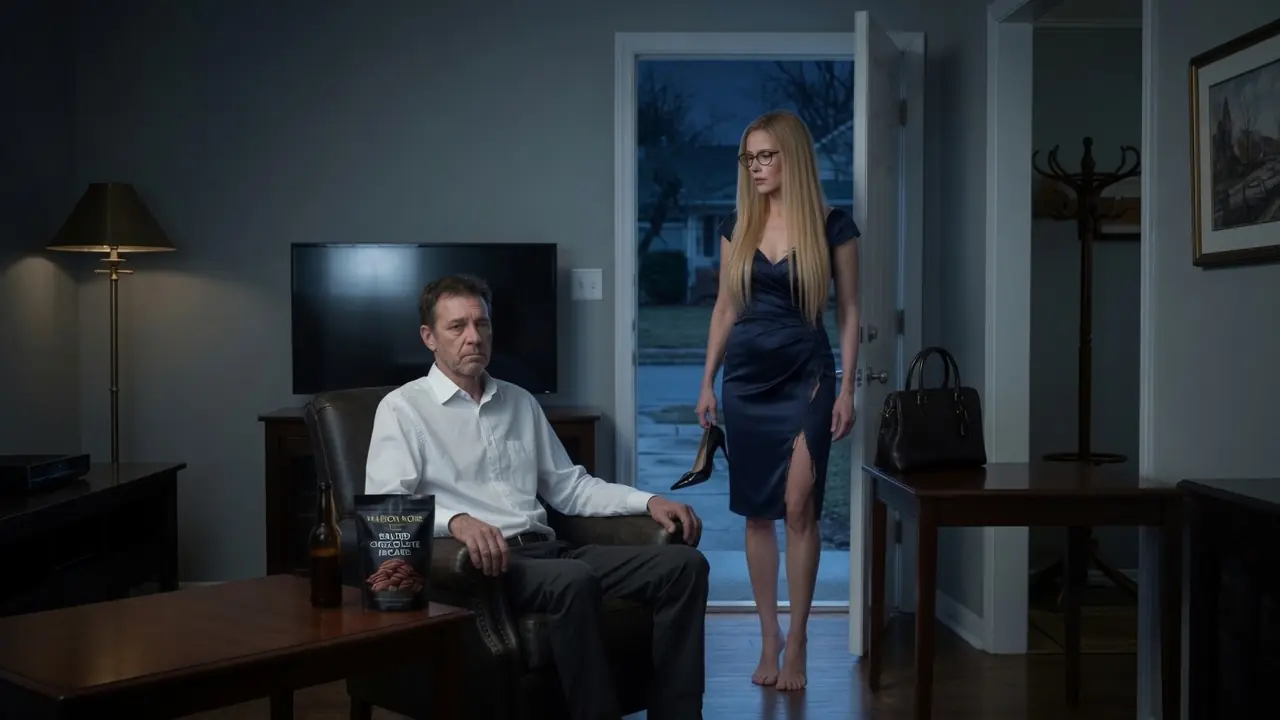
The part that ended me was her expression.
She did not look guilty.
She looked annoyed that I had witnessed it.
My name is Victor Marlowe. I was forty-eight years old when I learned that a marriage can be dead for months while still eating breakfast across from you. I owned a small company called Marlowe Precision Reels, a custom fishing gear business I built with borrowed tools, late nights, and hands that had known more metal shavings than rest.
I made reels for serious anglers.
Not the kind you grab off a rack before a weekend trip.
The kind a man saves for, waits for, and passes down to a son who understands why smooth drag and perfect balance matter. Every reel left my shop with my initials engraved inside the frame, not because I was vain, but because if something carried my name, it had to be right.
For most of my adult life, I believed my wife was proud of that.
Her name was Clara.
She ran a vintage boutique downtown called Willow & Wren. It had started as a narrow storefront with two racks of estate dresses, a cracked mirror, and a register that froze every third sale. I helped paint the walls after my shifts in the garage. I built the first display table from reclaimed oak because she said new wood had no soul.
Over the years, Clara turned that little store into something polished.
Women drove in from three towns over to buy velvet coats, silk scarves, antique handbags, and jewelry that looked like it had once belonged to somebody with secrets. She learned photography, branding, lighting, and how to make an old dress look like a new life. She had taste, and she knew it.
I admired her for that.
I admired the woman who could walk through a dusty estate sale and find the one thing everyone else had overlooked. I admired the way she spoke to customers like style was not about money, but about courage. I admired the woman who once stayed beside me in my workshop until three in the morning, helping wrap my first national order because I had no employee and no idea how to admit I was scared.
That was the Clara I married.
The woman who opened our front door after one in the morning was somebody else.
I was supposed to be in Alder City that Thursday night for a supplier conference. A plumbing issue at the hotel shut down half the rooms, pushed the main meeting to the next afternoon, and left a lobby full of irritated vendors pretending they were not checking flight prices. I could have stayed. I almost did.
But my own bed was less than four hours away, and at forty-eight, my back had reached an honest relationship with hotel mattresses.
So I drove home.
I did not call Clara.
Not because I suspected anything.
Not then.
I thought I would surprise her. Maybe open the bottle of wine we had been saving. Maybe sit with her on the back porch and tell her about the new titanium supplier I had found. Maybe have one quiet night where we were not two business owners passing each other like tired ships in the hallway.
I even stopped at Fenner’s Market for the salted dark-chocolate pecans she loved.
The expensive ones.
The ones she always said were too rich before eating almost the whole bag.
When I pulled into our driveway, her car was gone.
At first, that did not bother me.
Willow & Wren often held evening appointments. Private shopping nights. Styling events. Champagne previews for women who wanted to feel like they had discovered something rare before everyone else did. Clara had been pushing the boutique hard online, which meant more late nights, more photo shoots, more collaborations with young people who understood social media better than I ever would.
So I went inside.
I set the pecans on the kitchen counter, opened a beer, and waited.
One hour passed.
Then two.
Then three.
I checked the boutique’s page. Nothing new. No event photos, no tagged customers, no quick video of Clara holding up a silk dress under warm lights. I texted her once.
You still at the shop?
No answer.
I called.
Straight to voicemail.
By midnight, the house had changed shape.
A house can do that when you are alone with a thought you do not want to name. The living room felt too wide. The hallway felt too long. The refrigerator hummed in the kitchen like it knew something and had no intention of telling me.
I sat with the television on mute and thought about the last year.
The little changes I had explained away because marriage teaches you to be generous with discomfort until generosity becomes blindness. The new perfume. The fitness classes that somehow never left her tired. The way her phone tilted facedown at dinner. The way she stopped asking about the shop, then accused me of not asking enough about hers.
At 12:58, headlights swept across the living room wall.
I turned off the lamp.
I do not know why.
Maybe some part of me wanted to see the truth before it had time to put on makeup.
Her car door opened.
Then nothing.
For nearly a minute, she stayed in the driveway. I imagined her looking in the mirror, fixing her lipstick, smoothing her dress, deciding which version of the night would enter the house first. When she finally came in, she moved with careless confidence, the way people move when they believe everyone who matters is asleep.
Her purse hit the entry table.
Her heels clicked once on the hardwood.
Then again.
She hummed under her breath, a tune I did not know.
Then she turned on the light and saw me.
“Victor.” Her hand flew to her chest. “You scared me.”
I sat in my own living room like a man who had broken into someone else’s life.
“Conference got moved,” I said.
Her eyes moved fast.
My face.
The beer bottle.
The clock.
The dark television.
“I thought you were in Alder City.”
“I was.”
“You could have called.”
“You could have answered.”
That was when her expression shifted.
The shock faded first.
Then fear.
Then something harder arrived, something I had seen in difficult business meetings when a customer knew the reel was damaged but wanted to blame the packaging, the weather, or the delivery driver before admitting he dropped it.
“I was out with Dana,” she said.
“Dana?”
“Yes. From the shop.”
“At one in the morning?”
“We had drinks after a client consultation.”
“What consultation?”
She sighed.
Not nervously.
Irritated.
“Victor, do we really need to do this right now?”
I stood slowly.
Her navy dress had a small tear near the side seam. One earring was missing. Her hair was still pinned on one side but loose on the other. Her lipstick was gone except at the edges, and the air around her carried wine, cold night, and a cedar cologne I had never worn.
“Yes,” I said. “We do.”
She kicked off her heels with two sharp movements, trying to turn the moment into something ordinary.
“You’re being dramatic.”
“Call Dana.”
Her eyes narrowed.
“What?”
“Call her. Right now.”
“It is after one in the morning.”
“Exactly.”
She laughed once, but there was no humor in it.
“I don’t have to prove where I’ve been every time I leave the house.”
“You do tonight.”
That was the first time I saw real anger.
Not guilt.
Not sorrow.
Anger.
“When did you become this controlling?” she snapped. “I go out one night, and suddenly you’re sitting in the dark like some private investigator.”
“One night?” I asked.
Her jaw tightened.
There it was.
A small crack.
Not a confession.
Enough.
“Who is he?” I asked.
She looked away too quickly.
“No one.”
“Your dress is torn.”
“I caught it on a chair.”
“You smell like another man.”
The color changed in her face.
Just slightly.
But I had spent my life noticing fractions of a millimeter. A reel that is off by almost nothing is still wrong if you know what right feels like. Clara saw me see it.
For a moment, twenty-two years stood between us.
Our wedding.
Our first rental house.
The winter my business nearly failed and she fell asleep on the workshop floor beside stacks of unpaid invoices.
The year her brother died and I drove her mother to every doctor appointment because Clara could not bear to sit in that waiting room.
All of it stood there, asking her to choose truth.
She chose a weapon instead.
“You want honesty?” she said, voice low and sharp. “Fine. I’ve been lonely.”
The word hit me strangely.
Not because I had never considered it.
Because she said it like loneliness was evidence in her defense.
“I have been lonely in this marriage for years,” she continued. “You love those reels, your workshop, your customers, your little tolerances and bearings and custom finishes. You notice when a screw is off, but you stopped noticing me.”
I stepped back without meaning to.
It felt like being shoved.
“So you found someone else.”
She lifted her chin.
“I found someone who made me feel alive.”
“Name.”
“Victor—”
“Name.”
Her eyes hardened.
“Ryan.”
The name came out like a match striking.
“Ryan who?”
“Ryan Kessler.”
I knew the name.
Not personally, but I had seen him on the boutique’s page. Twenty-nine, maybe thirty. Tall. Smooth-faced. The kind of handsome that looks arranged by lighting. He modeled vintage leather jackets and men’s coats for Clara’s shoots, leaning against old brick walls and antique cars, selling dead men’s clothes with a smile that had never had to earn much.
“How long?” I asked.
She crossed her arms.
“Does it matter?”
“It matters to me.”
“Four months.”
I nodded slowly.
Four months.
Four months of dinners where she sat across from me and asked if I had remembered to renew our insurance. Four months of her telling me she was too tired while carrying another man through her phone. Four months of kissing me goodbye in the morning while already belonging somewhere else in all the ways that mattered.
“Do you love him?”
She hesitated.
That hurt more than yes.
“I don’t know,” she said. “He makes me feel seen.”
I almost laughed.
Not because it was funny.
Because people who say that never seem to ask who they had to make invisible first.
I did not shout.
I did not throw the beer bottle.
I did not call her a name, though several waited behind my teeth.
I simply said, “I’ll sleep in the guest room.”
Her face changed.
That surprised her.
She had expected anger, pleading, threats, a scene she could later repeat with herself as the wounded woman. Calm gave her nothing useful.
“Just like that?” she asked.
“No,” I said. “Not just like that. After twenty-two years of marriage, four months of lies, and a conversation where you still have not said you are sorry.”
I walked past her toward the hallway.
At the stairs, I stopped.
“I built Marlowe Precision Reels with my hands, Clara. I can rebuild my life with them too.”
I did not sleep.
I spent the night in the workshop behind the house, sitting at my bench under the white task light, turning the unfinished frame of a saltwater reel in my hands. Craft had always steadied me. Metal did not flatter you. It did not pretend. If something failed, the flaw existed somewhere real.
By sunrise, I knew two things.
My marriage was over.
And Clara had underestimated me.
On Friday morning, she entered the kitchen dressed in black trousers and a cream blouse I had never seen before. She looked composed, expensive, and annoyed that I had not collapsed in a way she could manage. She poured coffee without asking whether I wanted any.
“We need to be adults about last night,” she said.
“I agree.”
Her shoulders loosened slightly.
“I am glad. I think we both said things emotionally.”
“No,” I said. “You confessed to an affair.”
She stopped stirring her coffee.
“I told you the truth because you cornered me.”
“That is not the defense you think it is.”
Her face tightened.
“This is exactly what I mean. You turn everything into judgment.”
“Some choices deserve judgment.”
She set the spoon down too hard.
“So what now? You want to punish me? Humiliate me? Make me crawl?”
“No,” I said. “I want a divorce.”
She blinked.
For the first time since coming home, she looked genuinely unsure.
“A divorce?”
“Yes.”
“You are not even willing to try counseling?”
I looked at her carefully.
“Did you want counseling before or after sleeping with Ryan?”
Her eyes flashed.
“That is cruel.”
“No,” I said. “It is chronological.”
She grabbed her purse.
“You will regret moving this fast.”
“I am moving slowly compared to you.”
She left without answering.
The second she pulled out of the driveway, I called my attorney.
Her name was Patricia Voss. She had handled contracts for my business for nine years and had the unsettling ability to make a friendly question feel like a warning. She was also married to a fishing guide and knew exactly what Marlowe Precision Reels meant to me.
It was not just a company.
It was the life I had built one tiny part at a time.
She met me before lunch.
I told her everything.
She did not interrupt once.
When I finished, she folded her hands on the desk.
“Victor, I am sorry.”
“Thank you.”
“Now I need to say the hard part.”
“I’m listening.”
“This is a no-fault state. Her affair may matter emotionally, but the fight will be property. Your business is the obvious target. If she gets aggressive, she may claim marital growth, support labor, financial control, emotional neglect, anything that creates leverage.”
“She never touched the company.”
“She does not need to have touched it to make the argument expensive.”
A hard knot formed behind my ribs.
“There’s a prenup,” I said.
Patricia paused.
“You have a prenup?”
“Signed before the wedding. Her father insisted because he thought I was a broke machinist marrying his daughter for security.”
For the first time that morning, Patricia almost smiled.
“Please tell me you kept it.”
“I keep every important document.”
“That may save you more than you know.”
The prenup protected business assets I brought into the marriage and any expansion directly funded by company revenue. At the time, Marlowe Precision Reels had been worth almost nothing on paper. A few machines, a customer list, some early drawings, a logo Clara hated, and a rented shop space with bad lighting.
But the document was clean.
Patricia read it twice.
Then she looked at me and said, “Do not leave the house. Do not threaten her. Do not move money recklessly. Document everything. And Victor, change every business password today.”
So I did.
That weekend became a quiet war.
Clara came and went like she was testing how much disrespect the walls could hold. She spent Saturday at the boutique, or said she did. She spent Sunday on the back patio speaking softly into her phone, stopping every time I walked near the glass door.
I stopped asking questions.
Questions are for people who still believe answers can heal them.
By Monday, I had changed all business passwords, notified my accountant, backed up design files, and moved client contracts to a secure server. I called a meeting with the three people I trusted most: Boone, my production manager; April, who ran inspection and finishing; and Javier, who handled shipping and custom client communication.
We stood in the workshop before opening.
The air smelled like machine oil, cedar boxes, coffee, and early morning rain.
“I’m facing a divorce,” I said. “It may become ugly. Marlowe Precision Reels could be dragged into it. I need clean records, tighter access, and nothing informal.”
Boone crossed his arms.
“We’ve got you.”
April nodded.
“This shop exists because you never cheat the work. We won’t let anyone cheat you.”
Javier looked toward the side door.
“Does Clara still have a key?”
I hesitated.
“Yes.”
“Then we change the locks.”
So we did.
The first unexpected call came three days later.
A woman’s voice.
Nervous.
“Is this Victor Marlowe?”
“Yes.”
“My name is Erin Vale. I work at Willow & Wren.”
I sat straighter.
“What can I do for you?”
“I think we should meet. But not at the boutique.”
Thirty minutes later, I sat across from her in a small coffee shop outside Stonebridge Heights. Erin was in her late twenties, with dark hair pulled into a low bun, no makeup, and a face too tired for someone so young. She had a paper cup in front of her, both hands wrapped around it, but she had not taken a sip.
“I probably should not be here,” she said.
“Then why are you?”
“Because what she is doing is wrong.”
I waited.
Erin looked toward the window, then back at me.
“Clara and Ryan are not just having an affair.”
“I know that part.”
“She is planning the divorce with him. He thinks you are just some quiet workshop guy who will avoid a fight because you hate public embarrassment.”
Something cold moved through me.
“Go on.”
“I overheard them in her office. Ryan told her she needed to secure liquid assets before filing. He said the prenup could be challenged if she claimed you were emotionally abusive or financially controlling.”
I stared at her.
“She said that?”
“She said you would never see it coming because you still think she is fair.”
Erin looked ashamed, though she had done nothing wrong.
“She has been moving inventory too. Expensive pieces. Jewelry, designer coats, rare handbags, anything easy to carry and hard to track. She rented a storage unit under her cousin’s name.”
I took a slow breath.
“Why tell me?”
Her eyes met mine.
“My father lost his cabinet shop in a divorce when I was fourteen. My mother lied. Everyone believed her until the business was gone and he was too tired to fight anymore.”
She slid a small envelope across the table.
“Photos of the storage unit. Dates. Inventory sheets before and after she edited them.”
I did not touch it right away.
“You understand this could cost you your job.”
“I quit this morning.”
That told me more about her character than any speech could have.
I thanked her.
Then I called Patricia.
“We need a forensic accountant,” I said.
Her voice sharpened.
“How bad?”
“Bad enough that I am done protecting Clara from the truth.”
The forensic review moved quickly.
Willow & Wren had been bleeding inventory for months. Cash deposits did not match recorded sales. Expensive items had been marked as damaged, returned, or donated with no documentation. Clara had been creating a paper trail of weakness while moving assets out of sight.
At the same time, Patricia preserved Erin’s evidence and hired an investigator to confirm the storage unit.
Within ten days, we had enough to change the entire conversation.
Clara did not know that when she came home wearing the soft version of her face.
It was a Tuesday evening.
I was at the dining table sorting records when she walked in carrying takeout from the Thai restaurant we used to love. Her hair was done. Her perfume was the one she wore in our early years. She placed the food on the table gently, as if we were about to remember how to be married.
“Victor,” she said. “Can we talk?”
I kept one hand on the folder.
“About what?”
“About us.”
For one second, I felt sad.
Not for the woman standing there.
For the woman who used to say those words and mean them.
She sat across from me.
“This has gotten out of control. I did something reckless. I was lonely and selfish, and I handled it badly. But we built a life together. Twenty-two years should not end over one mistake.”
“One mistake?”
Her eyes flickered.
“You know what I mean.”
“I know exactly what you mean,” I said. “You mean four months of lying, a plan to attack my business, hidden inventory, and a boyfriend who thought I was an easy mark.”
The blood left her face.
“What are you talking about?”
“You do not want me to list it.”
She stood.
“Are you spying on me?”
“No. People you underestimate are tired of being used.”
Her eyes narrowed.
“Erin.”
I said nothing.
That was answer enough.
Clara’s gentle mask slipped.
“She is a bitter little assistant who does not understand business.”
“Interesting. Patricia understands business. So does the forensic accountant.”
She gripped the back of the chair.
“You hired a forensic accountant?”
“Yes.”
“You had no right.”
“I had every right to protect myself.”
Her voice dropped.
“What do you want?”
“A clean settlement. You keep the house temporarily and a fair amount of cash. I keep Marlowe Precision Reels, my patents, my designs, my tools, my client list, and every reel connected to the company.”
“The house needs work.”
“Then sell it.”
She stared at me like I had spoken in a language she never expected me to learn.
“If I refuse?”
“Then we go to court. The storage unit. The hidden inventory. The false financial-control plan. The messages. All of it.”
Her eyes filled with tears.
I had once believed Clara’s tears automatically meant pain.
Now I knew tears could also mean strategy.
“You have become cruel,” she whispered.
“No,” I said. “I have become informed.”
The settlement meeting happened in Patricia Voss’s office.
Clara came with a divorce attorney named Simone Greer, a sharp woman in a pale blazer who clearly expected me to be sentimental, embarrassed, and unprepared. She began aggressively, describing Clara’s emotional contributions to the marriage, her support in the early years, and her right to a meaningful share of the business growth.
Patricia listened patiently.
Then she opened the prenup.
“The agreement is enforceable,” she said. “The business existed before the marriage, is protected under section six, and its major growth was funded through retained company earnings.”
Simone leaned back.
“Prenuptial agreements can be challenged.”
“Of course,” Patricia said.
Then she opened a second folder.
“That is why we also need to discuss Mrs. Marlowe’s concealment of boutique inventory, a storage unit rented through a relative, altered sales reports, and communications regarding false allegations intended to influence property division.”
Clara did not look at me.
Simone opened the folder.
Her expression changed after the fourth page.
Good attorneys can attack.
Great attorneys know when their client has become the danger.
She asked for a private conference.
When they returned, the room felt different.
Simone no longer sounded like a woman charging a hill.
She sounded like a woman looking for a bridge before the ground collapsed.
“My client is willing to consider a revised settlement,” she said.
Patricia nodded.
Clara would keep the house temporarily, with the option to sell and retain proceeds after agreed offsets. She would receive a reasonable cash settlement and one year of health insurance support. I would retain full ownership of Marlowe Precision Reels, all designs, patents, tools, workshop equipment, inventory, client contracts, and brand assets.
No abuse claims.
No prenup challenge.
No court spectacle.
As the attorneys finalized terms, Clara finally spoke directly to me.
“You were always quieter than I understood.”
I looked at her.
“That is not the same as weak.”
Her mouth tightened.
“Ryan left.”
I said nothing.
“He said this was too much drama.”
Still nothing.
“I destroyed my marriage for someone who did not even stay.”
For a moment, I felt something.
Not satisfaction.
Not pity exactly.
Just the tired ache of watching someone arrive at the end of a road they had insisted on walking.
“Twenty-two years deserved better,” I said.
She looked like she wanted to answer.
But there was nothing useful left.
Six months later, Marlowe Precision Reels moved into a new workshop near the river.
It had wide windows, polished concrete floors, cedar display walls, and a testing dock behind the building where customers could feel a reel under real pressure. The expansion had been planned for years, but I had kept delaying it because the marriage always seemed too fragile to disturb.
Now there was no fragile marriage to protect.
Only work.
Honest work.
Boone ran production like a man finally given enough room to breathe. April rebuilt our inspection process and cut returns almost in half. Javier redesigned the packaging so every reel arrived like an heirloom instead of a product. Orders increased, and for the first time in years, growth did not feel like something I had to apologize for.
Erin came to work for us too.
At first, part-time.
Customer emails, catalog updates, photos, wholesale support. She was direct, steady, and allergic to drama in a way I found deeply reassuring. She asked good questions, gave clear answers, and never tried to turn kindness into debt.
One afternoon, she stood beside a display case adjusting product cards.
“You ever miss the old house?” she asked.
I thought about it.
The kitchen.
The porch.
The living room where Clara had walked in after one in the morning wearing another man’s scent.
“No,” I said.
“Not at all?”
“I miss who I thought lived there.”
Erin nodded.
“That makes sense.”
The shop bell rang before the conversation became too heavy, and we went back to work.
I liked that about her.
She did not try to make every honest sentence into a confession.
One year after the divorce, Marlowe Precision Reels was invited to the Great River Angler Expo in Westhaven.
It was the kind of event I had once dreamed about while machining parts alone after midnight. Our booth sat beneath bright lights, surrounded by custom rod builders, lodge owners, lure makers, and retailers who could talk about water currents like they were reading scripture. For three days, people handled our reels, asked technical questions, placed orders, and told stories about rivers as if they were old friends.
On the second day, a lodge owner named Barrett Lowell placed the largest wholesale order in our history.
After he left, Boone slapped my shoulder.
“Garage guy did all right.”
I looked around the booth.
The reels gleamed under the lights.
My company’s name hung above us.
For the first time in years, pride did not have pain attached to it.
Then I saw Clara.
Three aisles over.
She was working a booth for an outdoor lifestyle company, arranging waxed jackets and canvas bags on wooden shelves. Her clothes were simpler now. Her hair was shorter. The old polish remained, but consequence had softened the edges.
She saw me a few seconds later.
For one moment, we stood in the middle of a crowd and remembered being everything to each other.
Then she walked over.
“Victor.”
“Clara.”
“I heard about the expansion.”
“Thank you.”
“The reels are beautiful.”
“They are good.”
She smiled faintly.
“You still hate false modesty.”
“I still do.”
An awkward silence settled between us.
Then she said, “I am with Northline Outfitters now. Merchandising.”
“I am glad you landed somewhere.”
She seemed surprised by that.
“I am trying to do things differently.”
“I hope you do.”
Her eyes searched my face, maybe looking for anger, maybe hoping for a wound she could still recognize.
She did not find one.
“I lost more than I understood,” she said.
“Yes,” I answered. “You did.”
A customer called my name then.
I excused myself.
Clara nodded and stepped away.
That night, alone in my hotel room, I expected the encounter to reopen something.
It did not.
I felt quiet.
That was all.
Two years after the divorce, I bought a small cabin on a wooded lake an hour outside town.
Eighteen acres.
A dock.
A boathouse with enough space for a second bench.
A stretch of water perfect for testing drag systems at sunset.
It was the kind of place I had wanted for decades, but Clara had always dismissed it as too remote, too still, too much like disappearing. I understand now that she disliked places where noise stopped long enough for truth to speak.
I loved it immediately.
One evening, I stood on the dock casting into gold light, watching the line open over the water and settle softly across the surface.
My phone rang.
Patricia.
“I have news,” she said. “Your new sealed-drag patent was approved.”
I smiled.
“That is good news.”
“There is something else. I ran into Clara at the courthouse last week.”
I kept my eyes on the water.
“Is she all right?”
“She asked about you.”
“Did you tell her?”
“I told her you are doing well.”
That was true.
Not flashy.
Not performative.
Well.
After the call, I stood there for a long time, rod in hand, listening to the water move against the dock posts.
At fifty, my life looked nothing like I had planned.
The marriage was gone.
The old house was gone.
The woman I thought would sit beside me into old age had become someone from a previous chapter.
But I was not empty.
That surprised me most.
Marlowe Precision Reels had a nine-month waiting list. The team had grown to nineteen people. The new workshop smelled of cedar, machine oil, coffee, and purpose. Erin and I had started having dinner once in a while, carefully, slowly, without pretending history did not follow both of us into the room.
Nothing rushed.
Nothing hidden.
Nothing that needed darkness to survive.
I thought betrayal would make me harder.
In some ways, it did.
But it also made me cleaner.
More exact.
Less willing to confuse peace with silence or loyalty with tolerance.
Clara’s choices did not define the rest of my life.
My response did.
I chose not to beg.
I chose not to burn everything down.
I chose not to let someone else’s dishonesty make me dishonest too.
I protected what I built.
Then I kept building.
That evening, I cast again.
The line unrolled perfectly over the lake, landed soft, and sent small ripples through the reflection of the first stars.
For a long time, I thought twenty-two years of marriage meant something because of how long it lasted.
Now I know time alone does not make a thing sacred.
Truth does.
And when truth finally walked into my living room at 1:06 in the morning wearing another man’s cologne and irritation instead of guilt, it did not destroy me.
It woke me up.
I was not starting over from nothing.
I was starting over with skill, scars, patience, and hands that still knew how to build something worth keeping.