The first sound was the sharp insistent jangle of a bell from the floor below. Not the deep resonant toll from the stable clock that marked the hour, but the small silver handbell Clarissa kept by her bed, the one that meant now. Eleanor did not move. She had been awake for 2 hours, sitting in the single straight-backed chair by her window, watching the gray dawn seep over the frost-hardened lawns of Hartwell Park.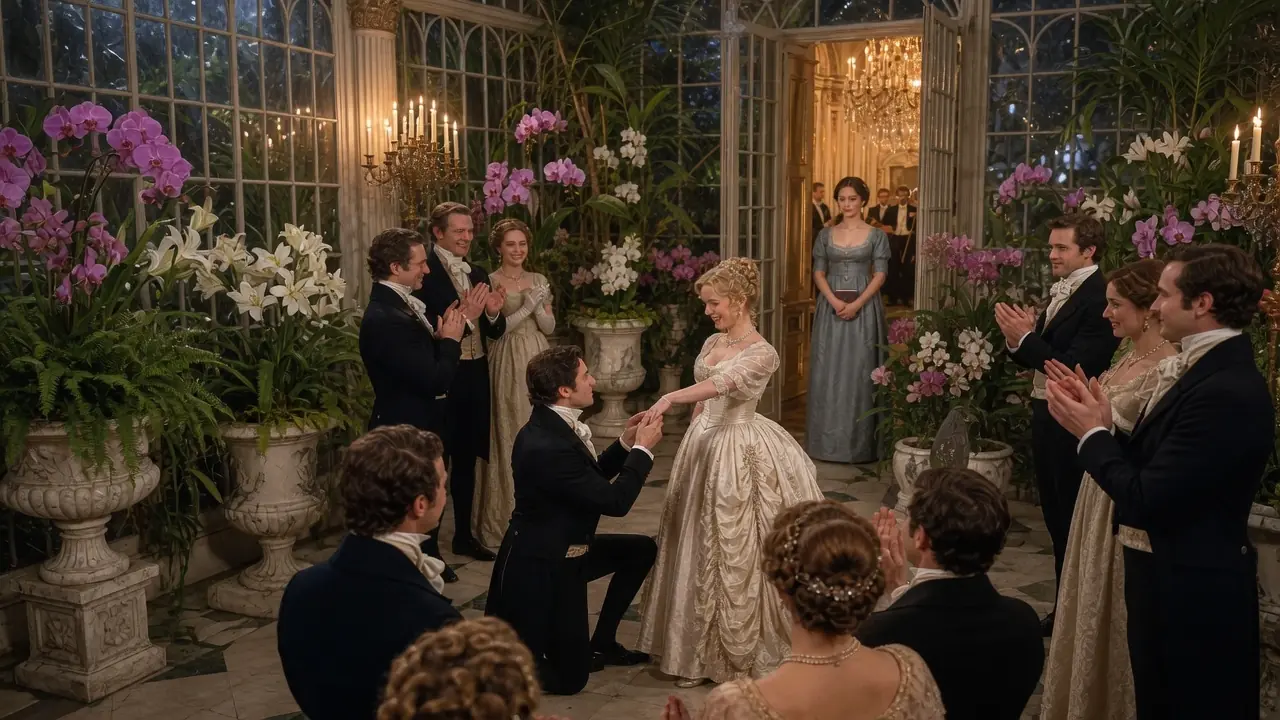
The cold of the floorboards was a distant fact against the soles of her bare feet. She did not weep. She had not wept when she heard the laughter from the conservatory the night before, nor when Clarissa had swept into her room near 3:00 in the morning, brandishing her hand like a trophy, the Blackwood diamond winking in the candlelight on her finger. She had simply nodded, said the correct words, and waited for her sister's breathless narration to end.
Now, in the quiet of her own room, she cataloged the feeling inside her. It was not grief. It was something colder, more clarifying. It was the silence of a room after a clock has stopped ticking.
You would not notice the sound until it was gone, and the absence of it was a presence in itself. The bell jangled again, a furious, impatient summons. Down the hall, feet padded, a door opened and closed. Clarissa's day had begun.
Eleanor's had simply continued. On the small writing desk beside her sat the household ledger, bound in worn green leather. It was open to the column for January expenditures. Beside it, a porcelain teacup, her mother's, held a splash of cold tea from the evening before.
A hairline crack ran from the rim to the base, a delicate dark web she had traced with her finger a thousand times. The cup still held its contents. It was still useful. She had mended what could be mended.
She had managed what could be managed. For 6 years, since their mother's passing, she had been the silent engine of this house. 2,190 days of meals planned, linens counted, wages paid, repairs negotiated, tenants placated. Clarissa, 2 years her junior, had tended to her watercolors and her social calendar. It was the proper division of things.
Clarissa was the beauty, the sun around which Hartwell orbited. Eleanor was the foundation, unseen and presumed stable.
The Duke of Blackwood had arrived 3 weeks prior. Alister, a man of immense fortune and lineage, his estate bordering their own. He was quiet for a duke with eyes that seemed to miss nothing, and yet had, in the end, missed everything. He had spoken with her, Eleanor, on three separate occasions.
About crop rotation, about the local quarry, about a book of Italian poetry she was reading. His attention had felt specific, a focused quiet that matched her own. She had allowed a foolish, tender seed of hope to be planted in the fallow ground of her heart. A mistake.
She understood that now. At the ball last night, he had been drawn into Clarissa's light, a moth to a flame so bright it was blinding. And in the heat of that light, surrounded by the scent of hothouse orchids, he had made his choice. A public choice.
The right choice for a duke. He had chosen the diamond, not the woman who quietly paid the bill for its setting. Eleanor finally rose. She dressed, not in mourning, but in her usual gray wool, the fabric practical and warm.
She pinned her dark hair with the same swift, efficient motions as always. She did not look in the mirror. She knew the face that would look back. Pale, composed, a face that had learned to ask for nothing and therefore could not be denied.
He rode a formidable black stallion that seemed to carve a space for itself out of the very air. Its hooves loud and certain on the gravel drive. Alister dismounted with a fluid economy of motion, handing the reins to a waiting groom without a glance. He looked, Eleanor noted from the library window, tired.
There were lines around his eyes that had not been there the night before. A tightness in the set of his jaw. The look of a man who had won a great prize and was only now beginning to calculate its cost. He had come to speak with her father, to make the formal arrangements.
Clarissa was a flurry of silk and lace and triumphant blushes, descending the main staircase as if it were a stage. She had practiced this moment in her mind, Eleanor knew, for years. The way she would give her hand, the soft, yielding angle of her head, the carefully modulated joy in her voice. It was a perfect performance.
Eleanor remained in the library. She had not been summoned. She was arranging a new shipment of books, the scent of paper and binding ink a clean grounding thing. She ran a gloved finger along the spines, her touch gentle but firm.
This was her domain, this quiet world of order and fact. She heard the low murmur of voices from her father's study, the formal cadence of the Duke, her father's bluff hearty replies. Then a brighter note, Clarissa's laughter, sharp and glittering as shattered glass. An hour passed, the study door opened.
The Duke was escorted not to the drawing room, but to the library. To her. Clarissa led him in, her hand possessively on his arm. "Eleanor, dearest, His Grace wished to see you." Clarissa's smile was a masterpiece of sisterly affection painted over a canvas of victory.
Eleanor turned from the bookshelf. She stripped off her thin leather work glove, setting it on a stack of books. The gesture was simple, domestic. She inclined her head.
"Your Grace?" Alister looked at her. He seemed to be searching her face for something, for tears, for a flicker of resentment, for the satisfying drama of the jilted elder sister. He found none of it. He found only a calm direct gaze and a stillness that seemed to absorb the frantic energy of the room.
"Miss Hartwell," he said. His voice was deeper than she remembered. "I trust you are well." "Quite well, thank you, Your Grace." The silence that followed was hers. She did not fill it.
She did not offer congratulations or platitudes. She simply waited. It was Clarissa who broke, her grip tightening on his arm. "Eleanor is always well. She is so wonderfully practical." It was meant as a dismissal, a label to file her away under.
But the Duke's eyes did not leave Eleanor's face. He saw the faint smudge of ink on her right index finger, the focused intelligence in her eyes. He saw the worn glove resting on a folio of botanical prints. He saw a world he had not noticed the night before, a world that operated on different principles from the one of glittering ballrooms and easy laughter.
That was his first mistake, choosing the laughter. His second was standing here now in the aftermath, and realizing the silence was infinitely more compelling. "I see you are busy," he said, his gaze falling to the books. "A new acquisition?" "From London, Your Grace. A collection on agricultural science." He raised an eyebrow.
"A surprising interest." "A necessary one," Eleanor replied. Not a defense, a statement of fact. And in that moment, something shifted in the room. A weight settled.
He had walked into this house this morning believing he understood its inhabitants. By noon, standing in the quiet, paper-scented air of the library, he was no longer certain of anything at all.
His certainty eroded piece by piece over the next 3 days. The engagement was announced. The papers were being drawn by the solicitors. The world considered the matter settled.
But Alister, now a frequent visitor at Hartwell Park, was beginning to feel like a man who had signed a contract without reading its terms. The first crack appeared that same afternoon. He was walking with Clarissa in the gardens, her chatter a constant bubbling stream about fabrics for her trousseau and the guest list for the engagement ball. A young housemaid, no more than 16, hurried past them on the path, her arms laden with a basket of linens.
She stumbled and a single, perfectly laundered sheet slipped into the damp soil of a flower bed. Clarissa stopped dead. "You clumsy little fool," she snapped, her voice stripped of all its pretty music. "Look what you have done. That is Belgian linen. Do you have any idea what it costs?" The girl's face went white with terror.
She stammered an apology, bending to retrieve the soiled sheet. "Leave it," Clarissa commanded. "You will have the cost of it deducted from your wages. Perhaps then you will learn to be more careful." She turned back to Alister, her smile reappearing as if summoned by a switch.
"One must be firm, you see. They take advantage otherwise." Alister said nothing. He looked at the girl who was now fighting back tears and at the muddy stain on the white linen and he felt a profound sense of unease. Later that evening, from the window of the guest suite, he saw Eleanor in the kitchen garden.
She was speaking with the same young maid. He was too far to hear the words, but he could see the scene clearly. Eleanor's posture was calm, her attention focused entirely on the girl. She gestured toward the laundry house, then said something that made the girl nod, her shoulders losing their terrified tension.
Eleanor then placed a hand briefly on the girl's arm before turning back to inspect a row of winter cabbages. It was a gesture of quiet reassurance, of restoration. He saw it again the next day. A tenant farmer, an old man with worry etched into his face, was waiting by the stables.
Clarissa swept past him without a glance, complaining about the smell of the manure. The Duke saw the hope in the old man's eyes curdle into weary resignation. An hour later, Alister found Eleanor in the estate office, a small, cold room he had never known existed. The old farmer, Mr. Finch, was with her, seated in a chair, cup of tea in his hands.
The green leather ledger was open on the desk between them. "The roof on the west barn, you said, Mr. Finch?" Eleanor's voice was low and clear. "Aye, Miss Eleanor. The winter storms took half the slates. The damp will ruin the hay if it's not seen to." "I see here," Eleanor said, her finger tracing a line in the ledger, "that the rent has been paid on time for 12 consecutive years, and that your yields have consistently been among the highest." Mr. Finch straightened a little.
"We work hard, miss." "I know you do," she said. "The steward will send men with new slates on Tuesday. Send the bill for the timber to me." The farmer's relief was a palpable thing. He thanked her profusely and left with a lighter step.
Eleanor made a neat notation in the ledger and closed it. She looked up and saw the Duke standing in the doorway. Her expression did not change. There was no pride in it, no surprise.
"Your Grace," she said, her voice even. "I did not realize you were there." "You manage the estate accounts?" he asked, stepping into the room. It felt like crossing a threshold into another country. "Someone must," she replied.
He looked at the rows of numbers, the precise, elegant script. He thought of Clarissa at that very moment in the drawing room debating the merits of French silk versus Italian satin. And he felt the ground beneath his feet, which had felt so solid his entire life, begin to give way. He had not simply chosen the wrong sister.
He had failed to see that one was holding up the entire world the other danced upon.
The next week was an education in the quiet, invisible labor that sustained a life of ease. Alister began to watch. He became an observer in the house he was soon to be master of through marriage. He saw Eleanor rise before the sun, her shadow moving past his door.
And he would hear the faint sounds of the house waking up in her wake. The clatter of pans in the kitchen, the sweep of a broom on the flagstones, the low murmur of her voice giving the day's orders to Mrs. Gable, the housekeeper. He inventoried her work. Three hours every morning were spent with the ledgers, reconciling the butcher's bills, the chandler's accounts, the farrier's invoices. 182 separate entries for the month of January alone.
He saw her walk the linen closets, counting sheets, noting which needed mending. Her hands moving with a practiced efficiency that was almost beautiful. He saw her in the still room, measuring out beeswax and lavender to make furniture polish because she found the purchased variety inferior and overpriced. He saw her consulting with the head gardener, not about the ornamental roses, but about the vegetable patches, about the blight on the potato crop, about the necessity of liming the soil in the north field.
Her knowledge was not decorative. It was deep, practical, and essential. She knew the name of every servant, their family situations, which child had the whooping cough, which wife was expecting. She did not dispense charity with a grand gesture.
She dispensed quiet solutions. Extra blankets appeared. A bottle of medicine was sent from the apothecary. A lighter set of duties was assigned.
All of it was done without fanfare, without any expectation of gratitude. It was simply the work. The endless, necessary work of holding things together. Clarissa, meanwhile, was consumed with the flurry of her own importance.
Her days were a whirlwind of fittings with the modiste from London, of composing invitation lists, of practicing her new signature. Clarissa, Duchess of Blackwood. She treated the staff as invisible functionaries. Their purpose solely to facilitate her comfort.
She complained that the tea was too weak, the fires not banked high enough, the floorboards too creaky. Her presence in a room created tension, a frantic desire to please and a corresponding fear of failure. Eleanor's presence created calm. The contrast was so stark, so absolute, that Alister began to wonder if he had been suffering from a form of madness at the ball.
What had he seen in Clarissa? A bright, polished surface. He had mistaken it for substance. He had been a fool.
The trap, however, was already sprung. His solicitors had met with her father's. Settlements were being finalized, properties joined. The announcement in the morning post had been read by everyone in the kingdom.
The wedding was set for June. To retreat now would be a catastrophe. It would brand him as a man without honor, and far worse, it would utterly destroy Clarissa. He had made a public promise, and a duke's promise was an iron cage.
He was bound to the beautiful, petulant, shallow woman who was planning their future, while the quiet, capable woman who ran the world he was marrying into remained just beyond his reach. One evening, unable to tolerate the cloying atmosphere of the drawing room where Clarissa was entertaining her giggling friends, he sought refuge in the library. He found Eleanor there, as he often did, but she was not reading. She was mending.
In her lap was a heavy wool blanket, a thick darning needle flashing in and out of the fabric. It was one of the stable blankets, rough and coarse. The task was menial, something a maid could have done. He stood in the doorway watching her.
Her brow was furrowed in concentration, the firelight catching the rich, dark sheen of her hair. She was not beautiful in the way Clarissa was. Hers was not a face that launched fleets. It was a face that built the ships, provisioned them, and charted their course.
A face that knew the tides. "Can the grooms not mend their own blankets?" he asked, his voice softer than he intended. She looked up, her hands stilling. "They could," she said, "but Thomas has five children, and his wife's hands are crippled with rheumatism. It is a small thing to do." She did not say it to shame him or to highlight her own virtue.
It was, like everything else, a simple statement of fact. He walked over and sat in the chair opposite her. He did not speak for a long time. He just watched her work, the rhythmic, steady pull of thread through wool.
It was the most peaceful moment he had experienced in weeks, and the most agonizing.
The crisis, when it came, was not grand or dramatic. It was small, domestic, and utterly revealing. It began with a missing brooch, a sapphire and diamond monstrosity that had been a gift to Clarissa from a doting aunt. She had wanted to wear it to a dinner party and could not find it.
Her personal maid, a timid girl named Sarah, was immediately accused of theft. Clarissa's fury was a storm that broke over the household. She had Sarah brought to the drawing room where she, her father, and the Duke were taking tea. The girl was pale and trembling, twisting the fabric of her apron in her hands.
"I did not take it, Miss Clarissa. I swear it," she whispered, tears streaming down her face. "You are a liar and a thief." Clarissa's voice was shrill. "It was in my jewelry box this morning, and now it is gone. No one else has been in my rooms. It must have been you." "Perhaps it has merely been misplaced," the Duke suggested quietly, disturbed by the naked cruelty in his fiancée's face.
"I have searched everywhere," Clarissa insisted. "She has stolen it. She must be dismissed, Papa, without a reference. We should have the magistrate called." The threat hung in the air, thick and poisonous.
For a servant girl, an accusation of theft, even without proof, was a sentence of ruin. She would never find respectable work again. At that moment, Eleanor entered the room. She was carrying a small lacquered box.
She paid no mind to the high drama of the scene, to Sarah's weeping or Clarissa's rage. She walked directly to her sister. "Is this what you are looking for?" she asked, her voice perfectly level. She opened the box.
Inside, nestled on a bed of velvet, was the sapphire brooch. Clarissa stared at it, her mouth falling open. "Where—where did you find it?" "In the library." Eleanor said calmly. "It was caught in the fringe of the Persian rug near the fireplace. You were sitting there yesterday afternoon reading a letter." She did not say, "You were careless." She did not say, "You have falsely accused an innocent girl." She simply stated the facts.
The silence in the room was profound. Sarah let out a choked sob of relief. Clarissa's face, which had been flushed with righteous anger, was now mottled with a furious, ugly shame. She could not admit her error.
Instead, she turned on Eleanor. "Why were you searching for it? Have you been spying on me?" "Mrs. Gable mentioned you had lost it," Eleanor said, her composure absolute. "I recalled seeing you in the library and thought it might have fallen. It took two minutes to locate. Two minutes." A lifetime of character had just been revealed in the space of 120 seconds.
The Duke looked at Clarissa, at her petulant, ungracious face, and felt a cold wave of revulsion. He then looked at Eleanor, who stood there, calm and dignified, having quietly averted a terrible injustice without raising her voice or seeking any credit. She had not come to rescue the maid. She had come to restore order.
To mend what had been broken by her sister's carelessness and cruelty. Clarissa, unable to salvage the situation, snatched the brooch from the box. "Well," she said sharply to the still weeping maid, "you may go, and be more careful in future." She swept from the room, leaving a wake of discord behind her. Eleanor met the Duke's eyes for a brief moment.
In her gaze, there was no triumph, no I told you so. There was only a quiet, weary assessment. She gave a small nod to Sarah, a silent dismissal, and then she too turned and left the drawing room. Alister was left alone with his future father-in-law, who merely cleared his throat and picked up the newspaper, pretending nothing had happened.
But something had happened. A line had been crossed. The Duke understood, with a clarity that felt like a physical blow, that he could not marry Clarissa. It was no longer a matter of preference.
It was a matter of moral impossibility. The problem, the great immovable problem, was how to undo what could not be undone. He was trapped.
For a week, he felt the bars of his gilded cage pressing in on him. Every smile from Clarissa, every discussion of their future, every letter of congratulations that arrived, was another lock on the door. He was the Duke of Blackwood. His word was his bond, his public honor the cornerstone of his identity.
He could not simply change his mind as if he were ordering a different wine with his dinner. The scandal would be immense. The humiliation for the Hartwell family profound. He would be seen as a cad, a man of fickle and cruel impulse.
Clarissa, whatever her faults, would be the victim. A jilted bride, pitied and whispered about by the entire town. He owed her the protection of his name, even if he could not give her his heart. He owed it to her because of a few careless words spoken in a conservatory.
He began to avoid Clarissa, pleading estate business that required his attention at Blackwood. He needed space to think. He spent his days riding his own lands, the familiar woods and fields a comfort. But his thoughts were always at Hartwell Park.
He thought of Eleanor. He pictured her in the garden, her hands in the soil. He pictured her in the library, her head bent over a book. He pictured her at her desk, the green ledger open, her pen scratching quietly as she brought order to a world that was constantly threatening to fall into chaos.
He had made a choice based on surface, and now he was haunted by the substance he had overlooked. His valet, a man who had served him for 20 years, noticed his distraction. "Is everything well, Your Grace?" Mr. Davies asked one evening as he laid out Alister's dinner clothes. "The Hartwell engagement seems complex." Alister looked at his valet's reflection in the mirror.
Davies was discreet, loyal, and had seen him through every crisis since he was a boy. "It is impossible, Davies." The admission, spoken aloud for the first time, was both a relief and a terror. Davies finished tying the Duke's cravat, his movements precise and unhurried. "In my experience, Your Grace, the things that seem most impossible are often merely the most difficult." "The question is whether one has the courage for the difficulty." The valet's words stayed with him.
Courage. It was not a quality he had ever felt he lacked. He had faced down political opponents in the House of Lords, managed vast and complicated financial holdings, and served his country. But this felt different.
This was a tangle of personal honor, social expectation, and a quiet, desperate longing for something he had carelessly cast aside. He knew he had to end it. But how? A direct confrontation would be a disaster, a public scene of the sort he abhorred.
Clarissa would not go quietly. She would rage. She would weep. She would weaponize her humiliation against him.
He needed a path that was quiet, dignified, and final. He needed a reason, an unassailable reason that would allow them both to withdraw with a semblance of grace. He did not yet know what that reason could be. He returned to Hartwell Park resolved to find a way, but the opportunity, the key to unlocking the cage, had not yet presented itself.
The household continued on its course, a ship sailing toward a wedding on the horizon with a captain who secretly prayed for a storm that would allow him to change course. He knew with a dreadful certainty that the storm would have to be of his own making, and he feared the wreckage it would leave in its wake.
The breaking point arrived, as it often does, through the intersection of money and pride. Clarissa, emboldened by her impending status, had begun to spend with a recklessness that startled even her indulgent father. Bills arrived from every fashionable shop in London for gowns, hats, jewels, and fripperies. She was furnishing her new life before it had even begun.
Her father, a man who preferred not to look too closely at unpleasant numbers, waved them away. But Mrs. Gable, the housekeeper, saw everything. She had served the family for 30 years, first as head housemaid to Eleanor's mother, and then as housekeeper after her death. She was a woman of quiet observation and fierce unspoken loyalties.
Her loyalty was not to the flighty, demanding girl who would soon be a duchess, but to the quiet, steady one who kept the house from ruin. One morning, Clarissa summoned the Duke and her father to the morning room. She was holding a sheaf of papers, her face a mask of outrage. "I have found the most appalling mismanagement," she announced, her voice trembling with theatrical fury.
"It seems our trusted Mrs. Gable has been helping herself to the household funds." She thrust the papers at her father. "Look, these are the accounts for the last quarter. The expenditures are astronomical, and I have found discrepancies. Sums unaccounted for. She has been stealing from us for years, right under our noses." Alister took the papers from Mr. Hartwell.
The figures were written in Clarissa's own florid hand, a chaotic mess of additions and subtractions. It looked less like an audit and more like a childish tantrum on paper. "I demand she be dismissed immediately," Clarissa declared. "We cannot have a thief in our employ." Mrs. Gable was summoned.
She entered the room, her back straight, her face calm. She was 60 years old, her hands gnarled from work, but her eyes were clear and intelligent. She looked at Clarissa, then at the Duke. She did not look afraid.
"You stand accused of theft, Mrs. Gable," Mr. Hartwell said, puffing out his chest, ready to play the part of the stern patriarch. "What do you have to say for yourself?" Before the housekeeper could speak, the door opened and Eleanor walked in. She carried the heavy green leather master ledger. She did not say a word.
She simply walked to the large mahogany table in the center of the room and placed the ledger upon it. She opened it to the section for the last quarter and smoothed the page flat with her hand. The silence was immediate and absolute. Eleanor's ledger was a work of art, of order.
Every line was perfectly ruled, every number written in a clear, precise script. Every expenditure was noted, dated, and cross-referenced with a receipt number. It was the unassailable truth of the household, recorded daily for 6 years. Clarissa's chaotic accusations withered in the face of such meticulous reality.
The Duke stepped forward. He looked at the page Clarissa had prepared, a fiction born of malice or incompetence or both. Then he looked at the ledger, at the evidence of years of faithful, painstaking work. He saw the entry for the Belgian linen with a note beside it.
Damaged sheet repurposed for cleaning rags, no loss. He saw the line for the new slates for Mr. Finch's barn. He saw everything. He turned to Mrs. Gable, who had not moved from her spot by the door.
She had not needed to defend herself. The work, Eleanor's work, had defended her. Then the loyal housekeeper, the quiet witness, finally acted. She looked directly at the Duke, her gaze steady and unwavering.
"The household has been solvent for 6 years, Your Grace, to the penny." She paused, then delivered the final, devastating blow. "Miss Eleanor sees to it." It was not an accusation against Clarissa. It was a simple statement of fact, more powerful than any argument. In that moment, the entire social structure of the house inverted.
The power was not with the blustering father, nor the beautiful, furious fiancée. It was with the quiet woman standing beside a book of numbers and the loyal servant who spoke the truth. Alister looked at Clarissa. He saw her face crumble.
The rage replaced by the panicked ugly expression of a liar exposed. He looked at Eleanor who met his gaze without triumph. Her face was still, her composure perfect. It was the composure of a woman who knew her own worth and had no need for the world to validate it.
And standing there in the silent sunlit morning room, Alister finally understood. He had not just made a mistake. He had failed a profound test of character. He had been shown gold and chosen glitter.
The end of the engagement was as quiet as the woman who precipitated it. There was no shouting match, no dramatic confrontation. That evening, Alister requested a private meeting with Mr. Hartwell and Clarissa. Eleanor was not present.
He did not need her there. Her presence was felt in the very fabric of the house's quiet orderly running. He did not accuse Clarissa of lying or cruelty. He did not mention the ledger or the falsely accused servants.
To do so would have been to engage in the very sort of messy undignified drama he now sought to escape. Instead, he spoke of incompatibility, of different temperaments and expectations for the future. He spoke with a calm implacable finality. He took the blame upon himself, framing it as his own failure to appreciate the nuances of a shared life.
It was a masterpiece of diplomatic withdrawal, leaving no room for argument. Clarissa, for her part, seemed to understand that the game was over. The public exposure of her fabricated accounts had stripped her of her primary weapon, her unshakable self-certainty. She wept, but her tears were those of frustrated ambition, not heartbreak.
She accepted the dissolution. The official story, released to the papers, was one of mutual agreement and amicable parting, citing the strain of such a swift courtship. The town would gossip, of course, but the scandal was contained. There was no villain, only a sad, regrettable end to a promising match.
Clarissa was sent to visit a cousin in Bath a week later, her departure as quiet as the rest of it. The house seemed to breathe a sigh of relief in her absence. The tension that had crackled in the air was gone, replaced by the calm, steady rhythm Eleanor had always maintained. The Duke did not see Eleanor again before he left Hartwell Park.
He knew he had no right to her time, no claim on her attention. He had caused a wound to her family, however quietly it was stanched. An apology felt inadequate. Grand gestures felt insulting.
He returned to Blackwood and waited. He sent no letters, he made no calls, he simply put his own house in order. Looking at his own estate with new eyes, seeing the invisible work of the people who sustained it. He learned the name of his head laundress.
He spoke to his tenant farmers himself. He read his own ledgers.
Three months passed. The seasons turned. It was spring. One afternoon, he rode to Hartwell Park.
He did not go to the main house. He went to the walled garden, where he knew she often worked. He found her there, on her knees, thinning out carrot seedlings. She was wearing a simple cotton dress and the worn leather gardening gloves he remembered from the library.
A smudge of dirt was on her cheek. She looked up as he approached, her expression unreadable. She did not seem surprised to see him. "Your Grace," she said, her voice even.
He stood before her for a long moment, the scent of damp earth and new leaves all around them. He had rehearsed a dozen speeches, elaborate apologies, heartfelt declarations. They all felt false now, theatrical. He held out his hand.
In it was a single, perfect lady slipper orchid, a rare and difficult flower he had spent weeks sourcing from a collector in Kew. It was a flower that required patience, quiet attention, and a deep understanding of its nature. It was a flower that had to be tended, not merely displayed. She looked at the orchid, then up at him.
She slowly stripped off her muddy glove and took it from him. Her fingers brushed his. It was the first time they had ever touched. "I was wondering," he said, his voice quiet, "if the soil at Blackwood might be suitable for a cutting." It was not a proposal of marriage, it was a question about gardening.
It was an acknowledgement of her knowledge, her skill, her substance. It was an invitation to build something together from the ground up. Eleanor looked at the orchid in her hand. A small, almost imperceptible smile touched her lips.
"Perhaps," she said, "with the proper care." He did not ask to call. He did not press for more. He simply stood with her in the quiet garden in the gentle spring light, and for the first time felt the solid ground of hope beneath his feet.
Five years later, the library at Blackwood Manor was quiet, filled with the warm late afternoon sun slanting through the tall Palladian windows. The air smelled of beeswax, old paper, and the faint sweet scent of the jasmine Eleanor had planted beneath the windows. Alister, the Duke of Blackwood, sat at the large mahogany desk, but he was not working. He was watching his wife.
Eleanor, the Duchess of Blackwood, sat opposite him. The estate ledgers for both Blackwood and the now conjoined Hartwell Park open before her. Her dark hair was simply pinned, and she wore a dress of deep blue wool that matched the color of her eyes. Her brow was furrowed in concentration as her pen moved across the page, her script as clear and elegant as ever.
Theirs was a partnership built not on whispered sweet nothings in a conservatory, but on the shared, quiet work of days. They managed their lands together, debated crop yields and tenant welfare, and read poetry aloud by the fire in the evenings. His love for her was a quiet, deep-rooted thing, a reverence for the calm strength and profound integrity he had almost been too blind to see. He had learned that composure was not the absence of feeling, but the mastery of it.
Her stillness was not emptiness, but a deep reservoir of power. The fate of her sister was a distant, sad footnote. Clarissa had eventually married a baronet from the north, a man with a handsome face and considerable debts. Her beauty, which had been her only currency, had soured under the strain of a disappointing life and a bitter spirit.
They lived in a damp, crumbling house in Northumberland, and by all accounts were profoundly miserable. There was no triumph in this knowledge, only a quiet sense of tragedy for a life wasted in the pursuit of glitter. Mrs. Gable was now the head housekeeper at Blackwood Manor, a position of immense respect and authority. She ran the vast household with the same quiet efficiency she had run Hartwell, her loyalty to Eleanor absolute.
She and the Duchess would consult every morning over a cup of tea from a beautiful flawless porcelain set, a quiet ritual of mutual respect. Alister looked at his wife's hand as it moved across the page. There was a faint permanent smudge of ink on her right index finger, a testament to her work. He reached across the desk and gently took her hand in his.
She looked up, her serious expression softening into a smile that was his alone. She had not changed. She had not become louder or more demanding with her new title. She had simply been given a larger garden to tend, and she made it flourish.
He understood now that he had not rescued her from obscurity. She, in her quiet profound way, had rescued him from a life of gilded emptiness. He had come so close to making the wrong choice, a choice that would have defined his entire existence. But life had granted him a rare, undeserved second chance, a chance to see beyond the performance and recognize the truth.
The truth was here, in this quiet room, in the steady capable hand he now held in his own.