By morning, London would agree on two things. That a woman had been quietly cast aside at the royal gardens, and that a duke had finally lost everything worth protecting. What no one would agree on was why they ended up on the same bench that night. Edwina had arrived first, abandoned at the gates, with nothing but the echo of carriage wheels disappearing into the distance. No explanation, no witness to what had just been taken from her.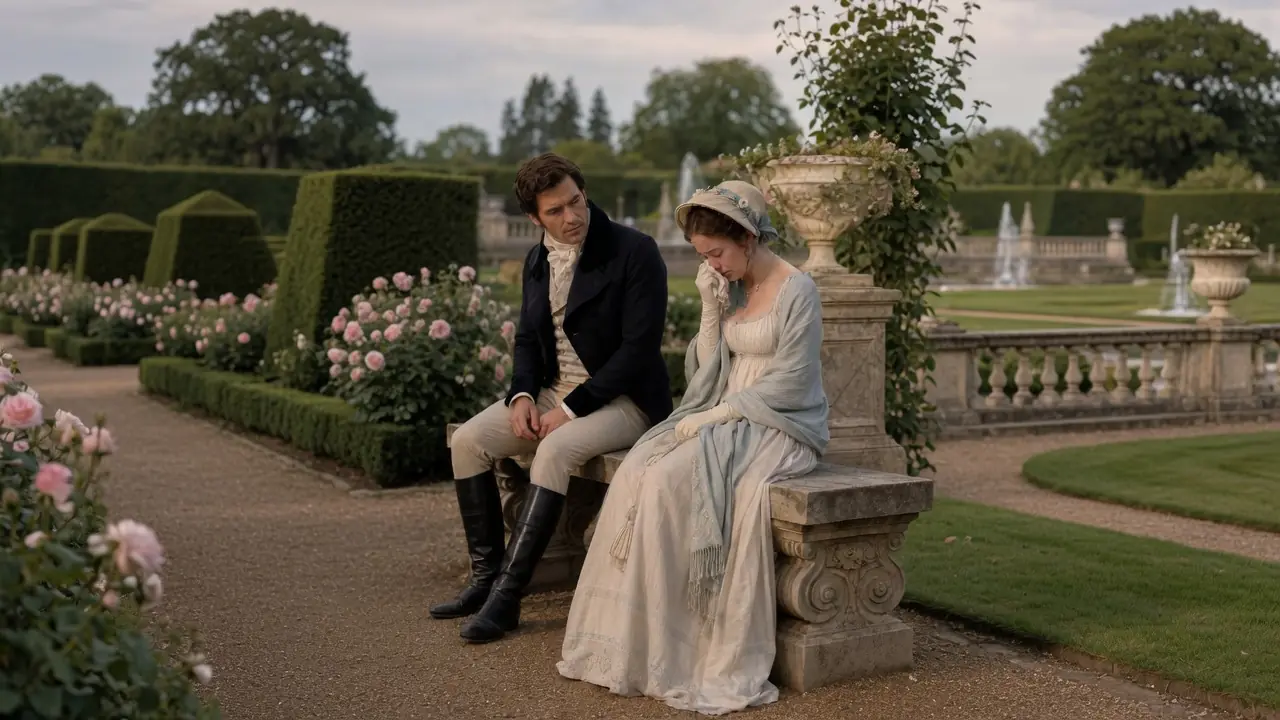
The Duke of Oakminster came later, walking paths he had once entered by right, but now traveled like a ghost. A man whose name still opened doors except the ones that mattered. Neither knew the other was there until it was too late to leave without being seen. So they stayed. Two strangers in the dark, both carrying losses too fresh to name.
Both certain they were alone in their disgrace. She spoke first—not her name, only her fear—that she had been valued only until something better came along. He answered not with comfort, but with recognition—the bitter understanding of someone who had just learned the same truth. What happened next should have been nothing. A brief encounter.
Two people passing through the same shadow before returning to separate lives. But London's elite had made a miscalculation. They had assumed disgrace would silence them both, that shame would keep them separate. That two people stripped of everything would have nothing left to offer each other. They were wrong because some connections aren't built on what you have.
They're built on what you've lost and what you're willing to risk to choose something real in a world built entirely on transaction. This is the story of a meeting that should have meant nothing and the choice that changed everything. The Duke of Oakminster learned the true measure of power on the evening he refused it. The summons had arrived 3 days prior, delivered not by courier but by the Earl of Pembroke himself. A gesture meant to convey honor, though it carried the unmistakable weight of expectation.
The message was brief, a private dinner, a conversation between men of influence, an opportunity to secure the future of both their houses. What it did not say, but what every man in the room understood, was that the Duke's attendance was not optional. He went. The dinner was held at Pembroke's London residence, a sprawling estate that spoke of old money and older alliances. The dining room glittered with candle light, the table set for intimacy rather than ceremony.
Only four men attended, Pembroke, his son-in-law Lord Hastings, a silent banker whose name the Duke did not catch, and the Duke himself. The conversation began with pleasantries: politics, the state of the harvest, the latest scandal involving a minor viscount whose gambling debts had finally caught up with him. The Duke participated minimally, aware that he was being studied, assessed, prepared. It was Pembroke who finally arrived at the point. "Your family has served England well for generations, Oakminster," he said, his voice smooth, practiced.
But these are uncertain times. Influence must be maintained, not merely inherited. The Duke inclined his head, saying nothing. My niece, Pembroke, continued, is a woman of excellent breeding and education. Her dowry is considerable. More importantly, her connections extend into circles that have become difficult to access in recent years.
There it was, the transaction laid bare. "A marriage between our families would benefit both parties," Hastings added, leaning forward slightly. Your estate would be secured. Your position at court restored to what it once was. The Duke set down his glass carefully.
Restored? He repeated, implying it has been diminished. Pembroke smiled, but the expression did not reach his eyes. Let us speak plainly. Your father's debts are known.
Your reluctance to engage with Parliament has been noted. There are those who question whether the title still carries the weight it once did. And this marriage would resolve those questions. "It would demonstrate commitment," Pembroke said, "to stability, to tradition, to the preservation of what matters." The Duke looked at each man in turn.
He saw calculation in their faces, the cold arithmetic of power. He saw his own future being written without his consent, his life reduced to a column in someone else's ledger. "No," he said quietly. The silence that followed was absolute. Pembroke's expression did not change, but something shifted in the air, a subtle recalibration of expectations.
"I beg your pardon. I am grateful for the offer," the Duke said, rising from his seat. "But I must decline." Hastings laughed, a short, incredulous sound. "You cannot be serious."
"I am entirely serious."
"Do you understand what you are refusing?" Pembroke's voice had lost its warmth. "This is not merely a marriage proposal. This is an opportunity to preserve everything your family has built."
"Without it, I will find another way."
"There is no other way," Pembroke said flatly. You have been offered a lifeline, Oakminster. If you refuse it, do not expect another. The Duke met his gaze without flinching. "Then I will learn to swim."
He left before the meal was finished, his departure marked by a silence more damning than any argument. By the following morning, the consequences had begun. There were no formal announcements, no public declarations. The punishment was far more insidious. Invitations that had once arrived weekly simply stopped.
Letters went unanswered. Men who had once sought his council now looked past him in corridors, their expressions carefully neutral. At court, the change was even more pronounced. The Duke attended a reception 2 days after the dinner, arriving as he always had, in formal dress and with every expectation of being received as his title demanded. He was not refused entry. That would have been too obvious, too cruel.
Instead, he was simply overlooked. Conversations ended as he approached. Circles closed subtly, naturally, as though his presence created a disturbance in the social order that required immediate correction. He stood in rooms filled with people he had known for years, and found himself utterly alone. The whispers began within the week.
Unstable, they said, proud beyond reason. Ruined though he refuses to admit it. The Duke heard them all. He said nothing. What defense could he offer that would not sound like desperation? What explanation would satisfy men who had already decided his worth?
He withdrew from public life gradually, not out of shame, but out of pragmatism. There was no purpose in attending events where his presence was tolerated but unwelcome. No value in pursuing conversations that would never move beyond polite dismissal. London, which had once felt like the center of everything, became a city of closed doors. He began walking at night, seeking anonymity in darkness.
He walked the path slowly, letting the silence settle over him like a blanket. The gardens were beautiful in the fading light, the carefully manicured hedges and flowering trees softened by shadow. For the first time in weeks, he felt something close to peace. And then he saw her. Edwina Fairley had believed until that evening that her life was proceeding exactly as it should.
She was 23 years old, the daughter of a gentleman whose modest estate provided comfort, but not extravagance. Her education had been thorough, her manners impeccable, her reputation unblemished. She had been raised with a single unspoken understanding that her future depended entirely on whom she married. When Mr. Richard Fairfax began courting her 6 months prior, Edwina had felt a cautious optimism. He was not titled, but his family was wealthy and well-connected.
He was polite, attentive, and expressed admiration for her intelligence, a quality not all men valued in a prospective wife. Their engagement had been announced quietly without fanfare, but with the full approval of both families. Edwina's mother had wept with relief. Her father had shaken Fairfax's hand with genuine warmth. Edwina herself had felt content, perhaps not swept away by passion, but satisfied that her life would be stable, predictable, safe.
She should have known better. The summons came that afternoon, delivered by a servant she did not recognize. Mr. Fairfax requested her presence at the gates of the royal gardens at 6:00. The message was brief, formal, and gave no indication of the purpose of the meeting. Edwina arrived early, her heart fluttering with a nervousness she could not quite explain.
Perhaps he had arranged something special. Perhaps this was to be a romantic gesture, a private moment before they began the more public rituals of courtship. She waited at the gates, watching carriages pass, nodding politely to strangers who glanced her way. Fairfax arrived precisely on time, stepping down from his carriage with a careful precision that characterized all his movements. He did not smile.
He did not take her hand. "Miss Fairley," he said, his tone clipped. "Thank you for meeting me."
"Of course," Edwina replied, searching his face for some clue to his mood. "Is something wrong?"
He hesitated. And in that hesitation, Edwina felt the world begin to tilt. "I must inform you," he said slowly, "that circumstances have changed. I have been offered an opportunity that requires a different arrangement." Edwina stared at him, uncomprehending.
"A different arrangement?"
"A marriage," he clarified. "One that will better serve my family's interests." The words landed with the force of a physical blow. "But we are engaged," Edwina said, her voice barely above a whisper.
"The engagement was never formalized in law," Fairfax replied, and there was something almost apologetic in his tone. Almost, but not quite. No contracts were signed. No announcements made in the papers. It was an understanding, one that I now find myself unable to honor.
"Unable?" Edwina's hands were shaking. She clasped them together to steady them.
"Or unwilling?"
Fairfax looked away. "I am sorry, Miss Fairley."
"Truly, but this is a matter of necessity. I hope you will understand."
"Understand?" She felt something breaking inside her, something she had not known was fragile. "You are ending our engagement with no explanation, no warning, and you expect me to understand?"
"I expect you to be reasonable," he said. And now there was an edge to his voice. "You are a sensible woman. You know how these things work. This is not personal."
"It is simply practical."
Practical. The word echoed in her mind. Cold and final. "Who is she?"
Edwina asked quietly. Fairfax hesitated again. That is not relevant. It is relevant to me, he sighed as though her insistence were an inconvenience. Lady Catherine Moore, the Earl of Pembroke's niece.
Edwina closed her eyes. Of course, a titled woman, a woman whose connections could open doors that Edwina never could. "I see," she said softly. I knew you would," Fairfax replied, and there was relief in his voice now, as though the worst had passed. "You have always been reasonable, Miss Fairley.
I admire that about you." He stepped back toward his carriage, already turning away, already moving on to the life he had chosen, the life that did not include her. "Goodbye, Miss Fairley," he said. "I wish you well." And then he was gone. Edwina stood at the gates watching the carriage disappear into the London streets and felt the full weight of what had just happened settle over her. She had been dismissed, discarded, replaced by someone more useful, and there was nothing she could do about it.
She could not return home yet. Her mother would see her face and know immediately that something was wrong. And Edwina could not bear the questions, the sympathy, the inevitable disappointment. She needed time. Time to compose herself, to construct the mask she would need to wear for the rest of her life. The garden stood behind her, quiet and inviting.
She entered without thinking, moving down the gravel paths on instinct, seeking shadows, seeking solitude. Her vision blurred with tears. She refused to let them fall in public. She walked until she found a bench tucked away from the main paths, partially hidden by hedges. She sat down, and finally alone, she allowed herself to cry.
The Duke saw her before she saw him. She was sitting on a stone bench near the eastern edge of the gardens, her face buried in her hands, her shoulders shaking with silent sobs. The fading light cast long shadows across the path, rendering her almost invisible to anyone who was not looking carefully. He should have walked past, should have left her to her grief, whatever its cause. But something stopped him.
Perhaps it was the loneliness of her posture, the way she seemed to be trying to make herself smaller, invisible. Perhaps it was recognition, the understanding that comes from shared experience. Perhaps it was simply that he could not bear to see another person suffering alone. He approached quietly, stopping a few feet from the bench. "Forgive me," he said gently.
"But are you quite all right?" She looked up sharply, startled, her eyes wide and red rimmed. For a moment she simply stared at him, and he saw the calculation happening behind her gaze, the rapid assessment of threat, of propriety, of whether she had the strength to maintain appearances. "I am fine," she said automatically, wiping at her eyes with trembling fingers. "Thank you for your concern." The Duke recognized the lie immediately. He had told the same one countless times in recent weeks.
"May I sit?" he asked. She hesitated, and in that pause, he prepared to leave. But then she nodded just once, a small defeated gesture. He sat down beside her, leaving a respectful distance between them. For a long moment, neither spoke.
"I am told," the Duke said finally, that gardens are meant to be places of peace. Though I have found that they are often better suited for sadness. She glanced at him, surprised by the honesty. "Do you come here often to be sad?" she asked, her voice still thick with tears. "More often than I would like," he admitted. "And you?
This is my first time," she said. "Though I suspect it will not be my last." He nodded, accepting this without question. "I am Edward," he said, offering the name his closest friends had called him, the name that carried no title, no expectations. "Edwina," she replied, and did not offer a surname. They sat in silence for another moment, and then, as though the words had been building pressure for too long, she spoke.
"Have you ever been told," she said slowly, that you were valued, only to discover that your value had an expiration date? The Duke turned to look at her, truly look at her, and saw the rawness in her expression. The kind of pain that comes not from a single blow, but from the sudden understanding that everything you believed was conditional. "Yes," he said quietly. "I have." She met his gaze, and something passed between them.
A recognition, wordless, but absolute. "What did you do?" she asked. "I refused to pretend it did not hurt," he said. And I walked away. And then and then I came here," she nodded slowly as though this answer made perfect sense. "I do not know how to walk away," she confessed.
"I do not know where I would go. Neither do I," the Duke admitted. "But I suspect that is the point. We are not meant to know. We are only meant to move." Edwina looked down at her hands, still trembling in her lap.
"I was engaged," she said softly, until an hour ago. He ended it without explanation, without apology. Simply informed me that circumstances had changed and left. The Duke felt anger stir in his chest, not at her, but at the cruelty of it, the casual dismissal of a person's worth. Did he give a reason?
He asked. "A better opportunity," she said bitterly. A more advantageous match. The Duke's jaw tightened. Then he is a fool.
She looked at him startled. You do not know me. No, he agreed. But I know that anyone who measures a person's value by their usefulness is not worthy of the person they discard. Edwina's eyes filled with fresh tears, but she did not look away.
"You say that as though you believe it," she whispered. "I do," the Duke said. Because I have recently been discarded for the same reason. She drew in a sharp breath. What happened? "I refused a marriage," he said simply.
One that would have secured my future but cost me my autonomy. And so I was quietly removed from the lives of people I thought valued me. "Do you regret it?" she asked. He considered the question carefully, turning it over in his mind like a stone. "I regret the loss," he said finally.
But I do not regret the choice. Edwina nodded slowly, absorbing this. "I wish I had been given a choice," she said. "Perhaps," the Duke said gently. You still have one.
She looked at him questioningly. "You can choose how you carry this," he said. Whether you allow it to define you or whether you define yourself despite it. Edwina studied him in the fading light. This stranger who had sat beside her grief without judgment, without expectation. "Who are you?" she asked softly.
"Someone who understands," he replied. "And someone who needed to sit beside another person who understands." The night was settling fully now, the gardens growing darker, the air cooling. "I should go," Edwina said, though she did not move. "As should I," the Duke agreed, also remaining seated. They sat together for another moment, two people who had lost everything they thought mattered, finding unexpected comfort in shared silence.
Finally, Edwina rose, smoothing her skirts with hands that no longer trembled quite so badly. "Thank you," she said. "For sitting with me. Thank you," the Duke replied, "for allowing me to." She walked away slowly, disappearing into the shadows of the garden paths. The Duke remained on the bench, staring into the gathering darkness, and felt something he had not felt in weeks.
Not quite hope, but not quite despair either, something in between, something like possibility. Edwina did not intend to return to the gardens. The morning after her encounter with Edward, she woke with the firm resolution that it had been an aberration, a moment of weakness brought on by shock and humiliation. She was a sensible woman. She did not form attachments to strangers in darkened gardens.
She did not share her private grief with men whose surnames she did not know. And yet, as afternoon light slanted through her bedroom window, she found herself thinking about the way he had sat beside her without demanding explanations. The way he had spoken of his own disgrace, as though it was simply a fact, neither shameful nor heroic, but merely true. By evening she had convinced herself that a walk would be beneficial. Fresh air, exercise, nothing more. She entered the gardens just as dusk began to settle, telling herself she was not looking for anyone in particular.
He was already there, sitting on the same bench, his posture suggesting he had been waiting. But for what or for whom, she could not say. When he saw her, something shifted in his expression. Not quite a smile, but a softening, a recognition. "Miss Edwina," he said, rising slightly as she approached.
I had hoped you might return. "I should not have," she replied, but she sat down beside him anyway. And yet you did. And yet I did, she echoed. They sat in silence for a moment, watching the last rays of sunlight filter through the trees.
"How have you been?" he asked finally. Edwina considered lying. Considered offering the polite fiction that she was perfectly well, that life continued as it always had. "Instead," she said, invisible. Edward turned to look at her, waiting. "I returned home after our meeting," she continued, her voice quiet but steady.
My mother asked if the evening had been pleasant. I told her it had been enlightening. She smiled and went back to her correspondence. My father did not ask at all. "They do not know," Edward said.
It was not a question. "They will know soon enough," Edwina replied. Word spread quickly in certain circles. But for now, I exist in a strange liminal space where my life has ended, but no one has noticed yet. Edward nodded slowly.
I know that space well. Do you? "I have spent the past week attending to estate business," he said. Correspondence, accounts, the mundane machinery of maintaining property. My steward looks at me with pity now as though he knows I am playing at relevance. "Are you?"
Edwina asked. "Perhaps," Edward admitted. I no longer know what relevance means. I thought it meant influence, position, the respect of one's peers. But those things were never truly mine.
They were conditional. And when I failed to meet the conditions, they evaporated. Edwina turned to face him more fully. What were the conditions? "Obedience," he said simply.
The willingness to trade autonomy for security, to become what was needed rather than what I was. And you refused. I did. Was it worth it? The question came out more sharply than she intended.
Edward was quiet for a long moment. "Ask me again in a year," he said finally. Ask me when I know whether I have built something in place of what I lost or whether I have simply lost. Edwina felt something tighten in her chest. "I was not given the choice to refuse," she said.
The decision was made for me, and now I live with the consequences of someone else's ambition. What will you do? What can I do? Edwina's voice carried an edge of bitterness. Now I am a woman of limited means and no title.
My value in society is measured entirely by whom I marry. Without that, she trailed off unable or unwilling to complete the thought. "Without that, you still exist," Edward said quietly. You still have thoughts, feelings, intelligence. Those things do not disappear simply because someone has decided you are inconvenient, but they become irrelevant.
Edwina accounted. What good is intelligence in a woman who cannot use it? What value has feeling when no one cares to witness it? "I witness it," Edward said. The words hung between them, simple and devastating, Edwina looked away, blinking back the sudden pressure behind her eyes.
"You are a stranger. Yes," Edward agreed. "Perhaps that is why it matters." They began meeting regularly after that, always at dusk, always at the same bench, tucked away from the main paths. Neither formally arranged these meetings. Neither sent word or confirmed attendance.
They simply appeared evening after evening, drawn by an understanding that required no explanation. Their conversations deepened gradually, like roots finding purchase in difficult soil. Edwina spoke of her childhood, of growing up in a house where love was abundant but security was not, of watching her mother's anxiety each time bills came due, of understanding from a young age that her primary purpose was to marry well enough to ensure her parents' comfort in their old age. "I was not resentful," she said. It seemed a fair exchange.
They had given me life, education, care. The least I could do was secure their future. "But now," Edward prompted, now I realize that my entire existence has been a transaction, Edwina said. And I have failed to deliver the agreed upon value. Edward listened without interruption, his expression thoughtful.
"I was raised to believe that duty and desire were the same thing," he said when she had finished. That wanting what was expected of me was a mark of character. It took me 31 years to realize that I had never actually asked myself what I wanted. And when you did, I discovered I had no answer," Edward admitted. "I only knew what I did not want, which is where I began.
"By refusing the marriage, by refusing to be sold," Edward corrected gently. The marriage itself might have been tolerable. It was the transaction I could not abide. The assumption that my future was a commodity to be traded for influence. Edwina was quiet for a moment, absorbing this. "Who was she?" she asked.
"The woman you were meant to marry. I never met her," Edward said. "She was a niece of the earl, well-connected, utterly irrelevant to the actual negotiation. The marriage was never about her or about me. It was about access, about positioning, about men securing their interests through our bodies.
Something cold settled in Edwina's stomach. "The Earl of Pembroke," she repeated slowly. "Yes, do you know him? No," Edwina said. "But I know of his niece." Edward turned to look at her sharply.
"How?" She is the woman my former fiance is now pursuing, Edwina said, the words emerging with careful precision. Lady Catherine Moore. The silence that followed was absolute. Edward stared at her, his expression shifting from confusion to comprehension to something darker, a recognition of pattern of design. "Your engagement ended," he said slowly, so that your fiance could pursue the woman I refused to marry.
"It would seem so," Edwina said, her voice remarkably steady. Despite the tremor in her hands. "We are not separate tragedies," Edward said almost to himself. "We are connected failures in the same transaction." Edwina felt something like vertigo, as though the ground beneath her had suddenly revealed itself to be far less stable than she had believed. "He dismissed me," she said, "to claim the opportunity you created by refusing. And I created that opportunity by refusing to be used as leverage," Edward finished.
They sat in stunned silence, the implication spreading between them like spilled ink. "They do not see us as people," Edwina said finally. We are simply pieces on a board to be moved or removed as strategy dictates. No, Edward said, and there was steel in his voice now. They do not see us as people.
But that does not mean we must accept their assessment. Edwina looked at him at this man whose name she barely knew but whose anger mirrored her own. What else can we do? "We can refuse to disappear," Edward said. We can insist on our own existence even when it is inconvenient for them.
That sounds like rebellion. "Perhaps it is," Edward agreed. Or perhaps it is simply survival.
Outside the gardens, the world continued its relentless machinery. Edwina's mother began receiving visitors with increasing frequency, women who arrived with sympathetic expressions and carefully probing questions. How was dear Edwina managing? Had there been any recent developments in her social calendar? Were there any promising acquaintances on the horizon?
The subtext was clear. They knew. Perhaps not the details, but enough. Enough to understand that Edwina's prospects had dimmed, that her value had decreased, that she was now a daughter in need of strategic repositioning. Her mother responded to these inquiries with practiced grace, deflecting without confirming, maintaining appearances while quietly panicking.
One evening, as Edwina prepared to leave for her walk, her mother stopped her in the hallway. "Mr. Peyton has expressed interest in calling on you," she said, her tone carefully neutral. Edwina paused, her hand on the door. Mr. "Peyton, he is a widower," her mother continued. Established.
Respectable. His children are nearly grown. It would be a comfortable arrangement. "Comfortable?" Edwina repeated, tasting the word like ash.
Edwina. Her mother's voice softened, taking on a pleading quality. I know this is not what you imagined, but circumstances have changed. We must be practical. "Practical?"
Edwina said, "Of course. Will you receive him?" Edwina looked at her mother and saw fear there, barely concealed. Fear of poverty, of insecurity, of a future where comfort could no longer be taken for granted. "I will think about it," Edwina said, and left before her mother could press further. As she walked toward the gardens, she felt the weight of expectation settling over her shoulders like a cloak she could not remove.
Her mother was not wrong. Circumstances had changed. Resources were limited. A comfortable arrangement with a respectable widower was perhaps the best she could hope for now. And yet the thought of it filled her with a despair so profound it threatened to pull her under.
Edward too found himself subject to renewed attention. The isolation that had defined his first weeks of disgrace began to crack, not with warmth, but with calculation. Lord Hastings called on him unexpectedly, arriving at his London residence with an apologetic smile and a bottle of excellent brandy. "I have been remiss in my correspondence," Hastings said, settling into a chair as though they were old friends, resuming a pleasant acquaintance. "The business of Parliament, you understand." Edward understood perfectly.
He said nothing. "There has been talk," Hastings continued, of reconsidering certain positions, the Foreign Office perhaps, or a seat on the Trade Commission. "Your expertise would be valued. Would it?" Edward said flatly. Of course, Hastings leaned forward, his expression earnest.
Your father's legacy, your own capabilities, these things have not been forgotten, Oakminster. The use of his title was deliberate, a reminder of what he stood to reclaim. "What would be required?" Edward asked, though he already knew. "Simply a willingness to engage," Hastings said smoothly.
To be present to demonstrate that past misunderstandings have been resolved. Misunderstandings. We all make decisions in haste that we later reconsider. Hastings said, "There is no shame in recognizing when circumstances allow for recalibration." Edward met his gaze evenly. "You want me to reconsider the marriage?
I want you to reconsider your isolation," Hastings corrected. "The marriage was simply one path. There may be others, but they all require your participation in society, your willingness to be part of the structures that maintain order and prosperity. And if I prefer my isolation, Hastings's smile thinned, then I fear it will become permanent. The door is open now, Oakminster.
The doors do not remain open indefinitely. He left shortly after, the brandy unopened on the table. Edward sat alone in his study, staring at the bottle, understanding the message clearly. Return to the fold or be cast out entirely. Submit or suffer.
That evening when Edward arrived at the gardens, Edwina was already there, her posture rigid, her expression distant. "You look troubled," he said, sitting beside her. "My mother wishes me to receive a suitor," Edwina said without preamble. "A widower. Respectable and dull and utterly safe.
Will you? I do not know," she admitted. "What choice do I have? I cannot remain in my parents' home indefinitely, unmarried and purposeless. And yet the thought of accepting this man, of pretending gratitude for being chosen only because I have been devalued.
She broke off, pressing her fingers to her temples. Edward was quiet for a moment. "I was offered a door back into society today," he said finally. Edwina looked at him sharply. What did you say?
"Nothing yet," Edward replied. But the implication was clear. Recant my refusal. Demonstrate willingness to comply, and I will be restored to something approximating my former position. And will you? Edward looked out across the darkening gardens at the shadows lengthening between the trees.
"I do not know," he said honestly. A week ago, I would have said no without hesitation. "But now, now, now I understand the cost of principle," Edward said. Not just to myself, but to those who depend on me, my estate, my tenants, the people whose livelihoods are connected to my own. "That is not the same as your own desires," Edwina said quietly.
No, Edward agreed. But perhaps my own desires are luxury I can no longer afford. Edwina turned to face him fully, and he saw something fierce in her expression, something that had not been there before. "Do not do that," she said. "Do not convince yourself that capitulation is noble.
I have watched my entire life be shaped by other people's needs, other people's expectations. I do not wish to watch you do the same. And what would you have me do?" Edward asked, not unkindly. "Maintain my isolation? Preserve my principles while everything around me crumbles?
"I would have you choose yourself," Edwina said, "At least once. At least here." The words hung between them, more intimate than either had intended. Edward reached out slowly, tentatively, and took her hand. She did not pull away. "I do not know how to do that," he admitted.
"I have spent my entire life being what was needed. I do not know what I am when no one needs me to be anything." Then perhaps," Edwina said, a fingers tightening around his, "We learn together." They sat in silence as darkness settled fully over the gardens. Two people caught between the lives they were expected to return to under a strange, fragile possibility of something else. Neither knew what would come next, but for the first time in weeks, neither felt entirely alone in facing it. The pressure mounted steadily over the following days.
Edwina's mother began speaking more openly about Mr. Peyton, describing his comfortable income, his well-appointed house, his reasonable temperament. She did not say, "You should be grateful," but the implication saturated every word. Edward received another visit, this time from an old friend or someone who had once been a friend before disgrace had redefined the terms of their relationship. "You are being foolish," the man said bluntly. "Pride is expensive," Oakminster.
"Can you afford it?" Edward did not answer. But that night when he met Edwina in the gardens, he saw the same question reflected in her eyes. Can we afford this? Can we afford to choose ourselves when the cost is so high? I am afraid, Edwina confessed, her voice barely above a whisper.
I am afraid that if I refuse what is offered, nothing else will come. That this is my last chance and I am too stubborn to take it. "I am afraid of the same thing," Edward admitted. That if I do not return now, the door will close permanently. That I will have sacrificed everything for nothing.
They sat together in the growing darkness, holding hands like children, afraid of getting lost. "What do we do?" Edwina asked. Edward looked at her at this woman he had known for mere weeks, but who felt more real to him than anyone he had known for years. "I do not know," he said. But I know I am not ready to let this go.
Whatever this is, Edwina's eyes filled with tears. Neither am I. "Then we hold on," Edward said. A little longer. Until we know what we are holding on to.
She nodded and they sat together as the night deepened around them, two people refusing to disappear, even as the world insisted they should. But the pressure continued to build, and both knew that eventually they would have to choose. The truth arrived on a Tuesday afternoon, wrapped in idle gossip and delivered without malice. Edwina had accompanied her mother to a small gathering at Lady Hartwell's residence, one of those carefully orchestrated social events where women gathered under the pretense of charitable work while actually engaging in the far more serious business of information exchange. Edwina had attended reluctantly, though in her absence would invite speculation, but unable to refuse without raising further questions.
She sat in the corner of the drawing room, ostensibly examining fabric samples for the church bazaar, while conversation swirled around her like currents. "Such a shame about Oakminster," someone said, the voice carrying clearly across the room. Edwina's hands stilled on the fabric. Oh, another woman replied, her tone suggesting she knew precisely what shame was being referenced, but wished to hear it articulated nonetheless. The Duke of Oakminster, the first woman clarified.
I heard he has been completely sidelined since that business with Pembroke. Refusing the marriage was bad enough, but to remain so stubbornly isolated, it borders on the absurd. He was seen walking in the royal gardens last week, a third voice added. Alone. Naturally, I suppose even dukes must seek fresh air when society has grown too stifling. The conversation continued, but Edwina no longer heard it.
The Duke of Oakminster. Edward. The fabric samples blurred before her eyes as understanding crashed over her in waves. Edward, the man who had sat beside her in grief, who had spoken of being cast aside for refusing to be sold, who had held her hand in the darkness and confessed his own fears, was not simply another victim of society's cruelty. He was the Duke of Oakminster, the man whose refusal had created the very opportunity that had destroyed her life.
The room seemed to tilt. Edwina forced herself to breathe slowly, carefully, maintaining the appearance of composure while her mind raced. He had known. He must have known when she told him about Richard Fairfax, about Lady Catherine Moore, about the political marriage that had cost her everything. He had known it was connected to his own refusal, and he had said nothing.
He had let her believe they were equal in their disgrace. Two strangers finding comfort in shared loss. But they were not equal. They had never been equal. He was a duke.
She was no one and he had lied to her. Edwina excused herself from the gathering early, claiming a headache that was not entirely fabricated. Her mother protested weakly, but Edwina was already moving toward the door, desperate for air, for space to think. She did not go home. Instead, she walked directly to the gardens, arriving well before their usual meeting time, her anger propelling her forward like a physical force.
She paced the paths near their bench, rehearsing confrontations in her mind, discarding them, starting again. Each imagined conversation ended differently, with tears, with accusations, with cold dismissal, but all began with the same question. Why did you lie? The sun was still high when she heard footsteps on the gravel path. Edward appeared around the hedge, stopping short when he saw her.
His expression shifted immediately from surprise to concern. "Edwina," he said, moving toward her. I did not expect you so early. Is something wrong? Who are you?
She asked, her voice tight and controlled. Edward froze. What? "I asked you a question?" Edwina said, each word precisely articulated.
Who are you? She watched, understanding dawn across his face, watched the careful composure slip, revealing something underneath. Guilt perhaps, or resignation. Edwina, your name? She interrupted.
Your full name. Edward closed his eyes briefly, and when he opened them again, she saw surrender there. "Edward Ashford," he said quietly. Duke of Oakminster. The confirmation, though expected, still struck like a blow.
"You lied to me," Edwina said. "I did," he admitted. "You lied," she repeated, her voice rising. You sat beside me and let me pour out my grief about a situation you created. And you said nothing.
You let me believe we were the same. Two people equally damaged by forces beyond our control. But we are not the same. We have never been the same. No, Edward agreed.
And there was pain in his voice now. We are not the same. But my feelings were honest. My understanding was real. Your understanding?
Edwina laughed. A sharp bitter sound. How can you understand what it means to have your entire future destroyed when you are a duke? When you have title, property, influence, when your identity exists independent of whom you marry or whom you please. My identity is not as secure as you believe.
Edward said, "Yes, I have a title, but titles without influence are hollow. I have been made irrelevant, Edwina. Perhaps not in the same way as you, but the isolation is no less real. "But you chose it," Edwina countered. You chose to refuse.
You chose to walk away. I was given no choice. I was simply discarded so that another man could claim what you rejected. Edward flinched. I know.
Do you? Edwina moved closer, her hands clenched at her sides. Do you understand that your principles, your refusal to be sold, cost me everything? That your moral stand came at my expense? "That was never my intention," Edward said, his voice raw.
"But it was the consequence," Edwina said. And you knew when I told you about Richard, about Lady Catherine, you knew it was connected, and you said nothing. "What should I have said?" Edward asked. That I was the Duke. That my refusal had created the opportunity that destroyed your engagement.
"How would that knowledge have helped either of us? It would have been the truth," Edwina said. "And I deserve the truth." Edward looked at her for a long moment, and she saw something break behind his eyes. "You are right," he said quietly. "You deserve the truth.
I should have told you from the beginning. I should have trusted you with my identity instead of hiding behind anonymity like a coward. The admission should have satisfied her. Instead, it only deepened her sense of betrayal. "Why didn't you?" she asked, and hated the way her voice wavered.
"Because for the first time in my life, someone saw me without seeing the title first," Edward said. You spoke to me as though I was simply a person. Not a duke, not a political asset, not a disappointment to powerful men, just someone who understood loss, and I was selfish enough to want that, to need it." Edwina closed her eyes, feeling tears threaten. "That does not excuse the deception. No," Edward agreed.
"It does not." They stood in silence, the space between them suddenly vast despite the physical proximity. "I should go," Edwina said finally. "Please," Edward said, and there was desperation in his voice. Now, please do not leave like this. Let me explain.
"You have explained," Edwina interrupted. You were lonely. You wanted to be seen as a person rather than a title. I understand. But your loneliness cost me my honesty, Edward.
You let me believe we were equals in suffering when we were never equal at all. "We are equal in this," Edward said, stepping closer. Whatever our positions in society, what we found here was real. "The conversations, the understanding, the the illusion," Edwina finished. We found an illusion.
A fantasy where titles did not matter and consequences did not exist. But that is not the world we live in. "It could be," Edward said quietly. If we chose it. Edwina laughed again, tears now falling freely down her cheeks. How?
How do we choose a world that does not exist? Edward reached for her hand, but she stepped back, shaking her head. "I need time," she said. I need to think. Edwina.
"Please," she whispered. Just let me go. She turned and walked away before he could respond. Her vision blurred with tears, her heart fracturing with each step. Behind her, Edward stood alone in the gardens, watching her disappear, knowing he had lost something irreplaceable.
The following days passed in a fog of misery and mechanical routine. Edwina remained in her room as much as propriety allowed, claiming the headache had worsened. Her mother fussed and worried, bringing tea and cool compresses, unaware that no remedy existed for the particular pain her daughter suffered. On the third day, Mr. Peyton called. Edwina's mother announced a visit with poorly concealed excitement, urging Edwina to dress appropriately, to compose herself, to remember that opportunities must be seized when presented.
Edwina descended to the drawing room with the heavy resignation of a prisoner approaching the gallows. Mr. Peyton was exactly as she had imagined, middle-aged, pleasant-faced, utterly unremarkable. He greeted her with courteous warmth, asked after her health with genuine concern, and spoke of his children with obvious affection. He was in every measurable way a good man, and the thought of marrying him filled Edwina with such profound emptiness that she could barely maintain conversation. "My daughter is quite accomplished on the piano 40," her mother said, guiding the conversation with practiced skill.
"Perhaps you might favor us with a performance, Edwina." Edwina played. Her fingers moved across the keys mechanically, producing sound without feeling, notes without music. Mr. Peyton applauded politely when she finished. "Lovely," he said. My late wife was also musical.
I find it brings great comfort to our household. Comfort. That word again. After he departed with promises to call again soon, Edwina's mother turned to her with barely contained hope. "He is very suitable," she said.
Do you not think so? "Very," Edwina agreed holy. Then you will encourage his suit. Edwina looked at her mother and saw the anxiety there, the fear of an uncertain future, the desperate hope that her daughter might yet be saved from spinsterhood and poverty. "I will consider it," she said, which was not quite a lie, but not quite the truth either.
Edward, too, faced renewed pressure. The Earl of Pembroke himself appeared at Oakminster House unannounced and uninvited, his presence a statement of either extraordinary confidence or calculated intimidation. "Your grace," Pembroke said, settling into a chair as though he owned it. "We should speak plainly. By all means," Edward replied, remaining standing.
"Your isolation has made its point," Pembroke continued. You have demonstrated your independence, your unwillingness to be dictated, too. All very admirable, but the time for posturing has passed. I was not posturing. "Then you were being foolish," Pembroke said bluntly.
Either way, the result is the same. You have damaged yourself unnecessarily. But damage can be repaired. Edward said nothing. Waiting.
Lady Catherine is no longer available. "Of course," Pembroke said, "Mr. Fairfax has proven himself adequate to that arrangement. But there are other opportunities. Other alliances that could restore your position. I am not interested in restoration through marriage," Edward said.
"No." Pembroke's eyebrows rose. "Then perhaps you are interested in complete obscurity, because that is the alternative, Oakminster. Without strategic alliance, your influence will continue to wane. Your estate may survive, but your relevance will not. Perhaps relevance is overrated.
Pembroke leaned forward, his expression hardening. Do not be naive. You are a duke. That title carries responsibility to your family, to your tenants, to the structure of society itself. Your personal feelings are immaterial.
"My personal feelings are the only thing that remain entirely mine," Edward countered. "Then you are a fool," Pembroke said, rising. But I will make you one final offer. Return to society. Demonstrate willingness to participate in the mechanisms that maintain order.
Do this and your previous misstep will be forgiven. And if I refuse, Pembroke moved toward the door, pausing at the threshold. "Then I will ensure your isolation becomes permanent," he said quietly. I will see to it that every door closes, that every opportunity evaporates, that you spend the remainder of your life as a cautionary tale about the cost of pride. He left without waiting for a response.
Edward stood alone in the drawing room, staring at the closed door, feeling the walls closing in. That evening, neither Edward nor Edwina went to the gardens. Edward remained in his study, a glass of untouched brandy before him, contemplating the ruins of his life. Edwina sat in her bedroom, staring out the window at the darkening sky, feeling the weight of expectations pressing down like a physical force. Both faced the same choice, though neither knew the other was facing it simultaneously. Capitulation or destruction, security or principle, the lives they were expected to reclaim, or the fragile, impossible thing they had found in the darkness.
Edward thought of Edwina's face when she learned the truth, the betrayal in her eyes, the way she had looked at him as though he were just another man who had used her for his own purposes. He thought of Penrock's threat of the life that awaited him if he continued to refuse a life of irrelevance and isolation. His title reduced to an empty formality. And he thought of the alternative, returning to society, playing the game he had always played, becoming once again what was needed rather than what he was. It would be easier, safer, more comfortable, and it would destroy whatever remained of the man he had discovered himself to be in those quiet conversations in the gardens.
Edward picked up the glass of brandy, stared at it for a long moment, then set it down untouched. He rose from his desk, pulled on his coat, and walked out into the night. Edwina sat by her window until full darkness fell, watching the streets empty, the lamplighters making their rounds. She thought of Mr. Peyton's kind eyes and pleasant conversation. The comfortable life he offered, the security her parents needed.
She thought of Edward's deception, the way he had let her believe they were equals when they never had been. But she also thought of the truth beneath the deception, the honesty in his voice when he spoke of his own fear and loneliness. The way he had listened to her without judgment, without expectation. The way he had seen her, truly seen her, perhaps for the first time in her life. Her mother's voice drifted up from downstairs, speaking to her father about Mr. Peyton's excellent prospects. Edwina closed her eyes.
She could accept what was offered, could salvage her reputation, secure her future, fulfill her obligations to her family, could spend the rest of her life being comfortable and safe and utterly invisible. Or she could choose herself, just once, just this once. Even if it cost her everything, even if Edward never forgave her for leaving, even if she remained angry at his deception, even if choosing herself meant choosing nothing but the principle of the choice itself, Edwina stood, pulled on her cloak, and slipped quietly out of the house. The gardens were dark when she arrived, the gates technically closed, but never locked. She made her way to their bench, not knowing if he would be there, not knowing what she would say if he was.
The bench was empty. Edwina sat down, pulling her cloak tighter against the chill. Feeling foolish and brave and terrified all at once, she waited. Minutes passed, then more. And then she heard footsteps on the gravel path.
Edward appeared from the shadows, stopping when he saw her. Even in the darkness, she could see the surprise on his face, followed quickly by something that looked like hope. "Edwina," he said quietly. "I am still angry," she said, her voice steady despite the pounding of her heart. You lied to me.
You let me believe we were the same when we were never the same. "I know," Edward said, and I do not know if I can forgive that. I understand, but Edwina continued, and now her voice wavered slightly. I also cannot accept what is being offered to me. I cannot return to that life.
I cannot pretend that these weeks meant nothing, that the person I discovered myself to be in your company was an aberration to be discarded. Edward moved closer slowly, as though approaching something fragile. "I refused Pembroke's offer," he said. I told him I would not return to society on his terms. That I would not trade myself for influence regardless of the cost.
Edwina's breath caught. You did? "I did," Edward confirmed. Before I knew you would be here. Before I knew if you would ever speak to me again, I chose this whatever this is over everything else.
"Even though you do not know what this is, especially because I do not know," Edward said, because for the first time I am choosing something that is not predetermined, not calculated, not safe. I am choosing the unknown because the alternative is a life I can no longer bear to live. Edwina stood facing him fully in the darkness. "I do not know if I can trust you again," she said. I know.
I do not know if this will work. Neither do I. "I only know," Edwina continued, tears now streaming down her face, but I would rather fail at choosing myself than succeed at becoming what everyone else needs me to be." Edward reached out, and this time she did not pull away. His hands found hers in the darkness, warm and solid and real. "Then we fail together," he said.
If that is what comes. We fail honestly, choosing freely without illusions about what we are risking. Together, Edwina echoed. "Together," Edward confirmed. They stood in the darkness, holding hands like children, afraid of getting lost, knowing they had just burned every bridge behind them, knowing the consequences would be severe and immediate.
But for the first time in their lives, they had chosen themselves. And whatever came next, they would face it not as a duke and a discarded woman, but as two people who had found something worth protecting in the ruins of everything else. The night deepened around them, and neither let go. The consequences arrived with the morning post. Three letters for Edward, all brief, all expressing the same sentiment in varying degrees of formality.
His presence would no longer be welcomed at certain gatherings. Certain clubs, certain circles where his family name had once guaranteed entry. He read them at breakfast, set them aside, and felt nothing resembling regret. For Edwina, the judgment came through silence. Invitations that should have arrived did not. Acquaintances who might have called suddenly discovered pressing obligations elsewhere.
Her mother's friends began finding excuses to cut their visit short, their expressions a mixture of pity and relief that their own daughters had not suffered similar disgrace. Mrs. Fairley took to her bed for 3 days, overcome by what she termed nervous exhaustion, but what everyone understood to be shame. Mr. Fairley, to his credit, said very little, he simply looked at his daughter across the breakfast table one morning and asked, "Are you certain?" Edwina met his gaze. I am. He nodded slowly, returned to his newspaper, and never raised the subject again.
Edward called on the Fairley household exactly one week after their reunion in the gardens. He arrived in full formal dress, his card presented properly, his intentions unmistakable. The butler who answered the door looked momentarily uncertain. Protocol dictated he should admit a duke without question, but household gossip had surely informed him of the complicated situation. He settled on a compromise, accepting the card and asking his grace to wait in the entrance hall while he consulted with the master.
Edward waited, standing rather than sitting, his hat held properly, his expression calm. Mr. Fairley appeared after several minutes, his face carefully neutral. "Your grace," he said, the title sitting strangely in the air between them. "This is unexpected. I apologize for calling without prior arrangement," Edward said.
But I wish to speak with you regarding your daughter. Mr. Fairley studied him for a long moment. You had better come into my study. The study was small, lined with books that showed signs of actual reading rather than decorative acquisition. Mr. Fairley gestured Edward toward a chair, then took his own seat behind a desk that had seen better decades.
I will speak plainly. Your grace, he began. I am a man of modest means and no particular influence. My daughter's happiness matters to me, but so does her security. I cannot afford romantic notions if they leave her destitute.
"I understand," Edward said. Do you? Mr. Fairley leaned forward slightly. Because from where I sit, you are a duke who has made himself unwelcome in society, and my daughter is a young woman whose reputation has already been damaged. If you are here to propose some clandestine arrangement.
"I am here to ask permission to marry her," Edward interrupted quietly. The silence that followed was profound. Mr. Fairley blinked. I beg your pardon. "I wish to marry your daughter," Edward repeated.
With your blessing, though I will respect her choice regardless of whether you grant it. "You are a duke," Mr. Fairley said slowly, as though explaining something Edward might have forgotten. "I am aware." And you wish to marry a woman with no title, no fortune, and a damaged reputation. "I wish to marry Edwina," Edward corrected. Her lack of title and fortune are immaterial.
As for her reputation, it was damaged by forces beyond her control. I will not hold her accountable for the cruelty of others. Mr. Fairley sat back in his chair, studying Edward with an intensity that suggested he was searching for deception and finding none. Why? He asked finally.
Edward considered the question carefully. Because she is the only person who has ever seen me as something other than a title or a disappointment. Because her intelligence and resilience deserve to be valued rather than discarded. Because I would rather build a life with her than reclaim the one I walked away from. That is not a practical answer.
No, Edward agreed, but it is an honest one. Mr. Fairley was quiet for a long moment. Then unexpectedly, he smiled, a small sad expression. "My wife will be horrified," he said. "She had hoped Edwina might still salvage a respectable match.
"I am a duke," Edward pointed out. "By most measures, this would be considered an exceptional match. "By most measures," Mr. Fairley agreed. But not by my wife's. She will see only the scandal, the closed doors, the whispers.
He paused. But I suspect Edwina cares very little for my wife's opinion at the moment. "She cares for your opinion," Edward said. She speaks of you with great affection. "Then I will tell you what I told her," Mr. Fairley said.
I asked if she was certain. If you ask her the same question and she gives you the same answer, then you have my blessing. He stood, extending his hand across the desk. Edward rose and shook it, feeling the weight of trust being offered. "Treat her well, your grace," Mr. Fairley said.
"Not because she is fragile. She is far stronger than anyone gives her credit for, but because she deserves to be treated well. I intend to," Edward promised. Edwina was called to the drawing room, where Edward waited with a formality that seemed almost absurd given the intimacy of their recent conversations. Her mother had apparently rallied from her nervous exhaustion, positioning herself in the corner as a chaperone, her expression suggesting she was witnessing either a miracle or a catastrophe, and had not yet determined which.
Edward stood as Edwina entered. Their eyes met, and something passed between them, recognition, reassurance, understanding. "Miss Fairley," Edward said, his voice carrying the careful precision of a man performing a ritual he knows is being observed. I wonder if you might do me the honor of a brief walk in your garden. It was not truly a question, and they both knew it.
Edwina glanced at her mother, whose expression suggested she wanted to object, but could find no proper ground for refusing a duke's request. "Of course, your grace," Edwina said. They walked into the small garden behind the house, her mother watching from the window with poorly concealed anxiety. Once they were a reasonable distance from observation, Edward's formality softened. "Your father has given his blessing," he said quietly.
If you will have it. Edwina stopped walking, turning to face him. You asked my father for permission to marry me. I did without asking me first. "I am asking you now," Edward said.
He reached for her hands, holding them gently. Edwina fairly. Will you marry me? Not because it will restore your reputation or secure your future, though I hope it will do both, but because I cannot imagine building a life with anyone else. Edwina felt tears prickling at her eyes.
You understand what you are asking? What this will cost you? "I understand that society will judge us," Edward said. That doors will remain closed, that we will be subjects of gossip and speculation. I understand that marrying you will confirm every suspicion about my unsuitability, my instability, my failure to uphold the standards of my position.
And yet you ask anyway. "I ask because every alternative feels like a form of death," Edward said simply. "I have spent my entire life being what I was supposed to be, and it brought me nothing but isolation. I would rather face judgment with you than acceptance without you." Edwina studied his face, searching for doubt, for hesitation, for any sign that this was romantic impulse rather than considered choice. She found none.
"Are you certain?" she asked, echoing her father's question. "I am," Edward replied without hesitation. "Are you?" Edwina thought of Mr. Peyton's kind offer and comfortable prospects. She thought of her mother's anxiety and society's expectations. She thought of the safe, respectable life she could have chosen.
And then she thought of the gardens at dusk, of conversations that felt like coming home, of being seen and valued for things that had nothing to do with usefulness or propriety. "Yes," she said. "I am certain." Edward smiled, a genuine expression of relief and joy that transformed his face. "Then we will be married," he said. Quietly, if you prefer, without spectacle or society's blessing. We will build our life on our own terms.
"On our own terms," Edwina repeated, and felt something settle in her chest. Not quite peace, but close. A sense of rightness that had been absent for as long as she could remember. Edward pulled her closer, and she went willingly, letting herself lean against him, letting herself believe that this impossible thing might actually be possible. Behind them, watching from the window, Mrs. Fairley began to cry, though whether from joy or despair remained unclear.
They were married six weeks later in a small church outside London with only immediate family present. There was no grand celebration, no receiving line of well-wishes, no announcements in the society papers. Edwina wore a simple dress of cream silk that had belonged to her grandmother. Edward wore his formal attire without any of the ducal regalia that might have made the ceremony feel like theater. The vicar who performed the ceremony was an old friend of Mr. Fairley, unbothered by scandal and genuinely moved by the obvious affection between the couple before him.
"Do you, Edward Ashford, Duke of Oakminster, take this woman to be your lawfully wedded wife?"
"I do." "Do you, Edwina Grace Fairley, take this man to be your lawfully wedded husband?"
"I do." The words were simple, traditional, spoken a thousand times in a thousand churches.
But in that moment, they felt revolutionary. When Edward kissed his bride, it was with the tenderness of someone who understands exactly what he has chosen and what he has chosen to leave behind. The weeks that followed were difficult, though not in ways they had not anticipated. Edward's estate required attention, and he threw himself into its management with an intensity that surprised even his steward. He met with tenants personally, reviewed accounts meticulously, made decisions about improvements and investments that had been deferred during his time of political distraction.
Edwina discovered she had a talent for organization and a genuine interest in the welfare of the people who lived on the estate. She began visiting tenant families, establishing a small school for children, consulting with Edward on matters of land management with an insight that occasionally surpassed his own. They worked together not as Duke and Duchess performing prescribed roles but as partners building something that felt authentically theirs. Society as expected was less welcoming. Invitations did not arrive.
Former friends crossed streets to avoid direct encounters. The subtle machinery of social exclusion operated with ruthless efficiency. But gradually, almost imperceptibly, something shifted. Edward's integrity in managing his estate, his refusal to engage in the political maneuvering that had once defined aristocratic life, began to earn a different kind of respect. Not from the powerful, but from people who valued substance over spectacle.
Edwina's quiet dignity, her refusal to perform either shame or defiance, slowly restored her standing among women who had initially judged her harshly. Her work with tenant families done without fanfare or expectation of recognition spoke more eloquently than any defense of her character could have. They were not welcomed back into the society they had left. But they built something else instead, a different kind of community, a different kind of life.
On the first anniversary of the night they met, Edward and Edwina returned to the royal gardens. They arrived separately by unspoken agreement, recreating the circumstances of their first encounter, though now with full knowledge of who they were and what they had become. Edwina sat on their bench as the sun began to set, watching the light filter through the trees, remembering the woman she had been a year ago. Lost, abandoned, convinced her life was ending. She barely recognized that woman now.
Edward approached from the same path he had taken that first night. And when Edwina looked up, she smiled, a genuine expression of joy that had become easier over the months, more natural. "Miss Edwina," Edward said, using the address from their early conversations. "Mr. Edward," she replied, playing along. He sat beside her, closer than propriety would have allowed a year ago, close enough that their shoulders touched.
"Do you remember what you asked me that first night?" Edwina said. "I asked if you were quite all right, and I lied and said I was fine." "As did I when you asked the same question," Edward said. They sat in comfortable silence, watching the gardens darken around them. "Are you all right now?" Edwina asked softly. Edward considered the question seriously, as he always did. "I am," he said. "Perhaps not in the way I once imagined being all right would feel. But yes, I am."
"So am I," Edwina said. Edward took her hand, no longer tentative or uncertain, but with the easy familiarity of repeated gesture. "Do you regret it?" he asked. "The choice we made. The life we left behind." Edwina looked at him at this man who had sat beside her grief and offered understanding without judgment, who had risked everything for the possibility of something honest. "Never," she said. "Do you?"
"Not once," Edward replied.
"Not even when it was hardest. Not even when I was most uncertain about everything else."
"What were you certain of?" Edwina asked, though she suspected she knew the answer. "This," Edward said simply. "Us—the rightness of choosing freely, even when the cost was high." Edwina leaned her head against his shoulder, feeling the steady rhythm of his breathing, the solidity of his presence.
"We chose each other," she said. "Before we knew what that choice would mean, before we knew if it would work, we chose each other when we had nothing else to offer but honesty. And now we have built something worth choosing again—every day, not because we must, but because we wish to." Edward pressed a kiss to the top of her head, a gesture of affection and gratitude. "I would choose you every time," he said. "Even knowing how it would turn out—especially knowing how it would turn out." They sat together as darkness settled over the gardens.
Two people who had lost everything and found something better in the ruins. Two people who had refused to disappear when the world insisted they should. The gardens had been their refuge when they had nowhere else to go. Now they were simply a place to remember. To remember that some loves begin not with power or position or strategic advantage, but with two people sitting beside each other in grief.
Choosing honesty when lives would have been easier. Choosing each other when society offered everything except understanding. They had been strangers once, defined by loss. Now they were partners defined by choice. And when they finally rose to leave, walking together through the gardens that had witnessed their beginning, they carried with them the certainty that what they had built would last, not because it was convenient or approved or socially advantageous, but because it was true, because they had chosen love before titles, and titles only after love.
And that made all the difference.