How badly do you think a noble family must betray their own daughter before she decides to destroy her name, risk her future, and marry a complete nobody just to be free? That was the question haunting Rosamond Whitmore the night she made the most reckless decision of her life and accepted that she was ruining her future forever. The sky above the Highlands had turned the color of iron, heavy with snow and old grief. Wind pressed itself against the windows of Whitmore Hall as though trying to force its way inside, rattling the glass, moaning through cracks in the stone, whispering through corridors that had once echoed with music, guests, servants, and laughter.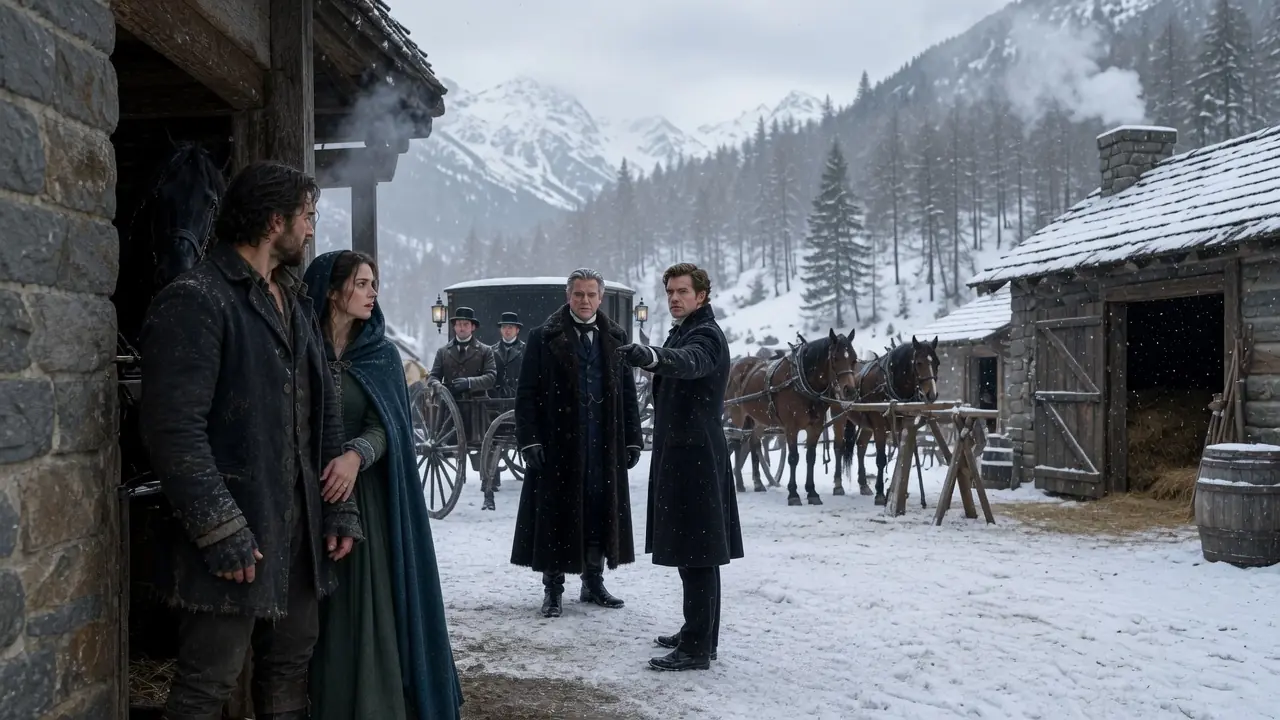
Now the great house was mostly silent. Silent except for the voices in her father's study. Rosamond stood outside the door with her hand pressed against the cold wall, her breath held so tightly it hurt. She had not meant to listen. Or perhaps she had.
Since her father's death six months earlier, nothing in Whitmore Hall happened honestly anymore. Every conversation ended when she entered a room. Every letter disappeared into her brother's locked drawer. Every creditor who came to the door was turned away by servants who no longer received wages on time. The house still looked grand from the road.
Its towers rose proudly against the hills. Its windows glittered. Its ancient name still carried weight among families who cared more for bloodlines than bank accounts. But inside, everything was rotting. The carpets were worn thin.
Fires were lit only in rooms guests might see. Half the staff had been dismissed. The silver had gone missing piece by piece, explained away as polishing or storage. Her mother's portrait still hung above the staircase in pearls and silk, staring down at an estate that could no longer afford candles for every room. Then Rosamond heard her brother laugh.
Edgar Whitmore, newly Lord Whitmore, had never laughed warmly in his life. His amusement was a sharp thing, usually born from another person's discomfort. "She is still beautiful enough to fetch a favorable bargain," he said. Rosamond went still. Inside the study, another man murmured something too low for her to catch.
The voice was older, smooth, and unpleasantly patient. Lord Edmund Blackmar. She had seen him only once, from across a drawing room in Inverness. He was nearly twice her age, broad in the shoulders, rich beyond measure, and rumored to have buried two wives with astonishing convenience. Men praised his fortune.
Women lowered their voices when they spoke of him. Servants avoided his eyes. Edgar continued, "My sister has been raised properly. She will not create difficulty once the contract is signed." The older man gave a quiet chuckle. "Most women resist until they understand resistance changes nothing." Rosamond's fingers curled against the wall.
She was 23 years old, which society had begun treating as a kind of expiration. For years, she had been praised for her manners, her complexion, her gentleness, her obedience. All the pretty qualities a woman was taught to cultivate until men decided what price they deserved. Her father, for all his faults, had loved her. He had been careless with money, foolish with investments, and far too proud to admit decline, but he had never spoken of her as merchandise.
Edgar did. Edgar had inherited the title, the estate, the debts, and apparently her future. Blackmar's voice came again. "And she understands the wedding will be soon?" "She will understand tomorrow," Edgar replied. "Once she sees the alternative." "What alternative?" "The street." Silence followed.
Rosamond stepped backward before either man could open the door and find her there. She moved down the corridor without sound, her heart beating so hard it seemed to shake her ribs. She reached her bedchamber, closed the door, and stood in the dark. Tomorrow. Lord Blackmar would come tomorrow.
Her life, apparently, had already been sold. She crossed to the mirror above her dressing table. A pale woman stared back, dark hair loosened from its pins, eyes wide with shock. She looked like the kind of lady who had been trained to survive by being agreeable. That woman would not survive Lord Blackmar.
Rosamond sat slowly at the edge of the bed. Running away would not work. A lady alone with no money, no protection, and no destination would be found quickly. Refusing would only give Edgar reason to lock her away until she became sensible. Begging would amuse him.
She did not need a husband society approved of. She needed the opposite. Someone so unsuitable, so humiliating, so impossible that Edgar would have no choice but to cast her out. Not a merchant. Edgar might recover from that.
Not a farmer. He might twist the story into rustic romance. No. Someone beneath every expectation. Someone her brother could never introduce, never explain, never use.
A beggar. A homeless man. The idea should have horrified her. Instead, for the first time in months, Rosamond felt air return to her lungs. If society wanted obedience, she would become impossible to control.
Before dawn, she packed almost nothing. A small purse with a few coins. Her mother's plain silver cross. A cloak lined with faded blue wool. One folded dress.
She took no jewels. They would only make her recognizable. The house was asleep when she left. Snow had begun to fall, silent and steady, softening the world into ghostly shapes. The courtyard stones were slick beneath her boots.
The stable boy was nowhere to be seen, and perhaps that was mercy. Rosamond saddled the gentlest mare herself with clumsy, shaking hands. She had ridden often enough for pleasure, but never as a fugitive. Every buckle seemed louder than thunder. Every breath of the horse felt like betrayal.
When she looked back at Whitmore Hall, its black windows stared down at her. For a moment, she almost turned around. Then she heard Edgar's voice again in memory. She is still beautiful enough to fetch a favorable bargain. Rosamond mounted and rode into the snow.
By the time she reached the outskirts of Inverness, morning had turned gray and savage. The snow fell harder now, blown sideways by a wind that cut through her cloak. Her fingers were numb. Her cheeks burned. Twice, the mare stumbled on the frozen road, and each time Rosamond whispered apologies into the animal's mane.
She had imagined courage would feel grand. It did not. It felt like terror with no place to sit down. She passed shuttered cottages, bare trees, and stone walls half buried in white. The world seemed empty of people.
Even the town, when she reached it, was strangely quiet beneath the storm. Shop signs creaked. Smoke curled from chimneys. A dog barked once and vanished behind a gate. Rosamond dismounted near the old chapel at the edge of town because her legs had begun to tremble too badly to trust.
The chapel had been abandoned for years, its roof broken in one corner, its arched entryway dark against the snow. She led the mare toward it, hoping only for shelter and a moment to think. Then she saw him. A man sat beneath the stone arch as though he had been carved there by the weather. His coat was dark, patched, and stiff with frost.
Snow clung to his shoulders and tangled in the thick, untamed fall of his hair. His beard hid much of his face, but not the sharp line of his cheekbones or the weary intelligence in his eyes. He looked exhausted. Not weak. Never that.
There was something dangerous in his stillness, like a sword forgotten under old cloth. Rosamond stopped. The man looked up. His eyes were a startling gray-blue, cold as winter sea. They moved over her quickly, the fine cloak, the shivering hands, the mare behind her, the desperation she could not hide.
"You should not be out alone," he said. His voice surprised her. Rough, yes, but educated. Low and controlled. Not the voice of a man without thought or breeding.
Rosamond swallowed. "Neither should you." One corner of his mouth moved, though it was not quite a smile. "I am accustomed to it." A black horse stood deeper beneath the broken arch, half shadowed, stamping its hoof against the frozen ground. It was too strong, too well-kept, too finely built for a man who owned nothing. Rosamond noticed.
The man noticed her noticing. For several seconds, neither spoke. This was madness. Complete madness. She should apologize, remount, and ride somewhere else.
Anywhere else. She had no idea who he was. No idea whether he was kind or cruel. No idea whether the danger behind her was worse than the danger before her. But Lord Blackmar was coming tomorrow.
And by tomorrow, she needed to belong to someone else. Rosamond took one step forward. Then another. Her voice, when it came, was thin but clear. "Would you consider marrying me?" The man stared at her.
Snow moved between them in pale, restless threads. At last, he said, "I beg your pardon." Rosamond's face burned despite the cold. "Marriage? I am asking whether you would consider it." His gaze sharpened. "Have you mistaken me for someone else?" "No." "Then have you struck your head?" "Not that I am aware." He rose slowly.
He was taller than she had expected. Broad-shouldered beneath the worn coat. His clothes were rough, but his posture was not. He stood like a man who had once been obeyed, or like one who had survived being hunted. Rosamond's courage wavered.
The man looked past her toward the road. "Who is chasing you?" "No one. Not yet." "That is not reassuring." "I need a husband," she said. "Immediately." "You need shelter and sense." "I have had too much shelter and too little freedom." His expression changed at that. Only slightly, but she saw it.
"What is your name?" he asked. "Lady Rosamond Whitmore." Recognition did not cross his face. Or if it did, he buried it well. "And yours?" she asked. A pause.
"Callum." "Callum what?" "Just Callum will do." Rosamond should have pushed for more. A proper surname. A history. Some assurance that she was not placing herself into worse peril. Instead, she looked at his frost-reddened hands and tired eyes and thought he seemed like a man who had been abandoned by the world long enough not to care for its rules.
That made him perfect. "I can pay you," she said quickly. "Not a fortune, but enough to help you leave this place, perhaps. Enough to make the arrangement worthwhile." His face hardened. "I am not for hire." Shame struck her.
"That is not what I meant." "It is exactly what you meant. You looked at me and saw a man low enough to serve your purpose." Rosamond flinched. The words were cruel because they were true. She lifted her chin, though her eyes stung. "Yes. At first. And I am sorry. But I am desperate. Desperate people make poor bargains." "So do frightened women with obedient manners." Callum said nothing.
The wind howled through the broken chapel stones. Rosamond forced herself to continue. "My brother has arranged my marriage to Lord Blackmar. He is wealthy, powerful, and cruel enough that no one will stop him. If I refuse, I will be locked away until I surrender. If I run, I will be dragged back. But if I am already married, especially to someone my family considers unforgivable, then I become useless to them." Callum watched her carefully.
"And you decided the answer was me." "I decided the answer was ruin." Something flickered in his eyes. Pain, perhaps. Or recognition. "You speak of ruin as though it is a door," he said. "It is more often a pit." "Then let me fall into one of my own choosing." His jaw tightened.
"Cold feels very different when it belongs to you, Lady Rosamond. Hunger, too. Loneliness. Being turned away at doors. Being looked through by people who once bowed. Do not mistake hardship for romance." "I do not." "You do. All gently bred people do until the first night without a fire." Rosamond stepped closer, anger warming her at last.
"And what would you have me do? Return home? Smile while my brother sells me? Thank Lord Blackmar for purchasing me before I grew too old to interest him?" Callum's expression darkened. She saw then that he believed her.
Not because her story shocked him, but because it did not. "My life in that house is already cold," she said quietly. "It is already lonely. The only difference is that everyone calls it respectable." For a long moment, he said nothing. Then he looked down at the snow gathering around his boots.
When he spoke again, his voice had lost its edge. "I have no estate to offer you." "I am not asking for one." "No grand house." "I am leaving one." "No servants." "I can learn." "No future that would make a lady comfortable." "Comfort is not the same as safety." His eyes returned to hers. She held his gaze. "Poverty frightens me less than captivity," she said. The words seemed to land somewhere deep in him.
The man called Callum looked away first. Behind them, the black horse shifted and snorted softly. The old chapel groaned in the wind. Snow settled on Rosamond's lashes, melting into tears she refused to shed. At last, Callum said, "If we do this, we do it properly." Rosamond blinked.
"You agree?" "I agree that you are desperate enough to do something worse if I refuse." "That is not a flattering reason." "It is an honest one." "Honest." The word felt strangely precious. Callum continued, "A lawful marriage. Witnesses. A priest. No tricks. No lies about what is being done. You understand that once spoken, vows are not a cloak you may put on and remove when the weather changes." "I understand." "No," he said softly.
"You do not. But perhaps neither do I." She studied him. "Why would you help me?" He looked toward the ruined altar inside the chapel, where snow had drifted over cracked stone. "Because I know something of cages," he said.
The wedding took place before sunset. It should have been impossible to arrange so quickly, but small towns knew how to move when scandal, pity, and weather pressed together. The priest was old and half-deaf, with hands that trembled as he opened his book. The innkeeper's wife agreed to serve as witness after wrapping Rosamond in dry wool and giving Callum a long, unreadable look. A stable boy stood near the door, solemn with importance.
The church was small, colder inside than out, and smelled faintly of damp stone and old smoke. Rosamond wore her own dress, though the hem was stained from snow. Her hair had loosened around her face. Her hands would not stop shaking. Callum stood beside her in the same worn coat, though he had brushed the snow from his shoulders and tied back his hair.
In the candlelight, he looked less like a beggar and more like a man pretending to be one. That thought unsettled her. But the priest had begun. Words filled the narrow space. Duty.
Honor. Faithfulness. Husband. Wife. Rosamond repeated what she was told to repeat.
Her voice did not break. When Callum took her hand, his palm was rough and warm. He did not squeeze too tightly. He did not look triumphant. He looked grave, almost sorrowful, as if he understood vows better than she did.
When the priest declared them married, Rosamond expected panic. Instead, she felt a strange, impossible calm. Lord Blackmar could not have her now. Edgar could rage. Society could whisper.
Doors could close. But the trap prepared for her had failed.
Outside the church, the snow had eased. Evening lay blue across Inverness. Rosamond borrowed ink and paper from the priest and wrote to her brother with steady hands. "Edgar, by the time this reaches you, I will already be married. Do not send for me. Do not attempt to bargain. I have chosen a husband without your permission, as you chose a future for me without mine. Your sister, Rosamond." She folded the letter before emotion could ruin it. Callum watched from the doorway. "You are certain?" he asked. "No," she said. "But I am married." His mouth softened at that. A practical distinction. The innkeeper's wife sent them away with bread, cheese, and a look toward Callum that Rosamond could not interpret. It was not pity. Not exactly. Respect? Surely not. A man outside the inn touched his cap when Callum passed. Another lowered his eyes. An older woman carrying a basket froze halfway across the street, then turned abruptly into an alley. Rosamond noticed. Callum pretended not to. "Do they know you?" she asked. "I have passed through before." "They look at you strangely." "Most people look strangely at a man who marries a lady before supper." That was reasonable enough. Almost.
They rode north as twilight deepened, Callum leading both horses along a narrow road between rising hills. The cold sharpened again. Rosamond's body ached from fear, travel, and the strange finality of the ring now resting on her finger. It was not gold. Callum had acquired it from somewhere, a plain silver band, slightly too large.
He had apologized for that. Rosamond had told him it did not matter. And oddly, it did not.
The cabin appeared after dark, tucked against a slope where pine trees bent beneath snow. It was small, made of stone and timber with smoke stains above the chimney and a roof that looked as though it had argued with several winters and only narrowly survived. Callum opened the door and stepped aside. Rosamond entered her new life. The room was plain but not filthy.
A hearth, a wooden table, two chairs, shelves with tin cups and a few books, a narrow bed against one wall, tools stacked near the door, a bearskin rug worn thin by age. No portraits, no chandeliers, no servants waiting to judge. Callum set down the bundle of food. "You may take the bed." Rosamond turned. "And you?" "The floor is familiar." "We are married." "That does not require you to surrender comfort on the first night." The gentleness of it nearly undid her.
She looked away. "Thank you." "Do not thank me yet." "Why?" He moved to the hearth and began building a fire with practiced hands. Sparks caught, flickered, and slowly became flame. In the glow, the rough edges of him softened, but the shadows in his face remained. "There are things about me," he said, "you may someday regret learning." Rosamond stood in the middle of the cabin wearing a borrowed cloak, a stranger's ring, and a name she had chosen in panic.
Outside, the Highlands vanished beneath snow. Inside, the man she had married would not meet her eyes. "What things?" she asked. Callum fed another piece of wood to the fire. "Not tonight," he said.
And for the first time since leaving Whitmore Hall, Rosamond wondered whether she had escaped one mystery only to marry another.
Morning came pale and uncertain over the Highlands. Rosamond woke to the sound of wind scraping against the cabin walls and the faint crackle of embers in the hearth. For several moments, she did not remember where she was. Her hand moved across unfamiliar blankets. Her eyes opened to timber beams, stone walls, a single small window glazed with frost.
Then memory returned. Whitmore Hall. Lord Blackmar. The chapel. The vows.
Callum. Her husband. The word sent a strange tremor through her chest. He was not in the room. The pallet near the fire had been folded neatly, though she doubted he had slept much.
His coat was gone from its peg. Through the little window, she saw him outside with an axe in hand splitting wood beside the shed. Snow clung to his dark hair. His sleeves were rolled despite the cold, revealing strong forearms marked with old scars. He moved with the rhythm of a man accustomed to work, yet there was nothing clumsy or common in him.
Even chopping wood, he carried himself with a quiet authority that did not belong to poverty. Rosamond watched him longer than she intended. When he glanced toward the window, she stepped back too quickly, embarrassed by being caught. By noon, she had ruined porridge, burned her fingers on the kettle, and dropped a tin cup loudly enough to make Callum turn from the door as if expecting danger. "I am not especially useful," she admitted.
"No one is born knowing how to keep a fire alive," he said. "I suspect many people are." "I was," he replied, and something like amusement touched his eyes, "but not ladies raised in halls with footmen." She expected the words to sting. They did not. He had said them without contempt.
The first days of their marriage settled into a rhythm both awkward and strangely peaceful. Callum rose before dawn. Rosamond learned the cabin slowly as one learns a new language. She learned which floorboard creaked, which pot heated fastest, how to stack wood near the hearth without smoking the room, and how quickly Highland weather could turn from silver to savage. Callum never demanded anything of her.
That, more than anything, unsettled her. Her brother had expected obedience. Blackmar would have expected gratitude. Society had expected silence. Callum expected only that she not freeze.
At night, they sat across from each other by the fire. Sometimes they spoke. More often they did not. Yet the silence between them lacked the sharpness of Whitmore Hall. It was not punishment.
It was space. Still, mysteries gathered around him like snowdrifts. The first came 3 days after the wedding when they walked to the village for flour and lamp oil. The innkeeper, a round-faced man with clever eyes, greeted Rosamond politely, then looked at Callum and went very still. "No charge," he said after packing their goods.
Callum's jaw tightened. "I pay my debts." "Aye," the innkeeper said carefully. "But not today." Rosamond looked between them. "Why would there be no charge?" The innkeeper lowered his eyes. "A kindness for newlyweds, my lady." Callum placed coins on the counter anyway.
The innkeeper did not touch them until they were nearly out the door. Outside, Rosamond asked, "Does everyone here behave so strangely?" "Highlanders are strange folk." "You are avoiding my question." "I am answering it poorly." She almost smiled despite herself.
The second mystery came the following week. A man in a fine dark coat arrived at the cabin on horseback. Rosamond saw him through the window and stiffened, afraid Edgar had sent someone. Callum opened the door before the visitor could knock. The stranger removed his hat at once.
"Your Grace—" Callum stepped outside and shut the door behind him. Rosamond stood frozen. Your Grace. She knew the form of address. Every aristocratic woman did.
No one called a homeless man Your Grace. Their voices outside were low but tense. When Callum returned, he carried a sealed letter. The wax was deep red, stamped with a crest Rosamond did not recognize, a raven beneath a crown. "What was that?" she asked.
"Old business." "What kind of old business calls you Your Grace?" His face closed. "The mistaken kind." "Callum." "Not tonight."
The same words again. But this time, they were heavier.
That night, he dreamed. Rosamond woke to the sound of him gasping beside the fire. Not loudly. Not dramatically. It was worse than that.
It was the sound of a man trying not to break even in sleep. She sat up. "Callum." He jerked awake, one hand reaching for something that was not there. For a moment, he did not seem to know her.
Then recognition returned, and shame followed. "Forgive me," he said hoarsely. "There is nothing to forgive." He turned away, breathing hard. Rosamond watched the firelight move across his face. Whatever he hid, it was not merely money or rank.
It was pain, folded carefully and carried until it had become part of him.
The next morning, she found the newspaper clipping. It was tucked inside one of the books on the shelf, brittle and yellowed at the edges. She had only meant to move the volume while dusting. The paper slipped free and landed at her feet. The headline struck her first.
Mysterious Duke of Raven's Hollow still missing after 3 years. Below it was a printed sketch of a younger man, clean-shaven and severe, with the same sharp cheekbones. The same eyes. Callum's eyes. Rosamond's hands went cold.
She read quickly. Callum Sinclair, Duke of Raven's Hollow. Last seen near Inverness after withdrawing from society following broken engagement and family scandal. Estates unmanaged. Tenants uncertain.
Rumors continued regarding his disappearance. The room tilted. The door opened. Callum stepped inside carrying wood and stopped when he saw the paper in her hand. Neither of them spoke.
The silence stretched until the fire popped sharply in the hearth. Rosamond lifted the clipping. "Tell me this is not you." Callum set down the wood slowly. "I cannot." Her breath shook. "You said your name was Callum." "It is." "You let me think you were homeless." "I was living as one." "That is not the same." "No," he said quietly.
"It is not." She stared at him trying to reconcile the man before her with the story in her hand. The worn coat, the rough beard, the cabin, the refusal of payment, the bows, the sealed letters. "You are the Duke of Raven's Hollow." "Yes." The word fell between them like a stone. Rosamond laughed once, but there was no humor in it. "I married a beggar to escape a powerful man and somehow married one of the most powerful men in Scotland."
Callum flinched. She saw it and hated that she cared. "Why?" she demanded. "Why hide it?" He looked older suddenly. Tired in a way no sleep could cure.
"Because the title became a cage." Rosamond said nothing. He moved to the window, not close enough to crowd her. "My father died when I was 21. By dawn, men who had never cared whether I lived or died were calling me Your Grace and asking favors. Relatives appeared with smiles and empty hands. Lawyers brought ledgers. Politicians brought invitations. Women brought expectations." "And your fiancee?" His mouth tightened. "She brought ambition. When she realized I did not intend to become the sort of duke she wanted, she chose a man more useful." "I am sorry." "Do not be."
It was a clean wound compared to the others. He looked out at the hills. "My uncle tried to control the estate through me. My cousins counted rooms before I had chosen one to sleep in. Every dinner was a negotiation. Every kindness had a hook. I began to feel less like a man than an inheritance walking about in boots." Rosamond lowered the clipping slightly. "So you vanished." "Yes." "And let people believe what they liked." "Madness. Death. Shame. Murder. People enjoy embroidery when truth is plain." "Plain?" she repeated.
"There is nothing plain about pretending to be homeless beneath a chapel." His eyes met hers then. "No. There is not." Anger rose again, but beneath it was something more painful. Hurt. "You let me expose my desperation while you kept your power hidden." "I know." "You could have stopped Edgar with one letter." "Yes." "You could have told me I was safe." "No," Callum said, his voice roughening. "Because I did not know if safety was what you wanted from me or only escape." Rosamond stared at him. He took a breath. "I had been chosen for my name before. For my fortune. For the doors I could open. Beneath that arch, you looked at me and saw nothing worth wanting except freedom. It was the first honest bargain anyone had offered me in years." "That does not excuse lying." "No." He did not defend himself.
Somehow that made it harder to remain furious. "I needed to know," he said very quietly, "whether someone could choose me before the title." Rosamond's throat tightened. She thought of the chapel, of his warnings, of how he had refused to take advantage of her fear. She thought of his patience in the cabin, his silence, his restraint.
He had deceived her, yes. But he had never owned her. Still, pain won. "I need air," she said. She walked past him into the snow.
He did not follow.
For 2 days, Rosamond spoke to him only when necessary. Callum accepted it without complaint. He slept by the fire, chopped wood, cooked when she forgot, and never once used his rank like a weapon. That almost angered her more. It would have been easier if power had made him cruel.
On the third evening, he placed a document on the table. "What is this?" she asked. "A letter to a solicitor." Her heart lurched. "For what purpose?" "Annulment, if you wish it." The cabin went very still. Callum stood across from her, hands at his sides.
"You entered this marriage without knowing who I was. That was unfair. If you want freedom from it, I will not stop you." Rosamond looked at the paper. Freedom. The thing she had risked everything to obtain.
Yet now, offered freely, it felt strangely hollow. "You would let me go?" "Yes." "Even if it damages your name?" "My name has survived worse than gossip." "And me? Where would I go?" "Wherever you choose. I would settle enough money upon you to live independently." There it was. The impossible gift no one had ever offered her.
Choice. Rosamond looked up slowly. "You truly do not understand, do you?" Callum frowned. "Understand what?" "You are the first man in my life who has had power over me and chosen not to use it." His expression shifted. She stood, trembling slightly.
"My brother would sell me. Blackmar would possess me. Society would judge me. You deceived me, Callum, and I am angry. But even in deception, you gave me more respect than truth ever gave me at Whitmore Hall."
He looked as though the words hurt him.
Before he could answer, hoofbeats sounded outside. Not one horse. Several. Callum turned toward the door. A fist struck the wood.
"Rosamond!" Edgar's voice rang through the cabin. "Open this door at once." The past had found her. Callum opened the door before Rosamond could move. Edgar stood in the snow, wrapped in a costly coat, his face red with cold and fury. Behind him waited Lord Blackmar, grim and broad, with two servants and a carriage half buried in the lane.
Edgar's eyes swept over Callum's rough clothes with disgust. Then, with visible effort, his expression changed. "Dearest sister," he said. Rosamond nearly laughed. He had never called her that in his life.
"I have come to bring you home," Edgar continued. "There has been a misunderstanding." "No," Rosamond said. "There has not." Blackmar stepped forward, his gaze fixed on her. "The girl has been misled." Callum's voice was calm. "My wife is not a girl." Blackmar looked at him as one might look at mud on a boot.
"And you are?" For one suspended moment, Callum said nothing. Then the man who had hidden beneath rags seemed to vanish. He straightened. Not much. Only enough.
But the air changed. "I am Callum Sinclair," he said, "Duke of Raven's Hollow." Edgar went white. Blackmar froze. The servants behind them lowered their eyes at once. Rosamond watched, breath caught, as the full force of Callum's identity settled over the clearing.
He did not shout. He did not threaten. He did not need to. Power stood in him naturally now, cold and quiet as the mountains. Edgar recovered first.
"Your Grace. Had I known—" "That your sister had married a duke instead of a man you considered beneath her?" Edgar swallowed. "I only meant—" "You meant to sell her." Blackmar's face darkened. "Careful, Raven's Hollow." Callum turned his gaze on him. "Very." Rosamond stepped beside him.
She expected Callum to move in front of her, but he did not. He stood with her, not over her. That mattered. Edgar clasped his hands. "Rosamond, surely we can settle this as family. Whitmore Hall is in difficulty. With His Grace's guidance, all may be restored." "There it is," Rosamond said softly.
Edgar blinked. "What?" "The bargain. You found a higher price." His mouth tightened. "Do not be childish." Callum's voice cut through the snow. "Lady Rosamond belongs to no man's bargain." Silence followed.
Blackmar looked between them, measuring, then gave a cold smile. "Keep her, then. I have no use for wives who run." Rosamond's cheeks burned, but Callum's hand moved, not to grip her, not to claim her. Only to rest near hers, steady and available. She took it.
Blackmar saw. So did Edgar. Something in her brother's face cracked then. Not guilt. Calculation failing.
"You will regret this," Edgar said. Rosamond met his eyes. "No. I think I already finished regretting you." Edgar left with Blackmar before sunset. The carriage vanished into falling snow.
For a while, neither Rosamond nor Callum spoke. Then Callum withdrew his hand gently. "You handled him well." "So did you." His smile was faint. "I had rank on my side." "No," she said. "You had restraint." That struck him harder than praise should have.
Later, inside the cabin, Callum stood by the hearth with the annulment paper still on the table between them. "You should still consider it," he said. Rosamond's chest tightened. "Why?" "Because now you know everything. Because marriage to me means Raven's Hollow. Society. Duties. The very world you tried to escape." "And what does marriage to me mean for you?" His answer came quietly. "Hope, which is more frightening than duty." She looked at him then, truly looked. Not at the duke.
Not at the vanished nobleman. Not at the homeless stranger beneath the chapel. At Callum. The man who had warned her against hunger before accepting her hand. The man who had slept on a floor to keep a promise.
The man who had hidden from a title because the world had loved his power more than his heart. Rosamond picked up the annulment letter. Callum went still. Then she moved to the fire and placed it among the flames. Paper curled.
Ink blackened. The word freedom disappeared first. Callum stared at the burning page. "Rosamond." "I did not fall in love with a duke," she said. His eyes lifted to hers.
Her voice softened. "I fell in love with the man beneath the snow." For a moment, he looked almost broken by tenderness. Then he crossed the room slowly, giving her every chance to step away. She did not. When he touched her face, his hand trembled.
It was the first time she had seen him uncertain. "Are you choosing me?" he asked. "Yes," she whispered. "Properly this time." He bowed his head and kissed her. It was gentle, careful, and full of all the words neither of them had known how to say.
Outside, the storm moved across the mountains. Inside, the cabin no longer felt like hiding. It felt like beginning.
Spring came late to Raven's Hollow, but it came. The estate stood three valleys north, vast and dark against the cliffs, with towers sharp as old memories. Rosamond first saw it beneath a sky washed clean after rain. It should have intimidated her. Perhaps it would have once.
But Callum rode beside her, not ahead. The servants gathered in the great hall when they arrived. Some wept at the sight of their duke returned. Others stared openly at Rosamond, the lady who had married him while believing him poor. Callum took her hand before them all.
"This is Her Grace, the Duchess of Raven's Hollow," he said. "You will honor her as you honor me." Rosamond squeezed his hand. Then she smiled at the housekeeper and said, "First, perhaps we might open the curtains." And so they did. Room by room, Raven's Hollow woke. Dust sheets were pulled from furniture.
Fires were lit in unused hearths. Tenants came with questions and left with answers. Callum returned to ledgers he had once despised, but now Rosamond sat beside him, reminding him that duty need not be a prison if shared. She changed the house in small ways first. Fresh bread in the kitchens.
Music in the drawing room. Blankets delivered before winter, not after. No servant dismissed without cause. No tenant ignored because his coat was patched. Callum watched her turn his cold inheritance into a home, and sometimes wondered aloud how he had ever mistaken disappearance for peace.
Rosamond would answer, "You were waiting beneath a chapel for someone foolish enough to propose." "And you were foolish enough." "Desperate enough." "Brave enough," he would correct.
Whitmore Hall did not recover. Edgar wrote twice, then stopped when no money came. Lord Blackmar married elsewhere, to the relief of every woman who had once feared his attention.
And across the Highlands, the story grew, as stories always do. Some said Lady Rosamond had found a beggar in a blizzard and made him a lord. Others said the Duke of Raven's Hollow had disguised himself to test the hearts of women. The truth was stranger and quieter. A frightened lady had chosen ruin and found freedom.
A broken Duke had chosen hiding and found home. And people across the Highlands would someday tell an impossible story of the lady who married a homeless man and accidentally found the duke who had vanished from the world.