In the West Wing of East Cross Park, Arthur Bowthorpe, the sixth Duke of Fenwood, stood before a map of his lands. It was a document of breathtaking detail, drawn a century ago. The ink faded to the color of old tea. Yet his focus was not on the familiar contours of his own estate, but on the line that marked its border with the neighboring property, Larklea.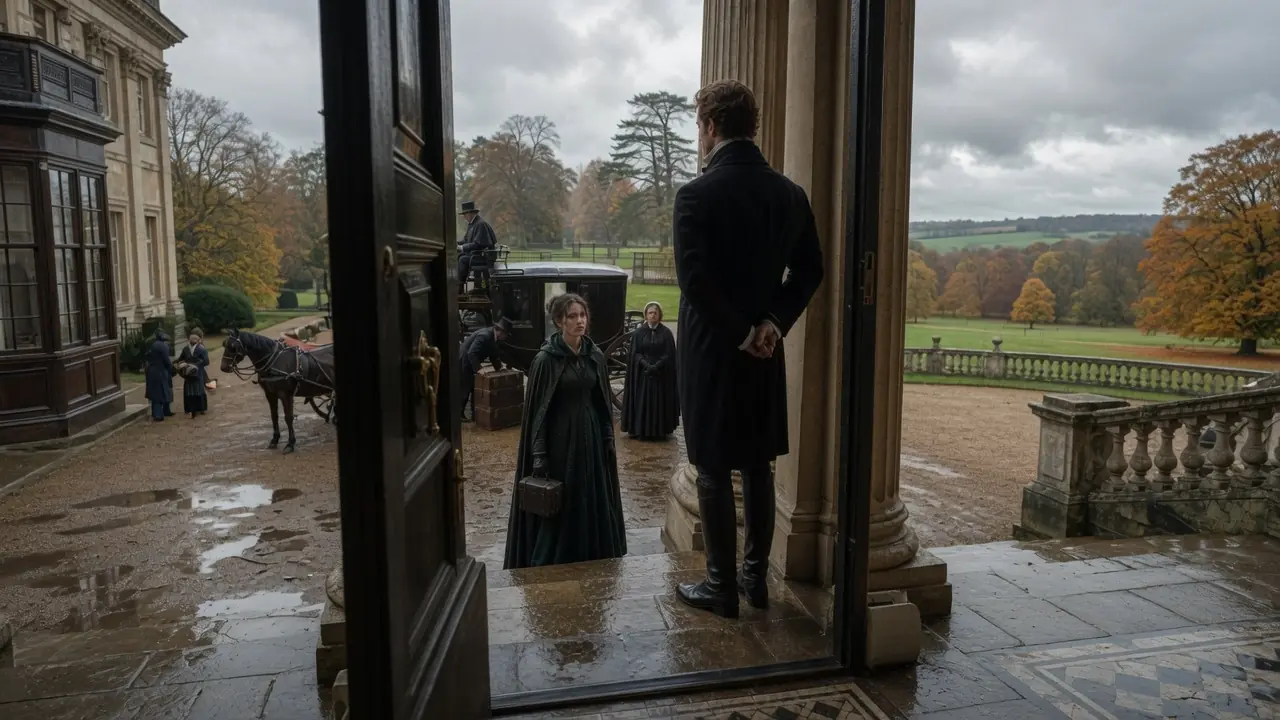
A line that for three generations had been a source of quiet, intractable dispute. His steward, Mr. Davies, a man as weathered as the park's ancient oaks, stood a respectful distance behind him. "Another letter from Mr. Pym, Your Grace. On behalf of the Wickley estate."
Arthur did not turn. His gaze remained on the map, where a small, architecturally distinct wing of the Larklea Manor House was shaded in a way that suggested ambiguity. The Penhaligon Wing. "And what does Mr. Pym say for Miss Wickley this time?"
"He reiterates her position, Your Grace: that the Penhaligon collection is, and has always been, part of the Wickley entail, and that any suggestion otherwise is an affront to her late father's memory." "My grandfather and father would have argued the point," Arthur said, his voice devoid of heat.
It was a statement of fact, not of temper. "The collection was collateral for a debt never repaid. The letters between my great-grandfather and hers are quite clear on the matter." Mr. Pym makes mention of a subsequent agreement for which he claims the documentation is lost. "That nullified the debt," Davies reported, his own tone neutral. He had been reporting on this dispute his entire working life.
Arthur finally turned from the map. His face was composed. His slate-blue eyes held a familiar expression of controlled patience. At 34, he had inherited the dukedom, the estate, and the quarrel all at once.
He treated them all with the same methodical seriousness. "The documentation is lost because it never existed. The Wickleys have pride; I understand that. But they do not have the right to my family's property." He moved towards his desk. "Draft a reply. We will not press the matter with undue aggression, but we will not yield. The claim stands." "Very good, Your Grace." Davies withdrew, leaving the Duke alone in the quiet of the library.
Arthur looked back at the map. He had never met the new Miss Wickley, who had inherited upon her father's death some months ago. He pictured a woman much like her father. Stubborn, proud, and clinging to a version of history that suited her family's narrative.
The dispute was not a matter of anger for him. It was a matter of order. A line on a map, a debt on a ledger, a principle to be upheld. He would be correct, and he would be patient.
And in the end, the matter would be resolved as it ought to be. Twenty miles away, in the morning room of Larklea Manor, Edith Wickley held a nearly identical letter from the same Mr. Pym in her hands. The paper was crisp, the solicitor's hand elegant, but the words were a familiar irritation. "The Duke of Fenwood remains firm in his ancestral claim." Her companion, a woman of her late mother's generation, named Mrs. Gable, watched her with sharp, knowing eyes.
"The new Duke is as stubborn as the old one, it seems." Edith placed the letter on the table beside a small, practical sewing basket. At 27, she had an air of quiet capability that had been hard won. She was not beautiful in the fashionable sense.
Her features were too serious. Her dark hair too plainly styled. But her eyes were intelligent, and her hands, though slender, looked as if they knew their way around more than just embroidery. "He is mistaken," Edith said, her voice calm.
My father was clear on the matter. The debt was forgiven. The Penhaligon Wing and the books within it are as much a part of Larklea as the roof over our heads. "A roof which is currently leaking in the West Gallery," Mrs. Gable noted, with the pragmatism of a long-serving friend.
Edith gave a small, weary sigh. I know. Mr. Henderson says the lead flashing has failed entirely. It is a major repair.
The truth was, Larklea was a drain. Her father had been a scholar, not a businessman, and the estate had suffered for it. Rents were low, tenants were struggling after a poor harvest, and the house itself was slowly succumbing to genteel decay. The Duke of Fenwood's persistent claim on the Penhaligon collection, the most valuable single asset she possessed, was more than an irritation.
It was a threat. "The Bowthorpes have always wanted what isn't theirs," Mrs. Gable said, echoing a sentiment Edith had heard her entire life. They have East Cross, one of the finest parks in the county. Is that not enough for them?
Edith looked out of the window, across the sloping lawns towards the dense woods that marked the boundary. She had never set foot on East Cross land, nor had the Duke of Fenwood, to her knowledge, ever set foot on hers. They were neighbors in geography only. In every other sense, they were opposing states.
Their relations conducted by paid emissaries like Mr. Pym. "It is a matter of pride for him, I suppose," Edith said, more to herself than to her companion. As it is for me. She picked up the letter again.
I will not have him think I am so easily cowed. I am my father's daughter. Larklea is my responsibility. He will find me no less firm than those who came before me.
She would write to Mr. Pym. She would instruct him to hold the line. The Duke of Fenwood, this stranger with his ancient title, and his baseless claims, would learn that the new mistress of Larklea was not a woman to be trifled with. The house, the land, and the quarrel were hers now, and she would not surrender an inch of any of them.
The autumn rains began that evening, a soft drumming on the window panes that by midnight had become a furious onslaught. All through the night the wind howled around the old stones of Larklea Manor, a mournful, angry sound. Edith lay awake listening to the groaning of timbers and the unsettling rattle of a loose slate somewhere above her. The house felt vulnerable, its age a weakness against the storm's assault.
The sound that finally brought her from her bed was not the wind, but a deep, rending crack followed by a rumbling cascade that seemed to shake the very foundations of the building. It came from the west, from the oldest part of the house, from the gallery. She was already pulling on a dressing gown when Mrs. Gable appeared at her door, a candle held aloft in a trembling hand, her face pale. "Edith, my dear, you must come. But be careful. Something has happened." The scene in the west gallery was one of devastation.
A huge section of the ceiling had collapsed, bringing down plaster, laths and a deluge of rainwater. Ancient beams, slick with damp, sagged ominously. The floor was a treacherous landscape of debris and spreading pools of dark water. The smell of wet plaster and old rot filled the air.
Her steward, Henderson, was already there, his face grim in the flickering candlelight. "The main truss has given way, Miss Wickley. The whole wing is unstable. We were lucky it happened at night. If anyone had been in here..." He did not need to finish. Edith looked at the wreckage, her heart sinking. This was not a simple leak.
The collapse is in the gallery adjoining it, miss. But the wall is compromised. It's not safe. None of it is.
For a long moment, she could only stare. The cost of it was unthinkable. It was more than the estate could possibly bear. Larklea was not just her home.
It was her burden, her duty, and it was crumbling around her. They spent the next day in a state of managed crisis. Buckets were placed, furniture was moved, and tarpaulins were dragged over what could be saved. By late afternoon, Anderson delivered his considered verdict.
It was worse than he had feared. Not only was the entire west wing uninhabitable, but the main part of the house had also suffered structural damage. The kitchens were flooded, and a chimney stack was threatening to collapse. It is not safe to remain here, Miss Wickley.
He said, his voice heavy with the weight of the pronouncement. Not for you, not for any of the staff. We must evacuate the house until it can be properly surveyed and secured. Evacuate?
The word seemed alien. Where would they go? The dower house was let. The vicarage was small.
She had no other property. The faces of her household staff looked towards her, waiting, trusting. She was their mistress, their provider, and she had nowhere to take them. It was Mrs. Gable who spoke the name.
Her voice hesitant, as if the word itself were a transgression. "There is East Cross." Edith's head snapped up. "Absolutely not."
"My dear, be reasonable," Mrs. Gable urged, her tone gentle but firm. "It is the only great house for miles. The Duke of Fenwood is your neighbor. It is a matter of county obligation. In a crisis of this nature—a fire, a flood—it is what is done. You cannot refuse." "I would rather sleep in the stables," Edith said, the words sharp with a pride that felt like all she had left. To be a supplicant to that man, to the Duke who was actively trying to strip her of her most precious inheritance. The humiliation was more than she could bear.
"And the staff?" Mrs. Gable asked quietly. Mrs. Davis, who is 60 years old, young Mary, the kitchen maid. Will they sleep in the stables, too? The question landed with the force of a physical blow.
Edith looked away, her jaw tight. Her pride was a luxury. Their safety was a necessity. The duty she owed to her people was greater than the enmity she felt for the Duke of Fenwood.
The rules of society, the obligations of her class, were a cage, but sometimes they were also a tool. He could not refuse. And she, it seemed, could not afford not to ask. The letter was the most difficult she had ever had to compose.
It was formal, devoid of emotion, a simple statement of fact. Larkly Manor had sustained significant damage in the storm. It was temporarily uninhabitable. She requested the courtesy of shelter for herself and her household until other arrangements could be made.
She signed it E. Wickley, sealed it with her father's ring, and sent a groom on the most reliable horse they had riding into the gathering dusk towards the enemy camp. She waited for the reply, her stomach knotted with apprehension and resentment. She expected a cold, correct acceptance.
She expected to be made to feel the full weight of his charity. The reply came within 2 hours. It was not a letter. It was the Duke of Fenwood's own carriage, empty, with his head coachman on the box, and a short, formal note delivered by his own footman.
Miss Wickley, it read in a strong, clear hand, "My house is at your disposal. I will expect you within the hour. The south wing has been prepared for you. Fenwood." There was no condescension, no flourish, just a simple, direct statement. An offer of sanctuary that, as Mrs. Gable had predicted, he could not refuse to make, and which she could no longer refuse to accept. As she gathered her few personal belongings, Edith felt a profound sense of dislocation. She was leaving her home, her fortress, to take up residence in the heart of enemy territory.
She was going to live under the roof of the man with whom she was, for all intents and purposes, at war. She did not know what to expect, but she armed herself with the only weapons she had left. Her dignity, her composure, and a cold, unyielding pride. The Duke of Fenwood would see no weakness.
He would see only the mistress of Larklea, temporarily displaced, but never defeated. The carriage ride to East Cross was short, a mere 20 minutes through winding lanes, and then, abruptly, through a set of magnificent gates bearing the Bowthorpe crest. The parkland that opened up before them was breathtaking, even in the fading light. Vast, ancient trees stood like sentinels on rolling hills.
A river, swollen with rain, gleamed like polished steel in the valley below. Larklea was a handsome estate, but this this was power made manifest in landscape. The house itself was a masterpiece of Palladian architecture, vast and symmetrical, its pale stone seeming to gather what little light was left in the sky. As the carriage crunched to a halt on the gravel drive, the great front doors swung open.
The Duke of Fenwood stood at the top of the steps. He was taller than she had imagined, and dressed in simple, severe black, the only white being the crisp line of his cravat. His hair was a dark, rich auburn, and his expression was entirely unreadable. He descended the steps as Edith was handed down from the carriage.
For a moment, they simply stood there. Two sovereigns meeting on a contested border. The wind whipped a strand of hair across Edith's face, and she impatiently pushed it back. "Miss Wickley," he said.
His voice was, as it had been in his note, low, formal, and without inflection. Welcome to East Cross. "Your Grace," she replied, her own voice steady, though her heart was beating a frantic rhythm against her ribs. Thank you for your generosity.
I trust we will not be a burden for long. It is no burden. It is a necessity. He gestured towards the open door.
My housekeeper, Mrs. Allen, will show you to your apartments. The south wing is entirely at your disposal. I trust you will find it comfortable. It was a dismissal.
A clear and precise delineation of territory. He was giving her a wing of his house, not the run of it. He was offering shelter, not friendship. The arrangement suited her perfectly.
"You are very kind," she said, the words feeling like ash in her mouth. He gave a slight, almost imperceptible nod. I have instructed my steward to offer Mr. Henderson whatever assistance he requires. If you need anything, you have only to ask Mrs. Allen.
And then he was gone, turning on his heel and disappearing back into the shadowy depths of his house without another word. He had not smiled. He had not offered his arm. He had performed his duty with the cold precision of a surgeon.
Edith watched him go, a strange mixture of relief and resentment warring within her. She had been received, provided for, and compartmentalized. She and her household were now residents of the South Wing, a self-contained unit within the vastness of East Cross. They were guests, but also prisoners of a strange, unspoken treaty.
The South Wing was, in fact, a complete house in miniature. A handsome drawing room, a smaller dining parlor, and a suite of bedrooms, all beautifully appointed, if a little impersonal. Mrs. Allen, a woman as formal and efficient as her master, showed them their rooms and explained the arrangements. Meals would be served in their own parlor.
Their staff would coordinate with hers. "The Duke," she explained, generally kept to the North Wing and the library. The central saloons were rarely used. The geography of the house was to be a mirror of the geography of their relations.
Two separate powers coexisting under one roof, with a vast, neutral territory in between. In the days that followed, this strange, stilted peace held. Edith saw the Duke only once, a fleeting glimpse of him walking across the lawn with his dogs. A tall, solitary figure against the gray sky.
He did not look towards the windows of the South Wing. It was as if she were not there. She spent her time in long, anxious conferences with Henderson, who brought daily reports of the disaster at Larklea. The news was never good.
The cost of the repairs would be ruinous. They pored over the estate accounts, searching for economies, for any source of revenue. The numbers swam before Edith's eyes, a relentless tide of debt and obligation. One afternoon, seeking a respite from the grim arithmetic, she found herself before the door to the East Cross library.
It was in the central part of the house, technically neutral ground. Hesitantly, she pushed it open. The room was magnificent, two stories high, lined from floor to ceiling with books. A fire crackled in the grate, and the air smelled of leather and beeswax.
And there, at a large table spread with papers, sat the Duke of Fenwood. He looked up as she entered, his expression betraying a flicker of surprise before settling back into its usual cool composure. Miss Wickley. Your Grace.
Forgive me for intruding. I... She faltered. I had hoped to find a book on on timber management.
He looked at her for a long moment, his slate blue eyes unnervingly direct. She felt a sudden foolish flush rise to her cheeks. She was an interloper, begging for scraps from his table, for knowledge from his library. "Of course," he said, his tone even.
He rose from his chair. "The section on estate matters is on the upper gallery, the third alcove on the left." He gestured towards the spiral staircase in the corner. "Thank you," she murmured, eager to escape his scrutiny. She climbed the narrow stairs, her hand trailing on the cool iron railing.
She felt his eyes on her as she went. From the gallery, she could see the papers on his table. They were not letters or novels. They were drainage plans, crop rotation schedules, detailed accounts.
She located the alcove he had indicated. The shelves were filled with practical, sober volumes. On the enclosure of common lands, a treatise on modern husbandry, the management of oak woodlands. She pulled out a volume on forestry.
As she opened it, she saw that the margins were filled with notes written in the same strong, clear hand as the letter she had received. They were not idle jottings. They were sharp, intelligent queries, calculations, cross-references to other texts. He had not just read these books.
He had studied them, argued with them. This method is inefficient. One note read. Compare with Loudon's figures for seasoning.
The cost of the sawpit is offset by the higher price for seasoned timber in 3 years, not five. She stood there for a long time reading his annotations. She had pictured him as a man of leisure, a duke concerned with titles and bloodlines. But these notes revealed a different man entirely.
A man who understood his land not just as a possession, but as a complex system, a responsibility. A man who worked. She heard a sound from below and looked down. A tenant farmer was being shown into the library by a footman.
The man was clearly agitated, twisting his hat in his hands. Your Grace, I'm sorry to be bursting in on you like this. "It's no matter, Giles," the Duke said, his voice calmer now, less formal. What is it?
It's the upper meadow, your grace. The one that borders Larklea. The old culvert is blocked again after the storm and the water's backing up. It'll ruin the grazing if we can't clear it. Edith froze. The upper meadow. The blocked culvert. She knew it well.
Her own tenant, John Carter, had complained of the same problem from his side of the boundary. The culvert ran under the ancient hedge that marked the border and was notoriously prone to silting up. Clearing it required access from both sides. It was a small, recurring problem that the two estates' stewards had always managed between them.
"Davies is away in York," the Duke said, thinking aloud. And Henderson has his hands full at the manor. He looked at the farmer, then up, his eyes meeting Edith's across the vast space of the library. It was a moment of pure, unexpected connection.
The great generational dispute over the Penhaligon collection seemed absurdly abstract. Here was a concrete problem, a field flooding, two tenants suffering, a single shared culvert that was their joint responsibility. My tenant, Mr. "Carter, has also reported the flooding," Edith said, her voice carrying clearly in the quiet room. Arthur looked back at the farmer.
Giles, tell Carter to meet you at the culvert tomorrow at dawn. Bring two men with shovels. I will be there. He then looked back up at Edith, a question in his eyes.
He did not ask it aloud. He did not need to. "I will be there as well," she said. For the first time since she had arrived at East Cross, the Duke of Fenwood almost smiled.
It was a bare flicker of an expression, a slight easing of the tension around his mouth, but it was there. And then it was gone. "Very good," he said. And he returned to his papers.
The next morning was cold and damp, the air thick with mist. Edith, dressed in a sturdy woolen gown and stout boots, walked from East Cross, a groom following at a respectful distance. As she approached the boundary hedge, she saw them. The Duke, already there, speaking with two farmers, Giles and Carter.
They were standing on opposite sides of the hedge, but they were talking like neighbors, not adversaries. The Duke wore no coat, despite the chill, only his shirt sleeves, which were already spattered with mud. He was holding a shovel. When he saw her, he gave a curt nod.
Miss Wickley. Your Grace. There was no awkwardness. There was only the problem, the blocked culvert.
For the next two hours, they worked. The Duke, alongside the two farmers, dug into the thick, clay-heavy mud, clearing the stones and debris that the storm had washed down. Edith, on her side of the hedge, directed her groom, pointing out the secondary blockage that was preventing the water from draining away, even once the main culvert was cleared. She watched the Duke.
He worked with a quiet, focused intensity. His movements efficient and strong. There was no sense that this was beneath him. He was simply a man solving a problem on his land.
He listened to the farmers, taking their advice on the flow of the water, treating them as experts. At one point, a large, deeply embedded rock refused to budge. After several minutes of fruitless effort, Arthur straightened up, breathing heavily. Edith, who had been observing from her side, spoke up.
There is a fissure on the underside. If you can get a lever into it from the east, it should shift. He looked at her, then at the rock. He nodded to Giles, who brought a long crowbar.
They positioned it as she had suggested. With a great heave, the rock groaned, shifted, and then broke free. A torrent of pent-up water surged through the cleared channel. The two farmers let out a satisfied cheer.
Carter touched his forelock to Edith. Thank you, miss. You've got your father's eye for it, you do. Giles grinned at the Duke.
And you've got your father's back for it, your grace. In that moment, standing in the damp meadow, surrounded by the smell of wet earth, Edith felt a strange sense of peace. The enmity between their houses felt distant, a story told by other people. Here, on the land, there was only the shared work, the shared satisfaction.
Arthur walked over to the hedge, wiping his muddy hands on a rag. My thanks, Miss Wickley. You saved us another hour's work. It is my land, too. She said simply. And my tenants' livelihood. Indeed. He looked at her.
And this time his gaze was different. It was not the cool assessing look of an adversary, but something else. Something approaching respect. You have a good understanding of drainage.
One learns what one must. She replied. An unaccustomed silence fell between them. Broken only by the gurgle of the cleared stream.
It was not the hostile silence of their first meeting, but a new, more thoughtful quiet. "I should return to the house," she said. Suddenly feeling the impropriety of being alone with him, unchaperoned in a muddy field.
Of course. He made no move to stop her. But as she turned to leave, he spoke again. Edith.
She stopped, her back to him. He had used her given name. The sound of it, in his low voice, was startlingly intimate. She turned back slowly.
"Arthur," she replied, testing the name on her own tongue. The almost smile returned. More definite this time.
The repairs at Larklea. Henderson's latest report is on my desk. I believe the surveyor has overestimated the cost of the timber required. She stared at him.
You have seen the surveyor's report? Henderson and Davies have been conferring. It seemed efficient. He seemed to be choosing his words with care.
My saw pits are at your disposal. We have a surplus of seasoned oak. It would be far more economical than buying it in. It was an offer of astonishing generosity.
An offer that would save her thousands of pounds. An offer that would put her deeply in his debt. And he was making it as if he were discussing the weather. I cannot accept such charity.
She stammered. Pride warring with the overwhelming relief the offer represented. "It is not charity," he said, his voice firm.
Larklea is my neighbor. A derelict house on my border is a blight on the landscape. And a danger to the community. It is in my own interest to see it repaired swiftly and properly.
I will sell you the timber at cost. A simple commercial transaction. He'd framed it in a way that preserved her dignity. A commercial transaction.
An act of self-interest. He was giving her a way to accept without submitting. He was, she realized with a jolt, being kind. Then, on those terms, She said. Her voice barely a whisper. I accept. And I thank you. It is nothing.
He said. And with a final nod he turned and strode away across the meadow. Leaving her standing by the boundary hedge. The sound of the running water filling the silence.
She watched him go. This proud, cold duke. And felt the foundations of her own certainty begin to shift. As surely as the rock in the stream.
The arrangement for the timber created a new kind of traffic between the two estates. Carts laden with seasoned oak from the East Cross saw pits rumbled up the drive to Larklea, and with them came a new level of interaction. Henderson and Davis were in constant conference. There were invoices to be checked, deliveries to be scheduled, and this new practical alliance necessitated more frequent meetings between the master of East Cross and the mistress of Larklea.
They met by unspoken agreement in the library. It had become their neutral ground, a place of maps and ledgers where the ghost of their formal dispute seemed less potent. Edith found herself looking forward to these meetings, to the quiet satisfaction of sitting opposite him at the great table, their heads bent over the same set of architectural plans. He was, she discovered, a man of formidable intelligence.
His understanding of construction, of finance, of law, was as deep and thorough as his understanding of agriculture. He never condescended to her, but spoke to her as an equal, listening to her opinions, and on more than one occasion deferring to her more intimate knowledge of Larklea's quirks. One evening, as they were finishing a discussion about the new roof trusses, he looked up from the plans. "The Penhaligon Collection," he said without preamble.
Edith's spine stiffened. The truce was over. Yes? The books will need to be moved while the work on the wing is underway.
It is not safe to leave them there. "I am aware," she said coolly. I intend to have them packed and stored in the cellars. The cellars at Larklea are damp, he stated.
It was not a criticism, just a fact. You will risk mildew and foxing. It would be a tragedy to see them damaged. He paused.
The muniment room at East Cross is dry and secure. It is empty, save for some old family papers. The collection would be safe there until your library is restored. She stared at him, speechless.
He was offering to house the very collection over which they were in dispute, to take it into his own fortress, where she would have no control over it. The audacity of it, the sheer breathtaking arrogance. Or was it trust? You wish me to move the contested property onto your land?
She asked, her voice laced with disbelief. "I wish to see it preserved," he corrected her, his gaze steady. The dispute is a matter of legal title. It has no bearing on the intrinsic value of the books themselves.
They are a treasure of the county, regardless of who holds the deed. Let us, for now, agree to be joint custodians of their safety. Joint custodians. The phrase hung in the air between them.
He was not trying to take the library. He was trying to save it. And he was trusting her to believe that. It was a risk, a gesture of faith that went far beyond the offer of timber.
And what of your claim? She asked, testing him. "My claim will be precisely as strong or as weak then as it is now," he said. And so will yours.
This is a practical matter and not a legal one. He leaned back in his chair. However, if you do not trust me, I will understand. The challenge was clear.
The entire fragile edifice of their new found respect rested on this moment. To refuse was to declare that she believed him capable of theft, of using this crisis to his advantage. To accept, to accept was to place her most valuable possession, the very symbol of her family's honor, into the hands of her enemy. She thought of the notes in his books, of his hands, muddy from clearing their shared stream, of the careful way he had framed his offer of timber to spare her pride.
He fought for what he believed was his, but he fought with honor. He was not a man who would steal books in the night. "Very well," she said, her voice quiet but firm. I accept your offer.
We will be joint custodians. A look of profound relief crossed his face, so swift she almost missed it. "Thank you," he said. The next days were a blur of activity.
Under Arthur's precise direction, a team of his estate workers, supervised by Edith, carefully packed the thousands of volumes of the Penhaligon collection. They worked together in the dusty, damaged wing, a strange partnership born of necessity. "Arthur," she noted, handled the books with a reverence that matched her own. He knew the collection, not just as a contested asset, but as a library.
He pointed out a rare first edition of Milton, a set of botanical illustrations he thought would particularly interest her. One afternoon, as they were carefully wrapping a heavy folio of antique maps, their hands brushed. It was the lightest of touches, skin against skin for a fraction of a second, but it sent a jolt through Edith that was as powerful as it was unexpected. She pulled her hand back as if burned.
She did not dare to look at him, but she could feel the sudden tension in the air, the way the comfortable silence had become charged with a new unspoken awareness. That evening, their solicitor, Mr. Pym, arrived. He had been summoned to draw up the formal agreement for the timber, and now a document acknowledging the temporary relocation of the library. He was a portly man with a smooth, reassuring manner that Edith was beginning to find unnerving.
He beamed at them as he was shown into the library. Your Grace, Miss Wickley, what a pleasure to see you both. And what a splendid example of neighborly cooperation in the face of adversity, a model for the entire county. "We are merely being practical, Pym," Arthur said, his tone dry.
Of course, of course, but it does my old heart good. He settled himself at the table, spreading his papers. Now, as to the matter of the collection, I have drawn up a simple receipt acknowledging that East Cross is holding the books on Larklea's behalf. It is without prejudice to either party's underlying claim, of course.
He slid the paper towards Edith. She read it. It was as he said. But as she reached for the pen, Mr. Pym spoke again, his tone conversational.
A shame though that this unfortunate business with the roof has weakened your position so, Miss Wickley. Edith looked up, frowning. I do not see how. My dear lady, Pym said with a sympathetic sigh.
You are now a guest in the Duke's home. You are accepting his assistance, his timber. It creates an appearance of dependency. In the eyes of the law such things can matter.
A Chancery judge might well see it as an implicit acknowledgement of his superior claim. A cold knot of anger formed in Edith's stomach. That is absurd. His Grace has offered assistance as a neighbor.
Nothing more. Of course, of course, Pym soothed. But you know how these things look. The Duke, you see, is concerned.
He mentioned to me only last week how delicate the situation was. How he worried you might feel beholden to him. Edith stared at the solicitor. Then slowly she turned her head to look at Arthur.
His face was a mask of cold fury. "Pym," the Duke said, his voice dangerously quiet. You will be silent. But the damage was done.
The solicitor's words, like a drop of poison, had tainted everything. Had Arthur's generosity been a strategy all along? A way to weaken her, to make her look like a poor relation, a dependent whose claims could be dismissed? The thought was physical pain, a betrayal that cut far deeper than their formal dispute.
All the nascent trust she had begun to feel curdled into suspicion and hurt. "Is this true?" she asked, her voice trembling slightly. Did you say this to him? No. Arthur said, his eyes locked on hers.
I did not. "But you thought it," she whispered, the accusation born of her own wounded pride. You offered me shelter. You offered me timber, all the while knowing it made my position weaker.
You used my misfortune against me. "That is not true," he said, rising from his chair. Pym is twisting my words. I expressed concern that you would feel uncomfortable, that the situation was difficult for you.
"A subtle distinction," she shot back, her hurt hardening into anger. She stood up, pushing the unsigned document away from her. The books will remain at Larklea. I will find a way to protect them myself.
I will not be your debtor, Your Grace, not in timber, and not in trust. She turned and walked towards the door, her back straight, her head held high. She did not look back. She could not bear to see the look of triumph she imagined must be on his face.
"Edith, wait," he called after her, but she did not stop. She fled the library, fled the central part of the house, and retreated to the cold sanctuary of the south wing. She'd been a fool, a naive, trusting fool. She had mistaken calculated strategy for kindness.
She had allowed herself to see a man who was not there. The war was not over. It had simply moved to a new, more treacherous battlefield. And she had just walked into his trap.
The days that followed were colder than any that had come before. The fragile truce was shattered. A wall of ice had descended between the south wing and the north. They communicated now only through their staff.
Brief, formal messages concerning the logistics of the ongoing repairs. The work on the Larklea roof continued with timber from the East Cross saw pits. But now every plank felt like a coin in an ever-increasing debt of humiliation. Edith avoided the library.
She took her meals alone in her parlor. Mrs. Gable's attempts at conversation falling into worried silence. She felt trapped. Not by the walls of East Cross, but by her own misjudgment.
The memory of her conversation with the Duke, poisoned by Mr. Pym's intervention, played over and over in her mind. Had he truly meant to deceive her? Or had she, in her pride and suspicion, wronged him? The uncertainty was a torment.
One afternoon, a message arrived from the vicar, Mr. Albright. A fever had broken out in the village. In the small cluster of cottages that lay half on Larklea land, half on East Cross land. Several families were ill, including the family of her own tenant, John Carter.
The doctor was overwhelmed. Help was needed. Without a second thought, Edith gathered a basket of soups and linens from the East Cross kitchens. A small act of appropriation she did not trouble to ask permission for, and set out for the village.
When she arrived at the Carter cottage, the scene was grim. John's wife, Mary, was desperately trying to tend to her two small children, both flushed with fever, while her husband lay shivering under a pile of blankets in the corner. Edith set to work immediately. Her personal turmoil forgotten in the face of real, immediate need.
She bathed the children's faces with cool water, forced spoonfuls of broth between their lips, and spoke to Mary in low, calming tones. She had been there for perhaps an hour when the cottage door opened, and the Duke of Fenwood walked in. He carried a large medical chest. He stopped short when he saw her, a look of profound surprise on his face.
For a moment, they simply stared at each other across the small, dim room, the air thick with the smell of sickness. "Miss Wickley," he said, his voice subdued. Your Grace. Any other time, the meeting would have been fraught with tension.
But here, in this small room, surrounded by human suffering, their personal quarrel seemed petty and insignificant. He did not question her presence. He simply came forward, knelt by the side of John Carter, and placed a cool hand on the man's forehead. Mr. "Albright sent for me," he explained quietly.
"The doctor is at the far end of the village. He asked me to bring quinine and laudanum." He opened the chest and began measuring out a dose. His movements calm and assured. Edith watched him, a strange feeling stirring in her heart. He was here, in this humble cottage, tending to a sick tenant, as if it were the most natural thing in the world.
There was no performance, no sense of noblesse oblige, just a quiet, focused competence. For the rest of the day, they worked together, a silent, efficient team. He tended to the men, his physical strength helping to move them, to make them comfortable. She tended to the women and children.
Her quiet patience soothing the frightened. Her practical knowledge invaluable. They moved from cottage to cottage, a strange procession of two, the Duke and the neighboring mistress. Their enmity suspended by a shared crisis.
They spoke very little. There was no need for words. They anticipated each other's needs, passing a cloth, a cup of water, a bottle of medicine, with an unspoken understanding. In the shared, urgent work of saving lives, they saw each other stripped of titles, of history, of pride.
They saw only the person. Late in the evening, as the last of the patients had been settled, they stood outside in the cold night air, exhausted. The moon was high, casting a silver light over the sleeping village. "You should not have been here," Arthur said, his voice rough with fatigue.
It was a risk, the fever. "They are my people," Edith replied simply. As they are yours. There was no choice to be made.
He looked at her, his face shadowed, his eyes dark in the moonlight. No, he said softly. There was not. He hesitated, then spoke again, the words seeming to be pulled from him.
Pym lied to you, Edith. She looked away, towards the distant lights of East Cross. Did he? Yes.
I have dismissed him. He will no longer act for my family or for my estate. The news was a shock. To dismiss a solicitor whose family had served yours for generations, it was a drastic, almost unheard-of step.
Why? Because he attempted to profit from our dispute. Because he used your misfortune to try and secure his position. And because he lied about me to you?
And I have no doubt about you to me. He took a step closer. For years, he has been the conduit through which our families have misunderstood each other. He has nurtured the grievance because the grievance paid his bills.
Edith thought of all the letters, all the carefully phrased insults and demands, all filtered through Mr. Pym. Had their entire family history of animosity been curated by one self-serving man? "I never said I thought you were beholden to me," Arthur continued, his voice low and intense. I said to Pym that I had placed you in an impossible position and that I regretted it.
I said that any woman of pride would resent being forced to accept help from an adversary and that I admired you for it. He paused. He took my respect for you and he twisted it into a weapon to use against you. And for that, I will not forgive him.
She looked at him then, and saw in his face not the cold, arrogant duke she had once imagined, but a man of deep, unbending integrity. A man who had just publicly defended her honor and his own at significant cost. "I believe you," she said. The words a quiet admission of her own failing.
I should have believed you in the library. My pride, it heard what it expected to hear. "We have both been ruled by pride," he said. And by a history that was not of our making.
A silence fell, but it was a silence full of meaning. A silence in which a new understanding was being forged. "The books," she said suddenly. They are still in the Penhaligon wing.
It is not secure. I know. "You should have them moved to your muniment room," she said. It was an apology, an act of trust, and a peace offering all in one.
"I will send the men tomorrow," he replied. His voice was gentle. We will be joint custodians. He offered her his arm.
After a fractional hesitation, she took it. Together, they began the long walk back to East Cross. Two adversaries who had in the crucible of a shared crisis found their way to an unexpected truce. The ground between them had shifted.
The war, they both knew, was over. The question that remained unspoken in the quiet of the night was what, if anything, would rise in its place. In the weeks that followed, the atmosphere at East Cross was transformed. The invisible walls between the north and south wings dissolved.
Edith no longer confined herself to her apartments, but moved freely about the house. She and Arthur now dined together each evening, often with Mrs. Gable as a silent, approving chaperone. Their conversations were no longer limited to timber and roof repairs. They spoke of books, of music, of politics, of the future of farming.
Edith discovered a keen, dry wit beneath Arthur's reserved exterior, and he, in turn, seemed to delight in her sharp, incisive mind. The Penhaligon collection was moved with great care to the East Cross muniment room. The day the last crate was sealed, Arthur handed Edith a key. "For your half of the custodianship," he said, a faint smile playing on his lips.
She took it, their fingers brushing for a second longer than was strictly necessary. The repairs at Larklea were proceeding at a pace that would have been impossible without Arthur's help. Edith rode over every other day to supervise the work, and more often than not, Arthur would find a reason to accompany her. They would walk through the shrouded, half-empty rooms of her home, discussing the placement of a new window, the restoration of a plaster cornice.
In a strange way, the rebuilding of her house had become a joint project. Edith knew she was falling in love. It was a slow, quiet, and deeply unnerving process. It was one thing to respect the Duke of Fenwood, to be grateful to him.
It was quite another to feel this breathless anticipation at the sound of his step in the hall. This deep, quiet contentment in his presence. He was still her family's ancestral enemy. He still maintained a legal claim to her most precious inheritance.
And yet her heart refused to remember these facts. It remembered only the man who had worked beside her in a muddy field, who had tended to her sick tenants, who looked at her, not as a rival, but as an equal. She began to spend her afternoons in the East Cross library, not for research, but for another purpose. The dispute over the Penhaligon collection had been based on a handful of letters from their great-grandfathers.
Driven by a new, urgent curiosity, she began to search for more. She wanted to understand how this all began, not from the curated history of solicitors, but from the source. She found what she was looking for, not in the main library, but in a dusty, forgotten corner of the Larcler attics, where her father's personal papers had been stored. It was a small, leather-bound journal, kept by her great-grandfather, Alister Wickley.
She took it back to East Cross, and with a sense of trepidation, began to read. The story that unfolded was not one of enmity, but of deep and profound friendship. Alister Wickley and Julian Bowthorpe, Arthur's great-grandfather, had been inseparable since their university days. They had traveled Europe together, been best man at each other's weddings.
The journal was filled with affection for my dearest Julian. Then, the tone shifted. Alister, it became clear, had made a series of disastrous investments. He was facing not just poverty, but public disgrace and debtor's prison.
He wrote of his shame, his despair, his inability to face his friend. And then came the entry that changed everything. Julian came to me today, Alister had written. He knows all.
I expected condemnation, or worse, pity. Instead, he came with a plan. A strange, mad, wonderful plan. He is to manufacture a legal claim against me.
A fictitious debt with the Penhaligon collection as collateral. He will press the claim publicly. And we will become, in the eyes of the world, estranged. Under the cover of this dispute, he will be able to transfer funds to me, not as charity, but as a settlement for other, equally fictitious, business dealings.
It will save my estate. It will save my honor. He's sacrificing his own good name, allowing the county to think him a grasping creditor, all to save me. There is no greater friend than this.
The world will see a feud, but we, and God, will know it for what it is. An act of love. Edith sat there, the journal open in her lap, the ink faded, but the words burning with a truth that dismantled a century of lies. The feud was a fabrication, a shield, a constructed performance designed to protect one friend's honor by another.
The Bowthorpe claim was not an act of aggression, but an act of profound secret loyalty. For generations, their families had nursed a grievance that was never real. They had inherited the performance, but forgotten the reason. The letters Mr. Pym had used as evidence were part of the script written for a public audience.
The truth was here, in this private journal. Her first instinct was to run to Arthur, to show him, to unravel the whole sorry tangle at once. But, she stopped herself. This was his family's honor as much as hers.
His great-grandfather had chosen to bear the world's censure in silence. To reveal the truth now would be to expose the Wickley family's secret shame. The very thing Julian Bowthorpe had given so much to conceal. What was the right thing to do?
To continue the charade out of respect for the dead, or to bring the truth to light and finally set their own generation free? She was still wrestling with this dilemma when a new complication arrived in the form of Sir Reginald Croft. Sir Reginald was a neighboring landowner, a widower of considerable fortune, who had been making his interest in Edith clear for some time. Now that she was in residence at East Cross, he became a frequent visitor.
He was handsome, charming, and unfailingly agreeable. And he was a vocal supporter of her side in the dispute with the Duke. "You are a paragon of fortitude, Miss Wickley," he said one afternoon as they sat in the south wing drawing room. Arthur had been called away to London on business for a few days.
To endure the Duke's hospitality while he continues to press this outrageous claim. I admire your strength. "The Duke has been very kind," Edith said, her tone cooler than she intended. Kind?
Sir Reginald laughed. My dear lady, he is a Bowthorpe. They are known for their arrogance. He's merely playing a part, biding his time.
Do not trust him. Your father would not have. His words, meant to be sympathetic, felt like an attack. He was echoing the old, false narrative, the very lies she now knew to be untrue.
She saw him then, not as a suitor, but as a representative of the world that had misunderstood the truth for a hundred years. When Arthur returned from London, he found Sir Reginald a near-permanent fixture in his house. He would arrive for tea and stay for dinner. His flattery of Edith and his subtle digs at Arthur's patience met a constant, grating presence.
Arthur endured it with a cold, impeccable courtesy that Edith knew was a mask for a growing fury. The breaking point came one evening in the drawing room. Sir Reginald was, once again, lamenting the injustice of the Bowthorpe claim. "It is a matter of principle," he declared, looking at Edith with soulful eyes.
A man's home, a lady's inheritance, should be inviolate. For the Duke to use his position, his power, to try and take what is rightfully yours. It is dishonorable. Before Edith could reply, Arthur spoke.
He was standing by the fireplace, his face carved from stone. "Sir Reginald," he said, his voice quiet, but carrying the clear ring of command. You are a guest in my home. You will not speak of my honor, or lack of it, under my roof.
Sir Reginald flushed. I speak only of what the entire county knows to be true. "You speak of things of which you know nothing," Arthur said, taking a step forward. The matter between Miss Wickley and myself is precisely that.
A matter between us. It does not concern you. And your opinion is not required. I have a right to my opinion.
Sir Reginald blustered, rising to his feet. And I have a right to defend a lady's interests when they are under attack. "Miss Wickley is more than capable of defending her own interests," Arthur said, his voice dropping to a dangerously low pitch. She does not require a champion.
Particularly one so ill-informed. The insult was deliberate, unmistakable. A challenge. Sir Reginald paled, then puffed out his chest.
I see. I see how it is. You will not bully me, Fenwood. Nor will you blind Miss Wickley with this pretense of civility.
I will take my leave. "Miss Wickley," he said, turning to her with a dramatic bow, when you have need of a true friend, you know where to find me. He stormed out of the room. A tense, heavy silence remained.
Edith looked at Arthur. He had not defended his claim. He had defended her. He had defended her competence, her strength, her right to fight her own battles.
He had dismissed a wealthy and influential neighbor, risking a public quarrel on her behalf. "Thank you," she said softly. He turned to face her, the anger draining from his face, leaving it weary. I'm sorry you were subjected to that.
"He meant well, I suppose," she said, though she did not believe it. "He meant to win your favor by echoing your prejudices," Arthur corrected her. He thinks you are a woman who needs to be flattered and rescued. He does not see you at all.
He took a step closer, his eyes searching hers. I see you, Edith. The simple words were more powerful than any declaration of love. He saw her, the capable, intelligent, stubborn woman who had argued with him over drainage plans, and worked beside him to save a dying child.
And in that moment, she knew what she had to do. The truth was not a weapon. It was a key. It could unlock them both from the prison of the past.
"Arthur," she said, her heart pounding. There is something you must see. Something that will change everything. She went to her room and returned with her great-grandfather's journal.
She opened it to the marked page and handed it to him. Read this. He took it, a frown of puzzlement on his face. He began to read.
She watched his face as the story unfolded. She saw his frown deepen, then his eyes widen in disbelief. She saw the slow dawn of comprehension, the shock, and then a profound, aching sadness. He read the entry twice, then slowly looked up at her.
His eyes filled with a century of his family's undeserved shame. "All this time," he whispered. All this time we were guarding your family's honor, and we did not even know it. He looked at the journal, then back at her.
My great-grandfather, he bore the county's scorn for this. "And my great-grandfather let him," Edith said softly. They were friends. It was a pact between them.
Arthur sank into a chair, the journal held loosely in his hand. The feud, it was an act of love. He looked around the room, at the house that had been built on the foundations of that noble lie. And we have been its unwitting jailers.
He looked at Edith, and his expression was one of raw, unguarded vulnerability. What do we do now? The question was not about the library. It was about them, about the two of them, the last heirs of this strange, sad story.
"We tell the truth," Edith said, her voice clear and strong. Not to the world. The world does not need to know. We tell it to each other.
We end the performance. We let them rest in peace, together. He stood up and came to her. He took her hands in his.
They were warm and strong. And the collection? "The collection?" she said, a smile finally breaking through. It's a monument to a great friendship. It belongs to both of us. Or to neither of us. To both of us. He said.
His voice thick with emotion. He raised her hand to his lips and kissed it gently. Edith Wickley. Will you do me the honor of helping me put an end to this ridiculous, noble, century-long war?
I will. She whispered. The final resolution was quiet and private. Conducted not with solicitors.
But between the two of them in the East Cross library. The place where they had first truly met. Arthur in a formal letter. A copy of which was sent only to her.
Officially and irrevocably withdrew the Bowthorpe family's claim on the Penhaligon collection. He made no mention of the journal. Stating only that new historical evidence had come to light. That proved his family's claim to be without merit.
It was a public act of concession. One that would cause whispers in the county. One that would make him look weak in the eyes of men like Sir Reginald. It was his act of peace.
Edith in turn wrote her own letter. She proposed that the Penhaligon collection now indisputably hers. Should not return to Barley. Instead she wished to gift it in its entirety to a new trust.
This trust she proposed. Would be charged with establishing a public lending library in the county town. To be governed by a board of trustees. She requested that the Duke of Fenwood consent to be the chairman of this new board.
It was her act of peace. Turning the object of their dispute. into a shared gift to the community. He accepted. The day the last of the workmen left Larklea, Edith walked through her restored home.
It was beautiful again, the scars of the storm healed, the rooms bright and airy. It was her home, secure and whole once more. But it was strangely quiet. She found herself standing in the empty Penhaligon wing.
It was just a room now, a handsome, vacant space. The books were gone. The dispute was gone. The war was over.
And she had never felt so lonely. There was a crunch of carriage wheels on the drive. She went to the window and saw the Fenwood carriage. Arthur himself swung down from the driver's seat.
He met her in the hall. He was holding a single, leather-bound book. "A housewarming gift," he said, holding it out to her. It was the first edition of Milton from the collection.
"But this is part of the trust," she said, confused. "The trustees met this morning," he said, a ghost of a smile on his face. The chairman exercised his discretion. He felt the first book in the new Larklea library should be an old friend.
She took the book, her fingers tracing the gold leaf tooling. Thank you. "Edith," he said, his voice serious now. I have become accustomed to your company.
East Cross is too quiet without you. She looked up at him, her heart in her eyes. Larklea is too quiet, also. "I have a proposal," he said, taking a deep breath.
"A final treaty to end all hostilities. A permanent union of the two estates—not through a legal claim, but through a marriage." He looked at her. His pride stripped away, leaving only a man vulnerable and hoping. "Edith Wickley, I have come to believe that my life will be a cold and empty thing without you in it. Will you be my wife?" She did not need to think. She had known the answer for weeks.
The war had been over for some time. But the peace, she now realized, was only just beginning. "Yes," she said. "Yes, Arthur. I will." One year later, the Fenwood and Wickley Library opened its doors to the public. It was a handsome new building in the center of the county town. Its shelves filled with the books of the Penhaligon collection.
On a simple brass plaque by the entrance, an inscription read, in memory of a great friendship. The Duke and Duchess of Fenwood stood among the crowd at the opening ceremony, side by side. He was the master of East Cross. She was the mistress of Larklea.
But they lived together, sometimes in one house, sometimes in the other, moving between the two estates as easily as crossing a room. The boundary line that had divided their families for a century was now just a line on a map. An old man, a tenant farmer from the village, approached them, his hat in his hand. "It is a wonderful thing you have done, Your Grace and Your Grace," he said, looking around the library in awe.
"All these books for the likes of us." Arthur smiled. A real, warm smile that reached his slate blue eyes. He put his arm around his wife's waist.
"It was my wife's idea," he said. "She is the one with the vision." Edith leaned her head against his shoulder. "It was a joint enterprise," she corrected him softly. "Like all the best things are." Later that evening, they sat together in the library at East Cross. A fire burned in the great fireplace.
The single volume of Milton, the first book of the new Larklea library, sat on the table between them. The war was a distant memory. Its history was known only to them. The disputed object had become a gift.
The enmity had become love. And two proud, stubborn people had, by looking past the stories they had been told, found in their greatest adversary their truest friend.