Clara Bennett stood at the edge of the ballroom floor, her fingers pressed white against the folds of a gown that had been mended twice. She was not counting the fiddler's notes. She was counting the seconds until someone noticed she did not belong. Then Jonathan Whitmore crossed the room past every heiress who had prayed for his attention and stopped in front of her. "Miss Bennett," he said loud enough for the whole hall to hear.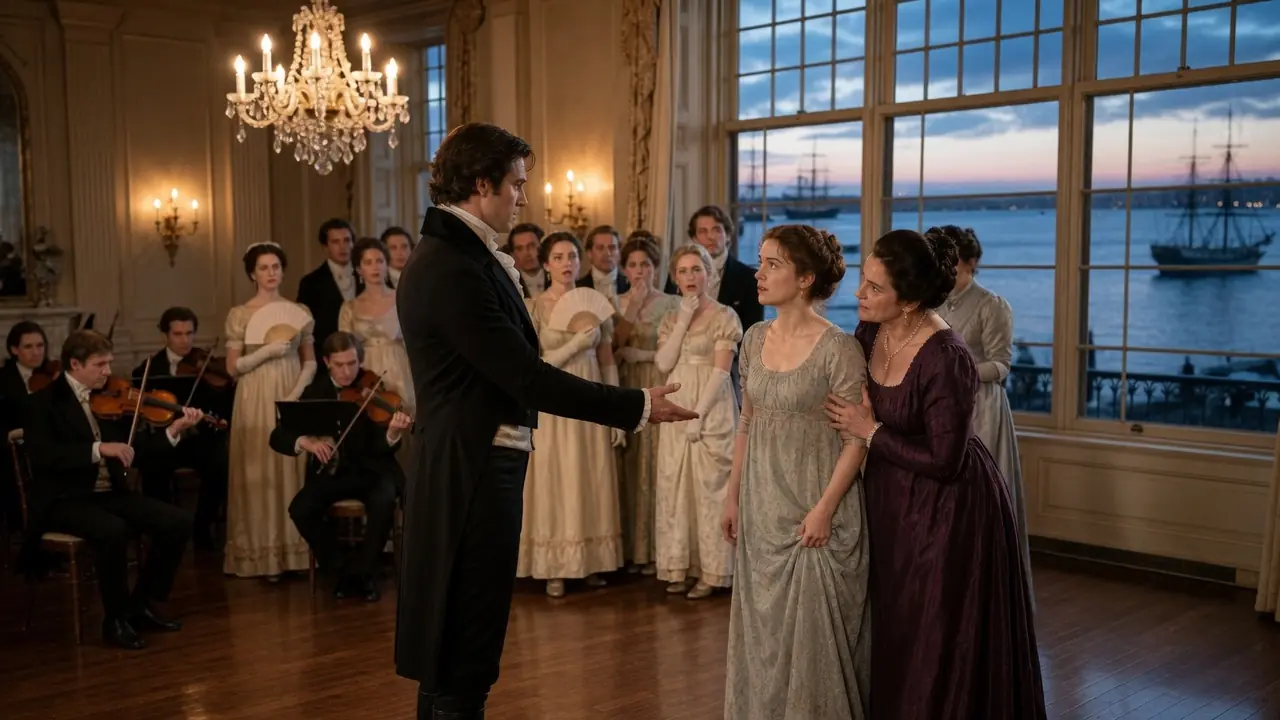
"Would you do me the honor?" The music had not yet started when Clara Bennett felt the first pair of eyes settle on her and she knew the way she always knew that it would not be a kind look. She stood near the tall windows of the assembly hall because the windows did not ask questions. They did not whisper. They did not turn their fans halfway up to hide a laugh that was not hidden at all. Outside the June evening had gone soft and gold over Boston Harbor, and Clara watched a gull cut across the sky rather than watch the room fill with silk and gossip.
"Stand up straight," her aunt hissed beside her. "You are an embarrassment standing like a broom."
"Yes, Aunt Margaret."
"And do not speak unless spoken to. God forbid you say something that reminds anyone whose charity keeps you fed." Clara said nothing. She had learned over nine years that nothing was the safest answer.
Margaret Collins smoothed the front of her own gown, new silk, bought Clara suspected with money that was not entirely her own, and surveyed the hall like a general counting troops. "The Whitmore boy is expected tonight," she said not to Clara exactly, but at her the way one might speak to a piece of furniture that happened to be listening. Every mother in Boston has her daughter primed for him. Foolish creatures, as if a man like that would look twice at anyone in this room. "Perhaps he won't come at all," Clara offered quietly.
"He'll come." Margaret's mouth thinned into something that was almost a smile. "Men like Jonathan Whitmore always come. It's deciding who to leave with that takes them longer." The fiddler tuned his strings.
Somewhere near the punch table, a cluster of young women in pale muslin gowns leaned their heads together, and Clara did not need to hear the words to know she was the subject. She had grown a strange kind of skill for it, reading the shape of cruelty from across a room, the way a sailor reads weather in the color of the sky. She turned back to the window and began out of old habit to count the panes of glass. Six across, four down—twenty-four in all. She had done this since she was thirteen years old the summer her mother died, and her father sent her north to live with her aunt for a season.
A season that had stretched into nine years and showed no sign of ending. Counting the window panes was the only thing in that house, in any house she had ever been made to live in, that stayed the same no matter how loud the room around her became. She did not hear the doors open. She heard instead the room go quiet. It was not a sudden silence.
It moved through the hall the way water moves through a low field after rain. First the doorway, then the punch table, then the young women with their pale gowns until even the fiddler's bow paused mid-stroke. Clara turned because everyone was turning because it seemed rude not to. Jonathan Whitmore stood in the doorway with his hat still in his hand, as if he had forgotten to give it to the footman, as if the whole room's attention had caught him somewhere between one motion and the next. He was not a small man, and he did not carry himself like one who needed the room to notice him, which was, Clara thought, precisely why it did.
"Mr. Whitmore," the hostess said, hurrying forward with her hands already fluttering toward the introduction she had planned for weeks. "What an honor! May I present—"
"In a moment, Mrs. Adler. Thank you." His voice was even, not unkind, but not the voice of a man who intended to be steered. He looked across the room once, the way a man looks across a field to judge the weather, and then he began to walk. Not toward the cluster of daughters arranged like a garden bed near the punch table.
Not toward Margaret Collins, who straightened so fast Clara heard her stays creak. He walked toward the window. Toward her. Clara felt her stomach drop the way it did on the wagon ride down from the hills back home. That lurch of ground disappearing beneath her.
Surely he's lost. A voice murmured somewhere to her left. "Or looking for the retiring room," said another, and there was a ripple of laughter quickly smothered because he was close enough now to hear it if he cared to. He stopped in front of Clara and gave a short formal bow. Miss Bennett, he said, I don't believe we've been introduced properly, though I knew your father.
The room did not breathe. Clara's mouth had gone dry. You knew my father, William Bennett. Something moved behind Jonathan's eyes quick and private gone before she could name it. A long time ago, before you'd have remembered me, Margaret appeared at Clara's elbow so quickly it was as though she had been launched from a cannon.
Mr. Whitmore, she said, her voice pitched high and sweet as spoiled cream. How kind of you to greet my niece. She is quite shy, I'm afraid, not accustomed to society. "Perhaps you'd care to meet my daughter Eliza.
She's just there by the—"
"I came to ask Miss Bennett to dance," Jonathan said. He said it plainly, the way a man states a fact rather than a request. "If she's willing." Clara heard the fiddler pick his bow back up, uncertain, waiting for some signal that never quite came from the hostess, who stood frozen with her hand still half raised toward an introduction nobody wanted anymore. "Do not embarrass this family," Margaret said under her breath close to Clara's ear, smiling all the while for the benefit of anyone watching.
"Do you understand me? Not tonight." Clara looked at the hand Jonathan Whitmore had extended. It was steady, unhurried. It did not tremble the way her own would if she lifted it. She thought of the room full of women who had spent a month's allowance on gowns for exactly this moment.
Women who had practiced their laughs in mirrors so they'd sound light and easy when he finally looked their way. She thought of her aunt's fingers thin and hard as wire digging into her elbow just below where the sleeve covered the bruise from last week's argument about the household accounts. She thought of her father's face, which she could barely remember anymore except in pieces. The sound of his laugh, the smell of pipe tobacco and saltwater. The way he used to say her name like it was worth something.
I'm willing, Clara said, and put her hand in his. The room exhaled all at once. A hundred silks rustling. A hundred voices dropping into a hundred different whispers. Margaret's hand fell away from Clara's arm as though it had been burned.
Jonathan led her onto the floor, and for one terrible moment, Clara was certain her legs would not remember how to move, that she would stumble in front of every family in Boston who had spent nine years pretending she did not exist. Then the music started, and his hand settled at her waist, light as a held breath, and something in her simply began. "You dance well," he said low, just for her. "You sound surprised."
"I am." Most people who've been made invisible for as long as you have forget how to be seen. His eyes held hers steady. It shows less than you think it does. If it helps to know that. Clara's throat tightened unexpectedly.
You don't know anything about me, Mr. Whitmore. I know you're William Bennett's daughter. I know you've been counting the window panes in every room you've stood in since you walked through that door. A small careful pause.
I watched you do it just now. She missed a step. He caught it smoothly as though it hadn't happened at all. How could you possibly? Your father used to do the same thing.
Jonathan said on a ship of all places where there wasn't a window worth counting for three thousand miles. He told me once it was the only way he could hold still when the world was trying to knock him down. Something in Clara's chest cracked open just slightly, just enough to let something old and aching through. "You knew him. Truly knew him." He saved my life once before you were born, before he ever set foot in this city.
Jonathan's jaw tightened the first crack in his composure since he'd walked through the door. I owe him a debt I've never had the chance to repay. Is that why you asked me to dance? Clara's voice came out sharper than she intended, sharper than she felt safe letting it be in a room full of watching eyes. "Out of some obligation?"
"No," he said without hesitation. And there was something in his face that made her believe him, even as every instinct nine years in the making told her not to trust a man's kindness. Not ever. Not for free. "I asked because I've been standing in doorways for six years watching rooms full of women who want nothing from me.
Clara knew it the way she knew rain was coming from the smell of the wind. But for these three minutes on this floor, with this man's hand steady against her waist and his eyes not once leaving her face, she found she did not care. "My aunt will say I've shamed the family," Clara said quietly. Your aunt, Jonathan said, has had nine years to say a great many things about you, and I intend to find out exactly what. The words landed harder than he could have known.
Clara's step faltered again, and this time it was not the dancing. What do you mean by that? The music was slowing the dance drawing to its close. And Jonathan Whitmore leaned in. Not improperly, not so close that anyone watching could call it scandal, but close enough that his words were meant for her alone.
I mean, Miss Bennett, that a man doesn't spend six years managing his father's ledgers without learning how to read the difference between a family that's poor and a family that's been made poor. And I've heard enough about the Collins household this past month to know which one yours is. His eyes flicked briefly to the faint shadow of a bruise just visible where her sleeve had shifted, then back to her face, and something hardened there, quiet and dangerous. "Whatever's been done to you in that house, it ends now. I give you my word." The music stopped.
The dance was over. And Clara Bennett stood in the middle of the assembly hall floor with every eye in Boston fixed on her, holding the hand of a man who had just promised in the space of four minutes to undo nine years of careful, quiet ruin. And she had no earthly idea whether to believe him or whether believing him was the most dangerous thing she had ever done. Margaret Collins was already moving toward her skirts, snapping like a whip. Her smile stretched so tight it looked ready to tear.
"Clara," she said, too sweet, too loud for the benefit of every listening ear. Come along now, darling. You look flushed. We mustn't overt tire you. "I'm quite well, Aunt Margaret."
"I said, come along." The grip on Clara's wrist was not gentle this time, hidden as it was beneath the folds of her aunt's glove. And Clara felt the old familiar instinct rise in her to simply obey, to fold herself small and quiet the way she had for nine years, because obedience was the only currency that had ever kept a roof over her head. But Jonathan Whitmore had not stepped back. He stood there still watching, and something about his stillness gave her a courage she did not know she still owned. "I said, I'm well," Clara repeated.
And this time she did not lower her eyes. Margaret's fingers tightened for half a second more than released because a public scene was the one thing Margaret Collins feared more than losing control of her niece. "Of course," she said, syrup sweet and murderous beneath it. "Of course, my dear." Jonathan bowed to Clara formal and correct, though his eyes said something far less formal. Miss Bennett, I hope to call on you this week with your aunt's permission, of course.
The last words carried the faintest edge, a challenge dressed as courtesy, and Margaret's smile flickered like a candle in a draft. Naturally, you're welcome, Mr. Whitmore, Margaret said, because there was nothing else she could say with half the city listening. Naturally, he looked once more at Clara. A long look steady, the kind that seemed to see straight past the mended gown and the lowered eyes she'd worn like armor for nine years, and then he turned and walked back through the parting crowd, leaving a silence behind him that was louder than any music had been all night.
Margaret waited only until they were in the carriage, its wheels grinding over the cobblestones toward home, before her hand came up and struck Clara hard across the cheek. "How dare you?" She hissed low so the driver wouldn't hear over the horses. How dare you humiliate this family in front of every soul in Boston. Clara pressed her fingers to her stinging cheek and said nothing because nothing was still after everything the safest answer. But for the first time in nine years, as the carriage rattled through the dark streets toward the house that had never once felt like home, Clara Bennett found herself thinking of Jonathan Whitmore's steady hand at her waist, his voice low and certain.
Whatever's been done to you in that house, it ends now. And she wondered with a hope so unfamiliar it frightened her more than her aunt's rage ever had. Whether a man's word might this one time be worth more than nine years of silence had taught her to expect. Jonathan Whitmore's carriage arrived at the Collins house on Thursday morning exactly as he had promised, and Clara heard the wheels on the gravel before her aunt did. She was in the small sitting room at the back of the house, mending a hem by the window because Margaret did not permit her a fire in her own room during the day, and she nearly dropped the needle when she recognized the sound of fine horses pulling to a stop.
She rose too fast, caught the hem in the chair leg, and had to steady herself against the sill. Clara. Margaret's voice cracked down the hallway like a whip. Clara, come here at once. By the time Clara reached the front parlor, her aunt had already smoothed her own hair, pinched color into her cheeks, and arranged herself in the good chair by the window, the one reserved for guests whose opinion mattered.
"Sit," Margaret hissed. "There. Hands folded." "Do not speak unless he addresses you directly, and for heaven's sake, do not mention money."
"I never mention money, Aunt Margaret."
"See that it stays that way." The housemaid, a thin girl named Sarah, who had been with the household longer than Clara had showed Jonathan into the parlor, and he filled the doorway the way he had filled the doorway of the assembly hall three nights before.
Unhurried, watchful, a man, who did not need to announce his presence, because the room simply reorganized itself around him. "Mr. Whitmore!" Margaret rose in a rustle of silk, her smile so wide it looked painful. "What an unexpected pleasure! We hardly dared hope you'd truly call.
"I keep my word, Mrs. Collins." His eyes moved past her, found Clara, and something in his face eased just slightly. "Miss Bennett."
"Mr. Whitmore." Clara stood dipped a small curtsy, and felt her aunt's gaze on her like a hand pressing between her shoulder blades. "Please sit. Sit." Margaret gestured him toward the chair nearest her own, putting herself deliberately between Clara and their guest, the way a woman might position herself between a hungry dog and a piece of meat.
"May I have Sarah bring tea? We have a lovely china blend, quite dear, but nothing's too good for tea would be welcome," Jonathan said. "Though I confess I came to speak with Miss Bennett, if you'll permit it." Margaret's smile did not waver, but something behind her eyes went hard and calculating. "Of course, though a young unmarried lady oughtn't receive gentleman callers without her guardian present. I'm sure you understand the delicacy of her position."
"I understand it very well," Jonathan said, and there was a weight beneath the words that made Margaret's chin lift half an inch as though she'd been struck lightly and was deciding whether to acknowledge it. "In fact, that's rather what I came to discuss." Sarah brought the tea. The cups clinked. Margaret poured with hands that were almost but not quite steady.
And Clara watched her aunt perform hospitality. The way an actress performs grief, all the correct gestures, none of the truth beneath them. Miss Bennett, Jonathan said once the tea had been distributed and Sarah had withdrawn. I mentioned the other evening that your father saved my life. I'd like to tell you how if you'll permit it, please.
Clara said before her aunt could redirect the conversation toward the weather or the price of muslin. It was 11 years ago. I was two-and-twenty sailing as a passenger on one of my father's ships bound for Charleston, and we ran into weather off the Carolina coast that no man aboard had seen the like of before or since. I went overboard a fool thing I was trying to secure a line that had come loose, and the deck pitched out from under me before I knew what had happened. Margaret's cup rattled faintly against its saucer.
Clara did not look at her. Your father was first mate on that voyage. Jonathan continued, "He went in after me. Waves that size, that cold, most men would have called it a lost cause and saved themselves the drowning. He didn't.
He got a line around me and hauled me back aboard, and he never once in all the years after mentioned it to another living soul as though it were something owed to him." Jonathan's jaw tightened. I only learned the whole of it because another sailor told the story years later over drink not knowing I was the man in it. "He never told me," Clara said quietly. "I don't remember him ever speaking of Charleston at all."
"That sounds like him." A faint private smile crossed Jonathan's face, gone as quickly as it came. "He was not a man who collected debts, but I am a man who intends to pay them whether he ever asked it of me or not." How generous," Margaret said in a voice like Sugared Vinegar.
"Though I hardly think a girl's company is proper repayment for a debt of that magnitude, Mr. Whitmore. Perhaps a more practical arrangement would suit better. A donation to the parish, perhaps in Williams memory, I had something more specific in mind." Jonathan set his cup down with a small, deliberate click. I understand Miss Bennett's father left an estate upon his passing, a modest one, but an estate nonetheless, the house on Marsh Street, a share in two trading vessels, and some little capital besides.
The room went very still. Clara felt her own pulse jump in her throat. She had heard vaguely, distantly, as a child hears adult conversations through a closed door, that her father had left something behind. She had never been told what or where or why. None of it had ever touched her own life.
In the nine years since, I'm afraid you've been misinformed," Margaret said too quickly, too brightly. William's affairs were quite modest. "What little there was went to settling his debts, and to Clara's keep, of course, which has been considerable these nine years. Feeding a growing girl, clothing her, educating her."
"I was under the impression Miss Bennett received no formal education beyond what you taught her yourself," Jonathan said mildly. I taught her everything a young woman needs to know.
I'm sure you did. His tone gave nothing away, but Clara saw the flicker of something sharpened in his eyes, the look of a man filing away a fact for later use. Regardless, I intend to look into the matter of the estate purely as a courtesy to an old friend's memory. I hope that won't trouble you, Mrs. Collins.
Trouble me? Margaret's laugh came out thin and high. Why would it trouble me? There's nothing to find. Williams affairs were closed and settled years ago, all quite properly, by the family solicitor.
"Then you won't mind if I speak with him." The silence that followed lasted only a heartbeat, but Clara felt it stretched like a held breath. Her aunt's face did not change. Margaret Collins had spent 30 years learning how to keep her face from changing, but something in the set of her shoulders shifted, some invisible weight settling deeper. "Of course not," Margaret said. "Mr.
Aldis Pruitt handles our family's affairs. Third floor above the counting house on Cornhill Street. Though I warn you, you'll find it a tedious errand for nothing." I don't mind tedium," Jonathan said, "when the truth is worth finding." He stayed another twenty minutes, speaking of small things, the weather, a shipment of Turkish carpets that had come into his father's warehouse. A question about which books Clara preferred, Clara found herself answering more freely than she had spoken to anyone in years, forgetting for whole stretches of minutes that her aunt sat 3 feet away, drinking in every word, like a woman gathering evidence.
When he rose to leave, he bowed to Margaret with perfect correctness, and then turned to Clara, and held her gaze a moment longer than propriety strictly allowed. "I'll call again, Miss Bennett, soon." I'd like that, Clara said, and meant it more than she'd meant almost anything in nine years. The front door closed behind him. The sound of his carriage wheels faded down the street. And Margaret Collins turned to her niece with a face gone the color of old ash.
"Go to your room, Aunt Margaret?"
"Go to your room, Clara, before I say something I'll regret." Margaret's hands had curled into fists at her sides, the knuckles white. Clara went, but she did not miss on her way up the narrow back stairs, the sound of her aunt's voice dropping low and urgent as she called for Sarah, nor the words that followed half- muffled through the parlor door. "Fetch my writing case.
I need to send word to Pruitt before that man reaches Cornhill Street." The letter went out within the hour, carried by a boy Margaret paid extra to run rather than walk. Clara did not see its contents, but she saw her aunt's face when Sarah returned two hours later without a reply. Only a message that Mr. Pruitt was engaged for the remainder of the week and could not be disturbed. "Coward!" Margaret muttered, pacing the length of the parlor with her skirt snapping at her ankles.
"Useless, spineless coward." Clara, seated by the window with her mending forgotten in her lap, watched her aunt wear a groove into the carpet and felt something she had not allowed herself to feel in a very long time. Curiosity sharpened into suspicion. "Aunt Margaret," she said carefully. "Is there something wrong with Father's estate?" Margaret stopped pacing, turned. For one unguarded second, something raw and frightened moved across her face before the mask slammed back down. "Don't be absurd," she said.
"There is nothing wrong with anything." Mr. Whitmore is stirring up trouble where none exists, likely to impress you. Likely because men of his sort enjoy playing at heroics with other people's affairs. She smoothed her skirts with hands that trembled almost imperceptibly. You'll do well to remember, Clara, that men who make grand promises rarely keep them once the novelty wears thin.
I won't have you building castles on a stranger's whim. He isn't a stranger. He knew father. He knew a story about your father. That isn't the same as knowing the man.
Margaret's eyes narrowed. And I'll thank you not to go filling his head with tales about this household. Whatever you think you know about how things are run here, you know nothing. Do you understand me? Clara understood in that moment far more than her aunt intended her to.
Jonathan Whitmore did not wait for a reply from Aldis Pruitt. He went to Cornhill Street himself the following morning and found the solicitor's office locked a note pinned to the door claiming urgent business out of town. He stood on the street a long moment had in hand, turning the strange sour taste of it over in his mind. A solicitor who vanished within a day of being asked to produce records was not a solicitor with nothing to hide. He went instead to the harbor to his father's counting house, and spent the better part of the afternoon in conversation with an old clerk named Ezra Combes, a man who had kept ledgers in Boston for forty years, and knew better than any judge in the city where every family's fortune had truly gone.
"Bennett," Ezra said, chewing the word over along with a mouthful of tobacco. "William Bennett—I remember him. Good man, fair dealer. Went down with fever, what, nine or ten years back?"
"Nine," Jonathan said. "I am trying to trace what became of his estate."
Ezra's eyes, pouched and yellowed with age, sharpened with sudden interest. "Now that is a question with a story behind it, or I am no judge of men." He leaned back in his chair, which creaked under him like a ship's timber. "William had a share in the Constance and the Fair Hope, both trading vessels and decent little earners in their day. He owned the house on Marsh Street outright, with no mortgage on it, and there was capital besides—three, perhaps four thousand dollars held in trust for the girl until she came of age or married, whichever came first."
Jonathan's jaw tightened. "Four thousand dollars?"
"Give or take. It was meant to be managed by a guardian until she turned one-and-twenty. Her aunt, I believe, took that role." Ezra spat neatly into a brass spittoon beside his chair. "I cannot say what has become of it since. A man like me keeps the harbor's books, not the family courts. But if you want my honest guess—and you are not obliged to take it—"
"I want it."
A widow with no fortune of her own raising another woman's child on money that isn't hers, with nobody looking over her shoulder for near a decade. Ezra shook his head slowly. Money has a way of disappearing under those conditions, Mr. Whitmore. It don't vanish all at once.
It goes a little at a time. A dress here, a dinner party there. A daughter's dowry that needs building up faster than an inheritance allows. He fixed Jonathan with a steady look. If I were you, I'd find myself a lawyer who isn't afraid of Margaret Collins, and I'd find the county trust records before somebody thinks to burn them.
That evening in the house on Marsh Street that Clara had never once been told belonged to her. Margaret Collins sat alone at her writing desk long after the household had gone to bed. A single candle burning low, a stack of yellowed papers spread before her. She read through the trust documents one final time, the original filing her own signature as guardian, the ledger of withdrawals stretching back nine years, each one smaller and more carefully justified than the last. And beneath them all folded and refolded.
So many times the creases had gone soft as cloth. A letter in William Bennett's own hand addressed to his daughter dated the week before he died. Margaret had read that letter perhaps 40 times over the years. She knew whole passages of it by heart. The way one knows a wound by heart from touching it too often.
My dearest Clara, if you are reading this, it means I did not live to see you groan. And there is no ache in this world greater than that knowledge. "Know that everything I have is yours—the house, the ships, whatever small fortune I managed to set aside." Know too that I have asked your aunt to hold it in trust and to raise you as her own. And I pray she honors that trust, as I know in my heart a sister of mine surely would. Margaret's hand shook as she folded the letter one final time.
She had told herself for nine years that she was owed something for the burden of raising another woman's daughter for the gowns and the schooling and the roof over a stranger's child's head. She had told herself the money was hers by right of sacrifice that Clara would never miss what she'd never known to expect. She struck a match, held it a long moment over the corner of the letter, watching the flame eat toward her fingers, watching the paper begin to curl and blacken at the edge. Then, with a sound that was almost a sob, she pulled the flame away and blew it out.
She could not burn it. Nine years of theft and still some last threat of conscience would not let her destroy the one thing that proved in her own long dead brother's hand exactly how far she had strayed from what he'd asked of her. Instead, she rose across to the hearth and pried loose a brick behind the coal scuttle, a hiding place she'd used since her own girlhood in this very house, and slid the letter and the ledgers deep into the dark space behind it. "Forgive me, William," she whispered to the empty room. "I'll make it right.
I only need a little more time." It was Clara would later understand the closest thing to truth her aunt ever spoke aloud in that house. Jonathan called again three days later, and this time he did not come alone. He brought with him a lean, sharp-eyed man, introduced only as Mr. Foster, an attorney from a firm on State Street, whose name Margaret recognized well enough to go pale beneath her rouge. "Mr.
"Mr. Foster has agreed to look into the administration of the Bennett Trust," Jonathan said once tea had been poured and the pleasantries exhausted. "Purely as a courtesy. I'm sure everything will prove to be in perfect order." I'm sure it will, Margaret said, her smile stretched thin as old lace. Though I must say, Mr.
Whitmore, I find this scrutiny rather insulting. Nine years I've raised that girl with my own resources, my own affection, and now to be treated as though I've done her some wrong. No one has accused you of anything, Mrs. Collins, Mr. Foster said pleasantly, though his eyes were cool and assessing behind his spectacles.
We simply require the trust records, the original filing, the guardianship papers, and an accounting of disbursements over the past nine years. A standard matter, I assure you. Of course, Margaret's voice had gone thin and brittle. I'll have Mr. Pruitt forward them at his earliest convenience.
Mr. Pruitt seems to have left town rather suddenly, Jonathan said. We stopped by his office yesterday, locked up tight. No forwarding address left with his clerk. Something flickered across Margaret's face.
Fear flickered across her face, quickly buried beneath indignation. "That's absurd. He was in his office not a week ago."
"Perhaps you might know where he's gone," Mr. Foster suggested mildly. "Given how closely he's managed the family's affairs."
"I have no idea where the man has run off to." Margaret's hands had begun very slightly to shake around her teacup.
"Solicitors are unreliable creatures, Mr. Foster. I'm sure you know that better than most." Clara sat very still through all of this, watching her aunt's careful composure crack in places she had never seen it crack before and felt something rise in her chest that she did not immediately recognize because it had been buried under nine years of obedience anger. Aunt Margaret, she said quietly, "Where is my father's letter?" The room went silent.
Margaret's teacup rattled hard against its saucer. What letter? You told me once when I was very young that father left a letter for me. I asked to see it and you said it had been lost. Clara's voice, though soft, did not waver.
I've thought of that letter every year since. I'd like to see it now if it still exists. I don't know what you're talking about. But Margaret's face had drained of color, and her eyes had gone to the hearth just for a fraction of a second, just long enough before snapping back to Clara's face. You imagined it.
You were a child grieving. You imagined a great many things. Jonathan had not missed the glance at the hearth. Clara saw him note it, saw the faint tightening at the corner of his mouth, and understood with a jolt that he had seen exactly what she had seen. We won't trouble you further today, Mrs.
"Mrs. Collins," he said, rising smoothly. "Mr. Foster will call on the county recorder's office to obtain copies of the original trust filing directly. I understand such records are kept regardless of what any individual solicitor may possess." Margaret's composure, thin as it had become, finally cracked all the way through." You have no right," she snapped, rising, her voice climbing. No right at all to come into my home and treat me like a common thief because a girl with nothing better to do than spin fantasies about lost letters.
"Mrs. Collins." Jonathan's voice did not rise, but something in it cut through the room like a blade drawn slow from its sheath. I did not accuse you of anything. I asked to see records that belong by law to your niece. If those records show everything to be in order, you have nothing to fear from my asking.
If they do not, he paused, and his eyes when they met Margaret's held no warmth at all. Then I'd advise you to consider very carefully what kind of woman you wish to be remembered as, before this city learns the truth for itself. He bowed to Clara, correct and formal as ever, though his eyes lingered on her a moment longer, softer now, before he and Mr. Foster showed themselves out. The front door closed.
The carriage wheels faded into the street. Margaret Collins turned on her niece with a face contorted by something Clara had never seen before. Not simple anger, but the raw cornered fury of a woman who understood for the first time in nine years that the walls she had built around her theft were beginning brick by brick to come down. "You stupid, ungrateful girl," she hissed. "Do you have any idea what you've done?" I asked about a letter, Aunt Margaret.
"I asked about a letter, Aunt Margaret. Nothing more."
"You've set that man against me. You've invited a stranger to pry into affairs that are none of his concern. All because he flattered you with a dance and a pretty story about your father. Margaret's hands curled into fists. Men like Jonathan Whitmore don't chase after penniless wards out of the goodness of their hearts.
Clara, they chase after them when there's something to be gained. Land, money, a story that makes them look noble in front of the whole of Boston society. Her lip curled. Has it occurred to you even once that he might simply be using you? The words landed exactly where Margaret intended them to land in the soft, unguarded place where nine years of being told she was worth nothing had left Clara raw and ready to believe the worst of any kindness shown to her.
He knew father, Clara said, but her voice had lost some of its certainty. He knew a story. Stories are cheap, Clara. Men tell them all the time to get what they want. Margaret stepped closer, her voice dropping into something almost gentle, almost kind, the particular cruelty of a woman who knew exactly which knife cut deepest.
"I have protected you for nine years—fed you, clothed you, kept a roof over your head when no one else in this city would have taken in your father's debts along with his orphan. And this is how you repay me, by inviting strangers to accuse me of theft in my own parlor." I didn't accuse you of anything. You didn't have to.
I saw the way he looked at me. Margaret's eyes glittered wet now, though Clara could not tell if the tears were real or another careful performance. You'll ruin us both, Clara, chasing after a man who'll tire of his little charity project the moment the novelty wears off and leave you with nothing but a ruined reputation and an aunt who no longer has any love left to give you. Clara said nothing. She had learned over nine years exactly how her aunt's words worked, how they wound themselves around a person's doubts and squeezed until even truth began to feel uncertain.
But that night, lying awake in the narrow bed in the small room at the top of the stairs, Clara found herself thinking not of her aunts warnings, but of Jonathan's eyes, when he'd looked toward the hearth, sharp, certain a man who had seen something true in a room full of lies, and of her father's voice, half remembered saying her name like it was worth something. She rose before dawn, dressed quietly, and crept down to the parlor while the house still slept. The hearth was cold. She knelt before it ran her fingers along the bricks the way she had seen her aunt glance toward them searching for anything loose, anything that did not sit quite flush with its neighbors.
Her fingers found it on the fourth try a brick set slightly forward of the rest cool and rough beneath her fingertips. She worked it free with shaking hands, and behind it in the dark dust thick space, her fingers closed around a bundle of paper tied with faded ribbon. She did not need a candle to know by the shape and weight of it alone that she had found something her aunt had spent nine years hiding. Clara carried the bundle to her room and did not light a candle until she was certain the house was still fully asleep until she had wedged a chair beneath her door handle the way she had learned to do as a girl whenever Margaret's temper ran high.
The letter lay on top her father's handwriting, unmistakable even after nine years. The same careful looping script that had signed her childhood drawings. The same hand that had once written her name on the fly leaf of a book of poems, she still kept hidden beneath a loose floorboard of her own devising. My dearest Clara, her hands shook so badly she nearly tore the page unfolding it. If you are reading this, it means I did not live to see you grown.
And there is no ache in this world greater than that knowledge. She read it three times through tears falling freely, now blotting where they landed on the old ink. Her father's voice rose up off the page as though he were in the room beside her. His hopes for her, his instructions to Margaret, his plain, unadorned love laid bare in every line. "Know that everything I have is yours—the house, the ships, whatever small fortune I managed to set aside." Beneath the letter, the ledgers told a colder, crueler story.
Nine years of withdrawals, each one small enough to seem innocent in isolation. Each one adding line by line, page by page, to a sum that made Clara's stomach turn. Four thousand dollars dwindled now to less than six hundred. Gowns, jewelry, a season's rent on a summer cottage Clara had never once been permitted to visit. Payments to a Mr.
Aldis Pruitt that grew steadily larger in the months just before his sudden convenient disappearance. Her aunt had not merely neglected her. Her aunt had stolen from her deliberately methodically for nine long years, and had built brick by careful brick an entire life of comfort at top the bones of Clara's inheritance. Clara sat on the edge of her narrow bed until the candle burned down to a stub. The letter clutched against her chest and felt something inside her that had been small and quiet and obedient for nine years finally irrevocably begin to change shape.
She would not confront her aunt. Not yet. Margaret was too skilled a liar too practiced at twisting truth into something unrecognizable. And Clara understood with a clarity that surprised her that a confrontation fought alone in this house would end only with the evidence destroyed and her own credibility in ruins. She needed Jonathan Whitmore.
Needed his lawyer, his standing in this city, his willingness to stand in a room and call a lie a lie without flinching. She wrapped the letter and ledgers carefully in a spare petticoat, tucked the bundle beneath the same loose floorboard that held her book of poems, and lay awake until dawn, planning for the first time in nine years, not how to survive the day ahead, but how to end the life that had been stolen from her. Word travels fast in a city the size of Boston, faster still, through drawing rooms hungry for scandal. And by the following week, whispers had begun to circulate that were not Clara suspected entirely accidental in their origin.
She heard them first from Sarah, who came to her one evening with her eyes downcast and her hands twisting in her apron. Begging your pardon, miss, but I thought you ought to know what's being said. Mrs. Pernell's cook told our cook that Mrs. Collins has been telling folk you set your cap at Mr.
Whitmore quite shamelessly following after him for his fortune on account of your own prospects being so poor. She says you are the sort of girl who would say anything to trap a rich man into marriage. Clara felt the blood drain from her face. She's saying that about me. That's not the whole of it, miss. Sarah's voice dropped lower, guiltier.
There's talk you've been well, that you've behaved improper with him already. That the dance at the assembly weren't the first time you two had been alone together, if you take my meaning. The room seemed to tilt beneath Clara's feet. That's a lie. A vicious lie.
I've never been alone with Mr. Whitmore a single moment in my life. I know it, miss. Everyone who knows you knows it. But you know how talk spreads, and Mrs.
Collins has been dropping the words in just the right ears, real careful like, so it don't trace back to her mouth. Exact. Sarah hesitated. I thought you ought to be warned before it reaches Mr. Whitmore's family and does you real harm.
Clara sat very still, her hands folded tight in her lap to keep them from shaking. Nine years she had endured her aunts cruelty in silence in private behind closed doors where no one could see the bruises or hear the insults. This was different. This was a public execution of her character carried out one whispered word at a time in every parlor in Boston. And Clara understood with sick clarity exactly why Margaret had chosen this particular weapon.
If Clara's reputation was ruined, Jonathan's family would forbid the connection. His lawyer's inquiries would lose their urgency, and Margaret, given time enough, could finish covering her tracks before anyone with real power, thought to look too closely. "Thank you for telling me, Sarah," Clara said quietly. "I won't forget it." Yeah. Jonathan heard the rumors two days later delivered not gently but bluntly by his own mother over breakfast in the tall sunlit dining room of the Whitmore house on Beacon Street.
They're saying she trapped you Jonathan deliberately that the whole business at the assembly was arranged. Eleanor Whitmore set down her coffee cup with a precision that betrayed her agitation. I don't credit a word of it myself, but you must understand how it looks. A penniless ward, a wealthy bachelor, a very public dance that half the city witnessed. I asked her to dance mother.
She didn't arrange anything. I know that. But knowing it and having Boston believe it are two very different matters, and you know as well as I do how quickly a woman's reputation can be shredded by talk alone deserved or not. Eleanor's eyes sharp as her son studied him carefully. You care for this girl.
It was not a question, and Jonathan did not treat it as one. I do. Then you'd better move quickly to protect her before the talk does damage that can't be undone. A woman's name, once stained, rarely washes clean again in this city, whatever the truth of the matter turns out to be. Jonathan set down his own cup, his jaw tight.
He had suspected from the moment he'd caught Margaret Collins's eyes flicked toward that hearth that the woman would not simply surrender nine years of theft without a fight. He had not expected the fight to take this particular shape. Not an attack on records and ledgers, which could be disproven with time and diligence, but an attack on Clara's very name, which no amount of documentation could fully repair once the damage was done. I need to see Foster today, he said, rising from the table. And I need to see Clara before this spreads any further.
He found her in the small garden behind the Collins house, the one modest patch of green Margaret permitted, seated on a stone bench with her hands folded so tightly in her lap that her knuckles had gone white. "You've heard then," she said before he'd even fully crossed the garden path. "I've heard." Jonathan sat beside her close enough that their conversation would not carry far enough to preserve every propriety her reputation now desperately required. None of it's true. I want you to hear me say that plainly.
None of it. It doesn't matter whether it's true. Clara's voice had gone thin, brittle in a way he hadn't heard from her before, not even in her aunt's presence. It only matters whether people believe it. And people believe whatever's whispered loudest and longest.
Mr. Whitmore, I learned that lesson a long time before you walked into my life. Jonathan, he said quietly. I think after everything you might call me Jonathan. Something in her seemed to crack just slightly at the gentleness of it.
Jonathan. Then a breath. I found something. Two nights ago. I've been carrying it ever since, not knowing what to do with it, not knowing who to trust with it.
She told him then the loose brick, the bundle of papers, the letter in her father's hand, the ledgers documenting nine years of careful deliberate theft. Jonathan listened without interrupting his face growing harder and stiller with every detail until by the end his hands had curled into fists against his knees. You still have it safely hidden beneath a floorboard in my room. She hasn't found it. I don't think she's even realized it's gone from behind the hearth yet.
Clara looked up at him and for the first time since he'd known her, he saw something other than careful composure in her face. Real fear, raw and unguarded. If she does realize, Jonathan, I don't know what she'll do. She's desperate. Desperate people do desperate things.
Then we move before she has the chance. Jonathan's voice had gone flat, and certain the voice of a man who had already begun calculating his next several moves. I'll have Foster draw up whatever's needed to make the letter and ledgers admissible before a magistrate. But Clara, his eyes softened, just slightly, meeting hers. I need you to trust me a little further than you've had to trust anyone in a very long time.
"Can you do that?" Clara looked at him a long moment. This man, who had crossed a crowded ballroom for her, who had listened to her father's letter without once looking away, who sat beside her now in a garden that belonged by law and by blood entirely to her, though she had never once been told so. I trust you," she said, and found to her own quiet astonishment that it was true. That night, Margaret Collins discovered the hearth stood empty.
She had gone to check it on instinct, a nervous habit born of nine years of guilt, and found the loose brick pried the space behind it, hollow and dark, and unmistakably robbed. She stood in the empty parlor a long moment, the candle trembling in her hand, and felt something cold and final settle into her chest. Clara knew, not suspected, not wondered, knew with proof in her own two hands, exactly what her aunt had done. Margaret sat down heavily in the good chair by the window, the chair reserved for guests, whose opinion mattered, though there was no guest here.
Now only the ruin of nine years spread out before her in the dying candle light, and for the first time since she'd struck the match over her brother's letter, allowed herself to cry. But grief in Margaret Collins had never lasted longer than the time it took to formulate a plan, and by the time the candle guttered out entirely, she had already begun to think with cold and narrowing focus of how to salvage what remained of her nine years of careful theft before the whole of it came crashing down around her. She thought of Aldis Pruitt hiding wherever Jonathan Whitmore's lawyer had not yet thought to look. She thought of the wealthy widower Mr.
Josiah Reeves, who had shown interest in Clara some months back before Jonathan Whitmore had ever crossed her path. A man old enough to be indifferent to scandal. Desperate enough for a young wife to overlook whatever whispers followed her, and most usefully of all, a man whose swift marriage to Clara would put the entire question of the Bennett trust conveniently, permanently beyond anyone's reach to examine. If Clara married before the truth came to light, the law would settle every remaining dollar of the estate directly into her husband's control, and a compliant husband chosen and cultivated by Margaret herself would be far easier to manage than a niece who had finally begun God helped them both to grow a spine.
Margaret Collins rose from her chair, wiped the last of her tears with the back of one steady hand, and went to her writing desk to compose a letter to Josiah Reeves, proposing a match with an urgency she dressed carefully in the language of a fond aunt, eager to see her beloved niece settled before the season's end. The war for Clara Bennett's future, Margaret decided, was far from over. It had only at long last truly begun. Clara did not learn of Josiah Reeves until three days later, and when she did, it came not from her aunt, but from Sarah, whose hands shook as she pressed a folded note into Clara's palm in the narrow back stairwell.
I weren't meant to see it, miss, but it was left open on the writing desk when I went to lay the fire. A letter to Mr. Reeves. She's asking him to call this Friday real particular about it, saying she's ready to discuss terms. Sarah's voice dropped to barely a whisper.
Terms, miss, like he was a horse being sold at auction. Clara felt the floor tilt beneath her. Josiah Reeves, the widower who called on us last spring. The very one, sixty if he was a day, and buried two wives already. God rest them.
Sarah crossed herself quickly, begging your pardon for speaking so plain, miss, but everyone in service knows what kind of man he is. Cold, particular about a woman knowing her place and keeping to it. Clara's hands had gone icy despite the warmth of the stairwell. She means to marry me off before Jonathan's lawyer finishes his inquiry. That's my thinking, too, miss.
Though I've no learning enough to say for certain. Clara did not wait to consider whether it was proper. She went straight to her room, penned a note in a hand made unsteady by fear, and paid the same errand boy Margaret usually employed a full week's saved pennies to carry it directly to the Whitmore House on Beacon Street. Jonathan—she means to marry me to Josiah Reeves before Friday's end. I do not know how much time we have left.
Please come.
He came within the hour, and this time he did not wait for Margaret's permission to be received. He walked past Sarah at the door with a briskness that startled the girl and found Clara in the small garden, pacing the narrow gravel path with her arms wrapped tight around herself. "Tell me everything," he said before he'd even fully closed the distance between them. She did the note on the writing desk. Sarah's warning, the particular urgency of this Friday, only two days away now.
Jonathan's face darkened with every word until by the end his jaw had gone tight as a drawn bowstring. "She can't force a marriage without your consent," he said. "Whatever else she is, the law requires you to agree. You don't know her." Clara's voice cracked the fear she'd been holding at bay finally breaking through. She'll make it seem I have no choice.
She'll say the family's ruined without it. That I owe her this after nine years of her charity. That Reeves is a kindness she's arranging on my behalf. She's done it before. Jonathan made me believe cruelty was love.
Made me thank her for things that wounded me. She's very, very good at it. Jonathan reached out and though propriety kept him from taking her hand outright in the open garden, his fingers brushed hers brief and warm and steadying. She won't get the chance. I promise you that.
How can you promise something like that? Because Foster found Pruitt yesterday. A grim satisfaction moved across his face. "Hiding in a boarding house in Salem under a false name, of all the cowardly things." He didn't put up much resistance once Foster made clear what evidence we already held. The man's terrified of prison Clara, and rightly so.
He's agreed to testify to everything, the falsified accounts, the withdrawals he processed, knowing full well they exceeded any lawful guardians allowance, all of it. Clara's breath caught. He'll testify against her. "He's already begun. Foster has a sworn statement in hand as of this morning." Jonathan's eyes held hers steady and certain in a way that made something in Clara's chest loosen for the first time in days.
Your aunt doesn't know it yet, but the ground beneath her has already given way. She's planning a wedding to save herself from a ruin that's already arrived. Then why not confront her now today? Because a quiet confrontation in a parlor changes nothing for you, Clara. She'll deny it, twist it, find some new lie to buy herself another week's time.
She's proven that skill nine years running. Jonathan's voice hardened with a resolve that startled her. I want the truth exposed. Somewhere she can't control the room. Somewhere every person who's ever whispered about you, every family who's ever looked at you with pity or contempt sees exactly who you are and exactly what's been done to you in the same breath.
At the Harborview charity assembly next Saturday. Every family of consequence in Boston will be there, my own parents among them, half the city's judges and ministers besides. A faint fierce light had come into his eyes. Margaret Collins built her whole life on the good opinion of that room. I intend to take it from her in front of every witness who ever gave it to her.
Clara felt a tremor move through her that was not entirely fear. That's 4 days from now. She means to have me married to Reeves inside two days. "Then we don't give her two days." Jonathan's jaw set. Foster will file an emergency petition with the county court tomorrow morning requesting an immediate accounting of the Bennett Trust on grounds of suspected malfeasance.
"It won't stop a wedding outright, but it will force a public inquiry that no respectable man like Reeves will want his name anywhere near. I'd wager good money he withdraws his suit the moment word reaches him. And if he doesn't, Jonathan's expression did not soften. Then you refuse him outright publicly if you must, and I will stand beside you when you do it, whatever it costs either of us in the eyes of this city." His voice dropped quieter, now meant only for her.
You are not without protection any longer, Clara. Whatever happens between now and Saturday, I need you to hold on to that. You are not alone in this." For the first time in nine years, Clara Bennett allowed herself to believe it. Margaret Collins felt the ground shift beneath her the following afternoon when a county clerk arrived at the door with a folded document bearing an official seal requesting her presence before a magistrate within the week to answer questions regarding the administration of the estate of the late William Bennett.
She read the notice twice through in the front hall, her hands trembling so violently the paper rattled audibly, and then folded it with excessive deliberate care, as though calm handling of the document might somehow undo the words printed upon it. Sarah, she called, her voice pitched unnaturally bright. Sarah, fetch my good bonnet. I'm calling on Mr. Reeves directly.
She arrived at the Reeves townhouse within the hour and found the widower in his study. A stiff silver whiskered man with the manner of someone accustomed to being obeyed rather than persuaded. "Josiah." Margaret settled into the chair across from his desk with a composure that cost her every ounce of will she possessed. I trust you received my letter regarding Clara. I did.
Reeves steepled his fingers, studying her with an assessing coldness that made Margaret's skin crawl, though she kept her smile fixed firmly in place. I confess I've had second thoughts, Margaret. There's talk about the girl now, a public dance with young Whitmore rumors of some scandal touching the family's finances. A man in my position can't afford to attach his name to controversy. There is no scandal, Margaret said too quickly, too sharply, and saw the flicker of doubt deepen in Reeves's pale eyes.
Merely idle talk, the sort that follows any young woman a wealthy man shows interest in. You know how this city loves to invent stories where none exist. Reeves did not look convinced. Regardless, I've decided to wait until the season's talk dies down before proceeding with any formal arrangement. A man my age has learned patience serves him better than haste Margaret.
I'm sure you understand. Margaret understood perfectly. She understood that her carefully constructed rescue had just crumbled in her hands that the county clerk's visit that morning had already begun to poison every avenue of escape she'd spent the past week building. She left the Reeves Townhouse with her composure barely intact, and by the time her carriage reached Marsh Street once more, something cold and desperate had begun to harden in her chest. If she could not marry Clara off before the truth emerged, then she would have to find another way to survive what was coming, and Margaret Collins, cornered now in ways she had never before experienced, began to consider options far more dangerous than a hasty wedding.
Clara felt the shift in her aunt's manner the moment she returned that evening, a brittleness beneath the usual venom, a sharpness in her eyes that had not been there before. "You've ruined everything," Margaret said. At the moment Clara appeared in the parlor doorway, her voice had lost its usual honeyed cruelty. What remained was raw and unguarded in a way Clara had rarely witnessed. Do you have any notion what you've done running to that man with your little discoveries?
A county summons, Clara. A magistrate's inquiry. Do you understand what that means for this family's name? I understand what nine years of theft means for mine. Clara said quietly and watched her aunt's face contort with a fury so raw it was almost frightening to witness.
I gave you a home, fed you, clothed you with my own money, Clara said. Money my father left for me. Money you stole a little at a time for nine years while telling me I owed you gratitude for every scrap of bread. The slap came before Clara had finished speaking hard enough to snap her head sideways hard enough that she tasted blood where her teeth had caught the inside of her cheek. "Ungrateful." Margaret hissed.
Her hand still raised trembling now with a rage that had crossed fully into something unhinged. "After everything I sacrificed, Aunt Margaret." Clara's voice when it came was steadier than either of them expected, steadier than nine years of silence should have permitted. Strike me again if it makes you feel less afraid. It won't change what's coming. Jonathan already has the letter.
He already has Pruitt's confession. Whatever happens to me now, the truth is already loose in this city, and no amount of striking me is going to call it back. Margaret's hand fell to her side slowly, as though the strength had drained out of her all at once. For a long moment, she simply stood there staring at her niece as though seeing her truly seeing her for the first time in nine years. "You'll destroy us both," Margaret whispered.
"No," Clara said. "You did that yourself a long time before I ever found that letter." The days that followed passed in a strange, suspended tension. Margaret retreating into a brittle silence broken only by whispered conferences with her own ladies maid and hurried secretive correspondence, Clara no longer bothered trying to intercept. She had said what needed saying. There was nothing left now but to wait for Saturday and for Jonathan's promise to hold.
He called each day always briefly, always correct in every particular of propriety, though his eyes carried a warmth that no amount of correctness could fully disguise. He brought news each time Pruitt's full confession was now filed with the court. Mr. Foster's petition had been granted an expedited hearing, the quiet, careful work of assembling every document needed to make Margaret's guilt impossible to deny before a room full of witnesses. Are you certain about Saturday? Clara asked him on the Thursday before, as they sat once more in the small garden that had become in these strange weeks the only place in the house where she felt she could breathe freely.
A public exposure. It will humiliate her beyond anything a courtroom could manage. Does that trouble you? Clara considered the question honestly before answering. I don't know.
Some part of me still remembers being a child who wanted nothing more than for her to love me. That part of me flinches at the thought of her ruin even now. She looked down at her hands. But a larger part of me remembers nine years of small cruelties dressed up as kindness. And that part wants the whole of Boston to finally see her exactly as she is.
Then let both parts be true," Jonathan said gently. "You can grieve what she should have been to you and still demand the justice you're owed for what she chose to be instead. The two aren't in conflict, Clara. They never were." Something in Clara eased at that some old tangled knot of guilt she hadn't realized she was still carrying. "Thank you," she said, "for all of it.
"For believing me before you had any proof at all."
"I believed your father first," Jonathan said. "And then I believed my own eyes watching you count window panes in a room full of people who'd spent nine years teaching you that you didn't deserve to be seen." His voice roughened slightly. "I intend to spend considerably more effort than that going forward, making certain you never doubt it again." Saturday arrived cold and bright. The Harborview charity assembly hall filling by early evening with every family of consequence.
Boston possessed merchants and their wives glittering in silk ministers in sober black. Two county judges seated near the front with their own wives beside them and Jonathan's parents. Eleanor and Charles Whitmore presiding near the head table with the quiet authority of a family whose good opinion carried weight in every room they entered. Clara arrived on Jonathan's arm wearing a gown that was new. His mother's gift had been offered with a warmth that had startled Clara nearly to tears when Eleanor Whitmore had first pressed the parcel into her hands.
Pale blue silk, simply cut—nothing showy, nothing that announced itself the way the gowns of the season's other young women did. It was Clara thought exactly the kind of gown a woman wore when she no longer needed to prove anything to anyone. Margaret arrived separately later. Her face composed into its usual careful mask. Though Clara could see, even from across the crowded hall, the tightness at the corners of her aunt's eyes, the particular brittleness of a woman holding herself together through sheer force of will.
The evening proceeded, for the first hour, exactly as such evenings always proceeded, speeches from the charity's organizers, polite applause, the slow circulation of guests through the hall in currents of silk and conversation. Clara felt Jonathan's hand steady at the small of her back throughout a quiet constant reassurance, though she noticed Mr. Foster moving through the crowd as well, exchanging brief, purposeful words with several of the judges present, and understood that the machinery Jonathan had promised was already quietly beginning to turn. It was Margaret herself, in the end, who lit the fuse.
She found Clara near the refreshment table, flanked by two of the season's more prominent matrons, and when she spoke, her voice carried with the deliberate clarity of a woman who intended to be overheard.
"My niece looks lovely tonight, does she not?" Margaret said, her smile bright and brittle. "Though I confess I worry, given how quickly she has attached herself to Mr. Whitmore. Nine years I raised that girl on nothing but charity, and this is the thanks I receive—accusations, county summonses, my own name dragged through scandal, all because a penniless girl saw an opportunity and seized it without a thought for the family that sheltered her."
The words landed exactly as Margaret intended. Several heads turned, and several conversations paused mid-sentence. Clara felt her face flush hot, old instincts screaming at her to shrink, apologize, and smooth the moment over as she had smoothed a thousand such moments before. But Jonathan's hand at her back had gone still and steady, and when Clara opened her mouth, she found that a different instinct had risen beneath the old one—quieter, but far more certain.
"Charity," Clara said, and her voice, though soft, carried farther than she expected in the sudden hush. "Is that truly the word you would choose, Aunt Margaret?"
Margaret's smile flickered. "I do not know what you mean."
"I think you do." Clara felt Jonathan shift beside her and Mr. Foster draw closer through the crowd. The whole room's attention began, slowly and inexorably, to gather toward them like water finding a drain. "Nine years you have called it charity. I wonder what the county magistrate will call it once he has seen the ledgers."
The color drained from Margaret's face all at once. "How dare you?"
"Mrs. Collins." Jonathan's voice cut through the gathering murmur, calm and carrying—the voice of a man who had waited a long while for exactly this moment. "Since the matter has been raised, perhaps this is as good a time as any to settle it properly, before witnesses who can speak to the truth of it firsthand."
He raised a hand, and Mr. Foster stepped forward from the crowd.
A leather portfolio tucked beneath his arm and behind him, unexpected and unmistakable, came a thin, nervous man in a rumpled coat that Clara recognized after a moment's confusion as Aldis Pruitt himself. A ripple of murmurs spread through the hall. Margaret's eyes went wide, then wild, darting toward the doors as though calculating the distance to escape. "What is this?" she said, her voice climbing. "What is the meaning of dragging that man in here?" The meaning Mrs.
Collins?" Mr. Foster said, his voice pitched to carry, "is that Mr. Pruitt has provided sworn testimony detailing nine years of falsified accounts related to the trust of the late William Bennett held in your name as guardian to his daughter, Miss Clara Bennett. He opened the portfolio. Testimony corroborated by the original ledgers recovered in Miss Bennett's own possession along with a letter in her father's hand explicitly bequeathing the entirety of his estate to her.
Contrary to the claims you have made publicly on multiple occasions that no such estate existed of any significant value." The hall had gone entirely silent. Every conversation stopped, every face turned toward the small terrible drama unfolding near the refreshment table. This is absurd, Margaret said, though her voice had lost all its former conviction thin now and cracking at the edges. Lies all of it a conspiracy between that man and this ungrateful girl to ruin my reputation. "Mrs.
"Mrs. Collins." One of the judges had risen from his seat near the front, an older man with a gravity that silenced even Margaret's protest. I am given to understand a petition has already been filed regarding this very matter. If what Mr. Foster represents is accurate. I would strongly advise you against further public statements this evening that might be used against you in the proceedings to come.
Margaret's mouth opened, closed, opened again, no sound emerging. Clara watched her aunt's face move through a rapid, terrible succession of expressions. Fury, calculation, and finally beneath it all, something that looked almost like fear, raw and unguarded. The mask she had worn for nine years, finally publicly shattering. "Clara." Margaret turned to her and for one moment, one brief unguarded moment, something in her voice cracked into what might almost have been genuine pleading.
Clara, tell them this is a misunderstanding. Tell them I've only ever tried to care for you. You struck me three nights ago, Clara said quietly, but the hall had gone so silent that every word carried to its farthest corner. You told me I was ungrateful for asking about a letter my own father wrote me. You burned nine years of my inheritance a little at a time and called it the cost of raising me.
Her voice did not rise. It did not need to. I have spent nine years believing I owed you my silence in exchange for a roof over my head. I don't owe you that any longer. Somewhere near the back of the hall, Clara heard a woman's sharp intake of breath.
Somewhere closer, she saw Eleanor Whitmore's face watching her with something that looked unmistakably like pride. The county has scheduled a formal hearing for Tuesday next. Mr. Mr. Foster said into the ringing silence that followed. Given the severity and duration of the malfeasance alleged and Mr.
Pruitt's corroborating testimony, I would advise all present that criminal proceedings are considered likely to follow the civil accounting. Margaret Collins stood alone in the center of a hall that had moment by moment drawn subtly, unmistakably away from her the silk and jewels of Boston's finest families, forming a widening circle of judgment around a woman whose careful reputation had just come apart in front of every witness who had ever granted it to her. "You'll regret this," she said to Clara, low and venomous, though there was no strength left behind the words, only the last desperate snarl of something already defeated. You'll regret humiliating me in front of the whole of this city.
"I regret," Clara said, "that it took me nine years to stop believing you loved me. I don't regret this." Margaret's composure broke entirely. Then she turned, pushed past the small crowd that had gathered and fled the hall with her skirt snapping behind her, leaving behind a silence that stretched long and heavy before the murmur of a hundred private conversations rose up to fill it. Jonathan's hand found Clara steady and warm, careless now of whatever propriety might have once demanded distance between them. "Are you well?" he asked low just for her.
Clara realized with some distant surprise that she was shaking, not with fear, not any longer, but with something closer to release nine years of held breath. Finally, finally let go. "I think," she said, "I am better than I have been in a very long time." Across the hall, she caught sight of Eleanor Whitmore, making her way toward them, and behind her, several of the matrons, who had only an hour before whispered cruelties about her within easy earshot, now watching her, instead, with expressions caught somewhere between shame and grudging respect. The truth once loose in a room like this one could not be called back.
Clara understood that now standing in the wreckage of her aunt's careful nine-year performance and found that for the first time since she was thirteen years old, she did not feel like a girl who needed to make herself small enough to survive the room around her. She felt instead exactly the size she had always secretly suspected she might be if anyone had ever bothered to look. Margaret Collins did not appear at the house on Marsh Street that night, nor the next morning. And by the second day, Clara understood with a strange hollow feeling that was neither grief nor relief, but some uneasy mixture of both, that her aunt had gone to ground somewhere in the city, waiting to see what Tuesday's hearing would bring.
Sarah found Clara in the kitchen on Sunday morning, staring at a cup of tea gone cold in her hands, and set a fresh pot on the stove without being asked. You needn't worry after her, miss, Sarah said quietly. Whatever she is to you, she made her own bed. Nine years running. I know that.
Clara wrapped her fingers tighter around the cold cup. I keep telling myself that it doesn't stop some small foolish part of me from wondering if she's eaten, if she's safe, if she's frightened. She let out a breath that was almost a laugh, almost a sob. Isn't that absurd? After everything.
Don't sound absurd to me, miss. Sounds like a kinder heart than she ever deserved. Sarah poured the fresh tea, said it before Clara, with a gentleness that had grown over the past weeks into something like real affection between them. For what it's worth, I think you'll manage to be angry and sorry for her both, and neither one will cancel the other out. That's just what it is, losing someone, even someone who hurt you.
Clara looked up at her, surprised by the simple wisdom of it. When did you grow so wise, Sarah? Service teaches a girl things miss if she keeps her eyes open. Sarah smiled small and real. Now drink your tea before it goes cold again.
You have a hearing to face tomorrow, and you'll want your strength for it. The county courthouse on Court Street filled early Tuesday morning word of Saturday's scene at the Harborview assembly, having spread through Boston with the particular speed reserved for scandal touching a respectable family. Clara arrived with Jonathan at her side and Mr. Foster a step ahead carrying the leather portfolio that had in the space of a single week become the instrument of nine years reckoning. Margaret was already seated when they entered.
Flanked by a solicitor, Clara did not recognize her face, pale and drawn beneath a bonnet pulled low, none of Saturday's brittle composure remaining. She did not look up as Clara passed. The magistrate, a stern, silver-haired man named Judge Ellery Whitfield, called the proceedings to order with a briskness that suggested he had little patience for theatrics, Clara found herself grateful for it. Grateful that the truth, when it finally emerged in full, would emerge through documents and testimony. Rather than through the kind of public spectacle that had unfolded at the assembly.
Aldis Pruitt testified first, his voice thin and apologetic, detailing with a solicitor's precision, exactly how he had falsified the trust's accounts at Margaret Collins's direction, a withdrawal disguised as household expense. Here, a fictitious repair to the Marsh Street property there, a systematic hollowing out of William Bennett's estate that had, by his own careful reckoning, transferred well over $three thousand into Margaret's personal use over nine years. And you did this knowingly, Judge Whitfield said, understanding the funds belonged by law to a minor child under your client's guardianship. I did, your honor.
Pruitt's hands trembled where they gripped the rail before him. I'm not proud of it. I told myself at first it was a small thing. A widow needing help to raise a child not her own. It stopped being small a long time before I found the courage to stop.
Margaret's solicitor rose to cross-examine attempting to paint Pruitt as an unreliable witness motivated by self-preservation. But the ledgers themselves recovered in Clara's own hand from behind that hearthstone brick corroborated every withdrawal down to the dollar. And by the time Mr. Foster submitted William Bennett's letter into evidence read aloud in its entirety before the hushed courtroom. Clara saw something in Judge Whitfield's face harden into a decision already all but made.
Mrs. Collins, the judge said once the letter had been read, once the full weight of nine years theft had been laid bare before the room. Do you wish to offer testimony in your own defense? Margaret rose slowly. For a long moment, she said nothing at all, and Clara watched her aunt's face move through something that looked for the first time in nine years almost like genuine reckoning.
"I loved my brother," Margaret said finally, her voice small and cracked in a courtroom built for larger, more confident voices. I loved him more than I think Clara ever understood. And when he died, I told myself I was simply owed something for the burden of raising his child alone with no husband of my own to share the weight of it. She swallowed hard. That was a lie I told myself so many times I nearly came to believe it.
I know now it was never anything but theft dressed up in the language of sacrifice. I have no defense to offer beyond that. I am sorry, Clara. I don't expect that to mean anything to you now. I only find I need to say it regardless.
The courtroom was very quiet. Clara felt Jonathan's hand find hers beneath the edge of the bench steady and warm and did not trust her own voice enough to speak. Judge Whitfield's ruling when it came was swift and unambiguous. The trust would be immediately restored to Clara's sole control. Its full remaining value, some six hundred dollars released to her at once, with a civil judgment entered against Margaret Collins for the balance of the misappropriated funds to be satisfied through whatever assets she possessed, including the judge, noted grimly the house on Marsh Street itself, which records confirmed had in fact belonged to William Bennett's estate all along and never to Margaret in her own right.
As to criminal proceedings, Judge Whitfield continued, "Given the defendant's age, her voluntary admission of wrongdoing, and the absence of any prior record, this court will refer the matter to the district attorney with a recommendation for leniency contingent upon full cooperation in satisfying the civil judgment. I would remind Mrs. Collins that such leniency is a mercy, not an entitlement, and I would advise her to conduct herself accordingly going forward." Margaret nodded small and defeated, and did not look at Clara again before her solicitor led her from the courtroom. It was over.
Nine years of careful, quiet theft unraveled in the span of a single hearing, and Clara sat in the sudden hush of the emptying courtroom, feeling not triumph exactly, but something quieter and stranger. The particular vertigo of a person who has spent so long bracing against a weight that its sudden absence leaves her unsteady on her feet. "It's finished," Jonathan said softly beside her. "You're free, Clara. Truly free for the first time since you were thirteen years old."
Clara looked down at her own hands folded in her lap and found she did not entirely know in that moment what freedom was supposed to feel like. The house on Marsh Street stood empty and unfamiliar when Clara returned to it that afternoon. Technically hers now by every legal measure, though nothing about it felt like home. Margaret had gone to stay with a distant cousin in Salem, her belongings removed within the week by a solicitor's arrangement, Clara found herself wandering rooms that echoed strangely with an absence she had not expected to feel so keenly.
Jonathan called the following day and the day after that, and Clara noticed with a gratitude she did not entirely trust herself to voice that he did not press her toward anything. No talk of courtship, no expectation dressed up as concern, simply a steady, patient presence that asked nothing of her beyond what she chose to give. "You've gone quiet," he observed on the third visit, finding her once more in the garden, though this garden now belonged entirely to her, and the thought still struck her strange each time it crossed her mind. "I don't know how to be a person who makes her own decisions," Clara admitted.
Nine years, someone else decided everything for me. What I wore, who I spoke to, whether I ate before or after the household's other business was settled. I sat in that courtroom yesterday and heard a judge say the money was mine, entirely mine, and I felt—she searched for the word—unmoored as though someone had cut a rope I'd spent years learning to hold on to, even knowing it was choking me. Jonathan was quiet a moment, considering this with the same careful attention he brought to everything. May I offer you something that isn't advice exactly, but might be useful regardless.
Please. Freedom. Real freedom isn't a feeling that arrives all at once fully formed the moment injustice ends. It's something you build slowly, decision by decision, until one day you look up and realize you've become someone who chooses her own life without quite noticing when the choosing became easy. He held her gaze.
I don't think you need rescuing Clara. I think you need time and space and the chance to discover what you actually want, separate from what anyone else has ever wanted for you or from you. Clara felt something in her chest ease at the words some fear she hadn't fully named until he'd spoken directly against it. "You're not going to ask me to marry you."
"Not today." A faint smile touched his mouth. "Perhaps not for a good while yet, if I'm honest. "I meant what I told you the night we danced. I've spent six years watching women want nothing from me but my name and my land. I don't intend to become for you another version of the same trap you've only just escaped.
You deserve to choose a life first before you choose a husband to share it with. And if I choose you eventually freely, I mean wanting nothing from you but yourself, then I'll count myself the most fortunate man in Massachusetts. Jonathan said quiet and certain. But that choice has to be entirely yours to make in your own time once you know what choosing even feels like. I can wait for that, Clara.
I find I don't mind waiting for something worth having." The weeks that followed unfolded slowly, and Clara found to her own quiet astonishment that slowness suited her better than she had ever imagined possible. She hired a small staff for the Marsh Street house, a cook, a girl, to help with the cleaning, and Sarah, who left the Collins household the very week Margaret departed for Salem. Glad enough, she said, to work for a mistress who spoke to her like a person rather than a piece of furniture. Clara opened her father's old sea chest stored in the attic for nine years, and never once touched and found inside it his books, navigation manuals, a worn copy of Robinson Crusoe, a slim volume of poetry inscribed to her mother in his own careful hand, and spent whole afternoons reading them by the window, no longer counting pains to survive the room around her, simply reading because she wanted to.
She learned to keep her own household accounts laboriously at first, with Mr. Foster's patient instruction until the columns of figures that had once represented nine years of theft against her became instead a record of her own small careful choices. What she spent on coal, on food, on the modest new curtains she'd chosen herself for the front parlor windows. Curtains in a soft yellow that made the room feel for the first time she could remember genuinely warm. She began cautiously to attend small gatherings on her own.
A reading circle organized by one of Eleanor Whitmore's friends, and an afternoon tea with two young women near her own age who had she was startled to discover always rather admired her quiet steadiness and simply never known how to approach a girl so carefully guarded by her aunt friendship it turned out was another thing Clara had to learn slowly the way she was learning everything else how to trust that kindness offered without obligation attached was not in fact a trap waiting to close. Jonathan called perhaps twice a week, never more, and their conversations ranged wide and unhurried books. They'd both read his father's shipping business. Small observations about the city and its people that made Clara laugh more freely than she had in years.
He never once mentioned marriage again after that afternoon in the garden. And Clara found somewhat to her own surprise that his patience made her trust him more deeply than any grand romantic gesture could have managed. "You're different than you were a month ago," he observed one afternoon in early autumn as they walked together along the harbor, the wind coming cool and briny off the water. "Am I? You stand differently, speak differently." You looked a woman in the eye at the milliner shop last week and told her plainly, "You didn't care for the trim she'd suggested, wanted something simpler instead." A small smile.
"I don't think the Clara Bennett I met at the assembly hall would have managed that." Clara considered this surprise to find it true. "I think I'm only just discovering what I actually prefer, separate from what I was taught to accept without complaint." She glanced at him. It's rather a strange thing learning your own mind at two-and-twenty as though I've been asleep for nine years and I'm only now properly waking. I don't think that's strange at all, Jonathan said gently. I think that's exactly what freedom looks like for someone who was never permitted to have it before.
But freedom Clara was learning did not mean the absence of difficulty. And the difficulty when it came arrived from a direction she had not anticipated. Margaret wrote to her in October a letter delivered by the Salem Post, and Clara sat with it unopened in her lap for the better part of an hour before she found the courage to break the seal. Clara, I do not expect forgiveness, and I would not presume to ask for it directly. I write only to tell you that I have taken a position as a companion to an elderly widow here in Salem.
Modest work, honest work, the first honest wage I have earned in longer than I care to admit. The civil judgment against me has been satisfied in full through the sale of what remained of my own small savings and the little jewelry I still possessed that was truly mine to sell. I think of your father often. I think too of you as a child before grief made me into someone I am not proud to have become. I do not ask you to receive me or to write back or to feel anything at all beyond what you already feel, which I imagine is little enough kindness toward me and more than I deserve.
Regardless, I only wanted you to know that I am in whatever small way remains possible now trying to become someone your father would not have been ashamed to call his sister. Margaret Clara read the letter three times through and found herself crying in a way that surprised her. Not the sharp defensive tears of old hurt reopened, but something quieter, sadder. The particular grief of mourning a relationship that had never once been what it should have been and never now would be. She showed the letter to Jonathan the following day, uncertain what she wanted from him beyond simply not carrying it alone.
"What will you do?" he asked once he'd read it through. "I don't know." Clara stared out at the garden bear now with Autumn's approach. Part of me wants to write back. Another part remembers the sting of her hand across my face and doesn't trust a single word of contrition dressed up in a letter she knows I'll likely show to others. She sighed.
Is it foolish wanting to believe her even a little? I don't think wanting to believe someone capable of change is foolish, Jonathan said carefully. I think it only becomes foolish if you let that wanting override what you've actually learned about her character through nine years of evidence. You don't owe her trust, Clara. But you're allowed to feel whatever you feel without either extreme total forgiveness or total refusal being the only honest response available to you.
Clara considered this a long moment. I think, she said slowly, I'll write back. Not to forgive her, not yet, perhaps not ever fully, but to tell her, "I hope the work in Salem brings her some measure of peace, and that I don't wish her further ruin beyond what she's already brought upon herself." She looked up at him. "Is that a strange kind of mercy?" I think it's exactly the kind of mercy a person can only offer once they've stopped being afraid, Jonathan said, and something in his voice carried a warmth that told Clara more clearly than any words could have, how proud he was of the woman she was slowly, carefully becoming.
Winter settled over Boston in earnest by December, Clara found herself for the first time in her adult memory, genuinely content within the rhythm of her own days. Mornings spent on the household accounts and correspondence afternoons given to reading or the small circle of friends she'd cautiously begun to trust. Evenings often shared with Jonathan, whether at a quiet supper in her own dining room or at some modest gathering among his family's wide acquaintance." He had never once in all the months since the hearing pressed her toward anything beyond what she offered freely. But Clara found watching him across her own dinner table on a cold December evening that she had begun without quite noticing the exact moment it happened to want more than his patient friendship.
"You have been staring at me for the better part of five minutes," Jonathan observed, amusement warm in his voice. "Should I be concerned or flattered?"
"Neither, perhaps. Or both." Clara set down her fork, considering him with a steadiness that would have been unthinkable to the girl who had counted window panes at the assembly hall eight months before. "I have been thinking about something you said to me in the garden back in the summer, about choosing a life first before choosing a husband to share it with. I remember. I think I have done that now."
"Chosen a life?"
"I mean this house, these friendships, the person I have become since the trust was restored to me. I know my own mind now in a way I never did before, and I find, when I examine that mind carefully, that it keeps returning to you." Her voice, though steady, carried a vulnerability she made no effort to hide. "I am not asking you to propose, Jonathan. I only wanted you to know that whatever choice you have been waiting for me to be ready to make, I think I might be ready to make it whenever you are."
Jonathan set down his own fork and, for a long moment, simply looked at her. Something moved behind his eyes that Clara had never quite seen there before—not the careful patience he had shown her all these months, but something raw and more openly hopeful.
"I have been ready since the night I watched you count window panes in a room that did not deserve you," he said quietly. "I only waited because you deserved the chance to be ready on your own terms, not mine."
"I know." Clara reached across the small table. This time there was no propriety left to observe and no watchful aunt to fear, only the simple, quiet certainty of her own hand finding his. "I think I am ready now."
Jonathan's fingers closed around hers, warm and sure.
"Then perhaps," he said, "we should discuss what comes next slowly on your own time, exactly as we've done everything else since the assembly hall." Clara smiled and found for the first time in nine long years that the future stretching ahead of her felt not like something to be endured, but something she was genuinely unreservedly eager to meet. Word spread quickly that Jonathan Whitmore had all but declared his intentions toward Clara Bennett, and with it came a fresh wave of scrutiny that Clara had not fully anticipated, even after everything she had already survived that year. It began, as these things always seem to begin, in Boston, with Eleanor Whitmore's closest circle of acquaintance women, who had spent decades cultivating the Whitmore family's reputation, and did not intend to see it, in their estimation, diminished by an attachment to a girl with no fortune of her own, beyond what a courtroom had only recently restored to her. You must understand, Clara," Eleanor said gently over tea one January afternoon, though her tone carried a weight that told Clara this was not idle conversation.
That some in our circle will always look at you and see only what you were before the hearing, a penniless ward, a scandal narrowly averted. It's unfair and it's unkind. And I intend to correct such talk wherever I hear it, but I'd be doing you a disservice not to warn you. It exists. I've lived with worse than whispers, Mrs.
Whitmore, Clara said, steadier than she might have managed even 3 months before. I don't intend to let them frighten me out of a life I've only just begun to build. Eleanor's face softened into something like genuine approval. "No," she said. "I don't imagine you will." Jonathan chose well whatever the gossip say.
But not everyone in the Whitmore family's orbit shared Eleanor's generosity, and the sharpest challenge came unexpectedly from Jonathan's own uncle, a stern, formidable man named Augustus Whitmore, who controlled a significant share of the family's shipping interests, and had until now taken little interest in his nephew's romantic affairs. He called at the Marsh Street House on a bitter February morning uninvited and made his purpose plain within minutes of being shown into the parlor. I'll speak plainly, Miss Bennett, as I find plain speech saves everyone considerable time. Augustus settled into the good chair without waiting to be offered it, his eyes assessing her with the cold thoroughness of a man evaluating a shipment of uncertain quality.
My nephew intends to marry you. I've come to understand why, given the circumstances of the trust and the rather public unpleasantness with your aunt. But I confess I remain unconvinced this match serves the family's interests as well as it might. I wasn't aware a family's interest required my convincing Mr. Whitmore.
Clara said, keeping her voice level, though her pulse had picked up sharply. I understood marriages were made between two people, not between a man and his uncle's ledgers. Something flickered in Augustus' stern face. Surprise, perhaps, or the beginning of respect, though it was difficult to tell beneath his carefully composed exterior. A bold answer for a young woman in your position.
I've had a difficult year learning to give bold answers, Mr. Whitmore. I don't intend to unlearn the skill simply because it's inconvenient for you. Augustus studied her a long moment and then unexpectedly something that might almost have been the ghost of a smile touched the corner of his mouth. My nephew mentioned you had spirit.
I confess I expected he was exaggerating the way young men in love so often do. He rose straightening his coat with brisk efficiency. I'll trouble you no further today, Miss Bennett. I came to test your metal, and I find somewhat to my own surprise that you've passed a test. I did not think many young women in Boston capable of passing.
Is that your blessing? Then it's my acknowledgement that Jonathan is not marrying a fool, which is rather more than I expected to find this morning. Augustus paused at the door, glancing back at her with an expression she couldn't entirely read. The rest of the family's approval, you'll have to earn the ordinary way through time and patience and proving yourself worthy of the name you'll carry. I dare say from what I've seen today, you're equal to the task.
He left and Clara sat alone in the parlor for a long moment afterward, shaking slightly with the release of tension she hadn't fully realized she'd been holding. When she told Jonathan about the visit that evening, he laughed a real surprised laugh that transformed his usually composed face into something younger, more unguarded. My uncle Augustus doesn't test people, Clara. He simply decides within the first five minutes of meeting them whether they're worth his time and dismisses them entirely if they're not. He shook his head, still smiling.
"You've made more of an impression on that man in one conversation than most of my father's business partners manage in a decade of acquaintance." I rather thought he meant to frighten me away. He meant exactly that, and you didn't frighten. Jonathan's expression sobered warmth, replacing amusement. I hope you understand what that tells me about the life we're building together. You're not the kind of woman who bends simply because someone with more power expects you to.
I find I love you rather a great deal for that particular quality among a great many others. It was the first time he had said the word aloud plainly without hedging it in careful courtship language, and Clara felt something in her chest crack open with a warmth she hadn't fully allowed herself to expect even after everything. I love you, too, she said simply and found the words came easier than she'd imagined they might after nine years of learning that love was something to be earned through obedience rather than something freely mutually given. I think I have for rather longer than I've let myself admit.
The proposal itself, when it finally came, was not the grand public spectacle Boston society might have expected from a man of Jonathan Whitmore's standing. It happened on an ordinary Tuesday in early March in the garden behind the Marsh Street house, where the first stubborn snow drops had begun pushing up through half-frozen ground, and where Clara had spent so many of the past month's quiet afternoons, learning slowly who she was, when no one required her to be smaller than her own true shape. Jonathan found her there kneeling in the cold dirt with a trowel in hand, entirely unglamorous, entirely herself, and something about the ordinariness of the moment made what followed feel more true than any grander gesture could have managed. "You're gardening," he observed, amused, "in March in New England, with frost still on the ground most mornings.
"My father used to say a garden planted too cautiously never truly belongs to the gardener." Clara sat back on her heels, brushing dirt from her hands with a laugh. "I thought I might test whether he was right."
"And is he?"
"I don't know yet. I suppose we'll find out together come summer."
She looked up at him, squinting against the pale winter sun, and something in his expression made her go still. "Jonathan, what is it?" He knelt beside her in the cold dirt without the slightest regard for his fine coat, and Clara felt her breath catch as understanding dawned. "I promised you back in the summer that I wouldn't ask this of you until you'd built a life you were certain you wanted to share, rather than a rescue you felt obligated to accept." His voice, usually so steady, carried a faint tremor that undid her more completely than any polished speech could have managed. I think you've built that life now, Clara.
I think I've watched you become someone entirely gloriously your own person over these past months, and I find I want nothing more in this world than to spend the whole of my life beside the woman you've chosen to become." He reached into his coat and produced a small ring, simple gold, nothing showy, exactly the kind of thing Clara herself might have chosen if given the choosing. Clara Bennett, will you marry me? Not because you need saving, not because any debt requires settling between our families. Simply because I love you, and because I think if you'll have me, we might build something together worth every difficult step that brought us here." Clara looked at the ring at the man kneeling in the cold dirt beside her, at the garden she had planted with her own two hands in soil that belonged finally entirely to her, and found that the answer required no deliberation at all.
Yes, she said. And then because the moment seemed to call for something more than simple agreement. Yes, a thousand times. Yes, though I warn you, Jonathan Whitmore, I intend to keep gardening in March, whether or not my father was right about it. He laughed, pulled her close despite the cold dirt still clinging to both their hands, and kissed her there in the half-frozen garden with a tenderness that told Clara more surely than any words could have that she had finally truly found the home she had spent nine years believing might never exist for her.
The wedding took place in June, a full year almost to the week since Jonathan had crossed a crowded ballroom for a girl nobody else had thought worth noticing. And Clara stood before the small gathering of friends and family. Eleanor beaming with unguarded pride, even stern Augustus present, and if not quite smiling, at least visibly satisfied, feeling a peace so complete it startled her with its steadiness. She had written to Margaret inviting her uncertain even as she sealed the letter whether she truly wanted her aunt present or was simply extending a courtesy she felt obligated to offer.
Margaret's reply had come brief and careful. I thank you for the kindness of the invitation, Clara, but I think it better for both our sakes that I remain in Salem. Please know I wish you every happiness your father would have wished for you had he lived to see this day. Clara had read the letter with a complicated ache that was neither quite grief nor quite relief, and had decided in the end that her aunt's absence was its own kind of mercy. A recognition, however, belated that some wounds healed better with distance than with forced proximity.
The ceremony itself was simple, exactly as Clara had wanted it. No ostentatious display, no attempt to prove anything to a society that had in the end come around to accepting her on her own terms rather than requiring her to perform wealth or status she did not genuinely possess. She wore her mother's pearls, recovered from among her father's things in the old sea chest, and carried a small bouquet of the same snow drops that had first bloomed in her garden the day Jonathan proposed. Do you, Jonathan Whitmore, take this woman? Clara barely heard the minister's words over the steady, certain beating of her own heart over Jonathan's hand, warm and sure in hers, over nine years of careful silence, finally completely giving way to a future she had built for herself, piece by painful piece until she had become someone capable of choosing it freely.
"I do," Jonathan said, and his voice did not waver. I do, Clara echoed when her turn came and found that the words felt less like a promise made to another person and more like a promise finally fully kept to herself that she would never again allow anyone to make her smaller than her own true shape required. Their life together in the years that followed did not unfold as a fairy tale free of further difficulty. Clara had learned too much by then to expect any life entirely free of hardship. But it unfolded steadily as a partnership built on the particular foundation she had insisted upon from the very beginning.
Two equals choosing each other freely day after day. Rather than one person rescuing another from a life she'd never been permitted to shape for herself, they settled into a larger house on Beacon Hill within the year close enough to Eleanor and Charles that Sunday dinners became a weekly ritual. Clara came genuinely to treasure, having never before known what it felt like to belong unquestioned within a family's easy warmth. Jonathan took on increasing responsibility for his father's shipping interests, and Clara, rather than retreating into the purely domestic role Boston society might once have expected of her, found herself drawn instead toward a purpose that grew directly out of her own nine years of hardship.
It began small. A young woman from the neighborhood, orphaned, and left with a guardian uncle, who managed her modest inheritance with the same careless cruelty Margaret had once shown Clara, coming to her in quiet desperation, after hearing through the particular gossip networks that moved through Boston's parlors, that Clara Bennett Whitmore had once faced the very same injustice and won. Clara helped her first through Mr. Foster's careful legal guidance, then through the simple, steady kindness of taking the girl into her own home until matters could be properly settled.
Word spread, as such things did, and within two years the house on Beacon Hill had become known throughout Massachusetts as a place where women left without family, without fortune, and without anyone willing to fight on their behalf could find both practical help and the kind of dignity Clara herself had spent nine years being denied.
"You have built quite a reputation," Jonathan observed one evening, watching her work through a stack of correspondence from women seeking guidance on trust disputes and guardianship matters that had by then become something of an unofficial second occupation for her. "Half the city's judges know your name better than they know mine, I think. Does that trouble you?"
"It delights me."
He crossed to where she sat and pressed a kiss to the top of her head with an easy tenderness that had grown only more natural over their years together. "I fell in love with a woman who refused to stay small, Clara. I would hardly complain now that you have grown into exactly the shape I always suspected you capable of."
Their first child, a daughter they named Margaret Elizabeth, arrived the following spring. The choice had surprised even Clara herself when she first proposed it, though Jonathan had understood immediately the complicated, generous grace behind the naming. Clara found herself watching her daughter sleep in the nursery where she had once feared she might never build a family of her own, overcome by a gratitude too large for words.
She wrote to Margaret that autumn, informing her of her granddaughter's namesake, and received a reply some weeks later that carried, for the first time in years, something that read almost like genuine peace.
"I do not deserve the honor of her name, Clara. But I receive it with more gratitude than I know how to express properly. I hope, in whatever small way remains possible from this distance, that she grows up knowing herself far more fully, far sooner, than either you or I ever had the chance to."
It was not, in the end, a perfect ending.
Clara had learned too much about the world to believe entirely in such things. But it was a true one built slowly and deliberately out of the wreckage of nine hard years, shaped by her own hands into something she had chosen for herself, rather than something merely survived. Ten years after that first dance at the assembly hall, Clara stood once more beside a window on a rainy autumn afternoon. Not the narrow window of a house that had never truly been her home, but the tall, generous windows of the parlor, she had furnished herself. In the house she had built a genuine life within, watching rain streak down the glass in long, unhurried rivulets.
Her daughter Margaret, now nine years old, and possessed of her mother's same quiet steadiness, sat curled in the window seat beside her, a book open in her lap, occasionally glancing up to watch the rain with the same absorbed attention. Clara herself had once given to counting window panes in a room where she'd felt entirely achingly invisible. "What are you thinking about, Mama?" Margaret asked, noticing her mother's stillness. Clara considered the question a long moment, watching the rain, feeling the warmth of the fire behind her and the weight of her husband's steady presence in the next room, where she could hear him laughing with their younger son over some small ordinary joke that belonged entirely to the safe, unremarkable rhythm of a family that had never once been in doubt.
"I'm thinking," Clara said finally, "about a very different rainy afternoon a long time ago when I stood beside a window very much like this one and believed with everything in me that no one would ever truly see who I was." "But someone did see you," Margaret said with the simple unshakable certainty of a child who had only ever known her mother as strong as certain as entirely unmistakably present. "Papa saw you."
"He did." Clara reached out and smoothed a strand of hair back from her daughter's forehead, feeling the particular ache of gratitude that came still even after all these years from remembering exactly how close she had come to a life spent entirely unseen. But I want you to understand something, my darling, that took me far too long to learn myself.
Your father saw me because I had already begun in small and frightened ways to see myself. He didn't build the person I became. He simply had the good sense to recognize her once I found the courage to stop hiding. Jonathan appeared in the doorway, then their son perched on his shoulders. Both of them laughing at some joke Clara hadn't caught, and she felt the same steady warmth she had felt that first night at the assembly hall when a man had crossed a crowded room for a girl nobody else had thought worth noticing.
"You two look thoroughly conspiratorial," Jonathan said, setting their son down and crossing to press a kiss against Clara's temple. "Should I be worried?"
"We're only talking about rainy afternoons," Clara said, leaning into him with an ease that had taken years to feel entirely natural and finding even now that it never once failed to feel like coming home. "And about how far a person can travel given enough courage and enough time from a window where she once believed herself invisible."
"I don't think you were ever truly invisible, Clara," Jonathan said quietly, his hand finding hers the way it had found hers a hundred times before, steady and certain and entirely without condition.
"I think the world simply hadn't yet learned how to look." Outside, the rain continued its slow, steady fall over Boston, over the harbor, where a father had once given his life's debt to a stranger, who would years later cross a room for his daughter, over the house on Marsh Street, where a nine-year theft had finally completely unraveled; over the garden, where a proposal had been made in cold March dirt; over the church, where two equals promised themselves to a partnership built on nothing but freely chosen love. Clara Bennett Whitmore stood beside her window, her daughter close against her side, her husband's hand warm in her own, and understood with a certainty that had taken nine hard years and one extraordinary dance to earn, that she had built from the wreckage of an invisible girl's stolen inheritance, a life entirely and unmistakably her own—one where love had never once required her to disappear, and where she at last and forever belonged.