Scientists Find Crows Are Capable of Recursion — A Cognitive Ability Thought to Be Unique to Humans and Other Primates
Facts 17/12/2025 10:00
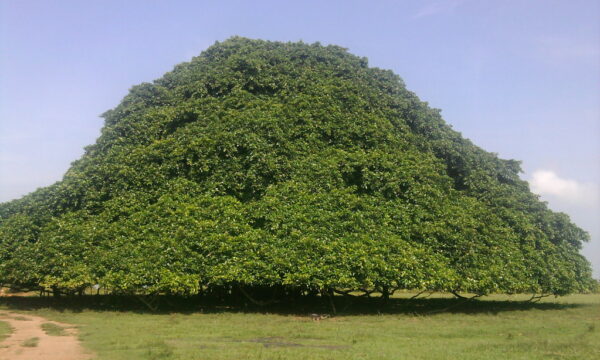
At first glance, it looks like a small mountain rising gently from the Colombian landscape. Only when people draw closer do they realize the truth: this is not a hill, but one of the largest and most extraordinary trees in Colombia. Towering, sprawling, and almost architectural in scale, the Giant Fig of San Marcos challenges the way we imagine what a single tree can be.
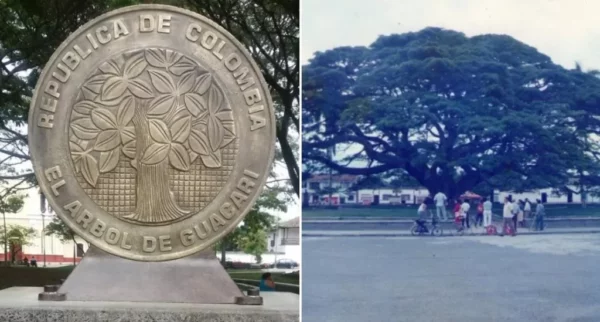
Located in Colombia’s Caribbean region, this colossal fig tree has often been confused with another famous giant, the Samán of Guacarí. That earlier tree, a Samanea saman (commonly known as a rain tree), was once so iconic that it appeared on Colombia’s 500-peso coin in the 1990s. However, the Samán of Guacarí was cut down in 1989 after its massive branches became structurally unstable.
The tree at San Marcos, though visually similar, belongs to an entirely different lineage. It is a Ficus—a member of the fig tree family, a group known worldwide not only for edible figs but also for some of the planet’s most dramatic “strangler figs,” trees that expand outward through aerial roots and gradually reshape entire landscapes (National Geographic).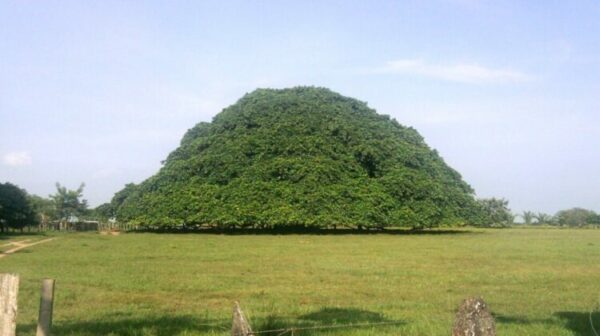
What makes the Giant Fig of San Marcos so striking is not just its size, but how it grows. Estimates suggest it may reach around 30 meters in height and span up to 75 meters in diameter, dimensions so vast that standing beneath its canopy feels less like being under a tree and more like entering a natural cathedral. While precise measurements vary, photographs and field observations consistently emphasize its immense footprint.
Its foliage forms a dense green mass that rolls outward like a forested hill. Long, heavy branches stretch so far from the original trunks that gravity alone could not support them. In response, the tree produces aerial roots that descend from the branches, harden into woody pillars, and anchor themselves into the ground. Over time, these roots become natural columns, supporting the canopy much like the pillars of a monumental building.
Botanists have long documented this behavior in large fig species, particularly tropical Ficus, which use aerial roots to expand laterally and stabilize their weight (Smithsonian National Museum of Natural History). In San Marcos, this process has created an illusion of motion. Locals sometimes refer to it as “the walking tree,” a poetic way of describing how it appears to advance across the land through its root-pillars.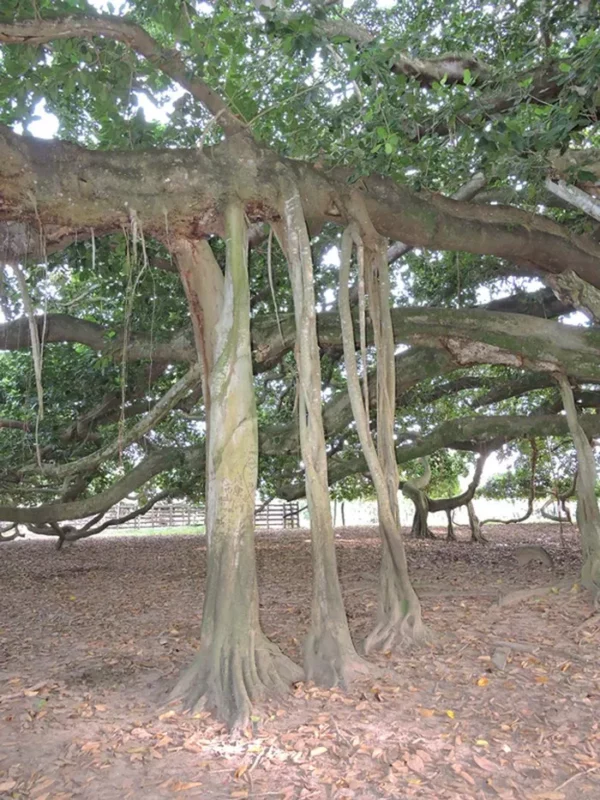
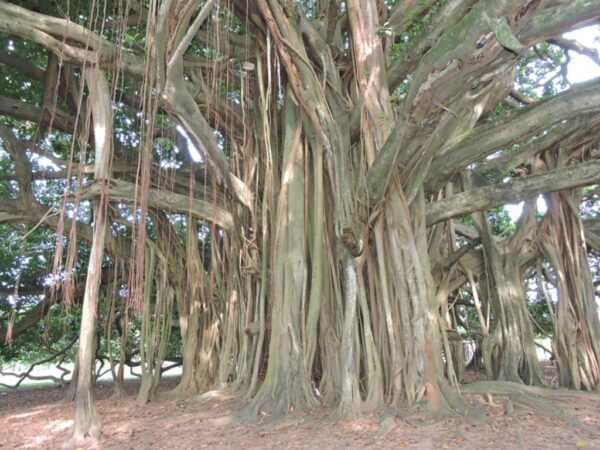
Perhaps the most surprising detail is that this giant is not a single tree at all. According to historical accounts, including descriptions by regional historian Raúl Ospino Rangel, the structure began as six separate fig cuttings planted in 1964.
The original intention was practical. The owner of the Alejandría farm placed six fig rods around a young yellow cedar tree to protect it from grazing cattle. Instead of acting as passive guards, the fig cuttings took root, sprouted branches, and eventually dominated the space. Over time, their aerial roots fused, their trunks merged, and the six trees became one interconnected organism. The cedar did not survive.
This process of fusion is not unique to figs. Scientists note that some Ficus species are especially adept at grafting and self-support through root systems, allowing multiple individuals to merge into a single massive structure (BBC Earth).
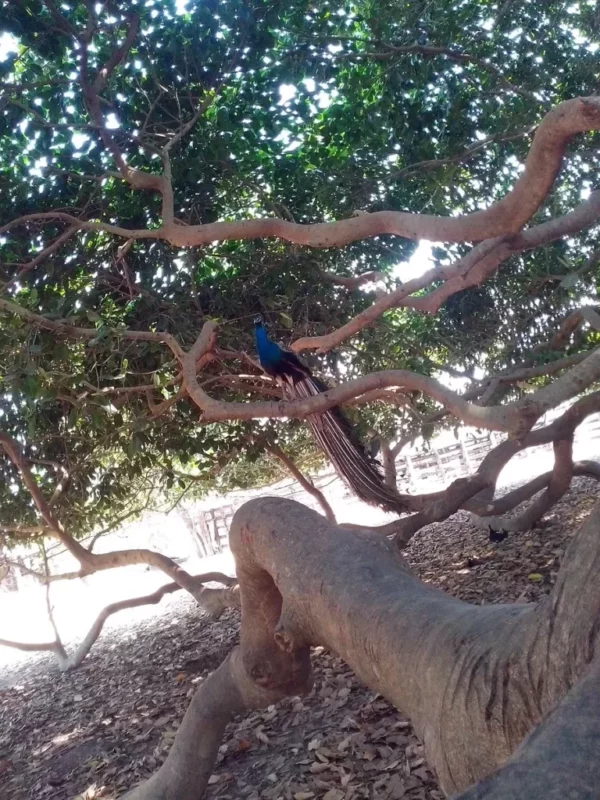
Standing beneath the Giant Fig of San Marcos evokes a sense of scale that is both humbling and intimate. People often describe feeling small but protected, surrounded by living columns and filtered light. The experience mirrors what ecologists and anthropologists often emphasize: trees of this scale become more than biological organisms. They turn into landmarks, gathering places, and symbols of endurance.
Although this fig tree does not rival General Sherman—the giant sequoia in California—in terms of volume, it rivals many of the world’s largest trees in spatial presence and visual impact. Its importance lies not only in size but in structure, history, and the way human action unintentionally shaped its existence.
Large fig trees across the tropics are increasingly recognized for their ecological role as keystone species, supporting birds, mammals, insects, and entire micro-ecosystems (Nature Ecology & Evolution). The Giant Fig of San Marcos is likely no exception.
In an era of deforestation and shrinking biodiversity, living monuments like the Giant Fig of San Marcos remind us that nature’s most impressive creations often emerge slowly, through decades of interaction between environment and chance. This tree is not the result of careful design, but of unintended consequences, resilience, and time.
Protecting such natural giants is not only about preserving beauty. It is about safeguarding ecological complexity and cultural memory. As climate pressures increase and land use intensifies, trees like this may become rarer than ever.
For those who visit Colombia’s Atlantic coast, the Giant Fig of San Marcos is visible long before one reaches the Alejandría farm—its green mass rising above the horizon like a hill that breathes. Up close, it offers a powerful reminder that nature can still dwarf human scale, even in a world we often believe we have fully mapped.