The night Ria Mercer wrapped a rusted chain around her fist and stepped into the dark, she wasn't thinking about consequences. She wasn't thinking about her grandmother's oxygen bills stacked on the kitchen counter, or the eviction notice tucked behind the coffee maker, or the three job rejections she'd collected that week like bad omens. She was thinking about the old man on his knees in the gravel, bleeding from his lip while six men laughed at him under a buzzing gas station light. She was thinking about her grandfather's voice, ragged and certain as an engine turning over in winter.
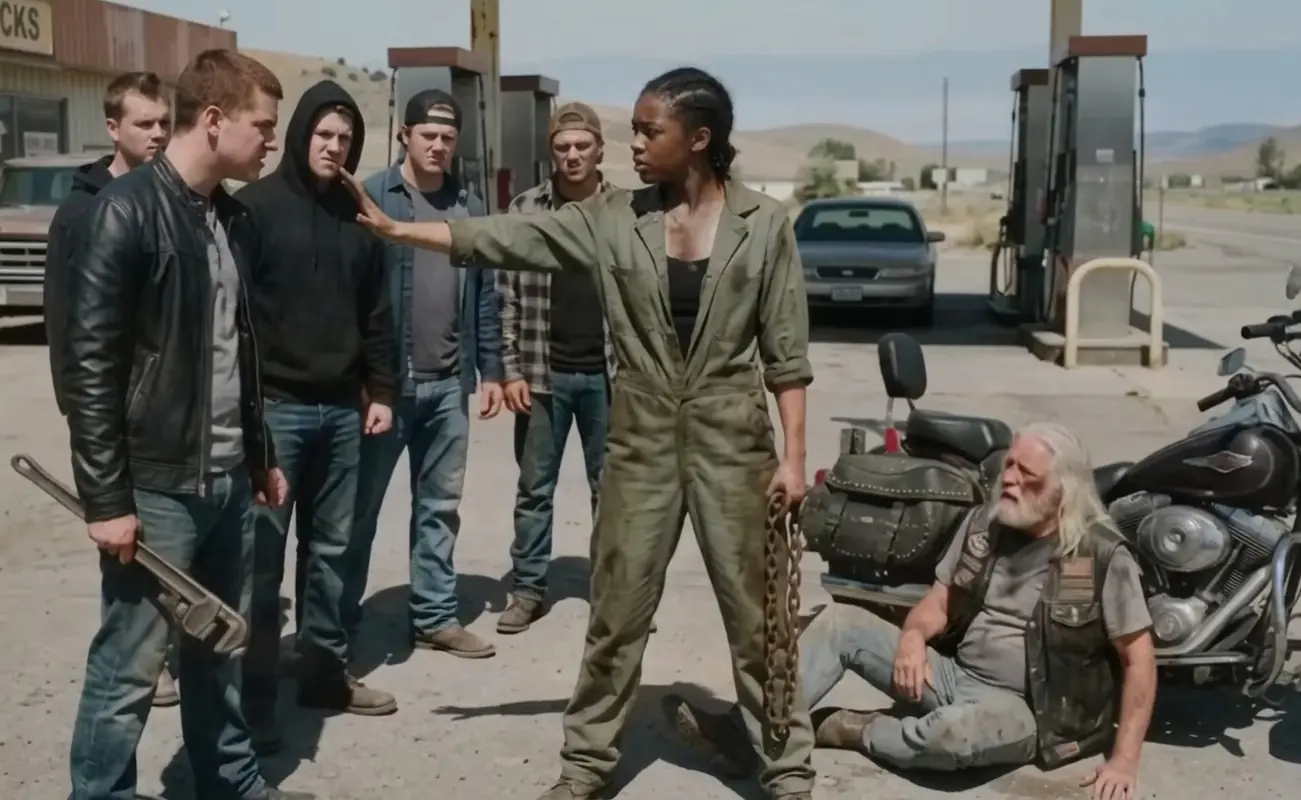
Someone has to stop. What she didn't know, what nobody warned her about, was that stepping into that circle of light would cost her everything she thought she was and give her everything she never knew she needed. And somewhere in the darkness beyond that gas station, engines were already running. The gas station on Route 9 had been dying for years.
The sign above the canopy was missing two letters. The pumps accepted cards only on alternating Tuesdays, and the single fluorescent tube above the restroom entrance flickered so reliably it had become a kind of clock for the long haul drivers who stopped there out of desperation rather than preference. The parking lot was cracked asphalt and old oil stains. And at 11:17 on a Thursday in late October, it was exactly the kind of place where bad things happened and nobody official ever arrived in time.
Ria Mercer was halfway across that parking lot when she heard the first sound. Not a shout, but a low, wet laugh that didn't have any warmth in it. She stopped. Her grocery bag was light in her hand, a loaf of bread, a can of soup, two apples she'd checked three times for bruising because every dollar was accounted for this week.
The wind came off the tree line to the east, carrying dead leaves and the smell of coming frost. And beneath it, she caught something else: diesel, worn leather, and the particular stillness of men who wanted witnesses to be absent. She should have kept moving. She knew that.
She'd learned how to keep moving when she was 17, and her parents' car note disappeared and the apartment went with it. And she'd refined the skill every year since. Staying invisible wasn't cowardice. It was math.
She was 24 years old, 132 lb of motorcycle grease, and borrowed time. And she had a grandmother whose oxygen concentrator hummed through the wall every night like a prayer she wasn't sure anyone was answering. She took three more steps toward the road. Then she heard the old man's voice. "I'll get up when I'm ready," he said, and it came out steady, not begging, not afraid, just a statement from somewhere very deep in the chest of someone who had learned how to absorb pain without flinching.
The kind of voice that had been steady once in a place where steadiness meant survival. Ria turned. There were six of them arranged in a loose half circle near the far pump island where two motorcycles sat idling on their kickstands. Older Harleys, a Sportster and a Road King, both carrying the particular patina of machines that had been ridden hard and maintained with love.
The man on his knees in front of them was somewhere past 70, broad-shouldered still, with white hair tucked under a battered leather vest that had more patches than open space. His hands were on the gravel and his lip was split and the nearest one, a thick-necked man in a Carhartt jacket, was laughing. "What's he going to do?" the man in the Carhartt jacket said to the others. "Call his little biker friends." More laughter.
One of them kicked the old man's saddle bag over and the contents spread across the pavement. A small tool roll, a folded road map, a photograph in a cracked plastic sleeve that skidded six feet and landed face up under the fluorescent light. The old man reached for it. The man in the Carhartt jacket put his boot on it. Something shifted in Ria's chest.
Not a decision exactly, more like a lock releasing. She set her grocery bag on the ground carefully. She picked up what she'd spotted when she first walked into this lot and cataloged from habit the way every mechanic cataloged useful objects. A length of rusted logging chain, maybe 18 in, coiled loose beside the air pump housing.
She wrapped one end twice around her right hand, let the rest hang, and walked toward the light. Her boots were steel-toed. That wasn't an accident. She'd bought them two years ago for the garage floor and never found a reason to wear anything else.
Her hands were calloused at every knuckle. That wasn't an accident either. She came into the edge of the fluorescent light and six heads turned. "Hey," she said, just the one word.
No threat in it, no bravado, just the sound of someone arriving who hadn't been asked to. Carhartt looked at her the way men like him always looked at women who interrupted them. First dismissal, then recalculation, then something that thought it was menace. Walk away, sweetheart.
Nothing here for you. You're on his photograph, Ria said. Nobody moved. Your boot, she said. You're standing on his photograph.
Step off it. The man to Carhartt's left actually smiled. A real one, like she'd done something funny. Two of the others traded a look.
The old man on the gravel was very still. And in that stillness, Ria caught something she hadn't expected. He wasn't watching the men around him anymore. He was watching her.
His eyes were dark, deep set, patient as water. They weren't afraid. They were waiting. "Last chance," Carhartt said and moved toward her.
What happened next was over almost immediately. The man in the Carhartt jacket came at Ria first, and she used the chain only long enough to stop his advance. When another man reached for her, she pulled away and kept distance. Then Silas rose with startling speed and moved with the compact efficiency of someone who had survived hard situations before.
Within seconds, the group lost its confidence and backed off. It lasted less than 30 seconds total. When it was done, Carhartt was on the asphalt holding his shin. Two others had retreated to a dented Silverado at the lot's edge.
The remaining three stood at the uncertain distance men choose when they've already lost the encounter and are trying to decide whether their pride is worth the additional cost. The old man reached down and picked up his photograph from the pavement. He looked at it once, then tucked it inside his vest close to his chest. He turned to Ria.
"Thank you," he said. "Don't thank me yet," she said, "because in the distance, from the direction of the highway, she could already see the flicker of red and blue lights." But her name was Ria Mercer, and she was, by most practical definitions, losing. She'd been losing slowly enough that she'd almost convinced herself it was standing still, which was how that particular kind of losing worked. She'd grown up in Caldwell, a town of 14,000 people 40 mi from anywhere that mattered.