Sometimes betrayal does not arrive with warning signs.
Sometimes it waits behind a hotel door, wearing your spouse’s perfume and another person’s shirt.
My name is Daniel Mercer. I was thirty-eight years old when I flew to Seattle with my two children to surprise my wife.
By the next morning, I was flying home with a son who would not speak, a daughter who kept asking why Mommy cried, and a marriage I already knew was finished.
My wife’s name was Laura.
We had been married for thirteen years.
We had two children: Noah, twelve, sharp-eyed and quiet in the way boys become when they start noticing more than adults want them to notice, and Emma, eight, soft-hearted, dramatic, and completely convinced her mother could fix anything in the world with one hug.
Laura worked as a senior marketing strategist for a medical technology company. Her job involved conferences, client dinners, presentations, and enough travel that the kids had grown used to missing her in little pieces.
Three days here.
Four days there.
A week every quarter.
She always came home tired, carrying airport coffee, conference tote bags, and guilt gifts from whatever city had borrowed her from us.
A stuffed sea lion from San Diego.
A snow globe from Denver.
A keychain shaped like the Space Needle from Seattle.
That week, she was back in Seattle for a product launch.
Five days.
She had left Sunday morning.
By Tuesday night, Emma was sleeping with one of Laura’s sweaters under her pillow.
By Wednesday morning, Noah asked over cereal, “Does Mom even like being home anymore?”
The question landed harder than he meant it to.
I looked up from packing his lunch.
“What makes you say that?”
He shrugged.
“She just seems happier when she’s going somewhere.”
I wanted to correct him.
I wanted to say his mother loved us, that work was demanding, that adults could be tired without being unhappy.
But before I could speak, Emma looked up with milk on her upper lip and said, “Can we go see her?”
At first, I almost laughed.
Then I stopped.
Why not?
The idea arrived bright and foolish.
A surprise trip.
A family reunion in the middle of her business week.
We could fly in Thursday evening, show up at her hotel, and take her to dinner. Laura loved surprises when they made her feel loved. Or at least she used to.
“Maybe,” I said.
Emma gasped as if I had promised Disneyland.
Noah looked skeptical.
“Seriously?”
“Seriously.”
Within two hours, I had checked flight prices, called my supervisor, rescheduled a Friday meeting, and booked three tickets to Seattle.
I texted Laura.
Kids miss you. Hope the launch is going well. Love you.
The message showed delivered.
No reply.
That was not unusual during events. Laura could go hours without checking her phone when she was on stage or in client meetings.
Still, something small moved in my stomach.
Not fear.
Not yet.
Just the first quiet note of unease.
I called her that night.
Voicemail.
I left a message.
“Hey, babe. Just wanted to hear your voice. Call when you can.”
Nothing.
The next morning, I tried again before we left for the airport.
Voicemail again.
Emma bounced through security wearing her purple backpack and carrying a handmade card she had spent half the night decorating.
On the front, in crooked marker letters, she had written:
SURPRISE, MOMMY!
Inside, she drew all four of us holding hands beneath a yellow sun.
Noah saw me look at it and said quietly, “Don’t make a big deal, Dad.”
“I’m not.”
“You look like you’re about to cry.”
“I have allergies.”
He gave me the look children give parents when the lie is too weak to deserve correction.
The flight was short enough to be easy and long enough for my unease to grow teeth.
I called Laura before boarding.
Nothing.
We’re thinking of you. Hope today went well.
Delivered.
No response.
By the time we reached downtown Seattle, rain had softened the city into reflections. Streetlights blurred across wet pavement. Emma pressed her face against the taxi window, delighted by everything.
“Look, Dad! The buildings are wearing clouds!”
Noah sat beside me, silent, watching my phone.
“She still hasn’t answered?” he asked.
“She’s probably at dinner.”
“You said her big presentation ended this afternoon.”
I looked at him.
He looked back.
Too smart.
Too young.
Both things were true.
Laura’s hotel was a polished glass tower near the waterfront, the kind of place her company booked without blinking. The lobby smelled of cedar, coffee, and expensive flowers. Business travelers moved through it with rolling suitcases and tired faces.
Emma clutched her card.
“Can we go straight to her room?”
“Let me check us in first.”
At the front desk, a young man with perfect posture smiled at me.
“Welcome. Checking in?”
“Yes. Mercer. Daniel Mercer.”
He typed.
“Three guests, one night?”
“That’s right.”
As he processed the reservation, I tried to keep my tone casual.
“My wife is staying here too. Laura Mercer. She’s here for a company event. Could you ring her room?”
“Of course.”
He typed again.
His expression changed.
Only slightly.
Professional people are trained to hide discomfort, but not all discomfort can be hidden.
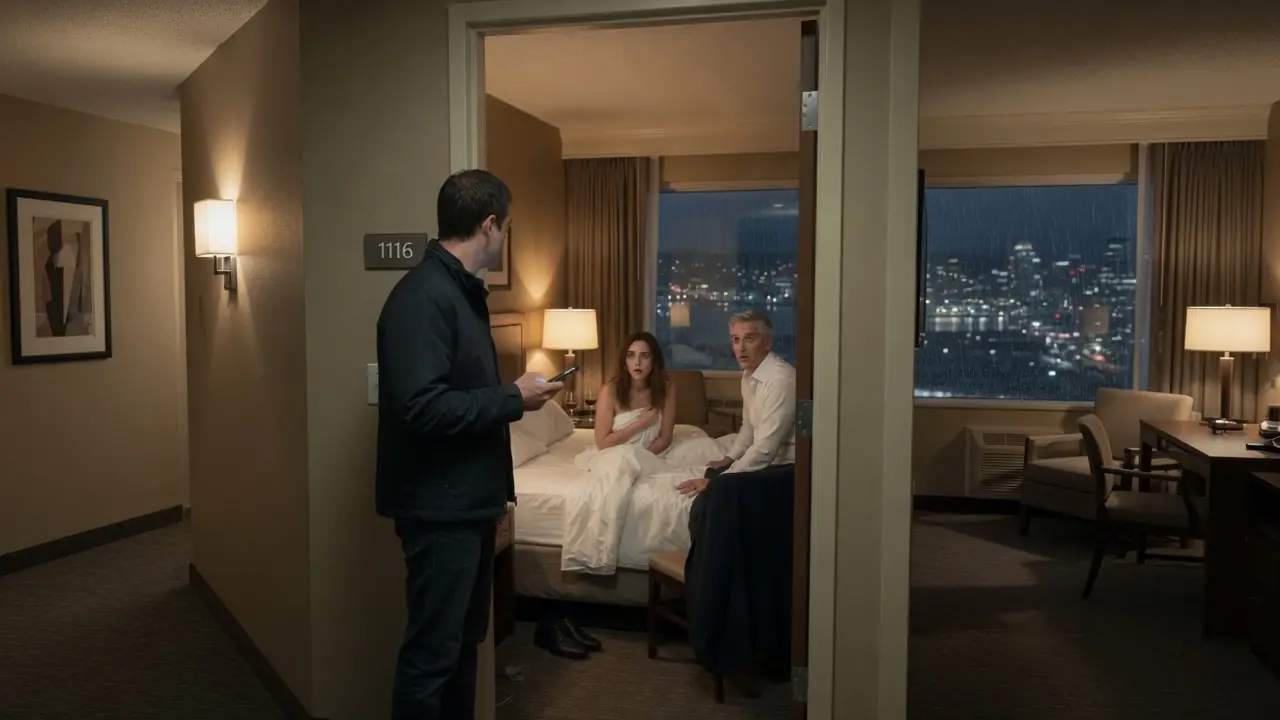
“Yes, Mrs. Mercer is in room 1116. Would you like me to call up?”
“Please.”
He dialed.
Waited.
No answer.
He tried again.
Still nothing.
“She may be out,” he said.
“Right. Sure.”
He handed me our key cards.
“You’re in 1108. Same floor.”
“Convenient.”
“Yes.”
Then he hesitated.
It lasted half a second, but I saw it.
“Is there something else?”
“No, sir.”
He smiled too quickly.
I took the key cards.
Noah noticed.
Of course he did.
“What was that?” he asked as we walked toward the elevators.
“What was what?”
“That face.”
“He was just being polite.”
Noah did not believe me.
Emma was too busy bouncing.
“Mom is going to freak out.”
I looked at her card.
My chest tightened.
The elevator rose slowly.
Too slowly.
When we reached the eleventh floor, I opened our room first and set the bags inside. Emma immediately climbed onto one of the beds and held up the card like a trophy.
“Now?”
“In a minute.”
I could hear my own voice from far away.
“Noah, stay here with your sister.”
His eyes narrowed.
“You’re going alone?”
“I’m just checking if she’s in.”
“Dad.”
“One minute.”
I stepped into the hallway before he could say more.
The corridor was quiet, carpeted, warm, and bright in that strange hotel way that makes every door look like it is hiding a different life.
Room 1116 was eight doors down.
I stood outside it and listened.
At first, nothing.
Then laughter.
A man’s laugh.
Low.
Familiar in the way betrayal becomes familiar before you know its name.
I knocked.
The laughter stopped.
I knocked again.
Harder.
Silence.
I took out my phone and typed.
I am outside your hotel room. Open the door.
For ten seconds, nothing happened.
Then I heard movement.
A drawer closing.
A whispered curse.
The lock clicked.
The door opened only a few inches.
Laura stood there in a white hotel robe, hair loose, makeup smudged, eyes wide.
For a second, I saw pure shock.
Then fear.
Then irritation.
That was the part that stayed with me.
Not the robe.
Not the room.
Not the man’s laugh.
The irritation.
As if I had interrupted something inconvenient.
“Daniel,” she whispered. “What are you doing here?”
I stared at her.
“Surprise.”
Her face went pale.
“The kids?”
“Down the hall.”
She gripped the edge of the door.
“You brought the kids?”
“They wanted to see their mother.”
She closed her eyes.
I could see the room behind her through the narrow gap.
A man’s jacket on a chair.
Two wineglasses.
A pair of men’s shoes near the bed.
My body became very still.
“Who is in the room, Laura?”
“No one.”
I looked at the shoes.
She followed my gaze and knew.
“Daniel, please. Not here.”
The door opened wider, and a man stepped into view behind her.
He was maybe forty-five, tall, silver at the temples, wearing a dress shirt not yet buttoned all the way. His face changed when he saw me.
Not guilt.
Confusion.
“Laura?” he said. “Is everything all right?”
I knew him.
Not well.
But I knew him.
Evan Cole.
Her department director.
The man whose name appeared in her stories too often.
Evan said, “Who is this?”
That question hit harder than I expected.
Not because he asked it.
Because he did not know.
I looked at Laura.
“You didn’t tell him you were married.”
Evan’s eyes moved to her.
“Married?”
Laura’s mouth opened.
Closed.
“Daniel, let me explain.”
I almost laughed.
It came out dead.
“Explain to both of us, apparently.”
Evan stepped back as if the room itself had shifted under him.
“You told me you were separated.”
Laura’s eyes filled.
“I was going to tell you.”
“Tell which one of us?” I asked.
She flinched.
Down the hall, a door opened.
A guest looked out, then quickly disappeared again.
Laura whispered, “Can we please not do this in the hallway?”
I leaned closer, keeping my voice low.
“Our daughter is in room 1108 holding a card she made for you. She drew all four of us under a sun. Our son is pretending he doesn’t know something is wrong. So yes, Laura, I agree. Let’s not do this in the hallway.”
The blood drained from her face.
Evan grabbed his jacket.
“I’m leaving.”
I looked at him.
“Did you know she had kids?”
His face hardened, not at me, but at her.
“No.”
Laura began crying then.
“Evan—”
He shook his head.
“No. Do not.”
He walked past us into the hall, buttoning his shirt with shaking hands.
When he reached the elevator, he looked back once.
“I’m sorry,” he said to me.
Then the doors opened and took him away.
Laura stood in the doorway, arms wrapped around herself.
“How long?” I asked.
She wiped her face.
“Daniel—”
“How long?”
She looked at the carpet.
“Six months.”
The hallway seemed to tilt.
Six months.
Half a year of late calls, locked phones, extra trips, tired smiles, and me telling myself marriage changed shape when people got busy.
“Was Seattle the first hotel?”
“No.”
That single word ended something in me.
Not loudly.
It simply ended.
I stepped back.
“Get dressed. The kids are waiting.”
Her eyes snapped up.
“You’re not going to tell them.”
“I haven’t decided what I’m going to tell them.”
“You can’t just—”
“I can.”
My voice was quiet enough that she stopped talking.
“I have lied to myself for six months without knowing it. I will not knowingly lie to my children for you.”
I turned and walked back to our room.
Each step felt heavy.
At the door, I paused and forced air into my lungs.
When I entered, Emma jumped off the bed.
“Is Mommy coming?”
Noah stood near the window, arms folded.
He took one look at my face and understood more than I wanted him to.
“She’s getting dressed,” I said.
Emma smiled.
“Did she scream?”
“No.”
“Cry?”
“A little.”
Emma looked pleased.
“Happy cry?”
I looked at my daughter’s hopeful face and felt something inside me crack.
“Maybe.”
Noah’s eyes narrowed.
I gave him the smallest shake of my head.
Not now.
He looked away.
Laura knocked five minutes later.
Emma ran to the door before I could stop her.
“Mommy!”
Laura stepped inside dressed in a navy blouse and black slacks, hair brushed, face repaired. If I had not seen her moments earlier, I might have believed nothing was wrong.
She hugged Emma tightly.
Too tightly.
Emma laughed.
“You’re squishing me!”
“I missed you,” Laura whispered, and for once I believed her.
Noah did not move.
Laura looked at him.
“Hey, sweetheart.”
He hated being called sweetheart now.
She knew that.
“Hey,” he said.
His voice was flat.
Laura crossed the room like she might hug him too.
He stepped back.
The movement was small.
But she felt it.
Her face crumpled for half a second before she fixed it.
Emma held up the card.
“I made this on the plane!”
Laura took it.
Her hands shook when she opened it.
Four stick figures under a sun.
Mom, Dad, Noah, Emma.
A heart over the hotel.
Laura pressed one hand to her mouth.
Emma beamed.
“Do you love it?”
Laura nodded.
“I love it so much.”
Noah turned toward the window.
Room service came with burgers, fries, and chocolate cake.
Emma talked through dinner as if sound could keep the world bright. She told Laura about the flight, the taxi, the buildings wearing clouds, the hotel shampoo that smelled like lemons.
Laura listened, smiled, nodded, and looked at me whenever Emma looked down.
Each look said the same thing.
Please.
Please help me keep this together.
But I was not sure there was anything left to keep together.
After dinner, Emma wanted to see the waterfront.
Laura said she had work calls.
I laughed once before I could stop myself.
Emma looked up.
“What?”
“Nothing.”
Laura’s eyes flashed.
“I can reschedule.”
“No,” I said. “Don’t change your plans on our account.”
The words were sharper than I meant to let them be.
Noah heard.
So did Laura.
Emma did not.
“Can Mom come tomorrow then?” she asked.
Laura knelt in front of her.
“Yes. Tomorrow. I promise.”
That word.
Promise.
It sat in the room like a broken glass.
I took the kids to the waterfront alone.
Rain had stopped, leaving the city wet and glowing. Boats moved in the harbor. Lights shimmered on the water. Emma held my hand and skipped every third step.
Noah walked beside me in silence.
After a while, he said, “It’s him, isn’t it?”
I did not answer.
“Dad.”
I looked at him.
He was twelve.
Still a child.
Already bracing like an adult.
“Your mom and I are having a serious problem,” I said carefully.
“That means yes.”
I stopped walking.
Emma was ahead of us, staring at a street musician with a violin.
“Noah.”
“I’m not stupid.”
“I know.”
“I saw her face. I saw yours. And she said she had calls instead of coming with us after we flew here.”
His voice lowered.
“She cheated.”
I closed my eyes.
I wanted to protect him from the word.
But the word was already there.
“Yes,” I said.
He looked toward the water.
His jaw tightened.
“How long?”
“I found out tonight.”
“That’s not what I asked.”
I exhaled.
“Six months, from what she said.”
He flinched.
Then his face hardened.
“With who?”
“Someone from work.”
“Does Emma know?”
“No.”
“Don’t tell her yet.”
“I wasn’t planning to tonight.”
“She still thinks Mom is perfect.”
I looked at him.
“And what do you think?”
He stared out at the dark water.
“I think perfect people don’t make their kids fly across the country to catch them lying.”
The sentence hit me so hard I could not speak.
Emma ran back to us.
“Dad! Noah! The violin man knows Disney songs!”
I forced a smile.
“That so?”
Noah stepped closer to me, shoulder brushing mine.
It was not quite a hug.
For him, it was more.
“We’ll be okay,” he said quietly.
I should have been the one saying that to him.
Instead, my son gave me the strength to keep standing.
When we returned to the hotel, Laura was waiting outside our room.
Her arms were crossed. Her face was pale.
“Where have you been? I called you eight times.”
I patted my pockets.
“Left my phone in the room.”
Noah walked past her without speaking and opened the door with his key card.
Laura’s eyes followed him.
“What did you tell him?”
“The truth.”
Her face changed.
“You had no right to do that without me.”
That sentence almost made me laugh.
But Emma was leaning against my side, sleepy and confused.
“Mommy, why are you mad?”
Laura bent quickly.
“I’m not mad, baby. I was worried.”
“It sounds mad.”
“I know.”
Emma yawned.
“I’m tired.”
I lifted her into my arms.
“I’ll put her to bed.”
Laura touched my arm.
“We need to talk.”
“Yes,” I said. “We do. After she’s asleep.”
Inside, Noah put on his headphones and sat with his back against the wall, though I knew he was listening to everything.
I helped Emma change, tucked her in, and sat beside her until her breathing slowed. Laura kissed her forehead, then stood awkwardly near the bed like a guest in her own family.
When Emma was asleep, Noah pulled off one headphone.
“Go,” he said. “I’m fine.”
Laura flinched at his tone.
I followed her down the hall to room 1116.
The room had been cleaned.
Or rather, arranged.
The wineglasses were gone. The bed was made. Evan’s shoes were no longer there.
But betrayal has a smell even housekeeping cannot remove.
I stayed near the door.
Laura sat on the edge of the bed, then seemed to realize what that looked like and stood again.
“I don’t know where to start,” she said.
“The beginning.”
She wiped at her eyes.
“It started in Chicago. At a conference. Evan and I were working late. We had drinks. It crossed a line.”
“How many lines did it cross before tonight?”
She looked down.
“Daniel.”
“How many hotels?”
Her shoulders sagged.
“Four.”
I nodded slowly.
Four hotels.
Four sets of sheets.
Four versions of me at home packing lunches, checking homework, making sure Emma had her allergy medicine, and telling Noah his mother was busy because she worked hard for this family.
“Did he know about us?”
“He thought we were separated.”
“That’s not an answer.”
“No,” she whispered. “Not at first.”
My chest tightened.
“So you lied to him too.”
She cried harder.
“I was confused.”
“No. You were selfish.”
She looked up.
“That’s not fair.”
“Fair?” I repeated. “Our daughter made you a card on the plane. Our son just asked me whether his parents are getting divorced beside the Seattle waterfront. Do not talk to me about fair.”
Her face crumpled.
“I never wanted to hurt the kids.”
“But you were willing to risk it.”
Silence.
That was the truth she could not argue with.
“I felt invisible,” she said finally. “At home, I was Mom. At work, I was useful. With Evan, I felt seen.”
I stared at her.
“If you were unhappy, you could have told me.”
“I tried.”
“No. You sighed. You withdrew. You stayed on your phone. You made me guess. That is not the same as fighting for us.”
“I know.”
“Do you?”
She stepped closer.
“I want to fix this.”
I looked at her.
The woman I had loved since twenty-five.
The mother of my children.
The person who had once held my hand in a hospital when Noah was born and whispered, “We’re a team forever.”
A stranger had borrowed her face.
“I don’t know if I can ever trust you again.”
“We can go to counseling.”
“Maybe.”
Hope flashed in her eyes.
I hated that I had given it to her by accident.
“I said maybe,” I continued. “Not because I know I want this marriage. Because I need to make decisions when I’m not standing in the room where you cheated on me.”
She covered her mouth.
I turned to leave.
“What do I tell the kids tomorrow?” she asked.
“The truth in pieces they can survive.”
“And us?”
“There is no us tonight.”
The flight home the next morning was quiet.
Laura stayed in Seattle to finish the launch.
That was what she told Emma.
Noah knew better.
At the airport, Emma hugged her mother tightly.
“Come home soon.”
Laura held her like she was afraid someone would pull the child away.
“I will, baby.”
Noah gave her a stiff hug.
When Laura whispered, “I love you,” he said, “Okay.”
That one word hurt her more than shouting would have.
On the plane, Emma fell asleep before takeoff.
Noah stared out the window.
After a while, he said, “Are you going to divorce her?”
“I don’t know.”
“You should.”
I looked at him.
“Noah.”
“I know. Adult decision. Complicated. Whatever.”
His voice cracked on the last word.
Then he turned away, but not before I saw the tears.
I reached across the armrest.
He let me put a hand on his shoulder.
Only for a second.
Then he leaned into it.
“I hate her,” he whispered.
“No, you don’t.”
“I want to.”
“I know.”
He cried silently, facing the window.
I kept my hand on his shoulder and said nothing.
Sometimes fatherhood is not having the right words.
Sometimes it is staying close while your child learns the world is not as safe as you tried to make it.
Laura came home three days later.
She brought gifts.
A stuffed otter for Emma.
A Seahawks cap for Noah.
He left it on the kitchen table.
Emma hugged the otter and asked why everyone was sad.
That night, after Emma was asleep, Laura and I sat at the kitchen table.
No hotel carpet.
No rain on windows.
No Evan.
Just our house.
Our life.
The place where the truth had to live now.
Laura cried.
I did not.
Not because I felt nothing.
Because something in me had gone still.
We talked for three hours.
She admitted the affair had lasted six months. She admitted she had told Evan we were separated. She admitted she had considered leaving but never seriously enough to stop accepting the comfort of home.
That was the worst part.
Not that she wanted another life.
That she had wanted both.
The excitement of betrayal and the safety of our family.
A man in hotel rooms and a husband packing school lunches.
“I ended it,” she said.
“That’s easy after being caught.”
“It’s still true.”
“I believe you.”
She looked relieved.
“That doesn’t mean I trust you.”
Her relief vanished.
For three weeks, we tried.
Counseling.
Separate bedrooms.
Hard conversations.
Schedules for the kids.
Emma learned only that Mommy had hurt Daddy very badly and that grown-ups sometimes broke promises in ways that could not be fixed quickly.
Noah knew more.
He spoke to Laura only when necessary.
That broke her.
But it did not fix what she had broken.
One night, after a counseling session where Laura spent forty minutes explaining how lonely she had felt, the therapist asked me what I felt.
I looked at Laura.
Then at my hands.
“Tired,” I said.
Laura cried.
The therapist waited.
I said, “I am tired of trying to understand why someone else’s loneliness gave them permission to destroy my peace.”
That was the moment I knew.
Not angrily.
Not dramatically.
I was done.
Two months later, divorce papers sat between us on the dining room table.
Laura signed first.
Her hand shook.
“I never thought we would end here,” she said.
“Neither did I.”
“Do you hate me?”
I considered.
“No.”
Her eyes filled.
“I wish you did. It would make more sense.”
“I don’t hate you,” I said. “But I don’t know how to stay married to someone I had to meet honestly in a hotel hallway.”
She closed her eyes.
“I’m sorry.”
“I know.”
“I’ll spend the rest of my life being sorry.”
“Spend it being better for the kids.”
She nodded and signed the last page.
The months after were not easy.
Divorce does not end pain.
It only gives pain a new address.
Emma cried the first time Laura moved into her apartment. Noah refused to stay overnight there for six weeks. I learned how to answer questions I did not want asked.
Why can’t Mommy come home?
Do you still love her?
Was it because of us?
That last one nearly killed me.
“No,” I told Emma, holding her while she sobbed into my shirt. “Never. None of this was because of you.”
Noah stood in the hallway listening.
Later, he came into the kitchen and said, “You always answer her better than Mom does.”
“That’s not a competition.”
“I know.”
He opened the fridge.
Then closed it without taking anything.
“I’m glad you didn’t lie to me.”
I looked at him.
“So am I.”
A year later, our life looked different.
Not perfect.
Different.
Emma split her time between two bedrooms and decided both needed glow-in-the-dark stars. Noah started talking to Laura again, slowly, cautiously, mostly about school and baseball. Laura never missed another call from the kids.
She changed.
I could admit that.
But change after damage does not erase the damage.
It only decides whether more will be added.
One Saturday, Emma found the old card she had made on the plane to Seattle.
SURPRISE, MOMMY!
The sun had faded a little.
One corner was bent.
She brought it to me.
“Do you remember this?”
“Yes.”
Her face turned serious.
“That was a bad trip.”
I sat beside her on the couch.
“Yes.”
“Were you sad?”
“Very.”
“Are you still sad?”
I thought about that.
“Sometimes. But not the same way.”
She nodded like that made sense.
Then she leaned against me.
“I still like the sun I drew.”
“I do too.”
Noah walked through the living room, saw the card, and stopped.
For a moment, I saw the twelve-year-old boy on the Seattle waterfront again, shoulders tight, trying to hold up a father who should have been holding him.
Then he said, “The sun looks like a fried egg.”
Emma gasped.
“It does not!”
“It does.”
I watched them argue until both were laughing.
And that was how healing looked in our house.
Not like a grand victory.
Not like forgetting.
Like laughter returning to a room where pain had once taken up all the space.
Sometimes I still think about that hotel hallway.
The robe.
The man’s shoes.
The look on Laura’s face.
I used to wish I had never gone to Seattle.
That I had stayed home, kept believing, let the lie live a little longer.
I do not wish that anymore.
The truth hurt.
But the truth also gave me back my life.
It gave Noah the knowledge that his father would not pretend poison was medicine.
It gave Emma a home where sadness was not hidden under fake smiles.
And it gave Laura the consequence she needed to become a better mother, even if she could no longer be my wife.
Some doors ruin your life when they open.
Some doors reveal it was already ruined behind the frame.
Room 1116 did both.
But I walked away from it with my children.
And in the end, that was the part that mattered most.
Not the betrayal.
Not the hotel.
Not the marriage that ended.
The two small hands I still had to hold.
The two hearts I still had to protect.
And the quiet promise I made to myself on the flight home:
I would never again call silence peace just because the truth was too painful to hear.