“Students like you should learn to be realistic.”
Mr. Warren Cole said it quietly enough that only the first two rows heard him, but loudly enough for Maya Brooks to understand exactly what he wanted the room to know.
Maya stood beside her science fair table with both hands at her sides.
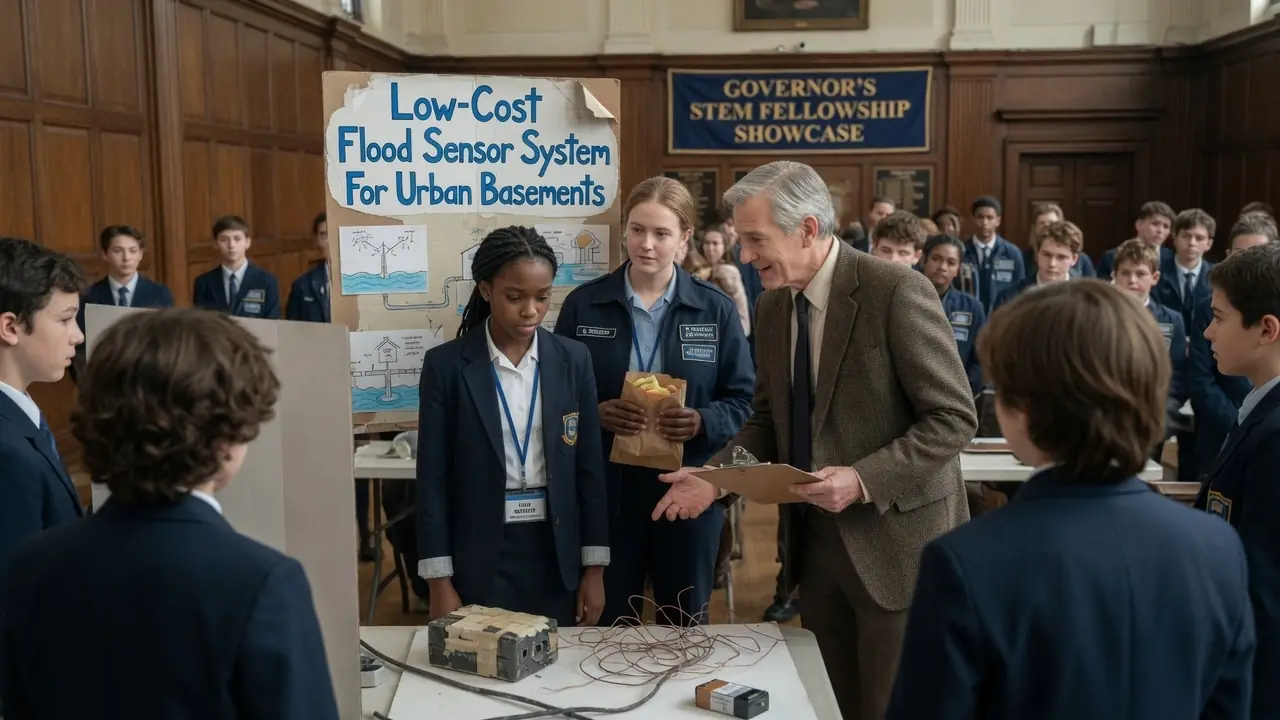
The cardboard sign behind her read:
Low-Cost Flood Sensor System For Urban Basements
One corner of the poster had curled because the glue stick had dried unevenly overnight.
Her mother had helped her press it flat under a stack of old church hymnals at 1:17 a.m.
Mr. Cole looked at the poster.
Then at Maya.
Then at the cracked plastic box of wires, sensors, and batteries sitting on her table.
“You know,” he said, smiling with no kindness in it, “ambition is admirable. But the Governor’s STEM Fellowship is not a participation prize.”
A few students nearby lowered their eyes.
One boy from the robotics team smirked.
Maya did not answer.
She had learned, at thirteen years old, that some adults did not ask questions because they wanted answers. They asked because they wanted witnesses.
Mr. Cole leaned closer.
“You can still present the simple circuit project from the packet. No shame in staying at your level.”
Maya looked at the water tank beneath her table.
Then at the sensor board she had soldered herself at the kitchen counter under a broken lamp.
“My project works,” she said.
Mr. Cole’s smile thinned.
“We’ll see.”
No one in that auditorium knew what he had done to make sure it would not.
Maya Brooks was an eighth grader at Westbridge Academy, a private school in Connecticut that liked to describe itself as a pipeline to Ivy League futures.
The hallways were polished.
The donors’ names were carved into brass plaques.
The tuition cost more than Maya’s mother earned in a year.
Maya was there on a full scholarship from the city outreach program, and the school never let her forget the word full.
Teachers said it with admiration when visitors toured the building.
They said it with warning when Maya asked for extra lab time.
Full scholarship.
As if she were not a student.
As if she were a bill someone else had agreed to pay.
Her mother, Denise Brooks, drove a city bus on the early route and cleaned medical offices three nights a week. On good days, she came home smelling like rain, diesel, lemon disinfectant, and exhaustion.
Maya had never heard her complain about work.
Not once.
She had heard her mother’s knees crack when she climbed the stairs.
She had seen her fall asleep at the kitchen table with one shoe still on.
She had watched her pay the electric bill in quarters once and pretend it was funny.
When Maya was nine, a storm flooded the basement of their apartment building. The landlord did not answer the phone for thirteen hours. Mrs. Alvarez downstairs lost three boxes of photographs. Mr. King lost his oxygen machine charger. Denise stood ankle-deep in brown water at two in the morning, holding a flashlight in her teeth while Maya sat on the stairs crying.
Two months later, Maya built her first water alarm from a dollar-store battery, foil, tape, and a toy speaker she took from a broken birthday card.
It screamed whenever water touched the foil.
It also screamed when the air got humid, when the cat walked near it, and once, for no reason, at 3:00 a.m.
But it worked enough.
That was how she started.
By eighth grade, she had taught herself enough coding, circuitry, and basic hydrology to build something real: a low-cost sensor network that could detect rising water in old buildings and send alerts before basements flooded.
Not a toy.
Not a science fair volcano.
A system.
Something useful for people nobody at Westbridge Academy designed things for.
Her science teacher, Mr. Warren Cole, disliked the project from the beginning.
He had been at Westbridge for twenty-two years. White, tall, silver-haired, soft-spoken, and beloved by parents who liked teachers who wore tweed jackets and quoted Latin at graduation.
He called certain students “future engineers.”
He called Maya “bright.”
Not gifted.
Bright.
Like a hallway bulb.
Enough to be noticed.
Not enough to be taken seriously.
At the first project meeting, Maya had shown him her prototype diagram.
He looked at it for twelve seconds.
“Did someone help you with this?”
“My mom bought the parts. I built it.”
“No, I mean with the design.”
“I built it.”
His eyes stayed on the page.
“From what source?”
“My own.”
“Maya,” he said gently, “there’s no need to be defensive.”
She had not been defensive.
Not yet.
He pushed the paper back toward her.
“This is a competitive event. Judges from MIT, Yale, and the state engineering board will be there. I would hate to see you embarrassed trying to present something beyond your preparation.”
Maya folded the diagram and put it back into her folder.
“What should I present?”
He handed her a packet.
A simple LED circuit.
Battery.
Switch.
Resistor.
Light.
The kind of project fourth graders made with adult supervision.
“This would be clean, achievable, and appropriate.”
Appropriate.
Maya carried the packet home that night.
Denise found it on the kitchen table after her second shift.
“What is that?”
“What Mr. Cole thinks I can do.”
Denise looked at the LED diagram.
Then looked at Maya.
“And what can you do?”
Maya slid her real notebook across the table.
Denise opened it.
She did not understand every equation. She did not understand every circuit note. She did not pretend to.
But she understood her daughter’s handwriting.
Tiny.
Precise.
Patient.
She understood the pages of tests, failures, corrections, and diagrams drawn again after midnight because there was no printer at home.
She closed the notebook.
“Then we do your project.”
“We?”
“Yes, we. I can’t solder a wire to save my life, but I can make coffee, hold a flashlight, and tell you when you are being too mean to yourself.”
So they worked.
Every night for six weeks.
Maya coded at the kitchen table.
Denise taped cardboard to the window to stop the February draft.
When the sensor board failed, Maya cried once in the bathroom, silently, with the fan running.
Then she came back out and fixed the grounding error.
When the old laptop froze, Denise took it to Mr. King upstairs, who knew a man at the library who knew how to recover files.
When Maya needed copper wire, the building superintendent gave her a broken fan from the storage room and said, “Take what you need, baby genius.”
By the week of the fair, Maya had a working prototype.
Three sensors.
A cheap microcontroller.
A buzzer.
A small transmitter.
A dashboard on her laptop that showed water level changes in real time.
The total cost was twenty-seven dollars and forty-three cents.
She wrote that number on her poster in blue marker.
Mr. Cole saw it during the final classroom check.
His face changed.
Only slightly.
But Maya saw it.
“This is what you’re submitting?”
“Yes, sir.”
“Who approved the final version?”
“You did. On the form.”
“I approved a basic circuit project.”
“No, sir. You signed my project title.”
She took out the copy.
He stared at his own signature.
For a moment, he said nothing.
Then he smiled.
“Very well. Bring it to the auditorium tomorrow. We’ll let the judges decide.”
That should have warned her.
The next morning, when Maya arrived at the auditorium, her assigned equipment box was already on her table.
She opened it and went cold.
The extension cord was missing.
The spare battery pack was dead.
The sensor cable had been cut near the connector and taped back together to look whole.
Her water pump was gone.
In its place sat a toy hand pump from the elementary classroom.
Maya stood very still.
Across the room, Mr. Cole watched from beside the robotics table.
He lifted his coffee cup to his mouth.
His eyes smiled before his lips did.
Denise, still in her bus uniform, arrived ten minutes later carrying a paper bag with two egg sandwiches and one small container of sliced apples.
She saw Maya’s face.
Then she saw the table.
“What happened?”
Maya held up the cut cable.
Denise’s jaw tightened.
“Who had access?”
“The teachers. Setup crew. Mr. Cole.”
Denise looked across the room.
Mr. Cole gave her a polite nod, the kind he gave staff members.
Denise did not nod back.
“Maya,” she said quietly, “can you fix it?”
Maya looked at the parts.
The cut cable.
Dead battery.
Missing pump.
Toy pump.
No spare power supply.
No lab access.
The judges would arrive in forty-five minutes.
Her throat tightened.
Then she remembered the first alarm she had built from foil and a birthday card.
She had not had proper parts then either.
“Yes,” she said.
Denise set the paper bag down.
“Then eat half the sandwich and tell me what to hold.”
For the next thirty-eight minutes, Maya rebuilt the system in front of half the auditorium.
She stripped the cable with a pair of nail clippers from her mother’s purse.
She borrowed two phone chargers from the debate team.
She took the small pump apart, removed the useless toy casing, and used the hand pressure mechanism to simulate rising water manually.
She rewired the sensor input using copper from a broken extension cord the janitor, Mr. Allen, found in the maintenance closet.
Mr. Allen was Black, sixty-one years old, and had been working at Westbridge longer than Mr. Cole.
He placed the cord on Maya’s table and said, “Thought this trash might be useful.”
Maya looked up.
“It is.”
He smiled.
“Trash often is, when the right person looks at it.”
Mr. Cole walked over at 8:52.
Judges were beginning to enter the auditorium.
“Maya,” he said, glancing at the mess of wires. “This is unfortunate.”
She kept working.
“Yes, sir.”
“It seems your project may not be presentation-ready.”
Denise stood behind her daughter.
Her bus badge was still clipped to her jacket.
“It was ready last night.”
Mr. Cole looked at Denise with professional sympathy.
“Mrs. Brooks, these competitions are stressful. Sometimes young students overestimate what they can manage.”
Denise’s voice stayed calm.
“My child did not cut her own cable.”
The air changed.
Mr. Cole’s smile froze.
“I beg your pardon?”
“You heard me.”
A few parents turned.
Maya whispered, “Mom.”
Denise looked down at her.
“You work. I’ll stand.”
So Maya worked.
The Governor’s STEM Fellowship Showcase began at nine-thirty.
Twelve finalists.
Twelve tables.
Three judges.
One grand prize: a full high school scholarship, a state engineering mentorship, and a summer placement at the Hartford Institute of Technology.
Maya was scheduled tenth.
By the time the judges reached her table, her hands were covered in electrical tape residue, her poster corner had curled again, and the rebuilt sensor board was held in place by binder clips.
Mr. Cole stood behind the judges with his clipboard.
Dr. Evelyn Park from MIT reviewed Maya’s display.
“You designed this?”
“Yes.”
“Total cost twenty-seven dollars and forty-three cents?”
“Yes.”
“For basement flood detection?”
“For old apartment buildings, storage rooms, boiler rooms, laundry rooms, anywhere water damage can hurt people before anyone notices.”
Dr. Park leaned closer.
“Why this problem?”
Maya looked at her mother.
“Our basement flooded when I was nine. Nobody came until morning.”
Denise’s eyes shone, but she did not move.
The second judge, a civil engineer named Robert Hill, pointed to the rebuilt wiring.
“What happened here?”
Before Maya could answer, Mr. Cole stepped in.
“Unfortunately, Miss Brooks had some equipment management issues this morning. She is presenting a modified version.”
Maya felt heat rise in her face.
Dr. Park looked at Mr. Cole.
Then back at Maya.
“Is that accurate?”
Maya looked at the cut cable on the table.
The dead battery.
The tape.
The parts that had been missing.
She could lie politely.
She could stay safe.
She could protect the feelings of the adult who had not protected her project.
“No,” Maya said.
The word was quiet.
Mr. Cole’s pen stopped moving.
Dr. Park waited.
Maya continued.
“My project was complete last night. This morning, my cable was cut, the battery was dead, and my pump was missing. I rebuilt it with borrowed parts.”
The third judge, a woman from the state engineering board, looked sharply at Mr. Cole.
Mr. Cole gave a short laugh.
“That is a serious accusation. Maya is frustrated, understandably, but there is no evidence of tampering.”
Maya opened her laptop.
“Yes, there is.”
Mr. Cole’s face changed.
Maya clicked a folder labeled System Logs.
“My board records connection tests. Last night at 7:43 p.m., all three sensors passed. This morning at 6:12 a.m., sensor two disconnected while the system was powered off. That means the cable was physically separated before I arrived.”
She opened another file.
“The auditorium camera in the ceiling also records setup. It saves still frames every thirty seconds to the event server.”
Mr. Cole took one step forward.
“How did you access that?”
Maya looked at him.
“You told us last month the event server was open to student presenters for uploading slides. You forgot the camera folder was inside the same directory.”
A murmur spread through the nearby tables.
She clicked the first image.
6:09 a.m.
The auditorium was empty except for one figure standing at Maya’s table.
A tall man in a tweed jacket.
His face was turned away.
But the silver hair was visible.
So was the coffee cup.
Maya clicked the second image.
6:10 a.m.
Mr. Cole’s hand was inside her equipment box.
The room went silent.
Denise closed her eyes once.
Not in surprise.
In confirmation.
Mr. Cole’s voice sharpened.
“This is absurd. I was checking all student setups.”
Maya clicked the third image.
6:12 a.m.
Mr. Cole was holding the cable.
The next image showed him placing something in his jacket pocket.
The missing pump.
Dr. Park turned fully toward him.
“Mr. Cole?”
He opened his mouth.
Nothing came out.
Then the auditorium lights flickered.
At first, no one moved.
The lights flickered again.
A low mechanical groan came from beneath the stage.
The janitor, Mr. Allen, turned his head toward the maintenance door.
“That’s the sump system.”
Rain had been falling since dawn.
The school’s auditorium sat partly below grade, built over an old foundation that everyone called historic when donors visited and expensive when maintenance bills came due.
Another groan.
Then water began seeping from under the stage stairs.
A parent gasped.
Someone said, “Is that supposed to happen?”
Mr. Allen cursed under his breath and ran toward the maintenance door.
The principal stood up from the front row.
“Everyone remain calm.”
But calm is not what people do when water appears near electrical cables in a crowded auditorium.
Maya looked at the spreading water.
Then at her sensor board.
Her project was built to detect rising water.
Not in theory.
Right now.
She grabbed one sensor.
“Mom, unplug the display board.”
Denise moved instantly.
Maya turned to Dr. Park.
“I need permission to use the stage outlet and access the maintenance panel.”
Dr. Park did not hesitate.
“Granted.”
Mr. Cole snapped, “She is a child.”
Dr. Park looked at him coldly.
“And apparently the only prepared engineer in the room.”
Maya ran toward the stage with her sensor unit, laptop under one arm.
Noah? No, keep new names. Mr. Allen had the maintenance door open and was staring into the dark service corridor below.
“Pump’s jammed,” he called. “Water’s backing up from the north drain.”
Maya crouched by the panel.
She saw the old wiring.
The corroded relay.
The manual override switch.
She saw the problem in pieces.
“Mr. Allen, can you open the drain grate?”
“Trying.”
She clipped her sensor to the lower stair rail and set the threshold alarm to two inches. Then she connected the transmitter to her laptop and pulled up the dashboard.
The water level number appeared.
1.3 inches.
Rising.
Maya’s voice became clear.
“If it reaches three inches, it hits the cable trench.”
The principal went pale.
“Cable trench?”
Mr. Allen shouted, “Main audio and lighting lines run under there.”
Maya looked at the panel again.
“The pump isn’t dead. The float switch is stuck.”
Mr. Allen stared.
“How do you know?”
“Because the breaker hasn’t tripped, and the motor hums every twelve seconds.”
She looked around.
“I need a wooden handle. Something nonconductive.”
Denise ran to the janitor cart and grabbed a mop.
Maya took the handle, broke off the head against the wall with more force than anyone expected from a thirteen-year-old, and handed it to Mr. Allen.
“Push the float up manually. Slowly.”
He did.
The pump coughed.
Once.
Twice.
Then roared to life.
Water began pulling away from the stage stairs.
The auditorium erupted into relieved noise.
But Maya did not move.
She watched the laptop.
2.1 inches.
2.0.
1.7.
1.2.
Only when it fell below one inch did she exhale.
Dr. Park stood behind her, staring at the screen.
“Your system worked.”
Maya looked down at the taped wires and borrowed chargers.
“Yes.”
Mr. Allen leaned against the wall, breathing hard.
“Saved us a whole lot of trouble, little engineer.”
Maya smiled for the first time that morning.
“Thank you.”
He shook his head.
“No. Thank you.”
By noon, no one was talking about the robotics team.
No one was talking about the solar car.
Everyone was talking about the girl whose sabotaged flood sensor system had detected real flooding in the auditorium before the school’s own maintenance alarms did.
And everyone had seen the photographs.
Mr. Cole was removed from the auditorium before the awards ceremony.
He walked out through the side door, still holding his clipboard.
No one clapped.
No one defended him.
The Governor’s STEM Fellowship panel deliberated for eleven minutes.
When Dr. Park returned to the stage, her voice carried through the auditorium without effort.
“This morning, we were asked to evaluate student innovation, technical skill, public presentation, and problem-solving under pressure.”
She paused.
“In one case, we also witnessed resilience under deliberate obstruction.”
Maya sat beside her mother in the third row.
Denise’s hand closed around hers.
“The fellowship is awarded to Maya Brooks.”
For one second, Maya did not move.
Then the auditorium stood.
Not everyone.
Not at first.
But enough.
Mr. Allen stood at the back.
Then Dr. Park.
Then the judges.
Then the students.
Then the parents who had looked away that morning.
Denise stood last.
Slowly.
One hand over her mouth.
Maya walked to the stage.
She was still wearing her navy blazer.
The sleeves were too short because she had grown since the thrift store purchase in September.
Her shoes were scuffed.
Electrical tape was stuck to one cuff.
She stepped onto the small wooden riser behind the microphone.
Dr. Park handed her the certificate.
Maya looked at it.
Then at the audience.
She had not prepared a speech.
So she told the truth.
“My project is for people who get ignored until something breaks.”
The room quieted.
“It is for apartment buildings where landlords don’t answer. For basements where old people keep medicine machines. For families who lose things in floods and get told it was just bad luck.”
She looked toward her mother.
“My mom drove a bus before sunrise and came here in uniform because she did not have time to change. She helped me build this project at our kitchen table. She held the flashlight when the lamp broke. She bought the parts when we needed groceries too.”
Denise bent forward, crying silently.
Maya continued.
“Mr. Cole told me to build something appropriate. So I did. I built something appropriate for the world I actually live in.”
A few people inhaled sharply.
Maya’s voice did not shake.
“I hope one day schools stop asking students like me to prove we belong after we already earned the seat.”
The applause started in the back.
Mr. Allen, clapping with both hands high.
Then the students.
Then the parents.
Then the whole auditorium.
Maya looked at her mother.
Denise was standing now.
Still in her bus uniform.
Still wearing her badge.
Still crying.
The photograph that ran the next morning showed mother and daughter looking at each other across the applause: Maya on stage holding the fellowship certificate, Denise in the third row, one hand over her heart, her bus badge bright under the lights.
The headline read:
Student’s Sabotaged Flood Sensor Saves Elite School Auditorium
The article did not treat Mr. Cole kindly.
Neither did the investigation.
The school reviewed the event server.
Then older records.
Then complaints.
Other students came forward.
A Latina student whose chemistry samples had “gone missing.”
A Black boy whose robotics code had been deleted from a shared computer.
A scholarship student from Haiti who had been told to “simplify” his project three years earlier after designing a low-cost water purifier.
Mr. Cole resigned before the board could fire him.
The board fired him anyway in the public report.
Westbridge Academy announced reforms.
Some were real.
Some were words.
Maya learned the difference quickly.
But one change mattered.
The school created a new open lab policy. Every student could access recorded lab space with checked-in equipment, and all project materials were logged by barcode.
Dr. Park invited Maya to visit MIT.
Denise said yes only after confirming transportation, meals, and whether Maya would be supervised the whole time.
“I am not sending my child to Cambridge with just anybody,” she told Dr. Park on the phone.
Dr. Park answered, “Good.”
That made Denise trust her more.
Maya’s flood sensor design later became a pilot program in three older housing complexes. Mr. Allen helped install the first units. Denise drove the bus past one of those buildings every Tuesday and Thursday.
Every time she passed, she looked at the basement windows.
No water.
No flashing alarm.
No emergency.
That was the point.
The best invention was not the one people applauded.
It was the one that worked quietly before disaster became news.
Two years later, Maya stood in a community center basement in Hartford, teaching younger students how to build their own sensors.
There were twelve kids.
Some from public housing.
Some from shelters.
Some from neighborhoods schools only remembered during donation drives.
On the table were wires, batteries, cheap plastic containers, old phones, and three broken extension cords donated by Mr. Allen.
A boy raised his hand.
“What if somebody says this isn’t real engineering?”
Maya smiled.
She was fifteen now.
Taller.
Still quiet.
Still direct.
“Ask them if they know what problem it solves.”
“And if they still say it?”
“Then solve the problem anyway.”
A girl with braids held up a taped wire.
“This looks messy.”
Maya walked over and examined it.
“It is messy.”
The girl’s face fell.
Maya added, “It also works. First we make it work. Then we make it beautiful.”
That evening, Denise picked her up after the workshop.
She was still driving Route 14, still wearing the transit badge, still keeping snacks in the glove compartment because Maya forgot to eat when she was focused.
“How’d it go?” Denise asked.
Maya buckled her seatbelt.
“One kid shocked himself a little.”
Denise turned.
“Maya.”
“He’s fine. Tiny battery. He also learned polarity.”
Denise stared at her.
Maya smiled.
Denise shook her head and pulled away from the curb.
Rain began falling as they drove home.
Not hard.
Just enough to shine on the windshield and turn the traffic lights soft.
Maya watched water run down the glass.
She thought about the auditorium.
The cut cable.
Mr. Cole’s smile.
The sump pump groaning under the stage.
Her mother standing in a bus uniform while an entire room learned what should never have needed proof.
She no longer thought of that day as the day Mr. Cole tried to ruin her project.
She thought of it as the day her project proved what it was for.
Some people wait for perfect conditions before they believe you deserve a chance.
Maya had learned not to wait.
Build with what you have.
Wire around what they break.
Let the evidence speak.
And when they ask how a child like you made something that worked, tell them the truth.
You built it for people they forgot to count.
That is why it worked.
That is why it mattered.
That is why, long after Mr. Cole’s name disappeared from Westbridge Academy, Maya Brooks’s flood sensors kept blinking quietly in basements across the city.
Green light.
Safe.
Green light.
Safe.
Green light.
Still here.