The Girl Who Read The River
The first time the town of Mercy Ridge noticed Aiyana Red Willow, they noticed the wrong thing.
They noticed her bare hands.
Not the steady way she held them.
Not the pale scars across her knuckles from years of work with rope, stone, and frightened horses.
Only that she did not wear gloves like the white women did when they came to market.
They noticed her braid, black and long down her back, tied with a strip of red cloth.
They noticed the copper tone of her skin, the quiet set of her mouth, the dark eyes that looked at people directly instead of lowering to the ground.
They noticed she was Apache.
And for most people in Mercy Ridge, that was enough to decide the rest.
Aiyana was nineteen years old when she rode into town on a dun mare named Cricket with two sacks of dried herbs, a bundle of willow bark, and one small wooden box strapped behind her saddle.
She had come from Red Willow Camp, a mixed settlement three miles beyond the ridge, where Apache families, Mexican herders, two widows from Kansas, and one old Black blacksmith named Isaiah Bell had built lives in the narrow space between tolerance and danger.
Mercy Ridge needed Red Willow Camp more than it admitted.
The camp repaired tools, broke horses, traded hides, delivered herbs, and guided lost travelers through country that killed arrogant men faster than snakes did.
But needing a people and respecting them were two different things.
Aiyana knew that before she was tall enough to saddle a pony.
Her grandmother, Nalin, had taught her early.
“People will look at your face and think they know your story,” the old woman said. “Let them be wrong. You do not owe every fool a correction.”
So Aiyana rarely corrected fools.
She listened.
She watched.
She learned more from silence than most people did from books.
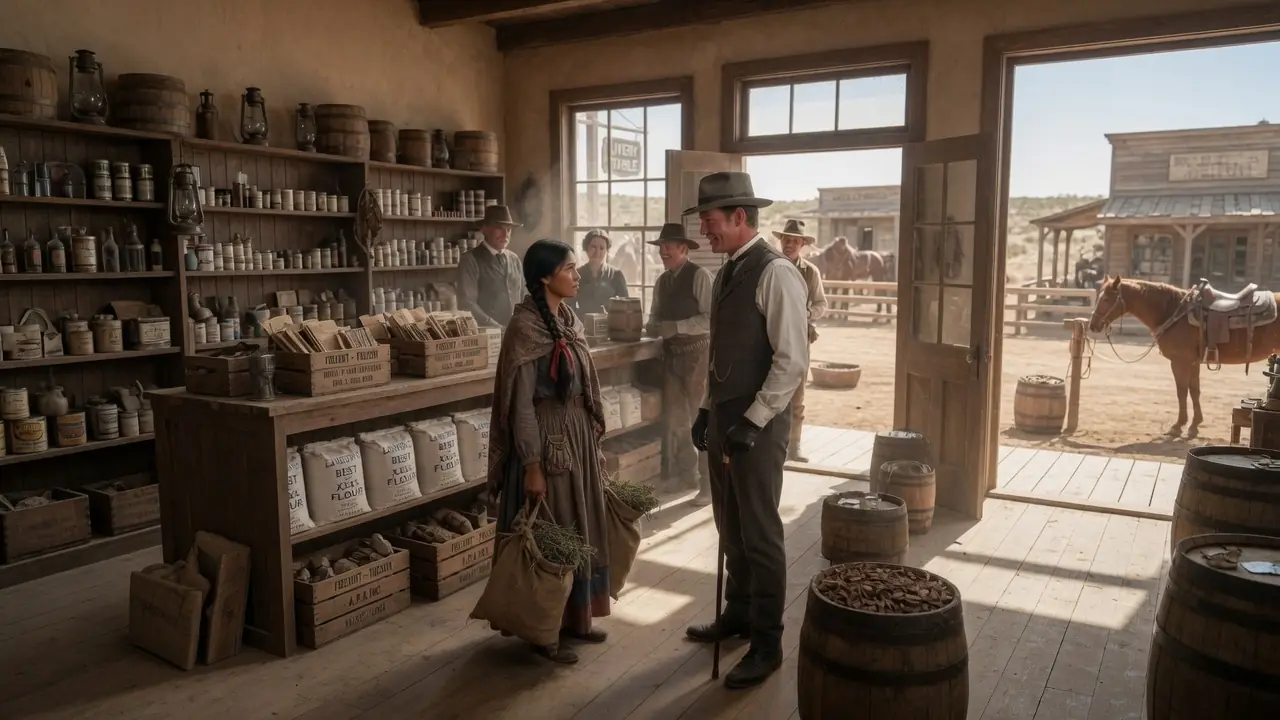
On the morning everything began, Mercy Ridge was bright with late summer heat. Dust lay thick in the street. Horses stood with drooping heads at the hitching rails. The general store door hung open, and inside, Mrs. Pritchard was arguing over flour prices with the patience of a woman who considered arguing a form of exercise.
Aiyana carried her herbs to the back counter.
Mr. Lawson, the storekeeper, barely looked at her.
“Same as last week?” he asked.
“No,” Aiyana said. “Less feverfew. More willow bark.”
“People buying more pain medicine?”
“People needing it.”
He glanced up then.
“What does that mean?”
“It means their joints hurt before storms.”
Lawson snorted.
“Sky’s clear.”
Aiyana looked toward the west window.
“Not for long.”
A man at the front of the store laughed.
“Indian girl thinks she can read clouds now.”
Aiyana turned.
The man was tall, sunburned, and dressed too well for a ranch hand. He wore a gray waistcoat despite the heat and had a silver watch chain stretched across his middle. His boots were clean. That alone told her he did not earn his money from the ground.
She had seen him twice before.
Mr. Alden Price.
New owner of the old copper claim north of town.
He had come to Mercy Ridge three months earlier with investors, surveyors, and a smile that made men feel included and women feel measured.
Aiyana did not like him.
Not because he was rude.
Rude men were simple.
That made him worse.
He looked her over now with amusement.
“What else can you read, miss?” he asked. “Cards? Palms? The future?”
A few men chuckled.
Aiyana tied the herb sacks with slow fingers.
“I read tracks,” she said.
Price smiled.
“Tracks?”
“Yes.”
“Then perhaps you can read mine.”
She looked at his clean boots.
“You step where other men clear the way.”
The store went quiet.
Lawson coughed into his hand.
Price’s smile held, but his eyes cooled.
“Sharp tongue.”
“No,” Aiyana said. “Only clear eyes.”
She lifted her bundle and left before he could answer.
Outside, Cricket flicked her ears as Aiyana tied the herbs to the saddle.
From across the street, a boy watched her.
He was perhaps ten, thin as a fence rail, with sandy hair and one arm wrapped in a dirty sling. His name was Eli Turner. His mother, Ruth, washed linens for the hotel. His father had died in a mine collapse two years before.
Eli stared at Cricket with open longing.
“She bite?” he asked.
Aiyana looked at the mare.
“Only men who deserve it.”
Eli grinned.
Then his face twisted in pain as his arm moved.
Aiyana stepped closer.
“Who set that?”
“Doc Miller.”
“Badly.”
Eli looked alarmed.
“You can tell?”
“Your fingers are swollen. Sling is too tight.”
He glanced toward the hotel.
“Ma says not to bother people.”
“You are not bothering. You are injured.”
She loosened the knot carefully, adjusted the cloth, and slid a folded strip of soft leather between the sling and his neck.
Eli exhaled.
“That’s better.”
“Tell your mother to come to Red Willow if the swelling worsens.”
“You a doctor?”
“No.”
“Then what are you?”
Aiyana considered.
“My grandmother says I am someone who notices what people pretend not to see.”
Eli seemed to accept that.
Behind them, Alden Price stepped out of the store and watched from the porch.
Aiyana felt his gaze.
She did not turn.
That afternoon, the storm came.
It rose from the west in bruised clouds, dark and sudden. Wind kicked dust down the street so hard people ran to close shutters. Thunder rolled over Mercy Ridge before sunset. Rain followed, heavy enough to turn the road into ribbons of mud.
Most people complained.
Aiyana only listened.
Rain told stories too.
Where water ran.
Where it pooled.
Where it smelled wrong.
By morning, three cattle were dead near the creek below Dawson’s pasture.
By noon, seven more.
By evening, two horses at the livery had gone weak in the legs, and Mrs. Pritchard’s milk cow was found lying on her side, breathing hard through foam.
Mercy Ridge began to whisper.
Bad feed.
Fever.
Snakebite.
Curse.
That last word came too easily from too many mouths.
By the next day, people were looking toward Red Willow Camp.
Aiyana heard it from Isaiah Bell when she returned from checking snares near the ridge.
“Town’s talking foolish,” Isaiah said, hammering a horseshoe into shape. “That kind of foolish that grows teeth.”
Aiyana stood in the shade of the forge.
“They say we poisoned the animals?”
“They don’t say it straight yet.”
“Who started it?”
Isaiah looked up.
“Price.”
Aiyana was not surprised.
Alden Price had been buying land quietly since he arrived. Dawson’s pasture. Two failed homesteads north of the creek. Half interest in the livery. Men smiled when he spoke because money has a way of making poison taste like honey.
“He says Red Willow wants the town scared off the water,” Isaiah continued. “Says your people know herbs, roots, bitter things.”
Aiyana looked toward the town road.
“And people believe him.”
“People believe what excuses what they already wanted to think.”
That evening, riders came to Red Willow Camp.
Sheriff Tom Rusk led them.
He was not a cruel man by nature. That almost made him more dangerous. Cruel men knew what they were. Weak men could tell themselves they were only keeping peace.
Aiyana stood beside her grandmother as the riders stopped near the central fire.
Sheriff Rusk removed his hat.
“Nalin,” he said.
The old woman sat wrapped in a dark shawl, her silver hair braided over one shoulder. She had survived soldiers, hunger, childbirth, and winter. She was not impressed by badges.
“Thomas,” she answered.
The sheriff shifted.
“There’s trouble with the water.”
“So I hear.”
“Town council thinks it best if no one from Red Willow enters Mercy Ridge until we know what’s happening.”
The camp went still.
Aiyana stepped forward.
“You mean until you decide whether we are guilty.”
Rusk looked uncomfortable.
“I didn’t say that.”
“You did. With cleaner boots.”
One of the riders muttered, “Watch your mouth.”
Nalin lifted one hand.
The rider fell quiet, not because he respected her, but because something in the old woman’s stillness warned him to.
Aiyana looked at the sheriff.
“Have you tested the creek upstream?”
“We sent men.”
“Which men?”
“Price’s surveyors.”
Aiyana laughed once.
No humor in it.
Rusk frowned.
“You know something?”
“I know cattle drink where water slows. I know poison moves with current. I know men who want land often create reasons for people to leave it.”
Alden Price rode up then from the road, as if summoned by his own name.
He smiled from the saddle.
“Careful, Sheriff. Accusations are easy. Proof is harder.”
Aiyana looked at him.
“Then you will not mind if I look for proof.”
Price’s smile thinned.
“This is not a matter for camp girls.”
“No,” Aiyana said. “It is a matter for someone who can read ground better than men who only read contracts.”
The riders murmured.
Price looked at Sheriff Rusk.
“Are you going to let her interfere?”
The sheriff hesitated.
That hesitation decided him more than words would have.
Aiyana turned to Cricket, tightened the saddle cinch, and mounted.
“Where are you going?” Rusk demanded.
“To the creek.”
“You’ll stay in camp until—”
“No.”
The word cracked across the firelight.
Aiyana looked down at him from the saddle.
“You came here to blame us without proof. I am going to find what you were too afraid to look for.”
Before anyone could stop her, she rode into the dark.
The creek north of Mercy Ridge ran narrow through cottonwoods and gray stone. By moonlight, the water looked harmless. Silver. Soft. Clean.
Aiyana knew better.
She dismounted, tied Cricket to a branch, and crouched near the bank.
The first sign was smell.
Not strong.
Most men would miss it.
A bitter metal note beneath wet earth.
She moved upstream slowly, lantern covered to keep the light low. The mud held stories from the day before. Cattle tracks. Horse tracks. Wagon wheels. Boot prints.
Most were ordinary.
One was not.
A heavy wagon had come to the creek after the storm, when the mud was fresh. It had stopped near a bend where the water pooled before flowing toward Dawson’s pasture. The wagon had been loaded going in. Lighter coming out.
Aiyana followed the tracks north.
They left the creek and climbed toward old mining land.
Alden Price’s land.
She found the barrels in a dry wash beneath a stand of scrub oak.
Three of them.
Two empty.
One cracked.
A dark residue clung to the inside.
Aiyana touched none of it.
She did not need to.
The smell was stronger there.
Copper leach. Bitter alkali. Waste from mine processing, dumped where stormwater could drag it into the creek.
Not accident.
Placement.
She crouched in the moonlit dust and studied the ground.
Three men.
One limped.
One smoked cigars.
One wore boots with a triangular nail pattern on the heel.
Price’s surveyor had those boots.
A twig snapped behind her.
Aiyana rolled sideways as a gunshot split the wash.
The bullet struck the dirt where her head had been.
She came up behind a rock, heart steady, knife in hand.
Two men emerged from the shadows.
Price’s men.
One with a limp.
One with a cigar clenched between his teeth.
The third stood above the wash with a rifle.
Triangular heel nails.
“Well,” the limping man said. “Looks like the little tracker found something.”
Aiyana did not answer.
The cigar man spat.
“Mr. Price said you were too clever.”
“No,” Aiyana said. “He is too careless.”
The man with the rifle shifted.
“Come out. We don’t want to hurt you.”
“Then why shoot?”
“Warning.”
“You missed.”
The cigar man smiled.
“Next one won’t.”
Aiyana looked past them.
Cricket stood above the wash, ears forward, reins loose.
Aiyana clicked her tongue once.
The mare bolted.
Not away.
Toward the men.
The rifleman cursed as Cricket crashed through brush, scattering dust and stone. The horse’s shoulder struck him hard enough to send him tumbling down the slope.
Aiyana moved.
She threw sand into the limping man’s face, ducked beneath the cigar man’s swing, and drove her elbow into his ribs. He grabbed for her braid. She cut the strap of his holster before he could draw.
The limping man recovered and lunged.
A gunshot cracked from the ridge.
He froze.
Then slowly raised his hands.
Isaiah Bell stepped into view with a rifle resting easy against his shoulder.
Behind him came Eli Turner’s mother, Ruth, holding a lantern, and Sheriff Rusk with three deputies.
Aiyana looked at the sheriff.
“You followed me.”
Rusk looked ashamed.
“Eli heard you tell his mother to watch the creek. He came to me. Said if I was too scared to ride, he would.”
From behind Ruth, Eli waved with his good hand.
Aiyana almost smiled.
Almost.
The sheriff looked at the barrels.
Then at Price’s men.
His face hardened.
“What is this?”
Aiyana stood, dust on her skirt, knife still in hand.
“Proof.”
By dawn, Mercy Ridge had gathered near the creek.
Alden Price arrived in a gray coat, looking irritated rather than afraid.
That changed when he saw the barrels.
Then his men.
Then Sheriff Rusk holding a ledger taken from the saddlebag of the surveyor with the triangular heel nails.
The ledger showed payments.
Dates.
Waste shipments.
Land offers made to ranchers whose animals died days later.
Aiyana stood beside the creek, silent, while the town read the truth one page at a time.
Price tried to smile.
“Sheriff, surely you don’t believe the word of an Apache girl over mine.”
The crowd shifted.
That sentence did what evidence alone had not.
It revealed him.
Mrs. Pritchard stepped forward first.
“My cow died drinking that water.”
Dawson followed.
“I lost ten cattle.”
The livery owner cursed.
Ruth Turner lifted Eli’s injured arm gently.
“My son drinks from that creek when he walks home.”
Price’s smile vanished.
Sheriff Rusk removed his cuffs.
“Alden Price, you’re under arrest for poisoning public water, destruction of livestock, fraud, and conspiracy.”
Price laughed.
“You cannot arrest me. Half this town owes me money.”
Aiyana looked at him.
“Then half this town just learned what your money costs.”
No one defended him.
Not one.
As the sheriff took him away, Price looked back at Aiyana.
“This changes nothing. They will still fear you.”
Aiyana met his eyes.
“Maybe.”
Then she turned toward the creek.
“But now they will also know I was right.”
That mattered more.
In the weeks that followed, Mercy Ridge tried to decide how to behave.
Guilt made people strange.
Some avoided looking at Red Willow families.
Some became too friendly, which was almost worse.
Mrs. Pritchard sent flour to the camp without a note. Lawson paid full price for herbs for the first time in his life and looked miserable doing it. Sheriff Rusk came to Nalin and apologized in front of witnesses, which made him sweat more than the August sun.
Nalin accepted the apology.
Aiyana did not.
Not at first.
Forgiveness was not a debt others could demand once they finally stopped being wrong.
But change came in practical things.
The town council asked Red Willow Camp to help test and protect the creek. Isaiah Bell was hired to repair the water pumps. Ruth Turner began sending Eli to learn tracking from Aiyana twice a week, though she insisted it was only because the boy needed “fresh air and useful discipline.”
Eli arrived every Tuesday with a sling no longer needed and questions too large for his body.
“Can you really tell how many men passed by a broken twig?”
“Yes.”
“What if the twig lies?”
“Twigs do not lie. People do.”
“Can horses understand words?”
“No.”
“Then why do they listen to you?”
“Because I listen first.”
He thought about that for a long time.
Aiyana began teaching him how to see.
Not look.
See.
The difference between a rabbit track and a fox track. The way mud dries at the edge before the center. The mark a nervous horse leaves compared to a tired one. How a person carrying guilt walks heavier on one side.
“Can you see guilt?” Eli asked.
“Sometimes.”
“What does mine look like?”
“You stole molasses candy from Lawson’s jar.”
His eyes went wide.
“How did you—”
“Sticky thumb.”
He hid his hand behind his back.
Aiyana smiled then.
A real one.
By autumn, the creek ran clean again.
The dead cattle had been buried. The sick horses recovered. Alden Price’s mine was seized, and his investors scattered like quail. The land he tried to frighten people away from was placed under town protection after months of argument, petitions, and one memorable meeting where Mrs. Pritchard threatened to beat a councilman with a rolling pin if he sold water rights again.
Mercy Ridge changed.
Not completely.
No town changes completely because of one truth.
But enough.
People stepped aside less when Aiyana entered the store. Some nodded. Some even spoke her name properly.
That was not justice.
But it was movement.
One evening, Aiyana rode to the ridge above the creek.
The sun was low, turning the water gold. Cricket grazed nearby. Below, Mercy Ridge sat small and dusty, smoke rising from chimneys, wagon wheels cutting the street, children running near the schoolhouse.
Nalin came to stand beside her.
“You did well,” the old woman said.
Aiyana looked down at the town.
“They believed him quickly.”
“Yes.”
“They doubted us quickly.”
“Yes.”
“I thought being right would feel better.”
Nalin’s face softened.
“Being right is heavy when it comes after harm.”
Aiyana watched the creek move through cottonwoods.
“What do I do with that?”
“Carry it until it teaches you where to put it down.”
They stood in silence.
Then Nalin said, “Mercy Ridge asked for you.”
Aiyana turned.
“For what?”
“They want you to serve as water keeper.”
Aiyana frowned.
“That is not a town position.”
“It is now.”
“Who asked?”
“Ruth Turner. Mrs. Pritchard. Isaiah. Sheriff Rusk.”
Aiyana looked back toward the town.
“They want me to protect the water they accused us of poisoning.”
“Yes.”
“That is foolish.”
“Yes.”
Aiyana almost laughed.
Nalin’s eyes shone.
“Sometimes foolish things become beginnings.”
That winter, Aiyana accepted.
Not because Mercy Ridge deserved her help.
Because the water deserved protection.
She rode the creek line every week. She tested pools, marked changes, tracked dumping, watched mining roads, and taught children from both the town and Red Willow how to read the land before the land had to scream.
Eli became her best student.
He grew stronger. Taller. Less afraid to ask questions. By spring, he could follow deer tracks across stone and tell which direction rain would come by smelling the air.
Aiyana pretended not to be proud.
Everyone knew she was.
The title Water Keeper sounded strange at first.
Then it became ordinary.
Then necessary.
Years later, when people told the story, some said Aiyana Red Willow saved Mercy Ridge because she could read tracks. Others said she saved it because she was braver than the sheriff and smarter than Alden Price.
Those things were partly true.
But not the whole truth.
Aiyana saved the town because she had learned to notice what others ignored.
A bitter smell under clean water.
A wagon lighter leaving than arriving.
A boy’s sling tied too tight.
A horse afraid because men had hurt her.
A greedy man hiding poison behind polished boots.
A town so eager to suspect her people that it almost drank its own ruin.
She noticed.
And because she noticed, she acted.
That was the gift her grandmother had given her.
Not magic.
Not mystery.
Attention.
The world speaks before it breaks, Nalin used to say.
Most people hear only the breaking.
Aiyana learned to listen sooner.
On the tenth anniversary of Alden Price’s arrest, Mercy Ridge and Red Willow Camp gathered by the creek. Children ran between both groups without knowing where one ended and the other began. Isaiah Bell’s forge bell rang from town. Mrs. Pritchard, older now but no less terrifying, brought pies and accused everyone of eating too slowly.
Eli Turner, tall now and wearing a deputy’s star, stood beside Aiyana at the water’s edge.
“You ever think about leaving?” he asked.
Aiyana looked at him.
“Often.”
“Why didn’t you?”
She looked across the creek, where Nalin sat in a chair under a cottonwood tree, wrapped in a red shawl.
“Because leaving would have given Price part of what he wanted.”
Eli nodded.
“And because the water needed someone stubborn?”
“That too.”
He smiled.
Then grew serious.
“I used to think you saved the town.”
Aiyana watched the creek move over stone.
“No.”
“No?”
“I saved the water. The town had to decide whether it wanted to be worth saving after that.”
Eli absorbed that, as he had absorbed so many lessons from her.
Then he said, “I think it did better.”
Aiyana looked toward Mercy Ridge.
The town was still imperfect.
Still dusty.
Still capable of foolishness.
But the creek ran clean. Red Willow children attended the school without entering through the back. The council included Nalin now, though no one had dared call that progress to her face. The mine roads were watched. The water rights were protected.
Better was not perfect.
But better was not nothing.
Aiyana knelt by the creek and dipped her hand into the cold current.
The water moved over her fingers, clear and alive.
Once, the town had looked at her and seen only what it feared.
Now, some looked and saw the woman who had saved them.
Even that was not the whole truth.
Aiyana Red Willow was not a symbol.
Not a warning.
Not a miracle.
She was a girl who had become a woman by listening carefully to a world that tried to speak beneath the noise of men.
She was her grandmother’s student.
Her people’s daughter.
The keeper of a river that remembered everything poured into it and still kept moving.
And if anyone asked her what justice sounded like, she would not mention courtrooms or handcuffs or Alden Price being dragged away in disgrace.
She would point to the creek.
To the clean water running over stone.
To children laughing on both banks.
To hoofprints crossing mud without fear.
Then she would say justice sounded like this:
A thing nearly poisoned, still alive.
A thing once stolen, guarded now.
A thing that kept moving because someone finally listened.