The Dakota wind did not blow. It scoured the earth like a rasp over bone, promising an early grave to anyone foolish enough to linger. Into this frozen hell rode a man with eyes as dead and gray as the winter sky above him.
This was Blackwood in the bitter heart of 1878, a place where hope froze solid before it could hit the ground. He rode a rangy gelding that looked as road-worn and starved as he did. His coat was a heavy, foul-smelling patchwork of buffalo hide, draped over faded Union wool.
It was a silent testament to a war that had officially ended over a decade ago, but still raged mercilessly somewhere behind his ribs. Men called him the Mute. They called him this because he had not uttered a single syllable since the day he drifted down from the high mountain passes.
The townsfolk, eager to label what they could not comprehend, whispered he was a halfwit born with a twisted tongue. Others, taking note of the fluid, lethal grace with which he moved, claimed the devil had stolen his voice as payment for dark, unspeakable deeds. The truth was far heavier.
The silence was not a lack of intellect. It was a fortress. Words had led men to slaughter on blood-soaked fields. Orders had been given, promises had been made, and thousands of good men had died screaming in the mud.
Elias Thorne had decided long ago that he would never offer another piece of himself to a world so eager to butcher. Silence was safe. Silence did not betray you.
Across the muddy, frozen rut that passed for Blackwood’s main thoroughfare, Clara Higgins wrestled a 100-pound sack of feed grain onto the splintered bed of her wagon. She was a woman carved from the very granite of the Dakota Hills, her face lined with the premature exhaustion of a widow fighting a losing battle against an unforgiving land.
Her husband, Thomas, had been dead exactly six months. A riding accident, the corrupt town sheriff had declared, waving a dismissive hand. A broken neck on a clear day with a gentle, sure-footed horse.
Clara knew a lie when she heard one. But out here on the ragged edge of civilization, truth was a luxury only the heavily armed could afford.
Elias tied his horse to the hitching post outside the mercantile. He needed work, and more urgently, he needed a corner out of the wind to outlast the coming blizzard. Inside, the shopkeeper took one long look at the silent drifter.
He took in the scarred, calloused hands, the ragged beard, and the unblinking, predatory stare. The shopkeeper spat a stream of black tobacco into a brass spittoon. Shaking his head, he told Elias they did not hire vagrants in Blackwood, especially not broken ones who could not even cry out for help if a steer pinned them to the corral boards.
Elias turned to leave, his face betraying absolutely no insult. He was profoundly accustomed to the cruelty of frightened, small-minded men.
“You know which end of a pitchfork to hold.”
The voice was sharp, cutting cleanly through the icy air outside the store.
Elias stopped on the porch and turned.
Clara stood by her wagon, brushing a layer of frost from her heavy woolen skirt. She studied him with piercing blue eyes. Where the shopkeeper saw a dangerous liability, Clara saw the rigid military bearing beneath the ragged coat.
She saw the quiet, deliberate efficiency in his movements. She saw a man who would not waste time complaining about the cold or the backbreaking labor.
Elias met her gaze and gave a single slow nod.
“I pay a dollar a week and a dry room in the barn,” Clara said, her breath pluming in the freezing air like locomotive smoke. “It is hard work. The cattle are starving. The fences are down, and the timber wolves are getting bold this year. If you ride out with me, you stay the season. I have no time for quitters.”
Elias stepped off the porch, stepped past her, and hoisted the remaining two sacks of grain from the mercantile steps with an effortless, terrifying strength. He tossed them into the back of her wagon, the heavy thuds echoing down the empty street.
The contract was sealed.
The Higgins Ranch sat in a sprawling valley a few miles from the town center, a starkly beautiful but desolate stretch of land that seemed to roll on into eternity. The work was precisely as brutal as Clara had promised.
From an hour before dawn until long after the sun had sunk below the jagged horizon, they fought the elements. They broke thick ice over the water troughs with heavy iron sledgehammers, hauled agonizing loads of hay to the shivering, mournful herd, and patched the rotting roof of the barn against the relentless snow.
Elias worked with a furious mechanical precision. He asked for nothing and required zero supervision. He ate his meager rations of salted pork and beans in the quiet shadows of the loft.
He spent his evenings sitting by a small lantern, carving intricate, delicate figures out of pine scraps with a large hunting knife. Clara watched him from the kitchen window of the main house, wondering what specific horrors had built the impenetrable wall behind his eyes.
Despite the suffocating silence, a rhythm developed between them. A dance of survival born of mutual necessity and an unspoken, growing respect.
This fragile peace shattered a week later with the arrival of Silas Vance.
He rode into the ranch yard in a gleaming, custom-built carriage that aggressively defied the rugged terrain, flanked by four mounted men armed with expensive repeating rifles.
Vance was a creature of stark contrast to the Dakota frontier. He wore tailored broadcloth suits, a silk cravat, and pristine kid-leather gloves. His boots were polished to a mirror shine despite the ubiquitous mud.
He owned the bank, the mercantile, the saloon, and the sheriff’s badge. He owned Blackwood body and soul, squeezing the life out of the small ranchers to feed his ever-expanding empire.
Clara stepped out onto the porch, a heavy double-barreled shotgun resting casually but firmly in the crook of her arm. The cold wind whipped her hair across her face.
Elias emerged from the dark interior of the barn, a heavy splitting maul resting upon his right shoulder. He did not approach the carriage, but he positioned himself precisely between the imposing vehicle and the main house.
He stood like an immovable obstacle of bone and muscle. His posture was relaxed, but entirely primed for sudden violence.
“Mrs. Higgins,” Vance called out smoothly, stepping down from his carriage with a practiced, predatory smile. “A bitter, unforgiving day to be tending such a failing enterprise.”
“The enterprise holds its own, Mr. Vance,” Clara replied, her voice steady and devoid of warmth. “State your business and get your horses off my winter grass.”
Vance sighed heavily, a highly theatrical display of patience.
“I am merely looking out for your welfare, Clara. A woman alone in this harsh territory is a tragedy just waiting to happen. Thomas would have wanted you safe and provided for. I am prepared to offer you a very generous sum for the deed to this land. Enough to buy a comfortable, heated house back east, away from this filth and freezing misery.”
“Thomas would have wanted me to keep what we built with our bare hands,” Clara snapped, her knuckles turning white around the stock of the shotgun. “The land is not for sale.”
Vance’s artificial smile vanished instantly, leaving behind a cold, calculating mask of pure arrogance.
His gaze shifted from Clara to the silent, ragged man standing near the barn. He looked Elias up and down, taking in the faded Union coat and the dead, unyielding eyes.
A flicker of something complicated crossed Vance’s aristocratic face. Annoyance perhaps, or a sudden sharp calculation.
Why was Silas Vance, a man who already controlled the entire county and thousands of acres of prime grazing land, so desperately fixated on this one barren patch of frozen earth?
“You surround yourself with stray, mangy dogs, Clara,” Vance sneered, his voice dripping with aristocratic contempt. “Dogs that cannot even bark when the real wolves come circling.”
Elias did not flinch. He did not shift his weight. He simply stared at Vance with a gaze so entirely devoid of fear or submission that it made one of the heavily armed riders rest a highly nervous hand on the butt of his holstered revolver.
It was the look of a man who had seen the devil and found him lacking.
“I will not make this generous offer again, Mrs. Higgins,” Vance said, turning back to his carriage and climbing inside. “The winter forecasts say it is going to be exceptionally cruel this year. Accidents happen on the frontier with alarming frequency. It would be a terrible shame if you were caught in the storm.”
The carriage wheeled around violently, throwing clouds of half-frozen mud into the air. The mounted men cast menacing, lingering glares at Elias as they rode out toward the town road.
Clara slowly lowered the shotgun, her hands shaking slightly from the sudden adrenaline dump.
She looked across the yard at Elias.
He was already turning his back on the retreating riders, walking methodically toward the woodpile. He lifted the heavy iron maul high above his head and brought it down with a resounding, violent crack that split a massive oak log perfectly in two.
War had come to the Higgins Ranch, and Elias Thorne knew exactly how to fight a war.
He just did not know if he had the soul left to survive another one.
What buried secrets lay hidden deep beneath the frost of Clara’s pasture? Secrets worth slaughtering a good man for.
Blackwood was a town slowly choking on its own lifeblood, suffocated by a man who measured his worth in stolen acreage and buried secrets. The rot started at the bank ledgers and bled out into the frozen, unforgiving soil of every struggling ranch in the territory.
Silas Vance did not conquer with a marching army. He conquered with paper, poison, and localized terror. He bought up the mercantile and quadrupled the price of winter seed and salt.
He held the mortgages on nearly every homestead, calling in debts the moment the first frost killed the late crops. Those who stubbornly refused to sell found their spring water fouled with the bloated carcasses of slaughtered coyotes.
Fences were cut in the dead of night, allowing precious livestock to wander into the freezing darkness to be claimed by timber wolves or Vance’s rustlers.
The law offered no sanctuary. Sheriff Cobb was a fat, sweating creature of Vance’s payroll, a man who only wore his tin star to legitimize the theft of the territory. The citizens of Blackwood walked with their heads down, their spirits crushed beneath the boot heel of a polite, well-dressed tyrant.
The true cost of this monopoly illuminated the midnight sky a week after Vance’s visit to the Higgins Ranch. Clara stood on her porch, wrapped tightly in a heavy woolen quilt, watching a sickening, violent orange glow pulse against the low-hanging clouds to the south.
It was the Miller homestead, a modest spread run by a stubborn family of five who had publicly refused Vance’s buyout just days prior.
Elias stood beside her in the biting cold, his breath pluming in the dark, his face a stony mask reflecting the distant inferno.
They rode out at first light, the icy wind lashing their faces. They arrived to find nothing but smoldering, blackened timbers jutting from the soot-stained snow like rotten teeth.
The barn was a heap of ash. The livestock were gone, driven off into the hills. Of the Miller family, there was no sign, only the chilling certainty that they had either fled into the deadly winter night with nothing but the clothes on their backs, or they were buried somewhere beneath the smoking ruins.
A handful of townsfolk had gathered at the perimeter, their faces pale, their eyes darting nervously toward the horizon. They spoke in hushed, terrified whispers. No one dared utter Silas Vance’s name, but his signature was written in the charcoal and ruin.
Elias dismounted and walked slowly toward the decimated cabin. He did not look at the frightened onlookers. He moved with a dreadful, clinical focus.
He knelt by a charred support beam, rubbing the blackened wood between his calloused fingers. He brought his fingers to his nose. The faint, acrid scent of coal oil lingered beneath the smell of burnt pine.
He stood and walked the perimeter of the yard, his gray eyes scanning the frozen mud. He tracked the chaotic churn of hoofprints. There were a dozen riders, maybe more, and they had not attacked in a disorganized mob.
They had swept the property in a flanking maneuver, cutting off the escape routes before setting the blaze.
Elias felt a cold, familiar knot tighten in his gut.
This was not the chaotic work of opportunistic frontier bandits. This was a calculated, military-style punitive strike. The precision, the absolute destruction, it pulled forcefully at the locked doors of his memory, threatening to unleash the screaming ghosts of the war he had fought so hard to bury.
What kind of ruthless commander had Silas Vance learned to emulate? And where had he acquired men who rode with such disciplined malice?
Two days later, necessity dragged Clara and Elias into the heart of Blackwood. The ranch was desperately low on rifle ammunition and medicinal supplies.
The town felt like an open graveyard. Eyes peered from behind dirty windowpanes, watching them navigate the muddy street, but no one offered a greeting.
Clara left Elias tying the horses outside the apothecary and marched toward the bank to dispute a sudden fraudulent fee added to her late husband’s account.
She never made it to the doors.
A massive figure stepped out from the shadow of the saloon awning, blocking her path on the boardwalk.
It was Callaway.
He was Vance’s chief enforcer, a hulking brute of a man with a ragged, pale scar that ran from his left ear down to his collarbone, pulling his jaw into a permanent mocking sneer. He wore twin revolvers low on his hips and smelled of stale whiskey and raw cruelty.
“Mrs. Higgins,” Callaway rumbled, his voice like grinding stones. “You are looking mighty pale. This bitter wind is no place for a grieving widow. You should be inside, packing your trunks.”
“Get out of my way, Callaway,” Clara said, her voice steady, though her heart hammered against her ribs.
She kept her chin high, refusing to give him the satisfaction of seeing her fear.
Callaway chuckled, a wet, ugly sound. He took a step closer, crowding her, his sheer bulk forcing her back a half step.
“Mr. Vance is losing his patience, ma’am. He made a fair offer. The generous window is closing. After what happened to the poor Millers, well, a man hates to think of a lovely woman like yourself meeting a sudden, fiery tragedy all alone out there in the dark.”
He reached out a thick, leather-gloved hand, intending to grab her shoulder to physically assert his dominance in the middle of the public street.
His hand never landed.
A hand clamped onto Callaway’s wrist like a raw iron vise. The grip was shockingly powerful, stopping the enforcer’s movement instantly.
Callaway whipped his head around, his free hand instinctively dropping toward the handle of his Colt revolver.
Elias stood there.
He had moved with terrifying silence, crossing the muddy street without making a sound. He did not say a word. He did not draw a weapon.
He simply stared up at the larger man.
Callaway tried to yank his arm free, his face flushing with sudden, violent anger.
He could not budge.
The silent drifter’s grip was absolute. Callaway looked into Elias’s eyes and felt a sudden, icy jolt of absolute terror pierce his whiskey-soaked bravado.
There was no anger in the Mute’s gray eyes. There was no posturing. There was only an endless, yawning void, the look of a man who had slaughtered hundreds and would feel absolutely nothing about adding one more bleeding corpse to the frozen mud of Blackwood.
It was a promise of immediate, unhesitating death.
For a long, agonizing moment, the street held its breath. The townsfolk watching from the windows braced for gunfire.
Slowly, deliberately, Elias released Callaway’s wrist. He stepped smoothly between the enforcer and Clara, turning his back to Callaway in a display of supreme, dismissive confidence.
He offered Clara his arm.
Callaway rubbed his aching wrist, his face pale beneath the grime. He took a step back, realizing with a predator’s instinct that he was suddenly the prey.
“You are making a grave mistake, Clara,” Callaway spat, his voice losing its mocking edge, replaced by genuine venom. “Both of you. This town belongs to Vance. You are just trespassing in a graveyard.”
He turned and stalked back toward the saloon, pushing violently through the swinging doors.
Clara let out a long, shaky breath, looking up at the silent man beside her. Elias’s face had already returned to its impassive, unreadable state. He gently guided her toward the apothecary, the immediate threat neutralized without a single gunshot or spoken word.
Yet, as they walked away, Clara could not shake the chill that had settled deep in her bones.
She knew Elias had saved her, but she had seen the absolute darkness in his eyes.
What unspeakable horrors had this man survived? And how much longer could he keep the beast chained before the violence of Blackwood forced it to break free?
Fear is a highly contagious disease in a town starved of hope, and the citizens of Blackwood had been cultivating it for years. Following the silent, bloodless humiliation of Callaway in the muddy street, whispers began to slither through the cracks of every frost-rimed window and saloon door.
The narrative was swiftly hijacked by Silas Vance’s men, who sat by roaring iron stoves and spun tall, venomous tales. They painted Elias not as a protector, but as a rabid dog waiting to turn on its master.
The townsfolk, eager for a scapegoat that did not carry a silver-plated badge, eagerly swallowed the poison. They decided the Mute was a disgraced bushwhacker, a coward fleeing the hangman’s noose in Missouri, or perhaps a lunatic who had carved out his own tongue to hide his sins.
When Clara Higgins drove her wagon into town for supplies, the street emptied. Neighbors she had known for a decade suddenly found urgent business elsewhere, leaving her isolated in a sea of paranoid, averted eyes.
Out on the ranch, insulated by miles of frozen prairie, the poisonous rumors held no sway. There was only the brutal daily arithmetic of survival and the quiet, profound bond forging itself in the crucible of winter.
They worked side by side from the dark hours of the morning until the stars punched through the frigid night sky. Clara chopped ice from the troughs until her hands blistered beneath her leather gloves. Elias swung a heavy felling axe until the cordwood stacked high against the barn walls.
They communicated through the efficient, economic language of shared labor: a nod toward a struggling calf, a steadying hand on a spooked horse, the shared passing of a battered tin canteen.
In the evenings, the sprawling silence of the prairie settled over the Higgins house. Clara would sit by the stone hearth, mending harness leather or patching wool coats, while Elias occupied a wooden chair in the corner.
He continued his meticulous whittling, his large, scarred hands coaxing delicate, beautiful forms from rough pine.
One particularly bitter night, with the wind howling like a wounded animal against the eaves, he finished a piece and set it gently on the small table beside Clara.
It was a perfect miniature carving of a meadowlark, its wings spread as if caught in mid-flight.
Clara looked from the wooden bird to the man sitting in the shadows. The dead gray void in his eyes had softened, replaced by a quiet, lingering sorrow that mirrored her own.
She reached out, her fingers lightly brushing against his rough knuckles as she took the carving.
A profound warmth blossomed in her chest, a fragile, tentative romance taking root in the frozen earth of her grief. They were two shattered souls, quietly piecing each other back together without a single spoken vow.
This fragile sanctuary was brutally besieged three days later.
The survival of the Higgins Ranch depended entirely on moving the remaining healthy steers to the eastern railhead before the heavy snows sealed the high passes. It was their only source of hard currency to survive the coming freeze.
Clara and Elias rode out at dawn to scout the primary cattle trail, a narrow defile cutting through a ridge of limestone.
They arrived to find a catastrophe.
The trail was obliterated. A massive pile of shattered rock and splintered timber choked the pass, clearly the result of deliberately planted blasting powder.
Beyond the rubble, a newly strung line of heavy barbed wire stretched across the horizon, guarded by three armed riders sitting leisurely in the distance.
Silas Vance had tightened the noose.
By severing her access to the railhead, he was enacting a slow financial strangulation. The cattle would starve. The bank would foreclose on the defaulted mortgage. And the land would fall into his manicured hands without a single shot fired.
Clara slumped in her saddle, the sheer crushing weight of the injustice stealing the breath from her lungs. She looked at the impassable mountain of stone, her eyes burning with unshed tears of absolute fury and despair.
Elias dismounted, his face an impenetrable mask. He walked toward the blast site, his boots crunching over the pulverized limestone.
He knelt near the origin of the explosion, his eyes scanning the disrupted earth. The destruction was precise, calculated, and deeply familiar.
He sifted through the dirt, his gloved fingers brushing against something hard and cold.
He unearthed it, rubbing the grime away with his thumb.
It was a brass button.
It was not a common frontier fastener. It was heavy, stamped with the distinct, unmistakable insignia of a Union Army officer: a stylized eagle gripping a bundle of arrows bordered by a specific regimental wreath.
The moment Elias’s thumb traced the raised metal of the eagle, the howling Dakota wind vanished. The freezing air was violently replaced by the suffocating heat of a Tennessee summer and the metallic, coppery stench of blood.
The stone ridge dissolved into the muddy banks of Miller’s Creek.
He was no longer standing in Blackwood. He was lying on his back in the suffocating dark, crushed beneath the weight of three dead men.
The deafening, concussive roar of artillery pounded against his skull, followed by the frantic, agonized screams of horses and the sickening thud of lead tearing through flesh.
It was a massacre.
But the fire raining down upon them was not Confederate gray. It was Union blue.
His own regiment was pinned down in a muddy ravine, systematically butchered by their own commanding officer to cover the theft of a massive wagon train of military payroll.
Elias saw the officer sitting atop a dark stallion through the smoke, directing the slaughter with cold, mechanical efficiency. The man wore a pristine uniform, the brass buttons gleaming like predatory eyes in the sun.
He remembered the arrogant tilt of the officer’s chin, the cruel satisfaction as the last of Elias’s brothers fell into the blood-soaked mud.
He had survived only by playing dead beneath the butchered remains of his closest friends, drowning in their blood. His voice was stolen by a trauma too massive for the human mind to process.
Elias gasped, a harsh, jagged sound tearing from his throat as the memory released its grip.
He was back on his knees in the Dakota frost, his lungs burning, the brass button cutting fiercely into the palm of his clenched hand.
He looked up at the blocked pass, his gray eyes darkening into a storm of unadulterated, lethal intent.
The military precision of the homestead burnings, the disciplined cruelty of the enforcers, the arrogant tailored suits of Silas Vance, the pieces locked together with a sickening, terrifying clarity.
The monster who had slaughtered his brothers at Miller’s Creek was not a ghost.
He was sitting in a warm parlor in Blackwood, holding a glass of imported whiskey and a stolen deed.
Elias slowly rose to his feet, slipping the tarnished button into his coat pocket. A terrible, righteous fury ignited within his chest, a fire that had lain dormant for a decade.
He turned to look at Clara, who was watching him with deep concern. She did not know what he had found, nor did she know the horrifying truth of his past.
But as she looked into his eyes, she saw the shift.
The quiet, broken ranch hand was gone.
The soldier had returned, and he had finally found his war.
How long would it take for Silas Vance to realize that the silent ghost he had provoked was the very man he had failed to kill ten years ago?
Nature itself seemed to conspire with the devil on the night Silas Vance decided to finally break the Higgins Ranch.
A torrential, unseasonal thunderstorm, rare and violently beautiful in its fury, rolled across the Dakota plains, turning the frozen prairie into an ocean of treacherous black mud.
The wind screamed through the valley, tearing shingles from the roof of the main house and drowning out all sound beneath a relentless, percussive deluge.
It was the perfect cover for a slaughter.
Inside the dark, freezing barn, Elias Thorne lay awake on his cot. His eyes were wide open, tracing the shadows thrown by the erratic, blinding flashes of lightning filtering through the cracks in the timber.
He had not slept since finding the brass button at the dynamited pass. The fragile lock on his memories had completely shattered. The ghosts of Miller’s Creek stood in the corners of the barn, their silent, bleeding forms demanding a reckoning.
He recognized the heavy, rhythmic vibration in the earth before he heard the horses. It was subtle, masked by the roaring thunder, but the instincts of a seasoned infantryman were hardwired into his marrow.
Riders were approaching.
They were moving deliberately, spreading out to encircle the property.
Elias rose from his cot with absolute, chilling silence. He did not reach for a lantern. He moved through the pitch-black barn by memory, his hands finding his heavy hunting knife and a coiled length of thick hemp rope.
He slipped through a side door just as the first massive crack of thunder rattled the foundation.
Outside, the rain was a solid wall of freezing water. A dozen men on horseback, their faces obscured by soaked bandanas and the wide brims of their hats, rode into the yard.
Callaway led them, his massive frame hunched against the gale. They carried torches that sputtered and hissed in the downpour, casting long, demonic shadows across the mud.
They had not come to negotiate.
They carried heavy cans of coal oil and lever-action rifles.
Their objective was clear. Burn the barn, slaughter the trapped livestock, and leave Clara Higgins with absolutely nothing but the ashes of her husband’s legacy.
They made their first fatal miscalculation by assuming the silent drifter would be cowering in his bed.
The first rider swung down from his saddle near the corral, raising a heavy iron crowbar to smash the padlock on the gate.
He never completed the swing.
A hand emerged from the darkness, clamped violently over his mouth, and pulled him backward into the shadows of a massive water trough. There was a dull, sickening impact, and the man simply ceased to exist as a threat.
Elias moved like a phantom born of the storm. The brutal, agonizing labor of the past weeks had not broken him. It had tempered him, hardening the muscle and sinew beneath his scarred skin.
He became a lethal, highly trained tactician operating in his element. He utilized the blinding strobe of the lightning to memorize enemy positions, striking exclusively in the pitch-black intervals between the flashes.
Two men approached the side of the barn, sloshing coal oil against the dry, weathered wood.
Elias dropped from the low overhang of the roof directly behind them. He drove the pommel of his heavy knife into the base of the first man’s skull, rendering him instantly unconscious.
As the second man spun around, raising his rifle in a panic, Elias grabbed the hot barrel, wrenched the weapon from his grip with terrifying force, and struck the man across the jaw with the heavy walnut stock.
The crack of bone was entirely swallowed by the thunder.
Callaway, sitting atop his frightened horse in the center of the yard, began to realize his raid was systematically falling apart. He saw a torch drop into the mud near the corral. He heard the panicked whinny of a riderless horse.
“Spread out!” Callaway roared, drawing his twin revolvers and firing blindly into the torrential rain. “Find him and put a hole in him.”
The gunfire finally woke Clara inside the house. She bolted upright in bed, her heart hammering violently against her ribs. She grabbed the double-barreled shotgun from beside her nightstand, threw a heavy shawl over her shoulders, and kicked open the front door.
The lightning illuminated a scene of absolute chaos.
Men were firing wildly at shadows, their horses rearing in panic. She saw a rider charging toward her porch, his rifle raised.
Clara leveled the heavy shotgun and pulled the front trigger. The massive recoil bruised her shoulder, and a cloud of buckshot tore through the wooden post beside the rider, sending a shower of lethal splinters into his face.
He screamed, dropping his weapon and clawing at his bleeding eyes as his horse bolted into the darkness.
But there were too many of them.
Three men converged on the porch, their weapons drawn. Recognizing Clara as the vulnerable center of the defense, they scrambled up the muddy steps, cornering her against the heavy oak door.
Clara raised the shotgun to fire her second barrel, but a brutal kick to her wrist sent the weapon spinning across the floorboards.
One of the men, his face twisted in a vicious sneer, reached out to grab her hair.
A heavy soaked rope lashed out from the darkness beside the porch, wrapping tightly around the man’s throat. He was violently jerked backward, flying off the steps and crashing heavily into the mud below.
Elias vaulted over the porch railing. He did not possess a firearm, but he wielded a heavy, iron-tipped pitchfork he had retrieved from the barn.
He moved with a terrifying mechanical grace, parrying a desperate rifle thrust from the second man and driving the blunt wooden shaft into the attacker’s solar plexus with enough force to shatter ribs.
The third man backed away, his eyes wide with absolute horror as the silent, soaked demon advanced on him. He raised his revolver, his hands shaking uncontrollably.
Elias closed the distance before the man could align the sights, sweeping the pitchfork in a devastating arc that knocked the gun into the mud and sent the man sprawling.
Elias stood in front of Clara, his chest heaving, rain pouring from his face. He had dismantled half of Callaway’s raiding party in a matter of minutes, fighting with a savage brilliance that Clara had never witnessed in any living man.
But the element of surprise was gone.
Callaway and his remaining five men formed a tight semicircle in the yard. Their rifles and revolvers were trained squarely on the porch.
Elias dropped the splintered pitchfork.
He was completely surrounded, unarmed, and vastly outnumbered.
He stood tall, shielding Clara with his body, his gray eyes locking onto Callaway with a promise of impending death that made the massive enforcer swallow hard.
“Light them up!” Callaway commanded, his voice trembling slightly despite his desperate attempt to project authority.
Before a single trigger could be pulled, the rhythmic, heavy thud of approaching hooves cut through the fading thunder.
From the main road, a column of riders emerged into the yard. They carried bright oil-burning lanterns that cut violently through the gloom.
At the head of the column rode Sheriff Cobb, his tin star pinned haphazardly to his heavy waterproof duster. He was flanked by six heavily armed deputies.
Clara let out a ragged gasp of relief.
“Sheriff, they tried to burn the ranch. They tried to kill us.”
Cobb did not look at Clara. He did not look at the heavy cans of coal oil abandoned in the mud, nor did he question why Callaway and his men were trespassing on private property in the middle of a torrential storm.
He rode his horse deliberately through the yard, looking down at the groaning, bleeding men Elias had systematically dismantled. The sheriff spat a thick stream of tobacco juice into the puddles.
He drew his polished Colt revolver and leveled it directly at Elias’s chest.
“Drop to your knees, drifter!” Cobb ordered, his voice dripping with an ugly, rehearsed authority.
“What are you doing?” Clara screamed, pushing past Elias, her eyes wide with shock. “They attacked us. He was defending my property.”
“I received a sworn complaint from Mr. Silas Vance this evening,” Cobb drawled, keeping his gun perfectly steady. “He reported a band of aggressive rustlers operating out of this valley. He deputized Mr. Callaway here to ride out and investigate.”
“And what do I find?”
Cobb gestured widely to the battered men groaning in the mud.
“I find my deputies brutally assaulted and one of them lying dead by the water trough with a crushed skull. Looks like we have a cold-blooded murderer on our hands.”
The trap snapped shut with a sickening finality.
The entire raid had not been designed merely to destroy the ranch. It had been a highly coordinated provocation.
Silas Vance had known the silent drifter would fight back. He had counted on it. He had sacrificed his own men to manufacture a legal justification to remove the only obstacle standing between him and the Higgins land.
Callaway holstered his weapons, a smug, bloodied grin spreading across his face as he stepped forward with a pair of heavy iron shackles.
Clara lunged at the sheriff, tears of pure fury streaming down her face.
“You corrupt coward. You know exactly what Vance is doing.”
Two deputies grabbed Clara roughly by the arms, dragging her back.
Elias tensed. A low, dangerous rumble emanated from his chest, the first sound he had made in a decade. He took a step toward the men holding Clara, his fists clenched, fully prepared to tear them apart with his bare hands, regardless of the guns pointed at his head.
Clara looked into his eyes, reading the suicidal violence pooling there.
She stopped struggling.
“No,” she choked out, her voice barely a whisper against the rain. “Elias, please. They will kill you right here. Please.”
Elias halted.
He looked at Clara, seeing the desperate, pleading terror in her eyes. He looked at the half-dozen rifles aimed at his heart.
If he fought now, Clara would be caught in the crossfire.
He slowly, agonizingly, unclenched his fists.
He dropped to his knees in the freezing mud.
Callaway stepped behind him, forcefully locking the heavy iron shackles around Elias’s wrists. The cold metal bit into his scarred flesh as they hauled him roughly to his feet and dragged him toward a waiting horse.
Elias looked back at Clara standing alone on the porch of her besieged home.
He was a prisoner of a corrupted law, destined for a rigged noose.
How could a mute man possibly defend himself against a town owned entirely by his executioner? And what terrible lengths would Clara have to go to in order to expose the monstrous truth buried beneath Silas Vance’s stolen empire?
The iron bars of the Blackwood jailhouse were cold enough to strip the skin straight from a man’s bones, but they were nothing compared to the chill of the town’s impending justice.
Here, the law was not blind. It was simply bought and paid for in blood.
Elias Thorne sat on a splintered wooden bench in the darkest corner of the cell. His heavy wrists were bound by thick iron chains that bolted directly to a ring in the stone floor.
He had been stripped of his heavy buffalo coat, left in his faded Union wool to endure the biting frost that crept through the gaps in the timber walls.
In the front office, Sheriff Cobb snored loudly behind his desk, an empty bottle of cheap rye whiskey resting near his boots.
Elias did not shiver. He sat with the terrifying, motionless patience of a predator waiting for the trap to spring. He had survived the squalid, disease-ridden confines of Confederate prisoner camps.
This crude frontier cage was merely an inconvenience.
The heavy front door of the jailhouse creaked open, admitting a swirling gust of snow and the imposing figure of Silas Vance. Vance brushed snowflakes from the immaculate lapels of his heavy cashmere overcoat and stepped delicately around the snoring sheriff.
He approached the iron bars of the cell holding a silver-tipped walking stick, his aristocratic features twisted into a mask of supreme, victorious amusement.
“I must admit, you gave my men quite a fright,” Vance murmured, his voice smooth and utterly devoid of the chaotic violence he had orchestrated. “Callaway is currently having his jaw wired shut by the apothecary. And I am short one relatively useful deputy. You fight like a man who has seen the absolute worst of the world.”
Elias did not look up. He kept his gray eyes fixed on the frozen mud caking his boots.
Vance sighed, tapping his walking stick rhythmically against the iron bars.
“It is a pity you cannot speak. I would love to hear you beg. But since you are a captive audience, and since you will be a dead man before the sun crests the eastern ridge, I feel a certain magnanimous urge to explain precisely why you are going to hang.”
Vance leaned closer, his breath pluming in the freezing air, his eyes gleaming with greedy fervor.
“It is not about the cattle, you stupid, silent beast. It is never about the cattle. Beneath that miserable freezing pasture Clara Higgins clings to so desperately, there is a vein of pure silver thick enough to pave the streets of Chicago. A veritable mountain of wealth buried right under the limestone ridge you so kindly helped block.”
Elias slowly raised his head.
He locked eyes with the man he knew to be Captain Silas Montgomery.
The sheer, unadulterated arrogance of the man had not changed in ten years.
“Thomas Higgins was a fool,” Vance continued, entirely oblivious to the lethal recognition burning behind the prisoner’s silent stare. “He stumbled upon the outcropping while chasing a stray calf. He brought a sample to an assayer in the next county over, thinking he had secured his family’s future. He did not realize I own the assayer, too.”
“Thomas refused my generous offer to buy him out quietly. He became stubborn. So he suffered a highly unfortunate riding accident. Clara was supposed to break. She was supposed to take the pennies I offered and flee back east. But then she found you.”
Vance straightened his posture, buttoning his cashmere coat against the draft.
“You delayed the inevitable. But tomorrow, the town will watch you swing for the murder of my deputy. Clara will be utterly ruined, deeply indebted, and entirely alone. The bank will foreclose by the end of the week, and the silver will be mine, legally and permanently. You died for absolutely nothing.”
Vance turned and walked out of the jailhouse, leaving Elias alone in the dark.
Elias closed his eyes, the revelation settling over him like a heavy shroud.
The conspiracy was complete.
The murder of Thomas Higgins, the destruction of the neighboring homesteads, the financial strangulation. It was all designed to feed the insatiable greed of a monster who had already slaughtered his own regiment for a wagon full of payroll.
Across town, Clara Higgins was fighting a losing battle against the suffocating cowardice of Blackwood. She stood in the center of the mercantile, her clothes still damp from the midnight raid, her voice raw from pleading.
She begged Mr. Abernathy, the store owner she had known for a decade, to send a rider to the federal marshal in the territorial capital.
Abernathy refused to look her in the eye. He busied himself arranging tins of peaches on a shelf, his hands trembling slightly.
“I cannot do it, Clara. Vance holds the note on this store. If I cross him, my family is out in the snow by nightfall. The drifter killed a deputy. The law has to take its course.”
“It is not the law,” Clara shouted, her voice echoing off the wooden rafters, startling the few patrons who immediately scurried out the front door. “It was an ambush. Vance sent them to burn me out, and Elias stopped them. Do you know what Silas Vance is doing to this town? You are all just standing by and letting him butcher us one by one.”
The silence that followed her accusation was absolute and damning.
Abernathy kept his back turned.
Clara looked at his hunched shoulders, realizing with crushing clarity that she was completely, terrifyingly isolated. The town was utterly broken. Fear had stripped them of their humanity.
She ran back to her wagon and drove the exhausted horses furiously back to the ranch.
If she could not find allies, she needed leverage. She needed money to hire a circuit lawyer or gold to bribe the miserable sheriff.
She burst into the main house, running directly into the bedroom she had shared with Thomas. She pulled his heavy cedar trunk from beneath the bed and smashed the iron lock with a fireplace poker.
She tore through old wool blankets, faded photographs, and carefully folded garments. At the very bottom, her hands struck solid wood.
She paused, tapping the floor of the trunk.
It sounded hollow.
Frantic, she wedged the tip of the poker into a small seam and pried upward. A false bottom popped loose with a sharp crack.
Inside the hidden compartment lay a heavy leather pouch and a small black ledger.
Clara opened the pouch first. Several heavy, jagged rocks spilled onto the braided rug. They were dull, gray, and exceptionally heavy.
She did not know much about mining, but she recognized raw ore when she saw it.
With shaking hands, she opened the ledger.
The handwriting was unmistakably Thomas’s, but the neat, methodical script she knew so well had deteriorated into hurried, panicked scrawls in the final entries.
She read the pages, the blood draining completely from her face.
Thomas documented the discovery of the vein near the limestone ridge. He detailed the assayer’s report, calculating a fortune that defied imagination.
But the final entries were chilling.
Vance knows.
Clara read the words, her breath catching in her throat.
Callaway has been trailing me for three days. The assayer betrayed me. They cut the fences again last night. I am riding to the capital tomorrow to file the claim directly with the federal land office. If anything happens to me on the road, it was not an accident. Clara, my love, do not trust the sheriff. Do not sell the land.
The ledger slipped from her fingers, hitting the floorboards with a soft thud.
The riding accident, the broken neck, the sheriff’s hasty, dismissive conclusion.
The truth hit her with the concussive force of a physical blow.
Silas Vance had murdered her husband.
The man she had mourned for six agonizing months had been butchered for the dirt beneath his boots.
And the very same men were now preparing to hang the only person who had stood up to them.
While Clara uncovered the bloody foundation of Vance’s empire, the architect of that empire was rapidly accelerating his timeline.
Silas Vance stood on the balcony of the saloon, looking down at the muddy, crowded street. Waiting for a formal trial, even with a judge he owned, presented an unacceptable risk.
Clara was desperate, and desperate women had a dangerous habit of making noise. He needed the mute drifter dead immediately before any federal authorities could catch wind of a disturbance in the territory.
He signaled to Callaway, who stood in the street below, his jaw tightly bandaged, his eyes burning with a venomous desire for revenge.
Callaway and the remaining enforcers moved through the crowd, passing out free whiskey and lighting heavy pine torches. They spread the poison quickly and efficiently.
They painted Elias as a rabid, bloodthirsty animal who had ambushed the deputies without provocation. They stoked the fears of the townsfolk, transforming their pervasive cowardice into a blind, righteous fury.
“Why wait for a corrupt circuit judge to show up and let this killer loose on a technicality?” Callaway roared over the murmuring crowd, his voice muffled by the bandages, but dripping with malice. “He slaughtered a lawman in cold blood. We are the law in Blackwood. We protect our own.”
The whiskey and the fear worked their dark magic. The murmurs escalated into shouts. A kangaroo court formed in the muddy street, a chaotic, terrifying manifestation of frontier mob justice.
Men who had cowered from Vance a day earlier now felt a sudden, intoxicating surge of collective power. They grabbed pickaxe handles, shotguns, and heavy coils of rope.
“Hang him!” someone shouted from the back of the crowd.
The chant was immediately picked up, echoing off the wooden storefronts, growing louder and more organized with every passing second.
Vance smiled thinly from his balcony, watching the mob turn into a weapon precisely aimed at the jailhouse. He raised his glass of whiskey in a silent toast to his own horrific genius.
Inside the freezing cell, Elias heard the chanting long before he saw the torches. He recognized the distinct, terrifying cadence of a mob out for blood. The rhythmic stomping of boots in the mud vibrated through the stone floor of the jail.
Sheriff Cobb jerked awake, wiping drool from his chin, his eyes widening in panic as the angry glow of the approaching torches illuminated the frosted windows of the office.
The roar of the bloodthirsty crowd outside the jailhouse walls signaled the absolute death of the law in Blackwood, leaving Clara with a terrifying choice.
Would she arrive in time with the ledger to stop the lynching? Or would she be forced to watch the only man who had ever truly fought for her swing from the end of Vance’s rope?
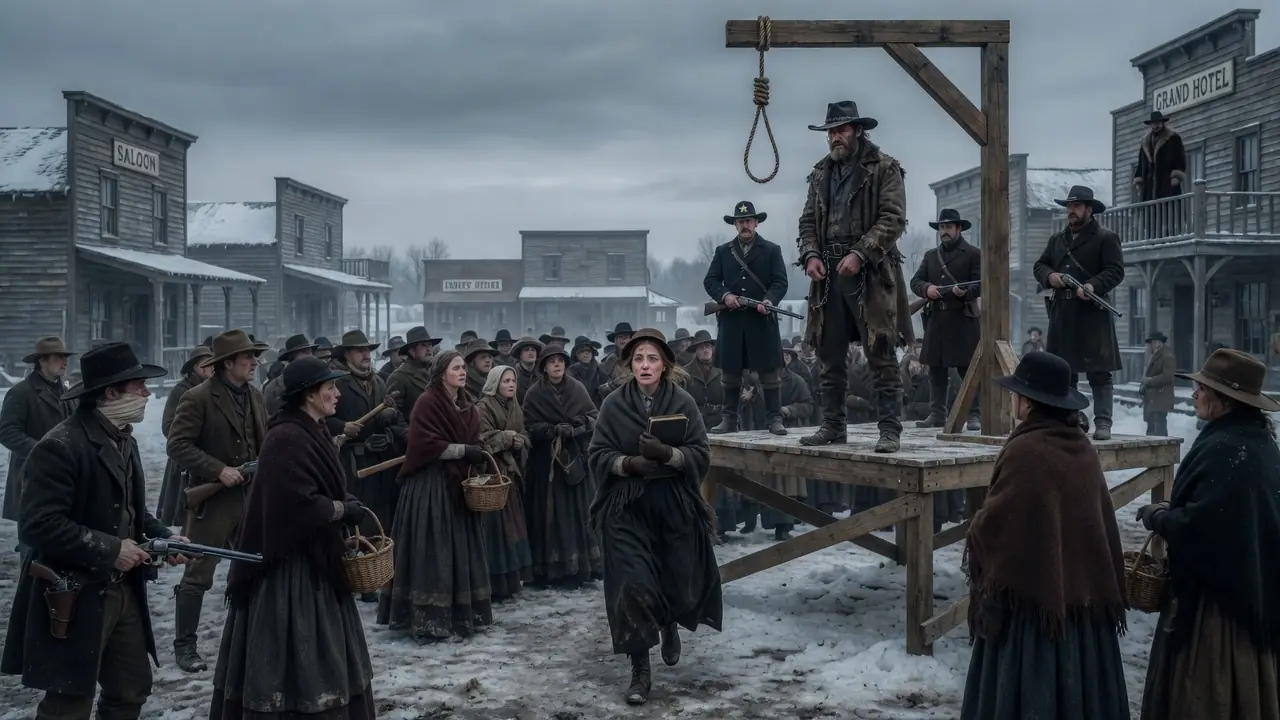
The morning sun did not rise over Blackwood. It bled through a bruised and suffocating sky, casting long, damning shadows over the newly erected pine gallows.
A town starved of justice had finally found its appetite, and the main street hummed with the electric, ugly anticipation of a public execution.
The storm from the previous night had broken, leaving behind a bitter freezing wind that turned the churned mud of the thoroughfare into hardened, treacherous ridges.
In the center of the square, carpenters on Silas Vance’s payroll had worked through the darkest hours, hammering heavy iron nails into fresh, sap-bleeding timber to construct a scaffold of death.
The citizens of Blackwood gathered in the freezing cold, their faces pale and pinched beneath wide-brimmed hats and heavy woolen shawls. They were a people broken by years of subjugation, their individual consciences swallowed whole by the terrifying, intoxicating anonymity of the mob.
They stood shoulder to shoulder, a sea of fearful eyes and nervous murmurs, desperately needing a villain to absolve them of their own pervasive cowardice.
Silas Vance had given them a monster, a silent, lethal drifter who had allegedly slaughtered a lawman, and they were eager to see the monster swing.
From the elevated balcony of the grand hotel, wrapped in a luxurious fur-lined coat, Silas Vance observed his handiwork. He held a steaming cup of imported black tea, savoring the absolute control he wielded over the miserable souls below.
The trap was set perfectly. The silver buried beneath the Higgins Ranch would soon be his, legally secured through the imminent destruction of the only two people who stood in his way.
The heavy iron door of the jailhouse groaned open, and the crowd surged forward, a collective intake of breath hissing through the frigid air.
Elias Thorne was marched out into the blinding gray light. He wore the same ragged, bloodstained Union coat, his wrists secured in front of him by thick iron chains that rattled with a dull, heavy finality against his thighs.
He was flanked by Sheriff Cobb and three heavily armed deputies, their rifles held at the ready, their eyes darting nervously over the restless crowd.
Elias did not stumble. He did not cower. He walked with the rigid, perfectly measured stride of a soldier marching to his final post.
The brutal beatings he had endured in the cells the previous night had left his face bruised and swollen, a deep cut tracing the line of his jaw, but his gray eyes remained entirely unbroken.
He did not look at the screaming townsfolk calling for his blood. He did not look at the rough hemp rope swaying gently in the biting wind.
He locked his gaze precisely on the balcony above the saloon, staring directly into the soul of Captain Silas Montgomery.
The sheer intensity of that silent, predatory stare made Vance shift uncomfortably behind his carved wooden railing. The aristocrat took a sip of his tea, trying to project an air of bored amusement, but a sudden, inexplicable chill prickled the back of his neck.
There was no fear in the condemned man’s eyes, only a cold, terrifying promise of retribution that defied the heavy chains and the looming gallows.
Suddenly, a violent commotion erupted at the edge of the square.
“Stop!”
The voice tore through the murmuring crowd, ragged and desperate.
“You are hanging an innocent man!”
Clara Higgins drove her exhausted wagon recklessly into the edge of the throng, the horses frothing at the mouth. She stood in the buckboard, her face pale and drawn, clutching the small black leather ledger high above her head like a shield against the madness.
She scrambled down from the wagon, shoving her way forcefully through the densely packed bodies.
“Listen to me!” Clara screamed, her voice cracking with the sheer, agonizing effort of piercing the mob’s bloodlust. “The Drifter did not ambush anyone. Vance sent them to burn my ranch. He sent them to kill us.”
The crowd parted slightly, turning to look at the frantic widow. A ripple of confusion washed over the front ranks.
Clara reached the base of the gallows, her eyes wide with a desperate, terrifying clarity. She pointed a trembling finger directly at the balcony.
“Silas Vance is a murderer. He killed my husband. Thomas found silver on our land, a massive vein of it, and Vance had him butchered to steal it. I have the proof right here. I have his journal.”
She waved the ledger frantically, pleading with the terrified faces surrounding her.
“He owns the sheriff. He owns the assayer. He is stealing your lives, and you are helping him kill the only man who tried to stop it.”
For one agonizing, fragile second, the absolute truth of her words hung suspended in the freezing air. The townsfolk looked from the weeping widow to the smug, fur-clad aristocrat on the balcony, the scales of their manufactured reality threatening to tip.
Mr. Abernathy, the mercantile owner, took a hesitant step forward, his face stricken with profound guilt.
Vance’s expression darkened into a mask of pure, concentrated venom.
He gave a sharp, imperceptible nod to the street below.
Callaway stepped out from the shadow of the gallows, the massive enforcer, his jaw heavily bandaged and his eyes burning with a sadistic fury. He crossed the distance to Clara in three long strides.
He did not utter a word.
He simply struck her across the face with the heavy barrel of his revolver.
Clara collapsed into the frozen mud, the ledger flying from her grasp.
A collective gasp rose from the crowd, but the fear of Vance’s enforcers immediately strangled any impulse to intervene.
Two deputies rushed forward, grabbing Clara roughly by the arms and dragging her forcefully away from the scaffold, her boots leaving deep, tragic gouges in the hardened earth.
Elias stopped his march.
The chains around his wrists drew taut as he strained against the deputies holding him. A low, terrifying growl built deep within his chest, a sound born of pure, unadulterated violence.
He watched Clara bleed in the mud, the ledger trampled beneath the boots of the retreating deputies.
The iron discipline that had held him together for a decade began to splinter. The ghosts of Miller’s Creek screamed for blood in the chaotic amphitheater of his mind.
“Keep him moving,” Sheriff Cobb barked, his voice laced with sudden panic. He shoved the barrel of his rifle hard against the base of Elias’s spine. “Get him up those steps right now.”
Elias was forced up the rough wooden stairs, his heavy boots thudding against the hollow pine.
He reached the platform, standing high above the sea of terrified, complicit faces. The wind whipped his ragged coat around his battered frame.
Below him, Clara was held securely by Callaway’s men, a thin stream of blood trailing from her lip, her eyes locked onto Elias in an agony of absolute helplessness.
The hangman, a burly blacksmith deputized for the morning, stepped behind Elias. He dropped the heavy thirteen-knot noose over the prisoner’s head, pulling the rough hemp tight against the scarred skin of his neck.
The coarse fibers bit into his throat, a stark physical reminder of the suffocating grip Silas Vance held over the entire territory.
Sheriff Cobb stepped to the front of the platform, unrolling a hastily scribbled piece of parchment. He cleared his throat loudly, attempting to project an aura of official, unshakable law.
“By the authority vested in me by the territorial governor,” Cobb bellowed, his voice echoing off the false-front buildings, “I hereby sentence this nameless vagrant to hang by the neck until dead for the vicious and unprovoked murder of a sworn deputy of Blackwood County. May God have mercy on his wretched soul.”
Cobb rolled the parchment, stuffing it into his coat pocket. He turned to the executioner and gave a curt nod.
The blacksmith moved to the heavy wooden lever that controlled the trap door.
The square fell completely, terrifyingly silent. The wind seemed to hold its breath. Even the horses tied to the hitching posts stopped their restless shifting.
The absolute, crushing weight of an innocent man’s impending death settled heavily onto the conscience of every soul present.
Clara closed her eyes, unable to watch the brutal termination of the man who had brought a fleeting spark of hope back into her shattered life.
Elias stood upon the trapdoor, the rope tight, the abyss waiting inches beneath his boots.
He did not tremble. He did not look at the lever or the sheriff.
He slowly raised his chin, ignoring the bite of the hemp, and locked his eyes onto Silas Vance one final time.
He reached deep within himself, past the trauma, past the decade of silence, and past the agonizing fear of the memories that had broken him.
He found the voice he had buried in the blood-soaked mud of Tennessee.
As the blacksmith wrapped his thick hands around the execution lever, preparing to plunge the town into an irreversible darkness, the Mute finally drew a deep, jagged breath.
What terrible, damning words would shatter the silence of ten long years? And could they possibly strike with enough force to dismantle an empire built on blood before the trap door swung open?
The silence of Blackwood was not broken by the violent snap of the gallows trap door, but by a sound far more terrifying to a guilty conscience.
A single gravelly word severed the freezing air, striking the aristocratic man on the balcony with the concussive force of a cannonball.
“Montgomery.”
The voice was raw, grating like iron dragged across stone, thick with the rust of a ten-year burial.
It did not emanate from the crowd. It came from the condemned man standing with a noose resting heavy upon his collarbone.
Elias Thorne raised his head, his gray eyes locking entirely onto the frozen figure of Silas Vance.
Sheriff Cobb flinched, his hand dropping from the lever as if the wood had suddenly caught fire. The townsfolk gasped, a collective shudder rippling through the dense mob.
The Mute had spoken.
Clara Higgins stopped struggling against Callaway’s deputies, her breath catching in her bruised throat, staring up at the scaffold in absolute, tear-filled disbelief.
On the balcony, the imported porcelain teacup slipped from Silas Vance’s manicured fingers. It shattered against the wooden floorboards, splashing dark liquid over his polished boots.
The blood drained instantly from his arrogant face, leaving behind a pale, terrifying realization. He gripped the wooden railing, his knuckles turning stark white.
“Pull the lever!” Vance shrieked, his smooth, practiced baritone disintegrating into a panicked, high-pitched command. “Hang him right now.”
Cobb lunged for the mechanism, but a massive collective shift in the crowd stayed his hand.
Mr. Abernathy stepped squarely to the base of the gallows, raising a heavy wooden pickaxe handle, his eyes narrowing at the terrified lawman.
The town was suddenly starving for the rest of the dead man’s words.
Elias did not beg for his life. He did not ask for mercy or forgiveness.
He stood tall, the rough hemp scraping his skin, and projected his voice over the windswept square. Every syllable was a hammer blow of truth against the fragile glass of Vance’s empire.
“His name is not Silas Vance,” Elias declared, his vocal cords straining, tearing loose the decade of enforced silence. “He is Captain Silas Montgomery of the United States Army. And every brick, every timber, every stolen acre in this town was purchased with the blood of sixty-four loyal men.”
The crowd stared in stunned silence.
Even Callaway and his deputies loosened their grip on Clara, their brutal minds struggling to comprehend the staggering accusation.
“August of 1864,” Elias continued, his voice gaining a dark, commanding resonance that vibrated in the chest of every listener. “Miller’s Creek, Tennessee. We were pinned down in a muddy ravine, fighting a war we believed in. We awaited reinforcements. We awaited our commanding officer. Instead, Captain Montgomery ordered a localized artillery strike directly onto our position.”
Elias took a step forward on the trap door, testing the limits of the chains binding his wrists.
“It was not a battlefield error. It was a calculated slaughter. He butchered his own regiment to cover the theft of a federal payroll wagon carrying $100,000 in gold. I lay beneath the shredded corpses of my friends, choking on their blood, while Captain Montgomery rode through the smoke, executing the survivors with his own revolver. I watched him strip the insignia from his uniform and ride away a wealthy ghost.”
“Lies!” Vance roared from the balcony, his aristocratic composure entirely shattered.
He drew a small silver-plated derringer from his coat pocket, aiming it wildly at the gallows.
“He is a lunatic, a desperate animal trying to save his own miserable neck. Cobb, do your duty or I will see you burn.”
“I have carried the silence of those dead men for ten years,” Elias shouted over the rising wind, turning his intense gaze from the balcony to the faces of the terrified townsfolk. “I buried my voice because the world that allowed a monster like Montgomery to thrive was not a world worth speaking to. But I will not stay silent while he butchers this woman and steals this town just as he stole that gold.”
Elias forcefully raised his chained hands, bringing them to the breast pocket of his faded, bloodstained Union wool shirt. With agonizing effort against the heavy iron links, his scarred fingers retrieved a small metallic object.
He held it up for the entire square to see.
It caught the meager gray light of the winter morning, a heavy, tarnished brass button bearing the distinct eagle and wreath of a Union officer.
“I found this in the dirt at the mountain pass,” Elias announced, his voice ringing with absolute, damning finality. “At the blast site where your beloved benefactor dynamited Clara Higgins’s cattle trail. The exact same explosive tactics he used to cover his tracks at Miller’s Creek. He lost it while securing the perimeter of his latest theft. Look at it. Look at the foundation of your town.”
The revelation struck the crowd like a physical blow.
The pieces of the horrific puzzle slammed together with sickening clarity: the military precision of the homestead burning, the ruthless, calculating financial strangulation, the murder of Thomas Higgins for the silver buried beneath his land.
They were not being governed by a shrewd businessman.
They had been entirely conquered by a treasonous mass murderer hiding behind a stolen name and a tailored suit.
“He bought your bank with dead men’s wages,” Elias challenged the mob, his eyes burning with righteous fury. “He bought your sheriff with blood money. He bought your fear, and he is using it to turn you all into his personal executioners. Are you going to pull that lever and finish the massacre he started ten years ago?”
The transformation in the square was immediate and terrifying.
The pervasive cowardice that had suffocated Blackwood for years evaporated, replaced by a deep, volcanic outrage. They had been manipulated, starved, and turned against one another to line the pockets of a butcher.
Mr. Abernathy turned his pickaxe handle toward the balcony.
“You sent men to burn out the Millers,” he screamed, his face red with sudden, violent courage. “You murdered Thomas Higgins.”
The accusation acted as a spark in a powder keg.
The mob erupted, but their fury was no longer directed at the silent drifter on the gallows. They turned as one massive, unstoppable entity toward the Grand Hotel and the deputies standing guard.
Shotguns were pumped. Hammers were cocked on ancient revolvers.
The townsfolk of Blackwood finally found their spine, and they intended to use it to break the man who had broken their town.
Callaway realized the catastrophic shift in the balance of power. He dropped his hold on Clara and drew his twin revolvers, backing away toward the saloon doors, his eyes darting frantically over the heavily armed, advancing mob.
Sheriff Cobb, sweating profusely despite the freezing wind, stepped entirely away from the execution lever, his hands raised in a gesture of desperate surrender.
Up on the balcony, Silas Vance realized his empire of paper and poison had just burned to the ground.
He looked at the screaming mob, then at the man standing tall on the gallows with the noose still around his neck.
The Mute had spoken, and his words had summoned a reckoning that no amount of stolen gold could possibly stop.
Vance fired his derringer wildly into the air, turning to sprint back into the luxurious suite of the hotel, desperately seeking an escape route.
The battle for Blackwood had officially begun.
But how many more lives would be claimed by the crossfire before the heavy chains binding Elias Thorne could be shattered?
The frozen paralysis of Blackwood shattered not with a whimper, but with the deafening roar of a town finally reclaiming its soul. A single wild gunshot from Silas Vance’s silver derringer acted as the match dropped into a powder keg of decade-old resentments and freshly exposed treachery.
Callaway, realizing the absolute collapse of his authority, raised his heavy revolvers, aiming to cut down the front line of the advancing mob.
He never had the chance to fire.
Mr. Abernathy, a man who had spent years quietly stocking shelves and swallowing his pride, swung his heavy pickaxe handle with the desperate strength of a man defending his home.
The solid oak struck Callaway flush against his jaw, shattering the bandages and the bone beneath. The massive enforcer crumpled backward into the freezing mud, his weapons tumbling from his limp hands.
The remaining deputies, recognizing they were vastly outnumbered by an enraged populace armed with shotguns, hunting rifles, and a profound thirst for vengeance, threw down their weapons and raised their hands in unconditional surrender.
The reign of terror disintegrated in a matter of seconds.
On the gallows platform, Sheriff Cobb cowered near the trapdoor lever, his hands trembling violently as the mob secured the square below.
Clara Higgins scrambled up the rough pine steps, her skirt stained with mud and her lip bleeding freely. Driven by an adrenaline fueled by pure love and desperation, she snatched the heavy iron ring of keys from Cobb’s belt, shoving the corrupt lawman aside with a fierce, undeniable strength.
With shaking hands, she found the correct key and unlocked the heavy iron manacles binding Elias.
The chains fell away, clattering loudly against the wooden floorboards.
She reached up and pulled the rough hemp noose from his neck, tossing it aside like a venomous snake.
Elias rubbed his raw, bruised wrists, his chest heaving as he drew his first free breath. He looked down at Clara, his gray eyes locking onto hers with a profound, unspoken gratitude.
But the fire of justice had not yet been fully quenched.
He shifted his gaze back to the Grand Hotel.
The architect of his misery, the butcher of his brothers, was escaping.
Elias did not sprint. He moved with the terrifying, deliberate pace of a seasoned hunter who had finally cornered his prey.
Clara picked up a discarded repeating rifle from the platform, checking the chamber with practiced efficiency, and followed closely behind him.
They pushed through the heavy mahogany doors of the hotel lobby. The opulent interior was completely deserted, the wealthy patrons and corrupt officials having fled at the very first sign of an uprising.
A trail of muddy footprints led up the grand sweeping staircase, staining the expensive crimson carpet.
They found Silas Vance, Captain Silas Montgomery, at the end of a long, dimly lit corridor on the second floor. He was desperately trying to unlock the heavy oak door to his private suite.
He fumbled frantically with a brass key, his aristocratic composure entirely replaced by the pathetic, hyperventilating terror of a cornered coward.
He turned as Elias and Clara approached, dropping the key and raising his small silver-plated derringer. His hand shook uncontrollably, his eyes wide with a manic, terrified light.
“You cannot do this,” Vance shrieked, his voice cracking, echoing harshly against the floral wallpaper. “I am a man of immense wealth. I can give you the gold. I can give you the entire territory. Name your price, you filthy animal.”
Elias stepped forward, his face an impenetrable mask of absolute, chilling resolve.
He offered no words, no negotiations.
Vance panicked and pulled the trigger.
The deafening crack filled the hallway, and the small-caliber bullet struck Elias high in the left shoulder. The lead tore through the thick, faded wool of his Union coat, blossoming a dark red stain across the fabric.
The impact did not even break Elias’s stride.
He absorbed the pain with the grim tolerance of a man who had survived far worse on the battlefields of Tennessee.
He closed the remaining distance in two massive, predatory steps, swatting the derringer from Vance’s hand with a savage backhand that echoed like a whip crack.
He grabbed the lapels of Vance’s expensive cashmere coat, lifted the aristocrat entirely off his polished boots, and slammed him violently against the corridor wall.
The impact rattled the framed paintings hanging nearby.
Elias looked deeply into the terrified eyes of the man who had ordered the slaughter of his regiment. The silence of ten years had been broken, and the words that flowed now were heavy with the weight of absolute judgment.
“The gold never belonged to you,” Elias stated, his gravelly voice vibrating with a dark, commanding resonance. “And neither do those men you left bleeding in the mud at Miller’s Creek. Your personal war ends today, Captain.”
Clara stepped up beside Elias, raising the repeating rifle and pressing the cold iron barrel directly against Vance’s chest.
Vance looked at the battered, resilient widow, his breath hitching in his throat as he realized his vast wealth and endless manipulation held absolutely no power over these two survivors.
He squeezed his eyes shut, bracing for the inevitable, violent execution he so richly deserved.
Clara did not pull the trigger.
She held the rifle steady for a long, agonizing moment, her eyes filled with a cold, undeniable justice.
“We are not butchers like you,” Clara said, her voice clear and resonant, cutting through the remnants of the town’s chaos outside. “You will not die a quick death in a quiet hallway. You will stand trial before a federal judge. You will be stripped of your stolen name, your stolen wealth, and your false dignity. And you will hang under the full crushing weight of the law, knowing that a woman and a silent drifter took absolutely everything from you.”
Elias released his iron grip, allowing Vance to slump to the floor in a pathetic, weeping heap.
They dragged the broken aristocrat down the grand staircase and threw him out the front doors of the hotel, delivering him directly into the waiting hands of the newly liberated townspeople.
The following week saw the arduous, painful, but incredibly beautiful resurrection of Blackwood.
The federal marshal arrived from the territorial capital with a detachment of heavily armed cavalrymen, taking permanent custody of Silas Vance, Callaway, and the surviving enforcers.
The hidden ledger Clara had salvaged from her husband’s trunk provided the undeniable, meticulous proof required to completely dismantle Vance’s fraudulent financial empire.
The stolen deeds were systematically returned to the surviving families. The bank was radically reorganized under the collective, democratic ownership of the local ranchers. The massive silver vein located beneath the limestone ridge on the Higgins property was legally secured and registered, bringing a sudden, unprecedented influx of honest prosperity to the entire region.
The town began to heal, governed no longer by fear, poison, and coercion, but by the hard-earned, fiercely protected principles of shared justice and mutual survival.
Spring eventually broke the iron, suffocating grip of the Dakota winter. The unforgiving ice melted into rushing crystalline streams, and patches of vibrant green grass pushed stubbornly through the thawing earth, a testament to the enduring will of life itself.
As Clara and Elias stood together on the front porch of the main house, the warm morning sun washing over their faces, they watched their healthy cattle graze peacefully in the blooming valley.
Elias wore a new canvas jacket, his shoulder nearly healed, the heavy, oppressive shadows of his past finally receding into the background of his mind.
The terrifying silence that had defined him for a decade was permanently broken. He had found his voice, not merely to condemn a monster, but to finally participate in the beautiful, messy world of the living.
He turned to Clara, his gray eyes soft, clear, and completely devoid of the haunting specters of war. He reached out, his calloused hand gently brushing a stray lock of hair from her cheek.
“The fence needs mending in the lower pasture,” Elias said, his voice quiet, steady, and filled with a profound, resonant warmth.
Clara smiled, leaning into his gentle touch, her heart entirely whole for the first time in over a grueling year.
“We will fix it together,” she replied.
They stood shoulder to shoulder, overlooking their vast, reclaimed land.
They were two shattered souls who had walked straight through the freezing fires of hell, refusing to let the darkness consume them.
They had emerged on the other side, forged into something entirely unbreakable, finding their deeply earned, quiet happiness on the rugged frontier.