The dust outside Crow Hollow rose so thick that noon looked like dusk.
I remember that first.
The color of the sky.
The taste of grit between my teeth.
The stink of horses, sweat, gun oil, and cheap tobacco.
And the auction bell.
It rang from the far edge of town, sharp and ugly, cutting through the ordinary noise of wagons and shouting men. At first, I thought it was another livestock sale. In Crow Hollow, nearly everything was sold under that bell sooner or later: cattle, tack, mining tools, broken wagons, stolen horses dressed up with new brands.
Then I heard a man laugh and say, “The girl still has fire in her, and the boy looks young enough to shape.”
I stopped walking.
Something inside me went still.
My name is Nathaniel Cross.
I was forty-one years old when I rode into Crow Hollow with a lame bay horse, an empty coffee tin, and a heart I had not used properly in years.
This was New Mexico Territory, 1884, near the high desert country where red stone rose out of the earth like old wounds. Men came there for silver, water rights, cattle, revenge, and whatever else they believed a gun could help them keep.
I had come for flour, coffee, salt, cartridges, and a new hinge for the north barn door.
Nothing more.
I owned a ranch two days north of Crow Hollow, tucked beneath a ridge of black volcanic rock locals called Devil’s Crown. It was not a grand spread. Dry pasture. Stubborn cattle. A good well. A house too large for one man. A barn that complained in every wind.
I lived there with Mrs. Alba Reyes, a widow who cooked, scolded, prayed, and ran my house with the authority of a general. I had four hands working for me, though most days it felt like the land itself required more men than any rancher could afford.
Once, I had worn a cavalry uniform.
I do not say that proudly.
I wore it because I was young, hungry, and eager to believe the world could be divided into orders and enemies. For a while, I did believe it. Then I saw what orders could do when men stopped asking whether they were right.
Burned camps.
Empty food stores.
Mothers walking behind wagons with children too tired to cry.
Prisoners counted like inventory.
By the time I left the army, I could not look at my own hands without wondering what they had helped carry.
My wife, Rebecca, used to say no man could undo his past, but he could decide whether the past got the last word.
She died of fever five years before that day.
After that, I let the past talk as much as it wanted.
I worked. I paid my men. I kept to myself. I gave water to travelers, food to widows, and silence to anyone foolish enough to ask too many questions.
That was the life I had left.
Then the auction bell rang again.
I tied my horse outside the dry goods store and followed the sound.
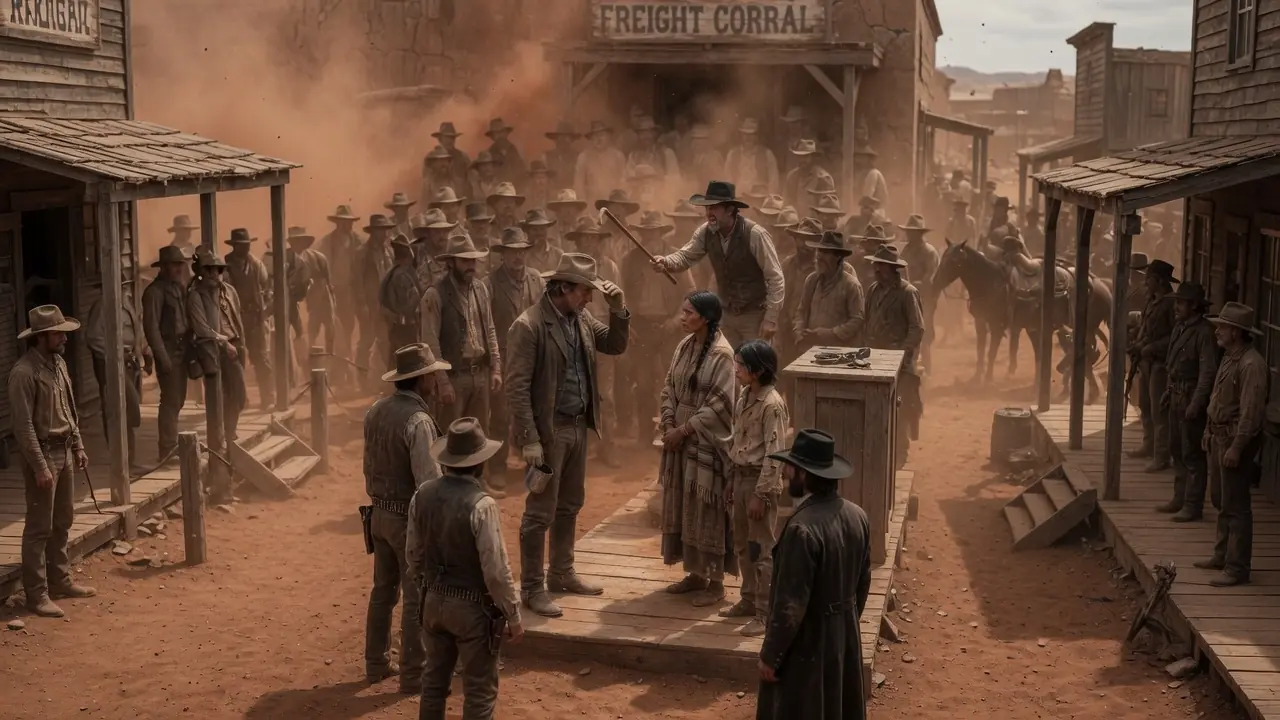
A crowd had gathered near the old freight corral. Miners, ranchers, drifters, teamsters, soldiers off duty, and men with faces I would not have trusted near a locked church door. They stood in a half circle before a crude wooden platform.
On that platform stood a man named Silas Greer.
I knew him by reputation. Most people did. He traded in horses when he could get them cheap, whiskey when he could sell it dear, and human misery whenever the law looked the other way.
Behind him stood several captives.
Three men.
An old woman.
And two young people whose posture struck me before their faces did.
A young woman stood slightly in front.
Apache, I thought, though I knew enough not to pretend that one word held every people, band, and family. She might have been twenty-four or twenty-five. Tall, straight-backed, with black hair braided over one shoulder, her face calm in a way that was not peace but discipline. Her wrists were bound, yet her chin stayed high. Her dark eyes moved across the crowd like she was memorizing every man who looked at her wrong.
Behind her stood a boy.
Sixteen, maybe seventeen.
Too young for the way he was trying to look like a man.
He had the same sharp cheekbones, the same black hair, the same guarded eyes. His shoulders were thin under his torn shirt, and one side of his mouth was split. He stood close behind the young woman but not hiding. His hands were tied too, and the knuckles of one hand were swollen.
Brother and sister.
No doubt about it.
The girl shielded him with her body.
The boy hated needing it.
That was what made my throat close.
Silas Greer lifted his cane and pointed toward them.
“Now here, gentlemen, is a rare lot. A strong Apache girl and her younger brother, taken near the western border country. The girl has spirit, I grant you that. Might need breaking, but she’ll work hard once trained. The boy is young, lean, and quick. Good for stable work, mine hauling, camp labor, whatever a man has use for.”
A few men laughed.
The boy’s jaw tightened.
The sister whispered something to him in Apache. I caught only the shape of it, not every word.
Be still.
Live first.
Fight later.
The boy breathed through his nose and lowered his hands.
Silas Greer grinned.
“We’ll start the pair at sixty dollars.”
Hands went up.
Seventy.
Ninety.
One hundred.
A rancher near the front bid one twenty-five and said the boy might make a fair horse hand if whipped proper.
The young woman’s eyes found him.
The rancher stopped smiling.
Then a man in a black hat stepped forward.
Elias Rusk.
My stomach turned.
Rusk owned a mining claim outside Bitter Wash and three graves behind his bunkhouse that no one asked about. Men who worked for him came back hollow-eyed. Women who fell under his control rarely came back at all.
“Two hundred,” Rusk called.
The crowd quieted.
Silas Greer’s smile grew.
“Two hundred from Mr. Rusk.”
The boy took one step forward.
The sister shifted instantly, blocking him.
He said something to her under his breath.
She answered without looking at him.
This time I understood.
No. You stay alive.
The words cut through me.
The boy was ready to die because he could not bear to watch his sister be sold.
The sister was ready to be sold because she could not bear to let him die.
I had seen courage in battle.
This was something harsher.
This was love with no room left to be gentle.
“Two hundred going once,” Greer called.
The young woman looked across the crowd.
Her gaze landed on me.
Maybe because I had gone too still.
Maybe because guilt has a scent people in chains learn to recognize.
Her eyes did not plead.
They accused.
Are you one more man who watches?
I had watched before.
Too often.
The truth of that sat in me like a stone.
“Three hundred,” I said.
The crowd turned.
Silas Greer blinked, then recovered fast.
“Nathaniel Cross. Three hundred dollars.”
Rusk looked at me slowly.
“You riding into business that doesn’t concern you, Cross?”
“I have a bad habit of that.”
“Three fifty,” Rusk said.
“Four hundred.”
Murmurs moved through the crowd.
That was not small money.
Not to me. Not to anyone with cattle to winter and fences to mend.
Rusk’s eyes narrowed.
“Five.”
“Six hundred,” I said.
The boy stared at me.
The sister did too.
Silas Greer nearly danced with greed.
“Six hundred from Mr. Cross.”
Rusk spat into the dirt.
“Seven.”
I thought of winter hay.
The barn roof.
The debt note in my desk.
Then I thought of the boy’s split mouth and the sister’s straight back.
“Eight hundred and fifty,” I said.
The crowd broke into noise.
Rusk turned red.
“You fool. They aren’t worth half that.”
I looked at him.
“That’s where you and I differ. I don’t think this is about worth.”
For a few seconds, Rusk looked like he might draw.
I almost wished he would.
Instead, he stepped back.
Silas Greer lifted the gavel.
“Eight hundred and fifty dollars going once. Going twice. Sold to Nathaniel Cross.”
The gavel hit wood.
Sold.
The word crawled under my skin.
I had stopped Rusk from taking them.
But I had still bought them.
A man does not make a wrong clean by standing beside something worse.
He only chooses what he will do next.
I paid Silas Greer with money meant for winter stock and a new wagon team. He counted every bill, wetting his thumb like he was handling honest trade.
“Fine purchase, Cross,” he said. “Strong girl. Young boy. They’ll serve you well.”
I stepped close enough that his smile thinned.
“You’ll hand me the papers. Then you’ll forget their faces.”
His eyes hardened.
“Law says they’re yours now.”
“Law says many things when cowards write it.”
He gave me the papers.
A deputy cut the pair from the line but left their wrists tied.
I took out my knife.
The boy jerked forward, putting himself between me and his sister.
She hissed his name.
“Tahu.”
I stopped.
“I am not going to hurt either of you,” I said in Apache.
Both of them froze.
The young woman’s eyes sharpened.
“You speak our words?”
“Some.”
“Why?”
“I was a soldier.”
Her face closed.
“Then you hurt our people.”
“Yes.”
I did not explain.
She had not asked for my excuses.
I cut the rope from the boy’s wrists first.
He stared at his hands, then at me, as if freedom might be another trick. Then I cut hers.
“My name is Nathaniel Cross,” I said. “I have a ranch north of Devil’s Crown. I am taking you there because it is safer than here. Once we arrive, you are not bound. You are not property. You may leave when you choose.”
The boy rubbed one raw wrist.
The sister watched me without blinking.
“What do you want?” she asked.
“Nothing.”
“No white man pays eight hundred and fifty dollars for nothing.”
She was right.
“I paid because if I did not, Rusk would have.”
Her gaze shifted toward Elias Rusk, still standing at the edge of the crowd with murder in his eyes.
Understanding crossed her face.
Not trust.
Not gratitude.
Only a clear measurement of danger.
“What are your names?” I asked.
She hesitated.
Then said, “I am Yara.”
The boy lifted his chin.
“Tahu.”
I repeated both names carefully.
Yara’s eyes followed my mouth.
“You say them badly.”
“I expect that will not be the last thing I do badly today.”
Tahu’s mouth twitched.
Almost a smile.
Almost.
We walked toward my wagon.
People muttered as we passed.
Some curious. Some cruel. Some disappointed that nothing worse had happened.
Sheriff Malachi Dorne stepped into my path near the hitching rail.
He wore his badge like a warning and his gun too low for honest work.
“Cross.”
“Sheriff.”
“You know what you’re taking on?”
“I know who I’m taking home.”
His eyes flicked toward Yara and Tahu.
“Apache trouble follows Apache feet.”
“So does white trouble. I notice you still allow boots in town.”
A man nearby gave one surprised laugh and swallowed the rest when Dorne looked at him.
The sheriff leaned closer.
“If they run, steal, cut a throat, it lands on you.”
“If anyone harms them,” I said, “it lands through me.”
Dorne studied me, trying to decide if I was bluffing.
I was not.
At last, he stepped aside.
We rode out of Crow Hollow with the sun lowering behind the red hills and the dust settling behind us like a curtain falling on shame.
For the first hour, no one spoke.
Yara and Tahu sat in the wagon bed wrapped in blankets I had given them. Tahu kept looking back toward town as if he expected riders to follow. Yara kept one hand near the small knife I had returned to her.
She had stared at it when I placed it in her palm.
“Why give this back?” she asked.
“Because a person who has been tied should have something sharp nearby.”
She looked at me then.
Not softly.
But differently.
At dusk, we stopped near a dry wash.
I built a small fire and put coffee on. Mrs. Reyes had packed corn cakes, beans, and dried peaches. I divided the food evenly and set their portion down first.
Tahu did not eat until Yara nodded.
Yara did not eat until Tahu had taken enough.
I noticed.
Yara noticed me noticing.
“You watch too much.”
“I’m trying to understand.”
“Men like you understand after damage is done.”
The words had no anger in them.
Only history.
That made them harder to hear.
“You may be right.”
She looked surprised.
Tahu spoke after a while in careful English.
“You have family?”
“No.”
“Dead?”
“Yes.”
His face changed.
“I am sorry.”
He meant it.
That undid me more than I expected.
A boy who had stood on an auction platform hours before still found room to offer sorrow to a stranger.
“Thank you,” I said.
Yara looked into the fire.
“Do not mistake my brother’s young face for weakness.”
“I did not.”
“You will.”
“No,” I said. “I’ve seen grown men with less courage than he showed today.”
Tahu looked away quickly.
Yara’s eyes lifted to mine.
For a moment, firelight caught the dark in them.
Then she looked back at the flames.
Devil’s Crown Ranch sat in a valley of black rock, red soil, and cottonwoods following a narrow creek. The land was hard, but not cruel if a person listened to it. The house was built from timber and stone, low and square, with a wide porch Rebecca had insisted on because she loved watching storms roll over the ridge.
I had not sat there much after she died.
Mrs. Alba Reyes came out before the wagon stopped.
She was fifty-six, strong as rawhide, with silver threaded through her black hair and eyes that could make hired men stand straighter.
She saw Yara and Tahu.
Then she saw the rope burns on their wrists.
Her mouth tightened.
“Nathaniel,” she said. “What happened?”
“Crow Hollow happened.”
She crossed herself.
Yara helped Tahu down before I could offer.
Mrs. Reyes noticed that.
“Come inside,” she said gently. “There is stew, hot water, and doors that close.”
Yara looked at me.
“Doors that lock?”
“From the inside,” I said.
“No one enters?”
“No one.”
“Even you?”
“Especially me.”
She studied me.
Then she nodded once.
Inside, Mrs. Reyes gave them warm water, clean cloth, and clothes from an old trunk. A plain blue dress for Yara. A shirt and trousers for Tahu that had belonged to a ranch hand who outgrew them before wearing them out.
Tahu touched the shirt as if unsure whether it would be taken back.
Mrs. Reyes saw that and cursed softly in Spanish under her breath.
That night, I sat on the porch alone while voices moved inside the house.
Mrs. Reyes speaking Spanish.
Tahu answering in broken English.
Yara’s Apache words, low and firm.
I understood only pieces.
Enough to know they were afraid.
Enough to know I was part of what frightened them.
That is a hard truth to sit with when you meant to help.
I had brought them out of Crow Hollow.
But safety is not a thing a man can hand over like a blanket.
It has to be believed.
By dawn, Yara was already outside.
She wore the blue dress Mrs. Reyes had found, but she moved as though cloth did not define her. Her braid hung over one shoulder. Her eyes marked every door, every fence line, every roof edge, every man coming from the bunkhouse.
She was mapping danger.
I recognized it.
I had done the same after the war.
“You sleep?”
“No.”
“Bed too soft?”
“Walls too close.”
I nodded.
Tahu emerged later, carrying firewood though no one had asked him. He moved stiffly, still sore, but set his jaw when Mrs. Reyes tried to take the load.
“No,” he said. “I work.”
“You heal first,” she snapped.
He blinked, startled by the force of her tone.
Yara almost smiled.
Almost.
At breakfast, my hired hands learned the shape of the new world.
There was Old Samuel Pike, who had been with me six years and trusted silence more than prayer. Mateo Reyes, Alba’s nephew, quick with horses and quicker with jokes. Clay Mercer, a decent hand with little imagination. And Bram Holt, a broad-shouldered man I had hired two months earlier because winter work was too much for three.
Samuel nodded respectfully to Yara and Tahu.
Mateo touched his hat and smiled at Tahu.
Clay looked confused but harmless.
Bram stared too long at Yara.
I set my coffee down.
“Bram.”
He looked at me.
“They are guests in this house.”
His mouth twisted.
“Guests. Sure.”
Yara heard the way he said it.
So did I.
Trouble had introduced itself.
Over the next week, the ranch shifted around Yara and Tahu.
Tahu stayed near the barn at first. He wanted work, but his body had been punished hard before we found him. Still, he learned fast. He fed chickens, carried water, and followed Mateo around the corrals asking the names of every tool and rope.
Mrs. Reyes fed him like she had declared private war on his thinness.
Yara spent most of her time near the horses.
She did not touch them immediately. She stood by the fence, patient and watchful, letting them learn her shape and scent.
On the fifth morning, a gray mare that had thrown Clay twice came to the rail and lowered her head toward Yara’s hand.
Samuel saw it from the barn.
“Well,” he muttered. “That mare hates nearly everybody.”
Yara touched the mare’s nose.
“Maybe she is wise.”
Samuel laughed once.
From then on, he liked her.
I tried to keep distance.
It seemed right.
Necessary.
Yara had not come to my ranch by choice. Not truly. And I would not turn rescue into another kind of possession.
But distance became difficult when someone changed the sound of a house.
Tahu’s questions filled the yard.
Mrs. Reyes’s scolding grew warmer.
Mateo taught Tahu card tricks, then regretted it when the boy beat him by the third night.
Yara’s presence moved through the place like a blade wrapped in cloth: sharp, hidden, always felt.
One afternoon, I found her in the stable with the gray mare.
Inside the stall.
No rope.
No whip.
No fear.
My heart nearly stopped.
“Yara,” I said quietly.
“If you shout, she will startle.”
“I was not planning to shout.”
“You are thinking too loudly.”
The mare snorted.
Yara raised one hand, palm low.
The animal lowered her head.
Slowly, impossibly, Yara touched the mare’s neck.
“She is not mean,” Yara said.
“She has made a strong argument otherwise.”
“She is afraid. Men hurt her and called her wild because she remembered.”
The words were about the horse.
Not only the horse.
I leaned against the stall door.
“You know horses.”
“My father taught me. Before soldiers took our valley.”
Her hand moved gently over the mare’s neck.
“What was his name?”
She went still.
For a moment, I thought she would refuse.
Then she said, “Nakai.”
I repeated it carefully.
“Nakai.”
She looked at me.
“Less wrong than before.”
“I can improve.”
She studied me for a breath too long.
“Yes,” she said. “Maybe.”
The first trouble from town came three days later.
Sheriff Dorne rode in with two men.
I met them in the yard before they reached the house.
Dorne stayed mounted.
“Cross.”
“Sheriff.”
“Word is you’ve got those two loose on your ranch.”
“They are free to move.”
“That so?”
“It is.”
“Had a complaint. Apache boy matching his description stole a bridle from Farrow’s place.”
“Farrow’s place is eleven miles south.”
“Apache boys run fast.”
I stared at him.
Behind me, the house door opened.
Tahu stepped onto the porch.
Yara appeared beside him.
Dorne’s eyes moved over them.
“Come here, boy.”
Tahu’s body tightened.
Yara stepped in front of him.
I moved before she had to.
“You’ll address him by name.”
Dorne smiled thinly.
“I don’t know his name.”
“Then you don’t know enough to speak to him.”
His riders shifted.
The sheriff leaned forward.
“Careful, Cross. Folks in this territory don’t like what you’re doing.”
“I noticed.”
“You taking up with Apache strays will make enemies.”
“I had enemies before breakfast.”
His eyes hardened.
“You bought them. That makes whatever they do your responsibility.”
The word bought hit the yard like a dropped blade.
Yara heard it.
Tahu heard it.
So did I.
Dorne smiled because he knew he had found the wound.
I kept my voice steady.
“I admit what I did. I do not accept what you think it means.”
“What it means is they’re property.”
“No,” I said. “It means men like Greer and Rusk made a market out of cruelty, and this town let them.”
Dorne’s smile vanished.
“You keep them under control.”
“They are not animals.”
“They are Apache.”
“So were some of the bravest people I ever faced.”
The yard went silent.
Dorne spat into the dirt.
“When trouble comes, don’t ride to me.”
“I’ve never found help there before.”
He rode away.
When I turned, Yara was looking at me.
“You said bought.”
“I did.”
Tahu’s mouth tightened.
Yara’s voice was cold.
“You speak truth. That does not always make truth clean.”
“No,” I said. “It doesn’t.”
She took Tahu inside.
For two days, she avoided me.
Tahu did not.
The boy followed me at a distance, angry and curious in equal measure. On the second evening, I found him near the tack room, trying to mend an old bridle with clumsy fingers.
“You don’t have to fix that.”
“I broke nothing.”
“I know.”
“Then why give me broken thing?”
“I didn’t give it to you.”
He frowned.
Then looked down at the bridle.
“I want to learn.”
I sat on a crate several feet away.
He watched me as if expecting a trick.
“My father taught me leatherwork,” I said. “Badly. I learned better from a Comanche scout named Eli Tall Bear.”
Tahu’s eyes lifted.
“You had Indian friend?”
“Yes.”
“You fight his people too?”
“Yes.”
He absorbed that.
“You are full of wrong things.”
I almost smiled.
“Yes.”
“Why Yara not leave?”
“That is her choice.”
“And mine?”
“Yours too.”
He stared at me hard.
“If I say we go tomorrow?”
“I give you two horses, food, money, and directions.”
“You lose money.”
“I already did.”
“Why?”
“Because people matter more than money.”
He looked away.
“My father said that.”
Then, quieter, “Before they killed him.”
I said nothing.
Sometimes silence was the only respectful answer.
On the third night, I found Yara by the creek.
Moonlight turned the water silver. Cottonwoods whispered in the dark. She sat on a fallen log with her arms resting on her knees.
I stopped several yards away.
“I should have said more when Dorne used that word.”
“You said enough.”
“No. I didn’t.”
She did not turn.
“I paid money in Crow Hollow,” I said. “That is true. I can say I meant to stop worse men, but it does not wash the wrong from the act itself.”
Her shoulders tightened.
“Men have papers,” she said. “Orders. Claims. Sales. Treaties. Always paper. Our dead do not fit on it.”
The words struck deep.
“Yes.”
“My mother died on a forced road. My father died trying to keep Tahu from being taken. My little cousin disappeared from a wagon line. All under papers.”
She turned to me.
“You say you are different. Maybe. But your difference does not erase what your uniform did.”
“No,” I said. “It doesn’t.”
“What do you want from us, Nathaniel Cross?”
The question came sharp.
Clean.
I answered it with the only truth I had.
“I want you to know that if you leave tomorrow, I will help you leave safely. If you stay, you stay by choice. Not because I paid. Not because you owe me. Not because this ranch has walls.”
“And if I never trust you?”
“Then I keep my word anyway.”
Something in her expression shifted.
Not surrender.
Not softness.
A single door unlatched somewhere deep.
“That is a hard promise.”
“Yes.”
“Good. Easy promises are cheap.”
She looked back at the creek.
I sat several feet away.
Not beside her.
For a long time, neither of us spoke.
The next morning, Bram Holt was gone.
So were two horses, a rifle, and Mrs. Reyes’s emergency money box.
Mateo found tracks leading south.
Samuel cursed so hard the chickens scattered.
I saddled up.
Yara came from the stable leading the gray mare, now saddled and calm.
“You’re not coming,” I said.
“Yes.”
“No.”
“Bram saw the mare come to my hand. He hated it. He will sell the horses before sundown if he reaches Bitter Wash.”
“This is not your fight.”
“He stole from this house.”
Tahu came running from the barn with a smaller rifle in his hands.
“I come too.”
Yara rounded on him.
“No.”
“He stole from this house,” Tahu said, throwing her own words back.
Yara’s eyes flashed.
“You are hurt.”
“I am alive.”
I looked at them both.
Brother and sister.
Shield and flame.
Yara stared at me as if daring me to decide for them.
I remembered my promise.
“If you come,” I said, “you follow orders when the shooting starts.”
Tahu lifted his chin.
“Whose orders?”
Yara answered before I could.
“Mine.”
He accepted that.
We rode hard.
Yara tracked better than any scout I had known. She saw broken grass, scuffed stone, a thread from a saddle blanket caught on thorn. Tahu saw smaller things: a cigarette end still warm, a hoof nick on a stone, the bend of a branch where a rider had passed too close.
By noon, we found Bram near an abandoned line shack, changing saddles.
He reached for his gun.
Yara already had her rifle up.
Tahu’s came up a second later.
“Do not,” Yara said.
Bram froze.
I dismounted.
“You stole from me.”
He glared.
“You chose them over your own.”
“My own don’t steal from my house.”
Bram’s eyes cut to Yara.
“She your woman now?”
Before I could speak, Yara said, “I am my own woman.”
Bram sneered at Tahu.
“And the boy? Your new pet?”
Tahu’s rifle steadied.
Yara’s voice sharpened.
“Tahu.”
He breathed once.
Twice.
Then lowered the barrel an inch.
I stepped closer to Bram.
“You are lucky they both have more discipline than you.”
We took him back to Crow Hollow and handed him to Sheriff Dorne, who looked disappointed that he could not blame the theft on Tahu.
On the ride home, the sun sank red behind the mesas.
Tahu rode beside me.
“You let us come.”
“You chose to.”
“You could have refused.”
“I could have tried.”
Yara, riding ahead, turned slightly.
“Smart man.”
Tahu looked at her, then at me.
For the first time, he smiled properly.
Trust came after that.
Not whole.
Not easy.
In pieces.
Tahu began sitting with me on the porch after supper, asking about ranch work, about Rebecca, about why stars looked closer in winter. Sometimes he asked about the war. Sometimes he stopped before the question left his mouth.
Mrs. Reyes taught him to make tortillas.
He taught her a song his mother used to sing while grinding corn. She pretended not to cry when he did.
Mateo became useless whenever Tahu beat him at cards, which was often. Samuel carved a small wooden horse and left it outside Tahu’s room without saying anything.
Yara took over horse work.
Not because I asked.
Because the horses chose her, and the ranch followed.
Soon men from neighboring spreads brought difficult animals to Devil’s Crown. Some came to learn. Some came to laugh.
They stopped laughing when a black stallion from Farrow’s place, a horse that had broken one man’s collarbone and another’s jaw, stood still while Yara murmured to him in Apache and placed her hand on his forehead.
“Witchcraft,” one man muttered.
Samuel spat tobacco into the dust.
“No. Skill. Fools often confuse the two.”
I loved the old man for that.
The ranch changed.
Where there had been silence, there were voices.
Where Rebecca’s empty chair had once accused me, Tahu now sat carving wood under Mrs. Reyes’s watch.
Where the stable had been only work, Yara made it a place of patience.
And I began waking with purpose again.
That frightened me more than loneliness ever had.
A man can grow used to grief. He can wear it long enough that warmth feels like betrayal when it returns.
One evening, I climbed the hill behind the house to Rebecca’s grave. The stone was warm from the day’s sun. The wind moved gently through dry grass.
“I don’t know what I’m doing,” I said.
No answer came.
Only wind.
“I thought helping them might settle something. Instead, it opened everything.”
I closed my eyes.
“I miss you.”
That remained true.
Then, after a long while, I whispered, “But I think I am alive again.”
When I opened my eyes, Yara stood at the bottom of the hill.
She did not come closer.
She waited.
I walked down.
“Your wife?” she asked.
“Yes.”
“You loved her.”
“Yes.”
“Still?”
“Yes.”
Yara nodded.
“Good.”
That surprised me.
“Good?”
“If death made you stop loving her, I would not trust your love for anyone living.”
I had no words.
Yara looked toward the grave.
“She is part of you.”
“Yes.”
“I do not want to fight ghosts.”
“No one could erase Rebecca.”
“Then maybe there is room.”
The words were quiet.
Dangerous.
I looked at her.
“Room for what?”
She looked away first.
“Do not make me say everything first, Nathaniel Cross.”
Despite myself, I almost laughed.
Instead, I took one step closer.
Not too close.
“I think there is room for love to return,” I said. “Not the same love. Not replacing. But real.”
Her breath caught.
“And this love?”
“You know.”
“I want to hear.”
Fair.
She had earned every honest word.
“You, Yara.”
The wind moved between us.
“I love you,” I said. “Maybe it began when you looked at me from that platform like you were daring me to remember my soul. Maybe when you calmed the gray mare. Maybe when you told Bram you belonged to yourself. I don’t know. But it is true.”
Her eyes shone in the fading light.
“I am not gentle.”
“I know.”
“I am angry.”
“Yes.”
“I do not forget.”
“Nor should you.”
“I may never become the kind of woman men call easy to love.”
“I am not asking for easy.”
“What are you asking for?”
“True.”
She stepped closer.
“Then hear truth. I love you too. It scares me. It angers me. But it is there.”
I reached for her hand slowly enough that she could refuse.
She did not.
Her fingers closed around mine.
For the first time in years, tomorrow did not feel like something I had to endure.
The final test came in summer.
Elias Rusk had not forgotten being outbid.
Men like him never forget losing what they believe they are owed.
He rode in at dusk with seven men.
I was in the stable with Yara when Samuel shouted from the yard.
“Riders!”
We came out fast.
Tahu appeared from the barn with his rifle.
Mrs. Reyes stepped onto the porch with a shotgun like she had been born holding it.
Rusk stopped in the yard, grinning beneath his black hat.
“Evening, Cross.”
“You’re trespassing.”
“I came to talk business.”
“I have none with you.”
His eyes moved to Yara.
“There she is. The costly one.”
I felt Yara stiffen beside me.
Rusk’s gaze slid to Tahu.
“And the boy. Looks healthier than when I almost bought him.”
Tahu raised his rifle.
Yara’s hand touched his arm.
Not stopping him.
Steadying him.
Rusk smiled wider.
“You wasted good money. I would have made both of them useful.”
Yara stepped forward.
“I am useful. Just not to men like you.”
Rusk’s face hardened.
“Careful, girl.”
I raised my rifle.
“You speak to her with respect or leave bleeding.”
His men shifted.
Then another rifle cocked from the porch.
Tahu had moved beside Mrs. Reyes.
Mateo came from the bunkhouse.
Samuel from the barn.
Clay from the tack room.
Even the gray mare screamed from the corral as if the whole ranch had chosen its side.
Rusk looked around.
He had expected a lonely man protecting two frightened captives.
He found a family.
“You cannot protect them forever,” he said.
“No,” Yara replied. “But I can protect myself today.”
Tahu lifted his rifle beside her.
“And I protect my sister.”
Rusk saw their eyes then.
Both of them.
And at last he understood that he was not looking at prey.
He spat into the dust.
“This territory is going soft.”
“No,” I said. “It’s becoming harder for ugly men.”
One by one, his riders turned.
Rusk followed.
We watched until they disappeared over the ridge.
Only then did Tahu lower his rifle.
His hands began to shake.
Yara turned and pulled him into her arms.
“You were brave,” she whispered.
“I was afraid.”
“Good,” she said. “Fear keeps fools from becoming dead heroes.”
He laughed shakily into her shoulder.
That night, we sat outside under the stars.
Mrs. Reyes made coffee. Mateo built a fire. Samuel carved a wooden hawk and handed it to Tahu without looking at him. Tahu held it like treasure.
Yara sat beside me.
Not touching at first.
Then her hand found mine in the dark.
No one mentioned it.
Everyone saw.
In September, an Apache elder named Chaska came to Devil’s Crown Ranch with four riders.
He was kin to Yara and Tahu through their mother’s family. The moment they saw him, both siblings ran from the yard.
There were tears.
Fast Apache words.
Hands on faces.
Grief and relief tangled together.
I stood back.
This was not mine to enter.
After a long time, Chaska came to me.
“You are Nathaniel Cross.”
“Yes.”
“You bought my sister’s children.”
“I did.”
His eyes were old and hard.
“You freed them?”
“Yes.”
“You love Yara?”
I looked at her.
She did not look away.
“Yes.”
Chaska studied me.
“You were cavalry.”
“Yes.”
“You rode against our people.”
“Yes.”
“You regret?”
The word was simple.
The answer was not.
“Every day.”
He was silent so long I heard the creek below the yard.
Then he said, “Regret is a stone. Some men throw it at others. Some carry it until they learn its weight.”
“I am trying to learn.”
He nodded.
“Then learn well.”
Yara came to stand beside me.
Chaska looked at her.
“You choose this man?”
“I do.”
“He does not own you?”
“No one owns me.”
“And Tahu?”
Tahu stepped forward.
“I choose to stay,” he said. “For now.”
Chaska smiled faintly.
“For now is honest.”
Then he looked back at me.
“If you harm them, I will come.”
“I would expect nothing less.”
He nodded.
“Then you have my blessing, Nathaniel Cross. Not for one act in a dirty town. One act does not make a life. What you build after may.”
Those words stayed with me.
One act does not make a life.
What you build after may.
Yara and I married at the end of October, one year after Crow Hollow.
We did not marry in that town.
I would not give it the honor.
We married beneath the cottonwoods near the creek, with Devil’s Crown rising black against the blue sky. Chaska spoke words in Apache. Mrs. Reyes said a prayer in Spanish. Samuel stood beside me and claimed the dust was bothering his eyes, though no dust was blowing.
Tahu walked Yara to me.
Not to give her away.
No one gave Yara away.
He walked beside her as her brother, her witness, and the boy who had survived because she refused to let him die.
Yara wore a simple pale dress sewn by Mrs. Reyes, with a deep red sash from her mother’s people. Her braid was woven with small white flowers that grew near the creek after rain.
When she stood before me, she took my hands.
“These hands once carried weapons against my people,” she said softly, for me alone.
“Yes.”
“Now they build fences, hold reins, mend what they can.”
“Yes.”
“They are not clean hands.”
“No.”
“But they are honest hands.”
My throat tightened.
“I hope so.”
She looked into my eyes.
“Then I will take them.”
After the vows, Tahu threw his arms around both of us.
“I have a brother now,” he said fiercely.
I held him with one arm and Yara with the other.
“You had one before the vows,” I said.
He buried his face against my shoulder and tried not to cry.
He failed.
The ranch grew after that.
Not first in wealth.
In purpose.
Word spread slowly that Devil’s Crown Ranch took in people with nowhere safe to go. Apache families. A Mexican widow with two daughters. A boy from a failed mining camp. A freed Black horseman from Texas who could ride anything with four legs and patience. A former soldier who woke screaming and did not know what to do with his shame.
We did not ask people to become the same.
We asked them to work, respect one another, and leave cruelty at the gate.
Some neighbors hated us.
Some respected us.
Some came around during the winter of 1886 when snow trapped half the valley and found Yara organizing food stores better than any officer I had ever served under.
Tahu started a school in the old tack room after Chaska brought books from a mission teacher who had died of fever. He taught children letters in English and Apache words for water, horse, sky, home. Mrs. Reyes taught Spanish when she felt like it. Samuel taught whittling and complained that modern children had no respect for wood grain.
There was laughter in the house.
Real laughter.
The kind I had thought buried with Rebecca.
One spring morning, I stood on the porch watching Yara work with a young colt in the corral. The animal circled her, nervous but curious. She stood still, hand extended, patient as sunrise.
Tahu came to stand beside me.
“She is happy,” he said.
“Yes.”
“So are you.”
I looked at him.
He smiled.
“You look surprised.”
“I suppose I am.”
“You should stop being surprised by good things. It insults them.”
I laughed.
Yara looked over from the corral.
“What is funny?”
“Tahu is correcting me.”
“Good,” she said. “Someone must.”
Years passed.
Crow Hollow changed slowly, as hard places do when enough stubborn people refuse to let them remain the same. Silas Greer died in prison after one too many trafficking charges reached the wrong federal desk. Sheriff Dorne lost his badge when a bribery book surfaced. Elias Rusk disappeared in a mining dispute far from anyone he could buy or frighten.
Devil’s Crown Ranch remained.
Bigger.
Louder.
Stranger.
Better.
Some called it a refuge.
Some called it foolishness.
We called it home.
On the anniversary of the day I first saw Yara and Tahu, I rode with my wife to the ridge above the ranch. Below us, smoke rose from the cookhouse. Children ran near the creek. Horses moved in the pasture. Tahu stood outside the schoolroom, scolding Mateo’s youngest for putting a lizard in the chalk box.
Yara sat beside me on her horse, her braid streaked now with a little silver.
“Do you still think of that platform?” I asked.
“Yes.”
“I am sorry.”
She looked at me.
“I know.”
“If I could have found another way—”
“You found the way that was there.”
“That does not make it right.”
“No,” she said. “But what came after matters.”
I thought of Chaska’s words.
One act does not make a life.
What you build after may.
Yara reached over and took my hand.
“You did not save me once, Nathaniel Cross,” she said. “You gave me ground to stand on until I could save myself again. And you gave my brother a place where he could grow without learning to hate his own breath.”
That was more grace than I deserved.
But love, I had learned, is often that.
Grace undeserved but not wasted.
When people ask how Devil’s Crown Ranch became what it became, some say it began with an auction. Some say it began with eight hundred and fifty dollars. Some say it began with guilt, or mercy, or a widower trying to make peace with his past.
They are all partly wrong.
It began when a sister and brother stood on a platform before men who wanted to turn them into property, and still they did not bow.
It began when the sister looked at me as if asking whether I would remain a coward forever.
It began when the brother lifted his chin though his mouth was split and his hands were tied.
It began when I finally answered no.
But the life we built did not come from that moment alone.
It came from every morning after.
Every fence mended.
Every meal shared.
Every child taught.
Every horse calmed.
Every time Yara chose to stay, not because she had nowhere else to go, but because this place had become hers.
Every time Tahu laughed like a boy instead of standing guard like a man too young for his own life.
And every time I remembered that taking someone home is not the same as giving them one.
A home is not a roof.
It is respect.
It is choice.
It is the right to stand without being owned.
It is the people who learn your wounds and do not use them against you.
That is what Yara taught me.
That is what Tahu brought into my house.
That is what Devil’s Crown Ranch became.
And if I had to ride into Crow Hollow again, if I had to stand in that dust before those cruel men and spend every dollar I had to change the road that sister and brother were on, I would do it.
Not because it made me good.
But because it gave me the chance to spend the rest of my life becoming better.