They said it was wrong, not behind his back. Some of them said it to his face, which at least had the virtue of honesty. His neighbor Gerald said it over the fence on a Tuesday morning while Edrick was bringing in the mail. His pastor said it in a conversation that was framed as concern, but that functioned as disapproval.
The woman at the post office did not say it in words, but said it with the specific quality of her silence every time he came in with the girls, which told him everything her words would have. They said it would not last, that he was too old, too alone, too set in his ways for this to work. They said two children needed more than one person, especially one person who was already forty-seven. They said the girls would grow up and leave, and that would be that.
And maybe it was better they had said so now rather than later. Two of those three things happened. The girls grew up. They left. And then they came back.
The town of Harwick sat in a valley between two ridges, in the kind of geography that produces communities that know each other thoroughly and sometimes confuse that knowledge with understanding. It was the sort of town where everyone attended the same events, used the same three mechanics, and had opinions about each other that had been forming since childhood and updated slowly, if at all. It was not a cruel town. It was a town with a long memory and a strong preference for the familiar, which amounts to the same thing in certain situations.
Edrick Vane had lived in Harwick for forty-one years when he walked into the county adoption office at forty-seven and said he wanted to apply. He was a carpenter, and had been since his mid-twenties, when he had apprenticed under a man named Oro, who had been making furniture in the county for forty years. Oro had taught him that good woodwork was not about the tool or the technique, but about understanding the material. Every piece of wood had a specific character determined by how the tree had grown and what it had endured, and the job of the carpenter was not to impose a design on the wood, but to find the design the wood was already capable of.
Edrick had taken this seriously. It had made him, over the years, the specific kind of craftsman that people drove distances for. Not the fastest or the cheapest, but the one whose work lasted and whose eye for the material was genuinely unusual. His shop was the converted garage behind his house on Milner Road.
It smelled of sawdust and linseed oil and the specific warmth of a space that had been worked in consistently for a long time. The tools were organized precisely. The wood was stacked by type and thickness along the back wall. There was a small radio on the shelf that played whatever was on, which Edrick had never upgraded to something that let him choose, because whatever was on was fine, and he was not listening closely anyway.
The radio was company, not entertainment. He had been married once, briefly, in his early thirties, to a woman named Claire, who had been kind and restless in equal measure. She was the kind of person who was very good at loving a place for a while, and then needed to move to the next one. She had left after four years to go somewhere that was not Harwick, which was a decision Edrick had understood without being able to agree with it.
They had long conversations about it in the months before she left, the kind that circled the same territory repeatedly without arriving anywhere new. Eventually, Edrick understood that the conversations were not going to change the outcome. What Claire needed was to leave, and what he needed was to stay, and those two things were not compatible with the same life. He wished her well. He meant it.
They had not had children. He had thought about it in the years after, not obsessively, not with grief exactly, but more with the recognition that certain doors had closed, and that the rooms behind them were rooms he was no longer going to see. He had made his peace with this the way he made his peace with most things, by accepting what was accurate about the situation and moving on to the next thing that needed doing. For thirteen years, the next things that needed doing were the workshop, the carpentry, the town, and the rhythm of a life that was, if not exactly what he had imagined when he was younger, genuinely his and genuinely good.
Then, at forty-six, something shifted. He could not have explained it precisely. It was not an epiphany, not a moment of sudden clarity. It was more like a gradual understanding that arrived over the course of a year, something that came to him the way solutions came to him in the workshop.
Not all at once, but incrementally. Each piece settled into the next until the whole thing was visible. He wanted to be someone’s father. Not abstractly, not as a concept, but in a specific daily way.
The school runs and the homework and the meals and the arguments and the making up after arguments. He wanted the ordinary things. He looked into adoption. He went to the library and read what was available.
He spoke to two people he knew who had adopted, one through the county system and one internationally, and asked them the questions he needed to ask. They were not sentimental questions about how it had felt, but practical questions about what it had actually required, what the realistic difficulties were, and what they wished they had known. Both conversations were long. Both were useful.
He spent four months being thorough, which was how he approached everything that mattered. He did not rush the conclusion. He looked at it from the angles available to him: practical, financial, personal. He made an honest assessment of what a forty-seven-year-old man living alone in a small town was and was not equipped to do.
He sat with each angle until he understood it. At the end of four months, he understood that it would be hard. He understood that he would make mistakes. He understood that he did not have all the skills it would require and would have to develop some of them as he went.
And he understood that he was going to do it anyway, because the wanting was real and the capacity was real, and those two things together were enough to begin with. He was sure. The county adoption office was forty minutes from Harwick. The social worker assigned to his case was a precise, careful woman named Adele, who asked him the same question three times across three separate appointments.
Not because she doubted him. By the third time, Edrick understood she was checking whether his certainty held under repetition, which was a reasonable thing to check. Each time, he said, “Yes.” Each time, she wrote something in her notes.
The process took fourteen months. There were home studies and background checks and interviews and waiting periods and paperwork that generated more paperwork. There were moments of uncertainty, not about the decision, but about the system, about whether the system would move fast enough and whether something would fall through. But the process moved the way thorough processes move.
At the end of fourteen months, Edrick Vane became the legal father of two five-year-old girls named Marin and Soleia, who had been in temporary placement for most of their short lives. They arrived at the house on Milner Road on a Wednesday afternoon in April with one bag between them and the particular wary attentiveness of children who had learned not to assume that any new place was permanent.
The town found out within a week. Harwick was not a large town. There was no keeping anything quiet, not for long, and Edrick had not tried to. He told the people who asked and let the information travel from there, which it did, as information in small towns does, efficiently and with embellishments that accumulated in the retelling.
The reactions ranged. Some people were genuinely warm. His neighbor on the left, a woman named Tess, who had children of her own, appeared on the doorstep the second day with casserole and the specific maternal practicality of someone who understood that what a new parent needed in the first week was one fewer meal to figure out. His friend Dorset, who ran the hardware store, called to say congratulations and meant it.
But there were others. Gerald over the fence had expressed his opinion on day one with the directness of someone who had decided that honesty and bluntness were the same thing, and who did not revise the opinion even as the years provided counter-evidence. He was not cruel about it. He mowed his lawn and nodded when he saw Edrick and the girls and maintained the formal civility of a neighbor who disapproved of something but had decided not to make it a daily confrontation.
Only the warmth was not there. The easy assumption that things were fine was not there. The pastor framed his concern as spiritual guidance, and his concern was essentially that this was not what people did, which he experienced as a moral position and which Edrick experienced as a preference masquerading as one. He visited once in the first month, and Edrick had listened to him, thanked him for coming, offered him coffee, and walked him to the door.
They were civil at church after that. The civility was sincere on Edrick’s side and effortful on the pastor’s, which told Edrick what he needed to know. There was a contingent, not a formal group, just a collection of individuals who shared an orientation that withheld the kind of easy warmth Harwick extended to situations it recognized. Not hostility, but the specific temperature that is several degrees below warmth.
It was the emotional equivalent of a door that was technically open, but not exactly inviting. Edrick had lived in Harwick long enough to know the difference between the temperature of acceptance and the temperature of tolerance, and he knew which one he was receiving. He received it with the same expression he brought to most things. Steady. Attentive. Not particularly interested in managing anyone else’s opinion of him.
He had work to do. The girls needed to get to school. There was a cabinet in the workshop that was not going to finish itself. Edrick Vane was not a saint.
He was not floating above the town’s judgment on some elevated spiritual plane, untouched by what they said. He heard what Gerald said over the fence. He felt the temperature in the post office. He noticed who crossed the street with their kids when they saw him coming and who did not.
He noticed all of it. There were days, especially in the first year, especially in the stretches when the girls were having a hard time and he was also tired and the workshop had a project that was not going well and everything seemed to require more than he currently had, when the collective weight of Harwick’s ambivalence sat on him like weather. Not crushing, just present. Just heavy.
He did not let it change what he did, not because he was above it, but because changing what he did would have been the wrong call, and he knew it was the wrong call, and he chose not to make it. That is a different thing from not being affected. That is a choice you make every morning when you are affected and you do the right thing anyway. What he did was this.
He got up and made breakfast. He took the girls to school and picked them up. He helped with homework and made dinner and read bedtime stories. Then he did it again the next day.
The rhythm of it was the answer to everything, not a verbal answer. He was not constructing a rebuttal to Gerald or anyone else. It was simply the daily accumulated fact of doing the thing he had decided to do. The doing of it over time became its own kind of statement.
The first year was the hardest, not because of the town, or not only because of the town, though the town was present in the background like weather. The harder thing was the girls themselves, which was not a complaint. Marin and Soleia were five years old, and they had come from circumstances that five-year-olds should not have to navigate. The work of being their father included being present for the aftermath of those circumstances in ways that could not be planned for or fully prepared for in advance.
There were nights when one of them woke up, usually Marin, who processed things loudly, while Soleia processed things internally in ways you could not always see until they emerged sideways later. On those nights, Edrick would sit on the edge of the bed until she settled, which sometimes took twenty minutes and sometimes took two hours. He learned quickly not to project an endpoint onto it. The endpoint arrived when it arrived.
Soleia went through a phase for about four months of not eating anything she had not seen Edrick prepare himself. She would stand in the kitchen doorway and watch, not in an accusatory way. She was not accusatory about it, just vigilant. She was checking that the food was real, the person making it was real, and the situation was what it appeared to be.
Edrick let her watch. He narrated what he was doing as he did it, not to explain himself, but because talking while working was something he did anyway, in the workshop and in the kitchen. Soleia would listen and eventually come closer. Eventually, the kitchen doorway stopped being a boundary and became just a place she passed through.
There were conversations Edrick did not feel equipped for and had anyway, about where they had been before, and about why things had been the way they were. He fumbled some of these and did better on others. He learned over time that the most important thing in the fumbled ones was not having said exactly the right thing, but having stayed present for the discomfort of the conversation rather than shortening it prematurely. He called Adele twice in the first year.
She answered both times. She gave him two pieces of advice across those two calls, both of which proved accurate. The vigilance would ease when they had enough consistent evidence to trust the consistency. And the timeline for that would be theirs to set, not his.
Both things were true. By the end of the first year, something had shifted. Not dramatically. There was not one day when everything became easy.
Soleia had stopped watching from the doorway. Marin had started asking questions. She was a questioner. Always had been. It was a quality that would serve her exceptionally well in a courtroom twenty years later, and one that made certain Tuesday evenings in year one genuinely taxing.
Edrick answered as many as he could and said, “I don’t know,” for the rest. Marin accepted this with the specific grudging respect of a child who had been lied to before and found the honest admission of ignorance more trustworthy than the confident wrong answer. The town’s ambivalence receded slowly. Not because it resolved.
Some people’s opinions do not resolve. They just become less active. Gerald remained skeptical and silent. The pastor found other topics. The contingent that had withheld warmth continued to withhold it, but with less energy, the way certain resistances lose force when they cannot find anything to act upon.
Edrick noticed none of this particularly. He was busy. The years passed in the way that years pass when you are raising children, quickly in retrospect and very slowly in the individual days. Certain moments stood out, and entire stretches blurred into the general texture of the time.
Marin’s first school play was one of those moments. She was cast as a tree and delivered her single line, “The forest grows in silence,” with a gravity completely disproportionate to the role. The other parents laughed gently. Edrick’s chest did something complicated that took him a moment to identify as pride so intense it had briefly felt like pain.
Soleia had a phase at eight years old of wanting to know the name of every bird she saw, not just the common ones. She wanted the Latin names, too. The proper names. The real names, as she called them.
By that, she meant the names that were the same everywhere, regardless of what language you spoke. Edrick bought three field guides. He learned more about regional birds in six months than he had in the previous forty-seven years. He still knew most of them.
There was the argument about the science fair project when Marin was eleven, which lasted three days and which Edrick was not entirely sure he had handled correctly at the time. Marin had apparently forgiven him, based on the fact that she referenced it in her law school application essay as the moment she understood the importance of evidence-based reasoning. There was the summer when both of them got sick at the same time, with different illnesses and maximum inconvenient timing. Edrick ran on approximately four hours of sleep for two weeks.
At the end of those two weeks, he sat on the back step in the early morning before either of them was awake and thought, with the clarity that exhaustion sometimes produces, “I would do all of this again. Every part of it. Without question.”
He had not said that out loud. It seemed like information that did not require stating. They were asleep inside the house. He was on the step outside it. The arrangement was its own statement.
They grew up in the way that children grow up when someone is paying attention. Not in dramatic leaps, but in the daily accumulation of becoming. Each year added something new to what had been there before without erasing it. Marin became precise and argumentative in the best sense.
She became someone who needed to understand the reason for things before she would accept them, someone who pushed back on rules she found arbitrary, someone who asked questions that occasionally made Edrick’s life more complicated and always made him think harder. She was difficult in adolescence in the specific way that smart, principled children are difficult. Not badly behaved, just deeply committed to making sure things were actually fair rather than just appearing to be. She drove Edrick to his limits, and he loved her more for it, though he did not always say so in the moment.
Soleia became observant and deliberate. She processed everything slowly and then said exactly what she meant. That meant she said less than Marin, but what she said landed differently. She had a precision to her, not coldness, precision.
It was the quality of someone who did not speak until she was ready, and who, when ready, was worth listening to. Edrick recognized it as the same quality he had seen in her at five years old, watching from the kitchen doorway, checking whether it was safe. It had not gone away. It had simply been redirected from self-protection toward the world.
Both of them left for university at eighteen. Marin first, for a law program at a university five hours away, which she had selected through a process so methodical that Edrick eventually stopped trying to follow the logic and simply trusted the conclusion. Soleia left a year later for architecture, which had surprised no one once you thought about it, and everyone until you did. Edrick drove both of them on their first day.
He helped carry things upstairs and ate dinner at campus dining halls that smelled of institutional food and the specific possibility of a life being organized differently than the one that came before. He drove home alone both times. The quiet in the house was different from the quiet before they had arrived. It was different from the quiet of a house that had never had children in it.
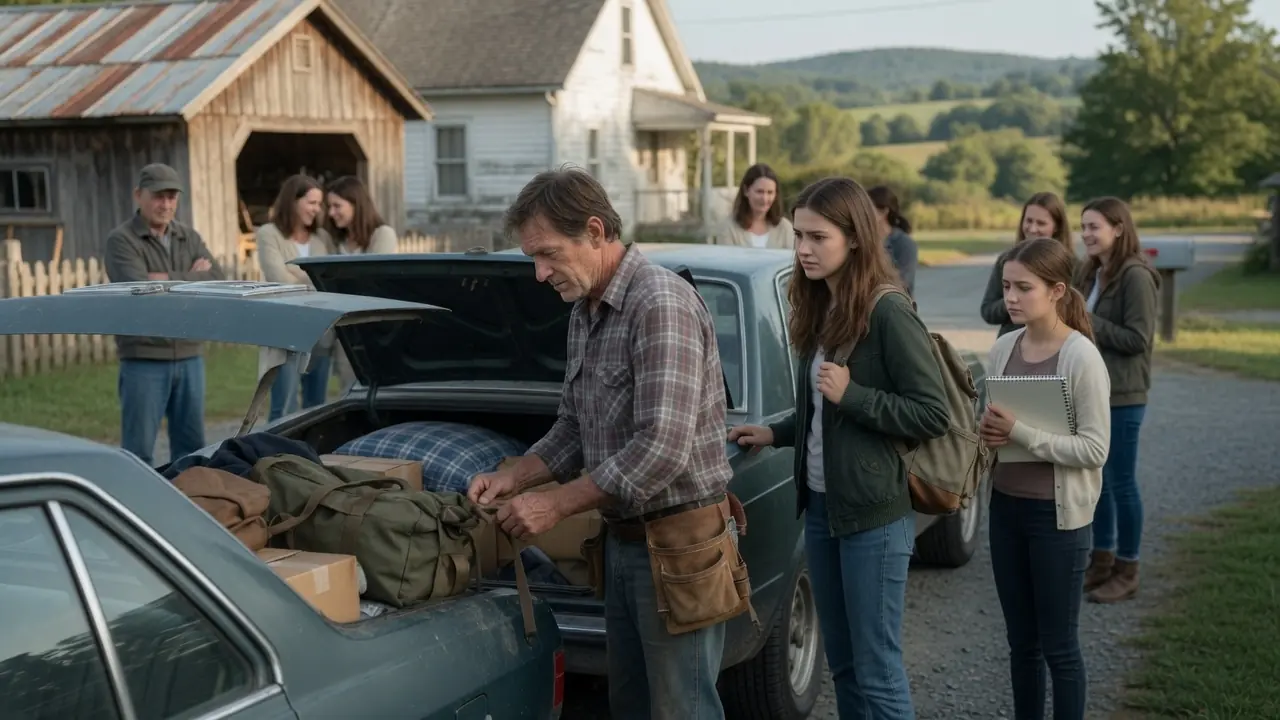
He understood, sitting with it both times, that the difference was not absence, but shape. The house had a shape it had not had before, and the shape was theirs. It remained even when they were not there. The town, predictably, had things to say about the leaving.
They always went back to the leaving. It confirmed, for some people, what they had always thought. See, they left, just like we said they would. Edrick did not engage with this.
He understood what the leaving was, which was not abandonment and not proof of anything except that he had raised daughters who were capable of going somewhere and doing something. They came home for holidays, Christmas and Thanksgiving and the occasional summer week. They called. Marin called more than Soleia.
Marin was a talker, but Soleia sent things. Postcards. Photographs. Once, a hand-drawn sketch of a building she was designing for a class project, with a note on the back that said, “I think you would like the woodwork on this.”
Edrick framed it in a simple oak frame he made himself and hung it on the wall of the workshop. He had it for five years. Twenty years had passed since the Wednesday in April when they arrived with one bag between them and that look in their eyes that said they had learned to wait and see.
Edrick was sixty-seven now. His hair had gone the specific gray of a man who had spent decades working outdoors and indoors in roughly equal measure, which produces a different gray than the gray that comes from one or the other exclusively. His hands looked the way the hands of a carpenter look after forty years, capable and marked by the work. Each scar had its own story, each callus its own location, corresponding precisely to the grip of a specific tool.
They were hands that had built furniture and repaired houses and braided hair badly in the first years until he got better at it. They had held small hands on the way into school and applied bandages and turned pages of bedtime books. Twice, they had handed diplomas across the gap at graduation ceremonies in the specific way of a person who had been waiting for that moment for years and was trying not to show quite how much. He still worked, though fewer hours than before.
His back complained in the mornings in a way it had not at fifty, and he had learned to listen to it, which was a concession to time he had made without resentment. The workshop was still his. The smell of it was still the smell of his days: sawdust and linseed oil and the specific warmth of a space that knows it is being used. He was on the back step with his morning coffee when the car turned into the driveway.
He heard it before he saw it, the specific sound of a car on the gravel he had poured himself six years ago, and that had compressed and settled into the particular crunch that meant it was time to add another layer, which he had been meaning to do. He set down the coffee. Two doors opened. Two women got out.
Marin came first. She was always first, had been since they were five years old. She had that quality of forward movement that did not require permission or reassurance, just located the next place to be and went there. She was tall now, taller than he remembered each time, which was a thing about seeing people you loved after a gap.
They were always slightly different from the fixed image you carried, slightly more themselves. She was wearing a suit jacket over a casual shirt, the wardrobe of someone who moved between professional and personal contexts frequently and had stopped making much of a distinction between them because the distinction was not real anyway, not when you were actually the same person in both places. Soleia came behind her, slower as always, not hesitant, just deliberate, the same way she had been deliberate at five years old in the kitchen doorway. She was looking at the house in the specific way she looked at buildings, from the exterior in, taking the whole thing in before she arrived at any particular detail.
Edrick knew this was what she was doing because he had watched her do it to every building they had encountered together since she started architecture school. He had recognized it even before she had named what it was, as something that had always been part of how she processed the world. They both looked at him. He looked at them.
Twenty years. He thought about one bag between two five-year-olds. The kitchen doorway. The field guides stacked on the shelf, three of them, the pages soft from repeated opening.
He thought about the two separate campus dining halls that smelled of the same institutional hope. He thought about the sketch on the workshop wall that had been there for five years. He stood up from the step. The coffee cup in his hand was still warm.
“You did not tell me you were coming,” he said.
“We wanted to surprise you,” Marin said.
“You succeeded,” he said.
And then, because it was true and sufficient, he added, “Come in.”
He held the door open.
They came inside. He made tea because they had both been tea people since adolescence. Marin drank hers black. Soleia took too much milk, a preference she had held for so long that Edrick kept a particular kind she liked even when she was not there, which told you something about how he operated.
They sat at the kitchen table, and the house, which had the shape of them in it, remembered what that shape felt like.
He held the door open. That was it. That was the whole gesture. Not a speech. Not a moment of dramatic reunion on the front lawn for the neighbors to see.
Just a man holding the door open for his daughters. The way he had been holding the door open his whole life. For them. For whoever needed it. Because that was what doors were for.
The town found out, of course. This was Harwick. Someone saw the car in the driveway on the first morning and mentioned it to someone at the coffee shop on Main Street. By afternoon, the word had traveled to the hardware store, where Dorset, seventy-one now, slower in his movements but still running the place, still behind the same counter he had been behind for forty years, came out to shake their hands when they came in to buy a bag of rock salt for Edrick’s path.
Dorset had been one of the warm ones twenty years ago. He was warm now, too. He shook Marin’s hand and asked about the law practice and listened to the answer with the specific attention of someone genuinely interested rather than merely polite. He shook Soleia’s hand and asked whether she was working on anything he would recognize the name of.
Soleia named a building, and Dorset said he had seen it written about somewhere and looked pleased with himself for having connected the information. He looked at the three of them together, the older man and the two women, and said, “You look like a family.”
He said it simply, not making a point of it, just stating the obvious thing in front of him.
Edrick said, “We are.”
The word continued to travel. By the following morning, most of Harwick knew that Edrick Vane’s daughters were back. The reactions were different from what they had been twenty years ago. Not all of them, but many.
Gerald, in his eighties now, had simply run out of energy for opinions about other people’s lives, which was its own kind of resolution. But others, people who had been among the ambivalent contingent twenty years ago and who were now looking at two accomplished women who had come back to their father on their own initiative to see him on a regular Tuesday in October, were recalculating something. Not loudly. Not with any dramatic acknowledgement.
The recalculation happened in the specific quiet of people who understand privately that they were wrong about something and are not quite ready to say so, but are no longer actively maintaining the wrong position. Edrick noticed none of this. He was having breakfast with his daughters. They stayed four days.
The first day was mostly the adjustment of being in each other’s presence again, in the specific way physical presence is different from phone calls and messages. They ate lunch and walked the neighborhood, which had changed in some ways and not in others. Marin pointed out the things that had changed, and Soleia noticed the things that had not. They argued briefly about something Edrick did not entirely follow, in the comfortable way of people who had been arguing with each other for twenty years and understood the argument was part of the relationship and not a threat to it.
The second day, Edrick took them to the workshop. He showed them what he was currently building, a cabinet for a family on the east side of town. Straightforward joinery. Good walnut that he had been selecting for three months.
He explained what he was doing and why and what the challenges were. Marin asked questions that were smart but not technical, the way she asked questions about everything. Soleia said almost nothing, but ran her hand along the grain in the specific way that told him she understood what she was feeling. The architect in her, or maybe just Soleia herself, connected to the wood the way Edrick did, which was one of the things about her that still surprised him and that he was still grateful for.
The third day, they helped him with the garden, which had gotten ahead of him in the fall and which he had been planning to address before the ground hardened. The three of them worked in the specific companionable silence that comes from doing physical work alongside people you know well. At some point, Marin started talking about a case she was working on, not to explain it, but to think through it out loud. Soleia occasionally offered an observation, and Edrick listened and asked one question and got a long answer, and it felt like every good afternoon had felt for twenty years.
The fourth evening, the last one, they sat on the back step, the same step where he had been sitting with his coffee when they arrived. The three of them sat in the cooling October air, with the yard dark and the ridge darker against the sky.
“Dad,” Marin said.
He waited.
“Did you ever regret it?”
She said it directly, the way she said everything, looking at him without any softening of the question. This was Marin. She had never been interested in easier versions of things.
Edrick thought about it. Not before forming consideration, but actually thinking. He looked at the question the way he looked at a piece of wood he was about to work. Checking the grain. Understanding the material.
“Regret what?” he said.
Marin smiled. It was the smile of someone who had received an answer better than the one they expected.
“Any of it,” she said. “All of it.”
He looked at the yard. At the dark ridge. At the two women on the step beside him, who had arrived twenty years ago with one bag between them and a weariness that had taken time to soften, and that had softened into something entirely different. Something he was looking at right now.
“No,” he said.
Soleia, who had been quiet, was often quiet and then said the precise thing.
“Not even the hard parts?” she asked.
“Especially not the hard parts,” Edrick said. “The hard parts were the parts where I learned something.”
The yard was quiet.
After a while, Marin leaned her head on his shoulder, which she had not done since she was maybe twelve. Edrick stood very still because he understood that you did not move when something important was resting against you.
Soleia looked at the sky.
“We talked about coming back more often,” she said. “Not just holidays.”
Edrick said nothing. He did not want to respond in a way that asked for something. Not from them. Not ever from them.
“Not to Harwick necessarily,” Marin said. “Just closer.”
Edrick looked at the ridge.
“I am not going anywhere,” he said.
That was all. Not a speech about what it would mean. Not a list of what he hoped for. Just a plain fact.
He was here, and he intended to stay here. Whatever they decided about closer or farther was theirs to decide. That was how he had always operated with them, not pulling, not making the love conditional on proximity, just being present in the place he had chosen and leaving the door open. He had been leaving the door open for twenty years.
They knew where it was.
The next morning, he drove them to the point on the highway where the road crested the ridge, the same point he had driven them to every time they left since they were eighteen. It was the place from which you could watch a car until it disappeared over the far side and the road showed empty. He had started doing it without deciding to, the first time Marin left for university, and had done it every time since. Stopping would have required a decision he was not going to make.
He stood there after both cars were gone. The October morning had that specific quality of autumn in the valley, crisp in a way that was not cold yet, but was clearly practicing. The ridge was doing its morning thing with the light, which Edrick had watched enough times to know could look like almost anything depending on the clouds and the angle. Today, it looked like a door, which was a thing he noticed and then let pass.
He got back in his truck. He drove back to Milner Road. He had the cabinet to finish. He was in the final stages, the fitting and the finishing, the parts that required the most patience and the most attention, and that produced the most visible result.
After that, there was a dining table for a young couple on the west side of town who had been saving up for it for three years, and who had chosen him specifically because of a table he had made for the wife’s parents a decade ago. After that, there was Tess next door, whose porch railing had finally given up after two winters of him telling her it was getting close. He made coffee. He went into the workshop.
He looked at the sketch on the wall, the building, the wood joinery, the note on the back. Then he looked at the cabinet, at where he was in it and where he was going. He picked up his tools. He got to work.
That was what he did. That was what he had always done. That was what he was going to keep doing. Some things do not need to change for them to be exactly right.
Edrick Vane understood this about wood and about work and about love. The understanding was the same in all three. You find a thing worth tending. You tend it. You do not ask it to be something it is not.
You show up for it every day with the right tools and the right attention. You trust that the material, if it is good material, will become what it is capable of being. His daughters were good material. He had known that since the first Wednesday in April.
Twenty years later, he still knew it.
That was the thing about Edrick Vane.
The town talked for twenty years about whether he had done the right thing.
He spent twenty years doing it.
Not as an argument. Not as a response to anything anyone said. Just as a life. The specific, ordinary daily life of a man who decided what mattered and then showed up for it every morning without an audience, without recognition, without anyone from the town coming to his door to say, “Actually, we think you are doing something remarkable.”
Nobody came to his door to say that.
That was fine.
He was not waiting.
The town eventually looked. Not all at once. Towns do not do things all at once. They do things gradually and then pretend they always felt that way.
But on a Tuesday morning in October, twenty years after a Wednesday in April, standing in their doorways or at the hardware store counter or on the sidewalk outside the post office, the people of Harwick looked at two women walking up a driveway and did a calculation.
The calculation was simple.
This was what had come of it.
These two, the lawyer and the architect, the questioner and the observer, the ones who had arrived with one bag and who had left and who had come back. These were what the forty-seven-year-old carpenter had made with twenty years of ordinary mornings. Some of them understood privately what that meant about the things they had said.
Edrick was not interested in any of that.
He was having breakfast with his daughters.
That was the whole point. That was the entire thing. The verdict of the town was not the measure of whether he had been right. The measure was the breakfast, the four days, the head on the back step.
“They are not going anywhere,” he said simply, without drama, because it was the truth, and the truth did not need decoration.
The ones who never quit do not wait for the verdict. They already know. The verdict is just a world catching up to what was always true.
And the people who were wrong, the Geralds, the ambivalent contingents, the ones who said it would not last, they had the option to sit with that quietly, without anyone asking them to account for it publicly. Edrick was not in the business of asking people to account for things. He was in the business of building furniture and raising daughters and keeping the door open.
That was a full life.
That was actually a very full life.
And the door, the one Edrick held open every morning for twenty years, quietly, without announcement, without anyone coming to acknowledge that what he was doing was right or remarkable or worth noting, was always going to lead somewhere.
Not because doors always lead somewhere, but because he kept it open long enough.
It led here.
Two daughters on a back step in October, twenty years later. One with her head on his shoulder. One looking at the sky. Both of them having come back.
Not because obligation required it. Not because circumstance pushed them toward it. But because the place they came back to was worth coming back to, and the person in it was worth being near.
And when Marin asked, “Did you ever regret it?” he looked at it the way he looked at wood.
He checked the grain.
He understood the material.
The answer was already there.
It had been there for twenty years.