The first motorcycle rolled into the parking lot at 11:43 p.m., its engine growling low and mean beneath the neon sign of Ruthie’s 24-Hour Diner.
Emma Carter heard it before she saw it.
She was behind the counter, wiping down the stainless-steel coffee machine with a damp rag, trying to ignore the ache in her feet. The diner sat at the edge of a highway outside Amarillo, Texas, where long-haul truckers, night-shift nurses, and lonely travelers came in for coffee that was too strong and pie that was better than it had any right to be.
At twenty-six, Emma had learned to read people the way other women read weather reports. A man who stared too long at the waitress but never looked at the menu meant trouble. A woman holding her purse with both hands usually needed kindness. A teenager counting coins before ordering fries deserved extra ketchup and no judgment.
And motorcycles at nearly midnight could mean anything.
Sometimes it was a harmless riding club, older men with gray beards and polite manners who tipped well and called her “ma’am.” Sometimes it was oil-field workers blowing off steam. Sometimes it was worse.
The second motorcycle came in behind the first. Then the third. Then the fourth.
By the time the twelfth bike turned off the highway and swung into the lot, Emma had stopped wiping the machine.
The engines filled the diner with vibration. The windows hummed. The spoons in the jar beside the register trembled softly against one another. Outside, headlights swept across the glass like searchlights.
Ray, the cook, leaned through the pass-through window from the kitchen. He was sixty-three, thin as a broom handle, with a white paper cap crooked on his head and a cigarette tucked behind one ear that he was never allowed to smoke inside.
“You expecting company?” he muttered.
Emma forced a small smile. “I was hoping for a quiet hour.”
Ray looked past her toward the parking lot. “That ain’t quiet.”
The riders killed their engines one by one, and the sudden silence felt worse. Boots hit asphalt. Low voices rose. Laughter followed, rough and careless.
Only five customers were inside Ruthie’s at that hour.
A trucker named Milo sat at the far end of the counter, shoulders hunched over a bowl of chili. He had been driving since Denver and could barely keep his eyes open. Two college girls occupied the booth near the jukebox, sharing pancakes and whispering over their phones. An elderly man sat alone in booth seven, wearing a clean gray coat and a faded ball cap pulled low over his forehead. He had ordered coffee and nothing else, then spent the last thirty minutes turning a spoon between his fingers without drinking much of it.
Emma had noticed him because he was too still.
Most people who came into a diner at night carried some kind of restlessness. They checked the window, the clock, their phone, the door. The old man had simply sat down, removed his gloves, folded them neatly beside his cup, and watched the steam rise.
He looked tired, but not weak. There was something settled about him, like an old fencepost that had survived storms by refusing to fall.
The diner door opened.
Cold air rushed in, carrying the smell of gasoline, leather, and dust. The bell above the door gave a bright little ring that sounded ridiculous under the weight of the men who entered.
They came in laughing.
There were twelve of them, all wearing leather vests over denim or work shirts, boots scuffed from road wear, chains at their belts, patches stitched across their backs. Their faces were weathered, bearded, sunburned, and hard. One had a shaved head and a silver ring in his eyebrow. Another had a scar running from the corner of his mouth to his jaw. The biggest of them, a broad-shouldered man with a heavy beard and pale eyes, walked in front as if every room he entered belonged to him.
Emma saw the name stitched over his vest pocket.
Graves.
He stopped just inside the door, scanned the diner, and smiled without warmth.
“Well, boys,” he said, loud enough for everyone to hear. “Looks like we found ourselves a palace.”
The riders laughed.
Emma straightened behind the counter and placed the rag beneath the register. Her heart had already begun to beat faster, but she kept her face calm. In this job, fear was something you folded and tucked behind your apron.
“Evening,” she said. “Sit anywhere you like. I’ll be right with you.”
Graves looked at her.
The look lasted too long.
Emma knew that kind of stare. It did not see a person. It measured what it could get away with.
“Anywhere we like?” he asked.
“That’s right,” Emma said.
He glanced back at the others. “Hear that? Lady says we own the place.”
“I didn’t say that,” Emma replied, still steady.
The smile slipped from his face for half a second, just long enough for her to see what lived underneath it. Then it came back wider.
The bikers spread across the diner like spilled oil. Four took the booth near the front window. Three dropped onto stools at the counter. The rest dragged chairs loudly across the floor and crowded around two tables pushed together in the middle. One of them bumped the college girls’ booth hard enough to make their pancake plate jump.
“Sorry, princess,” he said, not sounding sorry.
The girls lowered their eyes.
Milo, the trucker, stared into his chili and pretended not to hear.
Ray remained frozen in the kitchen window.
Emma grabbed a stack of menus and stepped out from behind the counter. She kept her shoulders straight. Her mother had once told her that walking like you were not afraid could sometimes make men forget you were.
Sometimes.
She handed menus to the riders at the center table first.
“What can I get started for you?”
“A smile,” said the one with the eyebrow ring.
His friends laughed.
Emma gave him the polite diner smile she used when customers mistook disrespect for charm. “Coffee?”
“Depends,” he said. “You pour it sweet?”
She ignored that. “Coffee all around?”
Graves leaned back in his chair and spread his knees, blocking the aisle. “Slow down, sweetheart. We just got here.”
Emma looked at him. “Take your time. I’ll be at the counter when you’re ready.”
She turned to walk away.
A boot shifted into the aisle.
Not enough to trip her completely, but enough that she had to catch herself on the back of a chair. The menus slid from her hand and slapped across the floor.
The bikers burst into laughter.
Emma’s face burned. She looked down at the boot, then at its owner, a narrow-faced rider with a toothpick in his mouth.
“My mistake,” he said.
She knelt to pick up the menus.
One landed near Graves’s boot. When she reached for it, he placed his boot on top of it.
The diner went very quiet around their table.
Emma stayed crouched for one second too long. She could feel all eyes on her. The college girls had stopped whispering. Milo’s spoon hovered over his chili. Ray’s hand gripped the metal edge of the kitchen window.
Emma looked up at Graves.
“I need that menu,” she said.
He tilted his head. “Ask nice.”
“I just did.”
“No.” His pale eyes narrowed. “Ask like you mean it.”
Her mouth went dry.
She had handled drunk men, angry men, lonely men, men who thought a waitress’s kindness was an invitation. But there was something different about a group that wanted an audience. They were not just trying to humiliate her. They were teaching the room to stay silent.
Emma rose slowly, leaving the menu under his boot.
“You can keep that one,” she said. “Kitchen closes for troublemakers.”
Graves stared at her.
For a moment, the room stopped breathing.
Then he laughed.
It started low in his chest and spread to the others. Chairs creaked. Boots scraped. The laughter grew too loud.
“Troublemakers,” Graves said. “You hear that? Little waitress has rules.”
Emma walked back behind the counter with her hands steady and her pulse pounding in her throat.
Ray came close to the pass-through. “Emma,” he whispered, “I can call the sheriff.”
She glanced toward the bikers. Graves was still watching her. “Do it quietly.”
Ray nodded and disappeared into the kitchen.
Emma poured coffee for Milo to give her hands something to do. The trucker leaned closer when she refilled his cup.
“You all right?” he murmured.
“I’m fine.”
He looked toward the riders, then back at her. His eyes were kind but afraid. “I got a schedule. Company tracks my stops.”
“It’s okay,” she said softly.
She did not blame him. Not everyone was built for standing between a storm and someone else’s roof.
The old man in booth seven lifted his cup at last, took a slow drink, and set it down without a sound.
Graves slapped the table.
“Service!”
Emma turned.
He raised one finger and curled it toward himself. “Come here.”
Every instinct in her body told her not to move. But she needed the job. Rent was due in four days. Her younger brother’s prescription had gone up again. Ruthie, the owner, was recovering from hip surgery and had trusted Emma with the night shift.
So Emma picked up her order pad and walked back out.
“What can I get you?” she asked.
Graves took the toothpick from the narrow-faced man’s mouth and rolled it between his fingers. “Now that’s better. We’ll take burgers. Twelve of them. Fries. Coffee. Pie if it ain’t stale.”
“The pie is fresh.”
“Prove it.”
Emma wrote without looking up. “Anything else?”
“Yeah,” said Eyebrow Ring. “You got a boyfriend?”
“No.”
That answer came too quickly. She regretted it instantly.
The men reacted like dogs hearing a gate open.
“No boyfriend,” Graves repeated. “Working nights alone. That’s dangerous.”
“I’m not alone,” Emma said.
He looked around the diner theatrically. “No? You mean the old man? The sleeping trucker? Those two little girls?”
The college girls stared down at the table.
Emma held the order pad tighter. “I mean I’m at work. You’re customers. Let’s keep it that way.”
Graves leaned forward. His voice dropped.
“You always talk to paying men like that?”
Only then did Emma notice the patch on the front of his vest. Not a club name she recognized, just a skull wrapped in barbed wire and the words Road Saints stitched beneath it. There was nothing saintly in his face.
“I talk to people the way they talk to me,” she said.
The scarred rider at the next table whistled. “She’s got teeth.”
Graves smiled again. “Maybe we ought to pull them.”
The line was spoken lightly.
That made it worse.
Emma stepped back. “Your food will be up soon.”
As she turned, a hand closed around the loose end of her apron.
Not hard. Not yet.
Just enough to stop her.
She froze.
The hand belonged to Graves.
“Forgot something,” he said.
Emma looked down at his fingers gripping the fabric at her waist. “Let go.”
“Coffee.”
“I’ll bring it.”
“Now.”
She could feel the pull of the apron against her body. A hot, sick wave of humiliation rose in her chest. She wanted to slap his hand away. She wanted to scream. She wanted to run.
Instead she said, clearly, “Take your hand off me.”
The diner door did not open. No hero stepped in. No siren wailed outside. The room remained exactly as it was, filled with people who were suddenly very interested in their plates.
Then a chair leg scraped against tile.
It came from booth seven.
The old man stood.
He was taller than Emma expected. Not huge, not broad like Graves, but straight-backed and solid. He removed his faded ball cap and set it on the table beside his gloves.
“Son,” he said.
His voice was quiet.
The bikers turned.
Graves did not release Emma’s apron. “You talking to me, old-timer?”
“I am.”
The old man stepped into the aisle. His gray coat hung neatly from his shoulders. His hair was silver and combed back, his face lined deeply around the eyes. He looked like someone’s grandfather, someone who should have been home watching late-night television with a blanket over his knees.
But his eyes were awake now.
Very awake.
“Let the young lady work,” he said.
A few of the bikers chuckled.
Graves looked amused. “You got some business here?”
“No,” the old man said. “Just eyes.”
“Then use them to mind your plate.”
“I don’t have a plate.”
“Then mind your coffee.”
The old man’s gaze dropped to Graves’s hand still holding Emma’s apron. “I asked you to let her go.”
Graves pulled the apron slightly, making Emma stumble half a step. “And if I don’t?”
Emma felt the room tilt toward something dangerous.
The old man looked at her, not at Graves. “Miss, are you all right?”
She swallowed. “I’m okay.”
“No,” he said gently. “You’re not.”
Something about that broke through the tight shell she had built around herself. Her eyes stung. She hated that. She hated that kindness, at the wrong moment, could make her weaker than cruelty.
Graves released the apron suddenly and stood.
He was bigger than the old man by at least forty pounds.
The riders went quiet, entertained now.
Graves stepped into the aisle, close enough that the old man had to look up a little. “You trying to be brave?”
The old man did not move. “No.”
“No?”
“No,” he said. “Brave is when you’re scared and you still do what needs doing. I’m too old to be scared of boys pretending to be wolves.”
The words landed like a match in gasoline.
Graves’s smile vanished.
Emma whispered, “Sir, please.”
The old man did not look away from Graves. “You should sit down.”
The diner seemed to shrink around them.
Then the kitchen phone clattered loudly.
Ray’s voice came from the back, sharp and nervous. “Line’s dead.”
Emma’s stomach dropped.
Graves heard it too.
He turned his head slightly and grinned. “That right?”
Ray appeared in the pass-through, pale. “Maybe the storm knocked it.”
There was no storm.
Graves glanced at one of his men near the counter. The man gave the smallest shrug, and Emma understood.
They had cut the phone line.
Not because of her. Not at first, maybe. Maybe they had done it for fun, or because they planned to leave without paying, or because men like that enjoyed making sure a place had no voice.
But now they knew.
Graves turned back to the old man. “Looks like nobody’s coming.”
The old man’s expression did not change. “Somebody always comes.”
“Not tonight.”
The old man looked past Graves toward the front windows. “Tonight especially.”
That was when Emma noticed headlights on the highway.
Not one pair.
Many.
But they were still far away, moving slow.
Graves did not see them yet. His focus had narrowed to the old man in front of him.
He shoved one finger into the old man’s chest.
The old man took the shove without stepping back.
“Sit down,” Graves said.
The old man looked at the finger, then at him. “You first.”
Graves swung.
It was not a full punch. More like a hard backhand meant to humiliate, to knock the old man down and restore the order of fear.
The old man moved faster than Emma believed possible.
He caught Graves’s wrist, turned his body slightly, and guided the bigger man forward just enough that Graves stumbled into the edge of the booth. It was not flashy. It was not like the movies. It was a small movement, practiced long ago and remembered by muscle.
Graves hit the booth shoulder-first.
The diner erupted.
Three bikers jumped up at once. Chairs scraped. The college girls screamed. Milo dropped his spoon. Ray came out of the kitchen holding a cast-iron skillet in both hands, looking terrified but determined.
Emma grabbed the coffee pot without thinking.
“Enough!” she shouted.
Nobody heard her.
Graves straightened slowly, his face dark with fury. He looked at the old man as if a line had been crossed that could only be answered with blood.
“You just made a mistake,” he said.
The old man breathed once through his nose. “Wouldn’t be my first.”
The front door opened again.
The bell rang.
This time, the sound cut through everything.
A woman stepped inside wearing a tan sheriff’s uniform, one hand resting near her belt. Behind her came two deputies. Behind them, through the windows, red and blue lights washed across the parking lot.
Emma stared.
The sheriff was in her late thirties, with brown hair tied back and a face that looked carved by long nights and hard choices. Her eyes moved once across the room and took in every detail: the bikers standing, Ray with the skillet, Emma pale behind the counter, Graves flexing his hand, the old man in the aisle.
“Evening,” the sheriff said. “Everybody keep your hands where I can see them.”
Graves turned slowly. “Sheriff Dalton.”
“Mr. Graves.”
“You got a reason to come storming in here?”
Sheriff Dalton glanced at the old man. “I do.”
Graves followed her gaze. Something flickered across his face.
Recognition.
Not fear exactly.
Something close.
The old man finally reached into his coat.
Every deputy tensed.
But he only removed a small leather wallet and opened it with two fingers.
A badge caught the diner light.
Not local.
Federal.
The old man held it up calmly.
“My name is Marshal Thomas Avery,” he said. “Retired from active duty, temporarily reinstated as a cooperating witness under federal protection.”
The words meant nothing to Emma at first. Then she saw Graves’s face.
All the color had left it.
Sheriff Dalton stepped farther inside. “Mr. Graves, you and your friends are under investigation for interstate extortion, assault, vehicle theft, witness intimidation, and tampering with communications equipment. That last one was a foolish addition tonight.”
One of the bikers near the counter whispered, “We gotta go.”
A deputy pointed at him. “Don’t.”
Graves looked at the old man. “You set us up.”
Marshal Avery closed the badge wallet. “No. You followed me.”
The room seemed to turn again.
Emma looked from Graves to the old man.
Followed him?
Graves’s jaw worked. “You think you’re clever?”
“I think you cut the phone line of a diner with two state troopers parked half a mile down the road and a sheriff who knew I was stopping here.” The old man’s voice remained calm. “I also think you harassed a waitress who had nothing to do with any of this. That was your choice.”
Sheriff Dalton nodded to the deputies. “Hands on the tables. Now.”
For one breath, Emma thought the bikers might fight.
There were twelve of them and only three officers inside. But outside, more lights appeared. More doors opened. More uniforms moved across the parking lot.
The Road Saints looked through the windows and realized the night had closed around them.
One by one, they placed their hands where they could be seen.
All except Graves.
His eyes remained fixed on Emma.
There was hatred there, but also something smaller. Shame, maybe. Or the rage of a man who had discovered the person he tried to frighten had witnessed his fall.
“You happy now, sweetheart?” he said.
Emma’s fingers tightened around the coffee pot. Her voice shook, but it did not break.
“No,” she said. “But I will be when you leave.”
For the first time all night, nobody laughed at her.
The deputies moved in.
Graves was handcuffed beside the table where he had demanded she ask nicely. The narrow-faced rider with the toothpick protested until a deputy found wire cutters in his jacket. Another rider cursed and kicked a chair, then stopped when Sheriff Dalton looked at him.
Ray slowly lowered the skillet.
The college girls held hands across the booth. Milo sat completely still, eyes wide now, as if sleep had been frightened out of him forever.
Emma stood behind the counter while the officers escorted the bikers out one at a time. The bell rang with each departure, bright and absurd, until the diner was left with only the smell of coffee, cold fries, and fear finally draining away.
Outside, the bikers were lined against their motorcycles under the flashing lights. Their shadows stretched long across the asphalt.
Inside, silence returned.
Then Ray exhaled so hard he almost folded in half.
“Lord have mercy,” he said.
Emma set the coffee pot down because her hand had started shaking.
Sheriff Dalton came to the counter. “Miss Carter?”
Emma blinked. “You know my name?”
“Ruthie called me before your shift started. Said she had a strange feeling about the old man who came in earlier.” The sheriff glanced at Marshal Avery. “Turns out her feeling was right.”
Emma looked at Avery. “You knew they were coming?”
“I suspected they might.” He looked genuinely sorry. “I didn’t know they would involve you.”
“But why here?”
He hesitated.
Sheriff Dalton answered for him. “Marshal Avery was testifying against men connected to that riding crew. He was moved through this county quietly tonight. The plan changed when we realized Graves had people watching the highway. This diner became a holding point until backup reached us.”
Emma stared at them. “A holding point?”
The sheriff’s mouth tightened. “It was supposed to be safe.”
Emma laughed once, but there was no humor in it. “Safe?”
Avery lowered his eyes. “You’re right. It wasn’t.”
The apology was so simple that Emma did not know what to do with it.
People who put her in danger usually had excuses. They talked about bad days, misunderstandings, how she was overreacting. The old man did none of that.
He looked at her as if her fear mattered.
“I am sorry, Miss Carter,” he said. “When Graves put his hand on you, I should have spoken sooner.”
Emma folded her arms, partly to stop them from trembling. “Why didn’t you?”
Avery looked toward the window, where officers were searching the motorcycles. “Because I spent most of my life stepping in too late and calling it strategy.”
The answer was strange. Heavy.
Emma did not understand it fully, but she felt the weight of it.
Sheriff Dalton touched the counter gently. “We’ll need a statement from you, but not right this second. Sit down if you need to.”
“I’m fine,” Emma said automatically.
Ray came around the counter and took the coffee pot from her. “No, honey. You ain’t.”
This time, she let herself sit.
She sank onto the stool behind the register, suddenly aware of every ache in her body. Her knees felt hollow. Her apron hung crooked where Graves had grabbed it. She untied it with fumbling fingers and pushed it away.
The college girls approached the counter together.
One of them had tears on her cheeks. “We’re sorry,” she said.
Emma looked up. “For what?”
“For not saying anything.”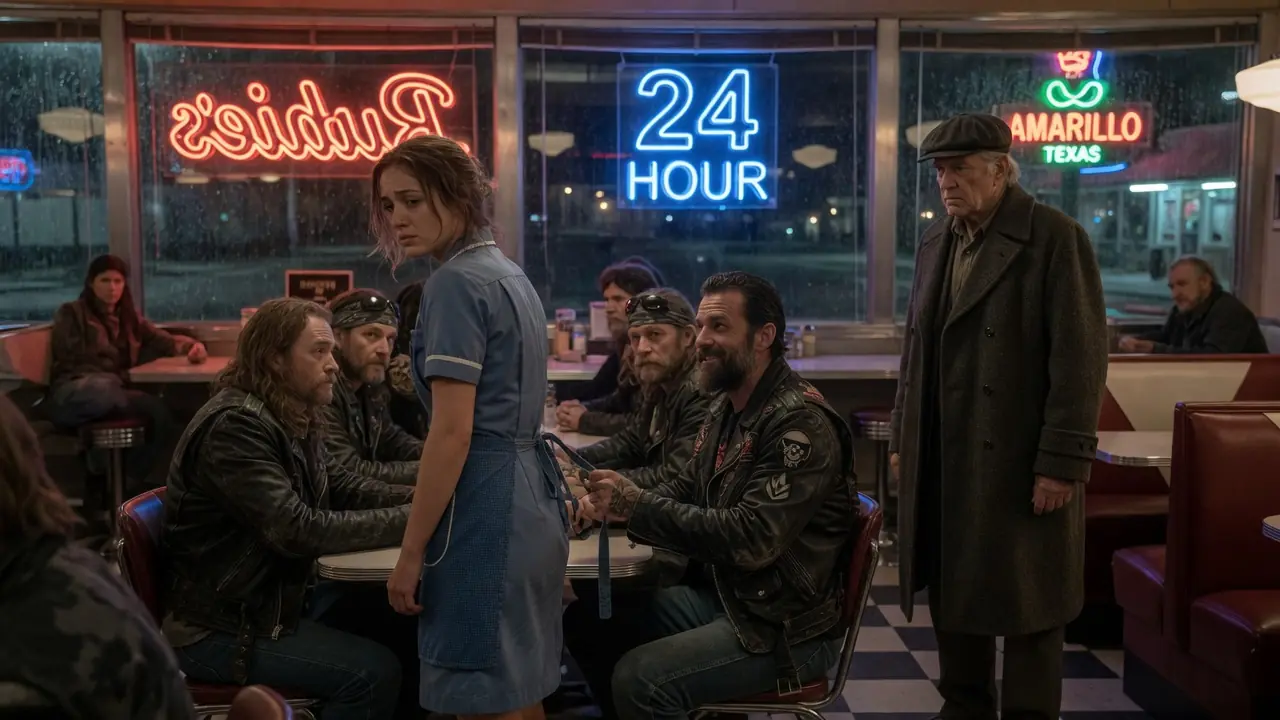
Emma did not know what answer to give.
The girl swallowed. “I wanted to. I just got scared.”
Emma nodded slowly. “Me too.”
The girl looked surprised.
That made Emma’s chest hurt more than the insult had.
People thought courage meant not being afraid. Emma had spent years smiling through fear because rent did not wait, bills did not care, and customers could be cruel without consequence. But fear had been there every time. She had just learned to carry plates with it.
Milo, the trucker, came to the counter and placed forty dollars beside his half-eaten chili.
“I should’ve stood up,” he said quietly.
Emma looked at the money. “Your bill was twelve.”
“Keep it.”
“I don’t need pity.”
“It ain’t pity.” He looked toward the door. “It’s an apology I don’t know how else to make.”
Emma studied his tired face and saw real shame there. Not the useless kind that looks away, but the kind that might make a man different tomorrow.
She nodded. “Drive safe.”
He gave her a small nod in return and left.
By 1:15 a.m., the parking lot had emptied of motorcycles. Tow trucks hauled them away one by one. The red and blue lights faded. Statements were taken. The college girls called one of their fathers, who arrived in a pickup and hugged them both in the doorway. Ray made a fresh pot of coffee nobody asked for but everyone needed.
Marshal Avery remained in booth seven.
When the diner finally settled, Emma brought him his bill.
He looked at it. “I only had coffee.”
“You also threw a federal investigation into my night shift,” she said.
For the first time, he smiled. It was small and tired. “Fair.”
She sat across from him without asking. “Were you really a marshal?”
“For thirty-eight years.”
“Retired?”
“Three times.” He folded the bill between his fingers. “I was supposed to stay retired after the last one.”
“What happened?”
His eyes lowered to the coffee cup. “A young man came to me asking for help. His father had gotten mixed up with Graves’s people. They were stealing motorcycles, moving parts across state lines, threatening shop owners. The young man wanted to testify. He was scared.”
“What happened to him?”
Avery was quiet for so long Emma thought he would not answer.
Then he said, “I told him to wait.”
Emma felt the air change.
“I told him we needed more evidence,” Avery continued. “More names. More patience. He didn’t have more patience. Graves found out he had talked.”
Emma looked down at the table.
“Did he die?”
“Yes.”
The word sat between them.
Avery turned the cup slightly. “His mother asked me why I carried a badge if I was always waiting for permission to use it.”
Emma’s anger softened without disappearing.
“So tonight you stopped waiting,” she said.
“Yes.”
“You could’ve been hurt.”
“So could you.”
“I was just working.”
“That doesn’t make you less worth protecting.”
Emma looked away quickly.
The sentence reached somewhere deep in her, somewhere she did not often let anyone touch. She thought of all the times men had made her feel like being at work meant surrendering her dignity. Like wearing an apron meant she had to accept whatever words were thrown at her. Like needing a paycheck meant she had to trade pieces of herself for tips.
She swallowed hard. “People don’t usually think that.”
“Then people are wrong.”
Outside, the last tow truck pulled away.
Sheriff Dalton entered again, rubbing her hands together against the cold. “Marshal, transport is ready.”
Avery nodded. Then he reached into his coat and took out a folded paper.
He slid it across the table to Emma.
“What is this?” she asked.
“My number. Direct line. If any of Graves’s associates contact you, call me first.”
Emma unfolded it. The handwriting was careful and old-fashioned.
“You’re retired,” she said.
He put his hat back on. “Not tonight.”
She stood as he did.
For a second, they faced each other in the aisle where Graves had grabbed her, where Avery had stood between her and twelve men who thought fear was a language everyone should speak.
“Thank you,” Emma said.
Avery looked uncomfortable with the words. “You held your ground before I ever stood up.”
“I didn’t feel like it.”
“That’s usually how it feels.”
He walked to the door, then paused with his hand on the handle.
“Miss Carter?”
“Yes?”
“You asked why I didn’t speak sooner.”
She nodded.
“I can’t change that. But I can tell you this.” His face softened. “The world is full of people waiting for someone else to be first. Tonight, you were first.”
Then he stepped out into the cold and was gone.
For the next week, Ruthie’s Diner became famous in ways Emma hated.
A local reporter called. Then another. Someone had filmed the arrests from across the highway and posted the clip online. The headline changed depending on who shared it. Biker Gang Arrested at Highway Diner. Retired Marshal Takes Down Outlaw Crew. Waitress Harassed Before Federal Raid.
Emma refused every interview.
She did not want to be the girl in the apron. She did not want strangers slowing down outside the diner to point at the window. She did not want men coming in to ask if she was the waitress from the video, then looking disappointed when she did not perform bravery for them.
But people came anyway.
Some were kind. Truckers left bigger tips. Women squeezed her hand and said they were proud of her. A group of nurses from the county hospital brought flowers and taped a note near the register that read, You deserved better.
Some were not kind.
One man laughed and said, “Bet you loved all that attention.”
Emma poured his coffee, walked to the register, printed his check, and told him he could pay now and leave.
Ray grinned from the kitchen for an hour afterward.
Two weeks after the arrests, Ruthie returned to the diner with a cane, a floral blouse, and enough fury to light the grill.
She was seventy-one, short and round, with silver curls and red lipstick she wore even to take out the trash. Ruthie had owned the diner for thirty-four years and treated it like both a business and a stubborn child.
She hugged Emma so hard the cane clattered to the floor.
“I should’ve been here,” Ruthie said.
“You had surgery.”
“I’ve had three husbands and two hip replacements. I could’ve handled a few leather boys.”
Emma laughed for the first time in days.
Ruthie pulled back and looked at her apron. “You still wearing that old thing?”
Emma glanced down. “It’s the uniform.”
“It’s stained.”
“It’s a diner.”
“It’s ugly.”
“It’s your diner.”
Ruthie waved this away and reached into a paper bag. She pulled out a new apron, dark blue with white stitching around the pockets. Across the front, in neat letters, was embroidered: Emma.
Emma stared at it.
Ruthie’s voice softened. “Nobody gets to grab this one.”
Emma touched the stitching. “You didn’t have to.”
“I know.” Ruthie sniffed. “That’s why I did.”
Life did not become perfect after that.
Graves and several members of the Road Saints were indicted. Sheriff Dalton said the case would take time. Emma was called twice to give statements and once to identify the man who had grabbed her apron. She hated the courthouse. She hated the polished floors, the echoing hallways, the way Graves looked smaller in a suit but not less cruel.
During one hearing, his lawyer suggested Emma had exaggerated what happened because she was frightened.
Emma’s hands went cold.
Then the prosecutor played the diner’s security footage.
There was no sound, but the picture was enough. Graves’s hand on her apron. Her body going still. The old man rising in booth seven. The room watching.
The lawyer stopped asking that question.
Afterward, Emma sat on a bench outside the courtroom, breathing carefully.
Sheriff Dalton came and sat beside her.
“You did well,” she said.
“I hated it.”
“Both can be true.”
Emma nodded.
Across the hallway, Marshal Avery stood speaking with a federal agent. He looked thinner than he had in the diner, older under the courthouse lights. But when he saw Emma, he excused himself and walked over.
“Miss Carter,” he said.
“Marshal.”
“How are you holding up?”
She almost said fine.
Then she did not.
“I’m angry,” she said.
Avery nodded like that was the most reasonable thing in the world. “Good.”
“Good?”
“Anger knows something wrong happened. Just don’t let it drive without a map.”
Despite herself, Emma smiled. “Do marshals all talk like fortune cookies?”
“Only the retired ones.”
She looked toward the courtroom doors. “Do you think they’ll go to prison?”
“Yes.”
“You sound sure.”
“I am.”
“Were you sure before?”
Avery understood the question. He took a long breath. “No. That was part of the problem.”
Emma studied him. “You really blame yourself for that young man?”
“Yes.”
“Was it your fault?”
His eyes shifted toward the floor. “Some of it.”
Emma thought of the people in the diner who had watched and done nothing. Milo. The college girls. Ray, until he came out with the skillet. Herself, in all the years she had laughed off things that deserved fury because she needed tips.
“Some of it,” she said quietly, “doesn’t mean all of it.”
Avery looked at her then.
For a moment, she saw not a marshal, not a witness, not the old man from booth seven, but simply a person carrying a memory that had become too heavy to put down.
“No,” he said. “But it’s enough.”
The trial came in October.
By then, the air in Amarillo had sharpened and the diner windows fogged in the mornings. Ruthie was back full-time, mostly bossing everyone around from a stool near the register. Ray had finally stopped telling the story of the skillet every night, though only because Ruthie threatened to charge admission.
Emma had changed in ways small enough that others did not always notice.
She no longer apologized when customers interrupted her. She no longer smiled at jokes that made her skin crawl. She kept Sheriff Dalton’s card taped under the counter and Marshal Avery’s number folded inside her wallet.
And when men stared too long, she stared back.
The trial lasted nine days.
Emma testified on the fourth.
She wore a simple navy dress Ruthie had insisted on buying her and shoes that hurt by lunchtime. Her voice shook when she began, but steadied when the prosecutor asked her what Graves had said.
“Tell the jury what happened when you tried to walk away,” the prosecutor said.
Emma looked at the twelve strangers in the jury box.
“He grabbed my apron,” she said.
“Did you give him permission to touch you?”
“No.”
“What did you say?”
“I told him to let go.”
“Did he?”
“Not until Marshal Avery stood up.”
The prosecutor paused. “How did you feel?”
Graves’s lawyer shifted, ready to object.
But Emma answered before anyone could stop her.
“Small,” she said. “That was the point. He wanted me to feel small.”
The courtroom went quiet.
Emma looked at the jury, then at Graves.
“But I wasn’t.”
Nobody spoke for a second.
The prosecutor nodded gently. “No further questions.”
Graves was convicted on multiple charges. So were most of the men who had ridden with him that night. The headlines came back for a while, then faded. The world moved on to other scandals, other storms, other strangers to praise and forget.
But Emma did not forget.
On the first anniversary of the night the bikers came to Ruthie’s, she arrived for her shift and found booth seven reserved with a handwritten sign.
For Marshal Avery.
She looked at Ruthie. “What did you do?”
Ruthie pretended to polish the pie case. “I don’t know what you mean.”
At 7:00 p.m., the diner door opened.
Marshal Avery stepped inside.
He wore the same gray coat and carried the same faded ball cap in his hands. He looked older, but lighter somehow. Behind him came Sheriff Dalton, Ray from the kitchen with his paper cap already crooked, Milo the trucker holding a bouquet of gas-station flowers, and the two college girls, who were now friends with Emma on social media and still sent Christmas cards to the diner.
Emma stood behind the counter, speechless.
Avery looked around. “Place looks different with the phones working.”
Ray lifted the skillet from behind the counter. “And with security.”
Everyone laughed.
They filled the diner with noise, but it was different this time. Safe noise. Human noise. The sound of people choosing to show up before the worst happened, not after.
Ruthie brought out pie.
Milo apologized again, though Emma told him he had already done that enough for one lifetime. The college girls told her they had started volunteering with a campus safety group. Sheriff Dalton reported that Graves would not be bothering anyone for a long time.
Avery listened more than he spoke.
Near closing, Emma found him standing outside beneath the neon sign, looking across the parking lot where the motorcycles had once stood.
She joined him with two cups of coffee.
“Thought you might want this,” she said.
He accepted one. “Thank you.”
They stood quietly.
The highway hummed in the distance. A truck passed. Somewhere far off, a dog barked.
“I still dream about it sometimes,” Emma said.
Avery looked at her. “That night?”
“Parts of it. The boot on the menu. The apron. The silence.”
He nodded. “Silence can be loud.”
“I used to think being rescued meant someone stronger came in and made everything okay.” She wrapped both hands around her cup. “But it didn’t feel like that.”
“No?”
“No. It felt like someone reminded me I was allowed to matter.”
Avery’s face softened.
“That’s a better definition,” he said.
Emma looked back through the window at Ruthie laughing with Sheriff Dalton, Ray cutting pie too large to sell, Milo helping the college girls tape a new sign beside the register.
It read: If you cannot respect the staff, you cannot eat here.
Emma smiled.
“Do you ever stop feeling guilty?” she asked.
Avery took a slow breath. “I don’t know.”
“That young man you told me about,” Emma said. “The one you couldn’t save.”
Avery’s eyes stayed on the parking lot.
“I think about him every day,” he said.
“Maybe tonight counts for him too.”
He turned to her.
Emma shrugged, suddenly embarrassed. “You said someone always comes. Maybe sometimes they come late. Maybe they still matter.”
Avery looked away, but not before she saw his eyes shine.
For a while, neither of them spoke.
Then he said, “Miss Carter, do you know why I picked booth seven that night?”
“No.”
“It faced the door.”
“That’s very marshal of you.”
He smiled faintly. “Also, Ruthie told me it was lucky.”
Emma laughed. “Ruthie says that about anything she wants people to use.”
“She was right.”
Emma looked at the old booth through the glass. “Maybe.”
A car pulled into the lot just then, and both of them turned.
It was only a family of four. A tired father, a mother rubbing her eyes, two children half-asleep in the back seat. Travelers. Hungry. Harmless.
Emma watched them climb out and smiled.
“I should get back in,” she said.
Avery nodded. “People need feeding.”
“People need a lot of things.”
“That too.”
She started toward the door, then stopped. “Marshal?”
“Yes?”
“Thank you for coming back.”
He put on his cap. “Thank you for being first.”
Emma went inside.
The bell above the door rang as she entered, bright and ordinary, and for once the sound did not make her tense.
The family took a booth near the window. Ruthie waved them in. Ray shouted from the kitchen that the grill was still hot. Sheriff Dalton poured herself more coffee without asking anyone.
Emma tied on her blue apron, the one with her name stitched across the front.
Then she walked to the new table with menus in her hand.
“Evening,” she said warmly. “Sit anywhere you like. I’ll be right with you.”
And this time, when the room answered with simple, tired, grateful smiles, Emma knew the truth in her bones.
She had been frightened.
She had been humiliated.
She had been alone for a moment that felt endless.
But she had not stayed alone.
Because sometimes rescue does not arrive like thunder. Sometimes it stands up quietly from booth seven. Sometimes it wears a badge no one expected. Sometimes it is a sheriff walking through the door, a cook holding a skillet, strangers learning to speak, and a woman in an apron finally understanding that needing help does not make her weak.
It only means she is human.
And humans were never meant to face cruelty by themselves.