The first thing Maddie Hayes did when she entered the Blue Lantern Diner was count the booths.
There were eight of them along the front window, each with red vinyl seats polished shiny from years of truckers, farmers, schoolteachers, highway patrol officers, and tired families sliding in and out. Maddie knew them all because her mother had worked at the diner for almost six years, and because, at ten years old, Maddie had learned that grown-up places were less frightening when you turned them into numbers.
Eight booths.
Twelve stools at the counter.
Six hanging lamps.
One pie case.
Two swinging kitchen doors.
One old jukebox that only worked when someone smacked the side of it with the flat of their hand.
Maddie liked booth number three best because it was close enough to the counter that her mother could see her, but far enough from the door that cold air did not rush over her whenever someone came in from the highway.
That afternoon, however, her mother was not behind the counter.
Maddie stood just inside the diner door, clutching the strap of her purple backpack with one hand and a cardboard shoebox with the other. The shoebox had holes poked carefully in the lid, though there was nothing alive inside. It held a school project, not a pet. On top, written in blue marker, were the words: “Prairie Homes: Then and Now.”
A thin rain tapped against the windows. Outside, cars hissed along Route 19, their tires slicing through shallow puddles. The sky over eastern Oklahoma looked low and tired, the color of wet newspaper.
“Maddie?”
The voice came from behind the counter.
Clara, the evening waitress, looked up from refilling the napkin holders. She was thirty-two, with copper hair tied in a loose bun and a pencil tucked behind one ear. She wore the Blue Lantern’s pale yellow uniform and the kind of expression adults used when they were trying not to show worry in front of a child.
Maddie stepped farther inside.
“Hi, Miss Clara.”
Clara came around the counter at once. “Honey, what are you doing here? Your mama said she was picking you up from school.”
“She tried.” Maddie lifted the shoebox slightly, as if it explained everything. “The car stopped by the grocery store. She called the school office, but Mrs. Palmer said the late bus already left, so Mom told me to walk here and wait. She said you’d know.”
Clara looked toward the rain-streaked windows. “You walked from school in this weather?”
“It wasn’t raining hard then.”
“It’s twelve blocks.”
“I know. I counted.”
Clara’s face softened.
Maddie did not say that counting kept her from crying. She did not say that when her mother’s voice shook on the school office phone, Maddie had felt something cold settle in her stomach. Her mother never cried, not even when bills came in envelopes with red letters, not even when she came home from double shifts with her feet swollen and her smile too heavy to hold.
“Come here,” Clara said.
She guided Maddie to booth three, took the shoebox from her carefully, and placed it on the table as if it were made of glass.
“Sit right here. I’ll call your mom and tell her you made it.”
“The phone at the grocery store isn’t working good. She said if you can’t reach her, I should stay until she comes.”
“That’s exactly what you’ll do.” Clara leaned closer. “Have you eaten?”
Maddie hesitated.
That was enough answer.
Clara pointed a warning finger at her. “Don’t even think about telling me you’re not hungry.”
“I have money.”
“I didn’t ask that.”
Maddie opened the little front pocket of her backpack anyway and removed a plastic bag with coins inside. “Two dollars and eighty-six cents.”
Clara looked at the coins, then at Maddie. “That’ll get you the best grilled cheese in Oklahoma and tomato soup with extra crackers.”
Maddie frowned. “That costs more.”
“Not today.”
“Mom says we have to pay what things cost.”
“And I say I’m the waitress, so I know the secret prices.”
Maddie almost smiled.
Clara tapped the shoebox. “Is this the big project?”
Maddie nodded. “It’s due tomorrow. I made a prairie house and a modern house. You lift the roof and see inside. There’s a tiny stove.”
“I can’t wait to see it.”
“You have to be careful. The chimney is made from a straw.”
“I’ll be very respectful to the straw chimney.”
This time, Maddie did smile.
Clara went behind the counter and leaned through the kitchen window.
“Boone,” she called. “One grilled cheese, tomato soup, extra crackers. Put it on my ticket.”
A low voice answered from the kitchen. “No ticket for the kid.”
“Don’t start with me.”
“I already started.”
Clara rolled her eyes, but she was smiling when she returned with a glass of water and a napkin-wrapped set of silverware.
Maddie looked toward the kitchen window.
She could see part of Mr. Boone moving behind the grill, just his shoulder and one large hand turning a sandwich with a spatula. He was the Blue Lantern’s cook, though Clara said he had once owned half the highway with his name and his temper.
Maddie had never known what that meant.
To her, Samuel Boone was simply an old man who made grilled cheese exactly right: crisp at the edges, soft in the middle, cut diagonally because he somehow knew triangles tasted better.
He was tall and broad even in his late sixties, with silver hair tied at the nape of his neck and a thick mustache that made him look stern until he smiled. He wore a white cook’s apron over a faded denim shirt, and his sleeves were always rolled to the elbows. On his right forearm, partly hidden by old scars and age-softened skin, was a tattoo Maddie had never been able to read.
Her mother told her not to stare at it.
Maddie tried not to.
The diner was quiet then. Only three customers sat inside: an elderly couple sharing pie near the pie case, a truck driver drinking coffee at the counter, and a young man in a rain jacket reading a newspaper in the last booth.
The Blue Lantern felt safe in the way familiar places do. It smelled of fried potatoes, coffee, melted cheese, lemon cleaner, and rainwater drying on the floor mats. Maddie loosened her backpack straps, placed the bag beside her, and turned the shoebox so the blue marker words faced her.
She touched the lid lightly.
“Don’t worry,” she whispered to the tiny straw chimney inside. “We made it.”
Her grilled cheese arrived seven minutes later, steaming beside a bowl of tomato soup with crackers stacked like little pillows on the saucer.
Clara set it down with a flourish. “Chef Boone’s finest.”
Maddie sat up straighter. “Thank you.”
From the kitchen window, Boone grunted, “Eat before it gets cold.”
“I will,” Maddie called back.
She dipped one corner of the sandwich into the soup and took a careful bite. It was perfect.
For a few minutes, the world stayed small and warm.
Then the motorcycles came.
At first, Maddie thought it was thunder.
A low rumble rolled beneath the rain, growing louder until the diner windows began to tremble. The elderly woman near the pie case looked up. The truck driver turned on his stool. Clara paused with the coffee pot in one hand.
The rumble split into separate engines.
One motorcycle pulled into the lot, then another, then another, tires cutting through puddles, chrome flashing beneath the diner’s neon sign. Their headlights swept across the windows, making the booths flicker bright and pale.
Maddie stopped chewing.
The motorcycles kept coming.
Five.
Seven.
Nine.
Eleven.
The last one parked sideways across two spaces, as if the lines painted on the asphalt were suggestions meant for smaller people.
The engines died one by one.
Silence followed, but it was not peaceful. It felt like the pause before something breaks.
Clara’s smile disappeared.
The truck driver muttered something into his coffee.
Maddie watched through the window as the riders climbed off their bikes. They wore heavy leather vests over denim jackets and rain-speckled shirts. Some had long beards. Some had shaved heads. One man had silver rings on nearly every finger. Patches covered their backs, but from where Maddie sat, she could only make out a snarling wolf stitched over the words “Gravel Kings.”
The tallest rider stood in the middle of them.
He had a thick neck, a square jaw, and a smile that looked like it had never been used for kindness. His beard was trimmed close, and his leather vest hung open over a gray shirt stretched tight across his chest. On the front of his vest, above his heart, was a name patch.
VANE.
He looked through the diner window and saw Maddie staring.
She dropped her eyes at once.
The bell above the door rang as the riders came in.
Cold rain air pushed across the floor. Boots thudded against the tile. Leather creaked. Someone laughed too loudly. The safe smell of grilled cheese and coffee was swallowed by wet road, gasoline, and cigarette smoke clinging to clothes.
Clara straightened behind the counter.
“Evening,” she said. “Sit wherever you like.”
The tall rider, Vane, looked slowly around the diner. His eyes passed over the elderly couple, the truck driver, the young man with the newspaper, then stopped on Maddie.
Not on her face.
On the booth.
Booth three.
“Well, now,” Vane said. “Looks like somebody’s in our seat.”
A few of the bikers chuckled.
Maddie looked at Clara, then at her soup.
Clara stepped forward. “There are plenty of open booths.”
Vane smiled at her, but his eyes stayed on Maddie. “That one’s got a window.”
“So do the others.”
“That one’s got history.”
Clara’s voice tightened. “That one’s occupied by a child.”
The word child should have ended it.
Instead, it made the bikers grin wider.
One of them, a thin man with a red bandana tied around his wrist, leaned down toward Maddie’s table. “Hey there, princess. You saving this castle for somebody?”
Maddie held her sandwich with both hands and did not answer.
Vane walked closer.
His boots stopped beside the booth. Water dripped from his vest onto the floor.
“What’s your name?” he asked.
Maddie swallowed the food in her mouth. “Maddie.”
“Maddie,” he repeated, as if testing whether the name amused him. “Well, Maddie, you’re sitting in the Gravel Kings’ booth.”
“I didn’t know.”
“Now you do.”
Clara came around the counter. “She’s waiting for her mother.”
Vane finally looked at Clara. “Then her mother can wait with her somewhere else.”
The elderly couple shifted uncomfortably. The truck driver stared into his cup. The young man in the rain jacket lowered his newspaper but did not speak.
Maddie’s hands began to sweat. She placed the sandwich down carefully because she did not want to drop it.
“My mom told me to stay here,” she said softly.
Vane looked back at her. “Your mom tell you not to talk back to grown men?”
Maddie’s face heated. “I wasn’t.”
“Sounded like it.”
Another biker slid into the opposite side of her booth without asking. He was huge, with a shaved head and a chain hanging from his belt. The vinyl seat squeaked under him.
Maddie pulled her backpack closer.
The biker looked at the shoebox. “What’s this?”
“My project.”
He reached for it.
Maddie grabbed the box with both arms. “Please don’t.”
The biker laughed. “Please don’t,” he repeated in a high, mocking voice.
Vane leaned one hand on the table. “We’re hungry, kid. We’ve been riding in rain for two hours. So here’s what’s going to happen. You’re going to pick up your little box, your little soup, your little schoolbag, and you’re going to move.”
Maddie stared at the table. Her mother’s instructions echoed in her mind.
Stay where Clara can see you.
Don’t go outside.
Don’t leave the diner.
Wait for me.
“I can move to the counter,” she whispered.
Clara’s eyes sharpened. “No, Maddie. You don’t have to move.”
Vane’s smile thinned. “Lady, you might want to remember you’re at work.”
“And you might want to remember you’re in a restaurant,” Clara snapped. “Not a barn.”
A few riders made low noises.
The air changed.
From the kitchen, the spatula stopped scraping against the grill.
Maddie saw Mr. Boone’s shadow pause behind the frosted glass of the swinging door.
Vane slowly turned his head toward Clara. “What did you say?”
Clara’s face had gone pale, but she did not step back. “I said she’s not moving unless she wants to.”
Vane looked at Maddie again.
“Do you want to move?”
Maddie’s throat felt too tight.
The huge biker sitting across from her reached out and dragged one finger through the edge of her tomato soup, then licked it from his knuckle.
“Soup’s cold anyway,” he said.
It was not cold. It had been perfect.
Something inside Maddie folded in on itself.
She wanted her mother. She wanted the school hallway. She wanted to be anywhere other than booth three with eleven strange men watching her and one sitting across from her like he owned the air she breathed.
“I just want to wait for my mom,” she said.
Her voice trembled.
The biker across from her grinned. “Aw. She just wants her mommy.”
The others laughed.
Maddie stared hard at the straw wrapper beside her plate. If she looked at that and only that, maybe she could disappear.
Vane straightened. “Move her stuff.”
“No,” Clara said.
But Bandana Wrist had already grabbed Maddie’s backpack.
Maddie lunged for it. “Wait! My inhaler’s in there!”
The words came out sharper than she meant them to.
The biker lifted the backpack higher, out of reach. “Your what?”
“My inhaler.” Maddie’s voice cracked. “Please. I need it sometimes.”
Vane looked amused. “Then don’t get too excited.”
Clara rushed forward. “Give that back.”
Another biker stepped into her path, not touching her, but blocking her with his body. “Easy, waitress.”
Maddie slid out of the booth, still holding the shoebox. “Please, sir. I’m sorry. I’ll move. Just give it back.”
The apology seemed to please Vane.
He tilted his head. “You hear that, boys? Manners.”
The huge biker in the booth picked up Maddie’s grilled cheese, took a bite, and dropped it back onto the plate.
“That ain’t bad.”
Maddie stared at the sandwich, now ruined, and tears filled her eyes before she could stop them.
She hated crying in public.
Crying made adults speak softer, but it made cruel people smile.
Vane crouched slightly so his face was closer to hers. “You gonna cry over a sandwich?”
Maddie shook her head quickly.
“No?”
She shook it again.
“Then smile.”
Maddie froze.
Vane’s voice lowered. “I said smile.”
Her mouth moved, but it would not become a smile. Her lips trembled instead.
Bandana Wrist laughed. “She’s defective.”
The shoebox slipped in Maddie’s arms.
She caught it, but the lid shifted. Inside, the small cardboard prairie house tilted, and the tiny straw chimney bent.
“No,” Maddie whispered.
She set the box on the table and tried to fix it with shaking fingers.
Vane reached into the box before anyone could stop him and lifted out the little prairie house by its roof.
Maddie gasped. “Don’t! It breaks there!”
He held it up for the others. “Look at that. We got ourselves an architect.”
The bikers laughed again.
The house dangled from his fingers. The straw chimney hung sideways.
“It’s for school,” Maddie said. “Please.”
Vane turned the house in his hand. “What grade do you get if it accidentally falls?”
He opened his fingers.
The cardboard house dropped.
Maddie lunged, but it hit the table, bounced against the soup bowl, and landed on the floor. The straw chimney snapped off and rolled beneath the booth.
For one second, no one spoke.
Then the huge biker laughed through his nose.
Something in Maddie’s chest tightened.
It was not only the project. It was the walk through rain, the broken car, her mother’s tired voice, the coins in the plastic bag, the sandwich someone had bitten, the backpack held too high, the grown men laughing as if her fear were entertainment.
Her breath caught.
Then caught again.
She reached for her backpack. “Please. My inhaler.”
Bandana Wrist swung it behind his back. “Say the magic word.”
“Please.”
“Not magic enough.”
Clara shoved past the biker blocking her. “Give it to her now!”
Vane stood to his full height. “You touch one of my men again, you’re going to regret it.”
Clara stopped.
The truck driver finally stood from his stool. He was broad, middle-aged, wearing a cap with a trucking company logo.
“Come on, man,” he said. “She’s just a little girl.”
Vane turned slowly.
The truck driver’s courage lasted about three seconds under that stare.
“You got something to add?” Vane asked.
The truck driver’s mouth opened. Then closed.
He sat down.
Maddie tried to breathe in, but the air came thin and whistling.
The diner blurred slightly at the edges.
She knew this feeling. It usually came during gym class or when pollen was bad in spring. Her mother always said, Find the inhaler first. Panic second.
But the inhaler was in the purple backpack, and the purple backpack was in a biker’s hand.
“Please,” Maddie wheezed.
That was when the kitchen doors swung open.
Samuel Boone stepped out.
He was still wearing his cook’s apron. In one hand, he held a clean towel. He folded it once, carefully, and placed it on the counter as if there were nothing unusual happening in his diner.
But his eyes were not ordinary.
They were fixed on Vane.
“Give the child her bag,” Boone said.
His voice was not loud.
It did not need to be.
The bikers turned toward him, some smiling already because old men in aprons did not look dangerous to men who mistook noise for strength.
Vane looked Boone up and down. “Cook wants to join the conversation.”
Boone walked past Clara and stopped beside Maddie.
He did not stand too close. He did not touch her. He simply placed himself between her and the men.
“Maddie,” he said without looking down, “eyes on me.”
She tried.
Her chest hurt.
“Slow breath in,” Boone said. “Like you’re smelling soup.”
“I can’t.”
“You can. I’ve seen you do harder things than breathe.”
Maddie made a tiny sound that might have been a sob.
Boone’s jaw tightened, but his voice stayed steady. “Bag. Now.”
Bandana Wrist shook the backpack. “This bag?”
Boone looked at him for the first time.
The biker’s smile faltered.
There was something in Boone’s face that did not fit the apron. Something old and road-worn. Something that had seen men test limits and had buried a few who guessed wrong.
Vane noticed too, but pride kept him leaning forward.
“You ordering my brother around?”
“I’m telling a grown man not to keep medicine from a child.”
“She should learn not to mouth off.”
“She asked to wait for her mother.”
“She sat in our booth.”
Boone’s expression hardened. “There is no booth in this country worth scaring a child over.”
The diner went silent.
Outside, rain tapped lightly against the windows.
Then one of the bikers near the door muttered, “Who does this old fool think he is?”
Boone slowly reached behind his neck and untied the apron.
He pulled it off, folded it once, and placed it on the nearest table.
Without the apron, the tattoo on his forearm showed clearly.
A crowned wolf.
The words beneath it were old and faded, but still readable.
FIRST KING.
A few bikers stopped smiling.
Vane saw the tattoo and went still.
Boone took one step closer.
“My name,” he said, “is Samuel Boone.”
The name moved through the bikers like a gust through dry leaves.
The huge rider in the booth stood halfway, then sank back down. Bandana Wrist lowered the backpack a few inches without seeming to realize it. The man by the door whispered, “No way.”
Vane’s face changed, but only for a moment. Recognition. Surprise. Then irritation at being surprised.
Boone pointed to the patch on Vane’s vest. “Take that off.”
Vane blinked. “Excuse me?”
“The Gravel Kings patch. Take it off.”
A few riders looked at one another.
Vane gave a short laugh. “You’ve been out a long time, old man.”
“Not long enough for boys to rewrite what that patch means.”
“It means we ride together.”
“It meant we protected people who couldn’t protect themselves,” Boone said. “It meant no child got scared in a roadside diner. It meant no woman working a shift had to choose between her paycheck and her dignity. It meant if a man needed medicine, you handed it over before he asked twice.”
He looked at the backpack.
Bandana Wrist swallowed.
Vane snapped, “Hold it.”
Boone’s eyes returned to him. “You tell him to hold that bag one more second and I promise you, every man wearing that wolf will remember tonight longer than he wants to.”
Vane stepped closer. “You threatening us?”
“No,” Boone said. “I’m explaining consequences.”
Maddie wheezed again.
Clara moved fast. While Vane’s eyes were on Boone, she snatched the backpack from Bandana Wrist’s lowered hand and dropped to one knee beside Maddie.
“Front pocket?” Clara asked.
Maddie nodded, tears slipping down her cheeks.
Clara found the inhaler and placed it in Maddie’s hand.
Boone did not look away from the bikers while Maddie used it.
Once.
Twice.
The first breath after medicine hurt. The second came easier. The third made her cough, but air finally entered her lungs the way it was supposed to.
Clara stayed beside her. “That’s it, honey. You’re doing good.”
Maddie hugged the inhaler to her chest and stared at the broken prairie house on the floor.
Vane noticed.
His mouth curled. “All this over a school project.”
Boone bent slowly, picked up the cardboard house, and set it gently back in the shoebox. Then he crouched and searched beneath the booth until he found the broken straw chimney.
He placed that beside the house as if it were something valuable.
Then he stood.
“All this,” Boone said, “because you looked at someone smaller than you and thought that made you important.”
The words hit harder than shouting.
One biker near the jukebox looked down at the floor.
Vane’s face flushed. “You don’t get to lecture me. You walked away from the Kings twenty years ago.”
“I walked away because men like you wanted the patch but not the code.”
“The code didn’t feed anybody.”
“It fed plenty. It just didn’t feed cowards.”
Vane moved so fast Clara gasped.
He shoved Boone in the chest with both hands.
Boone took one step back, but did not fall.
The diner exploded with motion.
The elderly couple hurried from their booth. The young man with the newspaper stood and raised his phone. The truck driver reached for something in his jacket, then thought better of it.
Clara pulled Maddie behind her.
Boone lifted one hand, palm out.
“Don’t,” he told the room.
Vane smiled again, but now it looked strained. “You’re not king of anything anymore.”
“No,” Boone said. “But I still know where every bone breaks.”
A strange quiet followed.
Vane’s riders shifted uneasily.
The line was not spoken like a threat. It was spoken like weather. Like an old farmer saying rain was coming because his knees could feel it.
Vane glanced toward his men. He had to do something now. Everyone could feel it. If he backed down in front of them, the authority he wore like armor would crack.
So he reached past Boone and grabbed the shoebox.
Maddie cried out. “No!”
Boone’s hand closed around Vane’s wrist.
Not hard enough to crush.
Hard enough to stop him completely.
Vane looked down at Boone’s hand, then slowly up at his face.
Boone’s voice dropped.
“You already scared her. You already damaged what she made. You already kept her medicine from her. Do not make the mistake of thinking I am asking twice.”
Vane tried to pull his wrist free.
It did not move.
The old man’s grip looked effortless.
For the first time, Maddie saw uncertainty in Vane’s eyes.
Then headlights flashed across the windows.
Not from passing traffic.
From vehicles turning into the diner lot.
The bell above the door rang again as Sheriff Lila Monroe stepped inside with two deputies behind her.
Sheriff Monroe was small, sharp-eyed, and known across three counties for never raising her voice unless someone had already made the mistake of ignoring her quiet one. Rain dotted the shoulders of her tan uniform. Her hand rested near her belt, and her gaze took in the room with terrifying speed.
“Samuel,” she said.
Boone released Vane’s wrist.
“Sheriff,” he replied.
Vane pulled back, rubbing his arm. “This is a private misunderstanding.”
Sheriff Monroe looked at Maddie, at Clara kneeling beside her, at the inhaler in the child’s hand, at the broken school project, then at the purple backpack on the floor.
“No,” she said. “It isn’t.”
Vane’s smile returned, but it did not reach his eyes. “You got a complaint?”
“I got three.” She glanced toward the counter. “Clara hit the silent alarm eleven minutes ago. The young man in the back booth has been recording since your friend took the child’s backpack. And Mr. Boone called me this morning when he heard Gravel Kings were coming through town.”
Vane turned sharply toward Boone.
Boone said nothing.
Sheriff Monroe continued. “Now here’s what’s going to happen. Every one of you will put your hands on the nearest table or counter. You will not reach into your pockets. You will not step toward the door. You will not speak to the child.”
Bandana Wrist muttered, “This is ridiculous.”
One deputy moved toward him. “Hands.”
The biker obeyed.
Vane did not.
He stared at Boone. “You knew we were coming.”
“I knew you were riding under a name you didn’t deserve,” Boone said. “Didn’t know you’d prove it on a little girl.”
Vane’s jaw tightened.
Sheriff Monroe stepped closer. “Hands, Mr. Vane.”
For a second, it seemed he might refuse.
Then more lights appeared outside. Two patrol cars. Then a pickup truck. Then motorcycles.
Not the Gravel Kings’ motorcycles.
Older bikes. Cleaner. Some ridden by gray-haired men, some by women in rain jackets, some by veterans with flags folded against the weather. They parked in a line along the edge of the lot, not blocking the sheriff, not rushing the door, simply arriving.
Boone’s old riders.
The men and women who remembered what the Gravel Kings had once been before Vane turned the name into a weapon.
Vane looked through the window and saw them.
His shoulders lowered half an inch.
That was enough.
He placed his hands on the table.
The deputies moved in.
Maddie watched from behind Clara as the bikers were questioned, separated, searched, and escorted outside one by one. Some argued. Some cursed. One tried to say he had never touched anything. The young man with the newspaper calmly showed the deputy his phone.
Bandana Wrist avoided looking at Maddie.
The huge biker who had bitten her sandwich mumbled, “I didn’t know about the inhaler.”
Boone looked at him with contempt so cold that the man fell silent.
Vane was the last to leave.
As Sheriff Monroe guided him toward the door, he turned his head toward Maddie.
Boone stepped into his line of sight.
“Don’t,” Boone said.
Vane looked at the old man for a long moment.
Then he went out into the rain.
The bell rang behind him.
The diner felt enormous once they were gone.
Maddie stood with her inhaler in one hand and her broken school project on the table. Her soup had cooled. Her sandwich was ruined. The coins in her plastic bag had spilled across the booth seat when she reached for her backpack.
She stared at everything and did not know which part to cry about first.
Clara wrapped an arm around her shoulders, careful and gentle. “Honey, are you hurt?”
Maddie shook her head.
“Can you breathe?”
She nodded.
Boone stood beside the booth, still without his apron. The tattoo on his arm looked less frightening now, though Maddie still did not fully understand it.
He looked down at the school project.
“I can fix the chimney,” he said.
Maddie blinked up at him.
His voice was gruff, almost awkward. “If you want.”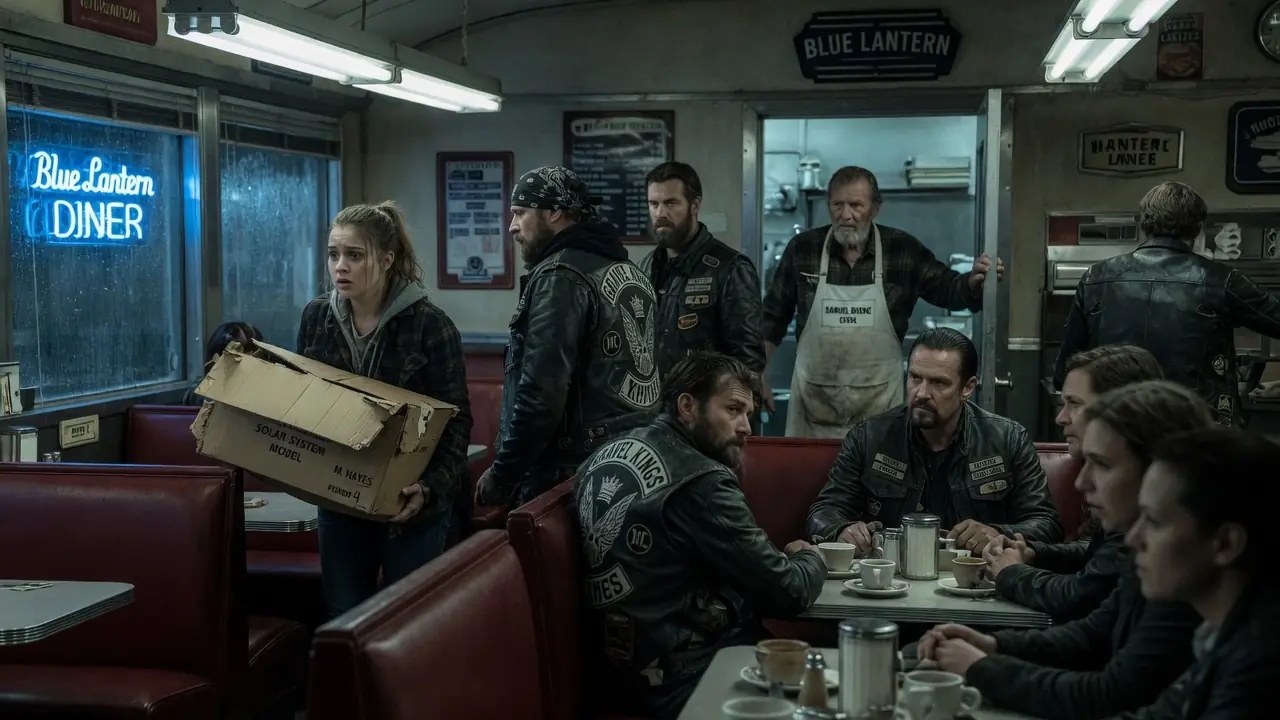
“You can?”
“I’ve fixed worse things than straw.”
Her lower lip trembled. “It was due tomorrow.”
“Then we’ll fix it tonight.”
Clara wiped the table with quick, angry motions. “And I’ll make you another grilled cheese.”
“I don’t have more money,” Maddie whispered.
Clara’s eyes filled. “Maddie Hayes, if you mention money again, I’m going to start charging those bikers rent for the space they wasted breathing in here.”
The truck driver gave a short, nervous laugh from the counter.
Boone picked up the plastic bag and began collecting Maddie’s coins from the booth seat. He counted them silently, then placed the bag beside her water glass.
“Two dollars and eighty-six cents,” he said.
Maddie looked surprised. “That’s right.”
“I count too.”
“Why?”
“Because some things feel safer when they have numbers.”
Maddie stared at him.
She had never told anyone that.
Before she could answer, the diner door burst open.
“Maddie!”
Her mother ran in soaked from the rain.
Angela Hayes was still wearing her grocery store cardigan over her work uniform from the clinic, her hair pulled loose from its clip, her face pale with fear. She nearly slipped on the mat in her hurry to cross the diner.
Maddie ran to her.
Angela dropped to her knees and pulled her daughter into her arms.
“I’m sorry,” Angela whispered again and again. “Baby, I’m so sorry. The car died, and my phone wouldn’t call, and then the sheriff called me, and I thought…”
“I’m okay,” Maddie said, though the words broke in the middle.
Angela held her tighter.
Clara turned away and wiped her eyes with the heel of her hand.
Boone stood very still.
At first, Maddie thought he was just giving them privacy. Then she saw his face.
He was staring at her mother as if she were a ghost.
Angela looked up.
Her expression changed.
The diner seemed to fade around them.
“Sam,” Angela said softly.
Boone’s hand closed around the back of the booth.
“Angela.”
Maddie looked from one adult to the other.
“You know each other?” she asked.
Angela slowly stood, keeping one hand on Maddie’s shoulder. Rain dripped from the ends of her hair.
“Yes,” she said.
Boone’s voice was rough. “I didn’t know you still lived around here.”
“I moved back last year.”
“You didn’t tell me.”
Angela’s mouth tightened. “You made it clear a long time ago you didn’t want to be told things.”
The words carried old pain.
Maddie pressed closer to her mother.
Boone looked at her then. Really looked. His eyes moved over her face, her brown hair, the small freckle beside her nose, the shape of her chin.
“Hayes,” he said quietly.
Angela nodded once. “Daniel’s daughter.”
Boone did not move.
Maddie knew her father’s name, of course. Daniel Hayes. She knew he had died when she was little. She knew he had been kind, that he had liked old motorcycles, pancakes, and singing badly in the car. She knew her mother kept his photograph in a drawer and sometimes cried without making noise.
But she did not know why Mr. Boone looked as if someone had opened a door inside him and all the light had rushed out.
Angela swallowed. “Maddie, this is your grandfather.”
Maddie stared.
“My what?”
Boone’s face folded with something too deep to be simple sadness.
“I didn’t know,” he said.
Angela’s eyes flashed. “You didn’t ask.”
“No,” Boone said. “I didn’t.”
There was no excuse in his voice.
That made the silence heavier.
Maddie looked at the old man who had made her grilled cheese, the man who had stood between her and the bikers, the man with the faded crowned wolf tattoo and hands strong enough to stop Vane.
“My dad’s dad?” she asked.
Boone nodded slowly. “Yes.”
“Mom said he had a dad, but he wasn’t around.”
Boone flinched as if the words had struck him.
Angela put a hand over Maddie’s hair. “Maddie.”
“It’s true,” Boone said.
He pulled out the booth seat and sat down heavily.
For the first time since Maddie had known him, Samuel Boone looked old.
Not stern. Not strong. Just old.
Angela took a breath. “Daniel wanted you at the wedding.”
“I know.”
“He wanted you at the hospital when Maddie was born.”
“I know.”
“He wanted you when he got sick.”
Boone closed his eyes.
Maddie’s heart gave a small, confused twist.
Her father had been sick? Her mother had said accident when she was smaller. Later she said his heart had stopped working right after an illness. Maddie had never known the grown-up details. She only knew her father was gone, and there were places in the house where sadness still stood like furniture no one knew how to move.
“I was proud,” Boone said.
Angela’s laugh was quiet and bitter. “You were cruel.”
“Yes.”
Again, no excuse.
Maddie looked at her broken project because the grown-up pain in the air felt too large.
Boone noticed.
He stood slowly. “This isn’t the night for old sins.”
Angela looked like she might argue, but Maddie tugged her sleeve.
“Mom,” she whispered. “He saved me.”
Angela’s face changed.
Clara stepped forward. “He did.”
Sheriff Monroe returned through the door just in time to hear it. She removed her hat and looked between Angela and Boone.
“Everything all right in here?”
Angela wiped Maddie’s cheek with her thumb. “I don’t know.”
“That’s honest,” Boone said.
Sheriff Monroe glanced at Maddie. “Those men won’t come near you again tonight. We’re taking statements. The one who kept your backpack is being charged. So is Vane.”
Maddie nodded.
“Are you feeling better?”
“Yes, ma’am.”
“Good.” The sheriff looked at Boone. “Samuel, the old riders outside are asking if they should stay.”
“Tell them to go home before the rain rusts their knees.”
Sheriff Monroe almost smiled. “They said you’d say that.”
“Then tell them I said thank you.”
She nodded and stepped back outside.
The diner began to breathe again.
Clara remade Maddie’s grilled cheese. Boone found glue, tape, scissors, two straws, and a box of toothpicks from beneath the counter. Angela sat beside Maddie in booth three, still shaken, watching Boone repair the cardboard house with the intense seriousness of a surgeon.
He did not rush.
He trimmed a new straw chimney. He reinforced the roof from inside with toothpicks. He used a tiny piece of tape so carefully Maddie could barely see it. When he was done, the little house looked stronger than before.
Maddie lifted the roof.
The tiny stove was still there.
She let out a breath she had not realized she was holding. “You fixed it.”
Boone cleared his throat. “Told you.”
“You made it better.”
He looked at the house, then at Angela. “Sometimes a thing breaks in the weak place. You can either throw it away or learn where it needed support.”
Angela looked down.
Maddie was too young to understand all the words beneath the words, but she felt them.
Clara brought the new sandwich and soup. This time, nobody touched it except Maddie.
By the time she finished eating, the rain had softened to mist. The bikers were gone. The patrol cars were gone. The old riders outside had disappeared down the highway, leaving only wet tire marks and the fading smell of exhaust.
Angela’s car was still broken by the grocery store, so Boone offered to drive them home.
Angela almost said no.
Maddie saw it in her face.
Then Angela looked at her daughter’s tired eyes, her damp socks, the repaired shoebox, and the inhaler still beside her plate.
“All right,” she said. “Thank you.”
Boone nodded once, as if the words were more than he deserved.
He closed the diner early that night.
Clara protested, saying she could handle the last hour, but Boone simply flipped the sign to CLOSED and told her the highway could feed itself until morning.
His truck was old but clean, with a toolbox behind the seat and a blanket folded neatly in the back. Maddie sat in the middle, the shoebox on her lap. Angela sat by the passenger door, her body angled slightly toward her daughter and slightly away from Boone.
For several minutes, no one spoke.
The road gleamed beneath the headlights. Rainwater shone in the ditches. The world outside the truck looked washed and lonely.
Finally, Maddie asked, “Did my dad like motorcycles?”
Boone’s hands tightened on the steering wheel.
Angela looked out the window.
“Yes,” Boone said. “He loved them.”
“Mom says they’re dangerous.”
“They can be.”
“Then why did he like them?”
Boone took a slow breath. “Because when your father rode, he said the world felt honest. Wind pushed, engine answered, road went where it went. No pretending.”
Maddie thought about that.
“Did you teach him?”
“Yes.”
“Were you good at it?”
Angela made a small sound, almost a laugh despite herself. “Your grandfather was famous for it.”
Boone looked startled to hear her say anything kind about him.
Maddie turned the shoebox slightly. “Were you famous like on TV?”
“No,” Boone said. “Just in places where men cared too much about engines.”
“That’s not real famous.”
“No,” he agreed. “It’s not.”
They reached the grocery store first, where Angela’s old sedan sat beneath a flickering parking lot light with its hood slightly raised. Boone got out in the mist, opened the hood, and checked the engine with a flashlight from his glove compartment.
Maddie watched through the windshield.
“He looks sad,” she said.
Angela’s face softened, then guarded itself again. “He made a lot of choices that made him sad.”
“Did he make Dad sad?”
Angela was quiet.
“Yes,” she said finally. “Sometimes.”
“Can people stop doing that?”
“Making people sad?”
“Making the bad choices.”
Angela watched Boone bend over the engine. “Sometimes. If they’re brave enough to be ashamed and still try to do better.”
Maddie did not understand every part, but she liked the idea that shame could be brave if it made someone better.
Boone closed the hood and returned to the truck.
“Alternator belt,” he said. “I can tow it to my shop in the morning. I’ve got one that’ll fit.”
Angela shook her head at once. “Sam, I can’t pay for a tow and a repair right now.”
“I didn’t ask you to.”
“I’m not taking charity from you.”
“It isn’t charity.”
“Then what is it?”
Boone looked at Maddie, then back at Angela.
“Late maintenance,” he said.
Angela stared at him.
Maddie felt there was another meaning there too.
The next morning, Maddie brought her repaired project to school.
She earned an A.
Her teacher wrote on the rubric: “Wonderful detail. Strong construction.”
Maddie smiled when she read that last part.
Strong construction.
She thought of toothpicks hidden beneath cardboard, tape placed where no one could see, and old things made sturdier because someone had taken the time to fix the weak place.
News of what happened at the Blue Lantern spread through town before lunch.
By the end of the week, everyone had heard some version of it. In one version, Boone knocked out three bikers with a frying pan. In another, Maddie threw soup on Vane. In another, fifty motorcycles surrounded the diner and made the Gravel Kings surrender by honking.
Maddie hated the stories.
They made people stare.
At school, kids asked if she had been scared. Some asked if the bikers had knives. One boy asked if she cried. She told him that crying was not a crime, and he did not know what to say after that.
Her mother met with Sheriff Monroe and signed papers. Clara gave a statement. The young man with the newspaper turned over his video. Vane and several others faced charges, and the Gravel Kings patch disappeared from the highway for a while.
But the biggest change happened more quietly.
Boone came by the house on Saturday with Angela’s repaired car.
He did not come inside.
He stood on the porch with the keys in one hand and a bag of groceries in the other.
Angela opened the door and looked at the bag.
“No,” she said.
Boone looked down at it. “It’s not much.”
“That’s not the point.”
“It’s bread, eggs, oranges, and those crackers Maddie likes with soup.”
Maddie peeked from behind her mother. “The square ones?”
Boone nodded. “The square ones.”
Angela sighed.
“Sam.”
“I know,” he said. “I don’t get to fix twenty years with groceries.”
“No. You don’t.”
“I’m not trying to.”
“What are you trying to do?”
Boone looked past her into the small living room, where a photograph of Daniel Hayes sat on the bookshelf. Maddie had placed her school project beside it because her father had liked motorcycles and old houses, and she thought he would understand.
“I’m trying to start with Saturday,” Boone said.
Angela’s face changed.
Maddie did not know if her mother would let him in.
For a long moment, neither adult moved.
Then Angela stepped aside.
“Coffee,” she said. “One cup. No promises.”
Boone nodded.
“One cup is more than I earned.”
He came in.
That became the beginning.
Not an easy beginning. Not a magical one. Angela still got angry. Boone still went quiet when he should have spoken. Maddie still had nightmares for a few weeks about Vane holding her backpack too high and laughing. Sometimes she woke up reaching for her inhaler even when she could breathe fine.
But things changed.
Boone started picking Maddie up from school on Wednesdays when Angela worked late. At first, Maddie sat silently in his truck, unsure what granddaughters were supposed to say to grandfathers who had appeared out of nowhere wearing grease on their hands and regret in their eyes.
Then Boone taught her how to check tire pressure.
Then how to tell if oil was clean.
Then how to listen to an engine and hear whether it was tired, angry, or simply cold.
“Engines aren’t angry,” Maddie told him.
“You haven’t met enough engines.”
He showed her his motorcycle shop behind the diner, a long metal building full of tools, spare parts, old photographs, and bikes in various stages of repair. On one wall hung a framed jacket with the original Gravel Kings patch, the crowned wolf faded nearly gray.
Maddie stared at it.
“Is that yours?”
Boone nodded.
“Are you still one of them?”
“No.”
“Because of Vane?”
“Because I forgot what it was supposed to mean before he did.”
Maddie looked at the patch. “What was it supposed to mean?”
Boone took a long time to answer.
“It was supposed to mean if you had strength, you used it to shelter someone. Not scare them. Not show off. Not take what you wanted from people who couldn’t stop you.”
“Like an umbrella.”
He looked at her.
She shrugged. “If you’re bigger, you can cover more people from the rain.”
Boone’s mustache twitched. “Yes. Like an umbrella.”
Maddie smiled. “That’s not a very scary biker thing.”
“No,” he said. “But it’s a better one.”
Two months after the diner incident, the Blue Lantern hosted a fundraiser for Maddie’s school art program.
It had been Clara’s idea, though Boone pretended to complain about it every day.
“You want me to feed half the county because some fifth graders need paint?”
“Yes,” Clara said.
“Paint doesn’t even taste good.”
“Then don’t put it on the grill.”
The fundraiser filled the parking lot by noon. Families came in minivans. Teachers brought poster boards. Sheriff Monroe stopped by with deputies. The elderly couple who had been in the diner that night brought pies. The truck driver sent a check with an apology note written on the back of a fuel receipt.
And then the motorcycles came.
Maddie heard them before she saw them.
Her body stiffened.
Angela, standing beside her at the raffle table, noticed instantly. “Maddie?”
The rumble grew louder.
For a moment, Maddie was back in booth three with cold soup, a stolen backpack, and grown men laughing.
Then Boone stepped outside.
Maddie watched through the diner window.
A line of motorcycles turned into the lot, but these riders were different. They parked properly. They removed their helmets. They waited by their bikes instead of storming the door. Men and women, young and old, wearing plain leather jackets, denim vests, rain gear, veterans’ caps, work boots, and careful expressions.
Boone walked to them.
The first rider, a woman with silver braids and a blue bandana around her neck, held out both hands where Maddie could see them.
Boone spoke with her.
Then he turned and looked through the window at Maddie.
He did not wave them in.
He waited.
Angela crouched beside Maddie. “You decide.”
Maddie’s heart beat hard.
“Are they Gravel Kings?”
“No,” Angela said. “They’re friends of your grandfather.”
“Do they know what happened?”
“Yes.”
Maddie watched the riders standing in the parking lot, patient in the afternoon sun. No one revved an engine. No one laughed. No one pointed at her.
“What do they want?”
Angela’s eyes softened. “To buy lunch. And maybe to show you that motorcycles aren’t what hurt you. Cruel people did.”
Maddie looked at Boone again.
He stood very still, letting her choose.
At last, Maddie nodded.
Angela stood and opened the diner door.
The riders entered one by one.
The woman with silver braids came first. She stopped a few feet from Maddie and smiled gently.
“Miss Hayes,” she said, “my name is Ruth Bell. I heard you build excellent houses.”
Maddie blinked. “I built one.”
“Then that’s one more than I’ve built.”
A small laugh escaped Maddie before she could stop it.
Ruth placed a folded twenty-dollar bill in the art program jar. “I’m sorry some riders made you afraid. That wasn’t your fault.”
Maddie looked at the jar. “Thank you.”
The other riders followed, each giving space, each ordering politely, each tipping too much. One man asked Clara if booth three was available, then immediately changed to another booth when he saw Maddie’s face.
Boone noticed.
So did Maddie.
By evening, the art program jar was full.
Maddie helped count the money.
Numbers felt safe again.
Eight hundred and sixteen dollars.
Plus forty-three cents.
Clara said the cents mattered most because kids always understood coins better than checks.
When the fundraiser ended, Boone found Maddie sitting in booth three with a fresh bowl of tomato soup. Her repaired school project had been displayed near the register all day, straw chimney standing proudly.
“Did today help?” he asked.
Maddie considered lying because adults liked simple answers.
Instead, she said, “A little.”
Boone nodded. “A little is allowed.”
“Will I stop being scared when I hear motorcycles?”
“Maybe. Maybe not all the way.”
She looked worried.
Boone sat across from her. “Being scared doesn’t mean you’re broken.”
“It feels broken.”
“I know.”
“What if I’m always scared?”
“Then we make more places where you can be scared and still safe.”
Maddie stirred her soup. “Like here?”
“Like here.”
She looked around the Blue Lantern.
At Clara laughing behind the counter.
At her mother speaking with Sheriff Monroe near the door.
At Ruth Bell helping stack chairs.
At Boone sitting across from her in a booth that had once belonged to fear and now simply belonged to whoever needed soup.
“Grandpa?” she said.
Boone went very still.
She had not called him that before.
His voice came rough. “Yes?”
“Can you teach me how to fix a real chimney?”
He looked confused. “A real chimney?”
“For a real house. If it breaks.”
Boone’s eyes shone, though he quickly looked toward the window.
“I can teach you how to fix a lot of things,” he said.
Maddie nodded. “Good.”
Then she dipped her grilled cheese into her soup and took a bite.
Months passed.
The case against Vane moved through court slowly, the way grown-up justice often did. Maddie had to speak once to a woman who worked with children and once to the prosecutor. She did not have to face Vane in the courtroom, and for that she was grateful.
The video from the diner helped. So did Clara’s statement. So did the fact that Boone and Sheriff Monroe had already been tracking Vane’s crew for harassing businesses along the highway.
Vane eventually pleaded guilty to several charges. Others in his group did too. The Gravel Kings as Vane had led them dissolved, though Boone said names mattered less than behavior.
“Bad men can ruin a good name,” he told Maddie. “Good people can build a better one.”
“What name are you building?”
He thought about it.
“Blue Lantern Riders,” he said.
“That sounds like a club for people who help lost cars.”
Boone smiled. “That’s exactly what it is.”
He started small.
A few trusted riders agreed to patrol the highway during storms, not like police, but like neighbors. They helped change tires. They brought gas to stranded drivers. They escorted nurses home after late shifts when requested. They raised money for school supplies and kept a strict rule posted in Boone’s shop.
Strength is shelter.
Maddie wrote the sign herself in blue marker.
Boone framed it.
On the first anniversary of the day the Gravel Kings came into the diner, the Blue Lantern was full before sunset. Not because anyone advertised the date, but because people remembered.
Clara made grilled cheese specials.
Angela baked lemon bars.
Sheriff Monroe stopped by after work.
Ruth Bell and the Blue Lantern Riders parked their motorcycles along the far edge of the lot, leaving every front space open for families and elderly customers because Maddie had once declared that was “more polite.”
Boone pretended not to care about the anniversary, but he spent all morning repainting booth three.
Maddie noticed.
The old red vinyl had been repaired. The table had been polished. On the wall beside it, Boone had hung a small brass plate.
Not a memorial.
Not something sad.
Just a sentence.
Reserved for anyone waiting to be brought safely home.
Maddie traced the words with her finger.
“Is this for me?” she asked.
Boone stood beside her, hands in his pockets. “Started that way.”
“And now?”
“Now it’s for whoever needs it.”
Maddie leaned against him.
He froze for half a heartbeat, then gently rested one hand on her shoulder.
That evening, a family came in soaked from sudden rain. Their car had overheated two miles down the road. They had two young boys, one crying, one angry, both hungry.
Maddie watched Clara guide them to booth three.
The smaller boy hugged a toy dinosaur and kept looking toward the motorcycles outside with wide eyes.
Maddie knew that look.
She went to the counter, picked up a pack of crayons, and walked to the booth.
“Hi,” she said. “I’m Maddie. The grilled cheese is best if you dip it in soup.”
The boy stared at her.
“Are those bikers scary?” he whispered.
Maddie looked through the window.
Boone was outside with Ruth Bell, helping the boys’ father look under the hood of the broken car. The motorcycles stood quietly in a neat line beneath the diner sign. No engines growled. No one laughed through the glass. No one owned the place by force.
“No,” Maddie said. “Not those.”
“How do you know?”
She thought about the answer.
Because one kind of person uses size like a storm.
Another uses it like a roof.
Because a patch means nothing unless the person wearing it remembers kindness.
Because rescue does not always erase fear, but it can teach fear where to stand.
Because sometimes an old man behind a grill is more than a cook.
Because sometimes a broken straw chimney gets fixed stronger than before.
Maddie placed the crayons on the table and smiled.
“I know,” she said, “because they wait outside until people say it’s okay to come in.”
The boy seemed to accept that.
Clara brought soup.
Angela laughed near the pie case.
Sheriff Monroe drank coffee at the counter.
Boone came back inside twenty minutes later, rain on his sleeves and grease on his hands. He looked across the diner and found Maddie helping the little boy draw a house with a very tall chimney.
His face softened.
Maddie looked up and saw him watching.
She waved him over.
“Grandpa,” she called, “do you think this chimney needs support?”
Boone crossed the diner slowly, passing booth three, the counter, the pie case, and the place where Vane had once stood thinking cruelty made him powerful.
He looked at the boy’s drawing with great seriousness.
“Every good chimney needs support,” he said.
The boy handed him a crayon. “Can you show me?”
Boone sat down.
Maddie smiled.
Outside, rain fell gently over the highway, over the parked motorcycles, over the Blue Lantern sign glowing against the evening.
Inside, the diner was warm.
And booth three was no longer the place where a little girl had been made to feel small.
It was the place where people learned the opposite.
It was the place where a frightened child had been protected.
It was the place where an old man remembered the code he had almost forgotten.
It was the place where strength became shelter again.