“They beat my mama, please. She’s still there.”
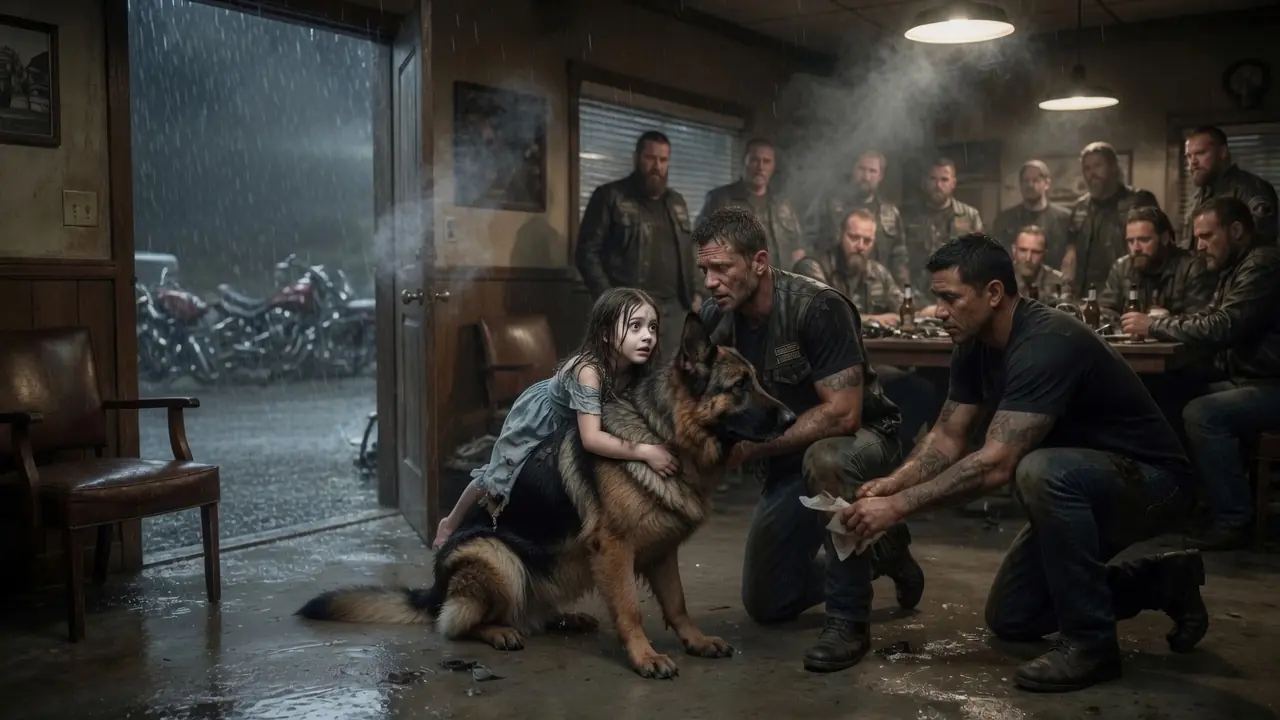
The words came from a child who could not have been more than five, soaking wet, barefoot, bleeding, sitting on the back of a German Shepherd that had just collapsed through the clubhouse door.
The dog’s leg was torn open. The girl’s dress was ripped at the shoulder.
She was not screaming. She was not crying.
She just looked straight up at the biggest man in the room with eyes that had already seen too much.
And she said it again, quieter this time, which was somehow so much worse than shouting.
Every hardened man in that room stopped breathing at the same time.
The German Shepherd hit the door at full speed.
Not scratching, not whimpering, not the way a lost dog acts when it finds a porch light and wants in out of the cold.
No.
Max hit that door like he was delivering a verdict.
Three hard slams of his body against the wood.
Each one rattled the frame, each one louder and more desperate than the last, until Bull, the club’s three-hundred-pound doorman, shoved back his chair and growled, “What in the—”
He yanked the door open, and the night poured in.
Rain, wind, mud, and a dog the size of a small pony standing in the doorway with a child on his back.
The little girl’s arms were locked around Max’s neck.
Her eyes were wide open.
Not the wide of wonder, but the wide of a child who has seen something no child should ever see and cannot figure out how to close her eyes and make it go away.
Her dress was torn at the shoulder.
There was a cut above her left eyebrow, crusted dark at the edges.
Her bare feet were bleeding.
Max took one step inside, then his legs gave out.
He did not fall hard.
He went down slowly, like he was choosing to kneel, like he was making one final deliberate decision.
The girl slid off his back and landed on her knees on the concrete floor.
And she did not even flinch.
She just put both hands flat on Max’s ribs and looked up.
The room, twelve bikers, three card games, two arguments about the Cardinals game, and one very heated debate about engine displacement, went completely silent.
Jake Morrison was at the back table.
He had a beer in his hand he had not touched in twenty minutes, turning it slow in circles while Dee talked at him about the upcoming run.
Jake was not listening.
He had not been listening to much of anything for about three weeks.
Not since he got out, not since he drove back into Milhaven and realized that the town looked exactly the same, but felt like a foreign country he did not have the right papers for.
He looked up when the room went quiet.
His brain registered dog, child, blood.
And he was moving before he made the conscious decision to move.
“Everybody back up,” he said, and his voice came out quiet and flat.
The kind of quiet that carried weight because it did not try to.
The bikers stepped back, not because they were scared of Jake.
Most of them had known him since he was nineteen.
But because there was something in his face that said this was not a moment for anyone to crowd.
Jake crossed the room and crouched down in front of the girl.
She looked at him.
She did not pull away. She did not cry.
She just looked at him with those dark, serious eyes.
And he noticed even then, even in the chaos of the moment, that her eyes were an unusual color.
Not quite brown, not quite hazel, like creek water in October when the light comes through the trees sideways.
“Hey,” Jake said. “You’re okay. You’re safe.”
“My name is Lily,” she said.
“Hi, Lily. I’m Jake.”
“I know,” she said.
He blinked.
“You know?”
“Max knows this place,” she said.
She looked down at the dog, who was breathing hard, his sides heaving, a thin line of blood working its way down his left front leg.
“He’s been here before. Mama said this was the safe place. She said if something ever happened, if it got really, really bad…”
Her voice caught just for a second.
She pressed her lips together the way adults do when they are trying not to come apart in public.
She was five years old, and she was trying not to come apart in public.
“She said to come here.”
Jake felt something move through his chest like a current.
“Where’s your mama, sweetheart?”
“Home,” Lily said.
Then, in a voice so steady it was almost worse than crying, she said, “Dennis hit her with the lamp. She fell down, and she didn’t get back up. I tried to wake her up, but she didn’t move. Max broke the window. He put his head under my arm, and he made me get on his back.”
She paused.
“He’s bleeding.”
“We’re going to take care of him,” Jake said. “Right now, before anything else.”
“Marcus.”
Marcus Reyes was already there.
Ex-Marine, the club’s unofficial medic, a man who had kept three men alive in a ditch in Kandahar with a knife, a prayer, and a roll of duct tape.
He came down to one knee beside Max, his big hands moving with a kind of gentle precision that looked wrong on a man with forearms like fence posts.
“Through and through on the leg,” Marcus said quietly. “Looks like glass. A lot of it.”
He looked up at Jake.
“He ran through a window. That’s what she’s saying.”
Marcus looked at the dog, and something shifted in his face.
“This dog ran through a plate-glass window in the rain, bleeding, and carried this child. How far?”
“The Fletcher place,” said Bo from the doorway.
He had pulled out his phone.
“That’s three and a half miles.”
The room stayed quiet.
Marcus cleared his throat.
He turned back to Max and got to work.
Jake turned back to Lily.
He took off his leather jacket, the cut with the Iron Brotherhood patch on the back that he had spent fifteen years earning and three years missing, and he wrapped it around her shoulders.
It swallowed her.
She looked like a child playing dress-up in her father’s clothes.
“Can you tell me what Dennis looks like?” Jake asked.
“Big,” Lily said immediately. “He smells like beer and cigarettes. He has a tattoo on his neck that looks like a snake.”
She considered.
“He’s mean. He’s always been mean, but tonight he was the worst kind of mean.”
“The worst kind,” Jake repeated carefully. “What does that mean?”
“It means he wasn’t yelling,” Lily said. “When he yells, Mama says it’s the fear talking. But tonight, he was quiet. Mama says the quiet is the kind you run from.”
Jake stared at her.
Twelve years old minimum was the wisdom coming out of this child’s mouth.
Twelve years old, carried in a five-year-old body that was shaking slightly now, starting to come down from whatever adrenaline had held her together on that dog’s back for three and a half miles of dark road in a thunderstorm.
“Dee,” Jake said without turning around.
“Already on it,” Dee said.
Jake heard the familiar crack-snap of a bolt being checked.
“You want us to move?”
“Not yet.”
Jake turned to look at him.
“We do this right. We call the sheriff first.”
Three or four voices made sounds of disagreement.
Jake did not raise his to compete with them.
“We call the sheriff first,” he said again. “Because there is a child sitting here who is going to need things to be done correctly for the rest of her life. We are not going to make this night harder on her. We are going to make it right.”
Dee looked at him for a long moment, jaw working.
Then he nodded once.
“All right. Sheriff first.”
Jake pulled out his phone.
Lily put her hand on his arm.
He looked down.
“She was still breathing,” the girl said. “When I left, I could see her chest moving. I made Max wait until I could see it moving three times.”
She held up three fingers.
“One, two, three. Then I got on his back.”
Jake covered her hand with his.
“That was very smart,” he said.
His voice was steady.
“You did everything right.”
Lily nodded.
She looked down at Max.
“Is he going to be okay?”
Marcus looked up from where he was working, his hands moving careful and sure.
He caught Jake’s eye for just a fraction of a second.
There was a question in it.
How honest do we be?
And Jake gave him the smallest nod.
“He’s tough,” Marcus said. “This dog is the toughest thing I have treated in a very long time, and I have treated some tough things. He’s going to need rest and care and probably some stitches. But I think he knew what he was doing tonight. I think he made a choice, and he’d make it again.”
Lily seemed to accept this the way children accept things that adults deliver with complete conviction.
She leaned slightly against Jake’s arm, and she did not say anything else.
Jake made the call.
Sheriff Dan Buckley picked up on the second ring, which meant he was awake, which meant he was already monitoring something.
Jake gave him the address.
He gave him Lily’s description of what she had found.
He gave him Dennis Fletcher’s name, and he felt Buckley go still on the other end of the line.
That particular brand of law enforcement stillness that means the name is already known.
“We’ve had prior calls to that residence,” Buckley said carefully.
“How many prior calls, Dan?”
A pause.
“This would be the fourth.”
“Fourth.”
Jake’s jaw tightened.
“And Sarah Fletcher. Sarah Morrison. She’s still there. She may be unconscious. She may be…”
He stopped.
He turned slightly away from Lily.
“Already rolling,” Buckley said. “Jake, you keep your boys at the clubhouse. You hear me? You let us handle this.”
“We called you first,” Jake said. “That’s all I promised.”
He ended the call.
Bull was standing by the window, watching the road.
“You know this woman,” he said.
It was not a question.
Jake was quiet for a moment.
“I knew her,” he said.
He turned back to Lily, and she was looking up at him with those October Creek eyes.
He felt it again.
That current, that pull, like standing at the edge of something he could not quite identify yet.
Something big and deep and completely terrifying in the way that truths are terrifying when they are just about to become real.
“Lily,” he said carefully. “How old are you?”
“Five,” she said. “Almost six. My birthday is in April.”
“April?”
Jake did the math without wanting to.
He did it twice.
The way you double-check an answer when you are hoping you made an error the first time.
He had not made an error.
“What’s your mama’s full name?” he asked.
He kept his voice level.
He was proud of how level he kept it.
“Sarah Anne Morrison,” Lily said, “but she changed it. It’s Fletcher now because of Dennis. She doesn’t like it, but she said it was easier.”
She paused.
“I don’t like it either. I like Morrison better. It sounds stronger.”
Something happened to Jake’s face then.
He could not have told you exactly what it was.
Bull, who had known Jake Morrison for twenty-two years, turned away from the window and looked at him, and his eyebrows went up slowly, the way a man’s do when he is putting pieces together that he did not realize were a puzzle.
“Jake,” Bull said slowly.
“Not now,” Jake said.
“Brother—”
“Not now, Bull.”
His voice was rough at the edges.
“Right now, we focus on keeping this child warm and keeping that dog alive and making sure Sarah—”
His voice caught on the name.
First time in six years he had said it out loud.
“Making sure her mother gets the help she needs.”
Lily reached into the neck of her torn dress and pulled out a necklace.
The chain was thin and silver, the kind that cost thirty dollars at a mall kiosk.
At the end of it hung a small heart pendant, silver, with a tiny engraved letter on the front.
The letter J.
Jake felt the air leave his body.
He knew that necklace.
He had held it in his hands in a fluorescent-lit gift shop seven years ago, turning it over, reading the description on the little cardboard tag.
He had been trying to find something real to give to someone who made everything else feel cheap and insufficient.
He had paid for it with crumpled twenties because that was all he had.
He had put it around Sarah’s neck himself.
He had told her, “J for Jake, so you don’t forget who loves you.”
She had laughed and told him she was not likely to forget.
And he had kissed her and believed her.
And three months later, he had been arrested.
And two months after that, she had stopped answering his calls.
And he had spent six years in a prison cell building a wall around the part of himself that had loved her.
Brick by patient brick, until he was sure the wall would hold.
The wall was not holding.
“Where did you get that necklace?” he asked.
His voice came out barely above a whisper.
Lily looked down at it, then back up at him.
“Mama gave it to me,” she said. “When I was little, she put it around my neck, and she said, ‘Someday I’ll tell you the story of this heart. But for now, just know that it means you are loved, you are protected, and you are never alone.’”
She closed her hand around the pendant.
“I wear it every day, even in the bath. Mama said it’s okay to wear it in the bath.”
Jake Morrison, who had not cried in front of another human being since he was eleven years old, felt the back of his throat close up entirely.
He looked at this child, her dark hair plastered to her forehead, his leather jacket wrapped around her shoulders like a tent, her bare bleeding feet, her three fingers held up in the rain-soaked dark to count the rise and fall of her mother’s chest before she trusted the night enough to leave.
And he felt something inside him that had been sealed shut and left alone for six years crack directly down the middle.
Marcus looked up from Max.
He read Jake’s face in one second, looked back down, and said nothing.
Bull crossed the room, put one heavy hand on Jake’s shoulder, squeezed once, then dropped it and stepped back.
Lily was still looking up at Jake.
“You’re going to help my mama, right?” she said.
And Jake Morrison, who had made many promises in his life and broken a good number of them, who had spent six years learning which promises were the ones you could not afford to break, looked at this child who carried his silver heart around her neck, and he said, “Yes.”
Just that word.
One word.
Flat and final and absolute.
Lily seemed satisfied.
She leaned back against him, her head against his arm, and she closed her eyes.
Max’s breathing was steadier now, Marcus having worked him over with the careful efficiency of a man who respects life in all its forms.
The rain hammered the roof of the clubhouse.
Outside, somewhere past the tree line in the dark road, sirens were beginning their long wail toward the Fletcher place.
Jake did not move.
He sat on the concrete floor of the Iron Brotherhood clubhouse with a five-year-old girl leaning against him, wearing his jacket and his necklace.
And he thought about the particular cruelty and grace of time.
The way it can take everything from you and then, without warning, in the middle of an ordinary night, bring it back in a form so unexpected you almost do not recognize it.
Almost.
The sirens grew louder.
Dee came and crouched beside Jake.
His voice was low. Private.
“They’re going to find her,” he said. “Buckley’s good. He’ll get her out.”
“She was breathing,” Jake said. “Lily counted three breaths.”
Dee nodded.
“Dennis Fletcher,” Jake said quietly. “You know the name.”
Dee’s expression changed slowly, like weather moving in.
“Fletcher. Dennis Fletcher from Milhaven. Big guy, snake tattoo.”
He stopped.
“Yeah,” he said. “I know that name.”
“From where?”
Dee looked at him for a long moment.
“Then he used to run with Crowley’s crew before you went in. You remember the Crowley crew?”
Jake remembered.
He remembered it like he remembered the specific weight of handcuffs on his wrists.
The kind of memory that lives in your body, not just your mind.
Crowley’s crew, the people who had directly or indirectly contributed to the night that had taken six years of his life.
“Dennis Fletcher,” Jake said again slowly, like he was testing the sound of it. “He’s been in that house with Sarah. With—”
He stopped.
He looked down at the top of Lily’s head.
“Jake,” Dee said carefully.
“I’m fine.”
“You don’t look fine.”
“I said I’m fine.”
He looked up.
“Which means we are going to sit here calmly and wait for Buckley to call, and then we are going to decide what comes next in the right order, the right way.”
A pause.
“And if Buckley doesn’t call within twenty minutes, then we decide something different.”
Dee studied him.
“All right,” he said.
“Twenty minutes,” Jake said.
He looked at his phone.
He looked at Lily.
He looked at the silver heart necklace barely visible above the collar of his jacket, the letter J catching the clubhouse light.
Nineteen minutes and forty-three seconds later, Dan Buckley called.
Jake answered before the first ring finished.
“She’s alive,” Buckley said. “She’s bad, Jake. Real bad. She’s going to need surgery. But she’s breathing, and she’s conscious. She was asking for the girl, for Lily.”
Jake exhaled one long breath.
“What about Fletcher?”
A pause lasted exactly long enough to tell him everything.
“He’s gone,” Buckley said. “Back door was open. Vehicle’s gone. Neighbors said they heard a truck pull out hard about forty minutes ago.”
Another pause.
“He ran, Jake. He knows what he did. And he ran.”
Jake looked across the room at Dee, who was reading his face, who had always been able to read his face.
Dee stood up.
Behind him, without a word being spoken, four other men stood up.
“Dan,” Jake said quietly. “We’re going to go check on some things.”
“Jake—”
“We’ll stay out of your way.”
“That is not what you said.”
“I said we’d call you first,” Jake said. “We called you first. Sarah’s alive because we called you first. I’m keeping that part of the deal.”
He looked at Lily, still leaning against his arm, now genuinely asleep, one small hand still clutching the silver heart.
“But he ran. And a man who runs has a direction. And I know Dennis Fletcher’s directions.”
He stood up carefully, shifting Lily so she settled against the arm of the couch without waking.
He looked at Marcus, who nodded.
He would stay.
He would watch the girl.
He would watch the dog.
Jake pulled on the jacket that was not around Lily’s shoulders anymore, his backup cut, the plain one without the patches.
He looked at his men, these rough and complicated people who had become, by accident and proximity and shared trouble, the closest thing he had to a family.
“Let’s go find him,” he said.
And every man in that room moved like they had been waiting all night for those exact three words.
The door opened.
The rain came in.
The night was loud and dark and full of the kind of consequence that does not warn you before it arrives.
And Jake Morrison walked into it like a man who finally understood what he was walking toward.
The trucks hit the wet road hard, headlights cutting through rain that had not decided yet whether it wanted to stop.
Jake rode up front with Dee.
The cab was quiet except for the engine and the wipers and the particular kind of silence that exists between two men who have known each other long enough to not need words to communicate the weight of what is happening.
Dee drove.
Jake stared through the windshield and ran numbers in his head that he did not want to run.
Five years old. Birthday in April.
Sarah had stopped answering his calls in October.
Six years and seven months ago.
The math did not lie.
The math never lied, which was the thing Jake hated most about math.
“You’re going to say it,” Dee said.
“I’m not saying anything.”
“You’ve got that face.”
“I don’t have a face, Dee.”
“Brother.”
Dee glanced at him.
“You’ve got the face you get when the world just handed you something you don’t know whether to be grateful for or destroyed by. I’ve seen that face twice in twenty years, and both times something enormous was about to happen.”
Jake looked out the side window.
“She’s mine,” he said.
The word landed in the cab like a stone dropped in still water.
Dee did not speak for a full ten seconds.
“You sure?”
“The necklace, Dee. The one I bought for Sarah at the Ridgemont Mall in October seven years ago. Twenty-two dollars. Silver heart. Letter J.”
He paused.
“Lily was wearing it. Sarah gave it to her. Told her it meant she was loved and protected and never alone.”
His jaw tightened.
“Sarah knew. She knew the whole time, and she never—”
He stopped.
Dee gripped the steering wheel.
“She couldn’t find you,” he said carefully. “You were inside, Jake.”
“There are ways to find people.”
“There are ways to find people if those people want to be found,” Dee said. “And you weren’t exactly sending postcards from Crestwood Correctional.”
Jake said nothing to that because Dee was not wrong.
There had been a period, eighteen months in, after the third letter came back unopened, where Jake had decided to stop reaching and start building that wall.
He had made himself hard and unreachable.
And he had done it with the focused efficiency of a man who believes that is the only way to survive.
He had survived.
He just had not understood until tonight what the cost of that survival looked like from the outside.
Dee’s phone buzzed on the dash.
He looked at it.
“Bull says the hospital’s got Sarah in surgery. She’s got a skull fracture, Jake. And three broken ribs.”
He set the phone down.
“He hit her hard.”
“I know.”
“And more than once.”
“I know,” Jake said again.
And his voice had dropped to something very low and very quiet.
Dee, who understood tone the way musicians understand pitch, did not say anything more on the subject.
He just drove faster.
The Fletcher place was a quarter mile off Route 9, down a dirt road that had turned into a mud river in the rain.
By the time they pulled up, Buckley’s cruisers were already there, lights spinning red and blue across the dark, deputies moving in and out of the house with flashlights, and that particular purposeful urgency of law enforcement that knows it is already a few minutes too late for the most important part.
Jake got out of the truck.
Buckley was standing at the edge of the yard talking into his radio.
And when he saw Jake, his expression did something complicated.
Dan Buckley was sixty-one years old, twenty-two years in the sheriff’s office, a man who had looked at hard things his entire career and was not easily rattled.
He looked right now slightly rattled.
He held up a hand to his deputy and walked over.
“You said you’d stay at the clubhouse,” Buckley said.
“I said I’d call you first. Different thing.”
Buckley looked at the four trucks that had parked behind Jake’s.
He looked at the seven bikers now standing in the rain.
Each one watching him with a careful, neutral expression of men who are behaving themselves precisely because they have chosen to, not because they have to.
Buckley, to his credit, understood the distinction.
“Dennis is gone,” Buckley said. “Forty-five minutes minimum, could be an hour. He took his truck, a blue Chevy 2019. Plates already out to every county in a hundred-mile radius.”
He paused.
“He knows these roads.”
“Jake grew up out here. He’s got places he can go that we don’t know about.”
“I know about them,” Jake said.
Buckley’s eyes sharpened.
“What does that mean?”
“It means Dennis Fletcher ran with Crowley’s crew, and I spent eighteen months running the same roads as Crowley’s crew before I went inside. If Dennis is running scared, there are three places he goes.”
Jake looked at him steadily.
“I’ll tell you all three. You take two. Let me take the third.”
“Absolutely not,” Buckley said immediately.
“Dan—”
“Jake, I cannot have civilians—”
“I’m not a civilian. I’m a father.”
The word came out before Jake fully chose it, raw-edged and unplanned.
It hit the air between them and just sat there.
Buckley blinked.
Jake pressed on, quieter now.
“He has been in that house with my daughter for however long Sarah’s been with him. He put her mother in surgery. He made my child count her mother’s breaths in the dark before she decided it was safe enough to leave. Tell me, Dan, as a man, not as the sheriff, as a man. Tell me to go home.”
Buckley stared at him for a very long time.
The rain drummed between them.
“You stay behind us,” Buckley finally said. “You do not engage. If I say stop, you stop. If I say back off, you back off.”
He pointed one finger at the bikers.
“And those men keep their hands visible at all times.”
“Agreed,” Jake said.
“All three conditions, Jake. Not two out of three.”
“All three,” Jake said. “I swear it.”
Buckley looked at him a moment longer, then turned back to his deputy and started issuing coordinates.
Dee came up beside Jake.
“Which place are we taking?” he murmured.
“Crowley’s old hunting cabin,” Jake said. “Past the Miller Creek crossing. No power, no running water, but it’s got a wood stove and four walls, and Dennis knows nobody’s driven that road since 2019.”
He started moving toward the trucks.
“It’s where I’d go.”
“How do you know that’s where he’d go?”
Jake looked at him.
“Because it’s where I went the night everything fell apart, and Dennis and I, whatever else we are to each other, were built by the same circumstances.”
Dee let that sit for exactly one second.
Then he said, “Then let’s go end this.”
The Miller Creek Road was barely a road.
It was more of a memory of a road, a suggestion from the land that at some point in the past something with wheels had passed this way and left a mark.
The truck bounced and lurched through mud and standing water, and in the back, Bull and two others sat in silence with the grim patience of men who have learned that the waiting is always longer than the doing.
Jake’s phone buzzed.
He looked at it.
Marcus.
She woke up.
The text read: Lily woke up and the first thing she said was, “Is Max okay?” I told her yes. Second thing she said was, “Is Jake still here?” Thought you should know.
Jake read the message twice.
He put the phone in his pocket.
He looked straight ahead at the road.
“You okay?” Dee asked.
“No,” Jake said honestly. “But I’m good. Those are two different things.”
“Yeah,” Jake said. “They are.”
The cabin came into view around a bend, and the first thing Jake saw was the truck.
Blue Chevy.
Backed into the tree line, the way a man parks when he wants the option of leaving fast.
The lights were off, but there was a thin line of light at the bottom of the cabin door.
The kind a wood stove throws.
“He’s here,” Jake said.
Dee immediately killed the headlights.
He stopped the truck fifty yards out.
Jake picked up his phone and called Buckley.
“We’ve got a visual,” he said. “Miller Creek cabin. Blue Chevy’s here. There’s light inside. We’re holding position.”
“Copy that,” Buckley said.
And in his voice, Jake heard something that might have been surprise.
That Jake was actually holding position.
“ETA twelve minutes. Do not move.”
“Copy,” Jake said.
And he meant it.
And he sat in the dark truck in the rain and stared at that thin line of light under the door.
And he thought about what was on the other side of it.
And he breathed in slow and breathed out slow the way Marcus had once taught him years ago after a night that had gone badly sideways.
Breathe in for four. Hold for four. Out for four.
It does not stop the feeling, Marcus had said.
It just gives the feeling somewhere to go that is not your fists.
In for four. Hold for four. Out for four.
Dee’s hand landed on his shoulder for just a second, then it was gone.
They waited.
Eight minutes in, the cabin door opened.
Dennis Fletcher stepped out.
Jake had not seen him in seven years.
He was bigger than Jake remembered, thicker through the chest, heavier in the jaw.
The kind of weight a man puts on when he stops moving and starts sitting and stops caring about the difference.
The snake tattoo on his neck had faded but was still there, crawling up toward his ear.
He had a bag in one hand and a bottle in the other, and he was moving toward his truck with a hurried, loose-legged gait of a man who is drunk enough to believe he has a plan.
“He’s running again,” Dee said quietly.
“I see it.”
“Jake.”
“I said I see it.”
Jake’s hand was on the door handle.
“He gets in that truck, he’s gone. Buckley’s four minutes out minimum.”
“You said you’d hold position.”
“I said I’d hold position until it was necessary not to.”
Jake looked at him.
“If he drives away, Lily doesn’t get closure. Sarah doesn’t get justice. He just becomes a ghost.”
He paused.
“I’ve been a ghost, Dee. I know exactly what that costs the people you leave behind.”
Dee looked at him.
He looked at Dennis.
He looked at the truck.
“I’m right behind you,” he said.
Jake got out of the truck.
The rain had let up slightly, enough that his footsteps on the gravel were audible.
Dennis heard them.
His head came up fast, animal fast, the way the guilty come to attention when they hear unexpected sound.
And he turned, and for one suspended moment, the two men looked at each other across twenty feet of wet dark.
Dennis recognized him.
Jake watched it happen.
Watched the recognition move through the man’s face like a stone through water, sending ripples of things outward.
Surprise. Guilt.
And then, beneath both of those, something uglier.
Defiance.
“Morrison,” Dennis said.
“Dennis,” Jake said.
“Well.”
Dennis set the bag down, but kept the bottle.
He looked Jake over in the slow, deliberate way of a man deciding whether to run or to stand.
“You got out three weeks ago. Heard that.”
He swirled the bottle.
“You look like hell.”
“You put a woman in surgery,” Jake said. “A woman with a five-year-old child.”
Something crossed Dennis’s face.
Not regret.
More like inconvenience.
“Sarah and I had a disagreement.”
“A disagreement?” Jake repeated.
“She’s got a mouth on her. Morrison always did. You know that better than anyone.”
He tilted his head.
“Or maybe you don’t. Maybe you weren’t around long enough to really know her.”
Jake kept walking slow and even.
Fifteen feet now.
“You know what’s interesting, Dennis? Of all the things I’ve been thinking about tonight, and I’ve been thinking about a lot of things, the one that keeps coming back is how you looked at that little girl. When you were in that house, when you were deciding what kind of man to be.”
He stopped.
Ten feet.
“What did you think about her?”
Dennis’s jaw moved.
“She’s Sarah’s kid.”
“She’s my kid,” Jake said.
The silence that followed was of a different quality than any that had come before it.
Dennis went very still.
The bottle stopped moving.
His eyes ran over Jake’s face, searching for the lie, not finding it.
“That’s not—” he started.
“April birthday,” Jake said. “Do the math. You’re good at math when it comes to things that matter to you. Do the math on this one.”
Dennis looked away.
He looked at his truck.
He looked back at Jake.
And Jake saw the exact moment the man chose.
Not flight, not surrender, but something worse.
The cornered-animal decision that if this is going to go badly, he is going to make it go as badly as possible for everyone.
“Doesn’t matter who she is,” Dennis said.
And his voice had shifted into something flat and ugly.
“She’s just a kid, and you’re just some ex-con who thinks he can come walking onto my property.”
“This isn’t your property,” Jake said. “This is Crowley’s cabin, and Crowley’s been dead since 2020, which you’d know if you weren’t so focused on hiding in it.”
Dennis threw the bottle.
He threw it hard and without real aim.
The way drunk men throw things.
Not to hit, but to create chaos.
To buy a second.
To do something with his hands that was not surrender.
Jake stepped to the side, and the bottle hit the gravel and shattered.
Dennis ran for his truck.
He made it three steps before Bull came out of the dark on the left and Reyes materialized on the right.
Dennis Fletcher, who had spent his whole life as the biggest, most frightening presence in any room, ran directly into men who made him look small and stopped.
He stopped hard.
Bull grabbed him by the collar, and for a moment, Dennis struggled genuinely, desperately, throwing elbows and twisting.
The kind of fight a trapped man puts up when he has nothing left to lose.
And then Bull simply sat him down on the ground.
Not violently.
Just firmly.
The way you sit a child down when they are having a tantrum that has run out of options.
Dennis sat.
He was breathing hard.
His hair was plastered to his face.
The snake tattoo pulsed on his neck with his pulse.
Jake crouched down in front of him.
He was thinking in that moment about Lily’s three fingers held up in the dark.
One. Two. Three.
About the counting-breaths logic of a five-year-old who had learned, in the specific school of an abusive household, to measure safety in increments that small.
He was thinking about Sarah in surgery right now, her skull fractured, her ribs broken.
And about the fact that she had kept her silence for six years, had taken the weight of his absence in Dennis’s presence and a child to raise and all the jagged pieces of a life that had gone wrong in every direction.
And had somehow, somehow, kept that necklace on Lily’s neck and taught her to find the safe place.
She had taught Lily to find Jake.
Even after everything, even not knowing if he would be the man she remembered or something harder and colder that the years had made, she had still taught their daughter the name Morrison.
Had still taught her that the safe place was the Iron Brotherhood.
She had trusted him from six years away in the dark without knowing if he had earned it.
He was going to earn it.
“Dennis,” Jake said quietly. “I need you to hear me.”
Dennis looked at him with bloodshot, defiant eyes.
“I am not going to hurt you,” Jake said. “I know you think that’s what this is. I know, given who you think I am, who you think we all are, that you’re expecting something violent and final. I’m not giving you that.”
He paused.
“You don’t get to make me into that. You don’t get to be the reason I become the version of myself I spent six years trying not to be.”
Dennis’s jaw worked.
“Big talk,” he said.
“It’s not talk,” Jake said. “It’s a decision.”
He straightened.
He looked at Bull.
“Hold him here until Buckley arrives.”
He looked at Dennis one more time.
“The sheriff’s four minutes out. You’re going to go with him. You’re going to answer for what you did to Sarah. And you’re going to spend a very long time understanding that the only reason you’re going with him instead of going somewhere else is because I made a choice.”
His voice was low and absolute.
“My daughter is going to grow up knowing her father made that choice. That’s what she gets from tonight. That’s the only part of tonight I have any control over, and I am keeping it.”
Dennis said nothing.
His defiance was still there in the set of his shoulders, the angle of his chin.
But underneath it, something had gone out.
Not remorse, not yet.
Maybe not ever.
But the particular fire of a man who was ready to fight had dimmed because the man across from him had refused to give it oxygen.
Dee appeared at Jake’s side.
“Buckley’s lights just came around the bend,” he said quietly.
Jake nodded.
He pulled out his phone.
One message from Marcus, sent two minutes ago.
Lily’s asking for you. The hospital called. Sarah’s out of surgery. She’s asking for Lily and Jake. She said to tell you she’s sorry she didn’t tell you sooner. She said she was scared. She said she didn’t know if you’d want to know.
Jake read it twice.
His throat tightened in a way that had nothing to do with anger.
He typed back: Tell Lily I’m on my way. Tell Sarah—
He stopped.
Started again.
Tell Sarah I know. Tell her it’s okay. Tell her we’ll figure the rest out when she can talk.
He sent it.
Buckley’s cruisers pulled in.
Lights up.
Deputies fanning out with the efficiency of people who had been briefed and were ready.
Buckley himself walked straight to Jake, looked at Dennis sitting in the mud with Bull’s hand on his shoulder, and then looked at Jake.
“You held position,” Buckley said, and there was something in his voice that might have been relief, might have been respect, might have been both.
“Long enough,” Jake said.
Buckley almost smiled.
“Long enough is good enough.”
He looked at Dennis.
“Dennis Fletcher, you are under arrest.”
He nodded to his deputy, who moved in with handcuffs.
Jake watched them process Dennis with the detached focus of a man who has completed a necessary task and is already thinking about the next one.
He felt Dee beside him, solid and steady.
He felt the rain lighter now, almost done.
He felt beneath everything the specific new weight of a word he had not used in seven years.
Father.
It sat differently in his chest now than it would have an hour ago.
It sat heavier and also lighter at the same time, the way real things do when they stop being abstract.
“I need to get to the hospital,” Jake said.
“Go,” Dee said. “We’ll handle everything here. Go.”
Jake walked to his truck.
He got in.
He sat for one second with both hands on the wheel, the engine not yet started, and he thought about a five-year-old girl in a hospital waiting room, still wearing his jacket, still holding a silver heart with his initial, waiting for him to come back the way he had said he would.
He started the engine.
He drove.
And the road that had been dark and unfamiliar three weeks ago, the road back into a life he was not sure he deserved, felt for the first time like it was pointing somewhere real.
The hospital was twenty-three miles from Miller Creek, and Jake drove every one of them with the particular focus of a man who is holding himself together by deciding, one mile at a time, that he will hold himself together.
His knuckles were not white on the wheel.
His jaw was not clenched.
He had made a deliberate choice to breathe in and breathe out and not let the accumulated weight of the last four hours compress him into something he could not come back from.
It was not working perfectly, but it was working enough.
He pulled into the hospital parking lot at 2:47 in the morning.
The ER entrance was lit up cold and fluorescent, the way hospitals are always lit, indifferent to the hour, indifferent to what you are carrying when you walk through the doors.
Jake had been in enough hospitals in his life, for himself, for others, for reasons he was not proud of and reasons he was, that the smell no longer affected him.
Antiseptic, an industrial cleaner, and underneath it something else, something medicinal and faintly sweet that no amount of cleaning could entirely cover.
He pushed through the doors.
Marcus was in the waiting room.
He was sitting in one of those hard plastic chairs that hospitals put out as a kind of passive endurance test, his big forearms resting on his knees, his head up, watching the door.
The moment he saw Jake, he stood.
“She’s asleep,” Marcus said quietly. “Lily. She held out as long as she could, but she crashed about forty minutes ago. Nurse let her use the bed in the family room.”
“Max?” Jake asked, because he knew Lily would ask.
“Vets patched him up. Reyes’s wife drove out and got him. He’s going to be fine. Lost some blood. Needed sixteen stitches on the leg. But the vet said…”
Marcus paused, and something moved through his face that was almost awe.
“He said he’d never seen a dog in that condition that had clearly been moving that hard for that long. Said most dogs would have stopped. Said this one just didn’t.”
He shook his head once.
“Didn’t stop.”
Jake stood with that for a moment.
“Sarah,” he said.
Marcus sat back down.
He did it slowly, the way a man does when what he is about to say needs a full breath behind it.
“She’s out of surgery. They relieved the pressure on her brain. The skull fracture was…”
He stopped.
“It was bad, Jake. Not unsurvivable, but the kind of bad that has consequences. The doctors aren’t saying permanent yet, but they’re not saying not permanent either.”
He looked at him directly.
“She’s asking for you.”
Jake’s chest tightened.
“She’s conscious in and out, but when she’s in, she’s been asking for you by name.”
Marcus hesitated.
“And she said something else to the nurse. She said, ‘Tell the man named Morrison that she kept the necklace safe.’”
He watched Jake’s face.
“I figured you’d know what that meant.”
Jake said, “Yeah.”
It came out rough.
And he did not apologize for it.
He went to the nurse’s station, gave his name, and explained that he was family.
The nurse on duty, a woman in her fifties with the kind of calm that comes from decades of managing chaos at three in the morning, looked at him for one assessing second and then said, “Room fourteen. She’s sleeping right now, but she was asking for you. Don’t stay too long. Don’t upset her.”
“I won’t,” Jake said.
He walked down the corridor.
The hospital was quiet the way only hospitals at night are quiet.
Not silent, but hushed in a way that felt like everyone had agreed, without speaking about it, to lower the volume on everything while the vulnerable were close by.
He stopped at the door of Room Fourteen.
He put one hand flat on the door, not pushing yet.
Just stopped.
He had been preparing himself for this moment for twenty-three miles.
And he realized now that preparation was a kind of fiction.
You cannot prepare for the first time you see someone you loved, who you lost, lying in a hospital bed because someone hurt her.
You can think about it.
You can breathe in for four and hold for four and out for four.
You can make decisions in the cold air of a parking lot about what kind of man you are going to be.
None of that changes the moment when the moment arrives.
He pushed the door open.
Sarah Morrison was smaller than he remembered.
That was the first thing.
Memory had kept her a certain size, present, full, alive in the room in the way some people are simply more alive than others.
What was in the bed was the same woman and also not.
She was pale in the way that is different from tired pale.
The deep pale of the body doing internal work, marshalling everything toward repair.
There was a bandage on the left side of her head.
There were bruises on her arms and throat that Jake did not look at for more than one second because if he looked at them longer than one second, he was going to feel something that was not useful right now.
Her eyes were closed.
He pulled a chair to the bedside and sat down.
He did not touch her.
He just sat for about two minutes.
Neither of them moved, and nothing happened.
And Jake was beginning to think she was asleep and he would just sit here until morning when Sarah opened her eyes.
They were the same.
Everything else had changed or been changed, but her eyes were the same.
And even now, even coming up out of anesthesia and pain and whatever the night had left behind, she watched him with that quality she had always had.
The quality of a person who sees you more accurately than is entirely comfortable.
“Jake,” she said.
Her voice was rough and low.
“Hey, Sarah,” he said.
She looked at him for a long moment.
Her hand resting on the sheet moved slightly toward him.
He reached out and took it, careful of the IV line, and her fingers closed around his with a grip that was stronger than he expected, given everything.
“Lily,” she said.
“She’s here. She’s safe. She’s asleep down the hall. Marcus has been with her.”
Sarah exhaled long and slow.
Something released in her face.
Not everything, but the sharpest edge of the fear.
“She went to the clubhouse,” she said. “I told her. I told her if it ever got…”
She stopped, swallowed.
“I never actually thought she’d need to use it. I told her just in case. I told her about Max, about how he’d been there, about how the men there were.”
She looked at him.
“I told her they were safe. I told her you were safe.”
“You told her about me?” Jake kept his voice level. “By name?”
Sarah’s grip on his hand tightened slightly.
“I told her she had a father,” she said quietly. “I told her his name was Jake Morrison. I told her he was a good man who made some mistakes, and that good men and mistakes are not the same thing.”
Her eyes were steady on his, but he could see the effort it was costing her.
“I didn’t tell her everything. She’s five, but I told her enough.”
Jake looked down at their joined hands.
He looked back up.
“Why didn’t you tell me? You were inside, Sarah. There are phones in prison.”
“I know.”
“There is mail.”
“I know.”
“Jake, I would have… what?”
Her voice was not sharp.
It was just honest.
Painfully, completely honest.
“What would you have done? You were serving six years. What were you going to do from inside Crestwood? I was twenty-four years old. I was alone. I was…”
She stopped.
“I was scared. I was scared that if I told you and you couldn’t be there, it would be worse for both of us than not knowing. And then the letters stopped coming.”
Her voice broke slightly on that, just at the edge.
“When the letters stopped coming, I thought… I thought you’d decided to let go. And I’d spent so long trying to be strong about it that when the letter stopped, I just…”
She pressed her lips together.
“I let go too.”
Jake sat with that.
He let it sit.
He did not fill the space with argument or justification because both of them already knew the story too well for either of those things to help.
“I stopped writing because you stopped writing back,” he said finally. “I thought you’d moved on. I thought I was making it harder for you.”
Sarah closed her eyes briefly.
“We were both trying to protect each other,” she said, “from six years away without talking.”
She almost laughed, but it turned into something else.
“We were very bad at it.”
“Yeah,” Jake said. “We were.”
They sat in the quiet.
The monitors beeped their steady rhythm.
“Dennis,” Sarah said. “Is he in custody?”
Jake said, “Buckley has him. He’s not coming back.”
She nodded once, and the relief on her face was so vast and so old that Jake understood, in a way that hit him somewhere deep and painful, that she had been holding that particular fear for a very long time.
Not hours.
Not days.
Years.
“How long?” he asked, because he needed to know, even though part of him did not want to.
“Three years,” she said.
She did not look away when she said it.
“The first year was okay, or I told myself it was okay. By the second year, I knew it wasn’t. By the third year, I was…”
She stopped.
“Why didn’t you leave?” he asked.
And he kept his voice entirely free of accusation because it was not an accusation.
It was a genuine question.
The question every person who has never been in that situation asks, and he wanted to understand.
Sarah looked at him with those direct, clear eyes.
“Because I had Lily,” she said simply. “Because he knew that. Because every time I got close to a door, he reminded me what happened to women who took their children and ran without finishing it correctly. And because I was trying to do it right, Jake. I was saving money. I had a plan. I had almost enough.”
Her voice steadied.
“I had another three weeks.”
Three weeks.
Jake thought about that.
Three weeks, and tonight happened instead.
“The plan’s different now,” he said.
“I know.”
“Whatever you need.”
“Jake.”
She said his name quietly, but it stopped him.
“I don’t need you to fix everything. I need you to…”
She paused, searching for it.
“I need you to just be here. That’s the one thing you couldn’t be, and it’s the one thing that matters. Can you be here?”
Jake looked at her.
He thought about three weeks out of Crestwood, about the foreign-country feeling of Milhaven, about the wall he had built brick by brick, and about a five-year-old girl who had dismantled it in under thirty seconds by whispering something to him in a voice that barely existed.
“Yeah,” he said. “I can be here.”
Sarah let out a breath.
Her eyes were getting heavier, the medication and the exhaustion and the surgery pulling her back toward sleep.
Her grip on his hand loosened but did not release.
“She looks like you,” Sarah murmured. “Around the eyes. I never told her that.”
Jake felt something happen in his chest that he was not going to name out loud.
“Get some sleep,” he said.
“The necklace,” she said, already halfway gone. “Did she still have it?”
“She had it,” Jake said. “She was wearing it when she walked through the door.”
Sarah made a sound that was somewhere between relief and something else.
Something so private he felt like he should not have heard it.
And then she was asleep.
Jake sat there for another ten minutes, her hand loose in his, the monitors beeping, the hospital doing its quiet night work around them.
Then he went to find his daughter.
The family room was at the end of the hall, and Lily was in the recliner chair, not the bed, still wearing Jake’s jacket, her feet tucked up under her, her cheek pressed against the armrest in the particular undone bonelessness of a child in deep sleep.
A nurse had put a blanket over her.
The silver necklace rested against the collar of the jacket.
Jake sat in the chair beside her.
He had been many things in his life.
He had made himself hard and capable and useful and dangerous when he needed to be.
He had survived things that broke other men by deciding each time to remain standing.
He had come back to Milhaven three weeks ago with nothing but a bag, a truck, and the grim arithmetic of a fresh start.
He sat in a hospital chair at three in the morning and watched his daughter sleep and felt, for the first time in longer than he could accurately measure, that the arithmetic was different.
That something had been added to it that changed the whole equation.
Lily stirred, her eyes opened partway, unfocused at first, then finding him.
“Jake,” she said.
Just his name.
No question in it.
“Hey, Lily. Go back to sleep.”
She blinked slowly.
“Did you find the bad man?”
“Yes.”
“Is he gone?”
“He’s gone,” Jake said. “He’s not coming back.”
Lily nodded, slow with sleep.
“Max is okay?”
“Max is fine. He’s resting. Sixteen stitches on his leg, which sounds like a lot, but he is a very tough dog.”
Lily’s mouth curved slightly.
“He is the toughest dog,” she said, with the complete authority of someone who has given the matter serious consideration.
“I think you might be right about that,” Jake said.
She was quiet for a moment.
The jacket had slid slightly off her shoulder, and Jake reached over and straightened it without thinking.
She let him.
“Jake,” she said.
“Yeah?”
“Are you my dad?”
The question hit the air between them and simply stayed there, honest and direct, and without any of the cushioning that adults would have wrapped around it.
Jake looked at her.
She was looking at him with those October Creek eyes that were his eyes.
He could see it plainly now that he was looking for it, that particular shape and particular stillness.
And she was waiting for the answer with the quiet patience of a child who has already had to learn a lot of patience.
He leaned forward.
He put his elbows on his knees.
He looked at her straight.
“Yeah,” he said. “I think I am.”
Lily considered this for about four seconds.
Then she said, “Okay,” in the tone of someone filing information in an orderly manner.
Jake blinked.
“Okay.”
“Mama said you might be,” Lily said. “She said, ‘I had a dad named Jake who was the safe kind of brave. Not scary brave, safe brave.’”
She tilted her head.
“You came tonight, so…”
She shrugged one small shoulder as if the case had been sufficiently proven and they could all move on.
Jake Morrison, hardened and scarred and carefully walled up for six years, sat in a hospital chair and felt completely and entirely undone by a five-year-old shrug.
“Your mama said I was safe brave?” he managed.
“She said it was the best kind,” Lily said.
Her eyes were drifting again.
“She said scary brave makes noise. Safe brave just shows up.”
A pause.
“You showed up.”
“I showed up,” Jake agreed.
His voice was barely there.
Lily closed her eyes.
Three minutes later, Marcus appeared in the doorway.
He looked at Jake.
He looked at Lily.
He read the room with the accuracy he had always had.
He stepped inside quietly, sat against the wall, and said nothing, which was exactly right.
Jake sat back.
He looked at the ceiling.
He thought about six years and three weeks and three and a half miles in the rain.
Then Marcus said quietly, “There’s something you need to know.”
Jake looked at him.
The tone was wrong.
Not urgent wrong, not emergency wrong, but careful wrong.
The tone of a man who has been sitting on a piece of information and has decided the moment to deliver it has arrived.
“The doctor came out while you were with Sarah,” Marcus said. “The one handling Lily’s intake.”
He paused.
“They ran the standard blood work on her when she came in, checking for shock, internal injuries, all of it.”
Another pause.
“Jake, she’s got a heart condition. They found it in the blood work. The doctor said it’s been there probably since birth and that someone should have caught it. And the fact that it wasn’t caught before tonight is…”
Marcus stopped.
He looked at Jake directly.
“He said she needs surgery. Not tonight, not an emergency tonight, but soon. He said within months, not years. He said…”
His jaw tightened.
“He said, ‘Without it, she’s living on borrowed time.’”
The room was very quiet.
Lily breathed slowly, deeply, the complete unguarded sleep of a child who had spent her courage and was rebuilding.
Jake stared at her.
He had spent the last four hours assembling a life that had been blown apart and finding it was not only assemblable, but better than before.
Finding a daughter, finding Sarah, finding some version of himself that had walked away from Dennis Fletcher without becoming Dennis Fletcher.
He had arrived at this chair feeling, against all probability, like the night had resolved into something.
And the night had one more thing to say.
“How much?” Jake asked.
His voice was steady.
He was proud of how steady it was.
“The surgery?”
Marcus met his eyes.
“Rough estimate: specialist, hospital, follow-up care.”
He paused.
“More than you have, Jake. More than the club has, without a serious effort.”
Jake looked at his daughter.
Her chest rose and fell.
Rose and fell.
He had counted her breaths now, the way she had once counted her mother’s, the way both of them had learned to measure the world in the simplest possible unit.
Is this person still breathing?
Is this person still here?
She was still here.
“Then we figure it out,” Jake said. “Whatever it costs, we figure it out.”
Marcus nodded once.
“I know we do,” he said. “I just needed you to know.”
Jake looked at Lily’s face, soft in sleep, the necklace rising and falling with her breath, his jacket wrapped around her like armor.
He thought about what Sarah had said.
Safe brave.
The kind that just shows up.
He was going to have to show up larger and longer and with more of himself than he had ever given to anything.
He was going to have to figure out money and medicine and a life that had tonight tripled in complexity and love in equal measure.
He was going to have to be, for the first time in his life, exactly what someone needed him to be.
Not occasionally, not when it was convenient, but consistently, completely, without the option of the wall.
He looked at his daughter.
She breathed in.
She breathed out.
“Okay,” Jake Morrison said to no one and to everything. “Okay.”
And somewhere beneath the weight of all of it, the surgery, the cost, the past, the years, he felt quiet and certain as a heartbeat that he meant it.
The morning came in without asking permission, the way mornings do after nights that have changed everything.
Jake had not slept.
He had dozed once briefly in the chair beside Lily and woken with a start when a nurse came in to check on her.
And after that, sleep was not available anymore.
So he stopped looking for it.
By 6:30, Lily was awake and asking for pancakes with the uncomplicated certainty of a child whose body has recovered faster than anyone around her has.
Jake told her he would find her pancakes.
He went to the hospital cafeteria, which did not have pancakes, and came back with a blueberry muffin and a cup of apple juice.
And Lily looked at these offerings with the diplomatic expression of someone who is accepting a compromise.
“This is not pancakes,” she said.
“It is not pancakes,” Jake agreed. “The hospital is out of pancakes.”
“Hospitals should have pancakes,” Lily said.
“I’ll write them a letter,” Jake said.
Lily considered the muffin, then took a very large bite, which Jake took as forgiveness.
Marcus had gone home at five to sleep for two hours and come back, which was exactly what Marcus did.
He left long enough to be functional and came back before he was needed.
Dee had called at 6:00.
Buckley had called at 6:15.
Bull had sent a text at 6:20 that was only four words.
We’re here. Say when.
And Jake had sat with that text for a moment, that simple, solid four-word declaration, before he typed back, I know. Thank you.
At seven, the doctor came in.
Dr. Patricia Hail was the pediatric cardiologist the hospital had brought in at five in the morning, called in from home, which told Jake something about how seriously they were taking what the blood work had found.
She was in her forties, small and precise, with the manner of a woman who delivers hard information for a living and has learned to do it clearly and kindly at the same time without softening the truth into something unrecognizable.
She sat across from Jake in the family room while Lily ate her muffin and watched a cartoon on the wall-mounted television with the sound low.
Hail opened a folder.
She looked at Jake.
“Lily has a congenital heart defect,” she said. “Specifically, a condition called pulmonary valve stenosis with secondary complications that have developed because it went undetected and untreated.”
She paused.
“The valve isn’t functioning correctly. Her heart is working harder than it should to compensate, and the compensating has caused some structural changes that we would not have wanted to see develop.”
She looked at him straight.
“She needs surgery. Not a patch, Mr. Morrison. A valve replacement.”
Jake kept his face still.
“How soon?”
“Ideally within three months,” Hail said. “Possibly sooner, depending on how her condition progresses.”
She paused.
“She’s been symptomatic, but in ways that look like other things. Fatigue, occasional shortness of breath, the kind of things that in a child can look like a bad week or a growth phase. Without blood work specifically targeting the heart, it’s easy to miss.”
Her voice was careful.
“Whoever was responsible for her routine care—”
“Let’s not do that right now,” Jake said quietly.
Hail stopped.
She nodded once.
“Of course. Right now, what matters is the path forward.”
“What does the surgery cost?” Jake asked.
Hail gave him the number.
Jake had known from what Marcus had said the night before that it was going to be a large number.
He had prepared himself in the way you prepare yourself for something you know is coming, for a large number.
The number Hail gave him was larger than the large number he had prepared himself for.
It sat in the air between them, specific and solid.
And Jake looked at it the way you look at a wall you have to climb knowing your arms are tired.
“Insurance?” he asked.
“Lily is currently listed under a Medicaid plan that would cover a portion,” Hail said. “With the circumstances, single parent, domestic violence situation, the coverage gaps, you’re looking at a significant out-of-pocket remainder.”
She paused.
“There are assistance programs. I have a social worker who can walk you through the options. It’s not impossible, but it will take time, and time is something we don’t have a lot of.”
“Time is something we’d rather not spend on paperwork,” Jake said.
“Yes,” Hail said.
Jake thanked her.
She left.
He sat for a moment looking at the floor, doing the math again, even though the math was not changing.
Running the numbers the way you run them when you are hoping the second pass will come out different.
Lily looked over from her cartoon.
She had finished the muffin.
“Is it about my heart?” she asked.
Jake looked at her.
“Yeah,” he said.
She nodded, unsurprised.
“I knew something was wrong with it,” she said. “Sometimes it goes fast when it shouldn’t, like when I’m sitting still. It goes fast like I’m running.”
She tapped her chest once.
“Right here.”
“Why didn’t you tell your mama?” Jake asked carefully.
Lily looked at him with those direct, complicated eyes.
“Mama had enough to worry about,” she said simply.
Jake felt the sentence land in him like something heavy dropped from a height.
Five years old, her heart was misfiring, and she had decided her mother had enough to worry about.
And she had carried it alone.
He thought about what kind of household teaches a five-year-old to manage her own fear quietly.
And then he stopped thinking about it because the answer was the kind that made him want to put his fist through a wall.
And he had already decided last night, in the mud outside a cabin, that he was not going to be that version of himself.
“You don’t have to do that anymore,” Jake said. “Carry things alone. That’s done.”
Lily looked at him for a moment.
Then she said, “Okay.”
In that same filing-information tone, the one that was becoming, Jake was realizing, her particular mode of accepting large truths efficiently.
He almost smiled.
He went into the hallway and called Dee.
“I need the club,” Jake said when Dee picked up.
“You’ve got it. What do you need?”
“Fundraiser. Whatever we can pull together. Bike run, raffle. I don’t care what the format is. I need it organized, and I need it soon.”
He outlined the number.
Dee was quiet for a moment.
“That’s a big number, Jake.”
“I know.”
“We can do part of it,” Dee said carefully. “A good part of it, but that number—”
“I know,” Jake said again. “We start with what we can do, and we figure out the rest. Can you get people moving today?”
“Today is already happening,” Dee said. “Bull called six people before you called me. Reyes has already talked to the VFW Post about a joint run. Give me forty-eight hours.”
Jake exhaled.
“Thank you.”
“Stop thanking me,” Dee said. “That’s your daughter. Stop thanking me like it’s a favor.”
Jake stood in the hospital corridor and felt the wall do another small internal collapse.
He went back to check on Sarah.
She was more awake than the night before, still pale, still careful with her movements, the bandage on her head stark white against her dark hair.
But her eyes were clear, and she was sitting up at an angle.
And when Jake came in, she tracked him across the room with an alertness that told him the sharpest part of her was still entirely present.
“How is she?” Sarah asked before he had even sat down.
“Eating muffins and critiquing the hospital’s breakfast options,” Jake said.
“She’s five. She’s resilient.”
“She’s tougher than both of us,” Sarah said. “She always has been.”
Jake sat.
He looked at Sarah.
She looked at him.
There were things between them.
Six years of things.
A child-shaped thing, a Dennis-shaped thing, an unfinished conversation that had been interrupted by time and circumstance and bad decisions on both sides.
And he was not going to crowd all of it into this room today.
She had a fractured skull.
There was time, or there would be time, once they made sure of certain other things.
“The heart condition,” he said.
Sarah’s face changed.
The alertness became something else, something older and heavier.
“They told you.”
“Last night. Marcus told me last night, then the cardiologist this morning.”
He kept his voice even.
“How long have you known?”
Sarah pressed her lips together.
“Eight months,” she said. “A pediatrician flagged something, referred us to a cardiologist. The cardiologist confirmed it.”
She looked at her hands.
“I was already saving to leave Dennis. And then this, and the cost.”
She stopped.
“I didn’t know who to call. I didn’t know how to. I had a plan that was already stretched thin. And then this on top of everything. And I just—”
“Sarah.”
“I know,” she said quietly. “I know I should have reached out. I know there were ways to find you. I was so tired, Jake. I was so tired of being the one holding everything together that I couldn’t figure out how to add one more thing to hold.”
She looked up.
“I was going to figure it out. I had a plan.”
“You always have a plan,” he said.
And he said it not with criticism, but with something that was almost tender.
Because it was true.
Sarah had always been a planner.
Always had a step and a next step and a step after that.
And the fact that the plans had been made under pressure and in fear and in the particular isolation of a bad situation did not make the making of them less remarkable.
“The plan kept not being enough,” she said.
“The plan is different now,” Jake said. “Same thing I said last night. I meant it last night, and I mean it more this morning.”
Sarah looked at him.
Really looked at him the way she had always been able to look at him, stripping away the surface, past the leather and the hardness and the wall, right down to the actual man.
He had always found it uncomfortable and necessary in equal measure, being seen by her.
“You look different,” she said.
“Six years does that.”
“Not just older,” she said. “Different, like something settled in you.”
She paused.
“Or like something broke and mended slightly off center the way bones do.”
“Both,” Jake said honestly. “It was both.”
She nodded slowly.
“Me too,” she said. “Both for me too.”
They sat in that shared acknowledgement for a moment.
Two people who had each been through something that had reshaped them, meeting on the other side of it and finding that the shapes, while different, were not incompatible.
“I’m scared,” Sarah said.
Her voice was low and flat, not asking for comfort, just stating a truth about the surgery, about what it costs.
About—
She stopped.
“She’s my whole world, Jake. She has everything I did right in the middle of everything I did wrong. If something happened to her—”
“Nothing is going to happen to her,” Jake said.
“You can’t promise that.”
“I know I can’t,” he said. “But I can promise that she is not going to be without what she needs. Whatever I have to do, whatever it takes.”
He looked at her steadily.
“I wasn’t there for the first five years. I know that. I’m not standing here pretending the last five years didn’t happen or asking you to pretend. But I’m here now, and I am not going anywhere. And that has to count for something going forward.”
Sarah watched him.
Her eyes were bright, not with tears exactly, but with the specific brightness of someone who has been dry for a very long time and is feeling the first edge of something that might eventually be relief.
“It counts,” she said quietly. “It counts for a lot.”
Jake’s phone buzzed.
He looked at it expecting Dee, and his eyebrows pulled together slightly because the number on the screen was not one he recognized.
He almost ignored it.
He answered it instead, some instinct tilting him toward the call.
“Morrison,” he said.
The voice on the other end was a woman’s, professional, neutral, with a particular cadence of someone who spends their days delivering news of various kinds to various people.
“Mr. Morrison, my name is Claire Weston. I’m an attorney with Alderman and Graves in Nashville. I’m calling regarding an account recently associated with your daughter, Lily Anne Morrison.”
A pause.
“I understand this may be unexpected.”
Jake stood up slowly.
“Go ahead,” he said.
“We were contacted late last night by a third party who made a directed charitable deposit into a newly established medical trust in Lily Morrison’s name. The amount designated is…”
She gave a number.
Jake stood very still.
The number was, within a margin of several thousand dollars, exactly the cost of Lily’s surgery plus aftercare.
“The deposit has cleared. The trust is active as of six this morning. All that is required for the funds to be accessible is verification of Lily’s medical status and your authorization as the designated guardian.”
Jake said nothing for five full seconds.
“Mr. Morrison?”
“Who made the deposit?” he asked.
Another pause, slightly longer this time.
“The donor requested anonymity,” Weston said. “However, I’m permitted to tell you that the instructions accompanying the transfer described the recipient specifically as the daughter of Sarah Morrison and included a personal note, which I’m authorized to read to you if you wish.”
“Read it,” Jake said.
He heard the rustle of paper.
Then Weston read in her careful, professional voice, “Some things can’t be taken back. Some debts can only be paid in one direction. Take care of the girl. That’s all any of it was ever worth.”
The room was very quiet.
Sarah was watching his face.
He could feel her watching his face.
“Is there a name on that note?” he asked.
“The transfer was made through a legal instrument signed D. Fletcher,” Weston said. “That is all I can confirm.”
Jake’s hand tightened on the phone.
Dennis Fletcher.
Dennis Fletcher, who was sitting in county lockup awaiting arraignment, had apparently at some point last night, before Buckley had caught up to him, in the hours he had been running, made a phone call to a lawyer and directed money that Jake now had no doubt was the accumulated wrong of years spent around Crowley’s crew into a trust for a child he had lived beside and failed and frightened, and whose father he had spent years competing against as a ghost.
Jake did not understand it.
He was not sure he was supposed to understand it.
He was not sure understanding it was the point.
“I’ll be in your office tomorrow,” Jake said. “With documentation. Thank you, Miss Weston.”
He ended the call.
He stood at the window.
He stood there long enough that Sarah said, “Jake, what is it?”
He turned around.
He looked at her.
He thought about what to say and how to say it, and then decided, as he had decided about most things in the last twelve hours, that the plain truth delivered plainly was the only version worth delivering.
He told her.
Sarah’s face went through several things in rapid succession.
Confusion. Disbelief.
And then something more complicated that Jake could not entirely name.
Something that was somewhere between grief and a strange, reluctant grace.
She put one hand over her mouth.
She looked at the ceiling.
She was quiet for a long time.
“He knew,” she finally said. “He found out about Lily’s heart. I don’t know how. Maybe the insurance paperwork. Maybe he went through my things. But he knew. And he didn’t say anything. And he just…”
She stopped.
“He left it as a last thing,” Jake said.
Sarah’s hand was still over her mouth.
When she lowered it, her voice was unsteady.
“I hated him,” she said. “I want you to know that I know that what he was is what he was. I’m not… I can’t…”
She pressed her lips together.
“But if this saves her life—”
“It saves her life,” Jake said.
“Then I don’t know what to do with that,” Sarah said. “I don’t know how to hold that and everything else at the same time.”
“You don’t have to hold it all right now,” Jake said.
He sat back down.
“Right now, you hold the part that matters. Lily is going to get her surgery. Everything else can be complicated later.”
Sarah looked at him.
Her eyes were full but not spilling.
The look of a woman who has learned to hold things right at the edge.
“You’ve gotten wiser,” she said.
“I’ve gotten older,” Jake said. “Sometimes those are the same.”
She almost laughed.
It was brief and careful, the way her first laugh was always careful, as if she was checking the structural integrity before committing to it.
Then it warmed into something real, and Jake felt something in his chest answer it the way a tuning fork answers its note.
He left her to rest and went back to Lily.
She was standing at the window when he came in, which alarmed the nurse and did not alarm Jake because he was beginning to understand that Lily Morrison standing in places she was supposed to be sitting was simply a feature of Lily Morrison.
She had his jacket still over her hospital gown, which looked ridiculous and somehow perfect.
“I want to see Mama,” Lily said before Jake could speak.
“Your mama is resting.”
“I’ll be quiet.”
“Lily.”
“I just want to see her,” Lily said.
And her voice stayed level and her chin stayed up, but her eyes did something that made Jake understand that the extraordinary composure of this child had limits.
And they were here now, in this hospital room, at this moment.
And the thing beneath the composure was the simple animal need of a small person for her mother.
He looked at the nurse.
The nurse looked at Jake.
“Five minutes,” the nurse said.
Jake took Lily’s hand.
She gave it easily, without self-consciousness, just slipped her hand into his like it was something she had been doing for years.
And the simplicity of it hit him somewhere it was going to keep hitting him for a very long time.
They walked down the corridor together.
He opened the door to Room Fourteen.
Sarah looked up, and when she saw Lily, everything in her face that had been managing and containing and holding at the edge just let go completely and all at once.
The way it only does when you see the person you were most afraid of losing standing in front of you intact.
Lily crossed the room in four steps and climbed carefully, with enormous deliberateness, up onto the bed beside her mother, tucking herself under Sarah’s arm with a practiced exactness of a child who has found that particular spot a thousand times.
Sarah held her with the arm that did not have the IV and put her face in Lily’s hair.
And for a moment, neither of them spoke.
Jake stood at the door.
He did not go in.
He did not need to go in.
This was not his moment.
This moment belonged entirely to the two of them.
And his place in it was to hold the door open and stay out of the way while they had it.
Then Lily looked up from her mother’s shoulder and across the room at Jake.
“You can come in,” she said.
Matter-of-fact, absolute, like someone issuing an invitation that they considered long overdue.
“There’s room.”
Jake looked at Sarah.
Sarah was looking at him over the top of Lily’s head, and her expression was the most open he had seen it since the night everything between them had broken apart years and years ago.
“Come in, Jake,” she said.
He came in.
He pulled the chair to the bedside.
He sat.
Lily reached out with her free hand and found his, and her small fingers closed around two of his and held on.
Connecting the three of them in a chain that was ragged at the edges and full of gaps and not anything like what any of them would have designed if they had been given the option of design.
And was exactly because of all of that completely real.
The monitor beeped its steady rhythm.
Lily’s heart, small and working too hard and finally known, beat its counted beats.
“When I have my surgery,” Lily said conversationally, addressing neither of them specifically and both of them equally, “I want Max there in the hospital. He has to be there.”
“Dogs aren’t generally allowed in hospitals,” Jake said.
Lily looked at him.
“Then we’ll ask very nicely,” she said.
Sarah made a sound that was definitely a laugh that time.
The real one.
No testing the structure first, just the actual laugh.
And it was the best sound Jake had heard in longer than he could measure.
He held on to Lily’s hand.
He looked at Sarah, and for one moment, suspended above everything that had happened and everything that was still to come, the surgery, the recovery, the long uncertain road of building something out of the wreckage of what they had each been through, he let himself simply be here.
Here with them.
In the space they had made for him.
That was enough.
That was, it turned out, everything.
Three weeks later, Dennis Fletcher died in county custody.
It was not dramatic.
It was not the way things like that happen in movies, with last words and lighting and a camera that lingers.
It was a Tuesday afternoon, a cardiac event.
A man whose body had been absorbing decades of hard living and had finally stopped negotiating.
The deputy called Buckley.
Buckley called Jake.
Jake sat with the phone in his hand for a long time after the call ended, trying to locate exactly what he was feeling because it was not what he had expected to feel.
And he wanted to be honest with himself about what it actually was.
It was not relief.
It was not grief.
It was not satisfaction.
It was something closer to silence.
The particular silence that follows a sound that has been going on so long you had stopped registering it as noise, and then it stops, and the absence is almost louder than the presence was.
He told Sarah that evening.
She was home by then.
Three weeks of recovery, two weeks in the hospital and one at her sister’s place out on Route 12, where there were no stairs and someone to help with Lily while Sarah got her footing back.
She was moving carefully still, the way you move when your body has been through something significant and is reminding you of it with every careless motion.
But she was moving.
She was upright.
She was, day by day, becoming more herself.
Jake told her, sitting across from her at her sister’s kitchen table, Lily asleep down the hall, the house quiet around them.
Sarah listened.
She kept her hands flat on the table.
When he finished, she was quiet for a moment.
Then she said, “Is it wrong that I feel sorry for him? Just a little. Just for the fact that this is how his life ended.”
“No,” Jake said. “I don’t think that’s wrong.”
“I don’t forgive him,” she said quickly. “Clearly. I want to say that clearly. What he did to me, what he did in that house, what Lily had to see and carry. I don’t forgive that. Not today. Maybe not ever. But I can feel sorry that someone got to the end of their life with nothing to show for it except the wrong they caused.”
She looked at Jake.
“Is that too complicated?”
“No,” Jake said. “That’s just accurate.”
Sarah nodded slowly.
Then she looked at him with the directness she always carried.
“How do you feel?” she asked. “Not how should you feel? How do you actually feel?”
Jake thought about it honestly.
The way she had always made him think about things honestly.
“Like a door closed,” he said. “Like a door I didn’t even know I was still leaving open finally closed. And now I have to figure out what to do with the extra room.”
Sarah held his eyes.
“I think I know what to do with it,” she said quietly.
Jake looked at her.
She reached across the table and covered his hand with hers.
Not urgently, not with the desperate grip of the hospital, just a hand over a hand.
Simple and deliberate, and in its simplicity, the most definitive thing she could have done.
“One thing at a time,” she said. “But I think I know.”
Jake turned his hand over and held hers back.
That was all.
That was enough for that night.
The surgery was scheduled for six weeks out.
Dr. Hail’s team at Vanderbilt Children’s Hospital, the best pediatric cardiac unit in the region.
The trust Claire Weston had called about covered the surgeon, the hospital, and the follow-up care with enough margin that the social worker had looked at the paperwork and said quietly that she had never seen a case resolved this cleanly on the financial side.
Jake had accepted this without explaining the source because explaining the source required explaining Dennis, and Dennis was a chapter that was closed now.
And the closed door still had the extra room he was figuring out what to do with.
Lily handled the news of her surgery with the same filing-information efficiency she handled everything.
She listened to Dr. Hail explain it at a follow-up appointment, Jake on one side of her, Sarah on the other.
Hail crouched to eye level with the patient-specific gravity of a good pediatric doctor.
And when Hail finished, Lily said, “Will it stop my heart from going fast when I’m sitting still?”
“Yes,” Hail said. “That’s exactly what it will do.”
“Good,” Lily said. “It’s very distracting.”
Hail looked at Jake.
Jake looked at Sarah.
Sarah put her hand over her mouth in the specific gesture Jake had come to recognize as her containing a laugh that was also slightly near crying.
The night before the surgery, Jake could not sleep.
He was at the Holiday Inn two blocks from Vanderbilt.
Sarah and Lily were in the family accommodations the hospital provided.
Dee and Bull and Marcus had driven up that afternoon and were in the rooms on either side of Jake’s because that was the kind of men they were.
The kind who show up without being asked and do not make a production of it.
Jake sat on the edge of his bed at two in the morning and stared at the carpet and ran every version of tomorrow he could construct.
The same way he had run every version of every important thing in his life since he was old enough to understand that running the versions in advance was the only preparation available.
His phone buzzed.
He looked at it.
A text from Sarah.
She awake?
He typed back.
No, sleeping like a rock. It’s me. Can’t sleep.
Jake looked at the phone for a moment.
Then he typed, What are you scared of?
A pause.
Then: That she wakes up different. That the surgery takes something along with the bad thing. That she comes out the other side less Lily somehow.
Jake thought about that.
He thought about Lily standing at the window in the hospital gown with his jacket over it.
He thought about her three fingers in the dark.
He thought about the muffin critique and the demand for pancakes and the absolute conviction that Max had to be present at the hospital.
He typed, That’s not possible. There is nothing in an operating room that can touch who she is. She is going to wake up and the first thing she will say is something about that dog.
Another pause.
Then: You’re probably right.
A longer pause.
Jake, I’m glad you’re here. I’m glad she found you.
Jake sat with that for a moment.
I’m glad she found me too, he typed. Get some sleep. I’ll be there at 6:00.
He put the phone down.
He sat in the quiet.
He thought about the particular strange mathematics of the last seven weeks.
How a night that had started with a dog and a thunderstorm and a child on a clubhouse floor had managed to undo six years of walls and distance and accumulated loss.
Not by reversing what had happened, but by building something new on top of it that was in its way more solid than what had been there before.
He thought about Dennis Fletcher’s note.
Some things can’t be taken back. Some debts can only be paid in one direction.
He had rolled that over in his mind many times in the weeks since Weston had read it to him.
Turning it the way you turn a stone over to see what is underneath.
He did not know what Dennis’s final hours had looked like.
He did not know what the man had been thinking, driving away from that cabin in the rain, deciding to make a call.
He would never know.
And he had accepted that the not knowing was part of it.
That some pieces of a story do not get explained because the person who could explain them runs out of time.
What he knew was that a child he loved was getting surgery because of money that had come from somewhere dark and been directed toward something entirely necessary.
And that Sarah had said plainly and correctly that something evil had been turned into something life-saving.
Jake had decided to let that be the end of the analysis.
He was not going to spend the rest of his life pulling at the thread of Dennis Fletcher’s last act.
He was going to let it be what it was.
Complicated.
Final.
Insufficient.
At 6:00, he was at the hospital.
Sarah was already up.
Lily was awake, dressed in the hospital gown with the small personal additions she had negotiated, her own socks, the ones with the cartoon dogs on them.
She was holding Max’s stuffed likeness, a toy that Marcus’s wife had bought and sent to the hospital with a card that Lily had read seven times and kept under her pillow.
The actual Max was at Reyes’s house, healed from his stitches, reported by Reyes to be sleeping approximately eighteen hours a day and accepting this as his due.
Lily looked up when Jake came in and said, “You look tired,” with the candid diagnostic accuracy of a small person who has not yet learned to soften observations.
“I didn’t sleep great,” Jake said.
“Me either,” Lily said. “But Dr. Hail says they’re going to give me medicine that makes me sleep really good, so that’s okay.”
“That’s a good trade,” Jake said.
“That’s what I thought,” Lily said.
He crossed the room and crouched in front of her.
She looked at him with those clear October Creek eyes.
He thought about everything he wanted to say.
About how proud he was, about how she had been brave in ways that most adults never have to be, about how she had done everything right from the moment she had counted three breaths and climbed onto Max’s back in the rain.
He thought about all of it.
And then he decided that Lily Morrison did not need a speech.
She needed one true thing delivered plainly.
“I’ll be right here when you wake up,” he said.
Lily nodded.
“I know,” she said. “That’s your job now.”
Jake’s throat did the thing it kept doing around this child.
“Yeah,” he said. “That’s my job now.”
Lily held out the stuffed Max.
“Hold him while I’m in there,” she said. “So he’s not alone.”
Jake took the toy.
He held it in both hands like it was something worth holding carefully.
“Got him,” he said.
A nurse came in.
The pre-op preparations began, the calm, systematic choreography of hospital routine that is specifically designed to give everyone something to do with their hands while the fear finds nowhere to land.
Sarah stayed close to Lily, talking quietly, the two of them having a private conversation in the low voices of people who have their own language.
Jake stood near the door and held the stuffed dog and did not trust himself to be anything other than steady.
Just before they wheeled Lily out, she looked at Jake one more time.
“Hey, Jake,” she said.
“Yeah?”
“When I wake up,” she said, “can we get real pancakes? Not hospital ones. Real ones.”
Jake felt the back of his throat close for the last time and then open again.
“I will find you the best pancakes in Nashville,” he said. “I promise.”
Lily seemed satisfied.
She looked at her mother, and Sarah kissed her forehead.
And then they wheeled her out, and Jake stood in the empty room holding a stuffed dog.
Sarah turned around and walked directly into his arms and stayed there.
And he held on.
Neither of them said anything because there was nothing to say that holding did not say better.
The surgery was four hours and seventeen minutes.
Jake knew this because he timed it, not on purpose.
He simply found himself at some point aware of the time when it started and aware of every increment between then and the moment Dr. Hail came through the door of the waiting room with her face doing the thing that good surgeons’ faces do when the news is what you need it to be.
Not smiling exactly, not triumphant, but settled, resolved.
The look of someone who has done the thing correctly and knows it.
“She’s out,” Hail said. “She did beautifully. The valve placement is clean. The secondary complications are addressed, and her heart is doing exactly what we wanted it to do.”
She paused.
“She’s in recovery. She was asking before she went fully under whether someone named Max was in the building.”
Sarah made a sound beside Jake that was half laugh and half sob and entirely real.
“We told her he was waiting outside,” Hail said, with the particular measured patience of a doctor who has learned to work with the emotional landscape of a family in crisis. “I trust that was acceptable.”
“That was perfect,” Jake said.
They were allowed in after another forty minutes.
Lily was pale and smaller-looking against the bed and the equipment, the way people look after surgery when the body is focused entirely inward, conserving everything for the work of repair.
But her eyes were open.
And the moment she saw them, both of them, Jake on one side, Sarah on the other, she said, with a voice that was raspy and thin and entirely herself, “I heard my heart.”
She paused.
“When I was going to sleep, it was going slow and even. It was like a clock.”
She paused to breathe.
“I liked it.”
Sarah made the sound again.
Jake put one hand on Lily’s and one hand on Sarah’s shoulder, and he stood there between the two of them like a post between two walls.
And he felt that the weight was exactly right.
That this was the weight he was built to carry.
And that he had been built to carry it the long way around through the years of absence and the wall and the foreign-country feeling of coming back.
Because everything before tonight had been the path to tonight.
Dee was in the waiting room when Jake came out to deliver the news.
Bull was beside him, which meant Bull had been there the whole time, which Jake had not asked him to be, and which required no comment.
Marcus stood when Jake came in and read his face in one second and sat back down with a slow exhale that contained everything.
“She’s good,” Jake said.
No one cheered.
These were not cheering men by nature or by habit.
What happened instead was a collective release of breath, a relaxing of shoulders, a shifting of weight, and Bull said, “Good,” in the plain, flat way that means that is the correct outcome and I’m relieved and I’m not going to say more than that because more would be less.
Dee looked at Jake.
He looked at the stuffed dog still in Jake’s hand.
He did not say anything about the stuffed dog, which was the exact right call.
“She asked for pancakes,” Jake said.
“Of course she did,” Dee said.
“I promised her the best ones in Nashville.”
“I know a place,” Marcus said. “Best pancakes in four states. They do the kind with the…”
He stopped, looked at the ceiling.
“She’s going to lose her mind.”
“Good,” Jake said. “She’s earned it.”
He went back to Lily’s room.
The weeks that followed had the quality that good things do when you have spent a long time on the wrong side of them.
Not perfect, not without difficulty, but warm in a way that gets into the walls.
Lily’s recovery was steady, occasionally impatient, consistently accompanied by negotiations about what Max was and was not allowed to do in their vicinity.
Sarah healed slower than Lily in more ways than one, but she healed.
She and Jake were careful with each other in the way people are when they are building something they do not want to break through carelessness, taking the time to do it right.
Acknowledging that trust between two people who have lost it is not a thing you recover, but a thing you build again.
Different from what it was and in some ways stronger for having been built twice.
Jake stayed.
That was the central fact of every day.
He stayed.
He found work.
The Iron Brotherhood had a legitimate shop.
Had always had a legitimate shop.
And there was enough of that work to keep him busy and present and inside the county line.
He was there when Lily’s stitches came out.
He was there for her first post-surgery checkup, when Hail listened to the repaired heart with her stethoscope and said, “That sounds exactly right.”
And Lily said, “Like a clock.”
And Hail said, “Exactly like a clock.”
He was there for the first time Lily ran across the yard purely for the joy of running, and he watched her chest rise and fall with the clean, easy rhythm of a body that was no longer working against itself.
And he felt something he did not have a word for and did not need one.
He was there the night Lily came to find him months later while he was sitting on Sarah’s porch with a coffee going cold in his hands.
She climbed up into the chair beside him the way she did now, without ceremony, without announcement, just present, and she leaned against his arm.
“Jake,” she said.
“Yeah.”
She was quiet for a moment in the way she got sometimes.
The old-soul quiet, the kind that meant something was being considered.
“Am I going to be okay?” she asked. “Like forever okay? Like my heart is going to work right forever?”
Jake looked at her.
He thought about honest, and he thought about kind.
And he thought about the fine line between them and how Lily, of all people, deserved the version that respected her enough to be both.
“The doctors say your heart is going to work right for a long, long time,” he said. “A whole lifetime of time. And I’m going to be here for every bit of it.”
He paused.
“That’s the best kind of forever okay I know how to give you.”
Lily considered this.
“That’s pretty good,” she said.
“I think so too,” Jake said.
She leaned her head against his arm.
The silver necklace rested at her collar, the J catching the porch light, small and permanent and exactly where it belonged.
Sarah came to the door, looked out at the two of them, and did not say anything.
She just leaned against the doorframe with her arms crossed and the soft expression she got sometimes.
The one that had nothing careful in it.
The one that was simply what was true.
And Jake looked at her, and she looked at him.
And the three of them stayed like that in the quiet of an ordinary evening, in the specific ordinary peace that is only available on the other side of extraordinary things.
Some dogs run three and a half miles through rain and glass and dark to deliver a child to the place she needs to be.
Some debts get paid in the only direction that still matters.
Some walls, built brick by brick over six careful years, come down in a single night because a five-year-old girl holds up three fingers in the dark and decides that the man who just crouched in front of her is the safe kind of brave.
And some families, cracked and repaired and shaped by everything they survived, hold on and hold each other and turn out to be exactly