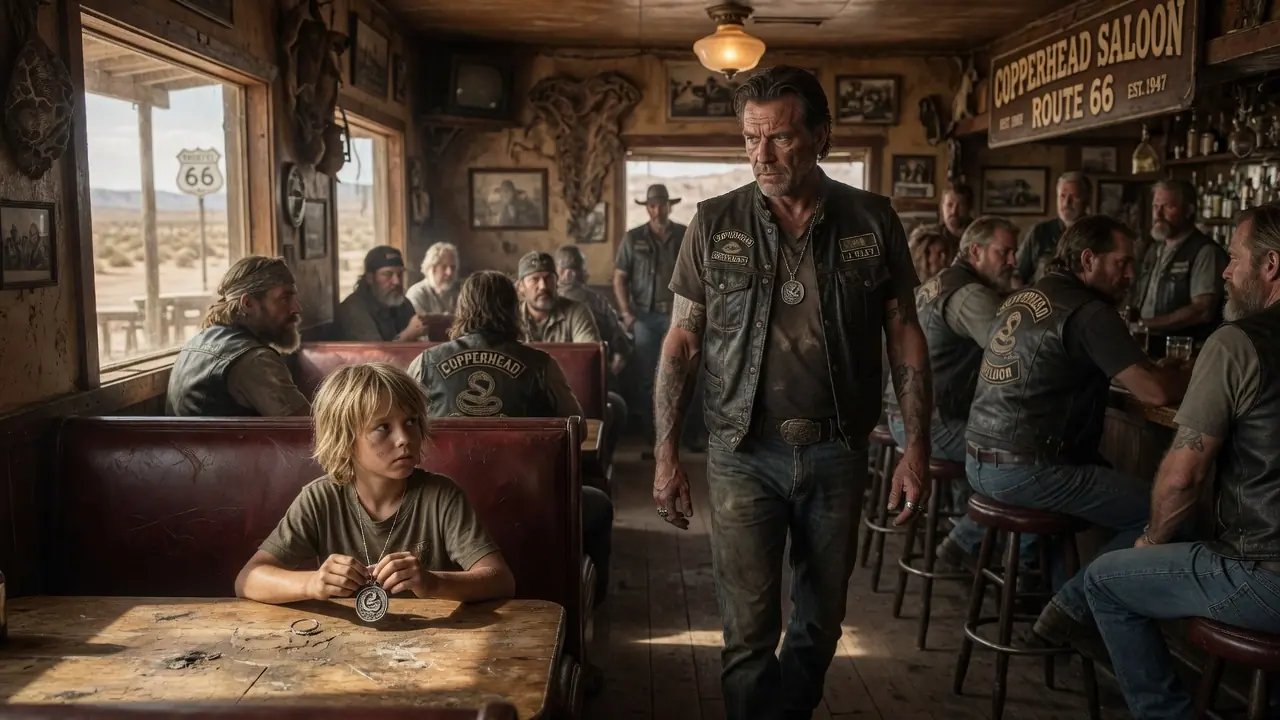
Where did you get that? His voice didn’t rise. It didn’t need to. The question landed like a blade dropped flat on a tile floor. Not loud, just final. Every head in the Copperhead Saloon turned. Every glass stopped moving. Fifty men who hadn’t been quiet since 1987 went absolutely still. And a ten-year-old boy looked up from his booth, silver pendant in his hand, eyes wide, completely unaware that he was holding the reason three men had died, one man had vanished, and an entire brotherhood had carried rage like a stone in their chest for fifteen years.
The Mojave doesn’t forgive anything. That’s what Maggie Carter always said when people asked her why she stayed. Why a woman her age, fifty-three, strong-boned, sharp-eyed, with hands that had poured ten thousand drinks and broken up six actual fist fights, would choose to plant herself in a cinder-block building off a dying stretch of Route 66, surrounded by nothing but heat shimmer and silence and the occasional tumbleweed that looked as lost as everyone else. Because everything out here tells the truth eventually, she’d say. The desert doesn’t let you hide. It just waits. She’d said that so many times it had become almost like a prayer, a habit of the mouth, something she said without really thinking about it anymore.
She was thinking about it now. It was a Tuesday in late July, which meant nothing to the calendar and everything to the thermometer. One hundred seven degrees by noon, pushing past one hundred twelve by three in the afternoon. The kind of heat that didn’t just sit on you, but got inside you behind your eyes, underneath your thoughts, making everything feel slow and thick and slightly unreal. The Copperhead Saloon existed in that heat the way a ship exists in water. Not comfortably, not elegantly, but completely, the way something becomes so embedded in its element that removal would mean destruction. The bar had been open since ten. It would stay open until whenever the last person left, which on Tuesdays was usually Hector, the retired pipeline foreman, who sat at the far end of the counter and nursed the same beer for three hours while watching the small television mounted above the liquor shelf.
Hector never caused problems. He never said much. He tipped exactly twelve percent every single time, which Maggie had calculated precisely enough to know. She didn’t mind Hector. Hector was the kind of regular who made a place feel real. Today, there was also a young couple from Phoenix who’d made a wrong turn and decided to stop for cold water and ended up staying for lunch. There were two truckers in the back booth who knew each other from somewhere else and were catching up in that particular trucker way, loud, full of mileage numbers and fuel prices and complaints about dispatch. There was old Pete at the table near the jukebox reading a paperback western the way he always did, so absorbed in someone else’s fictional desert that he seemed unaware he was sitting inside a real one. And there was Leo.
Leo Pendleton, aged ten, blond-haired, thin-wristed, sitting in the corner booth that Maggie had quietly come to think of as his booth. The one tucked back where the light was softer and the noise from the jukebox didn’t hit you full in the face. Leo had been coming to the Copperhead every afternoon for the past three weeks since school let out and since his mother Dana had started picking up double shifts at the truck-stop diner twelve miles east. Dana would drop him off at eight in the morning when Maggie opened the back kitchen, and Leo would sit quietly and eat whatever Maggie put in front of him and draw in his sketchbook or read or just sit with that particular stillness that children have when they’ve spent too much time around adult grief.
Maggie had known Dana Pendleton for eleven years. Had known her husband Arthur for almost as long. A quiet, careful man who kept other people’s books and had a habit of double-checking his own work even when no one was watching. Arthur had died in February. Heart failure, the death certificate said. Sudden, unexpected, gone at forty-four. Leo had been at school when it happened. Dana had been at work. Arthur had died alone in the kitchen of their small house in Needles, at the table where he did his bookkeeping, with a cup of coffee that had gone cold beside him and nothing left to explain the particular look on his face that the paramedics described later as something between peace and profound relief.
Maggie had not known what to make of that detail when Dana told her. She still didn’t. What she knew was that Leo had not cried at the funeral. He’d stood beside his mother in the small desert cemetery with his hands folded and his eyes dry and a silver pendant gripped in his right fist so tight that when he opened his hand afterward there was a red mark across his palm in the exact shape of the chain. She’d watched him do it. She’d watched him and thought that boy is holding himself together with that necklace. That boy has made that piece of metal into the only thing that’s allowed to know how he really feels. She hadn’t said anything. Some things you don’t say. You just make sure the booth is ready and the orange juice is cold and there’s something warm coming out of the kitchen at noon.
The jukebox was playing something by Merle Haggard. The truckers were arguing about I-40. The couple from Phoenix were sharing a plate of fries and laughing about something on one of their phones. Hector was watching the television. Old Pete was deep inside his paperback. Maggie was wiping down the counter. And Leo was in his booth, sketchbook open, silver pendant in his hands, turning it over the way he always did, not wearing it, not putting it away, just holding it, running his thumb along the edge of whatever was engraved on the back. The way you touch something when you’re trying to remember something the words won’t reach.
The jukebox shifted to something slower, a Waylon Jennings song that Maggie’s own father had loved. And that was the moment. That was the exact moment. Not dramatic, not announced, not preceded by anything except the ordinary turning of an ordinary afternoon when the sound arrived. Not a sound actually, a feeling first. A vibration that she felt in the soles of her feet through the concrete floor. Subtle enough that for three seconds she thought it was a truck on the highway, the kind of heavy rig that makes the ground hum. But it wasn’t stopping. It was growing. And it wasn’t one engine. It was dozens layered on top of each other, building toward something that the word sound didn’t quite cover. It was more like the bar was being swallowed by a living thing, something vast and mechanical and entirely deliberate.
Hector looked up from the television. The truckers stopped mid-sentence. The couple from Phoenix looked at the window. Old Pete didn’t look up from his book. Old Pete had been around long enough. Maggie set down her rag. She walked to the front window and looked through the gap in the beer-sign neon and saw them coming down Route 66. The way weather comes, not fast, not rushing, but inevitable. A column of motorcycles stretching back further than she could see, clearly two by two, perfectly spaced. The kind of formation that isn’t about riding together, but about being seen, about announcing. She counted fifteen before she stopped counting, then kept going with her eyes without the numbers. Twenty-five, thirty more. The patch was visible even through the sun haze in the distance. Even before she could read the words, she knew the shape. The skull, the wings, the particular architecture of a one-percenter club that had been operating in this desert since before she was born. Hell’s Angels.
Maggie had seen them before. Route 66 was their road as much as anyone’s, probably more. They moved through the Mojave the way they moved through everything, like they had been there first and intended to be there last. She had served them in this bar twice in the past decade. Both times had been uneventful. Both times they had drunk their drinks, paid their tabs, and left without breaking anything except the quiet. But this wasn’t two or three. This wasn’t a small group passing through. This was fifty motorcycles pulling off the highway and into her gravel lot, filling every inch of it. The engines cutting one by one in a staggered sequence that sounded almost choreographed, like music ending in sections. The silence spreading from the front of the formation backward until there was nothing left but the tick of hot metal and the crunch of boots on gravel and the low murmur of men organizing themselves.
They came in the way a tide comes in. Not all at once, not in a rush, but steadily filling space from the edges inward, taking up every available position with the efficiency of people who have done this before in hundreds of bars across hundreds of miles of American road. The noise level rose and then paradoxically organized itself. It wasn’t chaos. It was occupation. A careful, total occupation. They were big men. Not all of them, but enough of them. Road-worn and leather-heavy and carrying that particular smell of long-distance riding, exhaust and sweat and sun-heated leather and something else underneath, something older, like the road itself had soaked into them permanently. They ordered drinks with the directness of people who don’t expect to have to repeat themselves. They moved furniture. They claimed space.
Maggie poured. She kept her hands steady. She kept her face neutral. She had learned a long time ago that the worst thing you can do in a room full of dangerous men is look afraid. Not because it would necessarily make things worse, sometimes it wouldn’t, but because fear was a kind of invitation, and she wasn’t in the habit of sending invitations she hadn’t decided to send. She was watching the room the way she always watched it, not staring at any one person, but tracking everything at once. The way a shepherd watches a flock, sensing pressure and movement and the subtle shifts that precede trouble.
When the door opened one more time, everything changed. She knew it immediately. Not because anything dramatic happened, not because the room reacted visibly. She knew it the way you know when a room’s temperature drops. Not from a single indicator, but from a shift in the entire atmosphere, something your body registers before your brain catches up. The man who walked in last was not the largest man in the room. He was not the loudest. He was not wearing anything that visually separated him from the others. Same leather, same patches, same road dust on his boots. He was maybe six-two, blonde, going gray at the temples, somewhere in his middle forties, with a face that had been lived in hard and wasn’t apologizing for it. But he walked through that room differently. The others moved, not dramatically, not with the theatrical parting of a movie crowd, but they moved slightly, subtly, just enough to keep themselves out of his path, out of his immediate space, out of whatever radius surrounded him that everyone in that room could apparently feel and no one had apparently ever needed to announce.
Jackson Riley, she didn’t know his name yet. She would learn it later. What she knew in that moment was simpler and more fundamental. Whoever this man was, he was the reason fifty motorcycles had pulled off Route 66 and into her parking lot on a Tuesday in July. Everything else in the room, every leather jacket, every tattooed arm, every cold drink and loud voice, was context. This man was the sentence. He moved to the bar. He didn’t sit. He stood with both hands flat on the counter and looked at her with eyes that were gray-blue and completely still, the eyes of a man who had learned to keep everything important behind them. Cold beer, he said. Whatever you have on draft. Coming up, Maggie said. She pulled the tap and watched the glass fill and kept her breathing even and did not look at the corner booth. She did not look at Leo. She was very careful not to look at Leo because she had noticed in the three seconds since this man walked in something she didn’t have language for yet, only instinct, sharp and cold as a blade. This man was scanning the room. Not the way nervous people scan. Not the way aggressive people scan. The way a person scans when they have been looking for something for a very long time and have learned not to look like they’re looking.
She set the beer on the counter. He picked it up, drank, set it down, and his eyes kept moving around the room, table to table, face to face, not dwelling, not suspiciously obvious, just cataloging. The way you go through a room when you’ve lost something and you’re retracing your steps, methodical, patient, leaving nothing unchecked. Maggie moved to the other end of the bar. She picked up her rag. She found something to wipe and she started praying. Not to God, particularly, not with words exactly, just that specific desperate formless asking that people do when something is coming and they can’t stop it, praying that the afternoon light wouldn’t do what afternoon light in the Mojave did in this particular bar in this particular corner, that it wouldn’t catch on glass the way it sometimes did and send a beam of neon-colored reflection bouncing off the walls and the tables and whatever surfaces happened to be in its path. She prayed for that. The afternoon light didn’t listen.
The jukebox was midway through something slow and guitar-heavy when it happened. The light, copper and amber from the old Coors sign behind the bar combined with the flat white-gold of late afternoon coming through the front window, hit the beer glass on the counter. Bent, scattered, traveled across the room in a way that should have been invisible. Unremarkable. Just physics doing what physics does. Except it found the silver pendant in Leo’s hands. It hit that small piece of metal at the exact angle needed to send a flash of pure light off the engraved surface. Not a long flash, not sustained, just a single pulse like a signal, like something winking from a hilltop. One second, maybe less. Maggie saw it and she watched Jackson Riley’s head turn. Not quickly, not with the sudden jerk of a man startled, slowly. The way a compass needle turns toward north, not because it’s searching, but because it can’t do anything else. Because north is simply where it points.
His eyes found the corner booth, found the boy, found the pendant, and she watched the color leave his face. She had been tending bar for twenty-seven years. She had watched people receive bad news at her counter. She had watched men learn their friends were dead, their marriages were over, their money was gone. She had watched the full range of what bad information does to a human face. She had never seen anything quite like what happened to Jackson Riley’s face in that moment. It wasn’t grief. It wasn’t anger. It wasn’t quite recognition, though it was the closest of the three. It was something more like the expression of a man who has spent fifteen years building a wall carefully, deliberately, brick by brick, with tremendous effort and at tremendous cost, and has just watched a single crack appear that he knows with absolute certainty is going to bring the whole structure down.
He set his beer glass on the bar. He didn’t take his eyes off the pendant. He started walking toward the corner booth. The room, the whole room, all fifty men plus the truckers plus old Pete, seemed to sense it before they saw it. The noise dropped, not all at once, but sequentially, like lights going out in a building floor by floor, until what remained was the jukebox and then Maggie’s hand finding the plug and the jukebox stopping too. And the silence that replaced it wasn’t empty. It was full, dense, pressurized, the way the air feels before something in the weather makes its decision. Every eye in the room tracked Jackson Riley as he walked toward the corner booth. And Leo, who had been looking at his sketchbook, looked up. He looked up because children always know when something large is moving toward them, even before they can see it. Some animal awareness, some part of the nervous system that was old before language was young. He looked up and he saw the man coming toward him. And he didn’t run, didn’t speak, just held very still the way small animals hold still, the way Leo had been holding still, Maggie realized, for months now. Since February, since the kitchen, since the cup of cold coffee.
Jackson Riley stopped at the edge of the booth. He looked down at the pendant in the boy’s hands. His voice when it came was quiet. Completely quiet. The quietest voice in the room by far, and somehow the only sound in the universe. Where did you get that? Leo’s throat moved. His fingers tightened on the pendant. My dad gave it to me, he said. His voice was small, but it didn’t shake. Maggie felt something fierce and proud move through her at that. It didn’t shake. Your dad, Riley’s voice hadn’t changed in volume or tone. It was the same two words he might have used to confirm a drink order. What’s your dad’s name? A beat. Leo’s eyes moved to Maggie just for a second. The reflex of a child checking with the adult in the room, asking without words, Is this okay? Should I answer? Maggie gave him the smallest nod she could manage. Leo looked back at Jackson Riley. Arthur, he said. Arthur Pendleton.
The silence in the room changed. It had been a held breath before. Now it was something else. Something that had a sound beneath the soundlessness. A vibration that Maggie felt again in the soles of her feet. This time not from engines, but from the collective response of fifty men hearing two words they had not expected to hear in a bar off Route 66 on an ordinary Tuesday in July. Arthur Pendleton. She didn’t know that name yet. She would learn it soon. She would learn exactly what that name meant, what it had meant for fifteen years, what it had cost people, what it had justified, what it had become in the mythology of the men now filling her bar with their held breath and their sudden terrifying attention. What she knew in that moment was simpler. She knew that a ten-year-old boy had just said his dead father’s name. And she knew that something in that name had made Jackson Riley, a man who moved through rooms full of dangerous people the way a stone moves through water, parting everything, fearing nothing, go absolutely still.
He stared at Leo for a long moment. Then he pulled out the chair across from the booth. He sat down. He leaned forward, elbows on the table, and looked at the boy with those gray-blue eyes that weren’t showing anything now except a kind of concentrated attention that was in its own way more frightening than anger would have been. Arthur Pendleton is your father. Not a question, a recalibration. Was, Leo said. He died in February. Another pause, shorter this time. How old are you? Ten. Riley looked at the pendant again, then back at the boy. Can I see it? Leo’s hand tightened. Just once, just for a second. Then slowly, with the particular deliberateness of a child making a very adult decision, he held out his hand, the pendant resting in his open palm. Riley reached across the table and picked it up. He held it the way you hold something fragile or something that matters beyond its physical weight. He turned it over, looked at the back, and Maggie, watching from behind the bar, saw his jaw tighten just slightly, just once, before he composed his face again into something that gave nothing away.
He closed his hand around the pendant. This belonged to my father, he said very quietly. Leo blinked. Your father? Iron John Riley. He said the name the way people say names that have become larger than the person who carried them. President of this club for twenty-two years. He disappeared fifteen years ago. He paused. The same night that your father disappeared with half a million dollars of club money. The silence in the room had weight now. Physical weight. Maggie could feel it against her chest. Leo’s face had gone pale, but his eyes were steady. Those tired eyes that had been tired since February. Or maybe before February. Maybe since he was old enough to understand that his father carried something heavy and never put it down, even at the dinner table, even at bedtime, even when he was supposed to be just a dad.
My father wasn’t a thief, Leo said. His voice was quiet, but it wasn’t asking. Jackson Riley looked at him for a long moment. Son, he said, and there was something in the word. Not softness exactly, but the ghost of something that had once been soft long before the road and the years had worn it down to its current shape. That is exactly what a thief’s son would say. The two truckers in the back booth had gone very still. Old Pete had finally put down his book. Leo looked at the man across from him, and Maggie watched something happen in the boy’s face, watched him make some calculations, some interior decision, the way his father must have made decisions, carefully, double-checking, making sure before he moved, and then he reached into the pocket of his jacket and put something on the table. A small battered notebook, brown cover, water-stained, held together at the spine with a rubber band so old it had lost most of its elasticity and was more habit than function.
He left me more than the pendant, Leo said. Jackson Riley looked at the notebook, then looked at the boy. Outside, the Mojave Desert stretched in every direction, keeping its secrets the way it always had, in heat and silence and the particular patience of things that have been waiting a very long time. Inside the Copperhead Saloon, fifty men held their breath. And Maggie Carter stood behind her bar and felt in the soles of her feet, in the back of her throat, and somewhere deep beneath language the unmistakable sensation of the world preparing to be different than it had been. Something had been sleeping for fifteen years, and a ten-year-old boy with tired eyes and his dead father’s notebook had just walked into the room where it lay.
Nobody in that bar moved. Not one of the fifty men along the walls, not the two truckers frozen in the back booth, not old Pete, who had finally truly closed his book and set it on the table with the careful deliberateness of a man who understood that whatever was unfolding in front of him was more serious than anything inside it. Nobody moved, and the silence had its own texture now, thick and layered and full of history that Leo didn’t know and couldn’t see, the way a room can be full of smoke long after the fire’s out. Jackson Riley looked at the notebook on the table. He didn’t touch it. Not yet. He looked at it the way a man looks at a door he has been standing outside for fifteen years, knowing something is on the other side, having built entire walls of assumption and anger and grief around what he imagined was there, and suddenly confronting the possibility that he imagined wrong.
Where did he keep it? Riley said. In the wall, Leo said. Behind the kitchen baseboard. There was a loose piece. He showed me where it was the week before he died. He paused and something moved behind his eyes, a shadow of the memory, quick and painful. He said if anything ever happened to him, I should get it before anyone else did. He said it was important. He said it was the most important thing I’d ever hold. Riley’s jaw tightened. He knew he was dying. I don’t know what he knew, Leo’s voice was steadier than it had any right to be. I know he looked scared. And I know he hadn’t looked scared since I was really little. That landed in the room differently than the boy probably intended because several of the men along the walls shifted. Not much, not dramatically, but enough. Maggie caught it. She cataloged it. There were men in this room who remembered Arthur Pendleton, who had known him, and the mention of his fear wasn’t landing the way contempt for a thief would land. It was landing like recognition, like something confirmed.
Riley still hadn’t touched the notebook. Open it, he said. Leo shook his head. The room exhaled in surprise. Fifty men and a bartender and two truckers all registered the same thing simultaneously. A ten-year-old boy had just said no to the most dangerous person in the room. And he’d said it without hesitation, without drama, without any apparent understanding of what he was saying. No, or maybe with complete understanding, which was somehow more extraordinary. It’s mine, Leo said. My dad left it to me. Not to you. Riley leaned back in the chair. He looked at the boy for a long moment, and then Maggie would think about this later, would turn it over the way Leo turned the pendant over, examining it from every angle. The corner of his mouth moved. Not a smile, not quite, but something in that direction. Something that had been sleeping longer than fifteen years, maybe. You have his eyes, Riley said quietly.
Leo didn’t respond to that. Your father and I, Riley said. And then he stopped. He looked at the table. He picked up his beer and drank and set it down again. And when he looked back up, his face had reconfigured itself into something more careful. Your father and I knew each other a long time ago. I know, Leo said. Riley went still. What do you know? I know you were looking for him. Leo’s hands were flat on the notebook now, both palms down, like he was making sure it wasn’t going anywhere. He told me, not with words, but he kept a picture in the same place as the notebook. A picture of a bunch of men at a table, and he’d written names on the back. He paused. Your name was one of them. The silence shifted again, like a tide moving, like something large adjusting its weight.
He kept a picture, Riley repeated. Yeah. Of us. Of some of you. Riley was quiet for a moment. Then, was he happy in that picture? It was such an unexpected question that even Maggie felt it land somewhere soft and unprotected. Not the tactical question of a man building a case. The genuine, helpless question of a man who had been angry for so long he’d forgotten that underneath the anger was something else. Something that wore the angry thing over it like armor. Leo thought about it seriously. He gave it the weight it deserved. He looked younger, he said finally, like he didn’t know yet. Didn’t know what, whatever it was that made him look the way he looked the week before he died. That was when the first man spoke up from along the wall. He was big, bigger than Riley, broader, with a beard going gray and a face that had been hit enough times to stop apologizing for it. He pushed off the wall and took two steps forward and his voice came out like gravel sliding down sheet metal. Bull, he used the name like a warning. We letting this go? The kid walks in here with John’s token and we’re just talking.
Riley didn’t turn around. Sit down, Decker. That token was on John’s body when they buried him in whatever unmarked. Sit down. The voice hadn’t risen. It had dropped, actually gotten quieter, gotten denser, the way pressure works when it has nowhere to expand. Decker stopped. He didn’t sit, but he stopped. In the two feet of distance he’d covered was suddenly the entirety of the territory he was going to claim in this conversation. Riley turned back to Leo. The man behind me is angry, he said with the calm directness of a man who had been translating dangerous situations for children, or maybe just for everyone, for a very long time. He’s been angry for fifteen years. He’s not going to hurt you, but you need to understand something. He leaned forward. What you’re holding isn’t just your father’s. It’s connected to something that cost a lot of men a lot of years.
Leo looked at him. Then you should probably know the truth, the boy said. Something moved through the room like electricity through water. Decker made a sound that wasn’t quite a laugh. Kid thinks he knows the truth. Kid wasn’t born yet when the truth was still relevant. The money, Leo said. Just those two words, flat, certain, like he’d practiced them. Dead silence. The money is still there, Leo said. Nobody breathed. Not Riley, not Decker, not the fifty men packed into the Copperhead Saloon on the worst and most important Tuesday any of them had ever spent in a bar off Route 66. Not Maggie, who had stopped pretending to wipe the counter and was just standing there with her hands still, watching a ten-year-old boy drop a grenade into a room full of men who had been looking for it for fifteen years.
Decker was the first one to speak, and his voice had changed. The heat had gone out of it, and something colder had moved in, something more calculating and therefore more frightening. What did you just say? I said it’s still there, Leo repeated. My dad didn’t spend it. He didn’t take it. He hid it. He looked at Riley, not at Decker, at Riley. That’s what the notebook is. It’s directions. Riley looked at the boy for a very long moment. Something was happening behind his eyes. Maggie could see it. That slow internal motion of a man dismantling something he built with enormous effort, examining the foundation underneath, finding it different than he expected. Why would you tell us this? Riley said. Because it doesn’t belong to me, Leo said. And because my dad wanted me to give it back. He paused. That’s what he said. He said, When you’re old enough, find the people who it belongs to and give it back. He said it was the only thing left that he could do right.
Decker made a sound like he’d been hit. Not physically, something worse. The sound a man makes when an anger that has structured his entire internal world suddenly loses its foundation. He’s lying, Decker said. But his voice didn’t have the same conviction it had two minutes ago. He’s a kid. He doesn’t know what he’s saying. He sounds like he knows exactly what he’s saying, one of the other men said from along the wall. Young voice. Maggie couldn’t place the face. But the voice was careful and the men around it seemed to give it space. Another person in this room whose opinion carried weight. Tommy, don’t, Decker said. I’m just saying what everyone’s thinking. No one is thinking anything until we know more, Riley put his hand out flat without turning around, a gesture so habitual and so apparently effective that both men stopped immediately. Then he looked at Leo. Your father told you about the money. Yes. He told you it was still there. He didn’t tell me exactly where. That’s in the notebook. Leo looked down at his hands, then back up. He didn’t want me to know in case anyone came looking. He said it was safer that way. He said the only thing he could protect me with was not knowing.
Smart man, Riley said. Something in the way he said it was complicated. Not quite admiration, not quite grief, not quite the residue of anger. Something that had all three in it and had learned to coexist with all three the way a scar has pain and healing both written into it. He was terrified, Leo said, and his voice finally cracked just slightly, just once, like a fault line showing through stone. Every day. I didn’t understand it when I was little. I just thought that was how dads were. That dads looked at doors when they opened. That dads sat with their backs to walls. That dads woke up at three in the morning and went and sat in the kitchen alone. He swallowed. I understood later. He was waiting. Not for something good. The room was completely quiet. Maggie realized she had stopped breathing at some point and didn’t know when.
Riley looked at the boy and something in his face was doing something it clearly hadn’t done in a long time. Something it was working hard to do and not quite sure of the mechanism anymore. His eyes were still, but they were still in the way that very deep water is still, full of movement underneath that never breaks the surface. He was waiting for us, Riley said. Yes. For fifteen years. Yes. A long pause. He never ran, Riley said. And this time it wasn’t a question or a statement. It was something a man says when he is reorganizing everything he knows about another man. He stayed in the desert. He stayed close. He never changed his name. He exhaled. We could have found him. If we’d looked. He counted on that, Leo said. That’s in the notebook, too. He says he wrote that the only thing keeping him safe was the money, because you needed what he knew and he needed you to need it enough to not. Leo stopped. The fault line again, wider this time. To not just end it.
Decker sat down. Not gracefully, not voluntarily exactly, more like his legs made a decision without consulting the rest of him. He found a bar stool and sat on it heavily and put both hands on his knees and stared at the floor. From the back of the room came the sound of someone setting a glass down hard on a table. Not violently, just heavily. The sound of weight being put down. Show me the notebook, Riley said. Leo looked at him. Please, Riley said. And the word cost him something. Maggie could see it cost him something. A man like that saying please to a ten-year-old in front of fifty of his own people. But he said it. He said it and he kept his eyes on Leo and he waited. Leo picked up the notebook. He held it for a moment. Then he took the rubber band off carefully, slowly, the way you do something for the last time. And he opened it.
The pages were dense. Small handwriting, cramped and slanted, the writing of a man who had been putting thoughts down fast as if afraid of running out of time or out of paper or out of courage. Some pages were dated, some weren’t. Some were in pencil so old it had faded to a pale ghost of itself. Some were in ballpoint so heavy it had scored the page like a wound. Riley looked at the open notebook. He didn’t take it. He just looked. Read me something, he said. Leo looked down at the pages. He turned past the early ones, months, maybe years of writing, moving through it with a familiarity that told Maggie he had read it before, more than once, possibly many times in the corner booth or at the kitchen table or in the dark after his mother thought he was asleep. He found a page near the middle and stopped. He read. His voice was quiet but steady. That same steadiness that had been there from the beginning. The steadiness that came not from the absence of feeling, but from practice, from a child who had learned to carry weight by doing it.
October fourteenth. I watched a car slow down outside the school today and I lost ten years off my life before I saw it was just a parent. I need to stop this. I need to find a way to live inside the choice I made or it’s going to kill me slower than they would have. John knew this would be hard. He said, Whatever you do, don’t come back empty-handed. The money doesn’t matter. He said, The truth of it matters. I need to survive long enough for the truth to matter. Riley closed his eyes. Just for a second. One second. Then they opened again, and they were the same gray-blue and steady. But something had moved behind them. When did he write that? he said. Eleven years ago, Leo said. Riley stopped. I wasn’t born yet, Leo said. He was already doing this before I was born. A pause. He spent my whole life like this. Decker made a sound from the bar stool. A low sound from deep in his chest. The kind of sound that has no name in English but every person in a room full of people who have loved and lost and lived with anger too long knows exactly what it means.
Riley looked at the notebook for a long moment, then at the pendant still in his closed fist. He opened his hand and looked at it lying there on his palm, small, silver, engraved on the back with something Maggie still couldn’t read from where she stood. What does it say? she said, and she didn’t mean to say it out loud, but the room was quiet enough that it carried. And Riley looked up at her without surprise, like he’d been aware of her standing there the entire time. He looked back at the pendant. Keep the faith, he said. The club survives its kings. His voice was low. Even. My father had it made after his first time in federal prison. He gave it to every man he trusted. Absolutely. There weren’t many of them. He closed his hand around it again. I watched him bury this with my own hands fifteen years ago in a grave we dug ourselves because we couldn’t report what had happened. He looked at Leo. There was no body.
The room understood what that meant, or thought it did. Leo looked up from the notebook. Mr. Riley, he said. Bull, Riley said automatically. Then, Jackson. You can call me Jackson. Jackson, Leo said the name carefully, like he was making sure it fit what he was looking at. My dad wrote about your father. I know. He wrote a lot about him. I assumed. He didn’t write about him like he was afraid of him, Leo said. He wrote about him like he respected him. Like he was someone he would have done anything for. The room went very, very quiet. Not the held-breath quiet of before. This was different. This was the quiet that comes after something structural shifts, after the ground moves, after the first crack appears in a wall you built your entire life against. The quiet of reorientation, of men who have known one story for fifteen years beginning to understand in the cells of them before the words reached their brains that the story might have been wrong.
Decker raised his head from where he’d been staring at the floor. He looked at Leo. His face was doing something complicated and unguarded that Maggie suspected it hadn’t done in front of other people in a very long time. Kid, he said. His voice was rough. Not hostile anymore. Just rough, the way wood is rough when it’s been exposed to weather for too long. Your father, he stopped, swallowed. Your father was the best numbers man I ever saw in my life. I watched him catch a six-cent error in a forty-thousand-dollar ledger in under two minutes. He paused. I’m not saying that to, I’m just saying. He looked away. I’m just saying I knew him before. Leo looked at the man who had been, two minutes ago, the most frightening thing in the room. He talked about people from before, Leo said. He never said names, but he talked about them. He’d say things like, There was a guy who could fix any engine you put in front of him. There was a guy who could tell if food was off before he even tasted it. There was a woman who kept bees on the roof of a building. And he stopped, looked at Decker. Was that you? The engines?
Decker stared at him. Then he laughed. It was a short laugh, sharp and involuntary. The laugh of a man ambushed by something, but it was real. It was completely real. No, he said. That was Paulie. Paulie Marsh. He stopped. Something moved through his face. Paulie died in 2009. I’m sorry, Leo said. And he meant it. Maggie could hear that he meant it. A ten-year-old boy offering condolences to a grieving biker for the loss of a man he’d never met, only heard about through his father’s careful, nameless stories told in the dark of a small house in Needles by a man who spent fifteen years missing the people he was hiding from.
Riley stood up. The room’s attention reorganized immediately, everyone tracking him. We need to read the notebook, he said. He wasn’t talking to Leo. He was talking to the room, to his people, in the voice of a man accustomed to conclusions landing as decisions. Then he looked at Leo. All of it. Together. Tonight. He paused. With your permission. Leo looked at him. There’s a condition, the boy said. Riley waited. My aunt stays, Leo said. Maggie stays. Whatever you find out, she hears it too. He looked toward the bar, toward Maggie, and his face was still and serious. And underneath the seriousness was what had always been underneath it from the very first afternoon she’d watched him sit in that booth and hold his father’s pendant and be ten years old and carry something no ten-year-old should carry. Trust. A careful, conditional, hard-won trust directed at the one person in this room who had kept his orange juice cold and his booth ready and never once asked him to explain the weight on him.
Deal, Riley said. He looked at Maggie. I hope you have coffee. I have coffee, Maggie said. Her voice was steady. She was proud of that. And I’m going to need someone to explain to me who Iron John Riley was. That, said a voice from the back of the room, the young one, Tommy, whoever Tommy was, is going to take a while. Good, Maggie said. I’ve got time. She started the coffee. And outside, the desert waited the way it always waited, patient and enormous and holding its own secrets with the particular grip of something that has never been in a hurry. Because the desert has always understood what the people passing through it take lifetimes to learn, that truth doesn’t expire. It just waits for someone willing to go looking.
The notebook lay open on the table and fifty men and one bartender and one ten-year-old boy were about to find out whether what they found inside it was liberation or catastrophe. They were about to find out those two things were not always different. Maggie set the first pot of coffee on the counter and nobody moved to get it for a full thirty seconds, which told her everything she needed to know about where everyone’s head was. Then Tommy, the young voice from the back, twenty-something, with a face that still had some softness in it that the road hadn’t finished working on yet, came forward and poured two cups without being asked and brought one to Riley and one to Leo. And the small act of it, the normalcy of it, seemed to give the room permission to breathe again.
Riley opened the notebook to the first page. He read it the way you read something you’re afraid of, slowly, carefully. The way you disarm something if you weren’t entirely sure it was safe. His eyes moved down the page and his face gave nothing away. But his right hand, the one not holding the notebook, was flat on the table and pressing down slightly, like he needed the anchor. Nobody talked. The room had reorganized itself in the last twenty minutes from an occupation into something stranger and more complicated. Men who had ridden in ready for confrontation were now sitting on bar stools and pulled-up chairs and the edges of tables, arranged in a loose half-circle around the corner booth, with the focused, involuntary attention of people gathered around something they can’t look away from. Even the two truckers had given up any pretense of minding their own business. Old Pete had moved his chair three feet closer and wasn’t pretending he hadn’t.
Maggie stood at the end of the counter nearest the booth, close enough to hear, far enough to give the thing its space. Riley read for four minutes without stopping. Then he stopped. He set the notebook on the table face down, spine up like a tent. October third, 2008, he said. His voice was even. Your father writes that he counted the money for the eleventh time that year, that it was still all there, every dollar. He looked at the table. He counted it every year. I didn’t know that, Leo said. He writes that he was afraid it would start to feel like his. That was his specific fear. That living next to it long enough, he’d start to think of it as his. Riley looked up. That is not the journal of a man who stole.
From the wall, a man named Cruz, fifties, quiet, who hadn’t spoken once since they’d arrived and whose silence had therefore carried its own kind of authority, said, Read the part about the night. Riley looked at him. You found it, Cruz said. I can see it in your face. Read it. Riley looked back at the notebook. He picked it up, turned pages, found something, and stopped. And the change in his body was subtle but total. A slight forward lean, a stillness in the shoulders, the physical attitude of a man receiving information he has been waiting for without knowing he was waiting. He read it silently first, just his eyes moving, just that. Then Decker said, Out loud, Bull. We all waited fifteen years.
Riley looked up at the room. All of it. Every face. And then he read. November ninth, 2008. Fifteen years today. I need to write it again because I need to make sure I never forget the exact truth of it. Not the version my guilt has made, not the version my fear has shaped, but the actual sequence of what happened, because John deserves to have someone remember it correctly. Even if that someone is only me. Riley paused, just one beat, then continued. There were ten of them. Not three, not five. Ten. Federal informants and two actual agents. And they had been following the money for six months. And the night we were moving it was the night they chose. John knew before I did. He always knew before I did. He said, Arthur, take the box. Take the bikes. Do not stop. Do not come back. I said I wasn’t leaving him. And he hit me.
Another pause, longer. He hit me hard enough to put me down for a few seconds. And when I got up, he was already between me and them. And he said, This is a direct order. You ride. You hide it. You keep it safe until the club can take it back clean, without federal hands on it. You wait for my son to come find you. Riley’s voice had changed. Not dramatically, but something had happened to the edges of it. Something that had nothing to do with performance. I rode. I heard the shooting start when I was fifty yards out. I heard it and I kept riding because he told me to and because I was a coward and because I was following orders. And I have never in fifteen years been able to decide which one of those three things is most true.
The room was absolutely silent. Leo was looking at the table. Maggie realized her hand was over her mouth and she didn’t know when she’d put it there. Decker had both elbows on his knees and his face in his hands and he wasn’t moving. Riley set the notebook down. He didn’t put it face down this time. He left it open like closing it would be a kind of disrespect. Tommy said very quietly from across the room, He wasn’t a coward. He followed an order. He spent fifteen years deciding whether that was the same thing, Riley said. Apparently it’s not the same thing, Cruz said from the wall. Flat. Certain. The voice of a man who has thought about the gap between cowardice and obedience enough times to have an answer that doesn’t waver. It is not the same thing. Riley looked at him. No, he said. It’s not. He looked back at the notebook. He knew that. I think he knew that. I don’t think he believed it, but I think he knew it.
Leo looked up. He believed it at the end, Leo said. He said the last month he was different. He’d been, I don’t know how to explain it. He’d been somewhere inside himself for my whole life, somewhere you could see him but couldn’t quite reach him. And the last month he came back. He was present. He looked at me when I talked. He laughed at things. He paused. I thought it meant he was getting better. I thought his heart condition was improving. Nobody said anything to that. There was nothing to say to that. He knew he was dying, Riley said. Not a question. He’d said it before, but it meant something different now. I think he decided, Leo said. The word landed hard. Decided. The room absorbed it. Maggie thought of Arthur Pendleton’s face in the paramedic report, that expression described as something between peace and profound relief. She thought of a man who had spent fifteen years carrying something no human being was built to carry and who had at the end found a way to set it down. She thought about how sometimes relief and grief were exactly the same face.
Riley stood up abruptly. The chair scraped and several men reflexively straightened, hands moving, old trained responses kicking in. I need air, he said to nobody in particular. To everyone. He walked to the front of the bar and pushed through the door and was outside. The room held for three seconds. Then Decker stood up and followed him. Then Cruz, then Tommy. One by one, men peeled away from the walls and filtered out, not in a rush, not in a crowd, just quietly, the way people move away from something that needs space. Maggie looked at Leo. Leo was looking at the empty chair across from him where Riley had been sitting. You okay? she said. He thought about it genuinely, the way he did everything. I think so. A pause. Is he? Maggie looked at the door. I don’t know yet, she said honestly. She poured him a glass of orange juice and set it in front of him and let the quiet sit for a few minutes, which was its own kind of answer.
Outside she could hear them, not words, voices, the low register of men processing something in the way men do, which is usually standing close together and not talking about the thing directly and somehow talking about nothing else. When Riley came back in twelve minutes later, he looked like a different phase of the same thing. Not resolved, not healed, but reorganized, like a storm that has found its direction. His eyes found Leo immediately. He sat back down. He picked up the notebook. There’s more, he said. I know, Leo said. The coordinates. Turn to the last four pages, Leo said. He told me they were there. He said he said that’s where everything physical was. He said the words to understand them were in the middle section, but the location itself was at the end. Riley turned pages, reached the back, read and read, and his face went through something that took maybe ninety seconds from start to finish and covered more emotional ground than most faces cover in a year. First the controlled blankness of a man reading and processing simultaneously, then something tightening, then something releasing. Then a specific expression Maggie had no exact name for. It was the face of a person who has been punishing themselves and someone else with the same fist for fifteen years and has just realized both the punishment and the crime were built on a foundation that never existed.
He looked up. Anvil Rock, he said. Three men along the wall reacted to that, physical reactions. A sharp breath, head coming up, a hand dropping from a folded-arm position. You know it, Riley said. He wasn’t asking. That’s where we were supposed to meet him, Cruz said. His voice had changed. Rough at the edges now, something old and cracked working its way through the careful surface. The night it happened, that was the rendezvous point. He never showed. He showed, Riley said. He just didn’t. He couldn’t get back to us after. How far out? Decker said. Forty minutes from here, maybe forty-five. The room moved. Not chaotically, not all at once, but with a purpose that was sudden and total. Men pushing off walls, finishing drinks or setting them down unfinished. The creak of leather and the clink of keys. The room reorganizing from gathering into departure.
Wait, Leo said. Everyone stopped. He was standing up, notebook in his hands, small and blond and ten years old, and holding the room with nothing but the quality of his stillness, the same quality that had stopped Riley in the first place, this child’s particular gravity. I want to come, he said. Riley looked at him. No, he said. He’s my father, Leo said. Whatever’s out there is connected to my father. I’m the one who brought you here. I’m the one who kept the notebook. I have a right to. Leo. Riley’s voice was quiet. I hear you. And I’m telling you no. Not because you haven’t earned it. Because whatever is out there, a child should not be the one who finds it. He held the boy’s gaze steadily. Things you can know about without seeing. The knowing is enough. The seeing stays with you longer than you want it to.
Leo looked at him for a long moment. Will you tell me? he said. Whatever you find, will you come back and tell me? Yes, Riley said without hesitation. I will come back and tell you everything. Something in Leo’s face settled. Not happily, this wasn’t a happy moment, but settled, the way something settles when it’s found the right place to be. He held out the notebook. Riley took it. And then Leo reached into his jacket pocket and held out something else. Small. Silver. The pendant. The one Riley had set on the table. The one Leo had picked back up without anyone noticing. Take this too, Leo said. In case. In case there’s a reason to have it there. Riley looked at the pendant in the boy’s palm. He picked it up, put it in his breast pocket, close to the body, the natural place for something that matters. Stay with your aunt, he said. I will.
Riley looked at Maggie. There was a whole conversation in that look. A conversation about what he might find and what it might mean and what he was asking her to hold together while he was gone, which was not just a bar and not just a boy, but the specific fragile moment of a truth that hadn’t finished arriving yet. I’ll be here, she said. He nodded once. Then he turned and walked out, and fifty men followed him, and the sound of fifty engines starting was the loudest thing the Copperhead Saloon had heard all year. And then it was fading, moving east into the desert dark, and then it was gone.
The bar was suddenly enormously quiet. Old Pete cleared his throat. You know, he said to no one in particular in the voice of a man who reads westerns and understands the genre, I have had some interesting Tuesdays, but this one is going to take some beating. One of the truckers laughed, a short compressed sound that released something in the room, just barely, just enough. Maggie went around the bar and sat down in the booth across from Leo. She didn’t say anything. She just sat, the way she’d sat with Dana when Arthur died. The way you sit with someone when there is nothing useful to say and presence is the only honest offering. Leo was looking at the door. What if it’s not there? he said. What do you mean? What if my dad was wrong about what he remembered? It was a long time ago. What if the location is wrong? Or what if someone else found it? Or what if he stopped himself? He was so careful. He was careful about everything, but he was also scared for fifteen years. And scared people make mistakes.
Maggie thought about it. Your father counted that money every year, she said. For fifteen years. He was still checking, still confirming. A scared man who’s also that careful. That’s not someone who misremembers coordinates. Leo was quiet. He wrote in that notebook that keeping it safe was the only thing he could do right. Maggie said. A man who feels like that doesn’t get sloppy about the one thing he’s holding on to. She looked at the boy. He did his job, Leo. He did it for fifteen years alone, without any credit, without anyone knowing. He did it even knowing that when people finally found out, they might not believe him. She paused. He did it right. I think you know that. Leo looked at the table. Then he looked up at her. He talked about the desert in the notebook. He said, not the coordinates part. Earlier. He wrote about how the desert doesn’t change, how he could come back after years and the same rock was still in the same place and the same roads were still the same roads. He wrote that it was the one thing he trusted. He paused. He said the desert keeps what you put in it.
Maggie felt something move through her, through her chest, up her throat, settling behind her eyes in that specific way that was not quite tears but was closely related. Your father was a good man, she said. I know, Leo said quietly. I just needed other people to know it, too. They sat in silence for a while. The coffee was still hot. The jukebox was still unplugged. The Copperhead Saloon existed in a particular stillness that had nothing to do with quiet and everything to do with the specific breathless quality of a story in its final turn. Forty minutes east, somewhere in the dark of the Mojave, fifty men with shovels and fifteen years of wrongful anger were riding toward a hole in the ground and whatever truth it contained. Maggie didn’t know what they would find. She knew what Arthur Pendleton had spent his life hoping they would find. She looked at Leo, who was looking at the door, who had his father’s careful eyes and his father’s particular stillness. And she thought, this boy has been carrying a dead man’s reputation on his ten-year-old shoulders since February, and before February in ways he didn’t even know. And tonight that weight was either going to be confirmed or lifted.
She reached across the table and put her hand over his. He didn’t pull away. He turned his hand over and held on. And in the booth where he had sat every afternoon for three weeks, drawing in his sketchbook and drinking his orange juice and turning his father’s pendant over and over in his hands like a question he was trying to answer, Leo Pendleton held his aunt’s hand and waited for the desert to give back what it had been keeping.
The Mojave held its breath the way it always did when the truth was close. They rode in formation, but nobody was keeping track of the formation anymore. That was the first sign that something had fundamentally changed in the architecture of this group. Fifty men who had ridden in perfect two-by-two military precision down Route 66 three hours ago were now spread out across the desert road in a loose, urgent column that had abandoned ceremony for speed. Riley was at the front and he was pushing the pace harder than was strictly safe on an unlit highway at night, and nobody complained and nobody fell back. Decker rode two positions behind him. He hadn’t said a word since they left the bar. He had that specific silence that Cruz recognized from twenty-three years of riding beside him. Not the silence of a man with nothing to say, but the silence of a man who has too much happening inside to let any of it out yet, who is holding himself together by keeping his mouth shut and his hands on the bars and his eyes on the road ahead. Cruz understood. He was doing the same thing.
The notebook was in Riley’s inside jacket pocket, pressed against his chest beside the pendant. And he was aware of both of them the entire ride, their weight, their presence. The way two small objects could carry the mass of fifteen years of wrong believing. He’d read the critical pages three times before he left the bar. He had them memorized now, the way you memorize something that rewrites you, not by effort, but by impact. The words cutting channels in you that fill immediately and permanently. He knew what the coordinates pointed to, not just the location, Anvil Rock, which he’d known since he was seventeen years old and his father had taken him out there for the first time and shown him the desert the way another man might show a son a cathedral. He knew the specific spot, northeast face, forty feet from the base, where a natural shelf of rock created an overhang that shed water and kept the ground beneath it drier than the surrounding terrain. His father had shown him that spot specifically, had said, Remember this. Riley had been seventeen and hadn’t understood why. He was forty-four now, and his hands tightened on the handlebars because understanding arrives sometimes like a physical thing, like something pressing against your sternum from the inside. His father had known. Not that night specifically, not the ambush, not the timeline, but Iron John Riley had been a man who understood that the life he lived created enemies with patience, and he had spent twenty-two years as president creating contingencies so instinctively that some of them he hadn’t even told his own son about. He had shown a seventeen-year-old boy a specific place in the desert without explanation, trusting that the boy would become a man who would one day need to know it. The man became. The knowing came. Just fifteen years late. Riley pushed the throttle harder.
The desert on either side was dark and vast and indifferent in the way that only the Mojave can be indifferent. Not hostile, not welcoming, just ancient and enormous and entirely unimpressed by the urgency of human affairs. Stars were out in numbers that you only see this far from city light. So many of them that the sky had depth, layers, the universe showing its actual scale in a way that should have been humbling. But tonight it felt instead like witness, like something paying attention. Tommy was riding near the back of the column, and he was the youngest man there by six years, and he had joined the club twenty-two months ago and had therefore inherited the mythology of Iron John and Arthur Pendleton as history rather than living memory. He’d heard the story the way young members heard all foundational stories, around fires, at tables, with the reverential and slightly embellished quality of legend. The traitor bookkeeper. The missing president. The half million dollars that walked out of the club’s hands in the dark. He had never questioned it. Why would he? The men who told it had lived it. The anger in their voices when they told it was real anger, which meant the wound was real, which meant the story was real. Now he was riding toward the answer to a question he hadn’t known was a question. And the feeling in his chest was something he didn’t have a category for yet. Something between the floor dropping out and something new coming up through the gap. He thought about Leo, the boy in the booth, the ten-year-old with his father’s notebook and his father’s careful eyes who had walked into a room full of men armed with fifteen years of wrong and had not flinched. Had said, My father wasn’t a thief. Had said it not as a plea but as a fact. The way you state facts you are certain of. Tommy thought, I want to be that sure of something someday.
The turnoff for Anvil Rock came up on the right and Riley took it without slowing down enough and the gravel sprayed and the column followed him through it, and for two miles they rode the dirt access road with their headlights cutting the dark and the dust rising behind them like something being stirred awake. And then Riley stopped. He stopped and cut his engine and one by one in sequence fifty engines died and the silence that replaced them was so sudden and so total that it had physical presence, like a wall you’d ridden into. Nobody spoke. Riley dismounted. He reached into his saddlebag and pulled out a short-handled spade, the kind of tool that men who spend time in the desert keep without necessarily examining why too closely. He looked at it for a second. Then he started walking. He knew exactly where he was going. The other men followed with their own lights, their phone flashlights and the two proper lanterns that Decker had produced from somewhere, and they moved in the dark toward the northeast face of Anvil Rock. And the only sounds were boots on hard ground and the distant faint sound of something moving in the dark that was almost certainly nothing and felt like everything.
Forty feet from the base. The natural shelf. Riley stopped. He looked at the ground. The desert didn’t advertise what it held. That was the whole point. Fifteen years of weather and wind and the patient ongoing work of the Mojave to erase evidence of human intervention had done their job well. Nothing looked disturbed. Nothing looked placed. It looked exactly like every other square foot of desert floor in every direction. But Riley had stood here before, thirty years ago, with his father’s hand on his shoulder. And the body remembers what the mind has been told to forget. He put the spade in the ground. The first shovel of dirt came up, and then another. He didn’t ask for help. For the first eight minutes he dug alone. And nobody offered, understanding without being told that this particular act of excavation belonged to him first. That whatever was down here was connected to him by blood and history and fifteen years of carrying a grief that had been wearing anger’s clothes. He needed to be the first one to reach it the same way you need to be the one to answer the phone when you know who’s calling.
Then Decker stepped forward. He didn’t say anything. He just picked up the second spade, someone had quietly produced it from a saddlebag, and started digging beside Riley. And Riley looked at him sideways for one second and then looked back at the ground. And that was that. Two men digging, then Cruz on the other side, then Tommy, who didn’t have a spade and used his hands for three minutes until somebody gave him one because Tommy was the kind of man who would use his hands rather than stand and watch. The rest of the fifty stood in a loose circle, their lights pointed inward, holding the perimeter of the light the way you’d hold something important. Nobody talked. The work was the talking. Fifteen minutes in, Decker’s spade hit something that wasn’t rock and wasn’t root and wasn’t any of the other things the desert puts underground. A dull, flat impact with a slightly hollow resonance. Metal. Not thin metal. Thick metal. Container metal. The sound of something built to hold something and hold it for a long time. He stopped. Everyone stopped. The silence had a different quality now. Not the held-breath quiet of waiting. The stopped-heart quiet of arriving.
Riley crouched down. He used his hands from here, pushing dirt away from the edges of what was slowly revealing itself, a military-style lockbox, olive drab, approximately two feet by eighteen inches, sealed with a mechanism that had been designed for conditions exactly like this one, which was to say designed to survive being buried in the Mojave Desert for an indeterminate number of years by a frightened man with a direct order and nowhere else to put his faith. The box had survived. Riley cleared the last of the dirt from the lid. He gripped both handles. He looked at it. John, he said. One word. Just the name. Said the way you say the name of someone you have been missing for so long that the word for the missing has lost its shape and become something else, something without a clean English equivalent, the particular ache of an absence that has been present for so long it has become a kind of presence itself. He lifted the box out of the ground. It was heavy, heavier than the money alone would account for. He set it on the ground. He worked the lock mechanism, old, resistant, gritty with desert, and felt it give after three attempts. And then he opened the lid.
The money was there. Bundled. Banded. Wrapped in heavy plastic sheeting that had done its job with the thoroughness of something Arthur Pendleton had done, which was to say perfectly, with every contingency accounted for, every variable considered, the work of a meticulous man who understood that he was not wrapping money for a week or a month but possibly forever and had acted accordingly. Half a million dollars, fifteen years old, pristine. But Riley wasn’t looking at the money. He was looking at what was beside the box. Because the notebook’s last page had included something he hadn’t read aloud in the bar. Something he had read and then looked at the ceiling for a moment before closing the notebook and putting it in his pocket. Something he had not told anyone yet, not even Decker, because he needed to see it first. Needed to confirm it with his own eyes before he let it become real in the room. Arthur’s last entry, written three weeks before his death, in handwriting that was shakier than the earlier entries, the handwriting of a sick man writing carefully. There is something else at Anvil Rock, northeast face, under the shelf. I put it there the morning after. I couldn’t leave him in the open and I couldn’t bring him home and I couldn’t tell anyone where I was going. So I went alone with a shovel in the dark and I did what I could do, which wasn’t enough and was everything I had. I marked it. He would have hated anything elaborate. So I just put a flat stone. If Jackson finds this, if Jackson is reading this, your father died fighting. He was standing when it happened. I need you to know that he was standing and he did not run. And the last thing he said was my name, which I think was the order completing itself, which I think was him making sure I was already gone. He was standing.
The flat stone was eighteen inches to the left of the lockbox. Riley had seen it when he crouched down, had registered it, had understood it in that part of him that understood things before he was ready to understand them. He stood up now. He took one step to the left. He stood over the flat stone. Fifty men waited. The desert waited. Riley crouched down again. He put both hands on the flat stone and moved it. And beneath it, the ground was different. Not excavated differently, not obviously disturbed, just different in the way ground is different over something that has been given back to it. The desert had accepted what Arthur had put there. Had held it the way it held everything, without judgment, without ceremony, with perfect absolute faithfulness. Dig here, Riley said. His voice was steady. Completely steady, which was the most controlled thing Maggie would have thought possible if she’d been there to hear it. Carefully. Tommy was the one who did it. Nobody planned that. Nobody assigned it. It just happened the way things happen in groups when everyone understands instinctively who should do what. Tommy, the youngest, the one who had only inherited the myth, using his hands because he had already established that he’d use his hands rather than stand and watch, carefully moving soil from a place that had been undisturbed since a grieving man with a shovel had been there alone in the dark doing the only good thing he could think of left to do.
Two feet down, Tommy stopped. He sat back on his heels. He looked up at Riley and the look on Tommy’s face, young Tommy who hadn’t been born when Iron John Riley had become a legend, who had only known the story, the myth, the anger, that look said everything that needed saying before a word was spoken. Riley came forward. He crouched beside the hole. What Arthur Pendleton had wrapped in heavy canvas and leather, what he had placed in the desert floor with the care of a man performing a rite he hadn’t been taught but understood instinctively, what he had marked with a flat stone and protected with fifteen years of deliberate misdirection and isolation and fear, it was still here. The leather had the patches even under fifteen years of desert, through the canvas and the deterioration and the weight of time, the Hell’s Angels patch was visible, its shape, its specific unmistakable architecture. Iron John Riley had not been abandoned in some unknown place. He had not been left for the desert to take anonymously. Arthur Pendleton, the supposed traitor, the supposed thief, the ghost who had spent fifteen years in a small house in Needles counting money that wasn’t his, had gone back alone to it in the dark and had done the last act of loyalty available to him. He had brought the king home.
The sound that Decker made was not a sound that had a name. It started somewhere below language and stayed there. He turned away from the circle and walked six steps and stood with his back to everyone and his shoulders moved once, just once, and nobody looked directly at him because some things are private even in a crowd, especially in a crowd, especially among men who have learned that the performance of strength is its own kind of weakness. Cruz sat down on the ground, just sat cross-legged on the desert floor like he was twelve years old, like his legs had made a unilateral decision, and he put his hands on his knees and looked at the sky full of too many stars and breathed. Tommy hadn’t moved from his crouch beside the hole. He was still looking at the leather. His jaw was tight and his eyes were bright. And he was twenty-two years old. And the mythology he’d inherited had just become history in the most concrete, irreversible way possible, and history, he was learning, had a weight that mythology didn’t prepare you for.
Riley was the one who reached down. Riley was the one who put his hand on the canvas, gently, just resting it there. The way you put a hand on a shoulder. Not moving anything. Not yet. Just present. The way Arthur had been present, alone in the dark, fifteen years ago. I’m sorry, Riley said. To the desert. To his father. To the fifteen years of wrong direction their grief had traveled. I’m sorry it took this long. The wind moved through the group, just a breath of it, warm and dry, the Mojave exhaling in its slow geological way that had nothing to do with the human drama occurring on its surface and everything to do with it simultaneously. Decker came back. His face had been resettled into something that wasn’t composed exactly but was present, was engaged, was the face of a man who has allowed something to move through him and has come out the other side still standing. What do we do? he said. Riley looked at him. We do it right, Riley said. Finally. We do it the way he deserved fifteen years ago. A long pause. The money, Cruz said from the ground, looking up. Goes back, Riley said immediately. No hesitation. Every dollar. The way Arthur intended. The way John ordered. He looked at the lockbox. We don’t touch it for ourselves. We use it to do what John would have used it to do. He paused. And then we close this chapter. All of it. What about the law? Tommy said carefully. The law, Riley said, is a conversation for tomorrow. Tonight we take care of our own. Nobody argued with that. Because in this circle, on this night, in this desert, with the wind moving and the stars watching and fifteen years of wrong finally folded into its correct shape, there was a shared understanding that some things belong to the people most affected before they belong to any institution. That grief has a sequence. That before you can hand something over to the world’s systems, the people who carried it longest deserve to hold it first.
Riley reached into his breast pocket. He took out the pendant. Iron John’s pendant, passed to Arthur, kept fifteen years, given to a son, carried back across the desert in a child’s pocket. He held it for a moment. Then he looked at the place where his father rested. He set the pendant on the flat stone. Keep the faith, he said quietly. The inscription. His father’s own words coming home. The circle of men stood with their lights and their silence and their fifteen years of revised understanding, and the Mojave held them the way it held everything, without sentiment, without judgment, but faithfully, the way the desert keeps what you put in it. Then Riley stood up fully and turned to face his people. Let’s go home, he said. And for the first time in fifteen years that word, home, had a clean meaning. No ghost in it. No open wound underneath it. Just direction. Just the next right thing to do. He started walking back toward the bikes. Behind him, the flat stone caught the starlight and the pendant on it caught it too. And for just a moment the desert floor held a small silver flash, like a signal, like something winking from a hilltop. And then the lights moved away and the desert was dark again and quiet, keeping its own counsel the way it always had, the way it always would, long after the last engine faded and the last man was gone. And the Mojave was left alone with its secrets and its stars and the extraordinary ordinary faithfulness of the ground itself.
Forty minutes west, in a corner booth of the Copperhead Saloon, a ten-year-old boy was still holding his aunt’s hand and waiting. Leo heard them before he saw them. The sound started as a vibration in the floor again. That same low frequency from hours ago. The one that had announced everything. The one that had changed the entire direction of a Tuesday in July. But this time it felt different. Not the sound of something arriving with force and occupation. The sound of something returning. There’s a difference and the body knows it even when the mind hasn’t caught up yet. Leo sat up straighter in the booth. Maggie, who had been sitting across from him with a cold cup of coffee she hadn’t touched in forty minutes, looked toward the door. Old Pete, who had never left, who had at some point in the last two hours quietly made himself a sandwich from behind the counter with the comfortable familiarity of a man who had been coming to this bar for twenty years and understood that extraordinary circumstances required extraordinary self-sufficiency, looked up from his book. The two truckers were asleep in the back booth, heads tipped against the wall, breathing with the untroubled depth of men who had decided collectively that whatever was happening was above their pay grade and that the most dignified response was unconsciousness.
The engines grew, then they stopped one by one in the same staggered sequence before, the silence spreading from front to back. But this silence was different from the one three hours ago, too. That silence had been the silence of a group at full tension, coiled, ready. This was the silence of a group that had been somewhere and come back different, heavier and lighter simultaneously, the way people are when they’ve been carrying something wrong for a long time and have finally set it down in the right place. The door opened. Riley walked in first. Leo looked at his face and knew immediately. Not the details. He did not know the details yet. But the essential fact of it, the thing that mattered most, was written in the way Jackson Riley moved through the door, in the specific quality of his exhaustion, which was the exhaustion of resolution rather than defeat. The exhaustion of a man who has finished something.
Riley walked directly to the booth. He sat down across from Leo without preamble. He put Arthur’s notebook on the table between them. Then the pendant beside it. Leo looked at both objects, then at Riley. Tell me, Leo said. Riley told him. Not everything at once. Not in a rush. Not with the emotional release of a man unburdening himself, but carefully, in sequence, the way you tell a ten-year-old boy something that will restructure his understanding of his father and therefore of himself. He told it the way Arthur would have, double-checking each piece before moving to the next, making sure the weight of each truth was placed correctly before adding the next one. He told him about the lockbox. The money. Every dollar untouched and accounted for. He told him about Arthur’s instructions inside the notebook, the precise and meticulous record of a careful man completing his assignment with the same thoroughness he’d brought to every ledger he’d ever kept. Then he paused because the next part was harder.
Leo, he said. Your father went back. Leo looked at him. The night it happened. After he hid the money. After he did what my father ordered him to do. He went back. Riley held the boy’s gaze steadily. He found my father. And he made sure he wasn’t left alone out there. He took care of him. He buried him properly. With his patch. With respect. He marked the place. He stopped. He did it alone in the dark and he never told anyone because there was no one to tell. Leo’s face went through something. Maggie, watching from three feet away, couldn’t have named all of it. Grief was in there, but grief layered over something older and more complicated. The grief of a child who had spent years sensing a heaviness in his father that he couldn’t name and can now finally name it, which is both relief and a new kind of loss simultaneously. He never said, Leo said. He couldn’t. That’s in the notebook, too. He writes, he says that telling would have meant explaining everything. And explaining everything would have meant your mother knowing. And you knowing. And he chose to carry it alone so you didn’t have to. Riley’s voice was even, but something underneath it was not. That was his calculation. Right or wrong. That’s what he chose. That’s why he looked the way he looked, Leo said very quietly. To himself as much as to anyone. That’s what it was. He was carrying someone.
Nobody spoke for a moment. He was carrying two people, Maggie said gently. Your father. And yours. Leo looked at her. Then something broke open in his face. Not a collapse, this boy didn’t collapse, but a release. The slow, controlled release of a pressure that had been building since February. Since a kitchen in Needles. Since a cemetery where a ten-year-old stood dry-eyed with a pendant in his fist, holding himself together with the same discipline his father had passed down without intending to. The tears came quietly. No sound. Just his face doing what it had needed to do for months without the drama of wailing, without the performance of grief, just the honest physical response of a child who has been too careful for too long finally, briefly, being allowed to stop. Maggie slid out of her side of the booth and sat beside him without asking. She put her arm around his shoulders and he leaned into it, just slightly, just enough.
Riley watched this and something moved through his face that he didn’t attempt to control. He let it move. He was done, for tonight at least, with the management of his own interior. Behind him, the bar had been filling quietly. Men finding places to sit. Finding the coffee Maggie had left on the burner. Finding the particular stillness of people who have been through something together and are still inside the afterwards of it, not ready to separate into ordinary individual lives quite yet. Decker came and stood at the end of the booth. He didn’t sit. He stood with his big hands hanging at his sides, looking at the boy, and his face had the open, undefended quality of a man who has spent the last three hours having everything he thought he knew dismantled and rebuilt correctly and is still integrating the rebuild. Kid, he said. Leo looked up, his face still wet. He didn’t wipe it, which somehow made him look older rather than younger. Your father, Decker said, and then he stopped. Tried again. I’ve been angry at your father for fifteen years. I need you to know, I need to say it out loud, that I was wrong. And that wrong cost your father fifteen years of living like a hunted man. And I can’t fix that. He swallowed. I can’t fix it. But I’m saying it because you deserve to hear someone say it.
Leo looked at him for a long moment. He wasn’t angry at you, Leo said. He wrote about the people from before. He wasn’t angry in those entries. He wrote about you like he missed you. Like missing you was one of the punishments he’d accepted. Decker’s jaw went tight. He looked at the ceiling. He breathed in through his nose slowly, the breath of a man doing structural maintenance on himself in real time. Hell of a thing, he said finally to the ceiling. Then he looked back at Leo. Hell of a thing to find out from his kid. Better than not finding out, Leo said. Decker looked at him. Then he laughed, the same short involuntary laugh from earlier in the night. The laugh that kept escaping him despite everything because this boy had that effect. That particular ability to say the exact true thing in the simple way that bypassed all the elaborate defenses a person constructs and landed directly in the part that had always known better. Yeah, Decker said. Better than not finding out.
Tommy appeared at the counter. He poured himself coffee and then looked at Leo. Can I ask you something? he said. Leo nodded. The pendant. How long did you carry it before tonight? Since February, Leo said. Since the day he died. My mom wanted to put it in the casket, but I, I kept it. He paused. I don’t know why exactly. It just didn’t feel like it was supposed to go underground. It felt like it was supposed to go somewhere. Tommy looked at the pendant on the table, then at Riley. Riley picked up the pendant. He held it the way he’d held it before, with a particular weight of something that had traveled further than any object should have to travel to get where it belonged. He turned it over, read the inscription he already knew by heart. His father’s words. His father’s faith. Small and silver and fifteen years in the wrong hands through no fault of the hands that held it. He looked at Leo. This belongs in the club, he said. My father made it for the club. It should go back to the club. He paused. But you carried it here. You brought it back. That means something. And he set it on the table in the center, equidistant between them. What do you want to do with it?
Leo looked at the pendant. This was the moment. Maggie felt it. The whole room felt it. That specific quality of a moment that knows it is a moment. The held breath of something resolving into its final form. Leo picked up the pendant. He held it the way his father had held it in his closed fist. That same gesture from the cemetery, the one that had left a red mark on his palm. He held it for ten seconds, eyes closed, private, doing whatever he needed to do inside that darkness behind his eyelids. Then he opened his eyes. He held it out to Riley. He kept it safe, Leo said. My dad. He kept it safe for fifteen years for your family. Now I’m giving it back for my family. He held Riley’s gaze with those tired, ancient, ten-year-old eyes. We’re even.
The word landed in the room like the last note of a long piece of music. Even. The specific weight of that word. The accounting of it. The finality of it. A child closing a ledger that two families had been bleeding into for fifteen years with the same precision his father had brought to every account he’d ever kept. Riley took the pendant. He closed his hand around it. He stood up from the booth. For a moment he just stood there looking down at Leo. And the room was as quiet as it had been at any point in this entire extraordinary night. And the quality of the quiet was different from all the previous quiets. Not tense. Not shocked. Not waiting. Just full. The quiet of something complete. Then Riley did something that nobody in the room had seen him do. Not Decker, who had known him for twenty years. Not Cruz, who had ridden beside him for eighteen. Not Tommy, who had studied him the way young men study the people they’re trying to understand. He reached down and put his hand on Leo’s head. Not roughly. Not with the awkward performance of a man unused to tenderness pretending to be tender. Gently. The way you put a hand on someone’s head when words are not the right instrument. When only presence will do.
Your father was not a thief, he said. He was not a coward. He was not a traitor. He paused. He was the only man who followed an order all the way to the end at the cost of everything. And he did it right. And he kept it right for fifteen years alone. Another pause. That’s who your father was. Leo didn’t move. He sat very still under the weight of that hand, receiving those words the way you receive something you have needed to hear for longer than you knew. And something in his posture, some last tension, some final held quality, the physical residue of months of careful carrying, finally fully released. I know, he whispered. I just needed you to know it, too.
Riley took his hand away. He straightened. He looked at the room. All of it. Every man in it. Every face turned toward him. And he nodded once. The nod that meant something in the language of this particular group. The nod that translated roughly as, This is what happened here and we carry it forward correctly from here and we are changed. He walked to the front of the bar. At the door he stopped. He looked back at Maggie. The coffee was good, he said. Maggie looked at him across the length of the bar, across the heads of fifty men and one boy who had collectively dismantled fifteen years of wrong in the space of a single night. Come back sometime, she said, when it’s not an emergency. The corner of his mouth moved. Then he was through the door, and the others followed, filing out in that same quiet, sequential way they’d entered, leather and road dust and the particular solemnity of people who have been somewhere real and are carrying it carefully.
Decker stopped at the booth on his way out. He didn’t say anything. He just put something on the table in front of Leo. Small. Folded. A piece of paper with a phone number on it, handwritten. For your mom, he said. If she ever needs anything. If you ever need anything. He looked at Leo. We owe your family more than a phone number. But it’s a start. He walked out. Tommy was last. He stopped at the door, turned back. Hey, Leo, he said. Leo looked at him. When you’re old enough, Tommy started, then stopped, reconsidered, smiled genuinely. The smile of a young man who has just learned something that reorganized him. Never mind. You’re already old enough. You were old enough tonight. Then he was gone.
The engines started. The column formed. And this time when it moved down Route 66 it moved differently. Not in the tight territorial precision of arrival, but in the looser human way of departure, of men carrying something new and still figuring out how to hold it. The sound faded. The Copperhead Saloon held its silence. Old Pete closed his book. The two truckers in the back stirred and woke and looked around with the confused, blinking dignity of men who had slept through history and were trying to assess the damage. Leo was still sitting in the booth. He was looking at the door. His face was dry. He had the notebook in his hands again, holding it the way he’d held the pendant before, not to read, not to use, just to feel the physical fact of it. His father’s handwriting. His father’s careful words. His father’s fifteen-year account of a loyalty so complete it had looked from the outside exactly like betrayal.
Maggie slid back to her side of the booth. She sat across from him. She looked at him. You okay? she said. The same question as before, because some questions deserve to be asked more than once. Leo thought about it seriously, the way he did everything. Yeah, he said this time without the qualifier. No I think. Just yeah. Clean and certain. The answer of someone who has set something down and checked his hands and found them free. Your mom’s going to want to know all of this, Maggie said. I know. He looked at the notebook. I’ll tell her. I’ll tell her all of it. He paused. She always knew he wasn’t bad. She just couldn’t prove it. Now we can. Now you can, Maggie agreed.
Leo looked out the window. The sun was coming. Not arrived yet, but announced. That particular shift in the quality of the dark that is not light exactly but is the promise of light. The desert at its most provisional and most beautiful, hovering between what it was and what it’s about to become. Leo looked at the dawn that was coming and Maggie watched him look at it and she thought about the desert and its patience, about what it keeps and how long it keeps it. About a man who had put faith in the ground like a seed and tended it with fifteen years of fear and isolation and love, trusting that the ground would hold it until the right hands came to claim it. The right hands had come. The ground had held. She thought about what it meant that it had taken a ten-year-old boy, not a lawyer, not a detective, not a rival club or a federal investigation, but a child with his dead father’s notebook and his dead father’s pendant and his dead father’s careful eyes to walk into a room full of the right wrong people and say simply, My father wasn’t a thief, and be believed, and be right.
Leo set the notebook on the table. He looked at it one last time. Then he looked at Maggie with those eyes that were still tired and would maybe always have that quality, the particular tiredness of someone who has known more than their years should contain, but that had something new in them now. Not lightness exactly. Nothing so simple as lightness. More like clarity. The clarity of a window after rain. Of a story that has found its ending. Of a boy who came to a desert bar every afternoon for three weeks holding his father’s memory in his fist, waiting without knowing he was waiting for the moment when the desert would finally give back what his father had given it. The jukebox clicked on. Not because anyone touched it. The power had been cut to it hours ago by Maggie’s own hand. But the surge when the refrigerator compressor kicked back on sent a pulse through the circuit, and the old jukebox, that temperamental, ancient, inexplicably willful machine that had been a fixture of the Copperhead Saloon since before Maggie owned it, found the last song in its queue. Merle Haggard. Slow and guitar-heavy. The song that had been playing when the light hit the pendant. The song that had started everything.
Leo looked at the jukebox, then at Maggie. Then he almost smiled. Not quite, but close. The specific expression of someone standing at the edge of almost okay with their face pointing in the right direction for the first time in a long time. Maggie reached across the table and squeezed his hand once. Your father did his job, she said. Now you did yours. Outside, the Mojave was turning gold at the edges, the way it does when the sun decides to make its argument, and the argument is always the same and always won, that light, given enough time, finds everything. Every buried thing. Every kept secret. Every act of loyalty that looked like abandonment. And every truth that wore a lie’s face for fifteen years because the timing wasn’t right yet. Because the right person hadn’t walked through the right door at the right moment with the right piece of silver in their hand. The desert doesn’t lie. It just waits. And in the Copperhead Saloon, as the morning came gold and enormous through the windows, a ten-year-old boy named Leo Pendleton sat in his booth with his father’s notebook in his hands and his father’s name finally clean. And the long wait was over. And the truth had come home. And it had been worth every year of the keeping.