In the Kingdom of Albion, where every noble smile concealed a calculation and every candlelit ballroom served as a battlefield for ambition, there were two princes born beneath the same painted ceiling and raised beneath the same crown.
The elder was Prince Edmund, Duke of Rothmere, heir apparent to the throne. He was tall, grave, and beloved in the quiet manner of men who never asked to be adored. He listened when others spoke. He remembered servants’ names. He removed his gloves before shaking the hand of a wounded soldier. These small acts, harmless in a lesser man, made him dangerous in a prince, for the people began to believe that one day Albion might be ruled by a king who saw them.
The younger was Prince Lucien, Duke of Calder, whose beauty was praised from nursery to Parliament. He had golden hair, pale clever eyes, and a smile so perfectly shaped that half the court mistook it for kindness. He laughed easily, danced brilliantly, lost money gracefully, and never forgot an insult. While Edmund learned state papers, Lucien learned people. He knew which lord was indebted, which duchess feared scandal, which bishop desired influence, and which minister would sell his conscience if permitted to call it duty.
Their father, King Frederick IV, saw the difference between his sons too late.
By the winter of his fifty-eighth year, the King had grown weak. Not weak enough to abandon power, but weak enough for power to begin circling him like crows above a battlefield. His cough was discussed in drawing rooms. His appetite was recorded by foreign ambassadors. His physicians were watched more closely than generals.
And because the King had no surviving daughter, no other legitimate son, no cousin strong enough to challenge the direct line, all eyes turned to Edmund.
All eyes but Lucien’s.
Lucien had spent his life standing one step behind his brother.
One step behind at ceremonies.
One step behind in portraits.
One step behind in prayers.
One step behind the future.
He had been told, since childhood, that second sons must find happiness in freedom. Edmund would inherit the crown, the kingdom, the burden, the reverence. Lucien would inherit houses, income, admiration, and leisure. Many younger sons would have called that fortune.
Lucien called it exile.
At twenty-six, he had grown tired of clapping first when Edmund entered a room. He had grown tired of hearing old generals say the realm would be safe in Edmund’s hands. He had grown tired of women lowering their voices when the heir passed, as though goodness itself had taken human shape and put on a blue sash.
Most of all, he had grown tired of Lady Seraphina Vale.
Lady Seraphina was the only daughter of the Duke of Harrowden, a young woman with an ancient name, a dangerous fortune, and a mind that made courtiers either adore her or fear her, depending upon whether she had chosen to be polite to them.
Her beauty was not the soft, yielding kind preferred in sentimental poems. She had dark auburn hair, clear grey eyes, and the stillness of a portrait that might step from its frame if the room displeased her. At nineteen, she had refused three proposals, corrected a Cabinet minister on naval expenditure at dinner, and once silenced Lord Bramwell by asking him whether he had formed his opinion before or after understanding the question.
The Queen had disliked her immediately.
The King had laughed for ten minutes.
Prince Edmund had fallen in love quietly and completely.
Their engagement had not yet been formally announced, but everyone at court knew it was coming. Seraphina’s father approved. Parliament would approve. The people would approve once the newspapers described her as noble, charitable, and sufficiently modest, whether or not modesty had anything to do with her.
Lucien alone did not approve.
He had loved Seraphina first, or so he told himself. He had danced with her before Edmund did. He had made her laugh once behind a row of orange trees at Lord Wetherby’s summer ball. He had sent her a poem copied from a dead Italian and pretended it was his own. She had thanked him with devastating courtesy and never mentioned it again.
Two months later, she had walked with Edmund in the palace gardens for nearly an hour.
After that, Lucien stopped writing poetry.
He began writing lists.
The first list contained men loyal to Edmund.
The second contained men who feared Edmund.
The third contained men who could be persuaded that fear and patriotism were the same thing.
The fourth list contained the household routines of the heir apparent.
It was the fourth list that mattered most.
Prince Edmund took a small glass of medicinal cordial every night before sleep. His physicians said it eased the headaches he had suffered since a riding accident three years earlier. The cordial was prepared in the royal apothecary’s rooms and delivered by a trusted valet.
Trusted men, Lucien had discovered, were rarely bought all at once.
They were borrowed first.
A favor here. A gambling debt settled there. A brother appointed to a minor office. A secret kept. A signature delayed. A warning whispered.
By January, Edmund’s valet owed Lucien too much to disobey him.
By February, the cordial had changed.
Not in taste. Never in taste. Lucien was too careful for vulgar murder.
It changed in effect.
At first, Edmund merely slept poorly. Then his hands trembled during breakfast. Then he forgot a name he should have remembered. Then he grew pale in the mornings and feverish by evening. Physicians disagreed. One blamed nerves. Another blamed the old riding injury. A third suggested strain from affairs of state.
Lucien suggested nothing.
He looked worried. He visited often. He sat beside Edmund’s bed with brotherly devotion, asking whether the doctors had done enough, whether Parliament’s burdens should be eased, whether perhaps Edmund ought to withdraw from public affairs for a week or two.
“You are too good to admit exhaustion,” Lucien said one night, standing beside the fire in Edmund’s chamber.
Edmund sat near the window, wrapped in a dressing gown, his face thinner than it had been at Christmas. Snow tapped softly against the glass.
“I am not exhausted,” Edmund replied.
Lucien smiled sadly. “You look like a man being consumed by duty.”
“Duty does not consume a man unless he feeds it with vanity.”
“Then you are safe. You have never possessed enough vanity for a decent waistcoat.”
Edmund laughed, but the laugh turned into a cough.
Lucien crossed the room quickly, taking the cordial glass from the tray.
“Here. Drink this.”
Edmund reached for it, then paused.
For a moment, his gaze rested on the liquid.
Lucien’s hand remained steady.
“Brother?”
Edmund looked up.
There was something in his eyes, some shadow of thought not yet formed into suspicion.
Then he accepted the glass and drank.
Lucien watched every swallow.
Outside, the snow continued falling over Albion.
Inside, the crown moved one breath closer to his hands.
Lady Seraphina noticed the change in Edmund before the physicians admitted it.
She noticed because love, unlike court, did not require evidence before becoming afraid.
At the beginning of winter, Edmund’s letters had been steady and precise, written in a hand so controlled that even affection seemed disciplined. By February, his ink blotted. His sentences wandered. Once, he wrote the same line twice. Another time, he addressed her as “my dear S.” and signed only “E,” though he had always written his full name when matters were serious, as if honesty required formality.
She brought the letters to her father.
The Duke of Harrowden read them in his private library, his heavy brows drawing together.
“He is ill,” Seraphina said.
The Duke folded the papers carefully. “Everyone knows he is ill.”
“No. Everyone says he is weak.”
“That is often how illness is translated in politics.”
“I want to see him.”
“You are not yet publicly engaged.”
“I did not ask what I am allowed to want.”
Her father looked at her over the rims of his spectacles. “No. You rarely do.”
“I want to see him,” she repeated.
The Duke leaned back in his chair. He was a broad man with silver hair, a lined face, and the weary patience of someone who had survived three monarchs, two scandals, and one unhappy marriage.
“Seraphina,” he said, “the palace is not a sickroom. It is a cage filled with musicians. If Edmund is merely ill, your concern will be mocked. If he is politically endangered, your concern will be used.”
“Then let them use it badly.”
He studied her for a long moment.
“You suspect something.”
“I suspect that a healthy man does not collapse in stages that benefit his brother.”
The Duke’s expression changed.
No courtier survived to old age by dismissing a dangerous sentence simply because it came from his daughter.
“Careful,” he said quietly.
“I am being careful. That is why I said it here.”
The Duke rose and walked to the fire.
“Prince Lucien is charming, popular, well-connected, and without conscience when wounded. But suspicion is not proof.”
“Then I shall find proof.”
“You shall not go hunting alone through royal corridors.”
“I was thinking of beginning in the ballroom.”
Despite the tension, the Duke nearly smiled. “Naturally. Where else does one begin an investigation of treason?”
Three nights later, the Queen held a musicale at Carlton House.
It was, in theory, an intimate gathering. In practice, intimacy at court meant fewer than two hundred people and at least six ambassadors pretending not to listen to each other.
The great music room glittered with polished mirrors and pale candles. Ladies in silk gowns moved like flowers stirred by a careful breeze. Gentlemen stood in clusters, their conversation low, their eyes active. At the center of the room, Queen Charlotte sat beneath a canopy of embroidered satin, her jewels brilliant enough to compete with the chandelier.
Prince Lucien arrived first.
He wore midnight-blue velvet with silver embroidery and looked so splendid that several mothers inhaled sharply at the sight of him. He bowed to the Queen, kissed the hand of an elderly duchess, complimented a young lady on her voice, and accepted admiration as naturally as breathing.
Seraphina watched him from near the pianoforte.
He noticed, of course.
Lucien always noticed being watched.
He crossed the room with that graceful ease which made every movement seem unplanned.
“Lady Seraphina,” he said, bowing. “You look as though the music has offended you.”
“The music has done nothing so interesting, sir.”
“Then perhaps I may offend you in its place.”
“You often try.”
“And yet you keep speaking to me.”
“I have always had a scholarly interest in ambition.”
His smile deepened. “Then you must find court a university.”
“And you, perhaps, its most decorated lecturer.”
He laughed softly. “Ah, there she is. I had feared concern for my brother might have softened you.”
The words were lightly spoken.
Too lightly.
Seraphina felt the first small click of certainty.
“Your brother’s illness concerns everyone loyal to the Crown,” she said.
Lucien tilted his head. “Loyalty is a word used most loudly by those who wish to be rewarded for it.”
“And brotherly devotion?”
“Usually the same.”
She looked at him carefully.
For a heartbeat, the smile remained. Then something colder looked through it.
Before he could speak again, the room shifted.
Prince Edmund had entered.
The change in him silenced even those determined not to be seen noticing it. He was thinner, paler, his dark hair brushed back from a face that seemed carved too sharply. Yet he stood straight. His coat was formal, his sash properly arranged, and his expression calm enough to shame the whispers gathering around him.
The King, seated beside the Queen, lifted his chin with visible relief.
Seraphina’s heart clenched.
Edmund crossed to his parents, bowed, exchanged a few words, then turned.
His eyes found hers at once.
For one moment, the music room disappeared.
Then Lucien stepped slightly into Seraphina’s line of sight.
“How touching,” he murmured. “The court adores a doomed attachment.”
Seraphina did not look away from Edmund. “Then the court shall be disappointed. I have no intention of being doomed.”
“Intention is a fragile weapon.”
“So is envy.”
Lucien’s smile vanished.
Only for a second.
Then he bowed.
“Enjoy the evening, my lady.”
When Edmund reached her, his hand was cold.
“You should not have come,” he said softly.
Seraphina lifted her brows. “That is an unfortunate greeting.”
“I mean only that court is unpleasant tonight.”
“Court is unpleasant every night. Tonight it is simply honest about it.”
His mouth moved toward a smile, but fatigue caught it halfway.
She lowered her voice. “You are worse.”
“I am tired.”
“That is the word men use when they do not wish women to ask intelligent questions.”
“Seraphina.”
“Do not say my name as if it were a locked door.”
He looked away.
She softened, but only slightly. “Edmund, tell me the truth.”
He was silent long enough for her fear to grow teeth.
Then he said, “Sometimes I cannot trust my own thoughts.”
Her breath stilled.
He continued, very quietly. “Yesterday I woke with no memory of signing three letters. Last week I lost half an hour in the council chamber. This morning my hand shook so badly that I could not seal a dispatch. The physicians say it may pass. Lucien says I must rest. My father says nothing, but he watches me as if I am already a ghost.”
“You are not a ghost.”
“I may be something worse. An heir no one trusts.”
Seraphina gripped his hand more tightly. “I trust you.”
His eyes returned to hers.
For all his illness, for all the court around them, he looked then like the man she loved: not perfect, not untouchable, but honest enough to be wounded by his own doubt.
“Then I must ask something cruel,” he said.
“Ask.”
“If I am declared unfit, do not let them use your name to defend mine.”
She stared at him. “You think I would abandon you for the sake of my reputation?”
“I think I would rather lose the crown than see you destroyed in its quarrel.”
“That is very noble.”
“Seraphina.”
“And very foolish.”
His mouth tightened.
She stepped closer, ignoring every gaze in the room.
“If they move against you, they move through me as well.”
“That is precisely what I fear.”
“Then be afraid later. Tonight, stand upright and let them remember who you are.”
Something changed in his expression. Not recovery, but resolve.
At supper, Lucien watched them from the far end of the table.
He watched Edmund refuse wine.
He watched Seraphina exchange her untouched glass with Edmund’s when a footman turned away.
He watched his brother notice.
He watched suspicion become shared.
That night, the cordial tray arrived at Edmund’s chamber as always.
The valet, Mr. Pike, entered with his head lowered.
Prince Edmund sat beside the fire, reading a dispatch. His face was calm.
“Your cordial, sir.”
“Thank you, Pike.”
The valet placed the tray down.
Edmund did not touch it.
“You have served me how many years?” he asked.
“Eight, Your Royal Highness.”
“Eight years is a long loyalty.”
Pike’s hands twitched.
“It is my honor, sir.”
“Is it?”
The valet swallowed. “Sir?”
Edmund set down the dispatch.
“I want you to take this tray back to the apothecary.”
Pike’s face paled.
“The cordial displeases Your Royal Highness?”
“No. It interests me.”
The word fell softly.
Pike stared at the glass.
Then Edmund said, “Who frightened you?”
The valet’s eyes filled suddenly with tears.
He dropped to his knees.
“I never knew at first, sir. I swear before God. He said it was to strengthen the draught, that the physicians had agreed, that Your Royal Highness was not to be troubled by changes. Then when you grew ill, I tried to stop. He said my sister would be turned out of her husband’s house. He said my debts would be called. He said no one would believe me.”
Edmund felt the room grow distant.
Even when suspicion has stood beside a man for days, truth can still strike like a blade.
“Who?” he asked, though he already knew.
Pike bent his head to the floor.
“His Royal Highness, the Duke of Calder.”
Lucien.
His brother.
His mother’s golden child.
The boy who had once cried because Edmund rode a pony before he was allowed one.
The boy Edmund had carried from a frozen pond when they were children.
The boy who had grown into a man capable of murder by inches.
Edmund closed his eyes.
For a moment, grief nearly conquered him.
Then he opened them.
“Stand up,” he said.
Pike obeyed shakily.
“You will tell no one you confessed.”
The valet stared. “Sir?”
“You will continue as before.”
Terror returned to Pike’s face. “I cannot, sir. I cannot bring that glass again.”
“You will bring it. I will not drink it.”
“But His Royal Highness will know.”
“No,” Edmund said quietly. “He will believe his plan still works.”
Pike trembled. “What will you do?”
Edmund looked at the untouched cordial.
“What second sons rarely expect from elder brothers.”
“What is that, sir?”
“Wait.”
The next morning, Edmund collapsed during a meeting of the Privy Council.
It was not entirely feigned. His body had been weakened by weeks of poison, fatigue, and strain. But the timing was his own. So was the severity.
He let the room see him fall.
He let Lord Malvern cry out for physicians.
He let Lucien kneel beside him with perfect horror on his beautiful face.
He let the King grip his chair in helpless fury.
And when he was carried from the chamber, pale and barely conscious, he heard Lucien whisper to Lord Malvern, “The realm cannot continue like this.”
Good, Edmund thought through the pain.
Speak.
By evening, the palace had become a theater of crisis.
Physicians came and went. Ministers gathered in corners. The Queen wept publicly enough to satisfy sentiment and privately enough to make her servants afraid. The King refused to sleep.
Prince Lucien did not sleep either.
He moved through the palace with grave composure, receiving condolences no one had officially offered. When asked about his brother, he lowered his eyes. When asked about the succession, he said such matters were too painful to discuss. When asked whether Parliament would need to act if Edmund’s incapacity continued, he said only, “Albion must be preserved.”
By midnight, half the palace believed him heartbroken.
The other half believed him ready.
Lady Seraphina believed neither.
She was admitted to Edmund’s chamber just before dawn through the intervention of her father and the King’s personal command.
Edmund lay in bed, his face ashen, his breathing shallow. For one terrible moment, she forgot every suspicion and became only a woman looking at the man she loved.
Then he opened his eyes.
“Do not look so stricken,” he whispered. “It will flatter my enemies.”
She sat beside him at once. “You are alive.”
“More than they deserve.”
“You know.”
He nodded faintly.
“Lucien?”
“Yes.”
Her hand flew to her mouth, not in surprise but in fury sharpened by confirmation.
“He poisoned you?”
“Slowly. Carefully. Like a man writing a polite letter to death.”
Seraphina’s eyes burned.
“We must tell the King.”
“Not yet.”
“Edmund.”
“If I accuse him now, he denies it. Pike recants under pressure. The physicians disagree. The council divides. Lucien claims grief has made me paranoid. By tomorrow, I am not only ill but unstable.”
“Then what?”
“He must reach for the crown where all can see him.”
Seraphina looked at him for a long moment.
Then she said, “You are setting a trap.”
“I am trying to survive one.”
“What do you need?”
He smiled weakly. “That is why I love you.”
“This is not the hour for tenderness.”
“That is why I love you especially.”
Despite herself, she almost laughed, and the sound nearly broke them both.
Edmund reached beneath the blanket and withdrew a small folded paper.
“Pike has written a confession. I have hidden the original. This is a copy. My father must not receive it yet.”
“Why give it to me?”
“Because Lucien will search my rooms. He will watch my servants. He will flatter my physicians. But he still believes women are dangerous only when they are beautiful and harmless when they are intelligent.”
“That is a contradiction.”
“Lucien is full of them.”
She took the paper.
Their fingers touched.
“Seraphina,” he said. “If this fails, leave London.”
“No.”
“Please.”
“No.”
“You have not heard the danger.”
“I have heard enough. You are in it.”
He closed his eyes briefly. “You are impossible.”
“Fortunately for Albion.”
At that moment, footsteps sounded outside.
Seraphina slipped the paper into the lining of her glove.
Prince Lucien entered without waiting to be announced.
He stopped when he saw her.
“Lady Seraphina,” he said softly. “How devoted.”
“How observant.”
His gaze moved to Edmund. “Brother. You look improved.”
Edmund’s eyes opened. “Do I?”
Lucien approached the bed, all concern and candlelight.
“The physicians feared the worst.”
“Did they?”
“I feared it more.”
Seraphina watched him closely.
Lucien’s performance was exquisite. His voice trembled at the edges. His posture carried exhaustion. Even his eyes appeared wet.
But not once did he look afraid.
A truly loving brother standing beside a poisoned man would have been afraid of death.
Lucien was afraid only of delay.
He turned to Seraphina. “The palace is not a suitable place for you at present.”
“How kind to worry for my comfort.”
“I worry for your reputation. You are not yet his wife.”
Edmund’s voice was faint but cold. “She is under my protection.”
Lucien smiled down at him. “At present, dear Edmund, I am not certain you can protect yourself.”
The room went still.
Seraphina rose.
Lucien turned toward her.
For a moment, the mask dropped just enough for her to see the man beneath it.
He wanted her to be frightened.
She gave him disappointment instead.
“You should be careful, sir,” she said.
“Of what?”
“Speaking honestly before you are ready to be judged.”
His smile returned, but it no longer reached his eyes.
“Judgment,” he said, “belongs to the victorious.”
“No,” Edmund whispered from the bed. “Only for a little while.”
Lucien looked at him sharply.
But Edmund had closed his eyes again.
Two days later, King Frederick summoned the Council of Continuity.
It was an old body, rarely used, composed of the highest peers, bishops, judges, and ministers, empowered to advise on succession if the heir became incapacitated before accession. Its meetings were steeped in ancient language and modern ambition.
Prince Edmund was declared too ill to attend.
Prince Lucien attended in mourning grey.
Lady Seraphina attended only because her father, the Duke of Harrowden, had the right to bring one family witness in matters touching a proposed royal marriage. Queen Charlotte objected. King Frederick overruled her.
The meeting took place in the Painted Chamber of Whitehall, beneath a ceiling crowded with angels, kings, and allegorical virtues no one present intended to practice.
The King sat at the head of the table, wrapped in ermine despite the warmth of the room, his face gaunt, his eyes sharp with illness and suspicion.
Lucien stood at his right.
The empty chair at his left belonged to Edmund.
Everyone noticed it.
Lord Chancellor Ashwell opened the session with solemn phrases about stability, continuity, duty, and the sacred preservation of the Crown. He spoke for twelve minutes and said almost nothing, which many considered the mark of statesmanship.
Then Lord Malvern rose.
Malvern was Lucien’s most useful ally: old enough to appear respectable, frightened enough to be obedient, proud enough to believe obedience had been his own idea.
“My lords,” he said, “the kingdom suffers. His Majesty’s health is uncertain. His Royal Highness Prince Edmund, long honored as heir, now lies afflicted by a disorder of mind and body which no physician can confidently cure. We must therefore consider whether the Crown’s security requires immediate designation of Prince Lucien as Prince Regent and presumptive successor should the worst occur.”
A murmur ran around the table.
The King’s hand tightened on the arm of his chair.
Lucien lowered his head as if the suggestion pained him.
Seraphina could nearly admire him for it.
Nearly.
The Duke of Harrowden rose slowly.
“Before such a measure is entertained,” he said, “the council must ask whether Prince Edmund’s illness has been honestly understood.”
Lucien looked at him.
Lord Malvern frowned. “His Grace implies misconduct?”
“I imply nothing. I ask.”
“Ask whom?” Lucien said quietly. “The physicians have spoken.”
“Physicians speak according to what they know. Sometimes according to what they are permitted to know.”
The room chilled.
Lucien’s gaze moved to Seraphina.
She felt it, but did not look down.
King Frederick spoke for the first time.
“Bring the physicians.”
Three royal physicians entered. They bowed, sweated, contradicted one another politely, and agreed only on the fact that Prince Edmund was unfit for immediate public duty.
Lucien’s side strengthened.
Then Lord Malvern produced a letter.
“It pains me,” he said, with the satisfaction of a man not pained at all, “to present correspondence written by Prince Edmund in recent weeks, showing confusion, agitation, and thoughts unsuitable to a future sovereign.”
The letter was passed to the Chancellor.
Seraphina recognized Edmund’s handwriting at once.
But not his mind.
The letter rambled about betrayal, false faces, poisoned air, and the crown becoming a cup from which no honest man should drink. It was not madness exactly. It was worse. It was the sort of writing frightened men could interpret however they wished.
The King closed his eyes.
Seraphina’s stomach tightened.
Lucien had stolen more than Edmund’s health. He had stolen his private fear and arranged it into evidence.
Lord Malvern continued, “No one here wishes to shame His Royal Highness. But Albion cannot be guided by a prince who believes himself surrounded by invisible threats.”
Seraphina rose.
Her father’s hand moved slightly, but he did not stop her.
“My lords,” she said, “may I ask who supplied that letter?”
A rustle of disapproval passed through the room. Women were permitted to weep in political rooms, occasionally to inspire, never to interrogate.
Lucien answered before Malvern could.
“I did.”
“From where?”
“My brother’s private papers.”
“So you searched the rooms of a sick man?”
“I protected the kingdom from uncertainty.”
“How often crimes disguise themselves in that phrase.”
Lord Malvern snapped, “Lady Seraphina forgets herself.”
“No,” she said. “I remember Prince Edmund. That makes me inconvenient.”
Lucien smiled. “And what would you have us believe? That every sign of my brother’s decline is invented? That his trembling hands, his confusion, his collapse before the council were all staged?”
“No,” Seraphina said. “I believe his suffering is real.”
“Then we agree.”
“But not its cause.”
Silence struck the chamber.
Lucien’s face remained composed.
“Be careful,” he said softly. “Grief may be forgiven. Defamation cannot.”
The King leaned forward. “Let her speak.”
Lucien’s eyes flickered.
Seraphina drew the folded confession from her glove.
“This was written by Mr. Pike, valet to Prince Edmund. It states that the nightly cordial delivered to His Royal Highness was altered under secret instruction.”
Lord Malvern rose at once. “Absurd.”
Lucien said nothing.
The Chancellor took the paper.
His eyes moved across the lines. His expression tightened.
The King’s voice was rough. “Read it.”
The Chancellor did.
As the confession filled the Painted Chamber, men who had been eager a moment before became very interested in the table grain. Pike’s name. The threats. The altered cordial. The royal brother who commanded silence.
Then came the sentence that broke the room.
“His Royal Highness the Duke of Calder told me that England could survive a dead prince more easily than a weak one.”
The King stood.
No one had seen him stand without assistance in weeks.
Lucien bowed his head.
For one wild second, Seraphina thought he might confess.
Instead, he laughed.
It was soft at first. Almost sorrowful.
Then he lifted his face.
“My lords, is this the grand defense of Prince Edmund? A servant’s confession carried by the woman who hopes to be his queen?”
Seraphina’s hand closed at her side.
Lucien turned to the King. “Father, you know what this is. Edmund fears losing the crown. Lady Seraphina fears losing Edmund. Harrowden fears losing influence. Together they have found a valet who may be bribed, frightened, or forged into any story.”
The Duke of Harrowden’s voice became dangerous. “You accuse my daughter of forgery?”
“I accuse desperation of creativity.”
The King’s breathing grew harsh.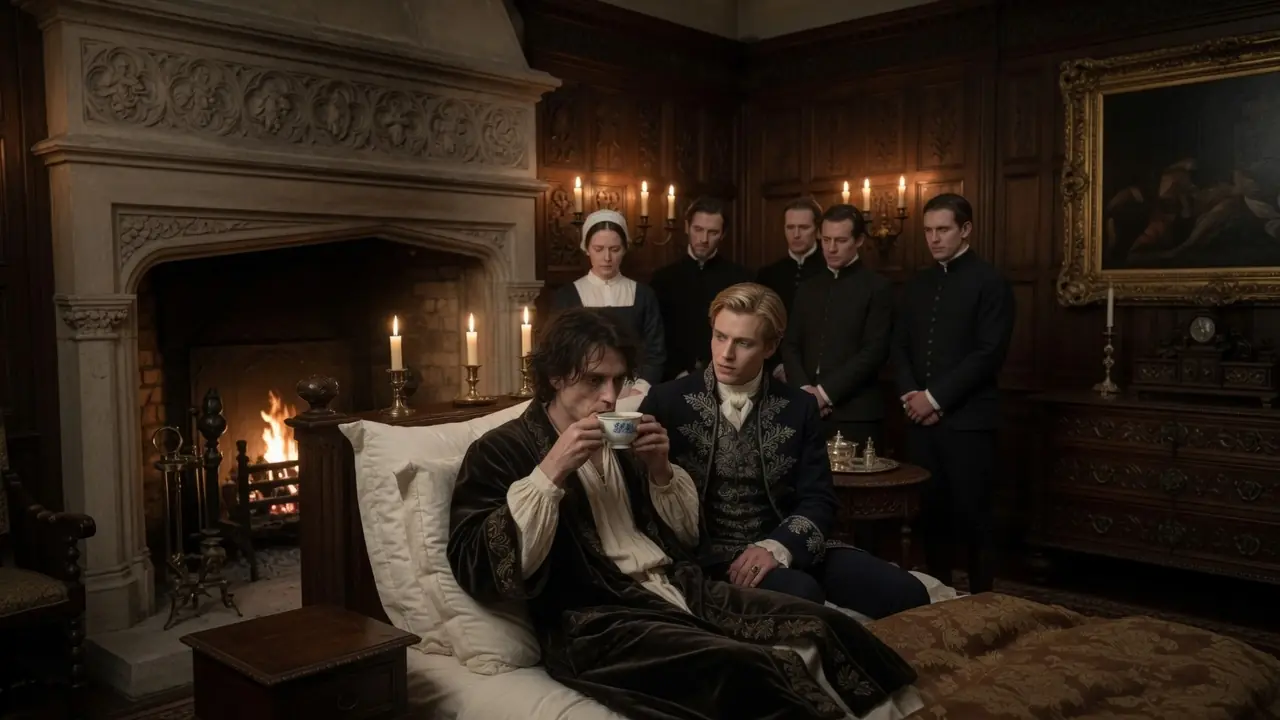
Lucien stepped forward, his voice gaining strength.
“If I wished my brother dead, why would he live? If I wished the throne, why wait through weeks of whispers when one accident, one fever, one carriage mishap would serve? No, my lords. I have waited because I hoped Edmund would recover. I have endured insult because I loved him. But now his faction accuses me of a crime so unnatural that only a diseased imagination could conceive it.”
The argument landed.
Not because it was true.
Because it was useful.
Several lords shifted. The bishops looked troubled. The judges whispered. A confession without the valet present could be dismissed. A lady carrying evidence could be attacked. A sick prince could be doubted.
Lucien knew it.
He turned to Seraphina.
“I pity you,” he said. “Love has made you reckless.”
“No,” she replied. “It has made me attentive.”
“Then attend to this. If Edmund were here, if he could stand before us with steady voice and sound mind, I would yield to him gladly. But he is not here. He cannot defend his claim. He cannot even defend your accusation.”
The chamber murmured.
Lucien faced the council.
“I therefore submit myself to examination. Search my rooms. Question my servants. Summon Pike, if he can be found. But until proof exists beyond a frightened note, Albion must not be left leaderless. I ask this council to name me Prince Regent until my brother can appear before you in health.”
It was brilliant.
He had turned accusation into sacrifice.
He had made doubt look like treason.
He had placed victory one vote away.
The King looked toward the doors as if will alone could bring Edmund through them.
Nothing happened.
The Chancellor whispered, “Your Majesty, the council must decide.”
Seraphina felt the trap closing.
Then the doors opened.
Not grandly.
Not with trumpets.
With a slow scrape of old hinges.
Every head turned.
Prince Edmund stood in the doorway.
He was pale as death and thinner than any man in that chamber had expected. One hand rested on a cane. The other gripped the arm of Mr. Pike, the valet whose confession had just been called desperate invention.
Behind them stood two guards, a palace physician not loyal to Lucien, and an elderly woman in a plain cap whom most of the nobles did not recognize.
Seraphina did.
Mrs. Wren.
The palace laundress.
Lucien went still.
Not afraid.
Not yet.
But still.
Edmund stepped into the Painted Chamber.
Every movement cost him. Everyone saw it. Yet with each step, the room changed. Not because he looked strong, but because he had come when power required his absence.
He stopped before the empty chair.
His chair.
Then he looked at Lucien.
“Brother,” he said, voice faint but clear, “you asked me to appear.”
Lucien recovered beautifully.
The sorrow returned. The tenderness. The wounded dignity.
“Edmund,” he whispered. “You should be in bed.”
“Yes,” Edmund said. “That was your intention.”
A sound went through the chamber.
Lucien’s eyes hardened.
Edmund turned to the council.
“You have read Mr. Pike’s confession. You have heard my brother deny it. That leaves us with an old difficulty. Servants tell the truth poorly when nobles lie well.”
A few faces flushed.
Edmund motioned to Mrs. Wren.
“This is Mrs. Agnes Wren, laundress in the royal household for thirty-two years.”
Lord Malvern scoffed. “Are we now to settle succession by laundry?”
Mrs. Wren looked at him. “My lord, I have settled worse stains than yours.”
A startled laugh broke from someone near the end of the table and died quickly.
Edmund said, “Mrs. Wren found three of my nightshirts marked repeatedly at the cuffs and collar after nights when the cordial was taken. She thought it illness. Then she found similar marks upon a cloth used to wipe a spill from the cordial tray. She kept it.”
Lucien’s face did not move.
The physician stepped forward. “The cloth was examined.”
Lord Malvern snapped, “By whom?”
“By me,” the physician said. “And by two apothecaries from outside the palace. The substance found upon it is consistent with the symptoms His Royal Highness suffered.”
Seraphina watched Lucien’s fingers curl once, then relax.
The Chancellor’s voice was sharp. “Where is this cloth?”
Mrs. Wren removed a sealed packet from her basket.
The simplicity of the basket did more damage than any jeweled box could have done. It made the evidence look ordinary. Real. Saved not for power, but because working people often understood danger before noblemen agreed to name it.
The Chancellor took the packet.
Lucien said, “A stained cloth proves nothing of who stained it.”
“Correct,” Edmund said.
He looked toward Pike.
The valet trembled, but he stood.
“Mr. Pike,” Edmund said, “tell the council who gave you the altered vial.”
Pike looked at Lucien and nearly broke.
Lucien’s gaze was not angry.
It was gentle.
That was worse.
Pike swallowed. “His Royal Highness Prince Lucien did, sir.”
Lucien sighed. “A terrified servant repeating a story promised to save his neck.”
Edmund nodded. “I expected you to say that.”
He turned to the elderly laundress again.
“Mrs. Wren.”
She reached into her basket once more and withdrew a small object wrapped in linen.
Lucien’s face changed.
Only Seraphina was watching closely enough to see it.
A flash of recognition.
A flash of fear.
Mrs. Wren unfolded the linen.
Inside lay a signet ring.
Not the royal signet. Not the King’s.
Lucien’s private ring, engraved with the Calder falcon.
The room seemed to stop breathing.
Mrs. Wren said, “Found it under the grate in the small apothecary passage, my lords. Same morning His Royal Highness took so ill. I knew it was royal, so I hid it until someone honest asked the proper question.”
Lucien stepped forward. “That ring was stolen from me.”
Edmund’s voice remained calm. “When?”
“Weeks ago.”
“Did you report the theft?”
“No. I did not wish scandal.”
“How thoughtful.”
“Anyone could have placed it there.”
“Yes.”
Edmund leaned slightly on his cane.
“Anyone could have placed your ring in the passage. Anyone could have frightened Pike. Anyone could have altered the cordial. Anyone could have searched my rooms and arranged my private writings before the council. Anyone could have urged that you be made Regent before our father was dead.”
He paused.
“But only one man benefited from all of it.”
Lucien’s smile returned, but now it was strained at the edges.
“Benefit is not proof.”
“No,” Edmund said. “But confession is.”
Lucien glanced at Pike. “We have had one already.”
“Not his.”
Edmund looked to the guards.
“Bring Lord Elswyth.”
The side door opened.
Lord Elswyth entered in custody.
Lucien’s composure cracked.
It was brief, but enough. The King saw it. Seraphina saw it. Half the council saw it, and the other half would later claim they had.
Elswyth had been Lucien’s closest companion for five years: handsome, indebted, witty, and morally hollow in the way fashionable men often mistook for sophistication. Now his face was grey, his cravat loose, his confidence gone.
Lucien spoke first.
“Rafe.”
Elswyth flinched.
Edmund said, “Lord Elswyth was arrested last night attempting to leave London with six thousand pounds in notes and a letter of passage under a false name.”
Lord Malvern looked ill.
The Chancellor asked, “What has he confessed?”
Elswyth’s mouth trembled. “I carried messages.”
Lucien’s voice cut through the room. “Say nothing.”
The King thundered, “He will speak.”
The old strength in his voice shook the chamber.
Elswyth broke.
“He said it would not kill him at first,” he rushed out. “Only weaken him. Only make the council afraid. He said Edmund would be removed from succession gently, sent abroad perhaps, kept comfortable. But then the dose changed. Edmund grew suspicious. Pike lost his nerve. Lady Seraphina began asking questions. His Royal Highness said mercy had become impractical.”
Lucien’s face was now utterly still.
No smile.
No sorrow.
No brotherly mask.
Only the cold, beautiful emptiness beneath.
The King stared at his younger son as if seeing a stranger wearing a beloved face.
“Lucien,” he whispered.
That whisper did what accusation had not. For the first time, Lucien looked wounded.
Not by guilt.
By rejection.
“You would choose him still?” Lucien asked.
The room froze.
The King gripped the table. “He is my heir.”
“He was always your heir.” Lucien’s voice sharpened. “When he was solemn, you called it wisdom. When I was brilliant, you called it vanity. When he disobeyed you, you called it conscience. When I pleased you, you called it performance. Do you know what it is to be loved only when one entertains?”
Queen Charlotte, silent until now, covered her mouth.
Edmund’s face tightened with pain.
Lucien turned to him.
“And you. Noble Edmund. Gentle Edmund. The kingdom’s patient saint. Did you ever once refuse what they placed in your hands?”
Edmund answered quietly. “The crown was not a gift.”
“No. It was the sun. And I was expected to grow in your shade.”
“You were my brother.”
“I was your spare.”
The word struck harder than shouting.
Seraphina almost pitied him.
Almost.
Then she remembered Edmund shaking beside the fire.
Lucien looked at the council, and something reckless entered his face.
“You think me monstrous because I did what all of you discuss in safer language. You marry daughters for votes. You ruin rivals with whispers. You starve villages with policy and call it economy. You send sons to die for territory and call it honor. But poison in a cup offends you because it lacks ceremony.”
No one answered.
Lucien smiled, and now the beauty of it was terrible.
“Very well. Let us have ceremony.”
He moved faster than anyone expected.
In one motion, he seized the ceremonial sword from Lord Malvern’s side and pulled Seraphina toward him, the blade flashing near her throat.
Gasps exploded around the chamber.
Edmund stepped forward and nearly fell.
Lucien held Seraphina firmly, but not close enough to injure her unless she struggled. That was his cruelty. Even now, he kept control elegant.
“Do not move,” he said.
The guards drew pistols.
The King shouted, “Lucien!”
“Back,” Lucien said.
Seraphina felt the cold line of steel near her skin. Her pulse hammered, but her mind became strangely clear.
This was the moment.
Not the confession. Not the evidence. Not even Edmund’s entrance.
This was the true climax, because Lucien had finally stopped pretending to seek lawful power. He had revealed what he believed power truly was: the ability to make every life in the room bend toward his desire.
Edmund stood across from him, pale, trembling, alive by force of will alone.
“Let her go,” Edmund said.
Lucien’s laugh was low. “Still giving commands from death’s doorstep.”
“She has nothing to do with this.”
“She has everything to do with this. She believed you. She carried your proof. She looked at me as though I were already condemned.”
Seraphina spoke, her voice steady despite the blade.
“You condemned yourself.”
Lucien’s grip tightened.
Edmund took another step.
“Lucien, listen to me.”
“No.”
“Listen.”
“No. I listened all my life. To tutors praising your judgment. To ministers awaiting your opinion. To Father correcting my posture while applauding your principles. I listened until I understood that no one hears the second son unless he becomes dangerous.”
Edmund’s voice softened. “I heard you.”
For a moment, Lucien’s expression faltered.
“You heard nothing.”
“I heard you crying the night Mother sent your dog away because you loved it more than your lessons.”
Queen Charlotte let out a broken sob.
Edmund continued, each word costing him. “I heard you outside my door after the hunting accident, asking the physician whether I would wake. I heard you tell Lord Wetherby at sixteen that if anyone mocked me for limping, you would break his teeth. I heard you, Lucien. Before ambition made you speak in another voice.”
Lucien’s blade lowered a fraction.
Seraphina felt it.
So did Edmund.
Then Lucien’s eyes hardened again.
“Do not make childhood an argument.”
“No,” Edmund said. “I make it an appeal.”
“To what? My conscience?”
“To your memory.”
The room held its breath.
Lucien looked at his brother for one long moment.
And Seraphina understood.
Edmund was not trying to save the crown now.
He was trying to save the last remaining part of his brother that had not yet been consumed.
But Lucien mistook mercy for condescension.
His face twisted.
“You would forgive me publicly, would you? Spare me beautifully? Stand above me even in mercy?”
“No,” Edmund said. “I would mourn you privately.”
Lucien flinched.
Seraphina moved.
Not dramatically. Not foolishly.
Only enough.
She shifted her weight onto Lucien’s instep with all her strength and drove her elbow backward into his ribs. The sword jerked away from her throat. Edmund lunged forward, collapsing more than charging, but his shoulder struck Lucien’s arm. The blade fell, ringing against the chamber floor.
The guards rushed.
Lucien shoved Edmund aside and reached for the sword again.
Seraphina kicked it under the table.
Lord Malvern, who had caused half the disaster, redeemed one inch of his soul by dropping heavily onto the sword hilt before Lucien could grasp it.
The guards seized Prince Lucien.
He fought then, not elegantly, not beautifully, but like any desperate man discovering that grandeur does not survive restraint.
When they forced him to his knees, silence returned.
Edmund lay on one hand, breathing hard.
Seraphina knelt beside him.
“Are you hurt?”
He tried to smile. “My pride may never recover from being rescued by Lord Malvern’s stomach.”
She laughed once, a sound too close to tears.
The King stood over Lucien.
The younger prince looked up at his father.
For a moment, all his anger drained away, leaving only the boy who had once wanted to be seen.
“Father,” he whispered.
King Frederick’s face broke.
But he did not look away.
“Lucien Calder,” he said, voice shaking, “you are stripped of royal authority, title of succession, offices, honors, and liberty, pending trial for high treason and attempted fratricide.”
Queen Charlotte sobbed openly now.
Lucien looked from the King to Edmund.
Then to Seraphina.
His smile returned faintly, ruined but recognizable.
“Be careful, brother,” he said. “They will love you most when you suffer beautifully.”
Edmund closed his eyes.
“Take him away,” the King said.
And so the younger prince, who had poisoned his brother to steal a throne, was dragged from the Painted Chamber beneath a ceiling crowded with painted angels who looked, in the trembling candlelight, almost ashamed.
The aftermath did not feel like victory.
That surprised Seraphina, though perhaps it should not have. Stories told in drawing rooms often ended at exposure. The villain was unmasked, the hero restored, the lady vindicated, and all decent people applauded.
Real court did not work that way.
Real court continued.
There were papers to sign, physicians to dismiss, servants to protect, rumors to contain, foreign ambassadors to reassure, and a Queen who refused to leave her chamber for three days because one son had nearly murdered the other and no etiquette book had prepared her for which grief to show first.
Prince Lucien was confined in the Tower under a guard chosen personally by the King.
His trial was delayed, not from mercy, but from terror. No one wanted the public spectacle of a royal son accused of poisoning the heir. No one wanted pamphleteers describing the cordial, the valet, the laundress, the confession, the sword, the lady at his mercy.
Yet London knew.
London always knew.
Within a week, ballads were sung in taverns. Within two, caricatures appeared showing Lucien pouring ambition into a cup while Edmund slept beneath a crown-shaped cloud. Within three, fashionable ladies began wearing small silver baskets on chains in honor of Mrs. Wren, which amused Mrs. Wren so little that she asked whether any of them knew how to remove candle grease from velvet.
Edmund recovered slowly.
The poison had weakened him. The confrontation had nearly broken what strength remained. For weeks he walked with a cane. For months his hands sometimes trembled when he was tired. But his mind cleared. His voice steadied. The letters he wrote regained their discipline, though Seraphina noticed they had become less guarded.
He no longer signed with his full name when he wrote to her.
Only E.
One morning in April, when the gardens of Harrowden House were bright with early bloom, Edmund came to see her without ceremony.
He found Seraphina in the orangery, reading a political pamphlet with such irritation that the pamphlet itself seemed at risk.
“You look severe,” he said.
“I am reading an article praising my feminine courage.”
“That sounds complimentary.”
“It says I was brave because love made me forget my natural timidity.”
Edmund leaned on his cane, considering. “Shall I have the author arrested?”
“That would be excessive.”
“Publicly corrected?”
“Too generous.”
“Privately bored to death by Lord Wrexham?”
She looked up. “Now that is statesmanship.”
He smiled, then grew quiet.
Seraphina set the pamphlet aside.
“What is it?”
He came closer.
“I have spoken with your father.”
“That sounds ominous.”
“I asked permission to speak with you.”
“That sounds archaic.”
“I know. He enjoyed it.”
“He would.”
Edmund stood before her, and for a moment the prince disappeared beneath the man: tired, scarred by betrayal, alive beyond expectation, and still uncertain in the presence of the woman he loved.
“I was going to wait,” he said.
“For what?”
“Health. Stability. A less scandalous season. A kingdom not discussing my brother over breakfast.”
“Ambitious conditions.”
“Impossible ones, perhaps.”
“Very.”
He took her hand.
“I cannot offer you an uncomplicated crown,” he said. “My family is wounded. My name is attached to scandal. My body may never be as strong as it was. My reign, when it comes, will begin under the memory of treason. You would be watched, judged, praised falsely, blamed sincerely, and quoted inaccurately by men less intelligent than your gloves.”
“That last part is already my life.”
His mouth moved, but did not quite smile.
“I love you,” he said. “Not because you saved me, though you did. Not because you believed me, though I would have been lost if you had not. I love you because in a court where everyone asks what power can take, you ask what truth requires.”
Seraphina’s throat tightened.
He reached into his coat and withdrew a ring.
Not grand. Not heavy with state jewels. A simple sapphire set in old gold, once belonging to his grandmother.
“Will you marry me?”
Seraphina looked at the ring, then at him.
“I have conditions.”
Edmund closed his eyes briefly. “Of course you do.”
“I will not be displayed as proof that the kingdom has healed.”
“No.”
“I will not be silenced when ministers say foolish things.”
“I would be disappointed if you were.”
“I will not pretend your brother never existed.”
His expression changed.
Pain moved through him, quiet and deep.
“No,” he said. “Nor will I.”
“And if you become king,” she continued, “you will remember that love is not weakness simply because Lucien mistook it for a chain.”
Edmund’s grip tightened around her hand.
“I will try.”
She studied him.
Then she smiled.
“Very well.”
He stared. “Very well?”
“I accept.”
He laughed then, softly at first, then with a relief that made him look young again.
When he placed the ring on her finger, his hand trembled.
Seraphina covered it with her own.
“Do not be embarrassed,” she said.
“I am not.”
“You are.”
“I am heir to the throne. I am above embarrassment.”
“You nearly fell into a fern just now.”
“That was political strategy.”
She laughed, and he kissed her hand as if it were something sacred.
Their wedding took place in June.
The newspapers called it a symbol of national restoration, which annoyed Seraphina because it made marriage sound like architecture. The people cheered. The King wept only once and pretended it was dust. Queen Charlotte wore silver and looked both proud and haunted.
Mrs. Wren was given a place of honor against her objections.
Mr. Pike was quietly sent abroad with enough money to begin again, though Edmund never forgot the cost of forgiveness, nor the danger of trusting men who had been forced into betrayal.
Lord Elswyth was imprisoned.
Lord Malvern resigned and spent the rest of his life writing unread memoirs in which he exaggerated his courage so greatly that his own nephew laughed at the manuscript.
Prince Lucien never stood public trial.
The King could not bear it. Parliament could not risk it. Edmund, after much silence, agreed to a private judgment. Lucien was stripped of succession and confined for life at Northmere Castle, an old royal fortress by the sea, where the waves struck the rocks all winter like applause from an audience that never tired.
Some called it mercy.
Some called it cowardice.
Seraphina called it punishment of the most precise kind.
Lucien, who had wanted the whole kingdom to see him, was hidden from it forever.
Once, years later, a letter arrived from Northmere addressed to King Edmund V.
By then, King Frederick was dead. Edmund had worn the crown for nearly two years. He opened the letter alone in his study, with Seraphina standing beside the fire.
The handwriting was still elegant.
Brother,
I hear you are loved. How fortunate for Albion. How exhausting for you.
The sea here is intolerably honest. It does not flatter, bargain, applaud, or remember rank. It simply returns every day and strikes the same stones. I begin to understand why prisoners become philosophers. There is nothing else to become.
Do you think of the cup?
I do.
Not with regret exactly. Do not comfort yourself. I regret failure, exposure, confinement, the ugliness of being held down by men whose names I did not know. But lately I have begun to wonder whether wanting the crown was ever the same as wanting to rule.
You will think that too late.
You always did enjoy being correct.
L.
Edmund read it twice.
Then he held it over the candle flame.
Seraphina stopped him.
“No,” she said.
He looked at her.
“Keep it.”
“Why?”
“Because one day our children will need to know that evil does not always arrive as a monster. Sometimes it arrives as charm, grievance, loneliness, and a smile everyone rewards too long.”
Edmund folded the letter.
“You are severe.”
“I read pamphlets.”
He kissed her temple.
Outside, the bells of London rang for some ordinary celebration. A treaty, perhaps. A birth. A saint’s day no one remembered properly. Inside the palace, the King placed his brother’s letter in a locked drawer.
He did not forgive Lucien.
Not fully.
But he remembered him.
And that, Seraphina thought, was the wound that kept Edmund human.
Years later, when historians wrote of the early reign of Edmund V, they praised his reforms, his restraint, his careful management of Parliament, his devotion to Queen Seraphina, and his unusual respect for testimony from those born far below the rank of duke.
Some scholars argued that his near death had made him compassionate.
Others argued that betrayal had made him cautious.
A few, wiser than the rest, suggested that both were true.
But in the oldest households of Albion, where servants passed down stories more accurately than official chronicles, they told it differently.
They spoke of the winter when the younger prince poisoned the heir by inches.
They spoke of the lady who hid a confession in her glove.
They spoke of the laundress who kept a stained cloth because she trusted evidence more than rank.
They spoke of the council chamber where ambition finally drew a sword and called itself ceremony.
And they spoke of the elder brother, pale and shaking, who entered the room everyone had arranged for his absence and reclaimed not merely a throne, but the truth.
For crowns are not only stolen by armies.
They may be stolen by whispers, by physicians, by forged concern, by a cup placed nightly beside a trusting bed.
And sometimes they are saved not by strength, nor by birth, nor even by law, but by the person who refuses to let a poisoned silence become history.