On an April Saturday morning, Nathan Cole paid one hundred dollars for a car that nearly everyone else would have sent straight to the crusher.
It sat in the back corner of Briggs Auto Salvage like a thing forgotten by time. Rust had chewed through the seams of the roof. The paint was stripped in places down to bare metal. The old plate hanging from the rear was so faded that the numbers were almost impossible to read.
To most men, it was junk.
To Nathan, it was a question.
He did not know the answer yet. He only knew the shape was wrong in a way that mattered.
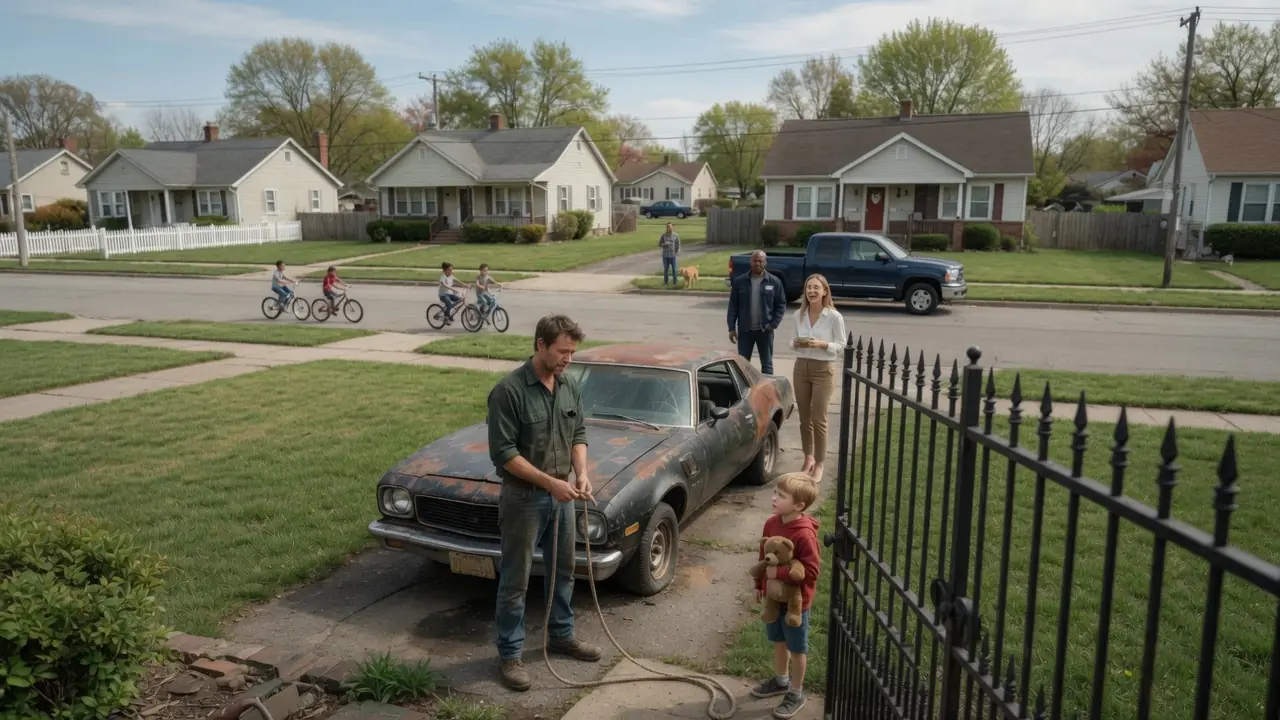
By noon, he had towed the car back to Hawthorne Lane behind Marcus Reed’s pickup, the two vehicles crawling along at an embarrassing fifteen miles an hour while the old coupe drifted slightly in the lane, its dead steering loose and stubborn.
People noticed before he had even backed it into the driveway.
That was how Hawthorne Lane worked.
Curtains moved. A man walking a retriever slowed at the corner. Two boys on bicycles stopped pedaling. Someone across the street stepped onto her porch, pretending to check the weather.
And at the black front gate of the neatest house on the block, Vanessa Price stood with a coffee cup in her hand.
She watched the rusted car roll into Nathan’s driveway and laughed.
Not quietly.
Not kindly.
“You just taught your son the fastest way to waste money,” she called.
A neighbor laughed too, then tried to hide it.
Nathan heard both of them.
So did his son.
Oliver Cole was seven years old, small for his age, missing a front tooth, and standing at the edge of the driveway with his backpack still hanging from one shoulder. He had run outside when he heard the truck. In one hand, he held Dash, the stuffed bear his mother had given him when he was born.
The bear had one missing button eye and two crooked repairs in mismatched thread.
Oliver did not care.
He looked from Vanessa to the car, then to his father.
Nathan did not answer Vanessa.
He did not turn around.
He only put the truck in park, climbed out, and said, “Oliver, go inside and get my tool bag.”
The boy stood for one more second.
Then he nodded and went inside.
Nathan began unhooking the tow rope.
He worked slowly, not because he wanted to prove anything, but because he had learned long ago that dignity did not require an audience. It only required a man not to bend himself around another person’s opinion.
Five days later, a racing legend would stand in that same driveway and offer Nathan five million dollars.
But on that first morning, all Vanessa saw was rust.
Nathan Cole was thirty-four years old and lived a life that did not look impressive from the street.
He woke every morning at five. He packed Oliver’s lunch, checked the handwritten schedule pinned to the refrigerator, fed the boy breakfast, and walked out to the converted garage behind the house where he worked as a freelance mechanic.
It was not glamorous.
It was not steady in the way people with salaries understood steady.
Some weeks, word-of-mouth repairs kept him busy enough to forget the bills for a while. Other weeks, the money arrived late, thin, and already spoken for before it touched his account.
Nathan did not complain.
He had never been good at turning hardship into conversation.
His wife, Emily, had died two years earlier in a highway accident on the interstate. The other driver had survived. Emily had not.
The medical bills survived too.
They came in envelopes. Then reminders. Then final notices. Nathan paid what he could, when he could, in quiet chunks that no one on Hawthorne Lane ever heard about.
To the neighbors, he was the quiet widower with the little boy and the garage.
That description was not wrong.
It was only unfinished.
Emily had loved cars.
Not in the way people loved shiny things or expensive things. She loved machines that had stories in their lines. She could look at a hood curve, a wheel arch, a windshield angle, and know whether someone had built it with care or merely manufactured it for sale.
She used to sketch cars in the evenings after Oliver fell asleep, sometimes from memory, sometimes from imagination. Long, low bodies. Sharp noses. Sloping glass. Wheels tucked beneath arches that looked carved rather than pressed.
Nathan had kept her sketchbooks in a drawer he rarely opened.
Not because he wanted to forget.
Because remembering had edges.
Nathan did not talk about Emily unless Oliver asked.
When he did ask, Nathan answered honestly.
But he did not volunteer stories.
Grief had settled in him like dust under a workbench: always there, visible only when disturbed.
Marcus Reed was the only man on the block who seemed to understand that.
He owned a small repair shop at the end of Hawthorne Lane and had known Nathan since before Emily died. Marcus was forty, broad-shouldered, patient, and blessed with the rare gift of knowing when silence was more useful than advice.
On Friday nights, he sometimes brought sandwiches over. He and Nathan would eat in the garage while Oliver did homework at the workbench, Dash sitting beside him like a loyal supervisor.
Marcus never said, “You should get out more.”
He never said, “Emily would want you to move on.”
He only said, “You need mustard?” and passed the packet before Nathan answered.
That was friendship.
Vanessa Price had moved to Hawthorne Lane eighteen months after Emily’s death.
Her house looked as though it had been designed to make other houses feel careless. Black front door. White Audi angled perfectly in the driveway. Window boxes full of flowers that somehow never leaned, wilted, or lost petals.
She worked as a real estate broker, dressed like someone always half prepared for a closing, and treated neighborhood appearance as if it were a moral category.
She was not evil.
Nathan knew that.
She was simply incurious.
That could look almost the same from a distance.
Once, early on, she had smiled at Nathan from across the fence and said, “Have you ever thought about moving somewhere a little more suited to your lifestyle?”
He had looked at her for a moment.
Then gone inside.
She considered that rude.
Nathan considered it efficient.
Briggs Auto Salvage sat on the east edge of town behind chain-link fencing and a hand-painted sign that had faded from red to something closer to dried brick. Hank Briggs had run the yard for more than thirty years. He was sixty, blunt, sun-browned, and believed research was something people did when they lacked instinct.
Nathan had gone there that Saturday to pick up a carburetor for a customer.
He had no intention of buying a car.
Hank was clearing out a lot of vehicles that had come from a private storage facility whose lease had expired. The estate executor wanted everything gone by Monday. Hank wanted the space. Anything not purchased would be crushed.
Nathan had been walking the back row when he saw the coupe.
At first, he did not know why he stopped.
The car was ugly from neglect. The metal was pitted. The glass was dusty. The interior looked ruined. The tires were long dead.
But the proportions were strange.
Important-strange.
The wheelbase sat just a little longer than it should have. The windshield had an angle Nathan did not associate with ordinary production cars from that era. The rear quarter panel curved in a way that looked intentional, almost sculpted. The wheel arches were not uniform in the clean, stamped way factory panels usually were. They had been shaped by hand.
Nathan could tell before touching it.
He touched it anyway.
His palm rested against the cold rear quarter panel.
Beneath the rust and old grime, he felt the truth of the work.
This was not a car someone had built casually.
Someone had thought about it.
For a long time.
Hank came up behind him.
“That one’s a hundred bucks,” he said. “You take it today, or Monday it gets crushed.”
Nathan looked at the car.
Then he thought about the electricity bill on the kitchen counter.
He thought about Oliver’s shoes, which had been too tight for weeks.
He thought about the fact that one hundred dollars was not nothing to him.
And then he thought about the line of that rear quarter panel.
He paid Hank.
When he opened the driver’s door, a brittle piece of old sticker peeled away from the lower doorframe and drifted to the ground. It was barely larger than a postage stamp.
Nathan picked it up and put it in his pocket.
He did not know why.
Only that it felt wrong to leave it behind.
That night, after Oliver was asleep, Nathan set two work lights in the garage and began cleaning.
He did not attack the car. He studied it.
He moved from the bottom up, from the back forward, wiping grime, scraping carefully, looking for information the way another man might look for gold.
The radio played low on the shelf between the wrenches and socket sets.
Outside, Hawthorne Lane went dark.
Inside, Nathan worked.
The first important mark was under the driver’s footwell.
He used a solvent cloth, and the old dirt came away in thick black sheets. Beneath it, stamped into the bare metal floor pan, was a chassis number.
He frowned.
It did not look like any standard VIN he knew.
The prefix was unusual: letters, digits, then more letters. It began with RAC, followed by numbers and a two-letter code. Not normal factory language. Not anything common.
Nathan photographed it.
He searched online for forty minutes and found nothing definite. A few old European racing registries had similar prefix styles in the early 1970s, but nothing matched exactly.
He texted Marcus.
Ever seen a chassis prefix starting RAC 67?
Eleven minutes later, Marcus replied:
Nope. Go to sleep.
Nathan did not go to sleep.
He remembered the sticker fragment.
He took it from his pocket and held it under the work light. Most of the paper had dissolved with age, but part of the image remained: a stylized wheel and what looked like a simplified flame, clean and bold, not the kind of decoration someone slapped on a street car.
He taped the fragment to a clean sheet of paper and stared at it.
Something about it felt familiar.
Not to memory.
To instinct.
The next morning, Marcus arrived before the coffee had finished brewing.
Nathan had called him at 6:45 and said only, “Come look at this.”
Marcus spent five minutes under the car on a rolling creeper.
When he came out, his face had changed.
“Nathan,” he said carefully, “this frame has been reinforced by hand.”
Nathan waited.
“I mean properly reinforced. Gussets at junction points. Custom welds. Not amateur stuff. Somebody knew exactly what they were doing.”
He stood, wiped his hands, and moved to the engine bay.
The hood barely lifted, but it lifted enough.
Marcus leaned in.
“This block has been machined,” he said. “Bored out. Reworked. Not stock.”
He straightened and looked at Nathan.
“This thing was built for a purpose.”
“I know.”
“No. I mean a serious purpose. Track. Testing. Something.”
Nathan had already taken photographs of the suspension geometry, the hand-shaped bodywork, the number in the floor pan, and the fragment of the sticker.
That afternoon, he posted them on a specialized forum for vintage racing vehicles.
The site looked ancient, almost untouched by modern internet design, but its members knew things that were not always written in books. Nathan described the car carefully and asked if anyone recognized the chassis prefix, body shape, or sticker logo.
By the next morning, the thread had forty-seven replies.
On that forum, that was the equivalent of shouting.
The members argued immediately.
Several insisted it was a kit build from the 1980s, an ambitious custom assembled from racing catalogs and salvaged parts. Others were not so quick.
One user named garage_legend_tx wrote:
If that chassis number is real, you may have found something people in this community have been hunting for fifteen years.
Another member sent a private message:
Stop posting public photos. Seriously.
Nathan printed the thread.
He put the pages in a folder.
Then he went back to the garage.
Oliver came home from school that afternoon and took his usual seat on the overturned bucket near the workbench.
Dash the Bear sat in his lap.
He watched Nathan polish one section of the rear panel for a while.
Then he asked, “Does the car have a name?”
Nathan paused.
“No.”
Oliver looked at the car seriously. He tilted his head the same way Nathan had done at the salvage yard, as if listening to something the metal was trying to say.
“Dash,” he said.
Nathan put down the polishing cloth.
For a second, he could not speak.
Emily had named the bear Dash.
Emily had loved racing.
Emily had drawn cars with lines like this one.
Nathan swallowed.
“That’s a good name,” he said.
Oliver nodded like the matter was settled.
On the fourth day, Nathan found the paint.
He was working along the passenger-side B-pillar when he noticed the layers were thicker than they should have been. He took fine-grit paper and worked slowly, cutting through black paint and old oxidation.
Underneath was another color.
White-blue.
Not plain white.
Not sky blue.
A pale metallic shade with a cool sheen, the kind of color chosen by someone with an opinion, not a catalog.
Nathan had seen it before.
In old racing photographs.
In books Emily had once left open on the kitchen table.
His pulse changed.
He worked more carefully now, removing the top layers in thin, patient passes.
Then he found the stamp.
It was not a sticker.
Not a plate.
It had been pressed directly into the metal on the inner face of the pillar where no one would see it unless the door was open and the paint was cut back.
A number.
And beside it, three connected letters shaped like a signature.
Nathan photographed it.
He searched for hours.
At two in the morning, he found the match in a digitized automotive trade magazine from 1983.
The article told the story of a racing team from the American Southwest that had fallen apart after a warehouse fire. The team had been known in the 1970s and early 1980s for experimental endurance racing designs. Several prototype vehicles were believed destroyed in the fire.
One paragraph mentioned a development prototype built around a revolutionary chassis geometry. It had never raced officially, but its design principles had quietly influenced endurance racing for years afterward.
The prototype was presumed lost.
The engineer behind it was Arthur Bell.
The owner of the team was Vincent Blackwood.
Arthur Bell had died in a testing accident in 1982.
The warehouse fire happened one year later.
Nathan sat in the garage until the first light of morning slid under the door.
By then, he understood the possibility.
The rusted one-hundred-dollar coupe might be something people had believed destroyed for forty years.
Marcus tried to keep quiet.
He failed.
He told his wife because some knowledge was too big to hold alone. His wife told the neighbor two houses down because she believed, sincerely, that news shared carefully did not count as gossip. That neighbor told her husband, who told the man with the retriever, who told someone else.
By the next morning, Hawthorne Lane knew that Nathan Cole’s junk car might be worth something.
Not a little something.
A lot.
Two people knocked on Nathan’s garage door with excuses.
One wanted to borrow a tire gauge.
Another asked whether he had seen a missing cat.
Both tried to look past him at the car.
After the second visit, Nathan covered it with a blue tarp.
Vanessa heard the story late, distorted through several mouths but still carrying the essential shape: the car she had mocked might be rare, possibly valuable, maybe even famous.
She laughed when she first heard it.
Then she went inside and opened her laptop.
She searched Vincent Blackwood.
She found more than she expected.
Vincent Blackwood was no forgotten racer. He was a legend. Former team owner. Collector. Investor. Billionaire. His historic vehicles had sold at auctions for numbers that looked unreal to anyone living on Hawthorne Lane.
One profile mentioned, almost as an aside, that Blackwood had quietly spent years searching for a prototype car from his early racing days, a car believed to have been lost in a 1983 warehouse fire.
Vanessa closed her laptop.
Then she looked out her kitchen window at the blue tarp in Nathan’s driveway.
That afternoon, she walked across the street carrying a measuring cup and knocked on his door.
Nathan opened it.
She smiled.
“I’m sorry to bother you. Do you happen to have a food processor I could borrow?”
Nathan looked at the measuring cup.
Then at her.
“I don’t.”
He closed the door.
Not dramatically.
Not rudely.
Just completely.
Vanessa stood on the step for a moment before turning back toward her house.
On the fourth evening, Nathan received an email through his forum account.
The sender was Caroline Hart.
Executive Assistant, Office of Vincent Blackwood.
The message was brief and formal.
Mr. Blackwood had seen the discussion and photographs. If Nathan was in possession of the vehicle described, Mr. Blackwood wished to meet him in person. A meeting could be arranged within twenty-four hours.
Nathan read the email three times at the kitchen table.
Then he went out to the garage, sat on Oliver’s overturned bucket, and called Marcus.
“You awake?”
“It’s 9:30.”
“I got an email from Vincent Blackwood’s office.”
Silence.
Then Marcus said, “Say that again, but slower.”
Nathan did.
Marcus was quiet for another few seconds.
Then he said, “You need to answer that email.”
The next morning was Saturday again.
Nathan woke at five as usual.
He made coffee. He packed Oliver breakfast even though there was no school, because routine held their days together and he did not break routine without a reason.
He put on his best flannel shirt, dark green and clean.
He knew it was not what most men would wear to meet a billionaire racing legend.
He wore it anyway.
Oliver sat at the kitchen table, swinging his legs.
“Is someone special coming?”
“Maybe.”
“Is Dash leaving?”
Nathan looked at him.
“Let’s see what happens.”
Marcus arrived at nine with two coffees and no pretense of needing an invitation.
At ten exactly, a black Cadillac pulled to the curb.
Vanessa watched from behind her front window, coffee cooling in her hand.
Vincent Blackwood got out of the passenger side.
He was fifty-eight, lean, white-haired, and moved with the calm purpose of a man who did not waste motion. Caroline Hart followed with a tablet tucked under one arm.
Vincent walked straight toward the garage.
Then he saw the car.
He stopped.
For a long time, he said nothing.
He circled it slowly, hands occasionally hovering over the bodywork, sometimes touching the metal with a gentleness Nathan recognized. It was the way a mechanic touched something built by another man’s hands and understood that work had memory.
Vincent crouched near the passenger-side pillar.
Nathan had left the area exposed.
The old man’s fingers moved to the stamped signature.
He touched it and stayed there.
One minute.
Maybe more.
When he spoke, his voice was low.
“I thought it was gone forever.”
Nathan stood beside the workbench.
“You know it?”
Vincent looked up.
“I built it.”
The garage went still.
“In 1971,” Vincent said. “It took nearly two years. It cost money, yes, but more than that. It cost sleep, friendships, nearly a marriage, and Arthur Bell’s sanity.”
He looked back at the car.
“Arthur was my chief engineer. Brilliant man. Difficult. He believed endurance racing was being built on the wrong assumptions. This car was his answer.”
Vincent stood.
“It never officially raced. It was a development prototype. A test bed. We used it to prove a geometry theory that later shaped cars people actually remember.”
He placed his hand on the roof.
“In 1983, I was told it burned in the warehouse fire. I believed it because the alternative was worse.”
“What alternative?” Nathan asked.
“That someone had taken it.”
Vincent’s eyes stayed on the car.
“I searched twice after the fire. Then again years later. Nothing. Eventually, I stopped looking.”
Nathan told him how he found it.
The salvage yard.
The back row.
The one-hundred-dollar price.
The crusher deadline.
The shape that would not let him walk past.
Vincent listened without interruption.
When Nathan finished, the older man looked at him carefully.
“Arthur once said almost the same thing,” he said. “That the right shape makes a man stop before his mind knows why.”
Oliver appeared in the doorway then, Dash the Bear tucked beneath one arm.
Nathan turned.
“Come here.”
Oliver came slowly and stood at his father’s side.
Vincent looked at him kindly.
Oliver looked at the car.
Then at Vincent.
“My dad says its name is Dash.”
Vincent’s face changed.
Only slightly.
But Nathan saw it.
“That’s a good name,” Vincent said.
Oliver nodded.
“Did you miss it?”
Vincent took a breath.
“Yes,” he said. “Very much.”
“That’s what my dad says about important things,” Oliver replied. “You miss them.”
No one spoke for a moment after that.
Then Caroline stepped forward and held the tablet toward Nathan.
On the screen was a number.
Five million dollars.
Below it was a simple purchase agreement.
Vincent said, “That is what it is worth to me and to the history it belongs to. You do not have to answer now. You can say no.”
Nathan looked at the number.
Then at Oliver.
Then at the car.
For a moment, he thought of Emily’s sketchbooks, the medical bills, Oliver’s shoes, the way Vanessa’s laughter had landed near his son.
He did not answer that morning.
Vincent respected that.
After they left, Nathan sat in the garage until evening.
Marcus stayed for a while, then left without pressing him.
Oliver watched television inside.
The car sat under the work lights, still rusted, still wounded, but no longer unknown.
Nathan thought about Emily.
He thought about how she might have recognized it. How she would have walked straight to that back corner in the salvage yard and said, “There. That one.”
He thought about the name Oliver had chosen.
Dash.
The bear.
The car.
The small invisible thread connecting a mother who was gone, a son who remembered her through softness, and a machine built for speed before he was born.
Finally, Nathan called Caroline.
“I have one condition,” he said.
“Tell me.”
“If I sell it, it does not disappear into a private collection. It gets displayed somewhere public. People should be able to see it.”
He paused.
“And the display needs to explain Arthur Bell’s work clearly. Not just the rich-owner part. The engineering. The man who built it. His name needs to matter.”
Caroline listened.
Nathan added, “And there should be a line saying it was found by someone who noticed its value when everyone else saw rust.”
He did not ask for his own name.
He did not need that.
Caroline called back eight minutes later.
“Mr. Blackwood agrees to all of it,” she said. “And he wants to add something.”
Nathan waited.
“He wants the name Dash included on the placard. He said your son named the car, and that should be part of its history.”
Nathan covered his eyes with one hand.
For a while, he could not speak.
Then he said, “Tell him thank you.”
The transport truck came the next morning.
Vanessa stood at her gate, this time with no coffee cup, no prop, nothing to hide behind.
The flatbed backed carefully into the street. Two technicians from a restoration company attached support harnesses to the car’s undercarriage with the care usually reserved for fragile art.
Nathan stood by, watching.
Vanessa crossed the street.
She stopped a few feet away.
“Nathan,” she began.
He looked at her.
There was no triumph on his face. No satisfaction. No desire to humiliate her.
That seemed to make it worse.
“It’s all right, Vanessa,” he said. “Next time you see someone believe in something, maybe wait five days before you decide it was foolish.”
She opened her mouth.
Closed it.
Then turned back toward her house.
Oliver came onto the porch in pajamas, Dash the Bear clutched to his side.
He watched the car being loaded.
When the flatbed began to move, he lifted one small hand and waved.
Nathan saw it from the corner of his eye.
His throat tightened.
He did not say anything.
Some goodbyes were too full for words.
The money arrived three weeks later.
A single transfer.
Nathan sat at the kitchen table staring at the number on the laptop screen for a long time.
Then he called the hospital billing office.
He paid Emily’s remaining medical debt in full.
The call lasted four minutes.
When it ended, Nathan set the phone down and sat very still.
He had expected relief to feel bigger.
Instead, it felt quiet.
Like a window opening in a room that had been closed for years.
After that, he bought Oliver new shoes.
The exact pair Oliver had pointed out months earlier in a store window but had never asked for.
He also bought a detailed building set of a classic endurance racing car.
When he gave it to Oliver, he said, “Thought we could build one ourselves.”
Oliver looked at the box.
Then at his father.
“Together?”
Nathan smiled.
“Together.”
He helped Marcus expand the garage at the end of Hawthorne Lane. Not as charity. Not as a dramatic investment. Just one man helping another man who had been there when help mattered.
They added a second lift.
Then hired an apprentice.
The rest of the money Nathan placed carefully.
Some for Oliver.
Some for the house.
Some into a school fund named after Emily, designed to help children whose families carried burdens that did not show in class pictures.
The school invited Nathan to speak.
He declined.
He sent a letter instead.
That was enough.
A few weeks later, Caroline Hart called again.
The restored car would be unveiled at the city Transport Museum in a new exhibit on American endurance racing engineering.
Nathan and Oliver were invited.
They went on a Thursday evening.
Oliver wore his new shoes and carried Dash the Bear.
Vincent Blackwood met them at the entrance. He shook Nathan’s hand, then crouched to greet Oliver properly.
Inside the gallery, the car sat beneath clean white lights on a low platform.
Restored.
White-blue.
Long, low, and beautiful in a way rust had never been able to fully hide.
It looked like something pulled out of time and returned to the world.
Nathan stood before it for a long while.
Then he read the placard.
Arthur Bell’s name was there, large and clear.
The engineering was explained in plain language: the chassis geometry, the experimental structure, the influence the prototype had carried into later racing designs without recognition.
Near the bottom, another line told how the car had been found in a salvage yard by a mechanic who saw its value beneath the rust.
And below that:
The car was named Dash by Oliver Cole, age seven, who said it was the right name.
Oliver stared at the words.
Then at the car.
“Dad,” he asked softly, “is Dash happy here?”
Nathan looked at the car.
He thought about Hank’s salvage yard. The back row. The crusher scheduled for Monday. He thought about Arthur Bell’s hand on the metal decades ago. Emily’s sketches. Oliver’s bear.
“I think so,” Nathan said. “More people can see him now.”
Oliver nodded.
“That’s good.”
Then he slipped his hand into Nathan’s.
“Can we get food after? The kind with dipping sauce?”
Nathan laughed.
A real laugh.
Unguarded.
“Yeah,” he said. “Whatever you want.”
Vanessa Price moved out of Hawthorne Lane the following month.
She told people it was because of a new office location and a more convenient commute.
That was true enough.
No one on the block said anything cruel.
Life’s justice was rarely as loud as people wanted it to be. Sometimes it arrived quietly and stayed, shaped exactly like the words a person wished they had never said.
Nathan stayed.
He kept the garage.
He kept the radio on the shelf between the wrenches and socket sets.
He kept the five o’clock mornings, the refrigerator schedule, the Friday sandwiches with Marcus, the homework at the workbench, and the small routines that had kept him and Oliver standing when everything else had fallen apart.
He did not become a different man.
He became more settled inside the man he already was.
That was all.
Some nights, after Oliver went to sleep, Nathan still worked late in the garage. Sometimes he talked to Emily, not out loud, but in that inward way people continue loving someone after death has taken the shape of their daily life.
He thought she would have known.
If she had walked into that salvage yard, she would have seen past the rust.
She would have put her hand on the rear quarter panel and said, “This one.”
He thought she would have loved the exhibit.
He thought she would have cried at the placard.
He thought she would have been proud of Oliver for naming the car.
And maybe, more than anything, she would have been proud that Nathan had spent one hundred dollars on something everyone else thought was worthless.
Because that had always been his gift.
He could look at broken things without needing them to prove themselves first.
He could see shape under damage.
Work under rust.
History under silence.
Value under neglect.
That was how he had built his life after losing Emily.
That was how he raised Oliver.
And that was how a dead car from the back of a salvage yard found its way into the light again.
Not because everyone saw what it was.
But because one quiet mechanic stopped long enough to look properly.