Eliza Hartwell knew her life had gone wrong the moment she saw the red mark across the account book.
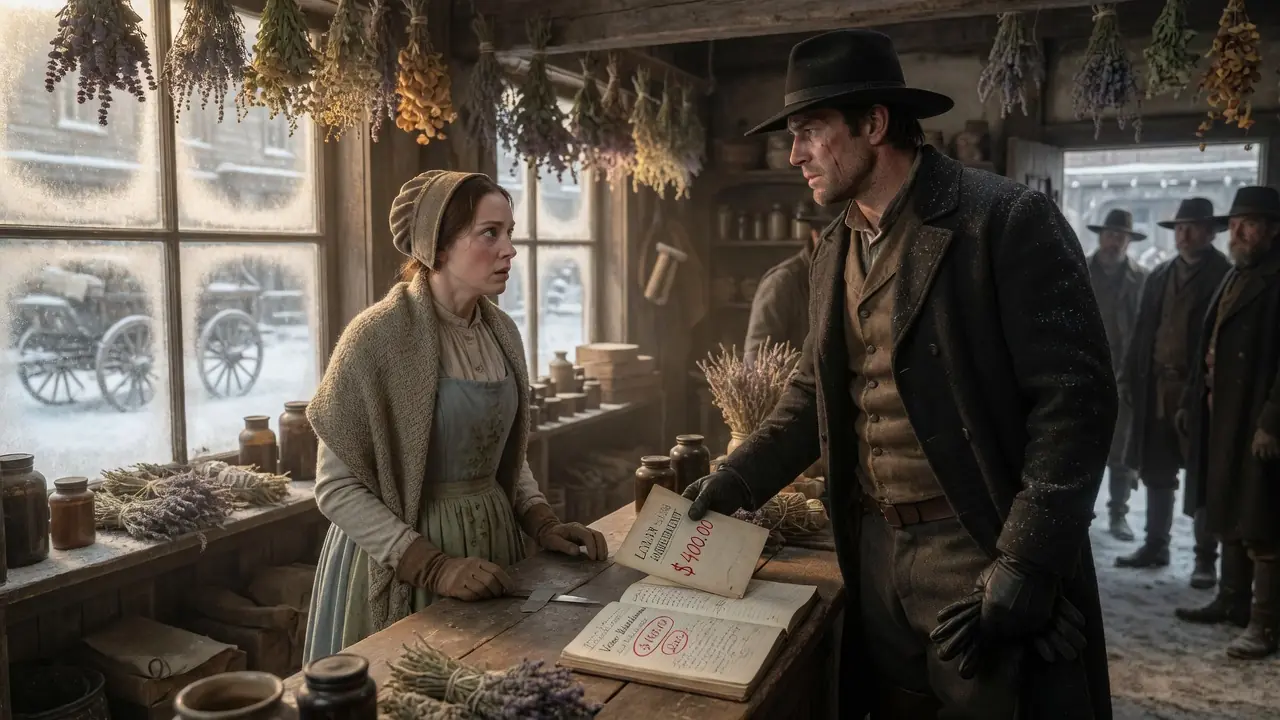
The little apothecary shop on Briar Street still smelled of lavender, cedar smoke, and dried orange peel. Glass jars lined the shelves in neat rows. Bundles of sage, chamomile, and mountain mint hung from the rafters. Outside, wagon wheels cracked over the frozen road, and somewhere beyond the window, a blacksmith’s hammer struck iron in steady rhythm.
Inside, the ledger lay open on the counter.
Four hundred dollars.
The number sat there like a sentence.
Her business partner, Jonah Reed, had vanished before dawn. He had taken the cash box, two crates of winter stock, and the gray mare Eliza used for deliveries. He left behind one short note, three unpaid invoices, and a loan document bearing a name every person in Ash Hollow knew.
Victor Blackthorne.
Eliza read the signature twice, hoping the letters would rearrange themselves into something less dangerous.
They did not.
Victor Blackthorne owned timber camps, freight roads, mining shares, and enough land in the northern mountains to make men remove their hats when speaking of him. People said he could ruin a business before breakfast and buy the bones of it by noon.
The bell above the shop door rang hard.
Eliza looked up.
Five men stepped inside.
They brought cold air with them. Snow clung to their coats. Their boots were muddy. Their faces were calm in the way of men who had not come to ask permission.
The tallest stopped at the counter.
“Miss Hartwell,” he said. “Mr. Blackthorne is waiting.”
Eliza’s hand moved beneath the counter toward the small knife she kept taped under the wood.
“I have patients waiting for tinctures,” she replied. “If Mr. Blackthorne wants to speak with me, he may write like a civilized man.”
“He did write,” the man said, placing the loan paper on the counter. “That is the problem.”
Eliza stared at the red mark.
The man added, “This is not an invitation.”
Twenty minutes later, she sat in a leather chair inside a stone lodge high above Ash Hollow, her hands folded tightly in her lap so no one would see them shake.
Through the tall windows, the valley stretched below in winter colors: black pine, gray rock, pale snow, and the thin silver line of a river cutting through the trees. A fire burned behind her, but she did not feel warm.
Across the room, Victor Blackthorne stood beside the window with his back to her.
He was taller than she expected.
Broad-shouldered, dark-haired, dressed in a black wool coat and riding boots polished just enough to reveal he did not care whether people noticed them. When he turned, his face looked almost too severe to be handsome, all sharp lines, guarded eyes, and a mouth that did not seem practiced in kindness.
“Miss Hartwell,” he said.
His voice was quiet.
That made it worse.
“Mr. Blackthorne,” she answered.
He walked to the desk and picked up the loan paper.
“Your partner borrowed four hundred dollars against your shop’s winter earnings. He claimed the money would expand your stock before the spring trade.”
“Jonah told me the money came from an uncle in Helena.”
“Jonah lied.”
“That appears to have been his favorite occupation.”
Victor’s eyes flickered.
Not amusement.
Not quite.
“The debt remains.”
“He stole from me too,” Eliza said. “If you want a villain, you will have to wait in line behind me.”
“I am not here for theater.”
“No. Men who send armed riders rarely are.”
He placed the paper down.
“The money went into your business. The shop remains. Jonah is gone. You are here.”
“If you demand payment today, I lose everything,” she said. “The building, the stock, the tools, the rooms above the shop. Everything.”
“Yes.”
She swallowed.
“My younger brother’s school fees come from that shop. My aunt’s medicine comes from that shop. I have three widows in town who buy on credit because their pensions arrive late.”
“Your charity does not settle accounts.”
“No,” Eliza said. “But it explains why I will fight before I hand over the key.”
Victor studied her for a long moment.
Then he opened a drawer and removed a slim black folder.
“I am offering you an alternative.”
Eliza’s chest tightened.
Men like Victor Blackthorne did not offer alternatives out of mercy.
They offered traps with cleaner wording.
“What kind of alternative?”
He set the folder on the desk.
“My grandfather is dying.”
That was not what she expected.
Victor continued, “He built the original Blackthorne freight line before I was born. He raised me after my parents died. He believes family is the only thing that gives a fortune purpose.”
“And you disagree?”
Her mouth tightened.
“Charming.”
“He wants to see me married before he dies,” Victor said. “More than that, he has tied controlling shares in the company to my marriage. If I remain unmarried when he passes, those shares go into a charitable trust controlled by men who would dismantle everything he built.”
Eliza stared at him.
“You need a wife.”
“For one year.”
The room seemed to shift under her feet.
“You cannot be serious.”
“I am rarely unserious about business.”
“Marriage is not business.”
“It often is. People merely decorate it with flowers first.”
Eliza stood so quickly the chair scraped behind her.
“You dragged me from my shop to suggest I marry you because my dishonest partner borrowed your money?”
“I dragged you from your shop because the law gives me the right to collect what I am owed. I am offering not to do that.”
“How generous.”
His eyes sharpened.
“Do not mistake restraint for softness.”
“Do not mistake desperation for obedience.”
For the first time, something like interest crossed Victor Blackthorne’s face.
He came around the desk, not close enough to crowd her, but close enough that she noticed the faint scar along his left jaw and the tired shadows beneath his eyes.
“The arrangement is simple,” he said. “We marry within six weeks. We appear devoted enough to satisfy my grandfather and the board. You live at Blackthorne House for one year. At the end of that year, we separate quietly. Your debt is erased, your shop is restored, and I give you enough money to start again anywhere you choose.”
Eliza let out a small, humorless laugh.
“You make selling myself sound very tidy.”
His jaw tightened.
“That is not what I am asking.”
“No? Then what do you call it?”
“A contract.”
“That is a cleaner word for an ugly thing.”
“Yes,” he said. “It is.”
The honesty caught her off guard.
Victor did not look away.
“I will not pretend the bargain is beautiful, Miss Hartwell. It is not. But it is survivable. And survival seems to be something you value.”
Eliza hated that he was right.
She thought of the shop.
The jars.
The ledger.
Her younger brother Peter at school in St. Louis, writing cheerful letters that never mentioned how much the tuition cost. Her Aunt Lydia coughing through cold mornings, pretending the medicine did not matter. The widows who came in with coins wrapped in handkerchiefs and shame in their eyes.
If she refused, Victor could ruin her before sunset.
If she agreed, she would become the temporary wife of the most feared man in the valley.
Both choices were cages.
One at least had a door at the end.
“Why me?” she asked.
Victor’s expression did not change.
“You are respectable enough to be believed. Unknown enough not to bring scandal. Intelligent enough to understand terms. Attractive enough that no one will question my interest.”
Her cheeks burned.
“And desperate enough to accept.”
“Yes.”
She wanted to slap him.
She wanted to cry.
Instead, she lifted her chin.
“If I agree, I have terms.”
His brows rose.
“You are in no position to bargain.”
“I am in exactly the position to bargain. You need a wife who can convince your grandfather and your board. You need someone to stand beside you in public without trembling or begging. That means you need me to cooperate, Mr. Blackthorne, not merely comply.”
For several seconds, silence held between them.
Then Victor said, “State your terms.”
“My debt cleared in writing before the wedding.”
“Agreed.”
“My shop remains mine. No transfer, no hidden lien, no claim by your company.”
“Agreed.”
“My assistant stays employed on full wages while I am away.”
“Agreed.”
“And you will fund the women’s clinic in Ash Hollow.”
That gave him pause.
“The clinic?”
“The town has one doctor who is drunk by dusk and two midwives working out of kitchens. Women are dying because no one considers them profitable. You own half this mountain. You can afford a clean building, supplies, and a proper nurse.”
Victor looked at her differently then.
“A clinic is an expensive condition.”
“So is my life.”
The words came out before fear could stop them.
Victor’s mouth almost moved.
Almost.
Then he held out his hand.
“One year. Debt cleared. Shop protected. Clinic funded. We perform the marriage, satisfy my grandfather, and end it quietly when the contract expires.”
Eliza looked at his hand.
It was strong, scarred across the knuckles, the hand of a man who had worked before he learned to command others.
She placed her hand in his.
“Deal,” she said. “But I will not pretend to adore you.”
His fingers closed firmly around hers.
“You will pretend whatever the situation requires.”
“I am terrible at pretending.”
“Then we will practice.”
The papers were drawn that afternoon.
By the time Eliza returned to Ash Hollow, the sun had already dipped behind the mountains. Her shop stood quiet beneath a thin crust of snow. The jars still lined the shelves. The bundles of herbs still hung from the rafters.
But everything felt different.
Her life had been split into before and after by one handshake.
Four days later, Eliza sat across from Victor in his mountain study while he explained the story they were expected to tell.
They had met at the winter charity supper.
He had bought three jars of her elderberry syrup.
She had refused to flatter him.
He had found that refreshing.
He had called on her twice, then secretly for several weeks, because he was “a private man with a public name.”
The proposal had happened near Lantern Bridge after the first snowfall.
Eliza stared at him.
“No one who knows me will believe that I met you at a charity supper and then wandered romantically to a bridge.”
“Your family is in Missouri. They have not seen you in over a year.”
“The town has seen me.”
“The town will believe whatever it hears often enough.”
“That may be the most depressing thing you have said yet.”
“There is competition.”
He slid a folder toward her.
Inside were sketches.
Her and Victor standing near Lantern Bridge.
Her and Victor at the charity supper.
Her and Victor walking through the snow.
There were even copied letters in a hand close enough to hers that it made her skin crawl.
She shut the folder.
“This is monstrous.”
“This is necessary.”
“It is false.”
“It is consistent,” Victor said. “Which is more useful.”
She stared at him.
“You cannot build a marriage on lies.”
“We are not building a marriage. We are building a believable year.”
“And your grandfather?”
Victor’s face tightened.
“Do not underestimate him. He has survived mining collapses, hostile takeovers, three broken ribs, and my grandmother’s temper. He can smell a lie before the ink dries.”
“Then perhaps we should tell him the truth.”
“No.”
The word was immediate.
Hard.
Eliza studied him.
“You fear him?”
Victor looked toward the window.
“I owe him.”
That was not an answer.
But it was honest enough to have weight.
“He raised me,” Victor said after a moment. “After my parents died, everyone else wanted the estate, the company, or the influence. He wanted me alive. There is a difference.”
The coldness in Eliza softened despite herself.
“And you think this lie will comfort him?”
“I think dying men deserve something gentle if the truth serves no purpose but pain.”
Eliza had no quick answer for that.
Victor opened a small wooden box and set it on the desk.
Inside lay a ring.
Gold, set with a deep red stone that looked like a trapped ember.
Eliza stared.
“That could pay every debt in my shop twice.”
“It is expected.”
“By whom?”
“Everyone who knows my name.”
He took her left hand.
She meant to pull away.
She did not.
His fingers were warm. Careful. He slid the ring onto her finger. It fit perfectly, which irritated her more than if it had not.
“There,” he said.
“It feels like a lock.”
Victor’s eyes lifted to hers.
“Then remember who holds the key.”
“I do?”
“You do.”
For one breath, she believed him.
That frightened her.
So she pulled her hand back.
“You said we would practice.”
“Yes.”
“I should warn you, I cannot act. In the school Christmas play, I forgot my only line and told the entire congregation Joseph looked tired.”
For the first time, Victor’s mouth curved.
Barely.
“Joseph probably was tired.”
“Eliza,” she said.
His brows lifted.
“If I am expected to pretend to love you, you cannot keep calling me Miss Hartwell like a tax notice.”
“Then you may call me Victor.”
“How generous.”
He stepped closer.
Too close, but not improper.
He reached for her face, then stopped.
“May I?”
The question startled her more than the movement.
Slowly, she nodded.
Victor cupped her cheek with one hand. His expression changed, the hard edges softening as though warmth had been waiting behind them and only needed permission.
“Eliza,” he said, voice low, “from the moment you refused to be afraid of me, I knew you were unlike any woman I had ever met.”
Her heart stumbled.
He went on.
“You make me think there may be parts of myself I have not yet ruined.”
For one dangerous second, the room faded.
Then he stepped back.
“That,” he said, cool again, “is the tone.”
Eliza stared at him.
“You are a cruel man.”
“For making you believe it?”
“For stopping.”
Victor’s eyes darkened.
Neither of them spoke.
The next evening, the Blackthorne carriage took Eliza through pine forest and up the mountain road to an old stone house overlooking the valley.
Blackthorne Hall was less grand than she expected and somehow more intimidating. Wide porches. Tall windows. Dark roof. Warm lamplight glowing from within.
At the door, Victor leaned close.
“Remember the story.”
“I remember your ridiculous bridge.”
“My grandfather will test you.”
“I assume that is a family hobby.”
A servant led them into a parlor where three people waited.
Victor introduced his aunt Beatrice, sharp-eyed and elegant, her husband Edmund, round-faced and kind, and finally his grandfather.
Augustus Blackthorne sat in a high-backed chair near the fire, a blanket over his knees and a cane beside him. Age had thinned him, but not weakened his gaze. His eyes were black and bright, alive with suspicion.
“So,” Augustus said. “This is the woman who captured my grandson.”
Eliza curtsied.
“I believe captured is a strong word, sir.”
Augustus’s mouth twitched.
“Good. Sit down.”
The questions began politely.
Where had she grown up?
Who taught her herbs?
Why open a shop in Ash Hollow?
Eliza answered steadily.
Then Augustus leaned back.
“And how did Victor first notice you?”
Eliza glanced at Victor.
His face revealed nothing.
“The winter charity supper,” she began. “He bought elderberry syrup and—”
Augustus raised one hand.
“No.”
Eliza stopped.
The old man’s eyes narrowed.
“That sounds like something Victor paid someone to write. I asked how he first noticed you, not what story he prepared.”
The parlor went still.
Victor’s gaze fixed on her.
Eliza felt the whole bargain tremble beneath her feet.
Then she chose.
“He tried to buy the building where my shop stands,” she said.
Victor’s jaw tightened.
Beatrice looked sharply at him.
Eliza continued, “He wanted to tear down my street for a freight warehouse. I told him he had the moral imagination of a locked cashbox and the charm of a snowbank.”
Edmund choked on a laugh.
Augustus looked delighted.
“That sounds more promising.”
Victor crossed the room slowly.
“She also organized five shopkeepers against me,” he said.
Eliza looked up at him.
“You doubled the offer after that.”
“You tripled the insults.”
“They were accurate.”
Augustus laughed then, a deep, rough sound that seemed to shake dust from the room.
“And after that?”
Victor looked at Eliza.
His expression shifted.
“He brought me a dying rose cutting,” Eliza said, softer now.
Victor’s eyes changed.
“A mountain rose,” he corrected. “Rare. Nearly dead.”
“Why?” Augustus asked.
Victor answered without looking away from Eliza.
“Because she had a habit of saving things other people had already written off. I wanted to see if she would try to save that too.”
The parlor quieted.
For a moment, the lie was wrapped so tightly around something true that Eliza could not tell where one ended and the other began.
Augustus watched them.
At last, he nodded.
“There it is,” he said. “Now I believe you.”
Later, under lanterns in the garden, Eliza walked beside Victor through a path lined with bare rose canes.
“That was reckless,” he said.
“It worked.”
“You nearly ruined everything.”
“No,” she replied. “Your fake charity supper nearly ruined everything. I gave the lie roots.”
Victor looked at her.
“The rose cutting was real.”
“I thought so.”
“My mother kept one when I was a boy. It bloomed even after everyone said it was dead.”
Eliza’s anger eased.
The garden lay quiet around them, the cold night smelling of pine and smoke.
“My grandfather does not have long,” Victor said. “The doctors are being polite, which means they are lying badly.”
“I am sorry.”
“He wants one more wedding in the family. One more reason to think the name continues as something more than a company seal.”
Eliza looked at him in the lantern glow.
“Then we will make it beautiful.”
Victor’s hand brushed hers.
Neither of them moved away.
On the porch, Augustus Blackthorne sat wrapped in a blanket and watched them.
He saw the way his grandson forgot to guard his face.
He saw the way Eliza turned toward Victor without noticing.
He smiled to himself and said nothing.
The wedding was set for six weeks later.
Then lightning struck the church.
It happened three days before the ceremony.
A storm rolled down from the mountains before dawn, tearing branches loose and rattling windows. By morning, half the town knew the church roof was burned through, the floor soaked, and the preacher refusing to let anyone inside.
Dorothy Bell, the seamstress hired for the wedding, came bursting into Eliza’s temporary room with pins in her hair and panic on her face.
“The church is unusable.”
Eliza sat up.
“What about the town hall?”
“Booked for harvest assembly.”
“The schoolhouse?”
“Too small.”
“The hotel?”
“Flooded cellar.”
Dorothy threw both hands up.
“Unless you intend to marry in the street, we need a miracle.”
Eliza thought of Augustus.
Of the old man’s thin hands gripping his cane.
Of Victor looking at his grandfather when he thought no one noticed.
“There is one place,” Dorothy said slowly.
Victor owned an old retreat near Moonfall Creek, a cabin and meadow his parents had once used. It had been closed for years.
By noon, Eliza rode there with Dorothy.
The track was rough, the pines thick, the air colder as they climbed. When they reached the clearing, Eliza saw a log house with a sagging porch, dirty windows, and weeds pressing up through the path.
Dorothy groaned.
Then Eliza walked past the cabin and saw the meadow.
It opened beyond the trees like a secret.
A clear stream curved through the grass. Mountain peaks rose behind it. Wildflowers clung stubbornly along the edge of the water, battered by cold but still bright.
Eliza smiled.
“This is it.”
“This is madness,” Dorothy said.
“Sometimes those are the same road.”
A carriage arrived just then.
Augustus Blackthorne stepped down with help from his nurse, leaning heavily on his cane. Victor had clearly told him where they had gone, or the old man had forced it out of someone.
He looked around the clearing.
His face softened.
“My son built this place for his wife,” he said. “Called it their piece of sky.”
Eliza looked toward the cabin.
“Would you mind if we brought it back to life?”
Augustus’s eyes shone.
“I would mind if you didn’t.”
Victor arrived later on horseback, black coat wet from rain, hair wind-tossed. He stopped at the edge of the meadow and stared.
For a moment, he was not the feared owner of Blackthorne Freight.
He was only a man standing in the ruins of a place that remembered his parents.
Eliza walked to him.
“It needs work.”
“Yes.”
“It is not elegant.”
“No.”
“It is honest.”
Victor looked at her then.
“That matters to you.”
“It should matter to everyone.”
He studied the cabin, the meadow, the stream.
Then he nodded.
“We will make it ready.”
The next days were chaos.
Men repaired the porch. Carpenters built benches. Women scrubbed windows, polished floors, hung lanterns, and shook dust from old curtains. Dorothy barked orders like a military general and threatened to stab a carpenter with a hatpin if he tracked mud onto a cleaned floor.
Eliza planted herbs and wildflowers along the path.
She worked in the cold morning light with soil under her nails and her skirt hem damp from frost. Victor came and went, riding between town, office, and meadow. Each evening, he returned to inspect progress and ended up carrying lumber, hanging lanterns, or standing beside Eliza while she argued over where the arch should face.
One evening by the stream, he found her sketching the altar layout.
“You have made it alive again,” he said.
“The land remembered how. I only reminded it.”
Victor sat beside her on the fallen log.
“I canceled the Pine Ridge logging contract.”
Eliza turned.
“You did?”
“The numbers no longer justified it.”
“That is not the whole truth.”
“No.”
He looked at the water.
“They would have lost the school and half the settlement by winter.”
Eliza said nothing.
Victor’s mouth tightened.
“You are very difficult to ignore.”
“Good.”
He looked at her, and the air between them changed.
Not dramatically.
Quietly.
Like a door opening inside a house.
The rehearsal supper took place under lanterns in the revived meadow.
Wagons filled the clearing. Music drifted through the trees. Guests laughed by the cabin steps. Augustus sat in a chair near the fire, wrapped in a blanket, alert to every detail.
Eliza wore a copper-colored dress Dorothy had altered at least four times while complaining that love stories caused more trouble than wars.
Before supper, Beatrice gave Eliza a velvet pouch.
“From Augustus,” she said. “He wanted you to wear them.”
Inside were silver earrings that had belonged to Victor’s mother.
Eliza touched them with careful fingers.
The weight of the family’s trust hurt more than she expected.
When she came downstairs wearing them, Victor saw her and stopped speaking mid-sentence.
The room noticed.
So did Eliza.
During the toasts, Edmund spoke warmly. Beatrice followed with a few careful words about second chances.
Then a woman in a wine-red dress stood near the back.
The air shifted.
Victor’s posture changed.
“Who is she?” Eliza whispered.
“Cassandra Vale,” he said.
The name tasted bitter in his mouth.
Cassandra smiled at the crowd.
“I admit surprise,” she said. “The Victor Blackthorne I knew did not believe in marriage. He once told me promises were just contracts people were too sentimental to read properly.”
A few uneasy laughs moved through the crowd.
Cassandra turned toward Eliza.
“So I must ask. What makes Miss Hartwell different?”
Victor started to rise.
Eliza placed her hand on his arm.
Then she stood.
“I am not different in some grand way,” Eliza said. “I simply refused to sell when Mr. Blackthorne expected everyone to have a price.”
The meadow quieted.
“He was not pleased. I was not polite. But somewhere in that argument, I saw something few people bother to see. The man behind the name.”
Victor looked up at her.
Eliza continued.
“I saw a man who sits with his grandfather through bad nights. A man who remembers the names of stable boys and clerks. A man who can be hard because the world made him so, but who is not cruel by nature. That difference matters.”
Her voice softened.
“I suppose I am fortunate. I met Victor Blackthorne when he was still becoming himself.”
The applause began slowly, then grew.
Cassandra sat.
Victor leaned close once Eliza sat down.
“Did you mean that?”
She looked at him.
The answer caught in her throat.
But he saw it anyway.
Then Augustus rose with help from his cane.
The music faded.
“I thought my grandson had mistaken strategy for love,” the old man said. “I know him well enough to know he would try.”
A wave of gentle laughter moved through the guests.
“But I have watched him with Eliza. And I have watched her with him. Real love does not always arrive properly dressed. Sometimes it comes disguised as argument, pride, debt, or inconvenience. But it grows. Quietly. Like roots beneath stone.”
He lifted his glass.
“To love that keeps growing after the lanterns go out.”
“To love,” the guests echoed.
Later that night, Eliza found Victor near the wild rose hedge.
“Your grandfather knows,” she said.
“Yes.”
“You knew?”
“I suspected.”
“And you let me keep pretending?”
Victor looked toward the lanterns.
“I think we both needed time to learn what was no longer pretend.”
Eliza’s heart tightened.
Victor reached up and brushed a loose strand of hair from her cheek.
“I did not plan this,” he said.
“No.”
“I planned a contract. A year. A clean ending.”
“And now?”
His hand rested lightly near her cheek.
“Now the idea of a clean ending feels like cutting out something still alive.”
Eliza forgot how to breathe.
Before she could answer, Dorothy shouted from the cabin about seating cards and feuding cousins, and the moment broke open.
But neither of them forgot it.
On the morning of the wedding, pale mist lay over Moonfall Creek.
Eliza stood before the mirror in a simple robe, staring at a woman who looked calmer than she felt.
A knock came.
Augustus’s nurse entered first, then Augustus himself, carrying a cedar chest tied with white ribbon.
“This belonged to Victor’s mother,” he said.
Inside lay a cream lace gown, folded in lavender paper.
Eliza’s throat tightened.
“I cannot wear this.”
“You can,” Augustus said. “And you will, if you are kind enough to humor an old man.”
When Dorothy helped lace her into it, the gown fit as though it had been waiting for her.
Eliza looked at herself and felt guilt rise hot in her chest.
Augustus watched her through the mirror.
“You look like a woman in love.”
She closed her eyes.
“How much do you know?”
“Enough.”
She turned.
“Then you know how this began.”
“I know it began badly,” Augustus said. “Most things worth saving do not begin as cleanly as people later pretend.”
“I deceived you.”
“No,” he said. “Victor deceived himself. You merely got dragged into the wreckage.”
Despite herself, she laughed softly.
The old man smiled.
“What matters is what you choose now.”
He left her with that.
A sharper knock came minutes later.
Victor.
Dorothy nearly blocked the door with her body.
“He cannot see the bride!”
“Tell him to close his eyes,” Eliza said.
She changed into a plain wrapper and stepped into the sitting room.
Victor stood there, eyes closed, jaw tight.
When she told him he could look, he opened his eyes.
There was no mask on his face.
Only fear.
“My grandfather signed the papers at dawn,” he said.
Eliza went still.
“What papers?”
“The company shares. Control passed to me this morning. The trust clause is removed. The board cannot touch it.”
The room tilted.
“So the wedding is no longer necessary.”
“No.”
The word was quiet.
Eliza folded her hands so he would not see them shake.
“Then the contract is finished.”
“Yes.”
“You are free.”
Victor stepped closer.
“I have never felt less free in my life.”
She looked up.
“I had a plan,” he said. “One year. A story. A separation. You would leave with money, and I would go back to being what everyone expected.”
“And now?”
“Now I want mornings with you walking through my house with soil on your hem. I want arguments about lumber prices and clinics. I want to hear you call me impossible when I deserve it. I want to build something that has nothing to do with shares or wills or fear.”
His voice roughened.
“I want you to stay because you choose to.”
Eliza’s eyes filled.
“I came into this bargain ready to survive you.”
“I know.”
“And somehow you became the person I trust when the world turns cruel.”
He reached for her hand.
“Do you still want to walk away?”
She looked at their joined hands.
At the ring that no longer felt like a lock.
“No,” she whispered. “I want the vows to be real.”
The ceremony began beneath the mountain sky.
Guests filled wooden benches lined with wildflowers. The stream moved softly beyond the meadow. The repaired cabin stood behind them, glowing in morning light.
Edmund walked Eliza down the path because Augustus insisted every bride deserved someone steady beside her.
Victor waited beneath the arch.
When he saw her in his mother’s gown, his face broke open just enough for everyone to understand the marriage was no longer merely a family obligation.
The minister spoke the formal words.
Then Victor turned to Eliza.
“I believed strength meant needing no one,” he said. “I built my life like a fortress and called loneliness discipline. Then you stood in my office, frightened and furious, and bargained for a town clinic while your own future was falling apart.”
His voice steadied.
“You showed me that power is not proven by taking. It is proven by what a man chooses to protect. I promise to protect what you love, to listen when you challenge me, and to keep becoming the man you saw before I knew he was there.”
Eliza’s tears slipped free.
She took a breath.
“I agreed to marry you because debt left me no gentle road. I thought I knew exactly who you were. Cold. Proud. Dangerous. And you are, sometimes.”
A soft laugh moved through the guests.
“But I also found the man who sits beside his grandfather in the dark. The man who remembers dying roses. The man who can change when truth finally reaches him. I promise to argue with you when you deserve it, steady you when you falter, and choose you freely, every day I am able.”
When the minister told them to seal the vows, Victor kissed her as though every careful distance between them had finally burned away.
The cheer that rose from the guests rolled across the meadow.
Augustus dabbed his eyes and muttered that it was about time.
Marriage did not make life simple.
Three months later, a Blackthorne freight storehouse collapsed in Pine Ridge because a foreman had cut costs on beams and pocketed the difference. Men were injured. Families were displaced. Newspapers called Blackthorne Freight a greedy empire built on broken backs.
Victor wanted to resign.
He stood in his study with resignation papers in one hand and shame in his face.
Eliza took the papers from him and threw them into the fire.
“Quitting is easier than repairing,” she said.
“They need someone to blame.”
“They need someone to change the company.”
Victor stared at the flames.
“What if I fail?”
“Then fail honestly while rebuilding what your name broke.”
He stayed.
At the town meeting, he stood before angry workers, widows, shopkeepers, and reporters. Eliza stood beside him.
Victor admitted the failures.
No excuses.
No polished defense.
He promised inspections, fair housing, safer stores, and public accounting. Then he did what he promised.
Old contracts were rewritten.
Unsafe buildings were torn down and rebuilt.
A portion of the company profits funded the Ash Hollow Women’s Clinic, then two schools, then worker housing with clean wells and proper chimneys.
Augustus lived long enough to see the clinic open.
He sat in a chair wrapped in a dark blanket while Eliza cut the ribbon.
The town named the new settlement Hartwell Commons.
Victor complained that the name would make her impossible to live with.
Eliza told him he had survived worse.
That evening, they returned to Moonfall Creek.
Lanterns hung from the same trees as on their wedding day. The wild rose hedge had begun to bloom. The cabin no longer looked abandoned. It looked lived in.
Victor stood with Eliza beneath the arch.
“I once threatened to take your shop,” he said.
“You did.”
“And somehow you married me.”
“You funded a clinic. That helped.”
He smiled.
Then grew serious.
“You saved me.”
“No,” Eliza said. “I argued with you until you became harder to ruin.”
His laugh was low and warm.
She looked toward the meadow, thinking of the day she had been dragged up the mountain to face him. She had thought she was walking into a trap. A year-long sentence. A bargain she would survive and then escape.
Instead, she had found a man stubborn enough to change and lonely enough to need love without knowing how to ask for it.
Victor took her hand.
The ring no longer felt like a lock.
It felt like a promise.
Sometimes the life you never would have chosen becomes the life that teaches you who you are.
Sometimes a debt becomes a doorway.
Sometimes the most unwanted beginning grows into the only future worth keeping.
And sometimes a woman with dirt under her nails and no gentle choices can bring the most dangerous man in the mountains to his knees simply by refusing to fear him.