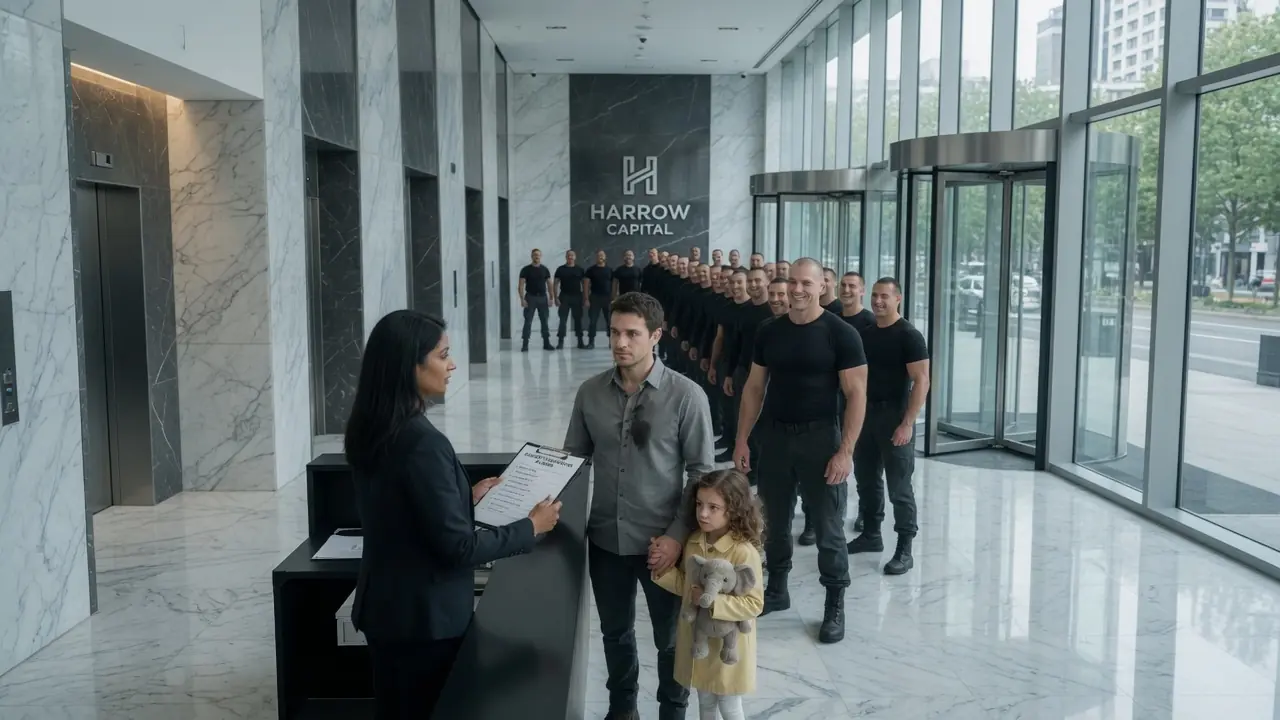
The first thing Damien Cole did when he walked into Harrow Capital’s lobby was set his daughter down and smooth the front of her coat.
The second thing he did was look up.
Forty-one men stood in the lobby in two straight lines, every one of them built like a statement.
Former special operations, professional fighters, men who got paid to look like trouble and had spent years getting very good at it.
They wore dark fitted clothes and the particular kind of stillness that men perform when they want to be mistaken for dangerous.
Damien was wearing a gray shirt with a small stain near the second button.
His daughter, Zara, was six years old, and she was holding a stuffed elephant named Blue with one arm missing.
The laughter started before the door finished turning.
Someone near the back said it loud enough to carry.
“Is this the wrong floor? I thought this was security, not daycare.”
A man named Victor Bram laughed the hardest.
Victor was thirty-seven, a former UFC contender, current head of personal security for three separate high-net-worth clients.
He had won this contract before the tryout started, at least in his own mind.
He crossed the lobby in seven steps, stopped two feet in front of Damien, and let the size difference do the talking.
“You lost, friend.”
Damien looked at him, not past him, not through him.
At him.
The way a man looks at a problem he has already solved.
“I have an appointment at 9:00.”
“You have a child.”
“Both things are true,” Damien said, and walked around him.
The registration desk sat at the far end of the lobby.
A young woman named Priya held a clipboard with forty-two names on it.
She looked at Damien, then at Zara, then back at Damien without expression.
“Damien Cole.”
Priya ran her finger down the list.
She stopped.
Her expression changed by approximately two millimeters, which was more than she probably intended.
The name Damien Cole sat at the very top of the roster, added the previous evening, added personally by Raina Vasquez, CEO of Harrow Capital, and the reason this tryout was happening at all.
Priya handed him his badge without further comment.
Zara was escorted to a side room near reception, where someone had set up a low table, two coloring books, and a cup of apple juice that Zara regarded seriously before sitting down and opening the book to the first clean page.
She placed Blue on the chair beside her and began to draw without being asked.
Damien walked into the main hall.
Each candidate stood at a desk for three minutes with a single interviewer and a list of situational questions.
No preparation. No prompts.
The men before Damien arrived holding printed credentials, laminated incident reports, framed certifications in plastic sleeves.
One of them had brought photographs of himself with two former senators and a professional athlete.
Damien came to the desk with nothing.
The interviewer, a thin man named Garrett, who had been running security assessments for eleven years, looked up.
“Documentation.”
Damien set a single sheet of paper on the desk.
One phone number. One sentence.
Contact this number for verification.
Victor Bram, standing nearby with his arms folded and the particular energy of a man who had decided to have a bad morning, let out a short sound through his nose.
“You’re serious with that.”
“Yes,” Damien said.
The response assessment followed.
Each candidate watched a ninety-second simulation video: a crowded event space, multiple actors moving through the frame, a principal in the foreground, and had thirty seconds to identify threats and describe a response.
Victor watched the video, paused two seconds, and named five of the eight marked threat positions.
He spoke with precision and confidence.
The room gave him a quiet nod of approval.
Damien watched the video once.
He stood with his hands at his sides, and when he spoke, his voice was the same temperature it had been all morning.
“Eight marked positions, three unmarked. The support column on the right side at eleven o’clock creates a clean approach corridor that isn’t covered by any of your identified sightlines. The man in the blue jacket near the bar has shifted his weight off his right foot four times in ninety seconds. He’s waiting for something, and the woman at the door is watching the principal, not the room. She’s not security. She’s a signal.”
The room went quiet.
Garrett stared at the paper in his hands for a moment before writing anything down.
Victor looked at the wall.
Upstairs on the thirty-second floor, Raina Vasquez was watching the assessment feed on a monitor above her credenza.
She sat straight-backed in a chair with a notepad she had not written on in twenty minutes.
Her assistant, Tomas, stood near the window with the careful posture of someone who had learned when to say nothing.
“He identified eleven positions,” Tomas said quietly.
“He identified twelve,” Raina said, “including the one Garrett didn’t mark.”
She picked up her pen, then set it back down.
On the monitor, Damien had returned to his seat and was sitting with the same expression he had had since arriving.
Not performing patience.
Not managing anyone’s perception of him.
Simply present in the way that people almost never are.
Raina had met hundreds of people in twelve years of running Harrow.
She had never met anyone who appeared to have no interest in impressing her.
That single fact held her attention more completely than anything she had seen all morning.
She picked up her phone.
The physical bracket was posted at 10:40.
Most matchups were balanced.
One was not.
Victor Bram’s name sat next to Damien Cole’s in the first round.
This was not accidental.
Marcus Webb, acting head of security and the man who would lose his position if this tryout produced a result he did not control, had arranged the bracket himself.
If Victor removed Damien cleanly in the first round, the whole problem resolved itself before lunch.
It was logical.
It was also the kind of thinking that works perfectly until it does not.
Victor read the bracket and felt nothing except confirmation.
He had ended three matches already that morning, all within forty seconds, all with the same approach: close, control, finish.
He was not cruel about it.
He simply did not think of this particular match as a match.
The candidates arranged themselves around the edge of the mat.
A few pulled out phones.
The room had the anticipatory energy of people who had agreed collectively to watch a short and predictable outcome.
Zara had stopped drawing.
She stood at the narrow window in the waiting room wall, both hands on the glass, Blue tucked under her elbow, watching without a sound.
The young staff member beside her glanced down.
“Is your dad good at this kind of thing?”
Zara considered the question the way she considered all questions, fully and without rushing.
“He doesn’t lose,” she said, “but he never says that.”
Victor came forward without hesitation.
He applied his sequence the way he always applied it.
Closed the distance. Established grip. Controlled weight. Transferred momentum.
It had worked forty-one times in professional competition.
It had worked three times already this morning.
He reached for Damien’s shoulder.
Damien moved back, not retreating.
One step, precisely calibrated, shifting his weight to the outer edge of his left foot in a way that redirected Victor’s approach angle by approximately eight degrees.
Barely visible, but Victor’s grip closed on air.
Victor recovered and came again.
By the ninth second, something in the room had changed.
The phones were still raised, but the people holding them had stopped anticipating the outcome and started actually watching.
Raina had come downstairs.
She stood at the entrance with Tomas two steps behind her, and she did not look at Victor once.
She was watching Damien’s eyes.
They were not tracking movement the way a fighter’s eyes usually tracked, reactive, following hands and feet.
They were still.
He was reading something deeper, something below the level of individual motion.
Victor attacked again, a third time.
Each time, Damien offered him a fraction of an opening, a half step of apparent vulnerability.
And each time, the follow-through arrived and found nothing.
Raina’s right hand found the wall beside the door without her noticing.
At the seventeenth second, Damien’s eyes changed.
A slight contraction.
He had seen what he needed to see.
He had spent sixteen seconds not fighting Victor Bram.
He had spent sixteen seconds learning him.
At the eighteenth second, he stepped in instead of back.
What followed happened faster than most of the room could track cleanly.
One hand controlled Victor’s elbow at the joint.
The other made a small, decisive adjustment to his center of gravity.
Not a throw in the traditional sense, but a redirection so exact that Victor’s own momentum carried him to the mat before his body understood what was happening.
Victor Bram, former UFC contender, landed face down and did not move.
Total time: twenty-three seconds.
No one spoke.
Damien released his hold, checked his hands once, a mechanical reflex, and stepped off the mat.
His breathing had not changed.
Marcus Webb was holding a sheet of paper that had fallen from his hand.
He did not seem to notice the sound it made against the floor.
Zara appeared at the main entrance eleven seconds after the room went silent.
She had slid from her chair the moment she heard stillness instead of noise.
She crossed the floor to Damien with the focused urgency of a six-year-old who had somewhere important to be.
“Dad, are you done?”
Damien crouched to her level and looked at her face with the same attention he gave to everything.
“All done.”
“Can we get a muffin?”
“We can get a muffin,” he said.
He stood, took her hand, and walked toward the hall exit.
Behind him, Victor was being helped to his feet by two other candidates who were doing their best to appear unsurprised.
Raina walked back to the elevator without a word.
Tomas fell into step beside her, and for the length of the corridor, neither of them said anything.
Then Tomas said, very quietly, “His breathing didn’t change.”
“I know,” Raina said.
She pressed the elevator button.
“Check whether the muffins are still out in the third-floor kitchen.”
Tomas looked at her.
“For the girl,” Raina said.
The doors opened.
She stepped in.
She called him up before the bracket finished.
The other forty candidates were still in the main hall when Tomas appeared at the door and asked Damien Cole to follow him.
Victor Bram watched this happen from across the room with an expression that had passed through anger and arrived somewhere quieter.
Marcus Webb opened his mouth.
Tomas had already turned toward the elevator.
The thirty-second floor was quiet in the particular way expensive buildings were quiet, not silent but managed.
Raina’s office held the northeast corner, floor-to-ceiling glass on two sides returning the city in clean rectangular frames.
Her desk had three items on it, nothing else.
Zara walked in, stopped, and turned a slow half circle, assessing.
“It’s nice,” she said. “But there’s no color in here.”
Raina, who had been watching Damien from behind the desk, looked at the girl.
Something passed across her face that she did not organize quickly enough to control.
“I know,” she said.
Zara accepted this and sat in the chair beside her father, opened a small notebook from her coat pocket, and began to draw.
Raina slid a folder across the desk.
“Sit down.”
He sat.
She asked about the technique.
He said it came from specific training in specific environments and did not elaborate.
She asked about his service record.
He said it was in the folder she had already reviewed.
She asked why he had left active service four years ago.
He was quiet for two seconds.
“Personal reasons.”
She watched him.
He was telling the truth.
She could see it the same way she could see when someone across a negotiation table was lying, the particular quality of stillness that accompanied an honest answer that cost something.
“What salary are you asking?”
He gave her a number, reasonable, not strategic.
It was the number of a man who had thought about what the work was worth, not what the room would bear.
She signed the contract without negotiation.
The first week, Damien moved like weather.
Present. Pervasive. Unprovoked.
He stayed exactly one step behind Raina and one step back, a positioning so correct that she noticed it on day two and said nothing because there was nothing to say.
It was how it was supposed to be done.
She had spent nine years finding ways to move around her security details.
She did not find herself doing that now.
She also noticed that he did not look at her the way most people looked at her.
The particular voltage that accompanied proximity to power, that low-grade performance posture, was absent.
He was not positioned toward her because she was important.
He was positioned toward her because she was his responsibility.
It took her four days to name the difference.
On the sixth day, she received the message.
It came through her personal email at 11:47 at night from an address that resolved to nothing when her team traced it.
The subject line was blank.
The body contained six words and one attachment.
You are not who they want.
The attachment was a forty-page document.
Inside were timestamped communications between three of her senior board members and a private equity group called Celadon Partners.
The communications stretched back fourteen months.
They described, in procedural language that was careful enough to be deniable and specific enough to be damning, a plan to restructure Harrow Capital’s leadership ahead of a forced acquisition.
The plan had a timeline.
The timeline was nine days away.
Raina read it twice, sitting at her kitchen table at midnight.
Then she sat for a long time without moving.
Damien was standing near the window when she looked up.
He had been there since she opened the attachment.
She had not heard him arrive.
“Did you know about this?” she said.
“Not the document,” he said, “but I’ve been watching Marcus Webb for four days. He has a contact number in his phone that doesn’t belong to Harrow. He used it twice yesterday and once this morning. And there’s an eleven-minute gap in the parking-level security footage from Tuesday night that shouldn’t exist.”
Raina looked at him.
“You’ve been building a parallel file.”
“I can’t protect you if I don’t understand what’s moving around you,” he said.
She looked at the document on the screen.
Then she looked back at him.
“How long do we have?”
“If the timeline in that document is accurate, eight days.”
She closed the laptop.
“Then we have work to do.”
They met with a private attorney the next morning, a woman named Castellon who operated out of a one-room office in a building with no lobby directory.
Raina spread the document across the desk.
Castellon read it without expression for eleven minutes.
“This is enough,” Castellon said, “if it’s authentic.”
“It is,” Raina said.
“You’ll need origination. You need to know who sent it to you and why.”
Raina looked at Damien.
He said, “Working on it.”
The source turned out to be a retired intelligence officer named Broderick Saul, who had spent twenty-two years running financial counterintelligence operations.
Saul had been watching Celadon Partners for three years before Harrow Capital entered the picture.
He had sent the document because he had a file on Damien Cole, and the file told him that Damien Cole was the right person to be standing next to Raina Vasquez when this happened.
Raina read the name in the report, sat back in her chair, and said to the empty office, “Someone built a play around me, and I didn’t see it until it was already halfway finished.”
Damien said from the door, “You saw it when it mattered.”
She looked at him.
He was not offering comfort.
He was stating a fact.
There was a difference, and she had come to recognize it.
The emergency board session was scheduled for a Wednesday.
Three board members had filed the agenda request through proper channels, framing it as a routine performance review.
But Damien had been tracking the peripheral activity for six days, and what he saw in the forty-eight hours before the session was not consistent with a routine anything.
Two access badges registered to a consulting firm that did not appear in Harrow’s vendor database had been used to enter the building after hours.
A service elevator on the seventh floor had been accessed on three separate occasions by maintenance credentials that had not been checked out through the standard system.
And on Tuesday night, a motion sensor on the executive floor had logged a presence for four seconds before stopping, which meant it had been overridden, not triggered and cleared.
Someone was planning to access Harrow’s central client server during the board session, when every decision maker in the building would be in one room facing one direction.
Damien had forty minutes.
He moved through the building without running, without drawing attention, with the particular focus of a person who has committed to a route entirely.
He cleared the lower floors, confirmed the boardroom was secured, placed Tomas at Raina’s side, and went to the executive floor by the fire stairwell at the back of the building.
They were already there.
Three of them, professional, unhurried, moving toward the server room with the confidence of people who had been told the floor would be empty.
It was not empty.
The first two were controlled before the third had processed what was happening.
The third came from the right with a technique that suggested military background.
Good technique. Decisive angle.
Damien had anticipated the direction from the team’s formation the moment he stepped onto the floor.
The third man lasted nine seconds.
Marcus Webb appeared from the eastern corridor.
He was holding a phone instead of a weapon.
His expression had the particular flatness of a man who had arrived at a moment he had rehearsed and found it different than expected.
“You should stand down,” Marcus said. “This is bigger than a security contract.”
Damien looked at him.
His right forearm had taken a hit in the last exchange.
He registered it and moved on.
“The people you’re working with, they already have what they came for.”
Marcus said nothing.
“They don’t,” Damien said, “because the server they’re trying to access has been isolated since 6:00 this morning. Everything they pull from it is a blank.”
Marcus stared at him.
“I rebuilt the access architecture yesterday,” Damien said. “Raina approved it at 5:00 a.m.”
The sound of footsteps on the fire stairs announced the building security team’s arrival ninety seconds later.
Marcus Webb sat against the wall with his hands immobilized and the expression of a man who had bet everything on an outcome that no longer existed.
In the boardroom, Raina was sitting at the head of the table with twenty-seven shareholders and three board members arranged in front of her.
She had received the update through a text from Tomas sixty seconds earlier.
She had absorbed it, organized her face, and let the meeting continue.
One of the three board members, a man named Farrell, had been speaking for four minutes about performance metrics.
She let him finish his sentence.
Then she said, “This session will need to be adjourned. Law enforcement is currently on the executive floor. The reasons will be clear within the hour.”
She looked at Farrell and the two men beside him with the direct attention of someone who had finished being patient.
“You’ll also want to arrange separate legal counsel before end of day. Not firm counsel. Personal.”
Farrell went the color of unfinished concrete.
“I’ve been building the file,” Raina said, “for six days.”
Damien declined the first ambulance with the same energy he applied to most things he did not need.
The cut on his forearm required eight stitches, and the forearm itself required an X-ray to confirm nothing structural had happened.
Raina drove him to the hospital herself and gave his insurance information to the intake desk from memory, a fact she had not mentioned to him.
In the exam room, while they waited, she took gauze from the supply shelf and began working on the cut herself.
He watched her for a moment.
“You know how to do this?” he said.
“No,” she said, “but I’m a fast learner.”
He said nothing further.
Zara arrived thirty minutes later with Tomas, who had called three sitters before finding one, and then driven over anyway when the sitter took too long to arrive.
She came through the door with Blue under her arm and covered the distance to her father’s bed in approximately four steps.
She held his hand for a long moment without speaking.
Then she looked at Raina with the deliberate assessment she applied to questions that mattered.
“Is Ms. Raina why Dad got hurt?”
Damien said, “Dad got hurt because of what his job needed him to do.”
Zara processed this.
The logic was acceptable.
She turned back to Raina and studied her face for a moment, finding something there she was looking for.
“Can you stay? I don’t like it when Dad is hurt and I’m the only one here.”
Raina looked at Damien.
He was studying the ceiling tile above the bed with focused, unnecessary attention.
She pulled the chair closer.
“Okay,” she said. “I’ll stay.”
By 10:00 at night, the corridor was mostly quiet.
Zara was asleep on the waiting room bench across the hall, Raina’s jacket folded under her head, Blue tucked against her chin.
Raina sat without moving, her hand resting lightly on the edge of the bench near the girl’s shoulder.
Damien stood in the exam room doorway, cleared for discharge.
His arm had been properly dressed.
He was wearing a clean shirt Tomas had retrieved from his apartment along with Zara’s things.
He stood in the doorway and watched them in the yellow corridor light and did not speak.
Raina looked up.
Neither of them said anything for a long moment.
The city made its usual sounds through the window at the end of the hall: distant traffic, the low harmonic of a place that did not slow for ordinary emergencies.
Damien walked back in and sat on the other side of the bench so that Zara lay between them, with Blue at the center.
After a while, Raina said quietly, “She added something to the drawing she gave me, the one from the waiting room on the first day.”
He waited.
“She came into my office this morning before I arrived,” Raina said. “She added two figures to it. One of them was mine.”
Damien was quiet.
The corridor light made a low, even sound above them.
Zara breathed in the slow, deep rhythm of a child who trusted entirely and without condition that whatever held the world was holding it now.
For the first time in that long and broken day, the corner of Damien Cole’s mouth moved.
It was small. It was quiet.
And in the way that real things always begin, it was unmistakably a beginning.