No birdsong. No wind through the trees. Only brittle grass snapping underfoot and the distant trickle of a narrow, half-frozen river.
The sky was the color of burned tin, cloudless and heavy, not snow yet, but close.
Harlon Tate squatted near the fire ring he had built three weeks earlier when he first set camp along a forgotten bend of the Verde River. He stirred a dented tin pot of beans with a pocketknife, his other hand resting on his knee. His battered Henry rifle lay across a rolled saddle blanket within reach.
No one had come through this part of the valley in days.
He liked it that way.
Harlon was thirty-eight years old, and every year showed on his face. The scars on his knuckles and jaw were reminders of bad orders, frostbite, and fights he never started. He had been a scout in the Union Army during the final years of the war, then stayed on as a tracker for officers who did not remember his name but trusted his eyes.
When that work dried up like the riverbeds, he wandered south, trapping mules, avoiding towns, and speaking to no one unless he had to.
He had not spoken to another person in two and a half weeks.
That afternoon, he stood slowly, brushing dirt from his knees, and moved toward the river with an empty canteen and a tin cup. He stepped over dry roots and sun-bleached bones. The air smelled of wood smoke and creosote. Cold clung low to the ground.
That was when he saw her.
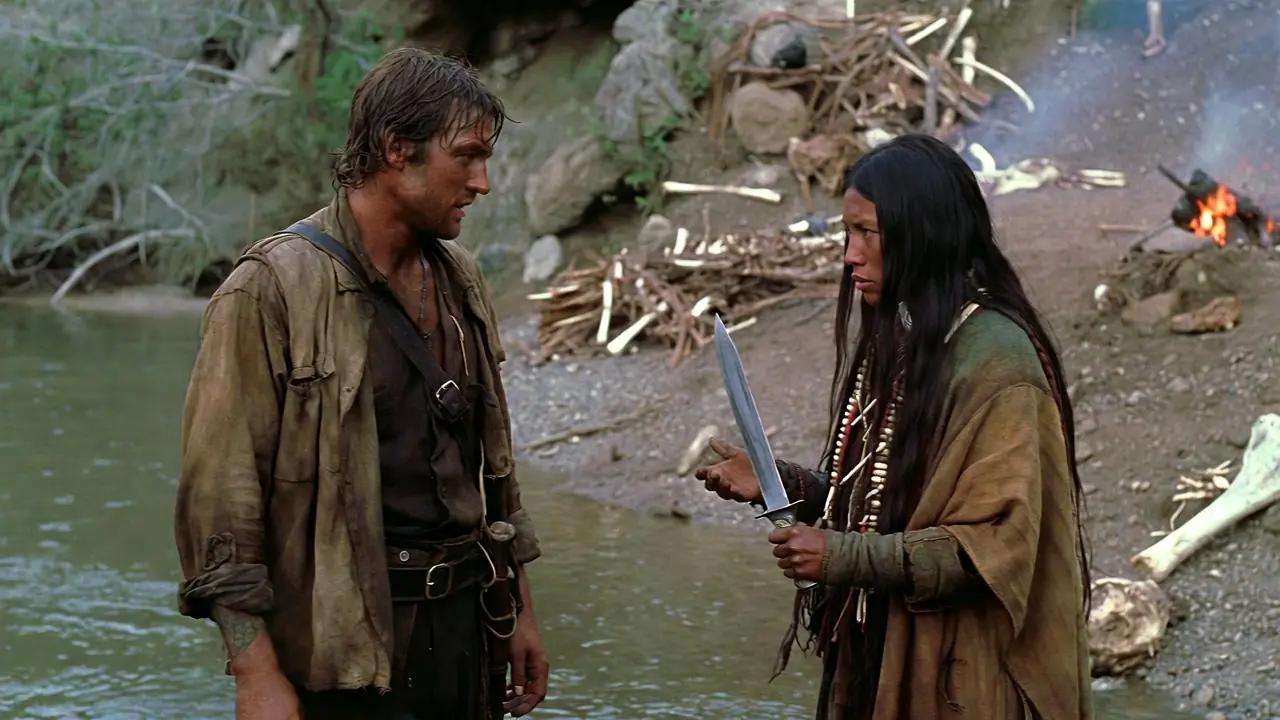
She stood in the shallow water near the bend, ankle deep and half turned away. Her dress was patched leather with beadwork and frayed seams, torn along one side and damp from the river. Her long dark hair hung wet down her back. She was young, mid-twenties perhaps, barefoot, shivering a little in the wind, but not helpless.
Her hands moved with control.
Harlon stopped twenty feet away.
His heart kicked hard in his chest.
Not desire. Not at first.
Instinct.
Do not move.
Do not speak.
Do not spook her.
He looked down the trail behind her. No horse. No pack. No one else. A lone Apache woman this far from the known routes, with no supplies and no escort, did not happen by choice.
His jaw tightened.
Then the edge of his boot crunched on gravel.
Her head turned.
Their eyes met.
Harlon did not raise his hands, but he did take one step back. Not in fear. As a gesture. A way to give her space.
“I did not mean to startle you,” he said, voice low and steady. “Only came for water.”.
She did not move. She did not reply.
Her gaze was direct, calm, almost challenging. Not hostile, only unflinching. Her chin lifted slightly, as if to say, You saw. Now what?
Harlon was not good with words. Not even when they mattered.
So he turned away and walked back toward camp.
If she wanted to run, she would.
If she wanted to follow, she would.
He was not going to ask why.
By the time he reached the fire pit, he could hear her walking behind him, bare feet careful in the brush. He did not turn around. He poured water into the bean pot, added wood to the fire, sat down cross-legged, and waited.
She appeared three minutes later and stayed just outside the circle of warmth.
Her dress clung to her legs, damp and worn. One shoulder seam had torn halfway down her arm and been pinned badly with sinew. Scrapes marked her elbows. A bruise darkened just below one knee.
He did not ask what had happened.
But he was sure now.
She had been cast out.
Harlon nodded toward the fire.
“Sit if you want.”.
She walked over, knelt across from him, and rested on her heels.
He handed her a spare tin cup, clean and warm from rinsing. She held it without drinking.
“I have beans and coffee,” he said. “Not much else.”.
She did not answer, but she stayed.
They sat nearly twenty minutes in silence, watching the fire rise and settle. Harlon tried not to stare, but he noticed her hands. Slow, methodical, like she was forcing herself to remain calm.
“You alone?” he asked.
She did not look at him, but she nodded.
There was pain in her eyes. Quiet and deep, buried under discipline.
Harlon did not press. He had known enough wounded people to understand that questions could feel like knives.
“You are welcome to rest here tonight,” he said. “I will keep the fire going.”.
This time, she looked directly at him.
There was no gratitude in her expression. Something closer to quiet acknowledgment, as if they both understood what neither one was saying.
He stood, walked to his tent, and pulled out a spare canvas sheet. He rigged it between two poles on the opposite side of the fire, enough to block the wind and give her space. Then he laid out a second blanket and stepped back.
She sat on it slowly and wrapped it around her shoulders.
That night, Harlon did not sleep much. He lay inside his tent, watching firelight flicker against the canvas and listening to her breathing beyond the windbreak. Steady. Not afraid.
He wondered why she was out there. How she had survived so long. Whether someone had chased her, and whether someone was still looking.
Then he thought about his own past: the war, the patrols, the bodies, the orders that never made sense once the blood dried.
He never got answers, so he stopped asking.
Out here, nothing made sense either, but at least nothing lied.
By first light, she was already up, kneeling near the river and tightening the sinew belt around her waist. Harlon stayed by the fire, not wanting to crowd her. When she came back, her eyes flicked toward the rifle leaning against a log.
He saw the glance.
She wanted to know whether it was meant for her.
Harlon picked up the rifle slowly and set it inside the tent flap.
She sat by the fire again without a word.
That was the first sign of trust.
He handed her another cup of coffee, this time thickened with a little ground corn. She sipped slowly, warming her hands around the tin.
There were thin cuts on her palms, the kind a person got from moving too long through brush without proper tools.
“How long you been out here?” he asked.
She looked at him, then held up both hands. Ten fingers. Then two more.
Twelve days.
Harlon nodded slowly.
Twelve days in the high country this time of year with no coat, no boots, and no fire.
That was not wandering.
That was running.
Later that morning, he saw her trying to patch the hem of her dress with a sharpened sliver of bone. Her hands were quick but clumsy with the tool.
He crouched nearby, not touching.
“You need a needle. I have one.”.
She did not answer, but she did not stop him.
He came back with his kit: needle, sinew, thread, a few strips of canvas. He handed them over without comment.
This time, she looked him straight in the eyes.
After a long pause, she spoke one word.
“Taya.”.
Her name.
Harlon nodded.
“Harlon.”.
She did not repeat it. She only gave one slow blink, then went back to sewing.
That afternoon, she repaired most of the worst tears. She still had not asked to stay. He still had not asked her to leave. That part settled itself in silence.
People did not end up out here unless they had nowhere else to go.
Later, while she gathered wood from the treeline, Harlon sat by the fire sharpening his knife. He watched the way she moved, cautious but not fearful. She did not flinch at sound. Whatever had driven her out had not broken her.
When she returned, she dropped the sticks neatly by the fire and sat across from him.
Harlon finally asked what had been sitting in his mind since she arrived.
“They send you out?”.
She nodded once, slowly.
“For what?”.
At first, she did not answer. Then she reached inside her dress and pulled out a small carved wooden piece, worn smooth. It looked like an elder man’s face.
She dropped it into the fire.
Harlon watched it burn.
No questions.
Taya stared into the flames. Her voice came low, rough from disuse.
“I said no.”.
That was all.
But Harlon understood enough.
Some elder had chosen her. She refused. They called it dishonor. And out she went.
She did not cry. Did not tremble. She only watched the carved face blacken and crumble in the coals.
That night, Harlon unrolled another blanket and added it to her bedding without comment. She gave him a long look, then lay down beneath the shelter he had made.
When coyotes called from the hills, neither of them stirred.
On the third day, Harlon went hunting before dawn. If she was staying, and it seemed she was, beans would not be enough. He snared one rabbit and shot another, then returned by midday to find smoke already rising from the fire.
Taya sat by the ring, stoking it carefully.
She did not look up, but he knew she had heard him long before he appeared.
He dropped the burlap sack beside the fire. She leaned forward, peeked inside, and the faintest smile passed over her face.
Gone in a breath.
But he saw it.
He cleaned the rabbits slowly, letting her watch if she wanted to learn. She observed without interruption. When he laid the meat over hot stones, she handed him a twig of desert sage.
She knew how to season it.
That told him something else.
She had not grown up sheltered. She knew how to live out here, even if she had not expected to be alone.
While the meat cooked, Harlon sat across from her.
“I was in the cavalry,” he said plainly. “Did six years. After that, I scouted and tracked for officers and survey crews. Saw too many things I did not want to see. Got tired of men giving orders who did not bleed for them.”.
Taya met his gaze.
“I left,” he continued. “Rode south. Took up trapping. Did not want to be around people anymore. They asked too many questions.”.
She finally spoke.
“Why me, then?”.
He paused.
“Did not plan it. Did not mean to see you. But once I did, I figured you looked like someone who was not trying to be seen either.”.
She nodded once, as if that answer made sense.
That afternoon, they worked side by side without ever saying they would. She fetched water. He mended the tent flap. She scraped bark from firewood. He taught her how to tie a better windbreak using stones and rope.
They did not smile much.
They did not joke.
But they moved like two people used to surviving, and now, for the first time, not surviving alone.
That night, she handed him the feather she usually kept in her hair. It had been cleaned, straightened, and tied with a loop of leather.
Harlon held it, uncertain.
Taya pointed to the tent, then the windbreak, then back to the feather.
Not a trade.
Not a gift.
A statement.
I am not a burden. I am part of this now.
Harlon nodded and took it seriously. He tucked the feather into a notch above the tent entrance where the wind could not catch it.
That night, the fire felt warmer.
Not because of the heat.
Because the silence was not empty anymore.
On the fourth night, the cold came harder. The wind pressed low over the valley, the kind that worked patiently into bone.
Harlon had already begun thinking differently.
If we are staying.
Three weeks ago, that thought would have made him laugh. He did not stay anywhere long. But now there was Taya: quiet, watchful, close. Not dependent. Present.
That night, with the wind cutting through the camp, Harlon pulled his bedroll beside hers across the windbreak. She watched him quietly, then shifted just slightly so her back was nearer the edge of his blanket.
Not touching.
Not quite.
He lay down, eyes on the stars.
Minutes passed.
Then, in a whisper so quiet he almost missed it, she said, “They tried to trade me like I was nothing.”.
He did not turn. He only listened.
“I was not his. I said no. That was enough.”.
Harlon’s throat tightened. He offered no pity. No empty words.
Instead, he said something he had not said in years.
“You are safe here.”.
She did not move, but her breathing slowed.
For the first time since she had come to his fire, she slept without her hand resting near the knife tied in her boot.
The next morning, the land changed.
No birdsong at first light. No wind. No ordinary movement in the brush.
Harlon felt it before he named it.
Taya was already awake, sitting upright with her eyes fixed toward the ridgeline. She had felt it, too.
He took the Henry rifle and climbed the slope, moving lightly through the brittle grass. At the crest, he crouched low and swept the valley with a rusted spyglass.
A mile away, three riders moved through the low brush. One had dismounted and was checking the ground. The other two waited with rifles across their laps.
Harlon cursed under his breath and backed away.
By the time he reached camp, Taya was already packing. Food, blanket, knife. Calm. Prepared.
“They are not scouts,” Harlon said. “One is checking tracks. Could be looking for you.”.
She nodded.
“South?” he asked.
She nodded again.
They moved within ten minutes. Harlon left the fire ring unbroken and scattered false tracks north. Then he led Taya through the stream for a quarter mile to break their trail.
When they stopped under dry mesquite, she finally spoke.
“They are not from my people. But they work for him.”.
Harlon did not need her to explain who him was.
“You think they will keep coming?”.
“He is too proud to let me go.”.
Harlon nodded.
“Then we do not let him find you.”.
They kept moving until evening, then took shelter in a narrow gulch with one way in and one way out. They did not light a fire. They ate dried meat and cold beans beneath a sky crowded with stars.
After a long silence, Taya asked, “Why did you really leave the army?”.
Harlon answered honestly.
“Because I saw men die for things they did not understand. Land they would never live on. Flags that did not care about their names. I figured if I kept going, I would stop caring, too.”.
Taya looked at him.
“But you do care.”.
He did not answer.
The next morning, they reached a bluff overlooking a basin of shale and boulders. Harlon scanned with the spyglass.
Movement.
One rider first. Then two more behind.
“They are coming,” he said.
“How many?”.
“Three.”.
Taya did not flinch.
“If we cross now, they will catch us halfway. Better to hold here.”.
She nodded.
“We stand.”.
They hid among boulders at the mouth of the basin. Harlon held the Henry across his knees. Taya pressed flat against the stone, knife in hand.
The riders appeared.
The first was lean, with a long coat and a brown hat. The second had a scar across his jaw and a stiff right leg. An old tracker, the kind soldiers used when they did not want officers involved.
Harlon raised the rifle and lined up the shot.
Then he hesitated.
Not because he could not do it.
Because this was not war anymore. These were not orders. This was survival, but it was personal now, and Harlon had spent years trying not to become a man who killed without thinking.
Taya’s hand touched his arm lightly.
Not pushing.
Not pulling.
Grounding him.
He breathed in.
Fired.
The shot cracked across the basin. The first rider dropped from the saddle. Return fire came fast. Taya slid low behind another rock, flanking one of the shooters. When the third man advanced, she rose and threw her knife clean into his thigh. He screamed and dropped.
Harlon took the opening.
One final shot through the shoulder of the last man standing.
Silence followed.
All three men were down. Two alive, groaning. One dead.
Taya retrieved her knife and cleaned the blade on her boot.
Harlon watched her.
“You have done that before.”.
“My uncle taught me. He trained warriors. I was not supposed to learn.”.
After a long moment, Harlon said, “You saved us.”.
She looked at him.
“You hesitated.”.
“I did.”.
She studied him, then said, “Good.”.
That night, they camped deep in a dry ravine. No fire. Only moonlight. Harlon wiped down the Henry while Taya cleaned her blade.
“You left the killing behind,” she said.
“I tried.”.
“But you still did it.”.
“You needed me to.”.
She nodded.
“Now what?”.
“We move again. There is a canyon farther south. Quiet. No trails. If we make it by week’s end, we will be safe for a while.”.
She did not answer, but when she lay down that night, she moved closer. Just enough for her hand to brush his sleeve.
He did not pull away.
Neither of them said the word home.
But for the first time, it did not feel impossible.
They reached the canyon by late afternoon the next day. It was barren, bleached stone and scrubland backed by high cliffs. Hidden against the rock face was a shallow cave with dry ground, shelter from wind, and a spring-fed pool nearby.
“That is the spot,” Harlon said.
They unpacked in silence. Tent stakes. Canvas. Rope knots. Firewood stacked low. Taya arranged rocks around the cave mouth like a boundary, marking it as lived in.
That evening, after the fire was built, she took the water pot and gestured toward the spring. Harlon walked with her, behind and to the side, close enough to guard, far enough not to crowd.
At the pool, she washed her face and arms. He turned away to give her privacy.
When they returned, the silence between them had changed again. Something gentler had entered it. Not desire rushing ahead of trust, but a slow understanding that both of them had chosen the same direction.
The next morning, Harlon checked the perimeter. No prints. No smoke. No horses.
Still, Taya asked, “You think they will come again?”.
“Maybe.”.
“If they do, it will not be three. Four men left that camp. You saw three. The fourth is older. Quiet. Smarter. He waits and finds the gap.”.
Harlon lowered the rifle.
“Then we move.”.
She shook her head.
“He will find us. I want to finish it.”.
It was not bravado.
It was resolve.
So they prepared as if they meant to stay. Harlon set traps at the canyon entrance. Taya laid thorn clusters in the brush. They found high ground, lines of retreat, and stones for defense.
Just before dawn, the fourth man appeared.
He came on foot, silent, emerging from the ridge like he had always been there. Gray coat. Wide-brim hat. Flintlock pistol. No wasted motion.
A killer.
He stopped beyond easy range and called, “I only want the girl. You walk away now. No blood.”.
Harlon stepped out from the cave mouth, rifle lowered.
“She is not going with you.”.
The man smiled without warmth.
“I do not need her alive.”.
Taya appeared beside Harlon, not behind him. Knife in hand. Jaw clenched. She did not shake.
The man laughed once.
“She yours now? Think you will keep her safe forever?”.
Harlon did not answer.
The man moved first. Fast. Smart.
But not smart enough.
The shot echoed across the basin.
When the dust settled, the man lay still.
Taya exhaled slowly. Her shoulders lowered for the first time in days.
“It is done,” she said.
Harlon nodded.
She stepped close, laid her head against his chest, and for the first time since he had left the army, Harlon Tate did not think about where he would go next.
He was already there.
The days that followed brought rhythm, and this time, it was intentional.
They were not only surviving now. They were building.
Harlon reinforced the cave entrance with logs and packed dirt, not a fort, not a prison, but a home. Taya shaped clay pots from red mud by the spring and dried them in the sun, smoothing the surfaces with river stones. When Harlon passed by, she always looked up and met his eyes.
That was enough.
They learned each other’s habits in silence. He cleaned his rifle in the morning. She braided her hair before dusk. He liked to stand watch after dinner. She slept with one hand beneath the blanket, close to the knife, but not wrapped around it anymore.
They did not ask why.
They only knew.
One evening, a dust storm rolled from the north. The sky turned old copper, and grit stung the skin. They dragged everything into the cave, sealed the entrance, and sat facing each other while the wind howled outside.
Harlon looked at her for a long time.
“I never thought I would come this far south and find anything worth staying for.”.
Taya’s eyes softened.
“You did not find it,” she said. “You made it.”.
He nodded.
“With you.”.
After a beat, she asked, “Do you still feel like you have to leave someday?”.
Harlon exhaled.
“No. I thought peace meant distance. Silence. Being alone long enough that nothing could touch me. But I was wrong. Peace is choosing to stay, even when you have a reason to run.”.
Taya reached forward and touched his face, her thumb brushing the line of his jaw.
Then she kissed him, slow and certain.
Not desperate.
Not afraid.
For the first time in decades, Harlon was not afraid of being seen. The quiet, the guilt, the scars — she saw all of it.
And she stayed.
Weeks turned to a month.
They built a smoke rack for drying meat, gathered stones for a wind wall, and planted yucca near the waterline. One day, a mule wandered into the ravine, lost from some ranch farther north. Harlon caught it gently and tied it near the spring.
“We could trade it,” he said.
Taya was quiet.
“Or we could keep it.”.
He nodded.
So they kept it.
In time, she gave him a small leather pouch sewn from scraps of her old dress. Inside was the burned fragment of the wooden totem she had once thrown into the fire.
“This is the last thing I carry from them,” she said.
Harlon held it carefully, then placed it on the small shelf they had carved into the cave wall between dried meat and fire flint.
“We do not have to forget,” he told her.
“No,” Taya said. “Only move forward.”.
That night, they lay beside the fire with the storm gone and the desert quiet around them.
“This is enough,” she said. “Even if nothing else comes.”.
Harlon wrapped an arm around her and pulled her close.
“It is more than I ever thought I would have.”.
No gunfire.
No orders.
No fear.
Only two people beneath one sky, in a place they chose, with no one left to take it from them.