For three hundred years, the House of Ashbourne had ruled the northern counties of England with a hand gloved in velvet and weighted with iron. Its dukes did not shout in Parliament. They did not beg at court. They did not need to. A single lifted brow from an Ashbourne could cool a cabinet minister’s enthusiasm, delay a royal marriage, or send a lesser nobleman’s heir into a regiment bound for foreign shores.
But on the night King Edmund III collapsed in the chapel of St. James’s Palace, even the Ashbournes discovered that power, however ancient, could tremble.
The bells did not ring at first. The palace physicians were summoned in silence, their black coats pulled over nightshirts, their hair tied hastily beneath powdered wigs. Servants crossed corridors with their eyes lowered and their mouths shut. Footmen who had spent their lives pretending not to hear secrets now heard nothing at all, which frightened them more.
By dawn, London knew only one thing: the King was alive, but he could not speak.
By noon, it knew the second: His Majesty’s only legitimate son, Prince Adrian, was twenty-one years old, handsome, clever, beloved by the people, and considered by half the court entirely unfit to rule.
By evening, it knew the third: the Duke of Ashbourne had arrived.
He came in a carriage the color of old blood, drawn by four black horses, with the Ashbourne crest painted upon the door. A silver hawk with its talons sunk into a crown. No one in the palace needed to ask why he had come. His Grace never hurried unless something precious was nearly lost.
And the kingdom was now precious.
Lady Evangeline Marlowe watched his arrival from the west gallery, standing partly behind a curtain of heavy blue damask. She had not meant to spy. Or rather, she had meant to spy, but only because everyone else at court did, and the honest ones were merely less skillful.
At twenty-three, Evangeline had learned that a lady’s silence was often mistaken for innocence. She had spent three years at court as companion to Queen Helena, smiling when required, playing the pianoforte when asked, and remembering everything no one intended her to remember.
She was the daughter of the late Earl of Veyne, a nobleman ruined by debt and forgiven by no one. Her mother had died when Evangeline was sixteen, her father when she was nineteen, and what remained of the Marlowe estate was a crumbling house in Sussex, two loyal servants, and a name old enough to be useful but poor enough to be pitied.
Queen Helena had taken her in out of kindness, or perhaps guilt. No one knew. Evangeline herself suspected both.
She was not considered dangerous.
That had always been her advantage.
From the gallery, she saw the Duke descend from his carriage. He was tall and narrow, his silver hair tied back, his black coat cut with severe perfection. Though he was nearly sixty, he moved like a blade leaving its sheath. Behind him stepped his nephew, Lord Cedric Vale, young, fair, and smiling as though grief were a social inconvenience.
The Prince stood at the foot of the palace steps, waiting.
Prince Adrian should have been wearing formal black for his father’s illness, but his cravat was loose, his hair wind-touched, and his expression too open for court. He looked, Evangeline thought, like a man who had spent the night not arranging power but fearing for his father.
That alone would condemn him among men like Ashbourne.
The Duke bowed.
“Your Royal Highness,” he said.
Adrian inclined his head. “Your Grace.”
A pause followed. It was short, but every servant nearby felt it.
“I trust His Majesty has improved,” the Duke said.
“He lives.”
“God be praised.”
The Prince’s eyes sharpened. “You rode very quickly from Northumberland.”
“When the sovereign falls silent, loyal men do not linger at their firesides.”
“And ambitious men?”
The Duke smiled faintly. “They arrive first, sir.”
Evangeline’s fingers tightened against the curtain.
Cedric Vale gave a soft laugh, but the Duke did not look amused. He looked pleased. As though the Prince had confirmed something.
The kingdom had two futures now. Everyone in London knew it. Either Prince Adrian would govern in his father’s name until the King recovered, or the Privy Council would appoint a formal regent.
A regent could guide a young prince.
A regent could restrain him.
A regent could rule.
And the Duke of Ashbourne had not crossed half of England to offer comfort.
That evening, Queen Helena summoned Evangeline to her private chamber.
The Queen sat near the fire, though June had already warmed the city. She was a graceful woman of forty-five, with pale gold hair hidden beneath a lace cap and eyes made tired by years of smiling beside a crown. On the small table before her lay a sealed letter, its wax impressed with the royal signet.
Evangeline curtsied. “Your Majesty sent for me?”
“Yes.” The Queen’s voice was calm, but her hands were clasped too tightly in her lap. “Lock the door.”
Evangeline obeyed.
Only then did the Queen lift the letter.
“This must not leave your possession,” she said.
Evangeline looked at the seal. “Your Majesty?”
“The King wrote it three months ago, after the fever at Windsor. He feared another illness might leave the succession vulnerable.”
“The succession?” Evangeline repeated softly.
“The regency.”
The room seemed to shrink around the word.
Queen Helena rose and crossed to Evangeline. She did not hand the letter over immediately. For one strange moment, she studied the young woman’s face as if searching for something she had long hoped would be there.
“His Majesty trusted very few,” the Queen said. “He trusted you because you listened more than you spoke.”
“I am honored, ma’am, but surely this should be given to the Prince.”
“It was meant to be. But not yet.”
Evangeline went still.
The Queen’s voice lowered. “There are men at court who would destroy this letter before dawn if they knew it existed. The Duke has friends in every chamber, every office, every regiment. If he discovers the King named Adrian as acting sovereign, he will claim the King was already unsound when he wrote it. He will bury the decree beneath physicians, lawyers, and bishops until the kingdom forgets it ever existed.”
“Then we must show it publicly.”
“Not before the council convenes. Not before every great lord has placed his ambition where all may see it.”
Evangeline understood then. The Queen did not merely want to protect the decree. She wanted to expose those who would betray it.
Her throat tightened. “Why give it to me?”
“Because no one searches the quiet lady standing beside the Queen.”
“That may change if they suspect.”
“They will suspect everyone by morning.”
The Queen placed the letter in Evangeline’s hands.
The wax felt colder than it should have.
“If I am prevented from attending council,” Queen Helena said, “you must bring this forward.”
Evangeline stared at her. “Your Majesty, I am no one.”
“No.” The Queen’s expression sharpened. “You are Lady Evangeline Marlowe, daughter of a house that stood before the Norman kings. Poverty has made court forget your blood. Let that be their mistake.”
A knock sounded at the door.
Both women turned.
“Your Majesty,” called a footman from outside, “His Grace the Duke of Ashbourne requests an audience.”
The Queen’s face hardened. “Hide it.”
Evangeline slipped the letter into the inner fold of her gown, beneath the embroidered sash. Her heart beat so loudly she feared the Duke would hear it when he entered.
Queen Helena returned to her chair. “Open the door.”
The Duke entered alone.
He bowed with perfect respect, but respect from Ashbourne always looked like ownership wearing gloves.
“Madam,” he said. “Forgive the intrusion.”
“Do men usually intrude after asking permission, Your Grace?”
“When the matter is urgent.”
“Everything is urgent at court when power is uncertain.”
A faint smile touched his mouth. “Then Your Majesty understands me already.”
His gaze moved to Evangeline. It rested there only a moment.
“Lady Evangeline,” he said. “You are far from the music room.”
“I go where Her Majesty commands.”
“How enviable, to possess such a simple understanding of duty.”
Evangeline lowered her eyes, not because she was afraid, but because she did not wish him to see that she was not.
The Duke turned back to the Queen. “The council will meet tomorrow at noon. His Majesty’s condition requires immediate stability.”
“The Prince will provide it.”
“The Prince is young.”
“The Prince is his father’s son.”
“Indeed,” said the Duke. “That is why caution is necessary.”
The Queen’s fingers curled against the arm of her chair. “Say what you came to say.”
“The council will be urged to establish a regency until His Majesty recovers or until Parliament determines a lawful course.”
“And who will be urged to serve as regent?”
The Duke bowed his head as though burdened by modesty. “I would accept the duty if the realm demanded it.”
“The realm has not spoken.”
“No,” he said softly. “But by tomorrow, it will.”
Silence filled the chamber.
Then the Duke looked again at Evangeline.
“A court is a dangerous place tonight, my lady. Papers disappear. Doors open. Servants repeat what they are paid to repeat. If Her Majesty values you, she should send you away from the palace.”
Queen Helena’s voice cooled. “Is that advice or warning?”
“Both, madam. I dislike waste. And innocence is so easily wasted.”
Evangeline curtsied. “Then I am fortunate, Your Grace. I have very little innocence left to spend.”
The Queen’s mouth did not move, but something in her eyes brightened.
The Duke studied Evangeline more carefully.
For the first time, he seemed to see her.
“That,” he said, “is a pity.”
He bowed and left.
When the door closed, Queen Helena whispered, “You must not sleep in your own room tonight.”
Evangeline did not.
She spent the night in a small retiring chamber behind the Queen’s apartments, seated upright in a chair with the King’s sealed decree hidden beneath a loose floorboard. Twice she heard footsteps pause outside. Once, near three in the morning, the handle moved.
She held her breath in the darkness.
The door was locked, but locks at court were promises made to honest men.
A soft scraping followed.
Someone was using a wire.
Evangeline rose without sound, took the iron poker from beside the cold hearth, and stood behind the door.
The scraping stopped.
A whisper came from the corridor. “Not this one.”
Another voice answered, “His Grace said every chamber near the Queen.”
“They’ll hear.”
“They’ll hear worse if we fail.”
The wire returned.
The lock clicked.
Evangeline lifted the poker.
The door opened two inches.
Then a voice rang from farther down the corridor.
“Who is there?”
The door snapped shut. Footsteps fled.
Evangeline remained frozen until she recognized the second set of steps approaching.
“Lady Evangeline?” Prince Adrian whispered.
She opened the door.
The Prince stood outside with a candle in one hand and a pistol in the other. He looked pale, angry, and very much unlike the careless young man the Duke wished the council to imagine.
“My lady,” he said, lowering the pistol at once. “Forgive me. I saw a light beneath the servants’ passage door.”
“You walk the palace armed, sir?”
“Tonight, I walk it awake.”
His eyes moved over her face. “Has someone frightened you?”
“No.”
“That is not what I asked.”
She hesitated.
The Prince stepped closer, lowering his voice. “My mother trusts you. That means there is something I have not been told.”
Evangeline looked down the corridor. Empty.
“Your Royal Highness,” she said carefully, “if there were something you had not been told, it might be because telling you too soon would put you in greater danger.”
A bitter smile crossed his face. “I am so beloved that everyone protects me by leaving me blind.”
“Not blind, sir. Watched.”
“By Ashbourne?”
“By everyone.”
He gave a low laugh without humor. “When I was a boy, I thought court was made of marble, silk, and music. Now I think it is made of keyholes.”
“And knives,” Evangeline said.
He looked at her then with sudden interest.
“You are not what they say you are.”
“What do they say?”
“That you are gentle, poor, grateful, and harmless.”
“I am poor,” she said.
The Prince smiled despite himself. “I stand corrected.”
A door opened somewhere below.
Evangeline stepped back. “You should go, sir.”
“So should you.”
“I cannot.”
He held her gaze. “Then whatever you guard, guard it well.”
He turned to leave, then paused.
“Lady Evangeline.”
“Yes, sir?”
“If tomorrow goes badly, do not let my mother stand alone.”
For a moment, the title fell away from him. He was not prince, heir, or future king. He was a son afraid that power would devour his family while the court applauded its manners.
Evangeline’s voice softened. “She will not stand alone.”
By noon the next day, the council chamber had become a battlefield disguised as furniture.
The long table was polished to a dark shine. Portraits of dead monarchs stared down from gilded frames as if eager to see whether their descendants would prove equally ruthless. Around the table sat dukes, ministers, bishops, judges, generals, and men whose names mattered less than the votes they controlled.
At the head stood an empty chair beneath the royal arms. King Edmund’s chair.
No one sat in it.
Prince Adrian stood to its right. Queen Helena stood to its left. The Duke of Ashbourne sat halfway down the table, precisely where he could see every face without appearing to claim command.
Lady Evangeline stood behind the Queen with folded hands.
The decree was hidden inside the lining of her sleeve.
The meeting began with prayer. Men who had spent the morning bargaining for power bowed their heads and asked God to preserve the kingdom from selfishness.
Then Lord Chancellor Wrexham rose.
“His Majesty’s condition,” he began, “requires this council to consider temporary measures of governance.”
Prince Adrian spoke at once. “I am prepared to act in my father’s name until he recovers.”
A murmur passed through the room.
The Duke of Ashbourne folded his hands. “No one doubts Your Royal Highness’s devotion.”
“Then doubt nothing else.”
“With respect, sir, devotion is not governance.”
The Prince’s jaw tightened.
The Duke continued, calm as falling snow. “The King is alive but unable to express will. The nation faces unrest in the manufacturing towns, agitation in Ireland, disputes with France, and a treasury strained by war debts. This is not the hour for sentimental succession.”
Queen Helena said, “It is not sentimental to obey blood and law.”
“Law,” said Ashbourne, “is precisely my concern.”
He nodded toward Lord Chancellor Wrexham, who reluctantly lifted a paper.
“In the absence of a written directive from His Majesty,” Wrexham said, “the council may recommend a regency acceptable to Parliament.”
“There is no absence,” the Queen said.
Every head turned.
Evangeline felt the air change.
The Duke did not move, but his eyes sharpened.
Lord Wrexham blinked. “Your Majesty?”
Queen Helena drew a breath. “The King made his wishes known.”
The Duke spoke before she could continue. “Verbally?”
The Queen’s face stilled.
Ashbourne leaned back. “A husband’s private assurance to a distressed wife, however sincere, cannot guide the state.”
Prince Adrian looked at his mother.
Evangeline saw the Queen’s pain. She could not reveal the letter yet. Not until Ashbourne committed himself before witnesses. Not until he went too far to retreat behind courtesy.
The Duke rose.
“Let us not burden Her Majesty,” he said. “Grief hears promises where illness mutters. We must be merciful.”
A few men nodded.
Evangeline’s blood warmed with anger.
Merciful. The word was poison dressed as prayer.
Queen Helena’s voice remained steady. “You speak much of mercy for a man seeking my husband’s authority.”
“I seek only to preserve it.”
“You seek to hold it.”
“If no stronger hand offers itself, yes.”
Prince Adrian stepped forward. “Mine does.”
Ashbourne looked at him almost kindly. “Your Royal Highness, forgive me. The people cheer you because they do not know you. We do.”
A dangerous silence followed.
The Prince’s face flushed. “Say plainly what you mean.”
The Duke sighed. “Must I?”
“You have wanted to since you arrived.”
A few councilors shifted in their chairs.
Ashbourne’s voice lowered. “Very well. You gamble. You keep company with reformers who would weaken the Lords. You speak warmly of Catholic relief in rooms where foreign envoys listen. You dismiss experienced ministers, ignore dispatches, and mistake popularity for judgment. If you govern now, every faction in Britain will try to use you before breakfast.”
“And you believe they cannot use you?”
“No,” said the Duke. “They fear me too much to try.”
It was the first honest sentence spoken all day.
Prince Adrian took one step toward him. “A frightened kingdom is not a stable kingdom.”
“A beloved boy is not a sovereign.”
Queen Helena said sharply, “Enough.”
But it was not enough. Evangeline knew it. The Duke had not yet revealed the heart of his design.
Lord Cedric Vale rose from his place near the far end of the table. His youthful face wore an expression of grave reluctance so theatrical that Evangeline almost admired his nerve.
“My lords,” Cedric said, “there is another matter.”
The Prince turned. “What matter?”
Cedric looked to Ashbourne. The Duke gave the smallest nod.
Cedric removed a folded document from his coat.
Evangeline’s stomach tightened.
“The legitimacy of command rests upon legitimacy of conduct,” Cedric said. “There exists correspondence suggesting that His Royal Highness has entered a secret engagement with a woman unsuitable to the dignity of the Crown.”
The room erupted.
Prince Adrian went white.
Queen Helena whispered, “No.”
The Duke remained seated.
Evangeline stared at Adrian. A secret engagement? She had heard rumors of flirtations, debts, imprudent friendships. Never this.
Cedric unfolded the document. “Letters written in the Prince’s own hand to Miss Clara Whitcombe, daughter of a radical publisher currently under investigation for seditious printing.”
Adrian’s voice cut across the room. “Those letters were private.”
“So they are genuine?” asked Ashbourne.
The Prince stopped.
It was a trap, and he had stepped into it.
Cedric continued, “The letters contain language of attachment, promises of protection, and statements implying marriage.”
“I made no lawful engagement.”
“But would you deny affection?” Cedric asked.
Adrian looked as if he might strike him.
The Duke rose again. “My lords, you see the danger. If the Prince assumes power, this woman and her father will hold influence over him. Reformists will claim the palace. Pamphleteers will rule policy through the bedchamber. The Crown itself may be dragged into scandal.”
“That is a lie,” Adrian said.
“Which part?”
The Prince said nothing.
Evangeline felt the council slipping. Not because every man believed Ashbourne. Belief was not necessary. Doubt was enough.
The Duke turned to the table.
“I therefore propose that this council recommend a regency under my temporary authority, with the Prince preserved from political exploitation until His Majesty recovers.”
Preserved. Like a prisoner.
Lord Wrexham looked miserable. The bishops whispered. The generals stared at the table. Men began counting not truth but advantage.
Queen Helena turned slightly, just enough for Evangeline to see her eyes.
Not yet, those eyes said.
But Ashbourne was not finished.
“Furthermore,” the Duke said, “for the sake of national confidence, the Prince must publicly renounce any unsuitable attachment and consent to a marriage alliance that restores confidence.”
Prince Adrian laughed once. “And whose bride have you chosen for me?”
Ashbourne’s gaze moved, slowly and deliberately, to Evangeline.
The chamber seemed to tilt.
“Lady Evangeline Marlowe,” he said.
Evangeline’s breath stopped.
The Queen stiffened.
The Prince looked at her, stunned.
Ashbourne continued smoothly. “Ancient blood, Protestant lineage, no foreign entanglements, no dangerous family influence. A respectable match, humble enough to be grateful, noble enough to satisfy form. Such an engagement would demonstrate the Prince’s submission to duty.”
Evangeline felt every eye upon her.
Humiliation rose hot in her face, but beneath it came something colder. Understanding.
Ashbourne did not truly want her married to Adrian. He wanted to use her as a leash. A poor noblewoman could be controlled. Her debts could be purchased. Her past could be examined. Her silence could be expected.
And if she refused, she could be painted as ungrateful.
Queen Helena’s voice shook with fury. “You dare arrange my son’s marriage in council?”
“I propose a remedy.”
“You propose ownership.”
The Duke bowed. “Majesty often feels that way to those unaccustomed to governing.”
Adrian stepped beside Evangeline as if to shield her from the room.
“She is not a paper to be signed,” he said.
Ashbourne’s eyes glittered. “No. She is a subject of the Crown. As we all are.”
Then he looked directly at Evangeline.
“What says Lady Evangeline? Does she refuse the honor of royal duty?”
It was beautifully done. If she refused, she insulted the Prince. If she accepted, she became Ashbourne’s tool. If she remained silent, silence would be interpreted for her.
The council waited.
Evangeline’s fingers touched the hidden seam of her sleeve.
Inside lay the King’s decree.
Queen Helena had wanted all ambitions exposed. Now they were. Ashbourne wished to seize the regency, discredit the Prince, command the Queen, and bind Evangeline into a political cage.
The moment had come.
But before Evangeline could speak, the chamber doors opened.
A guard entered, pale and breathless. “Forgive me, my lords. A messenger from the King’s chamber.”
The council froze.
The guard swallowed. “His Majesty is awake.”
A sound passed through the room like wind over water.
Queen Helena gripped the table. “Can he speak?”
The guard lowered his eyes. “No, ma’am. But he is conscious.”
Everyone moved at once.
The council dissolved into urgent whispers as the Queen and Prince hurried toward the door. The Duke did not hurry. He watched Evangeline.
For one heartbeat, they stood across the room from one another, no longer pretending.
Then he smiled.
And Evangeline knew he had changed his plan.
The King lay in a great bed beneath embroidered hangings, his face slack on one side, his eyes open and furious. He had always been a commanding man, broad of shoulder, thick of brow, fond of hunting and direct speech. To see him trapped in his own flesh was terrible.
Queen Helena went to him at once and took his hand.
“My love,” she whispered.
His eyes moved to her.
Prince Adrian knelt beside the bed. “Father.”
The King’s fingers twitched. Not enough to grip.
Physicians hovered like guilty ravens.
The Duke entered last, bowing deeply. “Your Majesty. All England rejoices.”
The King’s eyes shifted to him.
For a moment, something unmistakable burned there.
Hatred.
Evangeline saw it. So did the Queen. So did Adrian.
The Duke saw it too.
His expression did not change.
Lord Wrexham, who had followed with several councilors, stepped forward. “Your Majesty, if you understand us, blink once.”
The King blinked once.
A physician nearly sobbed from relief.
The Duke said, “A blessing. Then perhaps His Majesty may confirm his wishes by signal.”
Queen Helena’s hand tightened around the King’s.
Ashbourne continued, “The council must know whether Your Majesty wishes a regency established.”
The King stared at him.
“One blink for yes,” said the Duke. “Two for no.”
The room held its breath.
The King blinked once.
Queen Helena went still.
Prince Adrian whispered, “No.”
A murmur rose.
Ashbourne bowed his head. “Then His Majesty confirms the necessity.”
The King’s eyes widened with rage.
Evangeline’s heart lurched. Something was wrong.
The Duke spoke quickly. “And does Your Majesty wish the regency placed in steady hands approved by council?”
The King blinked once again.
“No,” Adrian said, rising. “He does not mean you.”
Ashbourne turned gently. “Sir, grief must not interfere with comprehension.”
The King’s breath grew harsh.
Evangeline watched his face. His eyes were fixed not on Ashbourne now but on the wall behind him.
No.
Not the wall.
The portrait.
A portrait of Queen Helena in a blue gown, painted twenty years earlier. Beneath it, a small writing desk stood against the wall. The King’s eyes strained toward it.
Evangeline stepped closer.
The Duke’s gaze snapped to her. “Lady Evangeline, stand back.”
She did not.
The King made a low sound, broken and raw.
Queen Helena followed his gaze. Her face changed.
“The desk,” she whispered.
The Duke moved first.
So did Prince Adrian.
But Evangeline was nearer.
She reached the desk before either man and pulled open the top drawer.
Empty.
The King groaned.
“Second drawer,” the Queen cried.
Evangeline opened it.
Inside lay a leather folio stamped with the royal crest.
The Duke seized her wrist.
Gasps broke through the room.
His grip was hard enough to bruise.
“My lady,” he said softly, “that is a private royal article.”
Prince Adrian’s voice turned deadly. “Remove your hand from her.”
The Duke did not.
Evangeline looked at him. For the first time in her life, she allowed every ounce of contempt she felt to show on her face.
“Your Grace,” she said, “you forget yourself.”
Something flickered in his eyes.
Then the King made another sound, louder, desperate.
The Duke released her.
Evangeline lifted the folio and brought it to the Queen.
Queen Helena opened it with trembling hands.
Inside were several papers, but the top sheet bore fresh ink, though uneven, as if written by a man in great haste.
The Queen read.
Her face drained of color.
“What is it?” Adrian asked.
She did not answer.
The Duke said, “Majesty?”
Queen Helena looked at him.
“You knew,” she said.
For the first time, uncertainty touched Ashbourne’s face.
The Queen handed the paper to Lord Wrexham.
The old Chancellor adjusted his spectacles and began to read aloud.
“To my beloved Helena, if the weakness in my head returns before I have spoken with Adrian, trust no gesture taken from me under the watch of Ashbourne.”
A silence like thunder filled the chamber.
Lord Wrexham’s voice shook, but he continued.
“I have learned that Ashbourne seeks to force a regency by controlling my physicians, isolating my son, and using scandal to frighten the council. He will ask questions that require one signal only, knowing the seizure may leave me unable to command my own eyes with certainty. He will call confusion consent.”
The Duke’s face hardened. “This is absurd.”
Lord Wrexham read on.
“I therefore affirm what is sealed separately under my signet: Prince Adrian shall act with full authority in my name during my incapacity. The Duke of Ashbourne is to be removed from all offices of royal confidence pending inquiry.”
Every person in the room turned toward Ashbourne.
The Duke did not retreat.
Instead, he laughed quietly.
“A touching forgery,” he said.
Queen Helena’s eyes flashed. “You heard the Chancellor.”
“I heard panic dressed as ink.” He looked around the room. “My lords, consider. A hidden paper discovered at the convenient moment by a dependent lady and read by a frightened wife. Will you place the government of Britain upon this theatre?”
The accusation struck its target. Several councilors hesitated.
Then Ashbourne pointed at Evangeline.
“Search her.”
Prince Adrian stepped forward. “You will not.”
“She has been the Queen’s creature from the start. If one paper can be planted, another can be carried.”
The Duke’s voice rose, colder and stronger. “Search Lady Evangeline Marlowe, and this farce will end.”
Evangeline stood very still.
The room shifted toward her. Not physically, but morally. Suspicion was a draft, and it moved wherever power opened a window.
Queen Helena whispered, “Evangeline.”
Evangeline met her eyes.
Then, calmly, she reached into the lining of her sleeve and drew out the sealed decree.
The royal wax shone red beneath the morning light.
“This,” she said, “is the separate instrument His Majesty described.”
The Duke stared.
It was the first time Evangeline had seen him truly surprised.
She held it up for all to see.
“The King entrusted it to Her Majesty. Her Majesty entrusted it to me. Its seal remains unbroken.”
Lord Wrexham approached with visible reverence.
“May I?”
Evangeline gave it to him.
He examined the seal. “It is genuine.”
“Seals can be stolen,” Ashbourne snapped.
Wrexham looked at him over his spectacles. “The wax bears the private fracture mark used by His Majesty after the attempted counterfeit of 1812. I created the register myself.”
The Duke’s jaw tightened.
The Chancellor broke the seal.
Every sound in the chamber seemed too loud. The crack of wax. The unfolding of paper. The King’s strained breathing. The small sob Queen Helena failed to stop.
Wrexham read.
“In the event that illness should render me unable to speak or sign, I appoint my beloved son Adrian, Prince of Wales, to act as sovereign authority in my name, subject only to the established laws of Parliament and Crown. No regency shall be formed under any peer, minister, or council faction without his consent.”
Prince Adrian closed his eyes.
Wrexham continued.
“I further command that Edmund, Duke of Ashbourne, be relieved of advisory authority if he obstructs this decree, conceals it, or attempts to govern by coercion during my incapacity.”
The King’s eyes fixed upon Ashbourne.
Lord Wrexham lowered the page.
The chamber did not erupt. It did something worse.
It waited for the Duke to fall.
But men like Ashbourne did not fall. They made the ground uncertain beneath everyone else.
He turned slowly toward Evangeline.
“Where was it hidden?”
She lifted her chin. “Where you failed to look.”
A few younger lords glanced away to hide their expressions.
The Duke took one step toward her.
Prince Adrian moved between them.
Ashbourne smiled at the Prince. “So this is how it begins. A kingdom ruled by a boy, a frightened queen, and a penniless lady with nimble fingers.”
Adrian’s voice was quiet. “No. It begins with your arrest.”
The word changed everything.
Arrest.
Not dismissal. Not inquiry. Not disgrace softened by retirement.
Arrest.
The Duke’s supporters stiffened.
Cedric Vale stood. “You cannot arrest a duke of the realm on the strength of a paper produced by a woman of ruined family.”
Evangeline turned to him. “Lord Cedric, are you protesting the King’s decree or your uncle’s exposure?”
His face flushed. “You forget your place.”
“No,” she said. “I have remembered it at last.”
The King made a faint sound. His eyes moved to Adrian.
The Prince understood.
He turned to the guards. “Duke of Ashbourne, by command of His Majesty’s written decree and under my authority as acting sovereign, you are confined pending examination by the Privy Council and the King’s Bench.”
No one breathed.
The guards hesitated.
There it was, Evangeline thought. The true test. Not the paper. Not the law. Not even the King’s will. Power existed only when men obeyed it.
Ashbourne saw the hesitation too.
His voice became silk. “Captain Harrow, your commission was signed upon my recommendation. Consider carefully before you lay hands upon me.”
The captain froze.
Prince Adrian’s face hardened, but Evangeline saw the danger. If the first order failed, the Prince’s authority might collapse before it began.
Ashbourne looked around the room.
“My lords, you witness coercion. A sick King, a rash Prince, a forged decree, and now soldiers commanded to seize a peer whose only crime is service.”
The room wavered.
Then Queen Helena rose from beside the King.
She was not tall, yet every person seemed smaller when she stood.
“You speak of service,” she said. “For twenty years, I have watched men like you call hunger patience, control guidance, and treason prudence. You would cage my son and speak of duty. You would silence my husband and speak of law. You would use Lady Evangeline’s poverty as proof of her weakness because wealth has taught you to mistake purchase for worth.”
The Duke’s expression darkened.
The Queen turned to Captain Harrow.
“Captain, you swore your oath to the Crown. The Crown has spoken through the King’s hand, the Chancellor’s witness, and the Prince’s command. If you require a simpler choice, here it is. Obey your sovereign, or obey Ashbourne.”
Captain Harrow’s face changed.
He drew his sword.
For one terrible second, no one knew toward whom.
Then he turned to the Duke.
“Your Grace,” he said, voice rough, “you will surrender your sword.”
Ashbourne looked at the blade, then at the captain.
“You are finished,” he said softly.
Harrow swallowed. “Perhaps, sir. But not today.”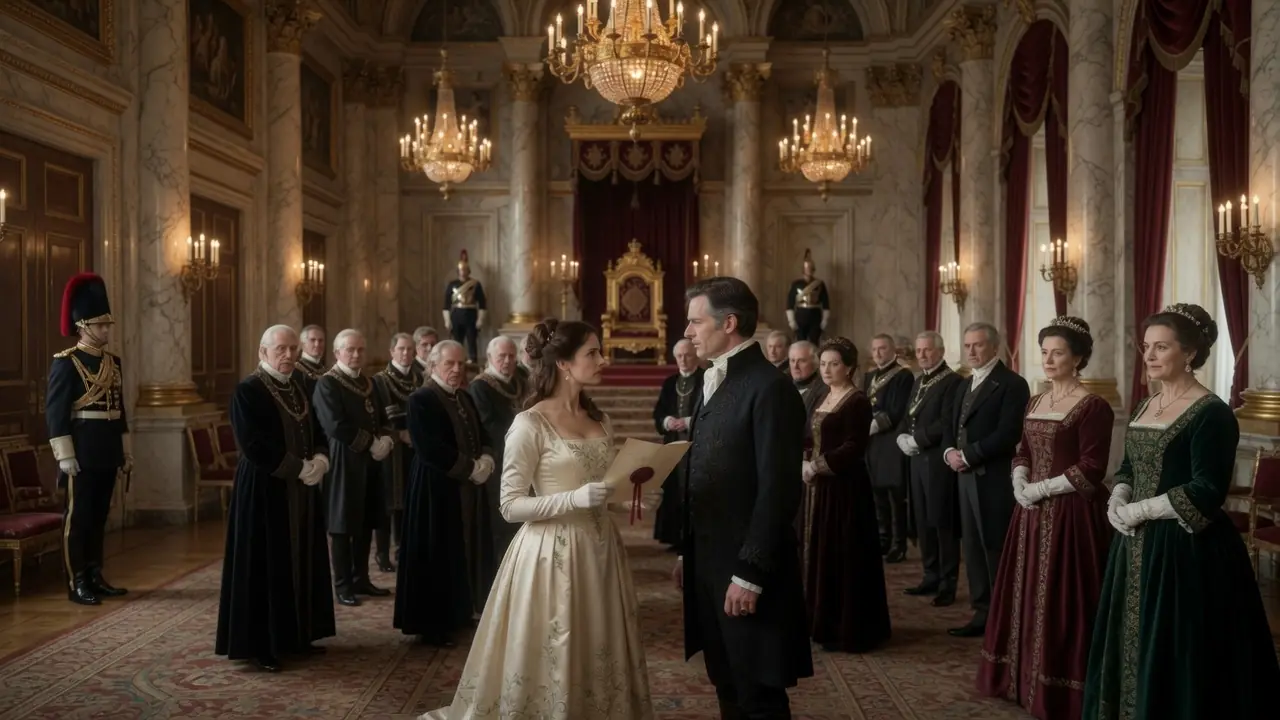
The guards stepped forward.
Cedric moved as if to intervene, but Adrian seized his wrist.
“Do not,” the Prince said.
Cedric stopped.
The Duke removed his ceremonial sword with slow dignity and handed it to Captain Harrow. His face had become unreadable again, which frightened Evangeline more than his anger.
As the guards took position beside him, he looked once more at her.
“This is not victory, Lady Evangeline.”
“No,” she said. “It is consequence.”
His eyes narrowed.
Then he was led from the King’s chamber.
No one applauded. Real power did not end with applause. It ended with doors closing, alliances recalculating, and frightened men deciding which version of truth they had always believed.
The inquiry began that very afternoon.
By evening, Ashbourne’s London house had been searched. By midnight, letters were found proving that he had bribed two royal physicians to exaggerate the King’s confusion and report selectively to the council. By dawn, one of his secretaries confessed that the Prince’s private letters to Clara Whitcombe had been stolen, copied, and altered.
The scandal that should have destroyed Adrian instead revealed Ashbourne’s methods.
Yet revelation did not cleanse everything.
Miss Clara Whitcombe was brought quietly to the palace two days later, not as a prisoner, though everyone knew the difference between invitation and summons could be a matter of carriage locks.
Evangeline saw her first in the Queen’s smaller drawing room. Clara was not the dangerous temptress described by Cedric Vale. She was twenty, with intelligent brown eyes, a plain muslin gown, ink stains near one cuff, and a chin lifted against terror.
Prince Adrian entered soon after.
The room went silent.
For a moment, they looked only at each other.
Then Clara curtsied deeply. “Your Royal Highness.”
Adrian flinched at the title. “Clara.”
Queen Helena watched them with sorrow rather than anger.
Evangeline stood near the window, trying to make herself invisible and failing. She had become visible now. It was inconvenient.
Clara spoke first. “My letters were foolish.”
“No,” Adrian said. “Mine were.”
“They were kind.”
“They endangered you.”
She smiled sadly. “Kindness often does, sir.”
The Prince looked as though every word cost him. “I cannot marry you.”
“I know.”
“I should have said it before I let affection write what duty could not honor.”
Clara’s eyes shone, but she did not cry. “My father says princes are raised to believe all doors open. I told him some doors are walls painted beautifully.”
Adrian bowed his head.
Queen Helena said gently, “Miss Whitcombe, arrangements will be made for your safety. Your father’s investigation will be reviewed fairly, without Ashbourne’s influence.”
Clara curtsied again. “Thank you, ma’am.”
Before she left, she turned to Evangeline.
“You are Lady Marlowe?”
“Yes.”
“My father said you did what half the Lords lacked courage to do.”
Evangeline nearly smiled. “Your father is generous.”
“No,” Clara said. “He is usually rude. That is how I know he meant it.”
After she was gone, Adrian stood alone by the mantel.
“I used her,” he said.
Queen Helena softened. “You cared for her.”
“I cared without consequence because I thought consequence belonged to other men.” He looked at Evangeline. “Ashbourne was wrong about many things. Not all.”
Evangeline did not flatter him. Somehow she knew he would resent it.
“Then Your Royal Highness has learned faster than most rulers.”
He gave a tired smile. “Is that comfort?”
“It is warning.”
Queen Helena laughed softly, the first true laugh Evangeline had heard from her in days.
The days that followed altered the court more than any formal proclamation could admit.
The Duke of Ashbourne was removed to his northern estate under guard while the inquiry continued. Cedric Vale fled London, was stopped at Dover, and returned with less dignity than he had left. Two physicians resigned before they could be dismissed. Lord Wrexham discovered a sudden passion for procedural clarity.
Prince Adrian assumed authority in his father’s name.
At first, London expected chaos.
It did not come.
The Prince made mistakes, certainly. He spoke too plainly to men accustomed to being deceived elegantly. He angered three peers in one morning by asking whether their objections were legal or merely ancestral. He forgot to flatter the Archbishop before requesting support for a relief measure. He signed one paper in the wrong place and endured a lecture from Lord Wrexham severe enough to humble a general.
But he listened.
That was what unsettled everyone most.
He listened to ministers, to merchants, to army officers, to reformers, to bishops, to his mother, and, increasingly, to Lady Evangeline Marlowe.
This last fact irritated the court beyond measure.
A poor lady could be pitied. A brave lady could be praised once. But a lady who remained useful after the heroic moment became intolerable.
Whispers began.
She had trapped the Prince’s gratitude.
She had manipulated the Queen.
She had hidden the decree for ambition.
She expected marriage.
She expected title.
She expected power.
Evangeline expected, mostly, sleep.
She received very little.
Queen Helena appointed her private secretary within a week. It was not a traditional position for a young unmarried woman, which meant half the court called it improper and the other half attempted to discover how much influence came with it.
The answer was enough.
Evangeline organized correspondence, reviewed petitions, noted which ministers contradicted themselves, and quietly identified the Ashbourne loyalists still embedded in palace offices. She did not raise her voice. She did not threaten. She simply remembered.
Within a month, three clerks had been dismissed, one chamberlain retired, and a certain Lord Fenwick stopped smiling at her in corridors.
One evening, Prince Adrian found her in the Blue Library surrounded by papers.
“You are making enemies,” he said.
She did not look up. “I inherited several. I may as well arrange them neatly.”
He laughed and sat across from her without permission. Princes rarely asked permission of chairs.
“You should walk outside,” he said. “It is nearly sunset.”
“I am told governance is urgent.”
“It was urgent before dinner. After dinner it became oppressive.”
She glanced at him. “Is that the official distinction?”
“I shall ask Wrexham to draft it.”
For a moment, they smiled like ordinary people.
Then Adrian’s expression sobered.
“I owe you more than thanks.”
“You owe me nothing, sir.”
“I owe you the truth, then.”
She set down her pen.
He looked toward the window, where the last light lay pale over the gardens.
“When Ashbourne named you in council, I thought he had chosen you because you were powerless.”
“He had.”
“No.” Adrian turned back to her. “He chose badly because he believed power must announce itself. In a title. In wealth. In command. You had none of those, so he saw nothing.”
“That is a generous interpretation of my poverty.”
“It is an accurate interpretation of his blindness.”
Evangeline’s chest tightened unexpectedly.
The Prince leaned forward.
“I will not insult you by pretending court will be kind now. It will punish you for surviving its judgment. My mother can protect you in part. I can protect you in part. But protection at court is another kind of cage if given carelessly.”
She studied him. “Are you offering me a cage, sir?”
“No.” His voice lowered. “I am offering you a choice.”
He placed a folded document on the table.
Evangeline looked at it but did not touch it.
“What is that?”
“A royal grant restoring the Marlowe estate lands lost through your father’s creditors. Not all. Enough to make you independent.”
She went very still.
“My father’s debts were lawful.”
“Some were. Some were purchased by Ashbourne’s agents at reduced value and pressed with unusual cruelty after your father refused to support one of his bills in the Lords.”
Evangeline stared at him.
She had known her father was flawed. Weak with money, proud with friends, foolish with grief after her mother’s death. But she had not known his ruin had been useful to someone.
Adrian’s voice gentled. “I had Wrexham examine the records. The grant does not erase debt. It corrects coercion.”
Evangeline touched the edge of the paper.
Independence.
Not gratitude. Not rescue. Not marriage.
A door opened where there had been a painted wall.
“I do not know what to say,” she whispered.
“Say you will consider it.”
She looked up. “And if I accept?”
“Then you may remain here because you choose to, not because you must.”
The room blurred for one dangerous second.
Evangeline had trained herself not to cry in public, then not to cry in private, and finally not to cry at all unless something had broken beyond repair. But this was not breaking. It was something harder to endure.
It was restoration.
She folded the document carefully. “Thank you.”
Adrian smiled. “That, Lady Evangeline, sounded painfully inadequate.”
“It was the best I could do.”
“Then I accept it as a triumph.”
The peace lasted eleven days.
On the twelfth, the Duke of Ashbourne escaped.
The news arrived during a morning audience with a delegation of merchants. Captain Harrow entered, pale and rigid, and whispered to Prince Adrian. The Prince dismissed the delegation at once.
Within an hour, the palace knew. By noon, all London knew.
Ashbourne had not fled abroad. That was the alarming part. Men who fled abroad admitted defeat. Ashbourne had vanished from his estate after a staged illness, leaving behind one dead guard, two bribed servants, and a note addressed to Prince Adrian.
It contained only one sentence.
A crown taken by paper may be taken back by blood.
Queen Helena read it once and burned it.
The palace tightened around the royal family. Guards doubled. Doors were sealed. Visitors were examined with humiliating care. The King, still unable to speak though slowly improving in movement, was moved to an inner chamber.
Adrian wanted to send Evangeline away.
She refused before he finished the sentence.
“Your Royal Highness, if Ashbourne means to strike, he will strike where authority gathers. That is here.”
“Exactly why you should leave.”
“Exactly why I should remain.”
He looked angry enough to command her, then wise enough not to.
Three nights later, the palace hosted what should have been a small diplomatic reception.
Canceling it, Wrexham argued, would signal fear. Holding it, Queen Helena said, would invite danger. Adrian chose a middle course, which satisfied no one: fewer guests, heavier guard, and every corridor watched.
Evangeline wore a gown of deep ivory silk restored from one of her mother’s old court dresses. She had chosen it for practical reasons. Its sleeves allowed hidden pockets. Its bodice concealed a folded list of suspected Ashbourne allies. Its skirt was wide enough to hide nervous hands.
The reception glittered with forced calm.
Chandeliers blazed above the ballroom. Musicians played as though violins could hold back treason. Noblewomen murmured behind fans. Men bowed too deeply to the Prince, then watched to see who watched them.
Evangeline stood near Queen Helena, scanning faces.
Lord Fenwick avoided her. That was suspicious.
Lady Bromley smiled too often. Also suspicious.
The French ambassador looked delighted by everyone’s discomfort. Not suspicious, merely French.
Then Evangeline saw Cedric Vale.
He stood near the eastern archway in a servant’s livery, powdered wig low over his brow, silver tray in hand.
Their eyes met.
He turned at once.
Evangeline did not shout. A shout would scatter him and perhaps trigger whatever plan was already in motion.
She moved through the crowd, calm and steady, as though crossing the room to greet an acquaintance. Cedric slipped through the archway. She followed.
The corridor beyond was quieter, lit by wall sconces. Cedric walked quickly but did not run.
At the far end, he turned left toward the old chapel passage.
Evangeline’s blood chilled.
The King’s temporary chamber lay beyond that passage.
She lifted her skirt and hurried.
A hand seized her arm from an alcove.
She turned sharply, a scream rising, but Prince Adrian stepped into the light.
“Evangeline.”
“Cedric is here,” she whispered. “Disguised. He went toward the chapel passage.”
Adrian’s face changed. “Guards.”
“No,” she said quickly. “There may be more. If we send visible alarm, they may strike immediately.”
He looked down the corridor. “You should return to the Queen.”
“So should you.”
“That is not an answer.”
“It is the one you deserve.”
Despite everything, a grim smile touched his mouth.
Together they moved toward the chapel passage.
They found the first guard unconscious behind the vestry door.
The second was gone.
Adrian took the fallen guard’s pistol. Evangeline took his keys.
“You are not coming farther,” Adrian said.
“Then you cannot open the locked service door ahead.”
He stared at her.
She lifted the keys. “Your Royal Highness, this is a poor moment for masculine tradition.”
They continued.
Beyond the service door lay a narrow stone passage used centuries earlier by priests and later by servants avoiding formal halls. It smelled of dust, wax, and old secrets.
Voices echoed ahead.
Adrian raised a hand.
They stopped near a bend in the passage.
Ashbourne’s voice drifted through the stone.
“Do not kill the King unless necessary. The Prince is enough.”
Evangeline’s stomach turned cold.
Cedric answered, “And the Queen?”
“Alive. Grief makes rulers pliable. Dead queens make martyrs.”
Adrian’s face went white with rage.
Evangeline gripped his sleeve before he could move.
Ashbourne continued, “Once Adrian is dead, the decree becomes chaos. The King cannot speak. Parliament will beg for order. I will provide it.”
Another voice asked, “And Lady Marlowe?”
A pause.
Ashbourne said, “Bring her to me if possible.”
Cedric laughed softly. “Still angry?”
“No,” said the Duke. “Curious. It is rare to find a woman who ruins a man properly.”
Evangeline felt Adrian’s hand cover hers for one brief second. Not romantic. Not gentle. A warning against fear.
Then footsteps approached.
Adrian pulled her into a recessed doorway just as two men passed, both armed beneath servant coats. When they turned the corner, Adrian moved silently behind them.
What happened next was fast and ugly.
He struck the first man with the pistol butt. Evangeline drove the heavy key ring into the second man’s face when he turned. He stumbled; Adrian caught him by the collar and slammed him against the wall. The man dropped.
Evangeline stared at the blood on the keys.
Adrian took them gently from her hand.
“Look at me,” he whispered.
She did.
“You did what was necessary.”
“There are more ahead.”
“Yes.”
They moved again.
The passage opened behind an old screen near the King’s private chapel. Beyond the screen, Evangeline saw the King’s chamber door guarded by two unfamiliar men in royal livery that did not fit them properly.
At the center of the chapel stood Ashbourne.
He wore black evening dress, immaculate as ever, with a sword at his side. He seemed less like a fugitive than a host awaiting late guests.
Cedric stood near him.
And between them, bound to a chair but upright with furious dignity, sat Captain Harrow.
His mouth was bloodied. His uniform torn.
Ashbourne said, “You should have accepted my recommendation, Captain.”
Harrow spat blood onto the chapel floor. “You talk too much for a man winning.”
Cedric struck him.
Evangeline flinched.
Adrian’s eyes burned.
Then a bell rang from the ballroom far away. Midnight.
Ashbourne drew his sword.
“The Prince will come,” he said. “He is sentimental. He cannot resist loyalty in distress.”
Cedric smiled. “And if he brings guards?”
“The guards are chasing rumors in the west wing. By the time they discover the error, England will be mourning.”
Evangeline looked at Adrian.
This was the climax. She felt it with terrifying clarity. Everything had narrowed to the chapel, the King beyond the door, the Duke with his sword, and the Prince who could not call an army without losing the moment.
Adrian whispered, “Go back. Bring help.”
“No.”
“That was not a request.”
“If you step out alone, he kills you before help comes.”
“If we both step out?”
“Then he has two targets.”
A strange calm came over Evangeline.
She looked at the screen, the candles, the narrow door to the sacristy, the bell rope hanging beside the chapel arch.
An idea formed. Dangerous. Undignified. Better than dying politely.
She leaned close and whispered it.
Adrian stared at her as though she had suggested burning Parliament.
Then he smiled.
“My lady,” he whispered, “you are alarming.”
“At last, a useful compliment.”
She slipped away through the side gap in the screen while Adrian waited.
Ashbourne continued speaking to Harrow, enjoying his own inevitability.
“You think me cruel,” the Duke said. “I am not. Cruelty is disorderly. I believe in structure. Kings are symbols. Princes are instruments. Women are alliances. Soldiers are force. Each thing has its place.”
Harrow lifted his head. “And traitors?”
Ashbourne smiled. “Traitors are winners described by losers.”
At that moment, Prince Adrian stepped from behind the screen.
“Then let us settle the description.”
Cedric spun. Ashbourne turned slowly.
His face lit with terrible satisfaction.
“Your Royal Highness,” he said. “How dutiful of you.”
Adrian held the pistol steady. “Step away from Captain Harrow.”
Ashbourne looked at the pistol, amused. “Have you ever shot a man?”
“No.”
“Then your hand should shake more.”
“It will afterward.”
For the first time, Ashbourne seemed almost proud.
“Better,” he said. “You may have become something after all.”
Cedric drew his own pistol and aimed at Adrian.
A chapel bell exploded overhead.
Not rang.
Exploded.
Evangeline had climbed the narrow sacristy stair, seized the bell rope, and pulled with all her strength. The old chapel bell, unused for royal worship in years, thundered above them with a violence that shook dust from the rafters.
Cedric startled and fired.
The shot went wide, shattering a candle sconce.
Adrian fired.
Cedric cried out and fell, clutching his shoulder.
Ashbourne lunged.
Adrian dropped the spent pistol and drew the fallen guard’s sword just in time.
Steel rang against steel.
Evangeline kept pulling the bell rope.
Again.
Again.
Again.
The palace would hear. The ballroom would hear. The guards chasing false rumors would hear.
Ashbourne drove Adrian backward with frightening skill. He was older, but he fought like a man who had practiced not sport but murder. Adrian gave ground, defending hard, jaw clenched.
Harrow struggled against his bonds.
Cedric groaned on the floor, reaching for his pistol with his good hand.
Evangeline saw him.
She let go of the rope.
The sudden silence was almost worse than the ringing.
She ran down the sacristy steps as Cedric’s fingers closed around the pistol.
“Lord Cedric,” she shouted.
He looked up.
She threw the iron chapel candlestick with both hands.
It struck his wrist. The pistol skidded across the floor.
Cedric cursed and rose unsteadily.
Evangeline backed away.
He smiled through pain. “You should have married the Prince when my uncle offered. You would have lived longer.”
Then Captain Harrow, still tied to the chair, slammed his entire weight sideways into Cedric’s legs.
Cedric crashed down.
Evangeline seized the pistol and kicked it away.
At the center of the chapel, Adrian faltered.
Ashbourne’s blade cut across his arm.
The Prince staggered.
The Duke raised his sword.
Evangeline screamed, “Adrian!”
The Prince dropped to one knee as Ashbourne struck. The blade carved into the wooden rail behind him. Adrian drove upward, not with elegance but with desperate force, striking Ashbourne across the ribs with the guard of his sword.
The Duke stumbled but did not fall.
He seized Adrian by the collar and slammed him against the altar steps.
“Do you know why your father failed?” Ashbourne hissed. “He loved too many people. A king must love only the Crown.”
Adrian gripped Ashbourne’s wrist.
“No,” he said through clenched teeth. “That is why men like you should never wear one.”
Ashbourne lifted his sword again.
The chapel doors burst open.
Guards flooded in, followed by Queen Helena herself, pale but unshaken, with Lord Wrexham behind her in a dressing gown and powdered wig set crookedly upon his head.
“Stop!” the Queen commanded.
Ashbourne froze.
Not because he feared her.
Because behind her stood King Edmund.
Supported by two physicians, dragging one weakened leg, his face twisted by illness, the King stood in the chapel doorway like a ghost summoned by treason.
His mouth worked.
No clear word came.
But his hand lifted.
One trembling finger pointed at Ashbourne.
Then, with a force that seemed to tear through the broken prison of his body, King Edmund spoke one word.
“Traitor.”
The chapel went utterly still.
Ashbourne’s sword lowered half an inch.
That was enough.
Adrian struck it from his hand.
The blade clattered across the stone.
The guards seized the Duke.
This time, no captain hesitated.
Ashbourne did not struggle. His eyes remained on the King.
For the first time, he looked old.
Not weak. Never that.
But old enough to understand that history had shifted without asking his permission.
As they dragged him past Evangeline, he stopped.
“You think you saved them,” he said.
She met his gaze.
“I think I chose them.”
His mouth twisted. “Choice is a luxury power allows until power regrets it.”
“Then perhaps power should be made to regret more often.”
For one brief second, something like admiration crossed his face.
Then he was taken away.
The trial of the Duke of Ashbourne became the most discussed event in Britain.
Pamphlets appeared before the official charges were read. Some painted him as a tyrant. Others as a martyr to weak monarchy. One particularly popular caricature showed him trying to steal the Crown while tripping over Lady Evangeline’s sewing basket. Evangeline found it vulgar and privately kept a copy.
Cedric Vale testified against his uncle in exchange for transportation rather than hanging. He wept convincingly. No one believed him sincerely, but the court accepted the tears as part of the proceedings.
The bribed physicians were imprisoned. Several ministers retired to estates where they could insist they had always supported the Prince from a distance. Lord Fenwick attempted to flee to Bath and was stopped by gout.
Ashbourne himself never begged.
At trial, he spoke for three hours on duty, order, monarchy, and the dangers of youthful sentiment. Some listeners were moved. More were frightened by how close his arguments sounded to things they had once said at dinner.
When sentence was passed, he bowed to the court.
Not to the Crown.
Never to that.
King Edmund survived, though he never fully recovered his strength. His speech returned slowly, word by hard-won word, and he took pleasure in using many of those words to criticize Lord Wrexham’s handwriting, Adrian’s impatience, and the palace kitchens.
Prince Adrian continued to govern in his father’s name and grew into authority not as a man born perfect for power, but as one corrected by it daily.
Queen Helena remained the quiet center of the court, though no one who had heard her in the King’s chamber ever again mistook quiet for surrender.
And Lady Evangeline Marlowe?
She became impossible to categorize, which troubled society deeply.
She was not the Prince’s mistress. She was not his fiancée. She was not merely the Queen’s secretary, nor merely the restored mistress of a modest Sussex estate, nor merely the lady who had carried the King’s decree in her sleeve.
She was invited everywhere and underestimated nowhere.
At balls, mothers warned their daughters not to speak too freely near her. Ministers lowered their voices when she entered rooms. Young ladies watched her with secret admiration. Older ladies pretended to disapprove while asking how she had managed the hidden pocket in her gown.
One autumn evening, months after the chapel, Evangeline returned to the Blue Library and found Prince Adrian waiting beside the window.
Outside, rain silvered the glass. Inside, the fire burned low.
“You sent for me, sir?”
“I did.”
He looked different now. Not older exactly, but less unfinished.
On the table lay another document.
Evangeline approached with caution. “Should I be alarmed?”
“With you, I generally assume the alarm goes both ways.”
She smiled. “A wise policy.”
He gestured to the document. “Parliament has approved the formation of a new advisory council for matters of royal household security and correspondence. My mother has agreed. My father complained about the name for twenty minutes, which I take as consent.”
“And?”
“And I want you to sit on it.”
Evangeline stared at him. “Women do not sit on royal councils.”
“No. They influence them invisibly, are blamed for them publicly, and are denied credit historically. I thought we might improve the arrangement.”
Her heart beat faster. “The Lords will object.”
“Violently.”
“The papers will mock it.”
“Creatively.”
“Your allies will call it unnecessary.”
“Privately.”
“And what do you call it?”
Adrian stepped closer.
“Justice delayed by centuries.”
For a moment, the only sound was the rain.
Evangeline looked down at the document. A council seat. Not ceremonial. Not ornamental. Real.
Power, offered without marriage.
Trust, offered without ownership.
“You understand,” she said slowly, “that if I accept, I will disagree with you often.”
“I am relying upon it.”
“I will not flatter you.”
“I have mirrors for that.”
“I will not be used to soften decisions already made.”
“Then help make them before they harden.”
She looked up.
There it was again, that dangerous thing he offered. Not rescue. Not romance disguised as reward. Partnership.
Evangeline thought of her father ruined in silence, of Queen Helena standing alone in rooms full of obedient men, of Ashbourne calling women alliances, of the King forcing one word through a broken body to name treason aloud.
She thought of the decree hidden in her sleeve.
She thought of the bell rope burning her palms as she pulled until the palace woke.
Then she picked up the pen.
“Very well,” she said. “But the council’s name is dreadful.”
Adrian laughed. “My father said the same.”
“Then His Majesty and I are in rare agreement.”
She signed.
Lady Evangeline Marlowe.
The ink dried black and certain.
Outside, London carried on beneath the rain, unaware that history sometimes changed not when armies marched or crowns fell, but when a woman everyone had called harmless wrote her name where no one had expected it to belong.
Years later, when King Edmund died peacefully and Adrian ascended the throne, the coronation chroniclers wrote at length about lineage, Parliament, national unity, foreign envoys, military banners, and the ancient solemnity of Westminster Abbey.
They mentioned the Duke of Ashbourne only briefly, as a traitor defeated before he could plunge the realm into crisis.
They mentioned Queen Helena with reverence.
They mentioned Lady Evangeline Marlowe with uncertainty, because history has always struggled with women who refuse to remain footnotes.
But those who had been present never forgot.
They remembered the council chamber, where a duke demanded the regency and a silent lady revealed the King’s last decree.
They remembered the chapel, where a prince fought for the Crown and a lady rang the bell that woke the palace.
Most of all, they remembered the lesson Ashbourne learned too late.
Power could be inherited.
Power could be seized.
Power could be bought, threatened, forged, and dressed in noble language.
But sometimes, at the hour when kingdoms held their breath, power passed into the hands of the person no one thought to search.
And when that happened, even dukes fell silent.