The first was sweet — cut hay, wet earth, the faint smoke of a neighbor’s burn pile.
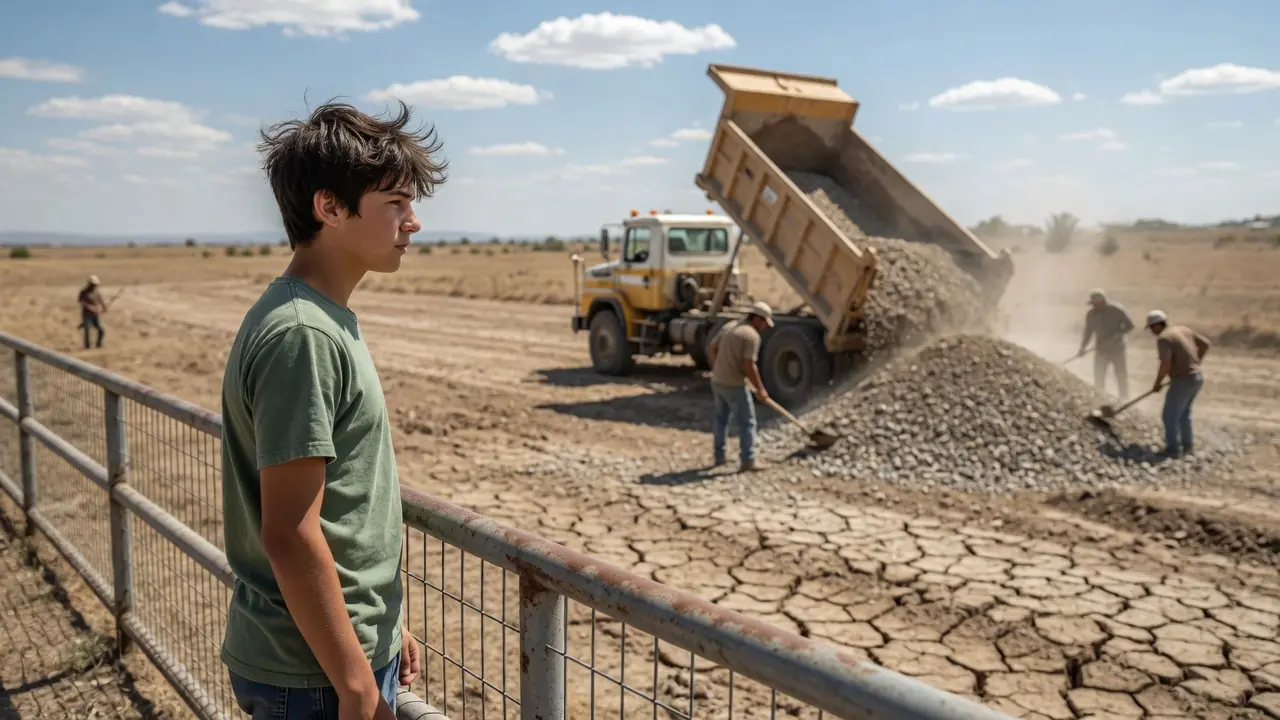
The second was sharper, drier, almost metallic. It came from the gray mountains of rice husks piled along the back fence line of the Brannon family farm, dumped there year after year by the Holloway rice mill half a mile down the road.
Rain never soaked into the husks. It just pooled, then drained sideways, cutting thin gullies into the topsoil. Where the runoff settled, the ground turned hard and pale, crusted like an old riverbed. The corn stalks nearest the fence grew thin and yellow, leaning like they were tired of standing.
Fifteen-year-old Dave Brannon had grown up walking that fence line. He remembered when the soil there was so soft you could push your whole hand into it. His grandfather used to kneel down, grab a fistful of dirt, and say, “Smell that, Dave. That’s a farm that’s alive.”
Now when Dave knelt in that same spot, the dirt smelled like nothing at all.
For years, the mill had simply needed somewhere to put its husks. Nobody in town thought much of it. It was just dry, useless, harmless-looking stuff.
But what nobody understood yet was that the very thing slowly choking the Brannon farm would one day become the thing that saved it.
And the only person willing to figure out how was a fifteen-year-old boy nobody expected anything from.
Dave’s father, Tom, had complained to the mill more than once. Mr. Holloway had always nodded politely and said he’d look into it. Nothing changed.
Dave’s mother, Carol, stopped planting a vegetable garden near the back acres. His father started rotating fewer crops. The barn that Grandpa Sam had built with his own hands began to feel less like the heart of the farm and more like a museum of better days.
Grandpa Sam had passed three winters earlier, but his voice still lived in Dave’s memory.
“Dirt doesn’t lie to you,” he used to say. “It just waits for you to listen.”
It was a damp morning in early spring when Dave noticed something strange.
Near the very edge of the oldest husk pile, where the husks had sat undisturbed for years and slowly broken down into a dark, crumbly layer, a patch of wild grass was growing thicker and greener than anywhere else on the property.
Dave knelt down and dug his fingers into the soil beneath it. It felt different — looser, cooler. It even smelled faintly earthy, the way Grandpa Sam’s old garden used to smell.
Dave didn’t understand it. The husks were supposed to be the problem, but here was ground sitting almost on top of the oldest pile, looking healthier than the rest of the farm combined.
He didn’t say anything to his parents yet. He just stood there, a question forming in his mind that he couldn’t quite shake.
That weekend, Dave rode his bike to the Millhaven Public Library. He started with anything about soil and composting.
An old agricultural extension pamphlet explained that rice husks, while tough and slow to break down, are rich in silica and carbon. When dumped in thick layers, they block water and air from reaching the soil — exactly what had been happening on the Brannon property.
But the same pamphlet mentioned something else.
When organic material like husks is broken down slowly through composting, it releases that carbon back into the soil in a form plants can use. The key was balance. Carbon-rich materials needed to be mixed with nitrogen-rich materials like manure and kept moist enough for microorganisms to do their work.
Dave also found a second idea in one of his grandfather’s old farming journals — biochar. Burning organic material slowly with very little oxygen turned it into a charcoal-like substance that acted like tiny sponges in the soil, holding water and nutrients and giving microorganisms a place to live.
Grandpa Sam had written in the margin in pencil: “Worth trying on the hard ground by the fence someday.”
Someday had arrived.
Dave started small and secretly. Behind the barn, he built his first compost pile — a mix of crushed rice husks, chicken manure from their small coop, and kitchen scraps.
He learned to keep the pile damp but not soggy, turning it every few days so air could reach the center.
Within two weeks, the pile was warm to the touch — a sign the microorganisms were working.
Progress wasn’t smooth.
The first heavy rainstorm soaked the pile completely, turning it into a slimy, foul-smelling mess. Dave had added too many husks and not enough manure. Without enough air, the pile had gone anaerobic, rotting instead of composting.
His older cousin caught a whiff of it and laughed, telling half the family at a barbecue that Dave was growing garbage behind the barn.
Dave almost gave up. He covered the pile and didn’t touch it for nearly two weeks.
But one evening, walking past it, he noticed the smell had changed. It was earthier now. Curious, he dug into the center and found it crumbly and dark. The pile had recovered on its own — slowly, the way Grandpa Sam always said dirt would if you gave it time.
Around that time, Dave started talking to Mr. Doyle, a retired agriculture teacher who lived two farms over and still kept a remarkably productive garden.
Mr. Doyle didn’t offer to fix anything. Instead, he asked questions — about moisture levels, about the ratio of husks to manure, about how often Dave turned the pile.
“You’re not wrong,” he told Dave one afternoon. “You’re just early in the process. Good soil takes longer to build than it does to ruin.”
With Mr. Doyle’s encouragement, Dave refined his method — smaller piles, better mixed, turned weekly, and kept covered during heavy rain.
He also tried a small batch of biochar, carefully charring leftover husks in a metal drum with limited airflow, then crushing the brittle black result and mixing it into one corner of the old garden bed near the fence.
By early summer, that one test bed — no bigger than a few raised rows — looked different from the rest of the farm.
The soil was darker, almost black in places. It held its shape when squeezed instead of crumbling into dust. After a light rain, water soaked in evenly instead of running off.
The tomato and pepper plants Dave had started there were noticeably stronger.
His mother noticed first.
“What did you do to this corner?” she asked, kneeling beside the plants.
Dave explained, a little nervously, about the compost and the biochar.
Instead of being skeptical, she just looked at the soil for a long moment and said quietly, “Your grandfather would have loved this.”
Word spread slowly. Neighbors walking the road would pause at the fence and ask what Dave was putting on that field to make it so different.
Dave kept his answers simple and humble: compost, old husks, patience. Nothing fancy.
Mr. Pruitt, who had once shrugged off the husk problem entirely, started saving his own kitchen scraps for Dave’s compost piles.
Eventually, word reached the county extension office. A soil scientist named Dr. Reyes came out to take samples from both the test bed and the untouched ground nearby.
Weeks later, the results came back.
The test bed had significantly higher organic matter, better soil structure, and far greater water retention. Microbial activity — the living engine Dave had read about — was measurably higher too.
“What you’ve done here,” Dr. Reyes told him, “is basically what good soil does naturally, just sped up a little with patience and the right ingredients.”
When Mr. Holloway from the rice mill finally came to see the Brannon farm, he wasn’t there out of guilt. He’d heard, through the small-town grapevine, that the Brannon boy had found a use for the husks that had been piling up for years.
Standing at the fence line, looking at the dark, healthy soil where pale, cracked ground used to be, he admitted he’d never thought of the husks as anything but waste to get rid of.
Before long, the mill began setting aside husks specifically for the Brannon family’s compost program — no longer dumped in careless piles, but delivered in manageable amounts they could actually use.
Three years later, the change had spread well beyond that first test bed.
Field by field, season by season, the Brannon farm soil grew darker, softer, more alive. Crop yields slowly climbed back to what they had been in Grandpa Sam’s day, and then beyond.
The drainage ditches ran clear again. Earthworms turned over rich, dark earth.
What Dave had learned, more than any single technique, was that the husks had never really been the enemy.
They had simply been misunderstood — sitting there for years waiting for someone patient enough to see what they could become.
Knowledge had turned a problem into an opportunity, one small, humble experiment at a time.
As Dave stood at that same fence line one evening, the sun setting gold over rows of healthy green crops, he thought about something his grandfather had written once in the margin of an old book.
A quote from George Washington Carver that Dave now understood in a way he never had before:
“Anything will give up its secrets if you love it enough.”
The wind carried the smell of rich, living soil across the fields — the same fields that had once smelled like nothing at all.