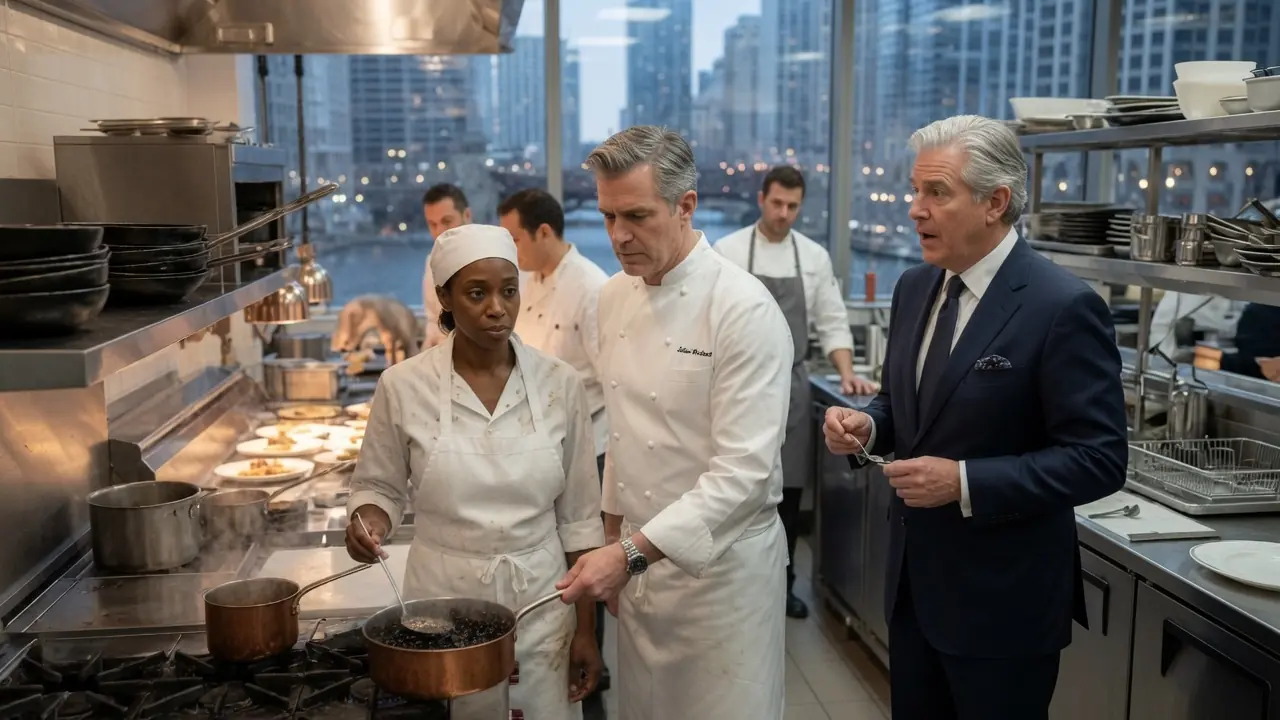
“What are you doing near my stove?”
Mara Ellis did not turn around.
Her hand stayed steady on the ladle.
The kitchen behind her had gone silent except for the hiss of burners and the low rattle of plates at the pass.
“Chef,” she said quietly, “the sauce split. Table twelve has been waiting nineteen minutes. I made something that can hold.”
Julian Marchand stared at the small copper pot in front of her as if she had filled it with mud.
“You made something?”
His voice was soft.
That was how everyone at Aurelia knew the danger had arrived.
Julian Marchand did not shout right away. He lowered his voice first. He liked making people lean in before he cut them.
Mara kept her eyes on the pot.
“Yes, Chef.”
Julian stepped closer.
He was forty-six years old, white, famous, adored by critics, and photographed more often than some actors. His restaurant, Aurelia, sat on the forty-second floor of a glass tower above Chicago, overlooking the river. Two Michelin stars. A tasting menu that cost four hundred and twenty dollars before wine. A six-month reservation list. A kitchen filled with copper, marble, polished steel, and fear.
Julian’s brand was elegance.
His temper was legend.
He looked at Mara the way some men looked at stains.
Mara Ellis was thirty-six years old, Black, quiet, and officially employed as a prep cook and morning stock assistant. That was what the payroll said.
In reality, she came in before sunrise, broke down vegetables, skimmed bones, cleaned walk-ins, labeled sauces, caught mistakes no one thanked her for, and left after midnight smelling of smoke and onions.
She had worked at Aurelia for eleven months.
Julian had never once called her Chef.
Not even by accident.
To him, she was “Mara” when guests were near, “prep” when line cooks were listening, and “you” when he was angry.
That night, she had stepped in because the brown butter sauce for the third course had broken beyond repair. The guests at table twelve were important. A food critic from London. A documentary producer. A hotel investor with a reputation for buying restaurants the way other men bought cufflinks.
The saucier, a nervous young man named Colin, had gone pale.
Julian was upstairs doing an interview.
The clock was bleeding.
So Mara moved.
She took roasted chicken bones from the reduced stock, black garlic from the garnish tray, a spoonful of sorghum molasses she had brought from home, smoked onion fat, bay leaf, cracked pepper, and a splash of cider vinegar. She whisked it over heat until it became glossy and dark, rich enough to cling to the back of a spoon, sharp enough to wake the tongue.
It was not French.
Not exactly.
It was not Southern either.
Not exactly.
It was the kind of sauce her grandmother used to make in Mississippi when there was almost nothing in the pantry and still somehow dinner tasted like memory.
Mara tasted it once.
Then she plated.
Three minutes later, Julian came down from his interview and saw her at the stove.
“What is that?” he asked.
“A black garlic sorghum jus,” Mara said.
“A what?”
She knew then.
He had not even tasted it, and he had already decided.
Colin whispered, “Chef, the original sauce split. She saved the course.”
Julian did not look at him.
He lifted the copper pot, sniffed once, and gave a small laugh.
“Is this what you people call fine dining now?”
The kitchen froze.
Mara felt the words enter her body.
Not like a knife.
A door closing.
Julian smiled.
“Let me guess. Some backyard church supper recipe?”
Mara’s voice stayed calm.
“It comes from my grandmother.”
“Then maybe it belongs in your grandmother’s kitchen.”
He walked to the sink.
Mara took one step forward.
“Chef, table twelve already tasted the first plate.”
Julian stopped.
His head turned slowly.
“What did you say?”
“The runner took one plate out before you came down.”
For the first time, uncertainty flickered across his face.
Only for a second.
Then anger covered it.
He tilted the copper pot over the drain.
The sauce slid out in a dark, shining ribbon and disappeared into the sink.
“Garbage,” Julian said. “This is Aurelia. We do not serve plantation gravy in my dining room.”
No one moved.
Mara looked at the empty pot.
Eleven months of silence pressed behind her teeth.
She swallowed it back.
Julian set the pot down hard.
“Back to prep. And understand this clearly: touching the pass without my order is grounds for termination.”
Mara nodded once.
“Yes, Chef.”
At table twelve, the London critic had already taken one bite of the plate she saved.
His name was Simon Vale.
He stopped chewing.
Then he looked down at the dish as if something impossible had happened inside his mouth.
“Who made this sauce?” he asked the waiter.
The waiter hesitated.
“Chef Marchand’s kitchen, sir.”
Simon lifted his eyes.
“That is not what I asked.”
Across from him, the documentary producer, Leona Pierce, dipped her fork into the sauce and tasted it.
Her expression changed.
Not surprise.
Recognition.
She was Black, raised in Savannah, and she knew sorghum before anyone at that table could pronounce it properly.
“This did not come from Marchand,” she said.
The waiter stood helplessly beside the table.
Leona leaned back.
“Tell whoever made it that I want to meet them.”
The waiter went pale.
In the kitchen, Mara was back at the prep sink washing herbs.
She had not cried.
That would have pleased Julian too much.
She washed parsley. Then chervil. Then tarragon.
Her hands smelled of green stems and cold water.
Behind her, Julian rebuilt the sauce his way. Brown butter. Veal reduction. Sherry vinegar. Perfect technique. No memory.
The dishes went out.
Table twelve ate them.
Simon Vale did not finish his plate.
Leona Pierce asked again who had made the first sauce.
This time, the waiter told the truth quietly.
“A prep cook. Mara Ellis.”
Leona wrote the name in her notebook.
Six months later, that name would be on the front page of every major food publication in America.
But that night, Mara rode the train home with aching feet and an empty lunch container.
Her apartment was on the South Side, third floor, narrow kitchen, one window that stuck in summer and screamed in winter. A small framed photograph sat above the stove.
Her grandmother, Odessa Ellis.
Born in 1938 outside Greenwood, Mississippi.
Cook, church mother, gardener, keeper of recipes no one wrote down until Mara made her.
Odessa had raised Mara after her mother died. She taught her to season by smell, measure by hand, and never trust a person who called food “simple” because they did not understand what it survived.
When Mara was seventeen, Odessa gave her a notebook with a red cloth cover.
“You write what I tell you,” she said. “Not because recipes die when people die. Because people act like they never lived.”
So Mara wrote.
Smothered quail.
Pepper vinegar greens.
Sweet potato biscuits.
Chicken backs in brown gravy.
Sorghum smoke sauce.
That last one was Odessa’s pride.
A sauce born from poverty but not defined by it. Roasted bones, blackened onion, pepper, sorghum, vinegar, patience. A sauce that tasted like Sunday after mourning, like grief turned edible, like women making richness out of what others threw away.
Mara had spent years refining it.
At culinary school, before she dropped out to care for Odessa.
In diners.
In catering kitchens.
In hotels.
In staff meals nobody remembered.
She had learned French technique on borrowed textbooks and late-night videos. She learned to clarify, reduce, mount, emulsify, strain, rest, and rebuild.
But the heart of the sauce stayed Odessa’s.
That night, after Julian poured it down the drain, Mara opened the red notebook to the page where her grandmother had written one sentence in crooked pencil:
“Baby, don’t let nobody call survival cheap.”
Mara read it three times.
Then she closed the notebook.
She went back to Aurelia the next day.
And the day after.
For two weeks, nothing happened.
Or rather, the usual things happened.
Julian ignored her unless he needed someone blamed. Colin avoided looking at her. The dishwasher, Andre, told her quietly that what happened was wrong. The pastry chef, Elise, squeezed her shoulder once in the walk-in and said nothing because words were dangerous there.
Then Simon Vale’s review appeared.
It was not officially a review of Aurelia.
It was an essay.
The title was:
“The Sauce That Disappeared.”
He wrote about a single bite at a Chicago restaurant, a sauce that had arrived by accident, been removed from the menu immediately, and then replaced by something technically perfect and spiritually empty.
He did not name Julian.
He named Mara.
Aurelia’s publicist called it a misunderstanding.
Julian called a staff meeting.
He stood in the center of the kitchen, phone in one hand, his face carved from rage.
“If anyone speaks to press again, they are finished in this city.”
His eyes landed on Mara.
“Do you understand me?”
Mara said, “I didn’t speak to anyone.”
“Of course not,” Julian said. “People like you never speak directly. You let others make noise for you.”
Andre dropped a sheet pan.
The sound cracked through the kitchen.
Julian turned.
Andre picked it up slowly.
“Sorry, Chef.”
The following Friday, Mara was fired.
The reason written on the paper was “failure to follow kitchen protocol and unauthorized alteration of menu items.”
Julian slid it across his office desk.
He did not bother smiling.
“You should have stayed where you belonged.”
Mara looked at the paper.
Then at him.
For almost a year, she had answered yes, Chef to a man who treated her as if her silence proved his importance.
This time, she did not say it.
She folded the paper once and put it in her bag.
At the door, Julian said, “No serious kitchen will touch you after this.”
Mara turned.
“My grandmother ran a serious kitchen with a wood stove and six children waiting.”
Julian blinked.
“She would not have hired you to peel onions.”
She walked out before he could answer.
For three days, Mara did nothing.
She slept.
She cleaned her apartment.
She made oatmeal.
She ignored six calls from unknown numbers.
On the fourth day, Leona Pierce knocked on her apartment door.
Mara opened it wearing sweatpants and a T-shirt with flour on the sleeve.
Leona stood in the hallway holding a paper bag and two coffees.
“I brought biscuits,” she said. “I am hoping that makes me less intrusive.”
Mara stared at her.
“You’re from table twelve.”
“I am.”
“How did you get my address?”
“I’m a documentary producer. Finding people is unfortunately one of my skills.”
“That sounds illegal.”
“Only impolite.”
Mara almost smiled despite herself.
She let her in.
Leona placed the bag on the tiny kitchen table and looked around the apartment, not with pity, but attention. Her eyes paused on Odessa’s photograph, then the red notebook.
“My grandmother had one too,” Leona said softly.
“A notebook?”
“A voice people ignored until she cooked.”
They sat.
Leona told Mara the truth.
She was developing a food documentary series about Black culinary inheritance in American fine dining. Not soul food as trend. Not comfort food as marketing. Lineage. Technique. Erasure. Ownership.
“I tasted your sauce,” Leona said. “And I knew it was the story I was looking for.”
Mara looked down at her coffee.
“I don’t want to be someone’s sad story.”
“Good,” Leona said. “I don’t make sad stories. I make evidence.”
That word stayed with Mara.
Evidence.
Leona did not offer charity. She offered a deal.
A six-episode documentary built around Mara developing her grandmother’s recipes into a tasting menu.
A temporary restaurant residency funded by the production company.
Creative control in writing.
Legal protection.
Mara laughed once.
“That sounds like something that happens to other people.”
“It does,” Leona said. “Until it happens to you.”
Mara looked toward Odessa’s photograph.
Her grandmother’s eyes seemed to be daring her from the wall.
Two months later, the pop-up opened in Bronzeville.
It was called Odessa’s Room.
Thirty seats.
No white tablecloths.
No chandeliers.
The walls were painted warm clay red. Family photographs lined one side. At the back, behind glass, sat Odessa’s red notebook, open to the page of the sorghum smoke sauce.
The first menu had five courses.
Cornbread madeleine with pepper honey.
Clear potlikker consommé.
Catfish with fermented tomato and charred okra.
Guinea hen with sorghum smoke sauce.
Sweet potato custard with benne brittle.
Mara cooked behind an open counter.
Leona filmed quietly.
No drama.
No crying close-ups.
No staged redemption.
Only hands.
Mara’s hands peeling onions.
Mara’s hands brushing oil onto cast iron.
Mara’s hands touching the notebook before service.
On opening night, Simon Vale came.
So did half the Chicago food world.
So did people from the neighborhood who had no interest in critics but wanted to see a Black woman cooking food that sounded like family and looked like power.
The meal ended in silence.
Not awkward silence.
The kind that comes after a room understands it has been fed something deeper than hunger.
Simon published a review the next morning.
Five stars.
The headline read:
“Odessa’s Room Is Not A Pop-Up. It Is A Reckoning.”
Reservations vanished in eleven minutes.
Julian Marchand watched the rise from his restaurant office.
He told himself it would fade.
It did not.
The documentary trailer dropped in January.
In it, Mara stood in her tiny apartment kitchen, holding Odessa’s notebook.
“My grandmother did not call this cuisine,” she said. “She called it supper. Other people decided it was valuable only after someone with a French accent did something similar.”
The clip went viral.
Aurelia’s phones began ringing with questions Julian could not answer.
Former employees started talking.
Andre spoke first.
Then Elise.
Then Colin, whose guilt had been eating him alive for months.
He told a reporter, on record, “Mara saved that service. Chef Marchand threw her sauce away without tasting it because he had already decided who she was.”
That quote did more damage than any review.
Julian denied everything.
Then Leona released the footage.
She had not had cameras in the kitchen that night.
But someone else had.
A waiter had recorded the confrontation on his phone from the service corridor.
The video was grainy but clear.
Julian’s voice carried.
“Is this what you people call fine dining now?”
“Plantation gravy.”
“Garbage.”
The internet did what the internet does.
But this time, outrage did not disappear in twenty-four hours.
Because the video had a face.
Mara’s face.
Still.
Controlled.
Refusing to give him the satisfaction of breaking.
Aurelia’s investors called an emergency meeting.
Julian was suspended within forty-eight hours.
Fired within a week.
His television development deal disappeared.
A guest chef dinner in Napa was canceled.
The culinary institute that had invited him to speak about leadership quietly removed his name from the program.
For years, Julian had built a reputation on refinement.
It took less than three minutes of video for people to see the rot beneath it.
Mara did not celebrate.
When Leona called to tell her Aurelia had fired him, Mara was in the prep kitchen peeling sweet potatoes.
She listened.
Then said, “I hope the people in that kitchen breathe easier tomorrow.”
That was all.
The documentary aired in March.
By then, Odessa’s Room had moved from pop-up to permanent restaurant.
A small investor group led by Black women restaurateurs bought a former bank building two blocks from the original residency. The vault became the wine room. The teller counter became the dessert station. The old manager’s office became a small archive of handwritten recipes from Black families across the South and Midwest.
Mara insisted on one thing.
The dish pit would have a window.
“Why?” the architect asked.
Mara looked at him.
“Because no one in my kitchen works in a place that feels like punishment.”
The new Odessa’s Room opened on a rainy Thursday night.
Her staff was not built like Julian’s brigade.
There were culinary school graduates, former cafeteria cooks, aunties who had run church kitchens, one ex-line cook from Aurelia, two teenagers from the neighborhood, and Andre, who became stewarding manager with full benefits and a salary that made him cry in the walk-in where he thought no one could see.
Mara saw.
She said nothing.
Only handed him a towel.
Six months later, Odessa’s Room received its first Michelin star.
At the ceremony, Mara wore a black suit and pinned one of her grandmother’s old buttons to the lapel. Leona sat in the audience. Andre sat beside her. Colin sat two rows back, invited by Mara after he sent a handwritten apology that did not ask for forgiveness.
When Mara’s name was called, she walked to the stage slowly.
She accepted the chef’s jacket.
Then she stepped to the microphone.
“I used to think recognition meant someone powerful finally saw you,” she said.
The room quieted.
“I don’t believe that anymore. My grandmother was brilliant before anyone wrote about her. My mother was brilliant feeding four children on almost nothing. The women in church basements and school cafeterias and family kitchens were brilliant before any critic learned the word heritage.”
She looked out over the audience.
“So this star does not make the food valuable. It only admits what was true before.”
The applause began in the back.
It spread.
Mara waited until it settled.
Then she added, “And to every Black cook who has ever been told to stay in the back, stay quiet, stay grateful, stay invisible: I hope you build your own door.”
The clip traveled further than the documentary.
Two days later, a young Black culinary student emailed Odessa’s Room and wrote:
I watched your speech in my dorm room. I was going to drop out. I am staying.
Mara printed the email.
She taped it inside her office cabinet.
Not for pride.
For memory.
A year after Julian poured the sauce down the drain, Leona filmed the final episode of the documentary inside Odessa’s Room before sunrise.
The restaurant was empty.
Mara stood alone at the stove, making sorghum smoke sauce.
Bones roasting.
Onions blackening.
Stock reducing.
Sorghum melting into darkness.
Vinegar brightening the edge.
Leona stood behind the camera.
“Do you ever think about that night at Aurelia?” she asked.
Mara stirred the pot.
“Yes.”
“What do you feel now?”
Mara considered.
“Not anger.”
“No?”
“Anger got me through the first door. It can’t build the whole house.”
She tasted the sauce.
Added salt.
“My grandmother used to say bitterness is useful if you know when to stop cooking it.”
Leona smiled behind the camera.
“And Julian?”
Mara set the spoon down.
“I don’t carry him.”
“That’s all?”
“That’s all he gets.”
Later that morning, a group of culinary students arrived for a workshop.
Mara brought them into the kitchen.
Not the dining room.
The kitchen.
She showed them the dish pit first.
“This is where every restaurant tells the truth about itself,” she said.
The students looked confused.
She pointed to the window.
“The people washing your plates deserve light. If your kitchen cannot honor the lowest-paid worker in the room, your food is already spoiled.”
Then she took them to the stove.
She opened Odessa’s red notebook.
The pages were protected now in a clear sleeve, but Mara still touched them gently.
“This,” she said, “is not a secret recipe.”
One student raised her hand.
“You’re sharing it?”
“Yes.”
“But what if someone steals it?”
Mara smiled.
“They can copy ingredients. They cannot steal the hands that taught mine.”
She gave every student a printed version of the sorghum smoke sauce.
At the bottom of the page was Odessa’s sentence:
Baby, don’t let nobody call survival cheap.
Years passed.
Odessa’s Room earned a second star.
Then refused expansion twice.
Mara wrote one cookbook, but only after insisting that half the book be blank pages for readers to write their own family recipes. The publisher objected.
Mara said, “Then there is no book.”
The blank pages stayed.
The scholarship she created paid for Black women and girls entering culinary school, hospitality management, farming programs, and food history research. She called it the Odessa Ellis Inheritance Fund.
Not charity.
Inheritance.
Aurelia reopened under new ownership as a simpler restaurant run by Elise, the former pastry chef. She invited Mara to opening night.
Mara went.
Not to forgive the room.
To reclaim the air.
The old kitchen had been rebuilt. The sink was new. The pass was lower. The staff meal table was in the main kitchen, not the basement.
Elise served Mara dessert herself.
Sweet corn custard with blackberry vinegar.
Mara tasted it.
Then smiled.
“That’s good.”
Elise exhaled like she had been holding her breath for a year.
At the end of the night, Mara stepped into the service corridor where the video had once been filmed.
For a moment, she could still hear Julian’s voice.
Garbage.
Plantation gravy.
You people.
Then she heard something else.
Laughter from the kitchen.
A dishwasher singing.
A sous chef asking a prep cook for advice.
The new sounds won.
Mara left through the front door.
Not the service entrance.
On the fifth anniversary of Odessa’s Room, Leona returned to film a short follow-up.
The restaurant was full.
At table seven sat a grandmother with her granddaughter. The girl could not have been more than ten. She watched Mara through the open kitchen with wide eyes.
After service, the girl approached shyly with a notebook.
“Chef Mara?”
Mara crouched so they were eye level.
“Yes?”
“My grandma says I make good biscuits.”
“Does she?”
The girl nodded.
“But my uncle says cooking isn’t a real dream.”
Mara looked at the grandmother.
The grandmother rolled her eyes.
Mara turned back to the girl.
“What’s your name?”
“Naomi.”
Mara took the notebook.
She wrote one sentence on the first page.
Naomi, a real dream is one you feed until it can stand.
Then she signed it.
The girl hugged the notebook to her chest.
“Can I be a chef like you?”
Mara smiled.
“No.”
Naomi’s face fell.
Mara touched the notebook.
“You be a chef like you. That will be harder. And better.”
That night, after everyone left, Mara stood alone in the kitchen.
The lights were low.
The counters were clean.
The red notebook sat in its glass case by the entrance, opened to Odessa’s sauce.
Mara stood before it for a long time.
Then she whispered, “We did it.”
She did not mean the star.
Or the restaurant.
Or the documentary.
She meant something older.
They had carried the recipe through insult.
Through poverty.
Through kitchens that wanted Black hands to labor but not lead.
Through men who called inheritance garbage because it did not arrive in the language they respected.
They had carried it anyway.
And now the sauce was not hidden in a notebook.
It was on plates.
In classrooms.
In scholarship essays.
In young cooks’ hands.
In the mouths of people who would never know how close it came to disappearing down a drain.
That was the thing about food.
The powerful could mock it.
Steal it.
Rename it.
Overcharge for it.
Throw it away.
But if somebody remembered, it could return.
And when it returned, it did not come back begging.
It came back seasoned.
Mara turned off the last kitchen light.
Outside, Chicago glittered cold and bright.
Inside Odessa’s Room, the air still held smoke, sorghum, black garlic, and the quiet promise of tomorrow’s broth.
The story was never about one cruel chef.
He was only the man foolish enough to say out loud what many had quietly believed.
The story was about a woman who knew the difference between being unseen and being unworthy.
One was something the world did to her.
The other was a lie she refused to swallow.
Mara Ellis had washed dishes, peeled onions, carried stockpots, buried her grandmother, buried her anger, and stood in kitchens where men mistook her silence for permission.
But silence is not surrender.
Sometimes silence is a pot simmering low.
Sometimes it is a recipe waiting for fire.
Sometimes it is a woman listening to the voices behind her, learning exactly when to lift the lid.
And when she finally did, the whole world tasted what one man had thrown away.