The rain had been falling over downtown Chicago since early morning, turning the streets silver beneath the traffic lights and washing the glass towers until they looked almost unreal. By six in the evening, the city was soaked, restless, and loud. Taxis hissed along the curb. Businessmen hurried beneath black umbrellas. Tourists ducked under awnings, dragging suitcases over wet sidewalks.
At the corner of Michigan Avenue and East Monroe stood the Bradford Grand Hotel, a forty-two-story building of polished stone, brass doors, and glowing windows. It had been part of Chicago for nearly a century. Presidents had slept there. Movie stars had been photographed on its staircase. Weddings, charity galas, and billion-dollar business deals had all passed through its marble lobby.
Inside, the hotel looked like money.
The floor was white marble veined with gray. Crystal chandeliers hung from the ceiling like frozen rain. Tall arrangements of lilies and orchids stood on carved tables. The scent of expensive perfume mixed with fresh coffee from the lounge. Behind the long front desk, three employees moved in crisp uniforms, smiling at guests with the practiced warmth of people trained to make luxury look effortless.
But that evening, the mood behind the desk was not effortless.
It was nervous.
The hotel had been struggling for years. Bad management, quiet debts, neglected repairs, and old-fashioned arrogance had turned the Bradford Grand from a landmark into a beautiful building with cracks under the paint. The staff did not know everything, but they knew enough. They knew paychecks had been late twice that year. They knew entire floors had been closed for “renovation” when really there were not enough bookings to keep them open. They knew the previous owner had been looking for a buyer.
And that morning, a rumor had started.
Someone had bought the hotel.
No one knew who.
Some said it was a New York investment firm. Some said it was a foreign billionaire. Others whispered it might be a hotel chain planning to fire half the staff and turn the Bradford into another soulless glass box with digital check-in kiosks.
At the front desk, Vanessa Cole was not afraid.
Vanessa was the evening front office manager, thirty-two years old, sharp-faced, perfectly made up, and proud of how much authority she could squeeze into a hotel blazer. She had worked at the Bradford Grand for seven years and believed she understood people the moment they walked through the doors. Expensive shoes meant respect. Designer luggage meant patience. A nervous smile meant someone could be pushed around. A worn coat meant trouble.
Standing beside her was Todd Miller, a young concierge with slick hair and a grin that always seemed half a second away from becoming a smirk. He admired Vanessa because she never wasted politeness on people she considered beneath the hotel.
Near the bell stand, an older bellman named Arthur Greene adjusted the luggage carts. Arthur had worked at the Bradford Grand for thirty-one years. He had seen managers come and go, guests rise and fall, and fortunes disappear overnight. He knew better than to judge a person by a coat.
That was why he was the first one to notice the man who walked in through the brass doors at 6:17 p.m.
The man was Black, perhaps in his late fifties, tall but slightly bent from fatigue. Rain clung to the shoulders of his dark wool coat. His shoes were clean but worn at the edges. In one hand, he carried a small leather duffel bag that looked old enough to have crossed half the country. He did not have a driver behind him. He did not have an assistant. He did not wear a watch that screamed wealth from across the room.
But there was something in his face.
He had the calm eyes of a man who had survived being underestimated for a very long time.
He stopped just inside the lobby and looked around.
Not like a tourist.
Not like a guest impressed by luxury.
He looked around the way a man looks at a house he once dreamed of building.
Vanessa glanced up from the computer. Her smile appeared for one second, then vanished when she saw his coat.
“Can I help you?” she asked.
The man approached the desk slowly. Rainwater dripped from the hem of his coat onto the marble floor.
“My name is Elijah Freeman,” he said. His voice was deep, quiet, and steady. “I need to speak with the general manager.”
Vanessa’s eyes moved over him again, from his damp coat to the old duffel bag.
“The general manager is unavailable,” she said. “Do you have a reservation?”
“No,” Elijah replied.
“Are you here for the restaurant?”
“No.”
“Then may I ask what business you have with hotel management?”
Elijah took a folded envelope from inside his coat. It was thick, cream-colored, and sealed in a clear protective sleeve.
“I’m here because this hotel belongs to me now.”
For half a second, the lobby seemed to pause.
Todd, standing a few feet away, turned his head.
Vanessa stared at Elijah, then laughed softly. Not loudly. Not kindly. Just enough for the insult to land.
“I’m sorry,” she said, though her tone made it clear she was not sorry at all. “What did you say?”
Elijah did not raise his voice.
“I said this hotel belongs to me.”
Todd gave a short laugh from behind the concierge desk. Vanessa glanced at him, and that gave her courage.
“Sir,” she said, leaning slightly forward, “this is the Bradford Grand Hotel. You cannot just walk in from the rain and claim ownership of a historic property.”
“I’m aware of what this place is.”
“Clearly not.”
Arthur looked toward Vanessa. His face tightened.
Elijah placed the envelope gently on the counter.
“These documents will explain everything. The purchase was finalized this afternoon. I was told Mr. Whitcomb would be here.”
Vanessa did not touch the envelope.
“Mr. Whitcomb is our general manager,” she said. “And he does not meet with people who wander in making ridiculous claims.”
Elijah looked at her for a long moment.
“I’ve been called ridiculous before,” he said. “Usually by people who later needed my signature.”
Todd laughed again, louder this time.
A couple near the elevators turned to look. A woman in a fur-trimmed coat whispered something to her husband. Vanessa noticed the attention and grew colder. In a luxury hotel, embarrassment was dangerous, and she had decided Elijah was the source of it.
“Sir, I’m going to ask you to leave,” she said.
“I’m not leaving.”
“This is private property.”
“Yes,” Elijah said. “Mine.”
Todd stepped closer, smiling openly now.
“Man, come on,” he said. “You really picked the wrong lobby for this act.”
Elijah turned his eyes to Todd.
“It is not an act.”
Todd looked at the old duffel bag. “Where’s your lawyer, then? Where’s your driver? Where’s your fancy suit?”
A few guests chuckled.
Arthur took one step forward. “Maybe we should call Mr. Whitcomb,” he said carefully.
Vanessa snapped her eyes toward him. “Arthur, I’ll handle this.”
“But the gentleman has documents.”
“The gentleman has a story,” Vanessa said.
Elijah’s jaw tightened, but his voice remained calm.
“You should read the envelope.”
Vanessa finally picked it up, looked at the seal, and dropped it back onto the counter without opening it.
“I don’t accept random paperwork from strangers.”
“I am not a stranger to this hotel.”
Vanessa folded her arms.
“Oh? Have you stayed with us before?”
Elijah looked past her toward the grand staircase at the far end of the lobby. His eyes softened for the first time.
“No,” he said. “My mother cleaned rooms here.”
The laughter stopped for a moment.
Arthur lowered his eyes.
Elijah continued, “Her name was Ruth Freeman. She worked here for twenty-four years. She used to leave home before sunrise and come back after dark with swollen hands. When I was ten years old, she brought me through the service entrance because she had no one to watch me. I sat in the laundry room doing homework while she made beds for people who never learned her name.”
Something flickered across Arthur’s face. Recognition.
Vanessa, however, only grew more impatient.
“That may be touching, sir, but it doesn’t make you the owner.”
“No,” Elijah said. “The wire transfer does.”
Todd snorted. “Wire transfer. Right.”
Elijah took a breath.
“My mother used to tell me that no honest work should make a person invisible. But in this hotel, she was invisible. She cleaned rooms guests destroyed. She was blamed when jewelry went missing, even when it was found later in a suitcase pocket. She was asked to use the freight elevator so certain guests wouldn’t be uncomfortable. And once, when I came to bring her medicine because she was sick, a manager told me boys like me belonged outside.”
Vanessa’s expression hardened.
“Sir, I don’t know what happened decades ago, but you are disturbing our guests.”
Elijah looked directly at her.
“No. I am telling you why I bought this place.”
Silence settled again.
Even Todd looked uncertain for a moment.
Then Vanessa smiled in the cruel way people smile when they decide compassion is weakness.
“You expect us to believe that you bought a hotel because your mother used to clean rooms here?”
“Yes.”
“Then where have you been all these years, Mr. Freeman?”
“Building enough to come back.”
Todd muttered, “Building what? A fantasy?”
Vanessa reached for the phone.
“I’m calling security.”
Arthur stepped closer. “Ms. Cole, please. Just call Mr. Whitcomb first.”
“I said I’ll handle it.”
Elijah did not move. He looked tired now, not afraid. There was sadness in him, but no surprise. That made Arthur feel ashamed, though he had done nothing wrong. It was the sadness of a man who had expected the door to be slammed in his face and had walked through it anyway.
Two security guards arrived within a minute.
The first was broad-shouldered and young. The second, a woman named Denise, had worked at the hotel for twelve years and recognized Arthur’s worried face immediately.
Vanessa pointed toward Elijah.
“This man is refusing to leave. He’s harassing staff and claiming he owns the hotel.”
Denise looked at Elijah. “Sir, is that true?”
“I said I own the hotel,” Elijah replied. “I did not harass anyone.”
Todd laughed under his breath. “Sure.”
Denise looked toward the envelope on the counter. “Did anyone check his documents?”
Vanessa’s face flushed.
“That is not security’s concern.”
“It might be if he’s telling the truth,” Denise said.
Vanessa straightened. “Are you questioning me?”
Denise hesitated.
The young guard did not. He stepped toward Elijah.
“Sir, you need to come with us.”
Elijah looked at the guard, then at the lobby. Guests were watching openly now. Phones had appeared in hands. A teenager near the lounge had already begun recording.
Elijah saw it.
So did Vanessa.
Her face tightened further. She wanted this over quickly.
“Remove him,” she said.
Arthur moved before he could stop himself.
“Don’t put hands on him,” he said.
Everyone turned.
Arthur’s voice shook, but he continued.
“I remember Ruth Freeman.”
Elijah turned slowly.
Arthur swallowed.
“She worked the eighth and ninth floors mostly. Always wore a blue scarf in winter. Used to bring sweet potato pie on Thanksgiving for the staff who couldn’t go home.”
Elijah’s face changed.
The lobby, the chandeliers, the cold desk between them, all seemed to fall away for one second.
“You knew my mother?”
Arthur nodded, eyes wet.
“She was kind to me when I first started. I was just a bellhop then. Didn’t know anything. She told me, ‘Baby, learn every corner of this hotel, but don’t let it own your soul.’”
Elijah closed his eyes briefly.
“That sounds like her.”
Vanessa looked furious now.
“This is not a reunion,” she snapped. “Security.”
The young guard reached for Elijah’s arm.
Elijah stepped back.
“Do not touch me.”
His voice was still quiet, but now it carried steel.
Todd moved around the side of the desk.
“You heard her. Get out before this gets worse.”
Elijah looked at him.
“It already is worse.”
Todd reached for the envelope on the counter, perhaps to throw it toward Elijah, perhaps to make some final mocking gesture. But before his fingers touched it, Arthur grabbed his wrist.
“Don’t,” Arthur said.
Todd yanked free. “Old man, stay out of it.”
That was when the lobby doors opened again.
A gust of rain-cooled air swept across the marble. Four people entered together: a silver-haired man in an expensive navy suit, a woman carrying a leather briefcase, and two younger men with tablets tucked under their arms. Behind them came the general manager, Charles Whitcomb, pale-faced and moving quickly.
Vanessa’s expression changed instantly.
“Mr. Whitcomb,” she said, forcing a professional smile. “We have a situation.”
Charles Whitcomb did not look at her.
He looked at Elijah Freeman.
Then he hurried forward with both hands extended.
“Mr. Freeman,” he said, breathless. “I am terribly sorry. We were delayed in traffic. I didn’t realize you had already arrived.”
The lobby went silent.
Vanessa’s smile froze.
Todd’s face emptied.
The young security guard dropped his hand to his side.
Elijah did not shake Whitcomb’s hand right away.
Instead, he looked at Vanessa.
Then Todd.
Then the security guards.
Then the guests holding phones.
Finally, he turned back to Whitcomb.
“Yes,” he said. “I arrived.”
Whitcomb looked around, sensing disaster.
“What happened?”
No one answered.
Arthur did.
“Mr. Freeman tried to explain who he was,” Arthur said. “They laughed at him. Then they tried to throw him out.”
Whitcomb’s face went gray.
The woman with the briefcase stepped forward. “Mr. Freeman, I’m Naomi Price, legal counsel for Freeman Hospitality Group. Are you all right?”
Elijah gave a small, humorless smile.
“I’ve had worse welcomes.”
Naomi’s eyes moved to Vanessa. It was not a loud look. It did not need to be.
Vanessa’s lips parted.
“Mr. Whitcomb, I had no way of knowing—”
“The documents were on the counter,” Arthur said.
Vanessa shot him a hateful glance.
Elijah picked up the envelope and handed it to Naomi.
“She refused to open them.”
Naomi accepted the envelope without looking away from Vanessa.
Whitcomb put a hand over his mouth.
“Ms. Cole,” he said weakly, “this is Mr. Elijah Freeman. As of 3:42 p.m. today, he is the sole owner and chairman of the Bradford Grand Hotel.”
A sound moved through the lobby. Not quite a gasp. Not quite a whisper. More like the building itself had inhaled.
Todd stepped backward.
Vanessa’s face turned red, then pale.
“Mr. Freeman,” she said quickly, “I sincerely apologize. There was confusion. We’ve had people come in before making strange claims, and I was only protecting the hotel.”
Elijah looked at her for a long moment.
“Protecting it from whom?”
She swallowed.
“From disruption.”
“From me?”
“No, sir, that’s not what I meant.”
“What did you mean?”
Vanessa had no answer.
Elijah placed his duffel bag on the floor. Rainwater had formed a small dark mark beneath it. He took off his coat slowly and handed it to Arthur, who received it with quiet respect.
Under the coat, Elijah wore a simple charcoal suit. Not flashy. Not new in the way Todd would have respected. But beautifully tailored, with a small gold pin on the lapel shaped like an open door.
He turned to the guests.
“My apologies for the interruption,” he said. “Your evening should not have included this.”
Then he faced the staff again.
“But perhaps it needed to.”
Whitcomb cleared his throat. “Mr. Freeman, we can continue this conversation privately upstairs.”
“No,” Elijah said. “We’ll continue it here.”
Vanessa looked terrified.
Elijah walked away from the desk and stood in the center of the lobby beneath the largest chandelier. His voice did not rise, but it carried to every corner.
“My mother entered this building for twenty-four years through a door in the alley. She cleaned rooms on floors where she was not allowed to sit. She smiled at people who spoke through her instead of to her. She worked sick. She worked tired. She worked when her feet hurt so badly she soaked them in a plastic tub at night.”
Arthur bowed his head.
Elijah continued.
“When I was a boy, I asked her why she didn’t quit. She told me, ‘Because I’m not cleaning rooms for them, Elijah. I’m building a future for you.’”
His voice tightened slightly.
“She died before she could see that future. But I remembered this place. I remembered the brass doors she was not welcomed through. I remembered the lobby she polished but never belonged in. And I made myself a promise.”
He looked at Vanessa.
“I promised I would come back one day through the front door.”
No one moved.
Todd stared at the floor.
Elijah turned to Whitcomb.
“I did not buy this hotel to punish people for the past. I bought it because history can either be covered up or corrected. I intended to restore the Bradford Grand. Not just the stone and glass. The soul.”
Whitcomb nodded quickly. “Of course, Mr. Freeman.”
Elijah’s eyes narrowed.
“But within five minutes of walking through my own front door, I was laughed at, dismissed, and nearly dragged back out into the rain. Not because I shouted. Not because I threatened anyone. But because I did not look like someone this desk expected to own anything.”
Vanessa’s eyes filled with tears. Whether from shame or fear, Elijah could not tell.
“Mr. Freeman, please,” she whispered. “I made a mistake.”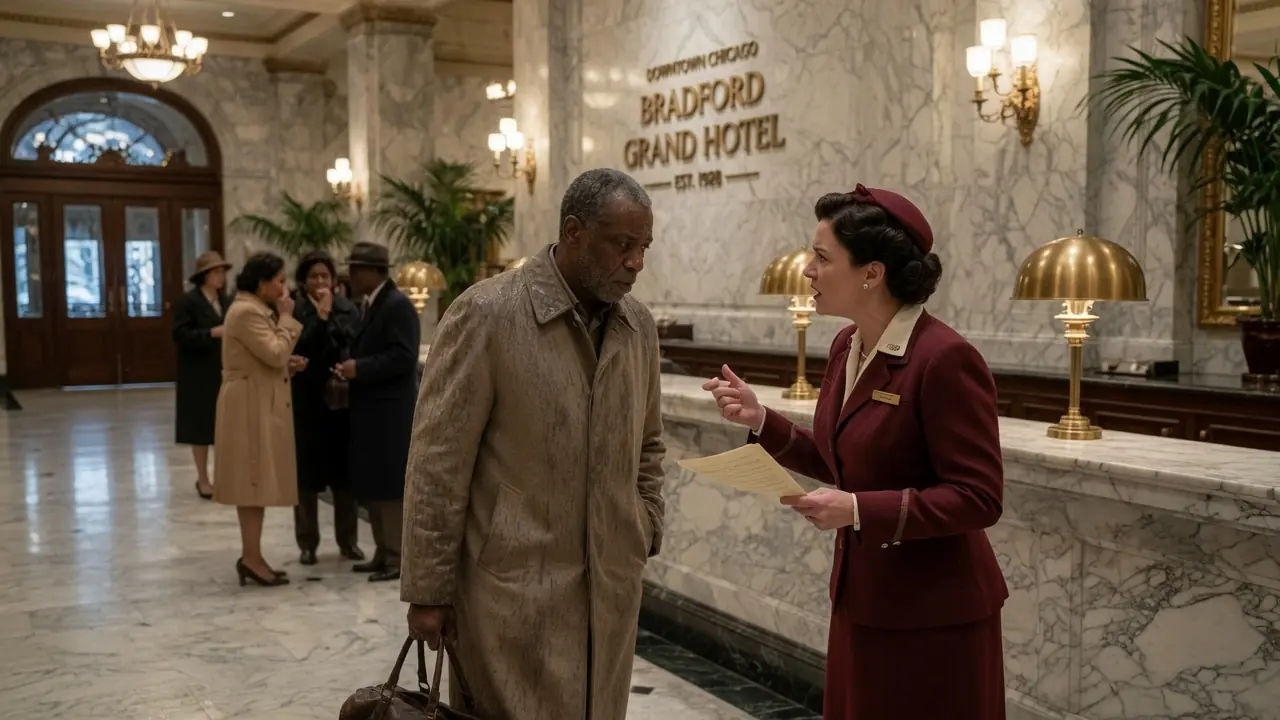
“Yes,” Elijah said. “You did.”
“I’m sorry.”
Elijah studied her.
“When you thought I was nobody, your apology was not available.”
The words landed harder than shouting.
Vanessa looked down.
Todd suddenly spoke. “Sir, I’m sorry too. I shouldn’t have laughed.”
Elijah turned to him.
“No, you shouldn’t have.”
Todd nodded, face burning.
“I was just following Ms. Cole’s lead.”
Vanessa looked at him, stunned by how quickly he abandoned her.
Elijah shook his head.
“Cowardice has many uniforms.”
Todd fell silent.
Naomi stepped closer to Elijah and spoke quietly, but he lifted a hand.
“I know what you’re going to say,” he said. “Liability. Procedure. Private meeting.”
Naomi gave the smallest smile. “Something like that.”
Elijah nodded.
“In a minute.”
Then he looked at Denise, the female security guard.
“You asked if anyone had checked my documents.”
Denise straightened. “Yes, sir.”
“Thank you.”
She nodded.
He looked at the young guard.
“And you were prepared to remove me without knowing whether I had the right to be here.”
The guard swallowed. “Yes, sir.”
“Why?”
The guard looked ashamed. “I was told to.”
Elijah’s voice softened, but only slightly.
“Never let a bad order borrow your hands.”
The young guard nodded.
Elijah turned to Arthur.
“And you remembered my mother.”
Arthur’s eyes were wet now. “I could never forget Miss Ruth.”
Elijah stepped closer to him.
For a moment, the owner of the hotel and the old bellman stood face to face, both carrying ghosts from the same building.
“She used to talk about a young bellhop,” Elijah said. “Said he was clumsy but kind.”
Arthur laughed through his tears. “That was probably me.”
“She said kindness mattered more than polish.”
Arthur wiped his eyes quickly.
Elijah smiled for the first time that evening.
“She was usually right.”
Then Elijah turned back to Whitcomb.
“I want the staff assembled tomorrow morning. All departments. Housekeeping, kitchen, front desk, maintenance, security, valet, laundry. Everyone.”
“Yes, sir,” Whitcomb said.
“And I want every employee file reviewed. Starting with wages, complaints, promotions denied, and disciplinary actions.”
Whitcomb’s face tightened almost invisibly.
Elijah noticed.
“Is that a problem?”
“No, sir.”
“It sounded like one.”
“It’s just a large undertaking.”
“I bought a large hotel.”
Naomi’s mouth twitched, almost a smile.
Elijah continued, “No employee who works full time in this building should need a second job to pay rent. No housekeeper should be invisible. No bellman should be treated like furniture. No guest should be measured by the price of their coat before they are offered dignity.”
Vanessa whispered, “Sir, please. I understand now.”
Elijah looked at her with tired eyes.
“No, Ms. Cole. You understand consequences now. Understanding people is different.”
She flinched.
Then Elijah said the words everyone expected and feared.
“You are suspended pending review.”
Vanessa’s mouth opened. “Suspended?”
“Yes.”
“Mr. Freeman, I have given seven years to this hotel.”
“My mother gave twenty-four.”
Vanessa had no reply.
Elijah looked at Todd.
“You too.”
Todd’s face collapsed. “Sir, please, I need this job.”
“So did the people you mocked before tonight.”
Todd looked like he wanted to argue, but something in Elijah’s face stopped him.
Whitcomb shifted uneasily.
“Mr. Freeman, perhaps we should let HR handle—”
“We will,” Elijah said. “Properly. Documented. Legally. But immediately.”
Naomi nodded. “We can arrange that.”
Elijah then turned toward the guests.
“For those recording, keep recording. But record this too. The Bradford Grand will not be a museum of old arrogance anymore. Beginning tonight, it becomes a hotel where dignity is not an amenity reserved for the rich.”
No one laughed now.
A woman near the elevators lowered her phone, ashamed.
An older man in a tailored coat began clapping softly.
Then someone else joined.
Soon, applause spread through the lobby, not thunderous at first, but steady. Arthur clapped with both hands trembling. Denise clapped. Even some employees behind the bar clapped, glancing nervously at Whitcomb as if afraid they might be punished for it.
Elijah did not smile at the applause.
He looked almost sad.
Because applause was easy.
Change was harder.
Later that night, after Vanessa and Todd had been escorted to collect their things, after the lobby had returned to its polished quiet, after the guests had gone upstairs with a story they would tell for years, Elijah stood alone near the grand staircase.
Arthur found him there.
The old bellman carried a small cardboard box.
“Mr. Freeman,” he said gently.
“Elijah,” the owner said.
Arthur hesitated. “Elijah. There’s something you should see.”
He opened the box.
Inside were old staff photographs, yellowed name tags, holiday cards, and brittle papers rescued from forgotten storage rooms. Arthur lifted a faded photograph from the top.
It showed a group of hotel workers standing near the service entrance sometime in the late 1980s. Most wore uniforms. Some smiled. Some looked exhausted. Near the center stood a Black woman with kind eyes and a blue scarf tied around her neck.
Elijah took the photograph with both hands.
His mother looked younger than he remembered.
For a moment, he was not a wealthy man, not a chairman, not the new owner of a landmark hotel. He was a boy again, waiting in the laundry room, listening for his mother’s footsteps.
“I found it years ago,” Arthur said. “Couldn’t throw it away.”
Elijah touched the image gently.
“She never had many pictures of herself,” he said.
“She was always taking care of everybody else.”
Elijah nodded.
Arthur reached into the box again and removed a small brass key attached to a cracked leather tag.
“This opened the old service entrance,” Arthur said. “They changed the locks years back. I kept it. Don’t know why.”
Elijah stared at the key.
The tag was stamped with three faded words: STAFF ENTRANCE ONLY.
Arthur held it out.
“I think it belongs to you now.”
Elijah accepted it.
His fingers closed around the cold brass.
For years, he had imagined returning to the Bradford Grand in triumph. He had imagined walking through the front doors while everyone who once looked down on his mother was forced to see what her sacrifice had built. But standing there with the old key in his hand, he realized triumph was not the feeling filling his chest.
It was grief.
Grief for every morning she had left before sunrise.
Grief for every insult she had swallowed because rent was due.
Grief for the boy who had believed success would heal every wound.
And beneath that grief, something stronger.
Purpose.
The next morning, every employee of the Bradford Grand gathered in the ballroom.
Housekeepers stood beside chefs. Valets stood beside accountants. Maintenance workers, bartenders, laundry attendants, reservation agents, and managers filled the room. Some looked frightened. Some looked hopeful. Most looked exhausted in the way workers look when they have learned not to expect much from people above them.
Elijah stood on the small stage without a podium.
Behind him, projected on a screen, was the old photograph of Ruth Freeman and the staff.
A murmur moved through the room.
Arthur stood near the front, hands folded.
Elijah began simply.
“My name is Elijah Freeman. As of yesterday, I own the Bradford Grand Hotel.”
The room was silent.
“Some of you have heard what happened last night. Some of you have probably heard ten different versions. Here is the only version that matters: I walked in, said who I was, and was treated like I did not belong. That experience did not surprise me. But it did clarify my first priority.”
He paused.
“This hotel has been beautiful for guests and difficult for workers for too long.”
People exchanged glances.
Elijah continued, “My mother, Ruth Freeman, worked here for twenty-four years. She is in the photograph behind me. Many of you never knew her. Some of you may have known someone like her. Someone who worked hard, stayed quiet, carried pain home, and still came back the next morning.”
A few housekeepers lowered their eyes.
“She used to tell me, ‘A building is only as grand as the people who keep it standing.’ So from this day forward, the Bradford Grand will honor the people who keep it standing.”
He looked toward Naomi, who stood near the side wall with a folder.
“Effective immediately, we are raising the base wage for hourly staff. Health benefits will be expanded. Break rooms will be renovated before any executive office is touched. Promotion reviews will be reopened for employees who were passed over without clear cause. Anonymous complaints will go to an outside firm, not buried in management desks.”
The room changed.
At first, no one reacted, as if they were afraid the words might disappear if they believed them too quickly.
Then someone began to cry.
A housekeeper near the back covered her mouth with both hands. A dishwasher whispered, “Thank God.” A valet stared at Elijah as if trying to decide whether this was real.
Elijah raised a hand.
“I am not promising perfection. I am promising accountability. That includes me.”
Then he lifted the brass key.
“This was the key to the old staff entrance. For decades, people who worked here were told to come through the back. People like my mother. People who made the beds, cleaned the floors, cooked the food, carried the bags, fixed the pipes, and kept the lights on.”
He closed his fingers around it.
“Today, this key will be placed in a glass case in the main lobby, not as decoration, but as a reminder. No one who serves this hotel is beneath the people who sleep in it.”
The applause started in the back, where the housekeeping staff stood.
This time, when it spread, Elijah allowed himself to feel it.
Not as praise.
As agreement.
Over the next months, the Bradford Grand changed.
Not all at once. Real change never arrives with music and perfect lighting. It arrives in meetings, payroll adjustments, uncomfortable conversations, resignations, repairs, apologies, and policies rewritten line by line.
Charles Whitcomb retired earlier than planned.
Vanessa Cole did not return after the review uncovered years of complaints from junior staff and guests she had judged unworthy of respect. Todd Miller resigned before his hearing. The young security guard stayed, completed new training, and later apologized to Elijah in person. Denise was promoted to head of safety and guest dignity, a new role Elijah insisted was just as important as loss prevention.
Arthur Greene became the hotel’s director of heritage and hospitality.
At first, he laughed at the title.
“I’m a bellman,” he told Elijah.
“No,” Elijah said. “You are the memory of this place.”
The old service entrance was cleaned, restored, and sealed behind glass with a plaque. The brass key sat beside it under soft light.
The plaque read:
This key once opened the door used by workers who were expected to remain unseen. The Bradford Grand honors every hand that built, cleaned, repaired, carried, cooked, served, and sacrificed here. No dignity enters through the back.
Below that was a name.
In memory of Ruth Freeman.
On the first anniversary of Elijah’s ownership, the hotel held a ceremony in the lobby. Not for investors. Not for celebrities. For staff.
Housekeepers came with their families. Cooks brought their children. Retired employees returned with canes, photographs, and stories. Arthur wore his best suit and stood proudly beside the key display.
Elijah spoke briefly. He had learned that the best speeches did not need to be long when the work behind them was real.
Afterward, as people ate cake and took pictures beneath the chandeliers, a young Black boy about ten years old stood in front of the glass case, staring at the brass key.
Elijah noticed him.
The boy’s mother wore a housekeeping uniform. She stood a few steps away, watching nervously as her son leaned close to the display.
Elijah walked over.
“What do you think?” he asked.
The boy looked up quickly. “Sorry, sir. I wasn’t touching it.”
“I know.”
The boy pointed at the key. “That was for the workers?”
“Yes.”
“Why didn’t they use the front door?”
Elijah looked at the brass doors across the lobby.
“Because some people believed the front door was only for people they considered important.”
The boy frowned.
“That’s stupid.”
Elijah smiled.
“Yes,” he said. “It was.”
The boy looked back at the key.
“My mom works here.”
“What’s her name?”
“Angela.”
Elijah looked toward the young housekeeper. She gave a shy wave.
“Then your mother helps keep this place standing,” Elijah said.
The boy stood a little taller.
“She says I should study hard so I can own something one day.”
Elijah felt the words strike somewhere deep.
“My mother told me something like that too.”
“Did you listen?”
Elijah looked around the lobby, at the chandeliers, the marble, the workers laughing with their families, the front desk where no one was being measured by their coat.
“Yes,” he said softly. “But it took me a long time to understand what she meant.”
The boy looked up at him.
“What did she mean?”
Elijah knelt so they were eye to eye.
“She meant ownership is not just having your name on the papers. It’s taking responsibility for what happens under your roof.”
The boy thought about that.
Then he said, “So this hotel is really yours?”
Elijah smiled.
“Yes.”
The boy looked around with wide eyes.
“And they didn’t believe you?”
“No.”
“Because you didn’t look rich?”
“Something like that.”
The boy shook his head with the clean honesty of childhood.
“They must’ve felt dumb.”
Elijah laughed then, truly laughed, and some of the heaviness in him loosened.
“Yes,” he said. “I imagine they did.”
The boy’s mother approached, embarrassed.
“Mr. Freeman, I’m sorry if he bothered you.”
“He didn’t bother me,” Elijah said. “He asked the right questions.”
Angela smiled nervously.
Elijah looked at her uniform, then at her tired eyes, and for a moment he saw Ruth again. Not because Angela was the same, but because sacrifice often wore familiar shapes.
“Angela,” he said, “make sure he sees every part of this hotel. Not just the employee areas. The lobby, the ballroom, the rooftop, the suites if they’re empty. Let him know none of it is too good for him to walk through.”
Angela’s eyes filled.
“Yes, sir.”
The boy grinned.
“Can I see the top floor?”
Elijah stood.
“I’ll take you myself.”
Arthur, watching from near the bell stand, smiled.
Together, Elijah Freeman, Angela, and her son crossed the lobby toward the elevators. Guests stepped aside. Staff members nodded. The brass doors gleamed behind them, no longer guarding a world meant only for certain people.
As the elevator rose, the boy pressed his face near the glass and watched Chicago spread beneath them in glittering lines of light.
“Mr. Freeman?” he asked.
“Yes?”
“When I grow up, I’m going to buy a building too.”
Elijah looked at him.
“What kind?”
The boy thought hard.
“A big one,” he said. “But everybody gets to come through the front.”
Elijah looked out over the city, remembering his mother’s swollen hands, her blue scarf, her tired smile, and the promise he had carried for most of his life.
Then he nodded.
“That,” he said, “would be a building worth owning.”
And far below, in the lobby of the Bradford Grand Hotel, the old brass key rested behind glass, no longer opening a back door, but telling the truth about one.
A truth no one could laugh out of the building again.