Agnes Bell lifted the tin cup to her nose, and every bit of warmth left her body.
It was not the smell of well water.
It was not rust from old pipes.
It was not the sourness of a sickroom that had been closed too long.
It was something sharper.
Something thin and chemical, hiding beneath the steam like a snake beneath dry grass.
Agnes set the cup down on the small bedside table and stared at the three boys lying in the room. Her hand trembled so badly the cup clicked against the wood. For one terrible second, the walls of Red Hollow Ranch disappeared, and she was back in another room, another year, beside another dying child.
Not again, she thought.
Dear Lord, not again.
The boys slept side by side in narrow beds, their faces pale against the pillows, their bodies too still for children. Their scalps were nearly bare, with only faint patches of dull hair left behind. Each of them looked as if some invisible hand had been slowly pulling life out through the roots.
Agnes had been at Red Hollow Ranch for only eight days.
Eight days was not long enough to accuse a doctor.
Eight days was not long enough to challenge a father who had already spent months praying for answers.
But it was long enough for a woman with a good nose and a terrible memory to know when something was wrong.
She stepped back from the bed, pressing one hand against the pocket of her apron.
Three boys.
One medicine.
One smell.
And a doctor everyone trusted too much.
Agnes Bell had arrived at Red Hollow Ranch on a dry August morning with one carpetbag, one folded recommendation letter, and not a single coin she could spare.
Her cousin Samuel had written the letter for her. He had not asked whether she wanted to work in a ranch house outside Marston Creek. He had simply decided that a widowed woman with no money and no children left alive needed somewhere to be useful.
That was how practical men solved grief.
They found work for it.
At the gate, a ranch hand named Eli Mercer met her with a cautious glance. He was young, sun-browned, and too polite to say what his eyes had already said.
“You’re Mrs. Bell?”
“I am.”
“You’re the new help?”
“That depends,” Agnes said. “Are you planning to carry this bag, or shall I show you how it’s done?”
Eli blinked, then took the bag quickly.
“Yes, ma’am.”
The house stood large and white against the flat Kansas land, its porch wide, its windows clean, its paint beginning to peel where the summer heat had done its work. Agnes noticed the windows first. Clean windows in a dusty country meant a woman in that house was either proud, afraid, or both.
She met that woman at the front door.
Mrs. Prudence Vale had been housekeeper at Red Hollow for nearly sixteen years. She had a narrow face, gray hair pulled tight enough to hurt, and the kind of posture that made every room seem like it had been inspected and found lacking.
“You’re late,” Prudence said.
Agnes looked at the sun.
“I’m alive. That will have to do for today.”
Prudence’s mouth tightened.
It was not a good beginning.
She led Agnes inside without offering a hand. The front hall smelled of polished wood, old wool, eucalyptus leaves, and something medicinal underneath it all. Something Agnes could not yet name. The smell did not belong to the house.
She stored it away.
Some truths arrived first as odors.
“Mr. Whitcomb will speak with you after supper,” Prudence said. “Until then, you’ll assist with laundry, kitchen work, and the boys’ doses.”
“The boys are sick,” Agnes said.
It was not a question.
Her cousin’s letter had warned her only that the rancher had three ill sons and needed help in the house.
Prudence stopped walking.
“The boys are under Dr. Whitlock’s care.”
“What kind of illness?”
Prudence turned with a look that had probably silenced many people over many years.
“Mrs. Bell, you are here to clean, cook, carry, mend, and follow instructions. You are not here to discuss medical matters.”
Agnes held her gaze.
“I see.”
“Do you?”
“I see that I am not welcome to ask.”
Prudence’s eyes hardened.
“That would be best.”
Agnes was shown to a small room at the back of the house, narrow but clean, with a bed, a washstand, and one window looking toward the barn. She unpacked in less than five minutes because grief had taught her how little a person truly needed once life had taken the important things.
Then she tied on an apron and went downstairs.
She learned the house the way she had learned every house she had ever worked in.
By sound.
By smell.
By the silence people kept in certain rooms.
She heard the boys before she saw them.
It was late afternoon, and she was carrying folded sheets along the upstairs hallway when a low sound came through a half-open door. It was not crying exactly. It was the tired little sound sick children make when even tears have become too expensive.
Agnes stopped.
She pushed the door gently with her elbow.
Three beds stood in a row.
In the first lay a boy of about nine, awake and watching the ceiling. In the second, another boy slept with one hand curled near his face. In the third, a small shape under a quilt pretended very badly not to be awake.
They were brothers beyond question.
Same dark eyes.
Same narrow chins.
Same brown skin warmed by their father’s blood and the prairie sun.
But their heads stopped Agnes where she stood.
All three were nearly bald.
Not shaved.
Not naturally thin.
Their scalps looked pale and fragile, with sparse strands clinging here and there like dry grass after fire.
“You’re new.”
“I am,” Agnes said. “My name is Agnes.”
“I’m Thomas,” he said. “That one sleeping is Caleb. The one pretending is Jonah.”
The quilt on the third bed shifted.
Agnes did not enter.
She leaned against the doorframe instead, respecting the invisible border of a sickroom.
“How long have you boys been poorly?”
Thomas looked at her with the careful expression of a child who had learned that adults did not always like honest answers.
“Since winter. Caleb got sick first. Then Jonah. Then me.”
“What does the doctor say?”
Thomas looked toward the window.
“He says different things. Blood weakness. Nerve fever. Some kind of wasting. Papa writes it down, but I don’t think he understands it.”
“Does the medicine help?”
“No.”
The answer came flat and immediate.
Not dramatic.
Just true.
“We keep taking it anyway.”
Agnes’s chest tightened.
She stayed with them a few minutes longer. She asked Thomas what books he liked. She asked Jonah if he preferred ponies or dogs. She told Caleb, when he woke long enough to blink at her, that she made cornbread good enough to wake the dead, and she expected him to try some before the week was out.
Then she gathered the sheets and left.
She met Nathaniel Whitcomb at supper.
He came in from the yard with dust on his boots and grief sitting heavy across his shoulders. He was younger than Agnes had expected, perhaps thirty-six, with dark hair, tired eyes, and hands roughened by work. His first glance went upward toward the ceiling, toward the boys’ room, before it settled anywhere else.
That told Agnes almost everything.
A father’s fear has direction.
“Mrs. Bell,” he said.
“Mr. Whitcomb.”
“Samuel speaks highly of you.”
“Samuel likes to make his choices sound wise after he’s made them.”
A small flicker moved in Nathaniel’s eyes.
Almost amusement.
Not quite.
“He said you were direct.”
“He was warning you.”
“Was he?”
“He should have been.”
This time, something near a smile appeared and vanished.
They ate at the long kitchen table. Or rather, food sat in front of them while Nathaniel moved his fork like a man who remembered meals only as something people were supposed to do. Prudence served silently, but her ears caught every word.
“My sons were healthy last spring,” Nathaniel said suddenly.
Agnes looked at him.
He stared at his plate.
“Loud. Wild. Always tracking mud through the back door. I used to complain about it.”
His fork stopped moving.
“Now I’d give half this ranch to hear them fighting over boots again.”
Agnes said nothing.
Some grief only wanted air.
“Dr. Whitlock says they are stable,” Nathaniel continued. “He says the treatments are holding the illness back.”
“Do you believe him?”
The question left her mouth before caution could catch it.
Prudence went still near the stove.
Nathaniel looked up slowly.
“I don’t know what else to believe.”
That answer stayed with Agnes all night.
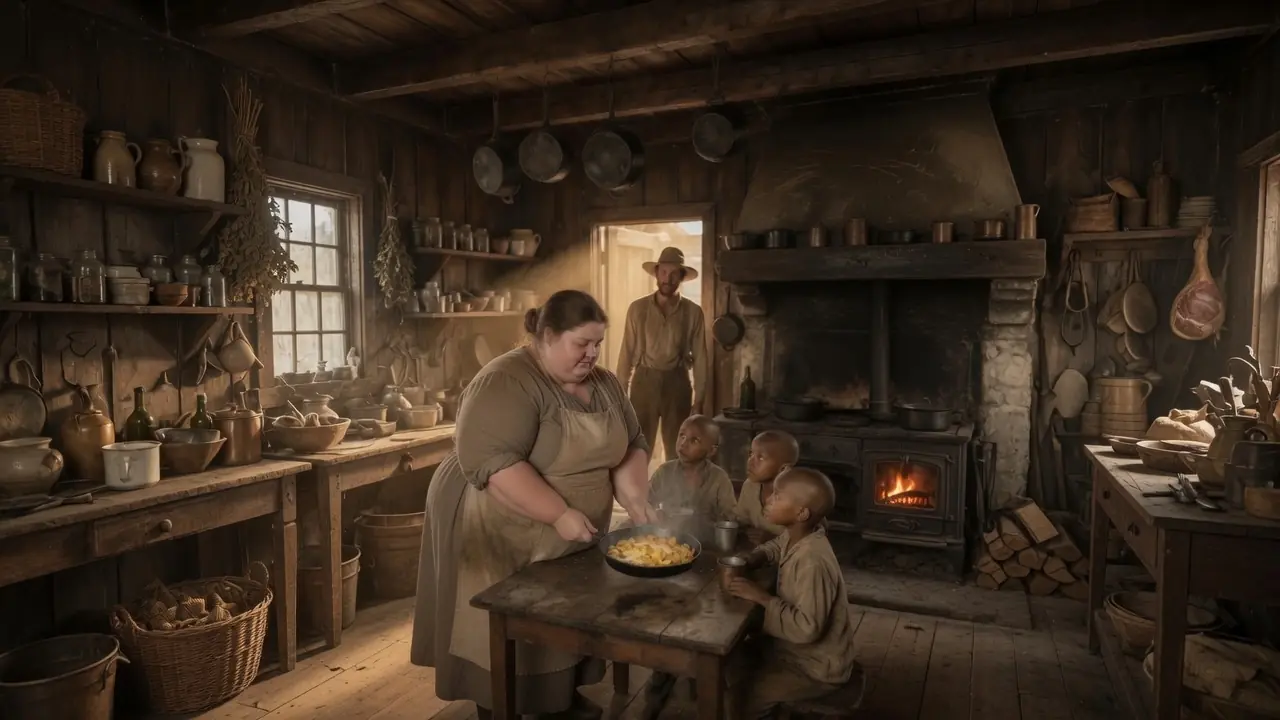
On her third evening, Agnes helped Prudence prepare the boys’ medicine.
The routine was exact. Two brown bottles on a wooden tray. One measuring spoon. One tin cup of water from the kitchen pump. Twelve drops from one bottle, eight from another, stirred twice, carried upstairs.
Prudence worked quickly and without conversation.
Agnes watched.
She noticed the handwritten labels, cramped and slanted, marked with Dr. Whitlock’s name. She noticed the pale yellow liquid inside the newer bottle. She noticed Prudence’s habit of rinsing the measuring spoon immediately after use, as if any trace of the medicine should not remain.
When Prudence carried the tray upstairs, Agnes stayed behind to wipe the counter.
The spoon lay near the basin.
One pale drop clung to its bowl.
Agnes bent close.
The smell struck her so sharply that her stomach turned.
Chemical.
Thin.
Wrong.
She knew that smell.
Years ago, in a mercantile storeroom in Abilene, a crate of agricultural compound had cracked open. The shopkeeper had shouted for everyone to cover their mouths and step back. Agnes had never forgotten the bitter metallic bite of it.
And years before that, she had ignored a different wrongness.
Her daughter Rose had been four.
Bright-eyed.
Always carrying a rag doll named Miss Violet.
A doctor had prescribed a tonic for a breathing sickness. Agnes had trusted him because he had letters after his name and certainty in his voice. Rose grew weaker every week. Agnes questioned too late.
Rose died on a cold Thursday morning with Miss Violet tucked beneath her arm.
Agnes lost her daughter, her husband’s tenderness, and her faith in doctors all in the same year.
She did not speak of Rose.
But Rose was always there.
In every sickroom.
In every child’s thin wrist.
In every bottle handed over by a confident man.
“Mrs. Bell.”
Agnes straightened.
Prudence stood in the doorway with the empty tray.
Her eyes moved from Agnes to the spoon.
“Everything all right?”
“Fine,” Agnes said. “Just cleaning.”
“I handle the medicine tools.”
“So I see.”
Prudence crossed the kitchen, took the spoon, rinsed it hard at the pump, and placed it in the rack with a sharp click.
“You were told not to interfere.”
“I smelled something.”
Prudence turned.
“What?”
Agnes looked at her carefully.
“I said I spilled something.”
Prudence’s face did not change, but something behind her eyes sharpened.
“Best get to bed. We rise early here.”
Agnes went to bed.
She did not sleep.
She lay staring at the dark ceiling, thinking about the spoon, the smell, Thomas saying the medicine did not help, and Nathaniel looking upward every time he entered a room.
Seven months.
Dr. Whitlock had been treating those boys for seven months.
Seven months of doses.
Seven months of worsening weakness.
Seven months of bald heads, headaches, and a father paying for hope by the bottle.
Agnes was not a doctor.
She had no degree.
No office.
No black bag.
But she had a nose, a memory, and a dead child whose silence had taught her never to swallow doubt again.
Before sunrise, Agnes made herself a promise.
Not again.
She rose before Prudence the next morning, lit the stove, started coffee, and went to the washroom where the household water barrel stood in the corner. She had watched Prudence draw water from that barrel when mixing the medicine.
Agnes dipped the ladle and smelled it.
Plain well water.
Nothing sharp.
Nothing chemical.
She checked the cabinet where the bottles were stored. She smelled the wooden spoon box, the cloths, the mixing cup, the shelf itself. Old soap, wood, dust.
Nothing.
The poison, if poison it was, came from the bottle.
A small voice spoke from the kitchen doorway.
“You’re looking for it too.”
Agnes turned.
Thomas stood barefoot in his nightshirt, pale scalp gleaming faintly in the dawn.
“You should be in bed.”
“I couldn’t sleep.”
He came to the table and sat down like an old man.
“Jonah talks in his sleep when his head hurts.”
“All of you get headaches?”
“All of us,” Thomas said. “Caleb’s are the worst. Light hurts him.”
Agnes sat across from him.
“When did the headaches begin?”
He traced one finger along a crack in the table.
“After the medicine changed.”
The kitchen became very still.
“Dr. Whitlock’s medicine?”
Thomas nodded.
“Papa thinks it helps. Dr. Whitlock says headaches mean the illness is fighting back before it leaves.” He looked up. “But it never leaves.”
Agnes folded her hands tightly.
“Do you like Dr. Whitlock?”
Thomas hesitated.
“He smiles wrong.”
“Wrong how?”
“With his mouth only.”
Agnes felt cold move through her.
“My mother used to say you can tell a true smile by the eyes,” Thomas said. “His eyes don’t do anything.”
Agnes looked at the boy and saw what adults had missed because they were too desperate, too frightened, or too obedient to authority.
A child had known.
A child had known something was wrong.
“You believe me?” Thomas asked.
“Yes,” Agnes said.
His face changed.
Not surprise.
Relief.
“What are you going to do?”
“I’m going to find out what’s in that bottle.”
“Papa will believe the doctor.”
“Maybe,” Agnes said. “Then I’ll have to give him something stronger than my word.”
Dr. Silas Whitlock came the following Friday.
Agnes heard him before she saw him. His voice carried through the lower floor, large and smooth, built to fill rooms and quiet questions. He spoke like a man who had long ago discovered that confidence could pass for proof if delivered properly.
Nathaniel’s voice was lower.
Rougher.
“It has been seven months, Doctor.”
“I understand your concern.”
“I do not need my concern understood. I need my sons improving.”
A pause.
Then Whitlock’s tone shifted softer.
“Nathaniel, your boys are alive. That matters. The compound is keeping them stable.”
Stable.
Agnes gripped the upstairs banister.
Not healing.
Stable.
A doctor who could not move the patient sometimes moved the definition of success.
She stepped back before Whitlock came upstairs.
Through the crack of the boys’ bedroom door, she saw him clearly. He was around fifty, silver-haired, well-dressed, with steady hands and a smile that looked practiced rather than kind. He examined each boy, asked questions, touched their scalps, checked their eyes, and wrote notes in a small book.
Then he placed a new brown bottle on the nightstand.
“Adjusted formula,” he said. “Twelve drops twice daily.”
Agnes memorized the label.
When he left the room, she stood at the end of the hall folding pillowcases.
He stopped beside her.
“You must be Mrs. Bell.”
“Yes.”
“Settling in?”
“As much as one can.”
His eyes moved over her, and Agnes recognized the look. Some men looked at large widowed women and decided they were harmless because the world had taught them to confuse softness of shape with softness of mind.
“These boys are fragile,” Whitlock said. “Their father is under great strain. The worst thing for this household would be unnecessary doubt.”
Agnes met his eyes.
“Doubt can be useful if something is wrong.”
His smile did not move upward.
“Only when it is informed.”
He touched the brim of his hat and walked away.
Agnes watched him go.
He had not warned her loudly.
He had done worse.
He had done it politely.
After he left, Agnes entered the boys’ room to collect cups.
Thomas pretended to sleep.
Jonah watched her.
Caleb breathed shallowly near the window.
Agnes picked up the new bottle and uncorked it.
The smell rose at once.
There was no mistaking it now.
Sharp.
Metallic.
Industrial.
She recorked the bottle, set it exactly where it had been, gathered the cups, and left with a calm face and a heart beating hard enough to hurt.
She needed proof.
Not suspicion.
Not grief.
Proof.
Her chance came the next afternoon when Nathaniel rode to the north pasture, Prudence drove into town for flour and lamp oil, and the boys slept upstairs.
Agnes went to the washroom cabinet and opened the medicine shelf.
She uncorked the older bottles first.
Nothing unusual.
Then the adjusted formula.
The smell hit her again.
She found a small empty vanilla vial in the pantry, cleaned it, dried it, and returned to the cabinet. She tipped a small amount of the yellow liquid into the vial and sealed it tight.
The sample went into the inner pocket of her apron.
Before leaving the room, she made sure every bottle sat exactly as before.
When she checked on the boys, Thomas opened his eyes.
“You smell like it,” he said.
Agnes stopped.
“Like what?”
“The medicine.”
His voice was quiet.
“I always smell it. Papa says I imagine things. So does Dr. Whitlock.”
Agnes sat on the edge of his bed.
“You are not imagining it.”
His eyes filled, though no tears fell.
That was the moment she understood how lonely the boys had been inside their own illness.
Not just sick.
Unbelieved.
“I’m going to find the name of it,” she said. “Then I’m going to tell your father.”
Thomas swallowed.
“What if he doesn’t believe you?”
“Then I’ll stand there until he does.”
Two days later, Agnes drove the small buggy into Marston Creek.
She told Prudence she needed thread and a mending needle, which was true enough. The vial was tucked inside her bodice, against her skin, because she trusted nothing she could not feel.
Marston Creek was little more than a main street with ambitions.
A general store.
A saloon.
A post office.
A church needing paint.
And near the far end, a narrow building with a sign painted in careful letters:
LUTHER PIKE — PHARMACIST & CHEMICAL GOODS
Luther Pike was thin, elderly, and precise. He moved like a man who had spent a lifetime measuring powders grain by grain. When his last customer left, Agnes placed the vial on the counter.
“I need to know what this is.”
Pike looked at it.
Then at her.
“Where did you get it?”
“I need to know what it is first.”
For a long second, he considered her.
Then he uncorked the vial and smelled it.
His expression changed so slightly most people would have missed it.
Agnes did not.
He knew.
“This came from medicine,” he said.
“Yes.”
“For children?”
“Yes.”
He set the vial down very carefully.
“Who gave it to them?”
“Dr. Silas Whitlock.”
Pike removed his spectacles, cleaned them, and put them back on.
That was not a good sign.
“What is it?” Agnes asked.
He touched the stopper lightly, then barely touched his finger to his tongue.
His face went flat.
“Lead acetate. Or near enough that I would stake my shop on it.”
Agnes felt the room narrow.
“Say the rest.”
“It is not medicine,” Pike said. “It is an industrial compound. Taken repeatedly, it would cause hair loss, headaches, weakness, nerve damage, confusion, and eventually death.”
The clock on the wall ticked loudly.
Agnes heard Rose’s cough in her memory.
She heard Thomas saying, You believe me?
She pushed the memory down because she had no time to break.
“I need that in writing,” she said.
Pike looked toward the door.
“You understand what you are asking me to put my name against.”
“Yes.”
“Whitlock is the only licensed physician within fifty miles.”
“And three boys are dying under his care.”
Pike closed his eyes briefly.
Then he reached for paper.
Agnes drove back faster than she should have, Pike’s signed statement folded inside her bodice beside the vial.
She did not let herself think too hard about what had been confirmed. If she did, she would have had to pull over and weep, and weeping was a luxury for after children were safe.
That evening, after supper, she stood outside Nathaniel’s study.
The lamp still burned beneath his door, as it did every night.
She raised her hand to knock, then lowered it.
A vial and one pharmacist’s statement were proof of poison.
But not proof of why.
Something in her told her Whitlock’s crime was bigger than one bottle.
The next night, she knocked.
“Come in,” Nathaniel said.
He sat behind his desk with a ledger open, though he had clearly not been writing. He looked up and saw her face. At once, he closed the ledger.
“What is it?”
“I need you to listen all the way through,” Agnes said. “Before you tell me it is not my place.”
He studied her.
Then nodded toward the chair.
“Sit down.”
She placed the vial and Pike’s statement on his desk.
Then she told him everything.
The smell on the spoon.
Thomas’s headaches.
Whitlock’s warning in the hallway.
The sample from the bottle.
The trip to Marston Creek.
Lead acetate.
Industrial compound.
No therapeutic use.
Consistent with chronic poisoning.
Nathaniel did not interrupt.
His face changed as she spoke.
Disbelief.
Resistance.
Anger.
Then something worse.
The terrible stillness of a father understanding that the man he had trusted had been standing beside his sons’ beds with death in a bottle.
When Agnes finished, Nathaniel stared at the vial.
“Whitlock,” he said.
It was not a question.
“I can prove the compound,” Agnes said. “I cannot yet prove intent.”
Nathaniel picked up Pike’s statement and read it twice.
His hand shook once.
Only once.
“For seven months,” he said.
“Yes.”
“He stood in this house and told me they were stable.”
“Yes.”
Nathaniel stood so abruptly the chair scraped against the floor.
He turned away and braced both hands on the bookshelf behind him, head lowered. For a moment, Agnes thought he might break the wood with his hands.
“My wife died under Whitlock’s care,” he said.
The sentence entered the room like smoke.
Agnes did not speak.
She knew too well that there are moments when words are only noise.
After a long time, Nathaniel turned back.
His face had hardened.
“What do we do?”
“We look in the locked storage shed behind the barn.”
His eyes sharpened.
“Why?”
“Because Whitlock is not making this compound in his medical bag. He is getting it somewhere. If he is storing it on your property, then he is also setting you up to look guilty if anyone finds it.”
Nathaniel went very still.
“He has had access to this ranch for months.”
“Yes.”
He took the lamp from his desk.
“Come on.”
The storage shed behind the barn had a padlock Nathaniel did not recognize.
“I did not put that there,” he said.
His voice had gone quiet in a frightening way.
He returned with bolt cutters.
The lock snapped on the second try.
The smell inside hit Agnes before the light revealed anything.
Sharp.
Chemical.
Wrong.
Six crates stood against the far wall. On a wooden shelf sat large brown bottles with printed labels.
Nathaniel held up the lamp.
Agnes picked up one bottle and read the label.
BELLWETHER CHEMICAL SUPPLY — ST. JOSEPH, MISSOURI.
Lead acetate solution.
Agricultural and industrial use.
Not for human consumption.
Nathaniel’s breath caught.
“He bought it.”
“And stored it on your land,” Agnes said.
“If anyone found it—”
“They would ask why a grieving father had poison stored beside his barn.”
Silence filled the shed.
This was no mistake.
No proud doctor refusing to reconsider.
No tragic error wrapped in authority.
This was planned.
Nathaniel touched one crate, then pulled his hand back as if it had burned him.
“Why?”
“Sick children require house calls,” Agnes said. “House calls require payment. If the treatment causes the sickness, then the doctor owns the cure forever.”
Nathaniel made a sound low in his chest.
Not anger exactly.
Something more wounded.
“We take two bottles,” Agnes said. “We lock the rest. Pike examines one and confirms it matches the boys’ medicine. Then we contact someone above the county.”
“The sheriff?”
“Can you trust him?”
Nathaniel’s mouth tightened.
“He grew up with Whitlock.”
“Then not the sheriff.”
“Who?”
“The circuit judge in Wichita Falls,” Agnes said. “And the medical board in Topeka. And a newspaper if we must.”
Nathaniel looked at her.
“You think like a lawyer.”
“No,” Agnes said. “I think like a woman who has been told to keep quiet too many times.”
They wrote letters that night.
Nathaniel wrote, and Agnes dictated where his anger made the sentences too wild. They described the medicine, the symptoms, Pike’s statement, the chemical bottles, the strange lock, the timeline, and the death of Nathaniel’s wife under Whitlock’s care.
Before dawn, Eli rode east with the letters and one bottle wrapped in cloth.
The boys stopped taking the medicine that same morning.
Whitlock came three days later.
Agnes stayed in the kitchen, visible and busy, chopping onions with careful hands.
She heard Nathaniel’s voice in the front hall.
“I have decided to discontinue the treatment.”
There was a pause.
Then Whitlock spoke, soft and controlled.
“That would be unwise.”
“They have not improved.”
“The compound is stabilizing them.”
“I am their father.”
Another silence.
That one was heavier.
“I would like to examine them,” Whitlock said. “For the record.”
“Of course,” Nathaniel answered.
Agnes kept chopping.
Twenty minutes later, Whitlock came downstairs alone. She saw him place two new brown bottles on the hall table before putting on his hat.
He turned when he noticed her.
“Mrs. Bell.”
“Doctor.”
“Mr. Whitcomb is under strain. Men under strain can become vulnerable to bad advice.”
“Then I hope he receives better advice soon.”
His smile appeared.
His eyes did not take part.
“Be careful, Mrs. Bell. Households under pressure often turn on the people who disturb them.”
Agnes looked at him.
“I have survived worse than being disliked.”
For a moment, the mask thinned.
Then he left.
Agnes carried the bottles to Nathaniel’s study.
“He left these after being told no.”
Nathaniel’s jaw tightened.
“Lock them with the others.”
Within three days, Caleb asked for breakfast for the first time in weeks.
He ate only half a biscuit and broth, but he asked.
Jonah slept through a night without crying out.
Thomas went one full day without a headache.
Agnes did not celebrate.
She recorded it.
Improvement was evidence.
Not victory.
When Nathaniel heard, he sat at his desk and covered his face with both hands.
“They are getting better because we stopped.”
“Yes.”
“He was keeping them sick.”
“Yes.”
His hands fell.
The fury in his face was cold now.
That was good.
Hot fury makes noise.
Cold fury builds cases.
Then a note arrived from Luther Pike.
Whitlock had visited his pharmacy asking questions.
Worse, Pike had searched recent invoices from Bellwether Chemical Supply and found six names of practitioners purchasing the same compound across multiple counties.
Agnes read the note twice.
Six doctors.
Not one evil man in one isolated town.
A network.
A business.
A way to turn sickness into money and children into income.
Nathaniel sent Eli to Topeka that night with the note, the bottle, Pike’s statement, and new letters.
No one slept much after that.
Near midnight, Agnes heard footsteps on the porch.
Not ranch sounds.
Not wind.
A man trying to be quiet.
She lowered the kitchen lamp until the room went dark.
Three soft knocks came at the back door.
She did not move.
After several minutes, the footsteps retreated.
She woke Nathaniel, and together they checked the porch.
No note.
No sign.
Only wet marks where boots had stood.
“He knows,” Agnes said.
Nathaniel’s hand curled into a fist.
They sat in the kitchen until dawn, his rifle leaning against the chair, her apron pocket holding Pike’s note.
At four in the morning, Thomas appeared in the doorway.
“Why are you both sitting in the dark?”
Nathaniel looked at his son.
Agnes watched him decide between comfort and truth.
“It will be all right,” Nathaniel said. “But first there will be a fight.”
Thomas nodded solemnly.
“I can wait.”
Then he returned upstairs.
Nathaniel stared after him for a long time.
“Topeka had better move fast,” he said.
“They will,” Agnes answered. “When a state official sees that bottle, they will move.”
Eli returned on Sunday.
He was not alone.
Two men rode with him through the gate. One wore a dark suit and carried a leather satchel. The other wore the brass buttons of a state marshal.
Agnes saw them from the kitchen window and called Nathaniel.
The man in the dark suit introduced himself as Franklin Marsh of the Kansas State Medical Board. His face was gray at the temples and grave around the mouth, the face of someone who had learned bad news was usually worse than first reported.
“We received your letters,” he said. “And two others from families in different counties. Similar symptoms. Similar treatments. Similar compounds.”
Nathaniel’s face hardened.
“How many?”
“Too early to say.”
Agnes stepped forward.
“Pike has six names.”
Marsh turned toward her.
“And you are?”
“Agnes Bell. Housekeeper.”
His eyes flicked over her once.
Then he seemed to think better of whatever first judgment had formed.
“Mrs. Bell, I will need your full written account.”
“You will have it by supper.”
The marshal searched the storage shed.
The bottles were seized.
Whitlock was arrested that afternoon at his home in Marston Creek.
According to Eli, who heard the story from the liveryman, Whitlock answered the door in shirtsleeves and read the warrant with perfect composure.
“This is a misunderstanding,” he said.
The marshal replied, “Then we will misunderstand you in custody.”
That evening, Thomas sat at the kitchen table for the first time in weeks, eating stew slowly but with real appetite.
“Is he going to jail?” Jonah asked.
“That is for a judge,” Nathaniel said.
“I hope he does,” Jonah said.
From upstairs, Caleb called, “Me too.”
Agnes turned toward the stove so no one would see her eyes fill.
The hearing took place six weeks later in Wichita Falls.
By then the investigation had widened.
Six doctors became eight.
Bellwether Chemical Supply had sold lead acetate to multiple practitioners who disguised it as treatment compounds. Records connected the same pattern across five counties. Children had been diagnosed with vague wasting illnesses, treated repeatedly, worsened steadily, and in too many cases died.
Eleven children.
That was the number confirmed before the hearing.
Eleven.
Agnes heard it from Franklin Marsh in Nathaniel’s study and sat very still for a full minute before trusting herself to speak.
“Do their families know?”
“Not all.”
“They need to.”
“They will be notified through official channels.”
Agnes looked at him.
“Official channels told them their children died naturally.”
Marsh did not answer.
The courthouse smelled of old paper, pipe smoke, and decisions made by men who did not always understand the cost of being wrong.
Agnes wore her best dark blue dress. It fit her body well and made no apology for the space she occupied. She walked beside Nathaniel into that room with her chin up.
Dr. Whitlock sat at the defense table with silver hair, a composed face, and a lawyer from Kansas City named Mr. Alden Pryce.
Pryce was well dressed, smooth voiced, and dangerous in the way of men who could make truth sound untidy.
The chemical evidence was strong.
Too strong to deny.
So Pryce attacked Agnes.
He called her to the stand on the second day.
“Mrs. Bell,” he said pleasantly, “you are a housekeeper.”
“Yes.”
“You have no medical training.”
“No.”
“No scientific education.”
“No.”
“And yet, within days of entering a stranger’s household, you concluded that a licensed physician was poisoning children because you smelled something unusual?”
Agnes looked at him.
“I concluded something was wrong. Then I found proof.”
A murmur moved through the room.
Pryce smiled thinly.
“You are a widow.”
“I am.”
“You lost a daughter several years ago.”
The courtroom quieted.
Agnes kept her hands still.
“Yes.”
“Under a doctor’s care, correct?”
“Yes.”
“And after that tragedy, you accused that doctor of error.”
“I did.”
“Your complaint was dismissed.”
“It was.”
“So you have a history of making accusations against physicians.”
Agnes looked past him to the jury.
Twelve men.
Most of them fathers.
None of them wanting to imagine they could be fooled by a serious man with a black bag.
“My complaint was dismissed,” she said, “because that doctor had standing and I had grief. That does not mean I was wrong.”
Pryce’s smile faded.
“This time,” Agnes continued, “I did not ask anyone to believe my grief. I collected a sample. I took it to a pharmacist. I obtained a written statement. I found the chemical source. I brought evidence to the medical board.”
She turned back to Pryce.
“The difference is not that I became more respectable. The difference is that this time I brought proof heavy enough that men could not pretend not to see it.”
Silence followed.
Not empty silence.
Full silence.
Pryce tried two more angles.
Agnes answered each plainly.
No drama.
No begging.
No apology.
When she stepped down, Nathaniel did not touch her, but he placed one hand on the back of her chair.
The gesture steadied her more than she wanted to admit.
Whitlock was found guilty on four counts, including criminal administration of a harmful compound and conspiracy with a commercial supplier. He was sentenced to twelve years.
Bellwether Chemical Supply lost its license and faced civil penalties. The other doctors were tried across their own counties, and none received less than eight years.
Agnes did not cheer when the verdict came.
She thought of eleven children.
She thought of Rose.
She thought of Miss Violet under a little arm.
Then she breathed.
Not forgiveness.
Not peace.
Only breath.
In the weeks after the hearing, Agnes accompanied Franklin Marsh to several of the nearest families.
She sat in kitchens and parlors where parents had been told their children died from mysterious illness, weak blood, nerve fever, or God’s will. She told them the truth as gently as truth could be told without becoming a lie.
One mother held Agnes’s hand so tightly it left marks.
One father stared at the floor for twenty minutes before saying, “Thank you for not letting them bury it.”
Agnes understood.
He could not say his daughter’s name.
He did not have to.
By November, Red Hollow Ranch had changed.
The boys were recovering.
Thomas’s hair had begun growing back in soft dark patches. Jonah was loud again, which Prudence claimed to find irritating, though Agnes caught her smiling when she thought nobody was looking. Caleb still tired easily, but the new physician from Topeka, Dr. Miriam Vale, said he would likely be running by spring.
Dr. Vale asked direct questions, gave clear answers, and smiled with her eyes.
That mattered to the boys.
It mattered to Agnes too.
One evening, after Agnes returned from visiting another family, Thomas looked up from his schoolbook.
“Were they sad?”
“Yes.”
“Did the truth help?”
Agnes thought about that.
“It did not bring anyone back. But it was better than a lie.”
Thomas nodded seriously.
“I’m glad you smelled the medicine.”
“So am I.”
She ruffled his new hair.
He let her.
In the doorway, Prudence stood with a dish towel twisted in her hands.
“I knew something was wrong,” she said suddenly.
Agnes turned.
Prudence looked toward the stove, not at her.
“For months, I knew. I told myself it was not my place.”
Agnes waited.
Prudence swallowed.
“I was wrong about what my place was.”
She went back to stirring stew.
Agnes poured two cups of coffee and left one within her reach.
Nothing more needed saying.
Months later, Franklin Marsh returned to Red Hollow with papers for Nathaniel and a question for Agnes.
“A state advisory panel is being formed,” he said. “Patient protection. Oversight. Community witnesses, not only physicians. I would like to submit your name.”
Agnes stared at him.
“My name?”
“Yes.”
“I am a housekeeper.”
“You are the reason eight doctors are no longer practicing medicine.”
She looked toward the window.
The Kansas land stretched flat and gold beneath the afternoon sun.
She thought of Rose.
I did not forget you, she thought.
Not this time.
“Submit it,” Agnes said.
Marsh nodded.
At the door, he paused.
“In twenty years of medical board work, Mrs. Bell, I have never seen a layperson build a tighter case.”
“I had a reason.”
“Many people have reasons. Fewer have discipline.”
After he left, Agnes sat in the study chair that had become hers without anyone naming it.
Upstairs, three sets of footsteps thundered down the hall.
Thomas appeared in the doorway, breathless.
“Is it true? You might be on a state board?”
“It might be.”
“Will you still stay here?”
The question came out too quickly.
He looked embarrassed the moment it left him.
Agnes looked at the boy, then at the house around her.
The kitchen she now knew by touch.
The hallways where fear had once lived.
The rooms where three children were returning to themselves.
Nathaniel’s desk, where letters had been written by lamplight and a father had learned the truth could hurt and save at the same time.
She had arrived at Red Hollow Ranch with one bag, one letter, and no place else to go.
She had been a widowed woman the world thought too large, too direct, too difficult, too poor, and too late in life to matter much.
Then she smelled a lie in a spoon.
“I’ll be here,” she said.
Thomas’s face broke open into the widest smile she had seen from him.
He ran upstairs shouting, “She’s staying!”
Jonah cheered.
Caleb called, “Good!”
Agnes smiled despite herself.
Downstairs, Prudence muttered that boys ought not shout indoors, but her voice had no real sharpness in it.
Nathaniel appeared at the study door, quiet as always, watching Agnes with an expression that had changed over the months from doubt to trust, and from trust into something deeper neither of them had yet named.
Agnes looked away first.
Some truths needed time.
Outside, the ranch settled into evening.
The same land.
The same house.
The same wide Kansas sky.
But the sickness that had lived inside those walls was gone now.
Not by miracle.
Not by mercy from the powerful.
By a woman who refused to ignore what everyone else had explained away.
Agnes Bell had come to Red Hollow as a desperate widow hired to cook, clean, and stay in her place.
Instead, she saved three boys, exposed eight doctors, uncovered a chemical racket that had stolen eleven children, and forced a state to change how it guarded the sick.
All because she lifted a tin cup, smelled something wrong, and decided that this time, silence would not be allowed to win.