The wine fell before anyone understood what was happening.
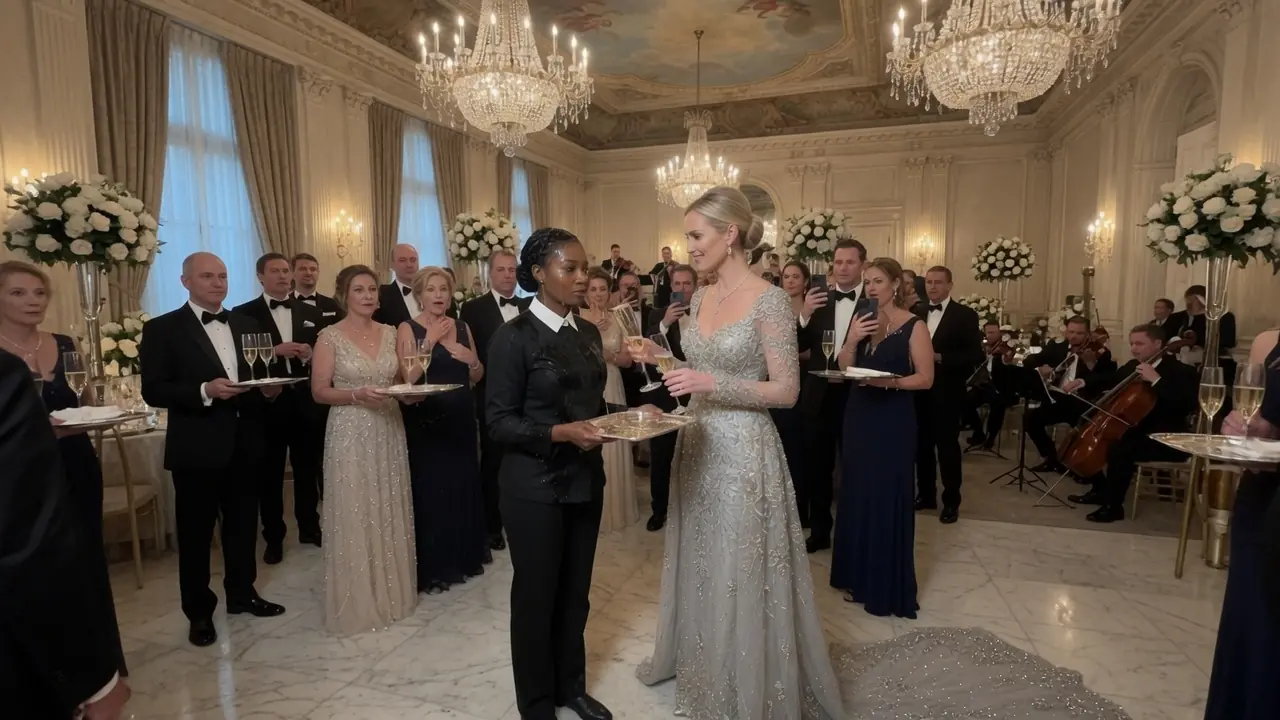
One moment, the ballroom was glowing with chandeliers, silk gowns, polished shoes, and the low music of a string quartet. The next moment, a stream of red wine poured down over the head of a young Black woman in a server’s uniform.
It slid over her neatly pinned hair.
It ran down her temple.
It soaked into the white collar of her black jacket and spread across the front of her shirt like a wound.
The glass emptied slowly, deliberately, as if the woman holding it wanted every person in the room to have enough time to watch.
A few people gasped.
A few looked away.
Most did neither.
They simply stood there, frozen in the comfort of people who knew they were not the ones being humiliated.
The woman holding the empty glass was Vanessa Whitmore, a white socialite with diamonds at her throat and a silver dress that shimmered every time she moved. She was beautiful in the kind of way money could polish, arrange, and display. Her blond hair was swept into a perfect knot. Her makeup had not cracked. Her smile had not disappeared.
If anything, it grew sharper.
“Next time,” Vanessa said, loud enough for the nearby guests to hear, “learn where you belong before you walk through a room like this.”
The young server did not move.
Her name was Amara Bennett.
She was twenty-eight years old, tall, graceful, and quiet in a way people often mistook for weakness. Her skin was a deep warm brown, her eyes dark and steady, her face composed even while wine dripped from her chin onto the marble floor.
Her uniform was ruined.
Her dignity was not.
That was what unsettled Vanessa first.
Amara did not cry.
She did not drop the silver tray in her hand.
She did not apologize for an offense she had not committed.
She only looked at Vanessa with a calm so complete that it made the insult look smaller than the woman who had delivered it.
The ballroom of the Astor Grand Hotel had been prepared for one of the most exclusive charity galas in New York. Crystal chandeliers threw golden light across painted ceilings. White roses filled tall glass vases. Champagne moved through the room on silver trays. Men in custom tuxedos discussed investments, elections, art collections, and the cost of appearing generous.
Outside, cameras lined the entrance.
Inside, power wore perfume.
The gala was hosted by Hawthorne Global Foundation, the charitable branch of one of the largest private investment empires in the country. The host himself had not yet appeared, which made the guests restless. Billionaires, governors, ambassadors, old-money families, and celebrity philanthropists had come less for the children’s hospital wing being funded that night and more for the chance to be seen in the same room as Adrian Hawthorne.
Adrian was a man people talked about carefully.
He was forty-two, white, private, and worth more money than most of the guests could imagine without turning it into a number they could brag about. He owned hotels, medical companies, logistics networks, real estate, private technology firms, and enough shares in enough quiet places to make even powerful people behave politely.
No one knew much about his personal life.
That made him more valuable to gossip.
Some said he had never married.
Some said he had a secret fiancée in Europe.
Some said he was too cold to love anyone and too disciplined to need anyone.
No one in that ballroom knew the truth.
No one except the woman now standing with red wine dripping down her face.
Amara Bennett Hawthorne.
The wife of the billionaire who owned the hotel, hosted the gala, funded the foundation, and had personally asked her to attend the evening quietly because she hated being displayed beside wealth as if marriage were an announcement instead of a promise.
She had not come as a server.
Not really.
She had only put on the uniform for ten minutes because one of the young waitresses had nearly fainted from panic in the service corridor after a tray broke and Vanessa Whitmore complained about “incompetent staff.” Amara had helped because helping came naturally to her. She had worked service jobs before law school, before boardrooms, before the world learned to call her “Mrs. Hawthorne” in private rooms where no one dared sneer.
The uniform fit because she had asked for one.
The tray was in her hand because she had carried it.
The mistake everyone made was assuming the clothing told the whole story.
Vanessa Whitmore looked at the silent young woman and laughed under her breath.
“What?” she said. “Nothing to say?”
The guests nearest them shifted.
An older man with a senator’s smile looked into his glass as if the champagne had suddenly become fascinating. A woman in emerald silk touched her pearls but did not speak. Two younger men near the bar smirked, more amused by the scene than offended by it.
Amara took a slow breath.
The wine smelled expensive.
Ridiculously expensive.
It mixed with the scent of roses, candle wax, cologne, and old money.
“Ma’am,” Amara said evenly, “you spilled wine on me.”
Vanessa’s eyebrows lifted.
“Spilled?”
She turned slightly toward the guests around her, inviting them into the performance.
“Oh, sweetheart, I did not spill it. I corrected you.”
A few people gave small, uncomfortable laughs.
Encouragement disguised as nervousness.
Vanessa fed on it.
The words cut through the music.
This time, more heads turned.
Amara’s hand tightened slightly around the tray. Not enough for the glasses to rattle. Just enough for her knuckles to show the pressure she refused to place in her voice.
“You do not know me,” Amara said.
Vanessa leaned closer.
“I know enough.”
Her eyes moved over Amara’s hair, her skin, her stained uniform, the tray in her hand.
“I know you were hired to serve, not stand in the middle of the room staring at guests as if you have opinions.”
Amara’s face remained still.
That seemed to anger Vanessa more than tears would have.
People like Vanessa preferred humiliation to produce a clean result. Shame. Collapse. An apology. A lowered gaze. Something that proved the insult had landed.
Amara gave her none of that.
A young Black waiter named Marcus stood near the service door, one hand frozen around a tray of champagne. His eyes moved between Amara and Vanessa, fear and fury fighting across his face.
He wanted to step forward.
Amara saw him.
With the smallest movement of her fingers, she told him no.
Not because she wanted silence.
Because she knew the room.
If Marcus defended her, Vanessa would become the victim before the story reached midnight. A wealthy white woman frightened by an aggressive Black employee. Security called. Careers ruined. Another lie dressed as concern.
Amara had seen too much of the world not to know how quickly power rewrote the scene.
Vanessa followed Amara’s glance and smiled.
“Oh, look,” she said. “Your friend wants to rescue you.”
Then she turned toward Marcus.
“Do not even think about it.”
Marcus swallowed hard.
His jaw worked.
But he stayed where he was.
Vanessa looked pleased.
“There. See? At least one of you understands instructions.”
A deeper silence spread now.
Not because the room had grown moral.
Because it had grown dangerous.
People could ignore one rude gesture. They could pretend the wine had been an accident. They could excuse tone, class, impatience, even cruelty.
But race, spoken so plainly, stained the air.
Amara slowly lowered the tray onto a nearby service table.
The soft sound of silver touching wood seemed louder than the quartet.
She reached for a napkin.
Vanessa snatched it first.
“No,” she said. “Staff restrooms are through the back, aren’t they?”
Then she leaned in again, voice lower but still audible.
“Go clean yourself up before Mr. Hawthorne arrives. He does not host evenings like this so people can look at stains.”
Amara looked at her then.
Truly looked.
For the first time, something flickered behind her calm.
Not fear.
Recognition.
Vanessa Whitmore was not simply cruel. She was confident in her cruelty. That kind of confidence did not come from one glass of wine or one bad mood. It came from a life in which consequences had always moved around her like servants opening doors.
“Mr. Hawthorne,” Amara said softly.
Vanessa smiled.
“Yes. Mr. Hawthorne. The man whose name is on everything in this building. The man people like you should thank for having work tonight.”
A man nearby cleared his throat.
“Vanessa,” he murmured, “perhaps that is enough.”
She turned on him.
“Don’t be dramatic, Charles. I am tired of pretending poor service is noble because the person giving it looks pitiful.”
Amara wiped one line of wine from her cheek with the back of her hand.
Her voice stayed low.
“What exactly did I do to offend you?”
Vanessa laughed.
“You walked between me and Senator Caldwell while I was speaking.”
“I was passing behind you with a tray.”
“You interrupted.”
“I said excuse me.”
“You said it like you expected me to move.”
Amara blinked once.
The whole accusation rested there, ugly and small.
A Black woman had passed too close. Spoken too evenly. Failed to shrink fast enough.
That was the crime.
Vanessa stepped back, satisfied that she had made her point.
“Someone call the event manager,” she said. “I want her removed from the floor.”
Marcus moved then despite himself.
“Ma’am, she didn’t do anything.”
Vanessa’s eyes sharpened.
“Excuse me?”
Marcus went pale but did not retreat.
“I saw it. She said excuse me. You grabbed the glass and dumped it on her.”
A ripple moved through the nearby guests.
Vanessa turned fully toward him.
“And who are you?”
“Marcus.”
“Of course you are.”
The contempt in her voice was soft enough to make it worse.
“Marcus, unless you would like to lose your job before dessert is served, I suggest you remember your position.”
Amara spoke before he could.
“Marcus, go back inside.”
He looked at her, wounded.
“But—”
“Please.”
There was something in her voice now that made him obey. Not submission. Authority.
Vanessa heard it too.
For the first time, uncertainty touched her expression.
It passed quickly.
“You speak to staff like you manage them.”
Amara picked up the stained napkin Vanessa had dropped.
“No,” she said. “I speak to people like they are people.”
That landed.
A few guests looked up.
Someone near the wall whispered, “Who is she?”
Vanessa heard that too, and irritation flushed her cheeks.
“She is nobody,” Vanessa said.
The sentence had barely left her mouth when the ballroom doors opened.
Not loudly.
No announcement.
No trumpet of attention.
Yet the room changed before anyone spoke.
Adrian Hawthorne walked in.
He was tall, broad-shouldered, and composed in a black tuxedo that looked severe rather than decorative. His light brown hair was brushed back from a face known from financial magazines, hospital dedications, and rare photographs taken by people brave enough to aim cameras at him.
His eyes were blue-gray, cold at first glance and difficult to read after that.
Beside him walked the hotel’s general manager, the foundation director, and two security men who kept enough distance to appear polite.
Conversations softened.
Then thinned.
Then stopped.
Adrian’s gaze moved over the ballroom with practiced detachment.
He was used to being stared at. Used to rooms adjusting themselves around him. Used to smiles appearing on faces that had been bored moments before.
Then he saw Amara.
The change in him was immediate.
Not dramatic to everyone.
But to those watching closely, it was unmistakable.
His shoulders stiffened.
His eyes narrowed.
His face, already controlled, became something colder than control.
He saw the wine in her hair.
The stain across her white collar.
The red drops on the marble.
The empty glass in Vanessa Whitmore’s hand.
Then he began walking toward them.
The crowd parted before understanding why.
Vanessa noticed him and transformed instantly. The sharpness left her mouth. Her posture softened into elegance. She turned just enough for the diamonds at her throat to catch the light.
“Mr. Hawthorne,” she said warmly, as if nothing in the world were wrong. “What an honor. Your gala is magnificent.”
Adrian did not look at her.
He went straight to Amara.
The room watched.
Amara held his gaze as he approached. For the first time all night, her expression shifted. Not much. Only a small loosening around the eyes, the kind that happens when a person who has been standing alone sees someone who knows where the wound is.
Adrian stopped in front of her.
For one second, he did not speak.
Then he removed the white pocket square from his jacket and gently touched it to the wine on her cheek.
The ballroom forgot how to breathe.
“Are you hurt?” he asked.
His voice was quiet.
Too quiet.
Amara looked at him.
“No.”
His jaw tightened.
“Who did this?”
Vanessa’s smile faltered.
Several guests turned toward her before they could stop themselves.
Amara did not answer immediately.
That silence was mercy.
Vanessa did not deserve it.
Adrian followed the direction of the room’s guilt and finally looked at her.
“Mrs. Whitmore,” he said.
Not a greeting.
A verdict beginning.
Vanessa laughed lightly.
“Oh, Mr. Hawthorne, this has been terribly exaggerated. Your staff member was rude, and unfortunately there was a little accident with my wine.”
Adrian looked at the empty glass in her hand.
“An accident.”
“Yes. These events can be crowded, and she came far too close. I’m sure your management will handle it.”
Adrian’s eyes did not move.
“My management.”
Vanessa smiled again, recovering confidence.
“Of course. I know you have high standards. That is why we all admire what you’ve built.”
Adrian turned slightly.
“Julian.”
The hotel manager stepped forward at once.
“Yes, sir.”
“Is this woman scheduled as staff tonight?”
The manager looked at Amara, then at Adrian, then went pale.
“No, sir.”
A murmur passed through the crowd.
Vanessa blinked.
“She is wearing a uniform.”
Adrian’s voice stayed flat.
“That was not my question.”
Julian swallowed.
“No, sir. She is not scheduled as staff.”
Vanessa gave a short laugh.
“Then perhaps she should not have been pretending to work here.”
Adrian looked back at Amara.
There was pain in his eyes now, controlled but visible.
“Did you put on the uniform to help Elise?”
Amara sighed softly.
“She was crying in the service corridor.”
The young waitress Elise, standing near the back, covered her mouth with both hands.
Adrian nodded once.
Then he turned to Marcus.
“You saw what happened?”
Marcus froze at being addressed directly by Adrian Hawthorne.
“Yes, sir.”
“Tell me.”
Marcus glanced at Vanessa, then at Amara.
Amara gave him the smallest nod.
His voice shook at first, then steadied.
“Mrs. Whitmore was speaking near the center aisle. Mrs.—”
He stopped.
He did not know what to call Amara.
Adrian said nothing.
Marcus corrected himself.
“Amara came through with a tray and said excuse me. She didn’t bump her. She didn’t spill anything. Mrs. Whitmore turned around, said she was tired of people not knowing their place, and poured the wine on her.”
The room stirred again.
Vanessa snapped, “That is a lie.”
Adrian did not look away from Marcus.
“Anything else?”
Marcus hesitated.
“She said people like us should remember our position.”
A heavy silence followed.
Adrian nodded.
“Thank you.”
Marcus stepped back, breathing hard.
Vanessa’s face had flushed beneath her makeup.
“This is absurd,” she said. “You are taking the word of a waiter over mine?”
Adrian turned to her slowly.
“No.”
Relief flashed across her face.
Then he continued.
“I am taking the word of a witness over the woman holding the empty glass.”
The relief died.
A few people lowered their heads.
Adrian looked at Julian.
“Security footage?”
Julian answered quickly.
“Every angle of the ballroom is recorded, sir.”
“Preserve it.”
“Yes, sir.”
Vanessa’s fingers tightened around the glass.
“Mr. Hawthorne, I think you are allowing this to become unpleasant.”
“It became unpleasant when my wife entered my ballroom covered in wine.”
The words landed like thunder.
For a moment, nobody moved.
Then the whisper passed through the room.
Wife.
His wife.
The server was his wife.
Vanessa stared at Amara.
The color drained from her face so quickly that her diamonds seemed brighter against her skin.
“I—” she began.
But no sentence came.
Adrian stepped closer to Amara and placed his hand, carefully, at the small of her back. Not possessive. Protective. Familiar.
“This is Amara Bennett Hawthorne,” he said, his voice carrying now through the ballroom. “My wife. Co-chair of Hawthorne Global Foundation. Principal donor behind the pediatric surgery wing we are funding tonight. And the woman who personally designed the scholarship program many of you came here to be photographed supporting.”
No one spoke.
A senator’s wife let out a tiny sound and covered it with a cough.
Vanessa’s lips parted.
“I didn’t know.”
Amara finally looked at her.
That sentence was the oldest excuse in the world.
I didn’t know you mattered.
I didn’t know you had power.
I didn’t know someone important loved you.
I didn’t know there would be consequences.
Amara wiped another drop of wine from her jaw.
“No,” she said. “You didn’t.”
Vanessa seized on the words as if they were a rope.
“Exactly. I did not know. There was a misunderstanding.”
Amara’s eyes remained steady.
“You misunderstood my humanity?”
The question stopped her.
Adrian looked at Vanessa as if she were something he had found rotting beneath polished silver.
“You did not insult her because you mistook her for staff,” he said. “You insulted her because you thought staff could be insulted safely.”
That was the truth no one in the room could dress up.
Vanessa looked around, searching for rescue.
But the room had already begun its favorite ritual.
Distance.
The same people who had laughed softly minutes earlier now looked offended. The same men who had watched in silence now frowned as if they had been morally opposed from the beginning. The same women who had enjoyed the spectacle now held their faces in tight arrangements of sympathy.
Cowardice could change costumes very quickly.
“Adrian,” said a man near the bar, stepping forward with nervous charm. “Surely this can be settled privately. Vanessa has had too much champagne, perhaps. Emotions run high at these events.”
Adrian turned his head.
“Charles, you watched.”
Charles froze.
“I beg your pardon?”
“You were standing there when it happened.”
Charles glanced around.
“I did not see everything.”
“You saw enough to ask her to stop.”
Charles went red.
“That is not fair.”
“No,” Adrian said. “It is not.”
The answer was so cold Charles stepped back.
Amara touched Adrian’s sleeve lightly.
He looked at her at once.
The room saw that too.
Power did not soften him.
She did.
“Let me speak,” she said.
Adrian’s expression changed. He did not like it. Every part of him wanted to end the evening, remove Vanessa, fire anyone complicit, and shelter his wife from another second of public injury.
But he knew Amara.
He stepped back half a pace.
The ballroom waited.
Amara faced Vanessa first.
Wine still clung to the ends of her hair. Her collar was stained. Her uniform was ruined. Yet somehow she looked more elegant than half the room in diamonds.
“When you poured that wine,” Amara said, “you believed you were correcting a woman beneath you.”
Vanessa swallowed.
“I said I was sorry.”
“No,” Amara said. “You said you didn’t know.”
The difference struck harder than anger.
Amara turned to the room.
“And most of you watched.”
No one moved.
“I know this kind of silence,” she continued. “I knew it when I was nineteen and serving tables at a private club while men discussed my body as if I could not hear them. I knew it when a woman handed me her coat and called me by the only Black name she could remember. I knew it when professors told me I was impressive for someone from my neighborhood. I knew it when board members smiled at my husband and asked me where the restroom was.”
Her voice did not rise.
That made it impossible to dismiss as emotion.
“This room is full of people who donate to fairness, sponsor opportunity, and praise courage in speeches. But ten minutes ago, a woman poured wine on my head, and most of you waited to see whether she had chosen someone important enough to defend.”
Several faces lowered.
Amara looked at Marcus.
“He was the first person who told the truth.”
Marcus blinked hard.
She looked toward Elise.
“And a frightened waitress in the back is the reason I was carrying that tray. She made a mistake. She expected to lose her job for it because some people in this room treat service like servitude.”
Adrian’s face hardened again.
Amara faced Vanessa.
“You did not humiliate me because I was in uniform. You humiliated me because you believed a uniform made me available for humiliation.”
Vanessa’s eyes shone now, but not with remorse.
Fear.
There was a difference.
“I apologize,” she said quickly. “Truly. I was wrong. I was upset. I spoke poorly.”
Amara tilted her head slightly.
“You spoke clearly.”
A quiet sound moved through the crowd.
Vanessa looked at Adrian.
“Mr. Hawthorne, please. My family has supported your foundation for years.”
Adrian’s answer was immediate.
“Your family’s pledge will be returned.”
Her mouth fell open.
“That is unnecessary.”
“It is already decided.”
“You cannot be serious.”
“I am rarely anything else.”
A few people would have smiled if the room had not been so tense.
Adrian turned to Julian.
“Mrs. Whitmore will leave the hotel tonight. Her family’s companies are to be removed from all foundation donor materials by morning. Any pending partnership with Whitmore Holdings is suspended until further review.”
Vanessa looked as if the floor had shifted beneath her.
“You would destroy a partnership over one mistake?”
Amara answered before Adrian could.
“No. Over one revelation.”
Vanessa’s gaze snapped back to her.
Amara stepped closer.
“A mistake is reaching for salt and knocking over a glass. What you did came from somewhere. Tonight only made it visible.”
The room was silent enough to hear the distant clink of dishes behind the service doors.
Security approached, careful and professional.
Vanessa stepped back.
“Don’t touch me.”
“No one needs to touch you,” Adrian said. “You can walk.”
Humiliation flooded her face. The same thing she had tried to place on Amara now returned to her in front of the people whose approval she valued most.
But there was one difference.
Vanessa was leaving with her dress clean, her body safe, and her name still protected by money.
Amara had been expected to leave quietly with wine in her hair.
Vanessa looked around for someone to object.
No one did.
That was almost funny.
She lifted her chin, gathered what remained of her pride, and walked toward the doors. Her heels struck the marble sharply. Security followed at a respectful distance.
At the doorway, she turned once.
Her eyes went to Amara, then Adrian, then the crowd.
For a second, hatred flickered through the mask.
Then she disappeared.
The ballroom remained silent after she was gone.
People did not know whether to clap, speak, apologize, or pretend the evening could continue.
Adrian looked at Amara.
“We can leave,” he said softly.
She understood what he meant.
Not just the room.
The performance.
The money.
The gowns.
The people who would spend tomorrow pretending they had always admired her.
She glanced toward Marcus, Elise, and the other staff standing near the service entrance.
Then she looked at the guests.
“No,” she said. “The hospital still needs funding.”
A strange, sad smile touched Adrian’s mouth.
“Of course it does.”
Amara reached for the ruined jacket button and slowly removed it. Adrian took it from her without a word. Someone rushed forward with a clean shawl, but Amara did not immediately accept it.
Instead, she stepped onto the small platform where Adrian had been scheduled to give his opening remarks.
The foundation director looked panicked.
Adrian gave him one look.
The man stepped aside.
Amara stood before the microphone, hair damp with wine, white shirt stained red, face calm.
Cameras that had been hired to capture generosity now captured truth.
She adjusted the microphone.
“My name is Amara Bennett Hawthorne,” she said. “Most of you were not introduced to me tonight. That was by my choice.”
The room listened as if listening had just become mandatory.
“I do not enjoy being treated as an accessory to my husband’s success. I do not enjoy the way some people become kinder when they learn my last name. And I do not enjoy what happened tonight.”
She looked across the ballroom.
“But I am glad it happened in the open.”
A murmur moved through the crowd.
“Because many people in this room support programs for children who will grow up being underestimated before they ever speak. Black children. Brown children. Poor children. Children whose parents clean hotel rooms, park cars, serve meals, stock kitchens, and carry trays through rooms where powerful people practice kindness in public and contempt in private.”
Adrian stood below the platform, watching her with an expression no magazine had ever captured.
Pride.
Love.
Rage held on a short leash.
Amara continued.
“The pediatric wing we are funding tonight will serve children whose families may never enter a room like this except through the service doors. Their lives are not made more valuable when a billionaire notices them. They are already valuable.”
No one dared look away.
“So tonight, the foundation is changing one thing. Ten percent of all unrestricted donations raised at this gala will go directly into a staff emergency fund for hospitality, service, and maintenance workers at Hawthorne properties in this city. Medical bills, childcare emergencies, legal support, housing crises. Quiet help before a life falls apart.”
Julian looked stunned.
Then Adrian nodded once.
It was done.
Amara looked toward the staff.
“And anyone who witnessed what happened tonight and tells the truth will not lose work for it.”
Marcus lowered his head.
Elise began crying.
Amara finally accepted the shawl someone offered and draped it around her shoulders.
Then she looked back at the guests.
“If you came here to be seen giving, give. If you came here to be photographed, the cameras are there. But after tonight, do not mistake a donation for decency.”
She stepped away from the microphone.
For one breath, the ballroom stayed frozen.
Then someone began clapping.
It was not one of the richest men in the room.
It was Marcus.
He clapped twice before realizing he was alone.
Then Elise joined.
Then another server.
Then the staff near the service doors.
Only after them did the guests begin, slowly, awkwardly, some with shame, some with calculation, some with genuine emotion.
The applause grew.
Amara did not smile.
She walked down from the platform, and Adrian met her at the bottom.
“Too much?” she asked quietly.
His eyes moved over her wine-stained shirt.
“No,” he said. “Not enough.”
That almost made her laugh.
He touched her hand.
This time, she let him take it.
The gala continued, but it was no longer the same party.
The music resumed softly. Conversations returned, but with less arrogance. People gave more than they had planned, partly from shame, partly from fear, partly because some truth, once spoken, makes stinginess look naked.
By midnight, the event had raised nearly twice its original goal.
By morning, Vanessa Whitmore’s name was everywhere.
Not because Amara leaked the footage.
She did not need to.
Too many people had recorded too much. Too many guests wanted to be remembered on the correct side of the scandal after failing to stand there in person.
The video spread quickly.
Vanessa’s silver dress.
The red wine.
The words “learn where you belong.”
Then Adrian Hawthorne’s voice.
“My wife.”
News anchors repeated it. Commentators argued. Publicists issued statements. Whitmore Holdings called it “an unfortunate interpersonal exchange.” The internet called it what it was.
Racism in diamonds.
But Amara refused every morning show invitation.
She did not want to become a clip.
She did not want strangers turning her humiliation into entertainment disguised as justice.
Instead, she went back to work.
Two weeks later, Hawthorne Global Foundation announced the Bennett Worker Relief Fund, named not after Adrian, but after Amara’s mother, Denise Bennett, who had cleaned office buildings for twenty-six years and raised two daughters alone.
The first grant went to Elise, the young waitress whose panic had started the chain of events. Her mother needed surgery, and Elise had been working double shifts to pay rent and medical bills.
The second went to Marcus, not because he asked, but because Amara learned his younger brother was about to drop out of community college after losing financial aid.
Marcus tried to refuse.
Amara called him personally.
“You told the truth in a room that punished truth,” she said. “Let someone help you without making you beg for it.”
He was quiet for a long time.
Then he said, “Yes, ma’am.”
“Amara,” she corrected gently.
“Yes, Amara.”
Months passed.
The gala became one of those stories people retold with increasing bravery. Guests who had stood silent began saying they had been just about to speak. Men who had stared into champagne glasses claimed they had been stunned. Women who had whispered behind gloves insisted they had always sensed Vanessa’s cruelty.
Amara heard these things and smiled politely.
She had learned long ago that some people wanted credit for the courage they found only after danger passed.
Vanessa disappeared from public events for a while. Her apology came through a statement written by someone who had clearly attended better schools than her conscience. It mentioned regret, misunderstanding, sensitivity, and growth.
It did not mention Amara by name.
Adrian read it at breakfast and folded the paper once.
“She still thinks the worst part is that people saw.”
Amara sipped her coffee.
“For people like Vanessa, being seen is the punishment.”
He looked at her across the table.
“And for you?”
She considered that.
“For me, the punishment would have been staying quiet.”
Adrian’s expression softened.
He reached across the table.
She placed her hand in his.
Their marriage had always been private by choice. Not hidden. Not shameful. Just protected. Amara had never wanted society pages measuring her dresses, guessing about children, or calling her “the woman who captured Adrian Hawthorne” as if she had hunted him.
After the gala, privacy became harder.
But something else became easier.
People stopped asking Adrian where his wife was.
They started asking Amara what she was building next.
A year later, the pediatric wing opened.
The lobby was bright with natural light, warm wood, and a mural painted by children from neighborhoods the hospital served. Donors gathered again, though this time the guest list looked different. Doctors, nurses, janitors, cafeteria workers, social workers, community organizers, and former patients stood beside wealthy patrons.
Marcus was there in a navy suit, standing with his younger brother, who had stayed in school.
Elise was there too, now promoted to event supervisor at the Astor Grand.
Adrian gave a short speech, because he hated long ones.
Then Amara stepped forward.
She wore a cream dress and no diamonds except her wedding ring. Her hair was loose around her shoulders. Her voice was steady as she looked out over the crowd.
“A year ago,” she said, “I stood in a ballroom a few blocks from here wearing a server’s uniform. Someone saw that uniform, saw my skin, and decided I was safe to degrade.”
The room quieted.
“That night was painful. But it clarified something. Charity that does not respect the people serving the meal is not charity. Power that only protects people with the right last name is not justice. And kindness that appears only after status is revealed is not kindness.”
Adrian stood near the wall, watching her.
Amara turned slightly toward the hospital doors.
“This wing exists for children. But I hope it also stands as a reminder to the adults who built it. Every person in a room has a story beyond what they are wearing. Every worker has a life beyond the service they provide. Every child watching us learns who matters by seeing who we defend.”
Her eyes moved across the crowd.
“Defend people before you know who they are married to. Respect them before you know what they own. Believe them before a billionaire confirms their worth.”
No one spoke for several seconds.
Then the applause came.
This time, it did not begin from shame.
It began from understanding.
Later, after the ceremony ended, Amara stepped outside for air. The city moved around her, loud and indifferent. Traffic rolled past. A nurse hurried across the sidewalk with coffee in one hand. A child in a yellow coat tugged at his mother’s sleeve and pointed up at the hospital windows.
Adrian joined her.
For a moment, they stood together without speaking.
Then he said, “Do you ever wish I had arrived sooner that night?”
Amara looked at him.
The question was quiet, but she heard the guilt beneath it.
“No,” she said.
He frowned.
“No?”
“If you had arrived sooner, everyone would have behaved.”
“That would have been preferable.”
“For me, maybe.” She looked back at the city. “But then we would not have known.”
Adrian was silent.
Amara continued.
“People reveal themselves in the moments when they think no one powerful is watching.”
He took that in.
Then he reached for her hand.
She let him.
Inside the hospital, cameras flashed, donors smiled, doctors shook hands, and children waited for rooms that now existed because money had finally moved in the right direction.
Outside, Amara stood beside the man who loved her, not because he had saved her from humiliation, but because when the room learned who she was, he made sure they also understood who they had been.
That mattered.
But it was not the whole story.
The whole story was not that a billionaire’s wife had been mistaken for a server.
The whole story was that a server should have been safe too.
And that was the sentence Amara carried with her long after the headlines faded, long after Vanessa Whitmore became a cautionary whisper at parties, long after guests rewrote their own silence into something braver.
A server should have been safe too.
A Black woman should not have needed a white husband with billions to make a room remember she was human.
A uniform should not have made cruelty feel permitted.
A tray should not have erased a person’s name.
That night, Vanessa Whitmore had poured wine onto Amara’s head because she believed she knew where power lived.
She was wrong.
Power was not in the glass.
Not in the diamonds.
Not even in the last name Hawthorne.
Power was in the woman who stood there soaked in red wine and still did not bow.
Power was in the waiter who told the truth while his job shook beneath him.
Power was in every worker who clapped before the wealthy remembered their hands.
And power was in the lesson that spread through every ballroom after that night.
Be careful whom you choose to humiliate.
Not because she might belong to a billionaire.
But because she already belongs to herself.