At Lincoln Ridge High, the annual book fair was the only time the school library felt alive instead of forgotten.
Folding tables filled the room from wall to wall, covered with paperbacks, mystery novels, science fiction books, sports biographies, comic collections, and glossy posters that curled at the edges. Cardboard signs hung from the shelves. A small cash box sat beside the librarian’s desk. The air smelled like fresh paper, dust, plastic wrap, and the faint sweetness of cinnamon rolls from the cafeteria down the hall.
For most students, the book fair was just something to pass through during English class.
For Caleb Morgan, it felt like a place where he could breathe.
Caleb was seventeen, quiet, and thin in a way that made people assume he was weaker than he was. He wore a faded denim jacket, old sneakers, and a backpack with one strap repaired in black tape. His hair fell across his forehead whenever he looked down, which was often. At Lincoln Ridge, looking down had become a habit. It helped him avoid eye contact with people who enjoyed turning eye contact into a challenge.
He had saved eleven dollars and fifty cents for the book fair.
That might not have sounded like much to most students, but to Caleb, it meant three weekends of skipping snacks after work at his mother’s laundromat and keeping every dollar bill folded inside an envelope under his mattress. He had come to the fair looking for one book in particular, a new adventure novel called The Last Gate of Orion. He had read the first two books in the series from the public library so many times that the librarian knew his name.
Stories mattered to Caleb. They had mattered since he was a kid sitting in the back room of the laundromat while washers shook the walls and his mother counted quarters at the counter. Books gave him places where quiet boys could discover secret courage, where impossible doors opened, where the person everyone ignored turned out to be the one who saved the day.
He knew real life did not work that neatly.
But he still liked holding the possibility in his hands.
That afternoon, Caleb stood near the fantasy table with his fingers resting on the cover of The Last Gate of Orion. The artwork showed a boy standing before a glowing doorway in a ruined city, one hand gripping a silver key. Caleb stared at it longer than he needed to. He had found the last copy.
“You going to buy it or marry it?”
The voice came from behind him.
Caleb’s shoulders tightened before he turned.
Derek Harlan stood at the end of the table with two friends behind him, Jason Pike and Miles Turner. Derek was tall, broad, and blond, with a varsity jacket hanging open over a red shirt. He played baseball, drove an old Mustang, and walked through Lincoln Ridge like every hallway had agreed to make room for him. Jason laughed at everything Derek said, and Miles usually watched for teachers while pretending he was not involved.
Derek had been bothering Caleb since junior year. At first, it was because Caleb worked at the laundromat and sometimes came to school smelling faintly of detergent. Then it was because Caleb carried books. Then it was simply because Caleb had become part of Derek’s routine.
“Laundry boy,” Derek said, smiling. “Didn’t know they sold books with pictures big enough for you.”
Jason laughed immediately.
Caleb kept his hand on the book. “I’m just looking.”
Derek stepped closer. “Yeah, I see that. Looks serious.” He leaned over the table and read the title badly on purpose. “The Last Gate of Orion. Wow. Sounds like something for seventh graders.”
Miles picked up another paperback and flipped through it. “Maybe it has instructions on how to make friends.”
A few students nearby glanced over. Some looked away quickly. Others slowed down, sensing trouble and not wanting to miss it.
Caleb felt the familiar heat rise in his face. He hated that reaction most of all. Derek could say one sentence, and Caleb’s body betrayed him before his mind had time to stay calm.
He picked up the book. “I’m buying this.”
Derek’s smile sharpened. “With what? Dryer quarters?”
Caleb turned toward the librarian’s desk, but Derek stepped into his path.
“Relax,” Derek said. “I want to see it.”
Caleb held the book against his chest. “No.”
The word was small, but in the library it sounded bigger than Caleb expected.
Derek blinked once. “No?”
Caleb’s fingers tightened around the book. “I said no.”
For a second, the book fair went quieter around them. Mrs. Avery, the librarian, was helping a freshman count change at the front desk and did not see them yet. A girl from Caleb’s English class, Hannah Lee, stood near the mystery table, watching with concern.
Derek looked around at the students nearby, then back at Caleb. He smiled like Caleb had just handed him something useful.
“You hear that?” Derek said. “Laundry boy has rules now.”
Caleb tried to step around him.
Derek snatched the book from his hands.
It happened fast. Caleb reached for it, but Derek lifted it above his head and backed away from the table. Jason laughed. Miles grinned, though his eyes flicked toward Mrs. Avery.
“Give it back,” Caleb said.
Derek held the book high. “What’s the magic word?”
Caleb’s jaw tightened. “Give it back.”
“That’s not magic.”
Hannah stepped forward. “Derek, stop.”
Derek turned toward her with fake surprise. “I’m just checking the quality. People should know what they’re buying.”
“You’re being a jerk,” she said.
A few students whispered. Derek’s face changed slightly. He did not like being called out, especially by someone who usually stayed quiet. He looked back at Caleb, and Caleb saw the anger under the grin.
Derek lowered the book and flipped it open roughly. The spine cracked.
Caleb’s stomach dropped. “Don’t.”
Derek looked at him. “Don’t what?”
“That’s the last copy.”
Derek’s smile widened. “Then it must be special.”
Caleb reached for it again, but Jason stepped between them and bumped his shoulder.
“Careful,” Jason said. “Don’t get emotional over a little story.”
Caleb looked past him at the book in Derek’s hands. “I saved for that.”
Something about saying it out loud made the room feel even colder.
Derek heard it too. His grin turned crueler, because bullies always recognized the thing that mattered most. If Caleb had pretended not to care, Derek might have tossed it back. But now he knew.
“You saved for it?” Derek asked. “That’s adorable.”
“Give it back,” Caleb said again.
Derek held the book by both covers.
Hannah’s voice sharpened. “Derek, don’t.”
Mrs. Avery looked up from the desk.
But it was too late.
Derek tore the book open at the middle.
The sound was small and terrible.
Paper ripped in a jagged line. Several pages tore loose and fluttered onto the carpet. The cover bent backward. The last copy of The Last Gate of Orion hung in Derek’s hands, broken.
The entire library froze.
Caleb stared at the torn book.
For a moment, he did not move. He did not speak. He could only look at the pages scattered near his shoes, the white torn edges, the ruined cover, the doorway on the front split by Derek’s hands.
Derek laughed once, but even he seemed to hear how wrong the sound was in the silence.
“Oops,” he said. “Guess the gate didn’t hold.”
Jason laughed weakly. Miles looked toward the front desk, suddenly nervous.
Mrs. Avery stepped around the desk. “Derek Harlan. What did you just do?”
Derek lifted his hands, still holding half the book. “It was already falling apart.”
“No, it wasn’t,” Hannah said immediately. “He ripped it.”
Another student added, “I saw him.”
Caleb still had not moved.
Something in him had gone very still. He had spent years telling himself that small humiliations were not worth fighting over. A nickname was not worth it. A shove in the hallway was not worth it. A joke about his mother’s laundromat was not worth it. A book was just paper.
But that was the lie.
It was never just paper.
It was his work hours. His saved dollars. His quiet place. His proof that something could belong to him without being taken.
Derek tossed one half of the book onto the table. “Relax. It’s just a story.”
Caleb slowly lifted his eyes.
“No,” he said. “It was mine.”
The room went silent again.
Derek’s face tightened. “What?”
Caleb stepped closer. “You destroyed something that was mine.”
Derek leaned down slightly, using his height like a weapon. “And what are you going to do about it?”
Caleb looked at the torn pages on the floor. Then he bent down and picked one up carefully. He placed it on the table beside the ruined cover. His hands were shaking, but his voice came out clear.
“You’re going to pay for it,” he said. “You’re going to apologize. And then you’re going to leave.”
Jason laughed. “Man, he’s giving orders.”
Derek stepped into Caleb’s space. “You don’t give me orders.”
Caleb did not step back. “Then stop acting like a child who needs them.”
A few students gasped softly.
Derek’s face flushed red. He shoved Caleb in the chest.
Caleb stumbled backward into the edge of the table. A stack of paperbacks slid sideways. Hannah shouted, “Stop!” Mrs. Avery hurried toward them, but Derek moved faster, grabbing the front of Caleb’s denim jacket.
“You think you’re tough now?” Derek snapped.
Caleb looked at Derek’s fist twisted in his jacket.
Then he looked at the torn book.
His uncle had taught him once, after Derek shoved him into a locker the year before, that defending yourself did not mean swinging wildly. “Break the grip,” Uncle Ray had said in the garage behind the laundromat. “Use balance. End it clean. Then stop.”
Caleb had never used it at school.
Until now.
He caught Derek’s wrist with both hands, turned his shoulder, and stepped sideways. Derek expected him to pull back. Instead, Caleb moved with the force, twisted out of the grip, and used Derek’s forward pressure against him.
Derek stumbled.
Caleb swept one foot behind Derek’s ankle and guided him down onto the carpet beside the fantasy table.
Derek hit the floor hard enough to knock the breath out of him, but not hard enough to seriously hurt him.
The library went completely silent.
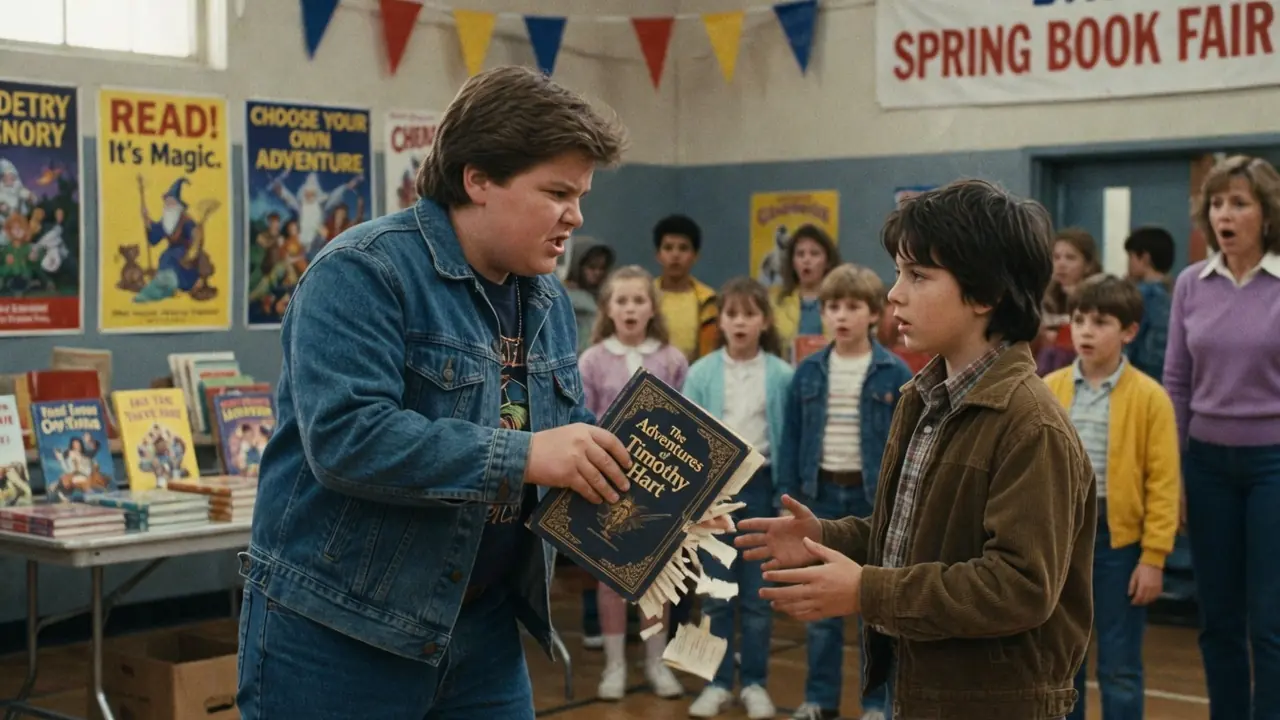
The boy who had walked in laughing now sat stunned beside the torn pages he had scattered.
Caleb stood over him, breathing hard, fists open at his sides. He did not hit again. He did not shout.
“Don’t touch my things,” Caleb said. “Don’t touch me. And don’t ever talk about my mother’s work again.”
Mrs. Avery reached them, face stern and pale with anger. “Enough. Derek, stay where you are. Jason, Miles, step back.”
Derek pushed himself up, humiliated. “He attacked me!”
Hannah spoke immediately. “You shoved him first.”
A freshman near the table added, “And you grabbed him.”
Another student pointed at the torn book. “He ripped it on purpose.”
For once, Derek looked around and found no one willing to carry his lie.
Jason stared at his shoes. Miles backed away from the table. The laughter had disappeared, and without it, Derek looked smaller than Caleb had ever seen him.
Mrs. Avery pointed toward the door. “Office. Now.”
Derek stood slowly, his face burning. “This is ridiculous.”
“No,” Mrs. Avery said sharply. “Destroying merchandise and putting your hands on another student is ridiculous. Move.”
Derek glared at Caleb one last time before walking toward the door. Jason and Miles followed under Mrs. Avery’s pointed stare.
Caleb stayed beside the table.
The torn book lay in pieces.
Now that the danger had passed, his hands shook harder. His throat tightened, and he hated that he felt close to tears. He had defended himself. He had made Derek fall. Everyone had seen the truth.
But the book was still ruined.
Hannah crouched and began picking up the torn pages.
Caleb looked at her. “You don’t have to.”
“I know,” she said. “I want to.”
A freshman helped too. Then another student gathered the loose pages from under the table. Someone straightened the stack of paperbacks that had nearly fallen. Within seconds, several students were helping put the pieces together.
Caleb stared at them, stunned.
He had expected humiliation to be something he cleaned up alone.
But this time, the room bent down with him.
Mrs. Avery returned after sending another teacher to escort Derek to the office. She looked at the torn book on the table, then at Caleb.
“I’m sorry,” she said softly.
Caleb swallowed. “It was the last copy.”
“I know.” Mrs. Avery picked up the broken cover carefully. “But it is not your fault. He will pay for the damaged book.” She paused. “And I can order another copy.”
Caleb nodded, but his eyes stayed on the torn pages. “It won’t be this one.”
Mrs. Avery’s expression softened. “No. It won’t.”
That was the part adults sometimes missed. Replacing something was not the same as undoing the moment someone decided they had the right to destroy it.
In the office, Derek tried to say Caleb had overreacted. He said the book had been weak, that it ripped by accident, that Caleb had attacked him for no reason. But too many students gave statements. Mrs. Avery gave hers. Hannah gave hers. The freshman who saw everything gave his too.
By the end of the day, Derek was suspended for three days, required to pay for the ruined book, and banned from the book fair. Jason and Miles received detention for encouraging the incident and lying at first.
But the real consequence came faster than any school punishment.
Everyone knew.
By lunch the next day, the story had moved through Lincoln Ridge High. Some students exaggerated, claiming Caleb had thrown Derek over the fantasy table. Some said Derek screamed, which was not true. Some said Caleb had been secretly training for years, which made Caleb roll his eyes when he heard it.
But the part that mattered stayed the same.
Derek took Caleb’s book.
Derek tore it.
Caleb made him answer for it.
At lunch, Caleb sat near the courtyard with a sandwich from home. He expected to eat alone. Instead, Hannah appeared with a tray and sat across from him.
“You okay?” she asked.
Caleb looked at his sandwich. “I’m fine.”
Hannah raised an eyebrow. “That is the least convincing sentence in American history.”
He almost smiled. “I’m not hurt.”
“I didn’t ask if you were hurt. I asked if you were okay.”
Caleb was quiet for a moment. “I keep seeing the book rip.”
Hannah nodded. “Yeah. That was awful.”
“It sounds stupid.”
“No, it doesn’t.”
“It was just a book.”
Hannah leaned forward. “No, Caleb. It was something you cared about. He knew that. That’s why he did it.”
Caleb looked away because she had said the truth too plainly.
A few minutes later, the freshman from the book fair walked over. He held a milk carton and looked nervous. “Can I sit here?”
Caleb blinked. “Sure.”
The freshman sat down carefully. His name was Oliver. He said Derek had once taken his sketchbook and passed it around the locker room. He had never told anyone because he thought people would laugh.
Hannah looked at Caleb.
Caleb understood the look.
“You should tell Mrs. Avery or Mr. Harris,” Caleb said.
Oliver looked doubtful. “Would they care?”
Caleb thought about the torn book, the statements, and Mrs. Avery’s face when she told Derek to go to the office.
“Yeah,” Caleb said. “This time, I think they will.”
By the end of the week, more students came forward. A girl whose poetry notebook had been mocked. A sophomore whose comic art had been shoved into a trash can. A junior whose backpack had been dumped in the hallway because Derek wanted a laugh. Each story was small enough for people to ignore, until they were placed together.
Then they became a pattern.
Principal Harris called an assembly the following Monday.
Students groaned when it was announced, assuming it would be another lecture about respect. But the assembly was different. The librarian, Mrs. Avery, stood on the auditorium stage holding the torn copy of The Last Gate of Orion, now taped together carefully but visibly damaged.
“This is a book,” she said. “Paper, ink, glue, and a cover. It can be replaced.”
She looked out at the students.
“But what happened to it was not only about paper. It was about a student’s right to care about something without having that care turned into a weapon against him.”
The auditorium quieted.
Mrs. Avery continued. “When you mock what someone loves, you are not being funny. You are testing whether the room will let you be cruel. When you destroy someone’s work, book, drawing, project, lunch, or belongings, you are not joking. You are taking something that does not belong to you.”
Caleb sat near the back, his face warm, wishing the whole school did not know exactly whose book she held. But he also felt something else. Relief, maybe. The thing that had hurt him was being named correctly.
Not drama.
Not overreaction.
Not a joke.
Cruelty.
After the assembly, Derek returned to school. Without his varsity jacket and without his usual grin, he looked less like the ruler of the hallway and more like a boy learning that his audience had limits. Students watched him pass, but nobody cheered. Nobody laughed.
Near the end of the day, Derek stopped by Caleb’s locker.
Caleb tensed.
Derek stood several feet away, hands at his sides. “I need to say something.”
Caleb closed his locker. “Then say it.”
Derek glanced around at the students nearby. “Not here.”
Caleb shook his head. “You ripped my book in public. If this is about that, say it in public.”
Derek’s jaw tightened. For a second, the old anger returned to his face. Then it faded into something more uncomfortable.
“I’m sorry,” Derek said.
Caleb waited.
Derek swallowed. “For taking it. For ripping it. For shoving you. And for the stuff about your mom.”
The hallway had gone quiet.
Caleb looked at him carefully. “Why did you do it?”
Derek looked irritated by the question. “I don’t know.”
“Yes, you do.”
Derek’s face reddened. He looked down at the floor. “Because I knew you cared about it.”
Caleb felt the answer land in his chest.
Derek continued, voice lower. “And because making people care less made me feel like I had control.”
Caleb did not forgive him. Not then. Maybe not ever fully. But he recognized that the truth had finally forced its way out.
“I’m not going to say it’s fine,” Caleb said.
Derek nodded. “I know.”
“And replacing the book doesn’t erase what you did.”
“I know that too.”
Caleb adjusted his backpack strap. “Then prove you’re sorry when nobody is watching.”
Derek nodded once and stepped aside.
Two weeks later, Mrs. Avery called Caleb to the library before first period. On her desk sat a brand-new copy of The Last Gate of Orion. The cover shone under the library lights, untouched and perfect.
Beside it sat the damaged copy, carefully repaired with clear tape.
Caleb looked at both books.
Mrs. Avery smiled gently. “Derek paid for the new copy. The damaged one technically can’t be sold, and I thought you might want it too.”
Caleb stared at the torn-and-taped version. “Why?”
“Because sometimes damaged books still matter.”
He picked it up carefully. The pages were uneven. The spine was weak. The glowing doorway on the cover was still split by the tear, but now held together.
Caleb ran his thumb over the tape.
“I’ll take both,” he said.
That afternoon, he sat in the courtyard with Hannah and Oliver and opened the damaged copy first. Hannah noticed and smiled.
“Not reading the new one?”
Caleb turned the first page gently. “This one survived more.”
Oliver nodded seriously. “That makes it cooler.”
Caleb laughed softly. “Maybe.”
Spring moved toward summer. The book fair ended. The tables disappeared. The library returned to its usual quiet. But something had changed at Lincoln Ridge. Students still joked, still formed groups, still made mistakes, but more people stepped in when a joke crossed a line.
When someone grabbed Oliver’s sketchbook, Hannah said, “Give it back,” before Oliver had to. When a freshman’s poem fell from her binder and a boy reached for it laughing, another student picked it up and returned it without reading. When Derek started to make a comment in the cafeteria, Jason looked at him and said, “Don’t.”
It was not perfect.
But it was different.
And different mattered.
By the last week of school, Caleb had finished The Last Gate of Orion. He read the final chapter twice. In the story, the boy with the silver key discovered that the last gate did not lead to another world. It led back to his own, but with the courage to stand in it differently.
Caleb closed the book and sat quietly for a long time.
Hannah found him near the courtyard steps. “Was it good?”
Caleb nodded. “Yeah.”
“Worth eleven dollars and fifty cents?”
He looked at the taped cover, the bent pages, the doorway still visible beneath the damage.
“More than that,” he said.
On graduation day, Caleb packed both copies of the book into a box with his notebooks, his old lunch cards, and the envelope where he had saved the money. The new copy was clean. The damaged one was taped, uneven, and impossible to sell.
He kept the damaged one on top.
Years later, when Caleb thought about Lincoln Ridge, he did not remember Derek falling first. He remembered the sound of paper tearing. He remembered the silence after. He remembered Hannah picking up the pages, Oliver helping, Mrs. Avery holding the damaged book on stage, and the strange power of seeing something broken treated like it still had worth.
Because that was what the whole moment had really been about.
Not the book alone.
Him.
Derek had tried to prove that something Caleb loved could be destroyed in front of everyone, and that Caleb would do nothing.
Instead, Caleb stood up.
And the torn story became the first one he ever truly owned.