At 6:12 on a humid Tuesday morning, the Sunrise Grill on North Roosevelt Boulevard had only seven customers.
The restaurant sat between a souvenir shop and a marina supply store on the edge of Key West, Florida. Its bright windows faced a parking lot still wet from an overnight storm, and beyond the road, palm trees leaned in the sea wind. Inside, the air smelled of coffee, fried potatoes, and the sweet batter used for breakfast biscuits.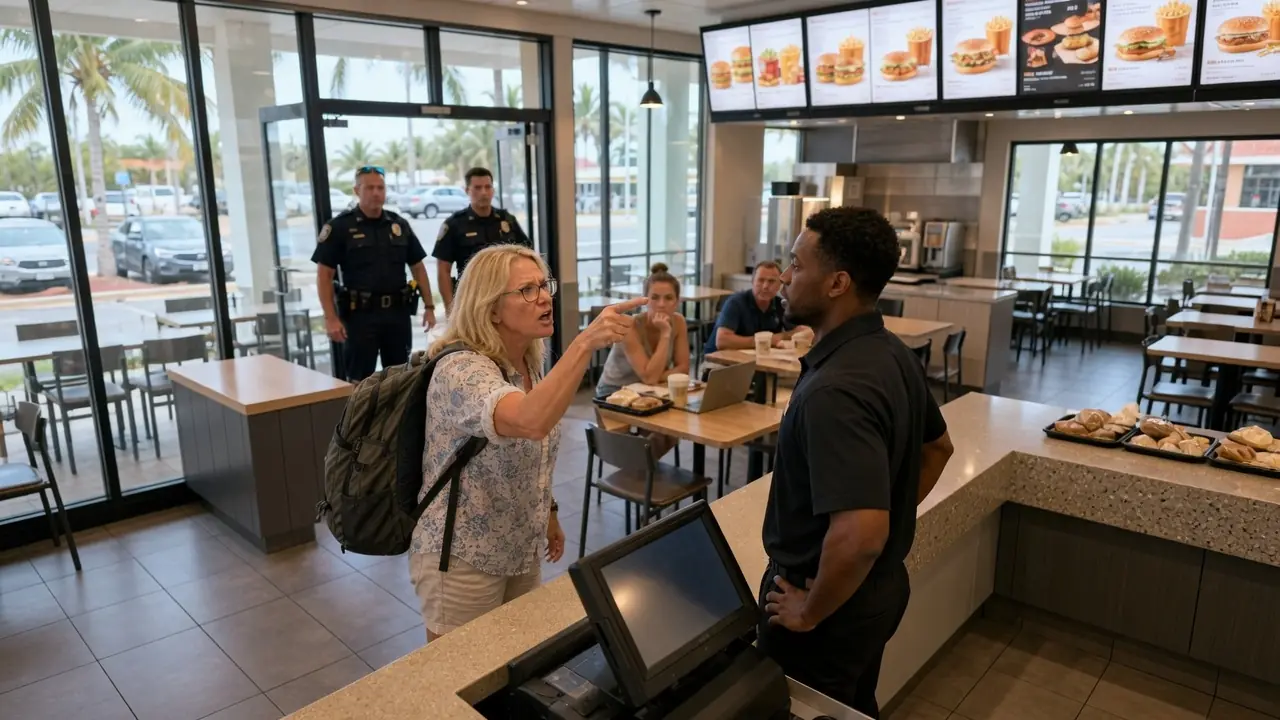
Marcus Bell had managed the restaurant for almost six years.
At forty-one, he had learned that the first hour of the morning often decided the tone of the entire day. If the coffee machines were clean, the cash drawers balanced, and the breakfast crew arrived on time, almost anything else could be managed. But when one small problem began before sunrise, it had a way of growing until the lunch rush.
Marcus was standing behind the service counter, checking the temperature log for the refrigerator, when he noticed the woman in the far corner.
She had been there when he arrived at 5:35.
She appeared to be in her early fifties, with short ash-blond hair, rectangular glasses, and a loose white blouse tucked into tan pants. A large gray backpack rested against her chair. On the table were a silver laptop, a phone charger, a spiral notebook, and a paper cup she had brought from somewhere else.
There was no Sunrise Grill food in front of her.
Marcus had assumed she was waiting for the restaurant to open fully. The doors unlocked at five, but the breakfast menu did not begin until five-thirty. Some travelers entered early to charge their phones, check flight times, or wait for rides.
By six o’clock, however, she had moved into the booth as though it were an office.
Her charger crossed the floor to the nearest outlet. Her backpack occupied one seat. A stack of printed pages covered another. She had removed her shoes and placed her feet on the lower support beneath the table.
Marcus watched her for another minute before approaching.
“Good morning, ma’am.”
The woman did not look up from her laptop.
“Good morning,” he repeated.
She continued typing.
Marcus moved slightly to the side so she could see him without turning. “Excuse me.”
The woman finally raised her eyes. “Yes?”
“My name is Marcus. I’m the manager here.”
She looked at his name badge, then back at the screen. “All right.”
“I wanted to check whether you were planning to order breakfast.”
Her fingers stopped above the keyboard. “Eventually.”
“We ask guests using the dining area during breakfast hours to make a purchase.”
“I’m using your Wi-Fi.”
“I understand.”
“So I’m a customer.”
Marcus maintained the patient expression he used with people who argued before they had actually been denied anything.
“The Wi-Fi is provided for paying customers,” he explained. “You’re welcome to place an order at the counter.”
The woman glanced toward the menu. “I’m not hungry.”
“Coffee is available.”
“I already have coffee.”
Marcus looked at the cup she had brought from outside.
She followed his gaze and placed one hand over it. “You cannot force me to buy something I don’t need.”
“No one is forcing you to buy anything. I’m letting you know that the tables are reserved for customers.”
“There are empty tables everywhere.”
“At the moment.”
“Then there is no problem.”
“It becomes busy after seven.”
The woman returned to her laptop. “Come back after seven.”
Marcus paused.
He could have argued, but he had been managing restaurants long enough to recognize when a customer wanted a debate more than a solution. The woman had not raised her voice, but her dismissive tone made her position clear. She did not believe the rule applied until every seat was occupied.
“I’ll give you thirty minutes,” he said. “After that, you’ll need to order or leave the dining area.”
Her fingers struck the keyboard again. “Fine.”
Marcus walked back toward the counter.
Tanya Lewis, the morning shift supervisor, had been arranging wrapped straws beside the soda machine. She watched him return.
“How long has she been here?” Tanya asked quietly.
“Before I arrived.”
“She was here when I clocked in at five-fifteen.”
“Did she order anything?”
“No. She asked me for the Wi-Fi password.”
Marcus glanced at the booth.
The woman had opened a video meeting. Her voice was low, but she spoke with the firm confidence of someone conducting business. She occasionally pointed toward the screen and made notes in the spiral notebook.
Marcus wondered whether she was a remote employee traveling through Key West. That would not have bothered him if she had bought even a small item and kept her belongings contained. Many customers worked from the restaurant for an hour while waiting for hotel rooms or flights.
But Sunrise Grill was not an all-day office.
The restaurant had a posted forty-five-minute dining limit during peak hours. The rule existed because tourists often remained at tables after eating, leaving families standing with trays. Marcus enforced it gently and rarely needed to mention it twice.
At 6:42, he returned to the woman’s booth.
She was still on the video call.
Marcus waited beside the table until she noticed him.
The woman muted her microphone. “I’m in a meeting.”
“It has been thirty minutes.”
“I heard you the first time.”
“Then you understand that you need to make a purchase or pack your things.”
“I am almost finished.”
“How much longer?”
She gave him an irritated look. “I don’t know. Twenty minutes.”
Marcus shook his head. “I can give you ten.”
“You just said the restaurant gets busy after seven.”
“It is almost seven.”
“There are still empty tables.”
A family of five had entered while they were speaking. The parents stood near the menu with three sleepy children in matching vacation shirts. Two construction workers sat at a booth near the windows, and an older couple had begun unwrapping breakfast sandwiches.
“There are customers arriving now,” Marcus said.
The woman looked around as though noticing the other people for the first time. “They have places to sit.”
“You are occupying four seats.”
“I am one person.”
“Your belongings are using the rest.”
She leaned back. “You seem very interested in me.”
“I am interested in keeping the dining room available for customers.”
“Maybe you should clean the tables instead of harassing educated women.”
Marcus’s expression did not change.
The comment was insulting, but it was not yet unusual. Some customers tried to establish superiority by mentioning education, employment, or social status. Marcus had been told by angry guests that they were doctors, attorneys, business owners, military officers, and personal friends of the restaurant’s regional director.
None of those titles changed the table policy.
“I am not harassing you,” he said. “I’m enforcing the same rule we use for everyone.”
“I doubt that.”
“You have ten minutes.”
She unmuted her microphone and turned back to the screen, ending the conversation without acknowledging him.
Marcus walked away.
At 6:58, a line formed at the counter.
The morning crew moved quickly. Tanya handled the register while two employees assembled sandwiches, and Marcus stepped between stations to help wherever the orders slowed. The restaurant filled with the normal sounds of breakfast: wrappers unfolding, ice falling into cups, children asking for syrup, and travelers discussing plans for boats and beaches.
The woman remained in the booth.
Her meeting ended, but instead of packing, she opened another document and continued working. Her outside coffee cup was empty now, yet she made no attempt to purchase anything.
A man carrying a tray looked toward her table, then searched for another place to sit. Marcus directed him to a smaller table near the windows.
At 7:10, two more families entered.
Marcus removed his food-preparation gloves and approached the booth for the third time.
“Ma’am, your time is up.”
She did not look at him. “I’m leaving soon.”
“You need to leave now.”
That made her raise her head.
Her face had changed. The earlier annoyance had sharpened into open hostility.
“Do you speak to all customers like this?”
“You haven’t purchased anything.”
“I am using the internet.”
“That does not make you a customer.”
“I was going to buy something.”
“You have been here for at least two hours.”
“Then clearly your business has survived.”
Marcus pointed toward the crowded dining room. “People with food are looking for seats.”
“They can sit elsewhere.”
“This is private property, and I am asking you to leave.”
The woman stared at him.
“Private property?” she repeated. “This is a restaurant.”
“Yes.”
“Open to the public.”
“Open to customers who follow the restaurant’s policies.”
She removed her glasses and placed them on the table. “You have no idea who I am.”
Marcus almost sighed.
“Your identity does not affect the policy.”
“I have a master’s degree.”
“Congratulations.”
“I own two properties.”
“That is not relevant.”
“I am not some homeless person you can push out because you don’t like the way I look.”
Marcus kept his voice even. “I did not mention your appearance or your housing situation.”
“You implied it.”
“No. I said you had not bought anything and had exceeded the time I gave you.”
The woman folded her arms. “I know why you are doing this.”
“Why?”
“You saw a successful white woman working, and you wanted to show authority.”
Several customers turned toward them.
Marcus felt his stomach tighten, but his face remained calm.
He had experienced this kind of reversal before. A person violated a rule, refused several polite requests, and then accused the employee enforcing it of personal hostility. Sometimes the accusation involved age. Sometimes gender. Sometimes class.
This time, the woman had chosen race.
“I approached you because you have been occupying a table without buying food,” he said. “Nothing else.”
She gave him a small, contemptuous smile.
“People like you always say that.”
Tanya had moved from behind the register and now stood several feet away. She was recording the interaction on the restaurant’s work phone, following company policy for escalating confrontations.
Marcus noticed but did not look directly at her.
“Pack your belongings,” he told the woman. “You need to leave.”
“No.”
“This is your final request.”
“You cannot remove me.”
“I can ask you to leave private property.”
“And if I don’t?”
“Then I will contact the police.”
The woman laughed.
“Go ahead.”
Marcus returned to the counter and called the non-emergency line.
He explained that a woman had refused repeated requests to leave the restaurant. He made clear that she had not physically threatened anyone, but the confrontation was escalating and the dining area was crowded.
The dispatcher said officers were already nearby and would arrive shortly.
The woman watched him throughout the call.
When he hung up, she called across the restaurant.
“You should be ashamed of yourself.”
Marcus did not answer.
“You are calling armed police on a fifty-three-year-old woman because she used Wi-Fi?”
Several customers looked from her to Marcus.
A teenage boy lifted his phone and began recording.
Marcus walked back toward the booth, stopping far enough away that she could not claim he was crowding her.
“I called because you refused to leave after being instructed several times.”
“You want them to scare me.”
“I want you to follow the same rule everyone else follows.”
“You are abusing your position.”
“I have offered you multiple opportunities to leave without police involvement.”
She pointed at him. “You are exactly the kind of person who should never be given authority.”
Marcus heard someone near the drink station whisper, “Oh, no.”
The woman continued.
“You think wearing that little manager shirt makes you important.”
Marcus’s uniform consisted of a black polo, khaki pants, and a name badge. He had worn nearly the same outfit every workday for six years. Until that moment, he had never considered it a symbol of power.
“It makes me responsible for this restaurant,” he said.
“It makes you an employee.”
“Yes. An employee whose request you are refusing.”
“You are uneducated.”
Marcus smiled faintly, though there was no humor in it. “You do not know anything about my education.”
“I can tell.”
“How?”
She hesitated.
The question had arrived before she could prepare a safe answer.
Marcus watched anger move through her face. She had expected him to accept the insult or respond emotionally. Instead, he had asked her to explain it.
“How can you tell?” he repeated.
The woman put her glasses back on. “Your manner.”
“My manner?”
“Your limited vocabulary. Your aggressive posture.”
Marcus stood with both arms relaxed at his sides.
“I have not threatened you or raised my voice.”
“Your presence is threatening.”
A murmur moved through the dining room.
Tanya stepped forward. “Ma’am, he has been calm the entire time.”
The woman looked at her. “I was not speaking to you.”
“I’m the shift supervisor.”
“Then supervise something.”
Marcus lifted one hand toward Tanya, signaling that she should remain back.
The front doors opened.
Two Key West police officers entered.
Officer Elena Ruiz walked in first. She was in her late thirties, with dark hair tied beneath her uniform cap. Beside her was Officer David Harper, a broad-shouldered man with a gray mustache. Neither officer placed a hand near a weapon.
Officer Ruiz approached the counter.
“Who called?”
“I did,” Marcus said.
He briefly explained the situation while Officer Harper observed the dining area. The woman remained at the booth with her laptop open and her backpack on the floor.
“Is there security footage?” Ruiz asked.
“Yes. The dining room cameras record continuously.”
“And you personally asked her to leave?”
“Three times. The last request was explicit.”
“All right.”
Ruiz turned toward the woman.
“Good morning, ma’am. I’m Officer Ruiz with the Key West Police Department.”
The woman looked at her laptop. “I am in the middle of work.”
“The manager has asked you to leave the restaurant.”
“He is discriminating against me.”
Ruiz’s expression remained neutral. “We can discuss your complaint outside, but right now the property representative has withdrawn permission for you to remain.”
“This is a public restaurant.”
“It is privately operated property open to customers under certain conditions.”
“I was a customer.”
Marcus spoke from several yards away. “You did not purchase anything.”
The woman snapped her head toward him. “Stop interrupting.”
Officer Ruiz raised one hand. “Ma’am, look at me.”
The woman reluctantly did.
“You are being directed to gather your belongings and leave,” Ruiz said. “You are not under arrest. You are not being detained. The manager does not want you inside the restaurant.”
“I have rights.”
“You do.”
“I have a right to sit in a restaurant.”
“Not after the restaurant has lawfully asked you to leave.”
“He only wants me gone because I challenged him.”
“The reason he provided is that you have occupied the booth for more than two hours without making a purchase.”
“That is a lie.”
Marcus glanced at Tanya.
Tanya quietly said, “The cameras have timestamps.”
The woman looked toward the ceiling and noticed the black security camera above the dining room.
For the first time, uncertainty appeared in her expression.
Officer Harper moved closer but remained behind Ruiz.
“Ma’am,” he said, “this does not need to become complicated. Pack up and walk outside with us.”
The woman closed her laptop halfway.
Then she stopped.
“What happens if I refuse?”
Ruiz answered calmly. “You will receive one final warning. If you continue refusing after that, you may be arrested for trespassing.”
The woman looked around the restaurant.
Dozens of faces were now turned toward her. Several customers held phones. The children at the nearest table had stopped eating.
Her cheeks reddened.
“You’re humiliating me.”
“No,” Ruiz said. “We are giving you an opportunity to leave voluntarily.”
The woman looked at Marcus again. “You are enjoying this.”
Marcus shook his head. “I wanted you to buy breakfast or leave two hours ago.”
“You think you’ve won.”
“This is not a competition.”
“It clearly is to you.”
She shut the laptop, disconnected the charger, and began gathering her papers. For a moment, Marcus thought the confrontation was finally ending.
Then a page slipped from the table and floated to the floor.
Officer Harper bent down to pick it up.
The woman lunged from the booth.
“Do not touch that!”
Her sudden movement caused several customers to gasp. Harper immediately stepped back and held both hands open, showing he was not reaching for her.
The page remained on the floor.
The woman grabbed it, folded it in half, and shoved it into her backpack.
Ruiz watched her carefully.
“Ma’am, slow down.”
“I told him not to touch my private documents.”
“He was attempting to return a page you dropped.”
“I don’t want anyone touching my things.”
“That is fine. Gather them yourself.”
The woman forced the remaining papers into the bag. Her hands moved quickly, almost desperately. She looked less angry now and more frightened.
Marcus noticed the change.
So did Officer Ruiz.
“What is your name?” Ruiz asked.
The woman froze.
“Why?”
“So we can document the call.”
“I’m not required to identify myself.”
“If you leave voluntarily without further incident, we may not need to take enforcement action. But I am asking for your name as part of resolving the complaint.”
The woman tightened both hands around the backpack straps.
“I did nothing wrong.”
“You are refusing to leave after being asked by the property manager.”
“I’m packing.”
“Then continue.”
Instead, the woman sat back down.
She placed the backpack against her chest and looked toward the window.
Marcus felt the room’s tension increase again.
Officer Ruiz’s voice became firmer.
“Ma’am, stand up and walk outside.”
“No.”
“That is your final warning.”
“I said no.”
“Are you refusing a lawful trespass warning?”
The woman pressed her lips together.
Her hands tightened around the backpack.
“Yes,” she said.
Officer Harper moved to one side of the booth while Ruiz remained in front.
“Stand up,” Ruiz instructed.
The woman shook her head.
“You are now under arrest for trespassing after warning.”
The restaurant became silent.
Ruiz asked the woman to place the backpack on the table and stand. Instead, she pulled it closer to her body.
“You are not taking my bag.”
“No one said we were taking it.”
“You will search it.”
“We will handle your property according to procedure after you are detained.”
The woman’s breathing quickened.
Marcus saw something beneath the anger now.
Fear.
Not simply fear of arrest.
Fear of the backpack.
Officer Ruiz saw it too.
“Is there something dangerous inside the bag?” she asked.
“No.”
“Are there any weapons, needles, or objects that could injure us?”
“No.”
“Then place it on the table.”
The woman looked toward the restaurant exit, but Officer Harper stood between her and the door.
She suddenly pushed the laptop across the table, sending it toward Ruiz, then tried to slide from the booth on the opposite side.
Harper blocked her path.
“Stop.”
The woman pulled back and screamed.
“Don’t touch me!”
“No one is touching you,” Harper said.
She grabbed the backpack with both arms and attempted to climb over the booth seat. The movement was clumsy and desperate. Her knee struck the table, knocking over the empty coffee cup and sending papers across the floor.
Ruiz reached for her forearm.
“Stop resisting.”
The woman twisted away and swung the backpack. It struck Ruiz’s shoulder, though not hard enough to injure her.
Within seconds, Harper controlled one arm while Ruiz secured the other. They guided the woman against the booth and placed her in handcuffs.
No one cheered.
The confrontation had become too uncomfortable for that.
The woman continued shouting.
“He set me up! He called you because he hates white women! This is discrimination!”
Marcus stood near the counter, his heart pounding.
He had not moved closer.
He had not spoken during the arrest.
Ruiz escorted the woman toward the front doors while Harper collected the laptop and backpack.
As he lifted the bag, the front zipper opened.
Several small envelopes spilled onto the floor.
The woman saw them.
Her face changed completely.
“Leave those there!”
Harper stopped.
The envelopes were stamped with the logos of local hotels. Each appeared to contain folded documents. One envelope had the words EMPLOYEE PAYROLL printed across the front.
Officer Ruiz guided the woman outside.
Harper looked at Marcus. “Do you recognize these?”
“No.”
“Did she have access to any employee area?”
“Not that I know of.”
Tanya stepped forward. “She went near the office earlier.”
Marcus turned toward her. “When?”
“Before you arrived. I thought she was looking for the restroom.”
The Sunrise Grill office was behind a short hallway beside the restrooms. The door usually remained locked, but employees sometimes left it open while carrying supply boxes.
Marcus felt a cold sensation in his stomach.
“What exactly did she do?” he asked.
Tanya frowned, trying to remember. “She walked down the hallway and came back maybe a minute later. I asked if she needed help. She said she had gone the wrong way.”
Officer Harper looked at the envelopes again.
He did not open them.
Instead, he placed everything inside the backpack, secured it, and carried it outside as property associated with the arrest.
Officer Ruiz returned several minutes later.
“The woman is secured in the patrol car,” she said. “We need to review your security footage.”
Marcus led the officers into the small office behind the kitchen.
The camera system recorded the dining room, front counter, entrances, hallway, and storage area. Marcus selected the footage from shortly after five o’clock.
The woman entered at 5:07.
She carried the gray backpack and outside coffee cup. At first, she sat in the booth and opened her laptop. Ten minutes later, Tanya disappeared into the kitchen to help an employee with a delivery.
The woman immediately looked around.
She closed the laptop, stood, and walked toward the hallway.
The camera above the corridor showed her trying the restroom door first.
Then she checked the office.
It opened.
She disappeared inside for forty-two seconds.
When she emerged, her backpack looked fuller.
Marcus felt his mouth go dry.
“What was inside the office?” Ruiz asked.
“Employee files, invoices, schedule records, some vendor documents.”
“Cash?”
“No. The safe is locked and bolted down.”
“Any customer information?”
“Not usually.”
Marcus moved the footage forward.
After leaving the office, the woman returned to the booth and placed several papers beneath her laptop. She remained there for the next two hours, occasionally photographing documents with her phone.
Her refusal to leave suddenly made sense.
She had not stayed because of Wi-Fi.
She had stayed because she was sorting through whatever she had taken.
Officer Ruiz called for a supervisor and contacted detectives.
The restaurant’s regional office instructed Marcus to close the dining room temporarily while police examined the office. Customers were asked to finish their meals and leave through the side door.
Within thirty minutes, the Sunrise Grill parking lot contained three patrol cars and an unmarked police vehicle.
The woman’s name was Evelyn Price.
She was fifty-three years old and lived in a rented condominium on Stock Island. Contrary to her claims about owning two properties, public records later showed that both had been sold during bankruptcy proceedings three years earlier.
She had no master’s degree.
She did, however, have a long history of presenting herself as a business consultant.
Detectives discovered that the envelopes in her backpack contained employment records, payroll summaries, copies of identification documents, and handwritten notes about workers at several hotels and restaurants around Key West.
Some of the documents had been stolen.
Others appeared to have been copied from unsecured computers.
The Sunrise Grill papers included employee names, partial banking details used for payroll verification, and copies of forms containing home addresses. Marcus’s personnel file was among them.
Evelyn had entered the office before he arrived and removed it from an unlocked cabinet.
The confrontation had never been only about a table.
She had needed time to photograph and organize the files before leaving. Every additional minute mattered because she was transferring information to an encrypted storage account through the restaurant’s Wi-Fi.
Her anger at Marcus was real, but it also served a purpose.
By turning the situation into an argument about discrimination, education, and authority, she had attempted to make him doubt himself. She expected that he would become cautious, retreat, or allow her to stay rather than risk appearing prejudiced.
She had mistaken his patience for uncertainty.
By noon, news of the arrest had spread across the island.
The teenage boy’s video appeared online first.
It showed Marcus calmly asking Evelyn to leave and Evelyn accusing him of targeting her because she was an educated white woman. It ended shortly after the officers entered, before the attempted escape and arrest.
The clip received thousands of views.
Comments divided almost immediately.
Some people defended Marcus.
Others accused the restaurant of calling police over free Wi-Fi.
A few claimed Evelyn had been targeted because she appeared homeless, though there was nothing in the video supporting that conclusion. Still others focused entirely on her race and Marcus’s, arguing about motives neither side could prove from the short clip.
Marcus refused all interview requests.
He had spent six hours speaking with detectives, reviewing security footage, contacting employees, and helping the regional office determine what information had been compromised. He did not have the energy to explain himself to strangers online.
That evening, he sat alone in his apartment with the lights off.
His wife, Alana, was working an overnight nursing shift at the hospital. Their fourteen-year-old daughter was staying with her grandmother. The apartment was quiet except for the air conditioner and the distant sound of traffic.
Marcus watched the video once.
Then he shut it off.
What disturbed him was not Evelyn’s shouting.
It was how close he had come to ignoring his instincts.
When she accused him of targeting her, he had briefly wondered whether enforcing the rule was worth the conflict. He had thought about giving her another twenty minutes simply to avoid a scene.
Had he done that, she might have finished copying the documents and left before police arrived.
His phone rang.
It was Tanya.
“Are you okay?” she asked.
“I’m fine.”
“That means no.”
Marcus leaned back on the couch. “I keep replaying it.”
“Me too.”
“You noticed her near the office.”
“I should have checked.”
“You asked if she needed help. You had no reason to assume she had stolen anything.”
“I still feel stupid.”
“So do I.”
“Why?”
“Because I thought the worst thing happening was an entitled customer refusing to leave.”
Tanya was quiet for a moment.
“Marcus, you handled it.”
“We got lucky.”
“We followed procedure.”
“That can still be luck.”
The following morning, Sunrise Grill opened two hours late.
The office door had been replaced with an automatic locking system. Employee records were moved into a secure cabinet, and the regional company arranged identity-monitoring services for everyone whose information might have been exposed.
Marcus gathered the staff before opening.
“I want everyone to hear this clearly,” he said. “No one here caused what happened except the woman who entered an employee area and took private documents.”
Tanya looked down.
Marcus noticed.
“We will improve security,” he continued. “But improving security is not the same thing as blaming the person who discovered the problem.”
He explained new rules for the office, visitors, Wi-Fi usage, and extended table stays. He also reminded employees not to engage with reporters or post private information about the case.
One young employee raised her hand.
“Are we allowed to tell customers they have to buy something?”
“Yes.”
“What if they call us racist?”
Marcus paused.
Several workers looked toward him.
“You stay calm,” he said. “You explain the policy. You call a manager. You document what happened. An accusation does not automatically mean you did something wrong, but it does mean you need to make sure your actions can be clearly explained.”
“Were you scared?” she asked.
Marcus considered lying.
“Yes.”
The employee seemed surprised.
“Not because I believed I was wrong,” he continued. “I was scared because people can watch thirty seconds of a situation and decide they know everything. But being scared of being misunderstood cannot stop us from protecting the staff and the restaurant.”
The criminal investigation expanded over the next month.
Evelyn had visited at least eleven businesses across the Florida Keys. In several places, she used the same method. She entered early in the morning, connected to public Wi-Fi, and remained for extended periods. When employees asked her to leave, she described herself as a consultant, journalist, or government contractor.
At two hotels, she persuaded young front-desk employees to print “verification documents” from management computers.
At another restaurant, she had photographed a staff schedule containing names and phone numbers.
Investigators believed she was gathering information for identity fraud and employment-related scams. Some stolen records had already been used to create online banking accounts and fraudulent tax filings.
Her confrontations were part of the strategy.
She selected employees she believed might hesitate to challenge her. She used class, age, education, and race depending on the person standing in front of her. With a young Latina hotel clerk, she had threatened to call immigration authorities. With an older white cashier, she claimed to work for the state health department. With Marcus, she used racial accusations and social status.
The pattern became clear only after the businesses compared their security footage.
Three weeks after the arrest, Detective Ruiz visited the restaurant.
Marcus invited her into the newly secured office.
“We recovered messages from Ms. Price’s devices,” she said. “She had notes about this location.”
“What kind of notes?”
Ruiz opened a folder.
“Morning office sometimes unlocked. Manager arrives around five-thirty. Young supervisor distracted during delivery.”
Marcus felt sick.
“She had been watching us?”
“Likely for several days.”
Ruiz showed him another page.
The note described Marcus.
Black male manager. Calm. Avoids confrontation. May hesitate if discrimination alleged.
Marcus read the sentence twice.
Evelyn had studied him.
His patience, which he considered a professional strength, had been categorized as a weakness she could exploit.
“Did she know my name?”
“Your first name. It was available on customer reviews and employee photographs.”
Marcus closed the folder.
“What happens now?”
“The state attorney is reviewing charges involving burglary, unlawful access to computer systems, identity theft, possession of personal identifying information, and resisting without violence. More charges may be added.”
“Is she still saying I targeted her?”
“Yes.”
“Even with the footage?”
“She says she entered the office accidentally and took documents because she believed they were discarded.”
Marcus looked around the office. The filing cabinet stood beside the desk, nowhere near a trash can.
Ruiz gave him a tired smile. “Evidence does not always stop people from lying. It just makes the lie more expensive.”
The online conversation changed when the police released a public statement about the broader investigation.
The statement did not reveal confidential evidence, but it confirmed that Evelyn had been found in possession of documents belonging to multiple local businesses. It also confirmed that Sunrise Grill security footage showed her entering a restricted office before the confrontation.
People who had accused Marcus of abusing his authority began deleting their comments.
A local news station requested an interview again.
This time, Marcus agreed.
He did not want celebrity or praise. He wanted the employees watching the story to understand how manipulation worked.
The interview took place inside the empty restaurant after closing.
“What went through your mind when she accused you of discrimination?” the reporter asked.
Marcus sat in the booth across from her, only a few tables away from where Evelyn had refused to leave.
“I checked myself,” he said. “I asked whether I had treated her differently. I reviewed what I had said and how many opportunities I had given her.”
“Did the accusation make you consider allowing her to stay?”
“For a moment.”
“Why didn’t you?”
“Because the rule was clear, other customers needed seats, and she had refused reasonable options. Fairness does not mean abandoning a rule whenever someone uses a serious accusation as a shield.”
“Some people believe calling police was excessive.”
“I did not call emergency services. I requested assistance after repeated refusals. When the officers arrived, they also gave her opportunities to leave.”
“Do you think race played a role?”
“In her behavior?”
“Yes.”
Marcus thought carefully.
“I cannot tell you what she believes privately. I can tell you she chose language she thought would make me question my authority. Investigators later found notes describing my race and predicting how I might react to an accusation.”
The reporter looked surprised, though she had already been told about the note.
“How did that make you feel?”
“Observed.”
“Angry?”
“Yes.”
“Vindicated?”
“No. Being correct about a dangerous situation does not make the situation good.”
The interview aired that evening.
Marcus’s final answer became the line most people shared.
Being correct about a dangerous situation does not make the situation good.
He received messages from restaurant managers, hotel workers, librarians, and café owners around the country. Many described customers who occupied spaces for hours, ignored policies, and then accused employees of cruelty when asked to leave.
Some messages came from Black managers who understood the additional calculation Marcus had faced.
One man wrote, You have to be calm enough to survive the accusation but firm enough not to be controlled by it.
Marcus saved that message.
Evelyn remained in custody until a judge approved supervised release with electronic monitoring. She was prohibited from contacting the businesses involved or accessing public computer networks except through her attorney’s office.
Her case did not go to trial.
Seven months after the restaurant incident, she accepted a plea agreement covering several of the charges. Prosecutors presented evidence that stolen employee information had been connected to attempted financial fraud, though Evelyn continued claiming she had never intended to harm anyone.
At sentencing, the judge asked whether she wanted to address the court.
Evelyn stood beside her attorney.
She looked different from the woman in the restaurant. Her hair had grown longer, and she wore a plain dark suit. Without the laptop, expensive glasses, and confident posture, she appeared smaller.
“I made poor decisions during a period of financial and emotional stress,” she said. “I felt judged by people who did not understand my education or abilities.”
Marcus sat in the second row with Tanya and two employees from another affected business.
Evelyn continued.
“At the restaurant, I felt humiliated by the manager’s tone. I reacted defensively because I believed I was being stereotyped.”
The prosecutor looked toward Marcus.
Marcus remained still.
The judge waited until Evelyn finished.
“Ms. Price,” the judge said, “the security footage shows the manager approached you politely on three separate occasions. It shows you were given time to make a purchase or leave. More importantly, it shows that before any conversation occurred, you entered a restricted office and removed documents.”
Evelyn stared forward.
“You did not become a suspect because someone misunderstood your education,” the judge continued. “You became a suspect because evidence documented your actions.”
The court imposed a prison sentence followed by supervised probation, restitution, and restrictions on computer use. The exact sentence was less than some victims wanted and more than Evelyn’s attorney requested.
Marcus felt no celebration when he heard it.
He only felt tired.
Outside the courthouse, a reporter asked whether justice had been served.
Marcus stopped on the steps.
“Justice is not a feeling I can measure today,” he said. “The employees will still have to monitor their identities for years. Some already had fraudulent accounts opened. A sentence does not erase that.”
“Do you forgive her?”
“That is not required for the legal process.”
The reporter tried another question.
“Would you handle the restaurant confrontation differently now?”
Marcus looked directly into the camera.
“Yes.”
The reporter appeared surprised.
“How?”
“I would secure the office door before opening.”
Then he walked away.
A year after the incident, Sunrise Grill looked almost the same.
Tourists still entered before sunrise. Coffee still spilled near the drink station. Families still occupied tables with maps, sunscreen, and half-finished breakfasts.
But some things had changed.
The office remained locked at all times. Public Wi-Fi required a receipt code that expired after ninety minutes. Signs near the tables politely explained that the dining area was reserved for paying customers and subject to time limits during busy hours.
The rules were written clearly so employees would not have to invent language during confrontations.
Marcus had also been promoted.
The regional company offered him a position overseeing six restaurants across the lower Florida Keys. He initially refused because he preferred working directly with one team. Then Tanya encouraged him to accept.
“You keep telling everybody else not to let one bad person decide what they do next,” she said. “Maybe you should listen to yourself.”
Marcus accepted the job.
On his final morning as the full-time Sunrise Grill manager, he arrived at 5:25.
The sky beyond the parking lot was beginning to turn pale blue. A delivery truck waited near the back entrance, and Tanya was already counting the register.
Marcus walked through the dining room.
A young man sat alone near the window with a laptop and a small suitcase. A receipt and breakfast sandwich rested on the table.
When Marcus passed, the man looked up.
“Is it okay if I stay until my bus arrives?”
“What time is your bus?”
“About forty minutes.”
Marcus glanced at the receipt.
“That’s fine.”
The man smiled. “Thanks.”
It was such a simple interaction that no one else noticed it.
The customer asked.
The manager answered.
The rule remained clear, and no one needed to be humiliated.
Marcus continued toward the counter.
At seven, the dining room began filling. Tanya directed the crew while Marcus helped an elderly couple carry their tray. Outside, the morning sun rose above the palm trees and reflected from the wet pavement.
The restaurant moved forward.
For months, strangers had described Marcus as the man who had a woman arrested over Wi-Fi.
That was never the truth.
He had not punished her for working, being educated, occupying a booth, or challenging him.
He had simply refused to let an accusation erase a boundary.
The woman had believed confidence could transform theft into entitlement and resistance into victimhood. She believed that if she insulted Marcus’s intelligence, questioned his authority, and invoked race loudly enough, everyone would focus on his response instead of her behavior.
For a few minutes, it almost worked.
But patience was not weakness.
Calmness was not surrender.
And authority did not become abusive simply because the person breaking the rule disliked hearing no.
Marcus looked across the dining room as the young traveler packed his laptop and lifted his suitcase. The man waved on his way out, leaving the table clean for the next customer.
Tanya walked up beside Marcus.
“You ready for the regional office?”
“No.”
“Good. Confidence is dangerous.”
He laughed.
Then she glanced toward the corner booth where Evelyn had once sat.
“Do you ever think about that morning?”
“Sometimes.”
“What part?”
Marcus considered the question.
Not the insults.
Not the arrest.
Not even the stolen files.
He remembered the moment Evelyn accused him of targeting her and how quickly doubt entered his mind. He remembered nearly giving her more time—not because she deserved it, but because he feared how firmness might look to people who had not seen the entire situation.
“That I almost let her stay,” he said.
Tanya nodded.
“But you didn’t.”
“No.”
“Why?”
Marcus watched another family enter through the doors.
“Because a boundary is only real when it survives pressure.”
Tanya smiled. “That sounds like something a regional manager would say.”
“It sounds expensive.”
“It probably is.”
They returned to the counter as the next breakfast rush began.
Behind them, the corner booth remained empty for less than a minute before a family sat down with three trays of food. A little girl climbed onto the seat by the window, while her father passed out napkins and her mother opened a paper bag of breakfast sandwiches.
They never knew what had happened there.
They did not need to.
The table was available because the people responsible for the restaurant had done their jobs, even when doing so became uncomfortable.
And that, Marcus had learned, was what responsibility often looked like.
Not power.
Not victory.
Simply the willingness to remain steady when someone else’s anger demanded that you step aside.