She heard his laughter before she ever saw his face. It rang across the manicured lawns of Ashford Park like a blade drawn from its sheath, sharp, effortless, and utterly without mercy.
Miss Eleanor Ashworth stood at the top of the stone steps, her fingers curled around the worn strap of her traveling bag, and she knew with absolute, bone-deep certainty that the laughter was directed at her.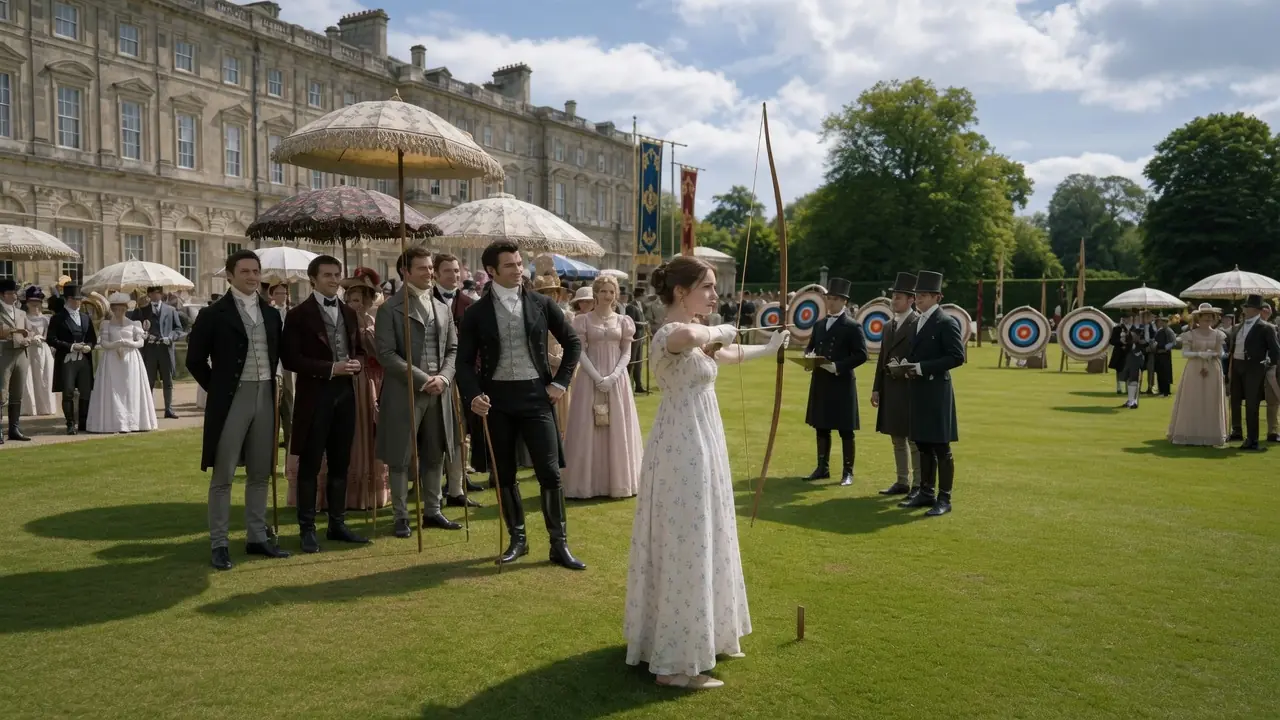
She did not flinch. She had been taught long ago that the cruelest thing one could do to a man who wished to wound you was to refuse to bleed. But oh, how it stung.
Her gown was pale muslin sprigged with tiny blue flowers, the kind of modest, sensible dress that a clergyman's daughter wears when she has been invited, rather unexpectedly, to the most fashionable house party of the 1815 London season. It was clean. It was pressed. It was, Eleanor thought with private resignation, entirely and hopelessly wrong.
The other ladies ascending the steps behind her rustled in silk and satin, their hems heavy with embroidery, their necks adorned with pearls that cost more than her father's entire annual living.
And standing at the bottom of the wide gravel sweep, flanked by two gentlemen who hung upon his every word like admiring satellites, was the source of that dreadful laughter.
Dark-haired, broad-shouldered, with a countenance so perfectly arranged by nature that it seemed almost an insult that a man so unconscionably handsome should also be so unconscionably rude.
His dark eyes found hers across the distance, and he did not look away. He simply smiled, slow, condescending, and terribly amused, then murmured something to the gentleman at his elbow that caused a fresh ripple of laughter to spread between them like a stone dropped into still water.
Eleanor held his gaze for three full seconds. Then she lifted her chin, squared her shoulders beneath her humble sprigged muslin, and walked through the front doors of Ashford Park as though she owned every stone of it.
Eleanor had been invited by Lady Cecily Vane, her dearest friend from their shared years at Mrs. Hartwell's Seminary. Lady Cecily had married well and believed, with generous sincerity, that Eleanor deserved a season's amusement, even if Eleanor's father could not fund one himself.
It was an act of pure friendship. Eleanor received it in that spirit and was grateful, though gratitude, she was quickly discovering, did not make silk gowns appear in her trunk.
The house party was to last ten days. It would include dinners, assemblies, morning rides, and the centerpiece of the entire gathering, a grand archery tournament on the seventh afternoon, a fashionable entertainment that all of polite society had decreed quite the thing.
Eleanor had been shooting a bow since she was nine years old. Her father, who possessed more learning than income, saw no reason to deny his daughter the same pursuits he offered her brothers.
So Eleanor had grown up with muddy boots and steady hands, reading Latin in the mornings and practicing at the archery butt in the afternoons. She had not thought of it as any great accomplishment. It was simply something she did as naturally as breathing, as quietly as prayer.
She did not mention it, not at dinner the first evening when the Duke sat at the head of the long mahogany table and held court with the easy authority of a man who had never once doubted his welcome in any room on earth.
Not when Lady Harrington asked each guest what entertainments they most favored, and Eleanor answered simply that she enjoyed reading.
Not even when, on the second morning, she overheard the Duke remark to his cousin that it was a pity some guests had been invited more out of sentiment than suitability.
She understood with crystalline clarity that Edmund Ashford, Duke of Ravenmore, had decided on first glance that she was of no consequence whatsoever.
It was, she reflected while walking alone through the long picture gallery that evening, the most liberating thing anyone had ever done for her.
A man who does not see you cannot guard himself against you.
The days passed in the manner of such gatherings, beautiful on the surface, complicated beneath. Eleanor read in the mornings, walked with Lady Cecily in the afternoons, and endured the evenings with quiet, steely composure.
She was not without admirers. Mr. Beaumont, a pleasant young baronet, sought her conversation at every opportunity.
But it was the Duke she found herself watching, studying almost, in the way one studies a complicated piece of music before attempting to play it.
He was not, she concluded reluctantly, simply a vain and careless man. There were moments, a word spoken gently to a nervous young footman, a rare and genuine smile directed at his elderly aunt, that suggested depths he preferred to keep beneath the glittering, arrogant surface he presented to the world.
It did not excuse him, but it made him considerably more interesting.
And then came the seventh afternoon.
The lawns had been arranged with exquisite care. Colored banners snapped in the warm summer breeze. Ladies in their finest afternoon dresses gathered in clusters of animated conversation, their parasols tilted against the August sun.
Gentlemen who had never held a bow in earnest did so now with theatrical confidence.
The Duke, Eleanor noticed, was quite genuinely skilled. He released his arrow with the relaxed authority he brought to everything, and it struck clean and close to the center.
Applause rose from the assembled party. He accepted it with a modest, handsome nod.
Then he looked at the list of remaining competitors, and his eyes landed on her name.
Miss Eleanor Ashworth.
Something shifted in his expression. Surprise, fleeting and quickly masked, then unmistakable amusement.
"Miss Ashworth," he said with that devastating, perfectly calibrated smile, "I confess I did not know you participated."
"There is perhaps a great deal about me you have not troubled yourself to learn, Your Grace," she replied, and turned to receive her bow from the steward before he could answer.
The company had grown quiet in that particular way that meant everyone was pretending not to pay attention while attending to nothing else.
Eleanor did not hurry. She had learned that steadiness was its own form of power.
She stood at the mark, settled her feet, drew a slow and measured breath, and felt the familiar, beloved stillness fall over her. It was the same stillness that had settled over her a hundred times in her father's garden, with mud on her boots and joy in her chest.
She drew.
She loosed.
The arrow sang through the warm afternoon air with a sound like a whispered secret and struck the bold dead center, perfect and absolute.
The silence that followed was quite unlike any silence Eleanor had ever heard. It had texture and weight. It pressed against the ears.
Then Lady Cecily shrieked with delight, and the applause broke over the lawn like a wave.
Eleanor lowered the bow. She did not smile in triumph. That would have been beneath her.
She simply turned, composed and unhurried, and found the Duke's eyes already upon her.
He was not laughing now. He was looking at her with the expression of a man who had, in a single unexpected moment, been required to entirely revise a firmly held opinion and found, to his own astonishment, that the revision was not unwelcome.
He crossed the lawn. She waited.
"Miss Ashworth." His voice had lost its careless, polished gloss. It was quieter now, more sincere. "That was extraordinary."
"Thank you, Your Grace."
A pause stretched between them, warm and tentative as the first light of a dawn neither of them had anticipated.
"I owe you an apology," he said. "Several, I suspect, if you would permit me the time to enumerate them properly."
Eleanor studied his countenance, the proud set of his jaw, the unfamiliar humility in his dark eyes, and found, to her own great inconvenience, that she believed him entirely.
"I suspect," she said quietly, "that I have ten days' worth of patience remaining. Whether that is sufficient for your enumeration, I cannot say."
The corner of his mouth lifted, not the practiced, devastating smile she had come to distrust, but something smaller, something real.
"Then perhaps," the Duke of Ravenmore said, "would you honor me with a walk, Miss Ashworth, and allow me to begin?"
She considered him for one long, beautiful moment, the kind of moment that exists at the precise hinge point between a story that has ended and one that is only just beginning.
Then Eleanor Ashworth, clergyman's daughter, champion of the Ashford Park Grand Tournament, folded her simple muslin skirts and said, "I suppose I shall."
And so it began. Not with silk, nor with pearls, nor with any of the glittering currencies of that gilded world, but with a single perfect arrow and the quiet, unshakable dignity of a woman who had always known her own worth and had simply waited for the world to catch up.