The hall was full of people, but the woman by the window did not feel part of it. She stood near a heavy curtain of deep red velvet, her hands folded in front of her. The cloth was thick and smelled of dust and old smoke from a hundred winter fires. She kept her fingers still.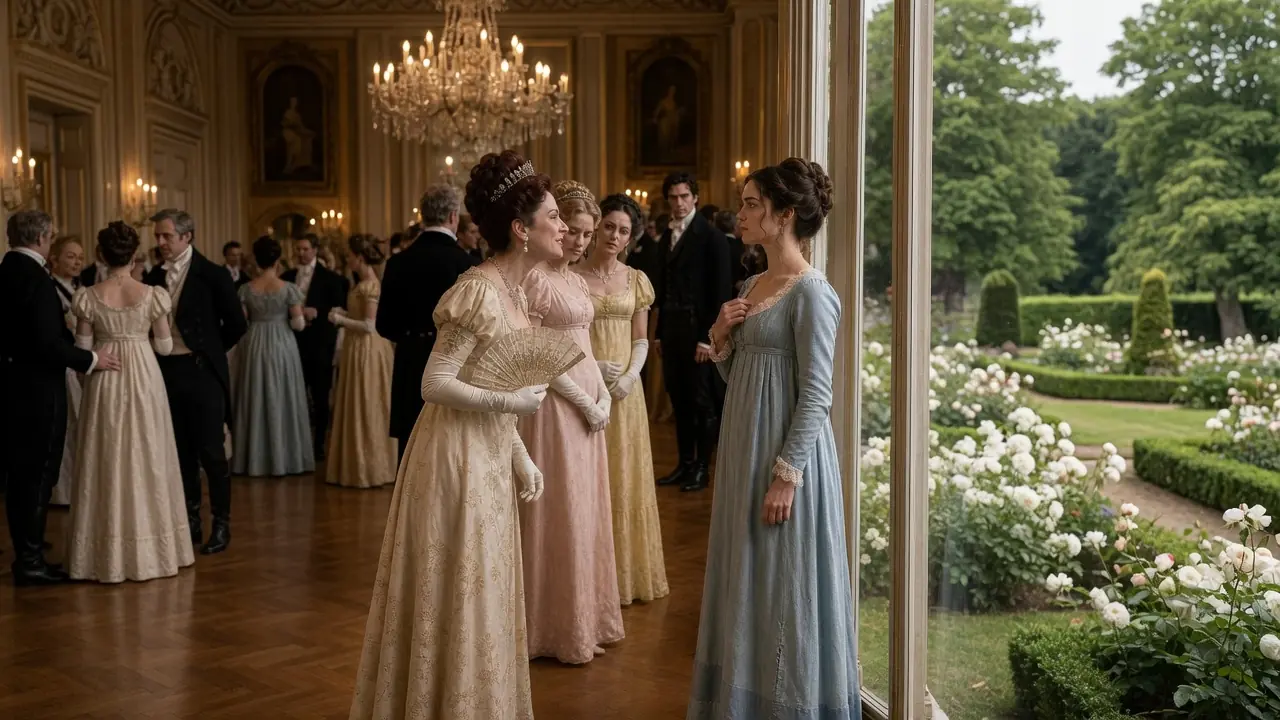
She did not want anyone to see them shake. Her name was Maren Holt. She was 23 years old. She had come to this ball with her aunt, who had walked off to find better company the moment they stepped inside.
That had been an hour ago. Maren had not moved much since. The room was lit by long white candles in silver holders along the walls. The flames made the air smell of warm wax and something sweeter, like crushed flowers.
Music came from the far end of the hall, where a small group of men played soft tunes on strings. The floor was made of dark wood, polished until it shone like still water. When a lady walked across it, her slippers made a small whisper sound, and her dress made a louder one. Maren wore her mother's gown.
It was made of pale blue silk with thin white lace at the wrists and along the neck. The blue had once been bright. Now it was soft and faded, the color of a sky that had been left out in the rain. Along the hem, where her mother had once caught her foot in a doorway, there was a long mended line.
The stitches were small and careful, but anyone who looked close could see them. Maren had stitched them herself three nights ago by the light of a single candle. Her fingers had ached after. She had let down the hem so it would fit her.
She was taller than her mother had been. The fabric, where it had been pinned up, showed a darker stripe near the bottom, where the sun had not faded it. She knew this. She had hoped no one else would notice.
She had not wanted to come tonight. Her aunt had not given her a choice. Her aunt was a thin woman with a sharp chin and a sharper tongue, and she had said that a girl with no dowry could not afford to hide. Maren had wanted to say that a girl with no dowry could not afford to be seen in a mended dress, either, but she had not said it.
She had learned long ago that saying things to her aunt did not help. So, she stood by the curtain. She watched. A group of young ladies stood near the middle of the room.
Their gowns were new. They were the color of fresh cream and pale pink and soft yellow, and they shone in the candlelight. The ladies laughed in a careful way, their gloved hands lifting to cover their mouths. Maren had known some of them since she was a child.
None of them had crossed the room to say hello. She did not blame them. She did not have anything to give them. No grand name, no large fortune, no powerful father.
Her father had died when she was 16. Her mother had died when she was 19. After that, her aunt had taken her in. And her aunt had made sure she understood what kind of place she now held in the world.
A small place. A quiet place. A place near the curtain. To pass the time, Maren did the thing she always did at these gatherings.
She had a small habit. She would lift her left hand very slowly and smooth the lace at her right wrist. Then she would lift her right hand and smooth the lace at her left wrist. Three times each side.
Always three. She did not know why she had started doing this. She had been doing it since she was 17, at her first ball, where no one had asked her to dance. The habit had grown around her like a second skin.
It calmed her. It made her hands feel useful. It made her feel less alone. She did it now.
Left wrist. Right wrist. Left. Right.
Left. Right. The music shifted. The musicians began a new tune, slower than the last one.
The smell of wax grew stronger as a servant came by to fix one of the candles that had burned crooked. Maren caught the smell of the man's coat, too, sharp with soap, and beneath it, the warm bread smell of someone who had worked all day. The servant gave her a small nod as he passed. She nodded back.
He was the first person to look at her in over an hour. Then, the room changed. She did not see what changed first. She felt it.
The sound shifted. The careful laughter near the middle of the room grew quieter. The men's voices near the wine table dropped. A few heads turned toward the wide doors at the top of the hall.
Maren turned her head, too, slowly, not wanting to seem too curious. A man had come in. He was not the most beautiful man she had ever seen. He was tall, but not the tallest in the room.
His hair was dark, cut close at the back, longer at the front, falling a little over one eye. His face was not soft. His mouth did not smile. He wore a black coat, well-made, but not showy, and a plain white shirt beneath it.
There was nothing about his clothes that should have made the room go quiet. But the room had gone quiet. He stood in the doorway for a moment, looking across the hall. He did not look like a man searching for someone.
He looked like a man checking a room before he chose to enter it. Two footmen by the door had straightened their backs without being told. A maid carrying a tray near the wall had stopped walking. She held the tray very still.
Even the music had not stopped, but it seemed softer now, as if the men playing it had also felt the change. A woman near Maren leaned to her friend and whispered. The whisper was loud enough to hear. "The Duke of Ravensmere," the woman said.
"He came after all." "He never comes," her friend said. "He came tonight." The Duke walked into the room. He did not hurry. He moved like a man who had nowhere he needed to be.
She could only see his mouth move and then stop. Move and stop. She watched him because everyone was watching him. To not watch would have been strange.
The Duke turned away from one old man and was at once met by a mother with two daughters. The mother smiled too widely. The daughters smiled, too. They both wore pale gowns and small pearl combs in their hair.
They were lovely. Maren felt no jealousy. She had felt no jealousy in a long time. Jealousy was something you felt when you thought you might also have a chance at the thing.
She had stopped thinking that. The Duke spoke to the mother for perhaps 4 seconds. He did not look at the daughters at all. Then, he stepped past them.
His eyes lifted and moved across the room. Maren went back to her wrists. Left, right, left. She did not know why her hand stopped on the third smooth.
She did not know why she looked up. He was looking at her. He was across the room. There were perhaps 30 people between them.
And he was looking at her. Not glancing. Looking. His face did not change.
His eyes did not narrow or widen. He simply did not look away. She forgot to finish her habit. Her hand froze at her wrist.
A small heat climbed up her neck. She wanted to turn her head. She wanted to study the curtain behind her. She had spent 6 years learning how to be invisible.
And now, with no warning, she was the most seen woman in the room. She did not know what to do with the feeling. It was not pleasant. It made her stomach feel strange, like she had stood up too fast.
He held her eyes for what felt like a long time. It was probably only a moment. Then a man came up to him and started to speak, and the Duke turned his head a little to listen. But his eyes did not leave her until the very last second.
Maren breathed out. Her shoulders, which had crept up, dropped a small way down. She told herself she had imagined it. He had been looking past her.
There was a painting on the wall behind her, a large dark thing of horses and hounds. He had been looking at the painting. Yes, the painting. That made sense.
She smoothed her wrist again. Three times, three times the other side. She made herself breathe slow. Then she heard footsteps.
Not the soft slipper sound of the ladies. The harder sound of a man's boot on polished wood. The sound was coming closer. She did not look up.
She told herself it was someone going to the wine table behind her. She told herself it was a servant. The footsteps stopped in front of her. She had no choice now.
She lifted her eyes. The duke stood there. Up close, his eyes were gray. Not pale gray.
The deep gray of a storm that had not yet broken. There were small lines at the corners of them. The kind a man got from looking at far things in hard weather. He was perhaps 32 years old.
His mouth was straight. His hands, hanging at his sides, were still. The room behind him had gone quiet again. Maren could feel the weight of eyes on her back.
The mother with the two daughters was staring. The cream-gowned girls had stopped laughing. Somewhere a fan had stopped fluttering. Even the smell of the room had changed, sharper now, as if everyone in it was holding the same breath.
"Miss Holt," the Duke said. His voice was lower than she had expected, quieter, too. He had not raised it for the room. He had said it for her.
Maren stared at him. He had said her name. He did not know her. She did not know him.
They had never been introduced. They had never stood in the same room before tonight. She was certain of it. She would have remembered.
A woman like her remembered every man who had ever spoken to her, because the list was short. And yet, he had said her name as if he had known it for some time. She found her voice. It came out smaller than she liked.
"Your Grace." She gave a small curtsy. It was not deep. Her mother's dress would not bend deeply without showing more of the mended hem. He noticed.
She saw him notice. His eyes did not drop to her skirt, but something in his face shifted, a small softening at the edge of his mouth that did not quite become a smile. "You are not dancing," he said. "No, Your Grace." "Why not?" She thought about the answer.
She could lie. She could say she did not care for dancing. She could say she was tired. She could give him the polite words that the room expected from a woman like her to a man like him.
Instead, she said, "No one has asked me." He looked at her for another long moment. The room behind him pressed in, full of waiting. "Then I am asking you," he said. She did not move.
She could not. Her feet felt like they had grown into the wood floor. Her mouth felt dry. She tasted the faint sweetness of the candle smoke and the sharp bitterness of her own fear.
He waited. He did not seem in a hurry. He held out his hand. She had two choices.
She could put her hand in his or she could refuse. A clever woman would have put her hand in his. A clever woman would have smiled and let him lead her to the floor and use this moment for everything it was worth. Maren was not clever in that way.
She had been quiet for too long. She had been overlooked for too long. She had had years to think about what she would say if a man ever crossed a room for her. She had not thought she would ever need the words.
But they had grown inside her anyway, the way moss grows on a stone no one tends. "Your Grace," she said very softly, "why are you doing this?" His head tilted a little to one side. "Doing what?" "Asking me to dance." His eyes did not leave hers. "Is that not what one does at a ball?" "It is what one does with the daughters of earls," she said, "not with the niece of a poor widow in a mended dress." She heard herself say it.
She did not believe she had said it. Behind him, a small gasp went up from someone in the crowd. The mother with the two daughters had heard. So had others.
The duke did not move. His hand was still held out. "I see no mended dress," he said. "I see a woman who has not been asked to dance." He said it quietly only to her.
But the room heard it anyway. The room had stopped breathing. She looked at his hand. It was a long hand with squared fingers.
A small scar ran across the back of it near the wrist, white against the skin. A horse, maybe, or a sword. She did not know. She put her hand in his.
His fingers closed around hers. They were warm. She had not expected that. She did not know what she had expected.
He led her to the floor. People stepped back to let them pass. Maren did not look at any of them. She looked at the wooden floor, then at the Duke's shoulder, then at the wooden floor again.
The music had shifted into a slow dance, something soft, full of long-held notes. He set his hand at the small of her back. He held her other hand out and a little high. "Look at me," he said quietly.
She lifted her eyes. "That is better," he said. They danced. He did not speak again at first.
He moved well. His steps were steady. She matched him without thinking. Her mother had taught her long ago in the small parlor of the house she could no longer go home to.
Her mother had hummed the tunes herself because they had no music. She had moved Maren's small feet with her own. "Always look at your partner," her mother had said. "A woman's eyes are her best gift.
Do not waste them on the floor." Maren looked at the Duke. He looked back. After a turn or two, he said, "You speak more plainly than most women in this room." "I had no plan to speak to you at all, Your Grace." A small line appeared at the corner of his mouth. Not a smile, but the start of one.
"And yet and yet," she agreed. They turned again. The dance moved them past the mother with the two daughters. The mother was no longer smiling.
The daughters were not smiling, either. Maren did not look at them. She looked at the Duke. "You are angry with me," he said.
It was not a question. "I am not angry, Your Grace. You are something." "I am suspicious," she said. His eyes narrowed a little.
The gray of them went darker. "Of what?" "Of why a Duke crossed a room for a girl in a mended dress when 10 girls in new ones stood between us. She had not meant to say it so flat. She had not meant to say it at all.
But once it was out, it was out. He did not answer at once. He guided her through another step. His hand on her back was very still.
"I have been at this ball for 10 minutes," he said. "In those 10 minutes I have been spoken to by 12 people. None of them said anything I had not heard before. None of them looked at me as if they saw me.
They looked at me as if they saw what I might give them. And I?" "You were not looking at me at all." She felt heat rise to her face. "I was." "At first you were not. You were doing a thing with your hands.
You did it three times on each side. I have seen you do it before." She missed a step. He caught her with the hand at her back, kept her moving. "Before?" she said.
"Twice," he said. "At Lady Branwin's gathering in the autumn. And once at the assembly in the village near my estate, four months ago." She had been at Lady Branwin's. She had been at the assembly.
She did not remember a duke at either. She would have remembered. "I do not understand," she said. "I was not seen.
I did not wish to be." She stared at him. The music ended. He held her hand a moment longer than the step required. Then he let it go.
He stepped back. He bowed. It was a real bow, not the small dip a man gave to a stranger. "Thank you, Miss Holt." She tried to curtsy.
She managed something close to it. He turned and walked away. She stood alone in the center of the floor for a moment. Then she made herself walk back to her curtain.
She put her hand against the velvet to steady herself. Her fingers were trembling. The dust smell rose around her again. The candles still burned.
The music had started up once more. Across the room, the cream-gowned girls were looking at her with their mouths slightly open. She did not see the Duke again that night. Her aunt found her an hour later, full of complaint and the smell of sweet wine.
They left together. In the carriage going home, her aunt asked sharp questions. Maren answered in small words. The horses' hooves sounded soft on the wet street.
Rain had begun while they were inside. The carriage smelled of damp wool and old leather. A drop of water came through a crack in the window frame and landed on Maren's wrist, right where the lace had been smoothed three times. She wiped it away.
"They are saying he asked you to dance," her aunt said. "He did." "Why?" "I do not know." "Did he say anything?" "He said my name." Her aunt was quiet a moment. Then, she made a small, cold sound through her teeth. "You are not to think anything of it, child.
Men like him do not mean things. They amuse themselves. They go home. They forget." "Yes, Aunt." "You will not see him again." "No, Aunt." But two weeks later, she saw him again.
It was at a smaller gathering in the home of a widow who held evenings on Wednesdays. Maren had been brought along to make up a number at the whist table. The room was warm and smelled of pipe smoke and tea and the faint sweet rot of last summer's roses, which the widow kept too long in their vases because she said they reminded her of her husband. The Duke came in halfway through the evening.
He came alone. He greeted the widow. He did not greet anyone else. He walked the length of the room, took a cup of tea from a small table, and sat down in a chair by the window.
He did not join any game. He did not speak. Maren tried to keep her eyes on her cards. She did not do well.
She lost a hand she should have won. Her partner, an elderly gentleman who had once served in the army, gave her a kind, sad look. She apologized. He patted her arm.
After a while, she got up to fetch herself some water. She went to the small side table where a glass jug stood. The water was warm and tasted faintly of the metal cup. She drank slowly.
A voice behind her said, "You are losing on purpose." She did not turn around. She knew the voice. "I am losing because I'm thinking about other things," she said. "What things?" "Things that are none of your concern, Your Grace." There was a pause.
Then, quieter, "Fair." She turned then. He was standing two paces away. He held his own cup. He looked tired.
Up close, in the warmer light of this small room, she could see that he had not slept well. There were faint dark patches under his eyes. "You came here alone," she said. "I did." "Why?" "To see if you would be here." She set the metal cup down.
The small sound of it was loud in her ears. "Your Grace, I do not mean to trouble you," he said. "I only mean to be honest. You asked me that night why I crossed the room.
I am not sure I gave you a true answer. I have been thinking about it since." "And?" He looked at her for a long moment. The pipe smoke from the next room curled between them. He shifted the cup in his hand, looked down at it, then back at her.
"I do not have a true answer yet," he said. "When I have one, I will give it to you. She did not know what to say to that. So, she said nothing.
He nodded once. He went back to his chair by the window. He did not speak to her again that night. She thought about it for 3 days.
She could not stop. Her aunt asked her sharply what was wrong with her, why she would not eat her bread at breakfast. Maren said she did not know. Her aunt told her to stop being foolish.
The third time she saw him was on a market day in the village near her aunt's small house. Her aunt had sent her out to buy thread and a bit of dried fish. The street was crowded. The air was full of the smell of horses and wet earth and bread baking somewhere down a side lane.
A thin rain was falling. Maren had her old wool cloak pulled close and her bonnet tied tight. She did not see him at first. He was in plain clothes, a dark coat without trim, his hat low over his eyes.
He was standing at a stall looking at a pile of apples. He looked like any other man. She passed him without knowing. It was the seller who said his name low and surprised.
Your Grace. The duke looked up. He saw Maren. He held an apple in his hand.
He paid the seller. He stepped away from the stall. He came to her through the wet crowd. Miss Holt.
Your Grace. The rain was making little dark spots on the shoulders of her cloak. He looked at the cloak. He looked at her face.
She knew her nose was pink with cold. She knew a curl of her hair had come loose from under her bonnet and was clinging to her cheek. You are buying thread, he said. How do you know?
You went to that stall. He nodded toward the small booth where threads of every color hung from a string. What else would you buy there? She almost laughed.
She caught herself. He held out the apple to her. Have this." "Your Grace, I cannot." "It is an apple, Miss Holt, not a marriage proposal." She took the apple. It was cold and firm in her gloved hand.
It smelled of the orchard, of leaves and rain, and something sweet underneath. "Thank you," she said. He nodded. He looked as if he would say something else.
Then, he did not. He touched the brim of his hat. He stepped back into the crowd. In a moment, he was gone.
She stood there with the apple in her hand. The rain came harder. A woman with a basket of fish pushed past her and muttered something. Maren moved out of the way.
She put the apple into the pocket of her cloak. She walked home. That evening, she sat by the small fire in the back parlor of her aunt's house. The room was cold even with the fire going.
The wind sang in the chimney. The smell of supper, thin soup and bread, still hung in the air. Her aunt had gone to bed early with a headache. Maren took the apple out of her pocket.
She turned it in her hands. She bit into it. The flesh was crisp. The juice was sharp and sweet at the same time.
She ate it slowly. She did not throw the core away. She wrapped it in a bit of paper and put it in the small box where she kept her few important things. She did not know why she did this.
She thought she knew. The next morning, her aunt's neighbor came over for tea. The neighbor was a sharp-eyed woman named Mrs. Pruitt. Mrs. Pruitt knew everything about everyone.
She drank her tea loud and asked her questions louder. "They are saying the Duke of Ravensmere is in the area," she said. Maren's aunt made a sound. "He has lands not far from here, has he not?" "He does." "He has not been to them in 3 years, but he is here now.
Why? No one knows." Mrs. Pruitt's eyes slid to Maren. Maren kept her face still. She lifted her teacup.
The tea was lukewarm. It tasted of nothing. "There is a ball, Mrs. Pruitt said, at Lord Verrin's house in two weeks' time. They say he will be there." "He will not," said Maren's aunt.
"He never goes to balls. He went to one last month." Maren's aunt looked at Maren. Maren looked at her tea. "Did he?" said her aunt.
"He did," said Mrs. Pruitt, "and he danced. Only once, with a girl in a faded blue gown. They are still talking about it." The room went still. The fire snapped.
Maren felt the heat climb her neck. Her aunt set her cup down hard. "Idle gossip." "Perhaps," said Mrs. Pruitt. Maren could feel the older woman's eyes on her.
She did not look up. After Mrs. Pruitt left, her aunt was quiet for a long time. Then she said, "Was it you?" "Yes." Her aunt drew a long, slow breath. She put her hands flat on the table.
"Listen to me, child." "Yes, Aunt." "You will not go to Lord Verrin's ball." "Yes, Aunt." "And if you see that man again, in the street, in the market, anywhere, you will pass him by. You will not curtsy. You will not speak. You will look down and you will walk on." Maren said nothing.
"Do you hear me?" "Yes, Aunt." But she did not mean it. She did not know that she did not mean it until later, alone in her small room with the apple core in its paper in the small box on her table. She held the box on her lap. The wood was warm from her hands.
The smell of the dried apple piece was very faint now, but it was there. She did not know what she wanted. She did not know what she was being offered. She did not know if she was being offered anything at all, or if she was simply being looked at by a man who would lose interest in a week.
But she knew she would not look down. She would not walk on. The night of Lord Verrin's ball, she came down the stairs in her mother's mended dress. Her aunt was at the bottom of the stairs.
Her aunt's mouth opened. Her aunt's face turned a color that was not healthy. "I told you I am going, aunt, in that?" "Yes, you will be a joke. You will be a joke in front of all of them." "Then I will be a joke," said Maren.
Her aunt's eyes shone with fury. "You ungrateful." "I have been grateful for 6 years, aunt. I will be grateful for the rest of my life. But tonight I am going to a ball in this dress because it is my mother's and because it is what I have and because I am tired of pretending I have something better." Her aunt slapped her.
The sound was sharp in the small hall. Maren's cheek went hot. She did not raise her hand to it. She did not step back.
She looked at her aunt and waited. Her aunt's eyes filled with something that was not love, but was close to fear. Maren had never seen her aunt afraid before. It was a strange thing.
"Go then," her aunt said. "Go and shame us both." Maren went. She walked. The Verin house was not far.
She held her cloak tight around the blue dress. The night was clear. The cold air smelled of cut hay from a far field and wood smoke from the houses along the lane. Her shoes were thin.
She felt the cold of the road through them. She walked on. She arrived late. The footman at the door looked at her cloak and her face and let her in without question.
She gave him her cloak. He took it without expression. She walked into the hall. The hall was even larger than the one where she had first seen the Duke.
There were more candles. There was more music. There were more people. The air was thick with the smell of perfume and pomade and warm bodies.
A small drift of cooler air came from an open window somewhere carrying the scent of garden flowers and damp earth. She stood at the edge of the room. She did her habit. Left wrist.
Right wrist. Three times each side. People noticed her. She had been right.
They saw the faded blue. They saw the mended hem. A few smiled without kindness. A few looked away.
The mother with the two daughters from the first ball was here and she made a small sound when she saw Maren. A small laugh she did not bother to hide. Maren did not flinch. She did not look down.
She kept smoothing her wrists. The mother of the two daughters was a woman named Lady Crayton. She had a long thin face and small bright eyes. She had wanted the Duke for one of her daughters for three full seasons.
She had made plans. She had told her friends. She had said things at small dinners that everyone in the county had heard. Lady Crayton walked over to where Maren stood.
She did not come alone. She brought two other women with her. She wanted witnesses. "Miss Holt," said Lady Crayton.
Her voice was sweet. Her smile was not. "Lady Crayton, what a charming gown." "Thank you." "My mother had one very like it, I think. Years ago.
Before the war. It was my mother's." "Was it?" Lady Crayton's smile grew. "How thoughtful of you to keep it in such use." Maren did not answer. "Tell me, dear," said Lady Crayton.
She leaned in a little. Her perfume was heavy and sweet like flowers left too long in water. "Do you truly believe that wearing a dead woman's mended gown will make a Duke see you as anything more than what you are. The words landed like cold water down Maren's spine.
She did not move. She did not look away. The two women behind Lady Crayton did not laugh. They looked as if they did not know whether to.
The room around them was not silent. The music still played, people still spoke, but a small ring of quiet had formed where they stood. Maren felt the slap of her aunt's hand on her cheek again. Hours ago.
She felt the cold of the road on her thin shoes. She felt the weight of six years of being passed over and smiled at and laughed at and ignored. She felt the apple in her hand on a rainy day. She felt her mother's stitches against her wrist.
She did not cry. She did not raise her voice. She lifted her hand, slow. She touched the lace at her wrist.
She smoothed it once. The stitches there were her mother's, small and even and made by a woman who had loved her. "My mother taught me three things, Lady Crayton." She said. Her voice was clear.
Not loud. Clear. She taught me to dance. She taught me to read.
And she taught me that a woman is not made by what she wears, but by what she will not say to wound another. She paused. "I am sorry your mother did not teach you the third." The small ring of quiet grew larger. The women behind Lady Crayton both looked at the floor.
Lady Crayton's face went white, then red. Her mouth opened. Nothing came out. Maren turned.
She walked away. She did not hurry. She did not look back. She found an empty corner near the garden doors.
The cooler air from the open window touched her cheek. It smelled of cut grass and roses. She closed her eyes for one breath. She opened them.
She did not know that the Duke had seen. He had been at the far end of the room. He had come in late after she had. He had been about to cross the floor to her when Lady Crayton had reached her first.
He had stopped. He had watched. He had heard every word. He did not come to her then.
He turned. He left the room. She did not know where he had gone. She stayed at the ball another hour.
She did not dance. No one asked her to. But the women who had laughed at her before did not laugh now. The mother with the two daughters had gone home early pleading a headache.
Word of what had been said in the corner near the curtain had moved through the room like a slow tide. People looked at Maren differently. Not warmly but carefully. She did not feel proud.
She felt tired. She felt the kind of tired that comes from holding yourself very still for a long time. When the clock struck 11 she fetched her cloak and walked home. She did not know that the Duke had not gone home.
He had gone to his study. He had sat by the fire. He had not lit the lamp. He had sat in the half-dark for 2 hours, his hands resting on the arms of the chair.
He did not move much. The fire burned down. The room grew cold. A clock on the mantel ticked.
He was a man who did not feel anger easily. He had felt it tonight. Not for himself. For her.
The feeling had surprised him. He had not had a feeling like that in many years. He was also a man who solved problems. He had been a Duke since he was 26.
He had a great house, large lands, four villages that paid him rent and a hundred small matters that crossed his desk in any given week. He had learned long ago that anger without action was a waste. The trick was to feel the anger, hold it, and use it. He thought through what he knew.
The girl had no fortune. He did not care about fortune. He had enough for two lifetimes. The girl had no powerful family.
He did not care about that, either. He had family enough. The girl had been raised by a cold woman who slapped her. The girl had a habit at her wrist that she did not know she had until she was alone.
The girl had spoken to him plainly, twice. The girl had answered Lady Crayton in a way he would remember until the day he died. He had been told, since he was a boy, what kind of wife a man like him should have. He had been told it by his father and by his uncles and by every mother of every daughter in three counties.
He had listened. He had nodded. He had not yet done anything about it. He was 32 years old.
He had thought he might wait until he was 40. He did not want to wait until he was 40. He thought about what he would do. He thought, a long time.
The fire died down to red coals. The smell of the smoke was sharp and clean. Outside, an owl called once, then again. By the time the sky began to gray, he had decided.
Three days later, Maren was helping her aunt fold linens in the back parlor. The wind was high outside. The window rattled. The smell of starch and clean cloth was heavy in the room.
There was a knock at the front door. Her aunt grumbled. She went to answer it. Maren heard her aunt's voice change in the hall.
It rose. It softened. It rose again. Maren had not heard her aunt's voice like that since her uncle was alive.
A moment later, her aunt was at the parlor door. Her face was pale. Her hand was on the doorframe. "Maren," she said.
"Yes, Aunt?" "There is a man here to see you. Maren set the linen down. Who? The Duke of Ravensmere.
Maren's hands felt strange. She wiped them on her apron. She took the apron off. Her hair was tied back simply.
Her dress was plain gray wool. She had no time to change. She did not change. She walked into the hall.
He was there. He stood near the door, his hat in his hands. His hair was a little wind-tossed. He had ridden then.
He had ridden himself with no carriage. She did not know why this mattered to her, but it did. Your Grace. Miss Holt.
Her aunt stood by the wall, very small. "I have come," said the Duke, "to ask if you would walk with me. Only as far as the lane and back." Maren glanced at her aunt. Her aunt nodded fast, twice, like a bird.
"I will fetch my cloak," said Maren. The lane outside her aunt's house was narrow. Hedges grew tall on both sides. The wind was strong, but down here, between the hedges, it dropped.
The air was cool and smelled of earth, and the wet stone of the lane, and far away, the smoke of a chimney being lit for the afternoon. Maren walked beside the Duke. He did not offer his arm. She did not take one.
They walked at the same pace without trying. For a while, neither spoke. Then he said, "I heard what Lady Crayton said to you." She did not slow her step. "I thought you might have.
You answered her well." "I answered her in anger. Anger can be honest." She turned her head to look at him. He was looking ahead. His jaw was set.
"Your Grace," she said. "I have a question to ask you. I would like a true answer this time." "You shall have one." She drew in a breath. The air filled her lungs.
The smell of the lane was clean and earthy. A bird called from a tree she could not see. "Why?" she said. He was quiet a long time.
They walked perhaps 30 steps. The gravel under their feet was the only sound. Then he said, "I have known I would have to marry for many years. I have been shown daughters, sisters, cousins.
I have been shown them at dinners. I have been shown them at balls. I have been shown them in their own drawing rooms. They have been shown to me like horses at a fair." He stopped walking.
She stopped, too. He turned to face her. The hedges rose on either side of them, closing them in like a small green room. "I noticed you," he said, "the first time I saw you.
At Lady Branwin's. You were sitting near the back. You were doing the thing with your hands. I asked someone your name.
They told me. They told me you had nothing. They told me you were not worth the asking. I went away.
Then then I saw you again. At the assembly. You did not see me. I was in a corner.
I was tired, and I had only come to be sure my steward was paid. You were doing the same small thing with your hands. I watched you for some time. You did not perform.
You did not flatter. You did not look around to see who was watching. You simply existed in that room the way most people do not know how to exist. "That is not a reason to marry me," she said.
"I am not finished. Forgive me. I went home that night," he said. "I told myself it was nothing.
I told myself for 2 months. Then there was the Branwin ball again. The one where I crossed the room to you. I had not planned to.
I had planned to go in, greet our host, and go out. Then I saw you by the curtain and I knew, in a way I cannot explain to you, that if I left that room without speaking to you, I would think about it for the rest of my life. His gray eyes held hers. The wind moved a strand of her hair across her face.
He did not lift his hand to move it. You asked me that night why I had crossed the room. I did not have a true answer. I have one now.
What is it? You are the only woman I have ever met, he said, who does not want anything from me. She felt her breath catch. That is not love, your grace.
No, he said, not yet. But it is the ground on which love grows and I would like, with your permission, to try to grow it there. The wind moved between them. She could smell the cold green of the hedges.
She could feel her own heart beating in her throat. Why now? She said. Why not last week or last month?
Because of what you said to Lady Crayton. She blinked. You did not raise your voice, he said. You did not weep.
You did not run. You took the thing she meant to be a slap and you turned it into a small clear knife and you set it down on the table and walked away. I have known many men of great houses, Miss Holt. I have known few who could have done what you did in that corner.
I do not need a wife who can run a ballroom. I need a wife who can hold her ground when the world tries to make her small. She did not know what to say. She looked down at her shoes.
They were old. The toes were scuffed. She had been so careful all evening that no one should see them. Your Grace, she said.
You may refuse me, he said. I would rather you refuse me than say yes for the wrong reasons. I have not come to take you. I have come to ask.
She lifted her head. Her eyes burned. There is something you should know, she said, about this dress. I know it was your mother's." "Yes, but I did not wear it to that last ball because I had nothing else.
My aunt would have lent me a gown of hers, plain but new. I wore my mother's dress because I had spent six years pretending to be smaller than I was. I had spent six years smoothing my wrists in corners. I had spent six years letting women like Lady Crayton speak through me as if I were not there.
I wore the dress because I was done pretending. If I was to be laughed at, I was to be laughed at as myself, not as someone wearing borrowed cloth." "I know," he said. "How?" "Because I have watched you. Because the woman I saw at Lady Branwin's and the woman I saw at the assembly and the woman I saw across the ballroom floor at Branwin's again and the woman I saw face down Lady Crayton was the same woman.
There was no false self under the dress, Miss Holt. There was only you. The dress was the first time you let the rest of us see it." She turned away. She did not want him to see her face.
She pressed her hand against the green of the hedge and felt the small cold drops of water there. The hedge smelled sharp and clean. A leaf came away in her fingers. "Your Grace," she said.
"Yes, I have to think. Of course, I cannot answer you today." "I do not ask you to." She turned back. He was standing exactly where he had been. His hat was in his hands.
The wind had pulled at his hair again. He looked, for the first time since she had met him, uncertain. "How long do you need?" he said. "A week." "A week then." He raised his hand, slow.
He held it out, palm up, the way one offers a sugar lump to a horse one wants to gentle. She looked at the hand. She thought of the apple, cold and firm on a rainy day in the village. She thought of his fingers closing around hers on the polished floor.
She placed her hand in his. He bent his head. He pressed his mouth briefly to her knuckles. It was not a kiss of passion.
It was a kiss of promise. He let her go. "A week," he said. He walked back down the lane to his horse, which was tied at her aunt's gate.
He mounted. He looked at her once across the small distance. Then he rode away. The sound of the hooves on the wet road grew smaller and smaller.
She stood in the lane a long time. Her hand was warm where his mouth had been. The wind moved her cloak. The hedge dripped.
A small bird flew low across the lane and was gone. She did not yet know what her answer would be. But she thought she did. The week was long.
Her aunt did not speak much. Mrs. Pruitt came by twice. Maren did not see her. She walked in the mornings alone along the lanes near her aunt's house.
She thought. On the fifth day, a letter came. It was not from the Duke. It was from a woman she did not know.
The handwriting was old and shaky. The seal was a small dove in green wax. The letter said, "Miss Holt, you do not know me. My name is Mrs. Alden.
I am the housekeeper at the Duke of Ravensmere's small house in the village of Hartstone, where I have lived all my life. I am writing because I learned by chance that the Duke has called upon you. I would not write at all if not for what I learned this winter past, which I think you ought to know. There was in our village an old woman named Mrs. Field.
She had no family. She had been the seamstress at the great house when the late duke was a boy. She fell ill in November. She had no money for the doctor.
She had no money for the wood for the fire. She had no money for the broth. She would have died. The Duke did not visit her.
The Duke did not write of her. But every week from November until she died in February a basket came to her door. There was wood in it and bread and a small jar of broth and once a length of soft wool to wrap her feet. The basket was left by the servants of the great house.
They were sworn not to say where it came from. Mrs. Field died at peace. She did not know who the basket came from. The Duke did not tell her.
He has not told anyone. The girl who left the baskets told me only after Mrs. Field was buried because she could not bear to keep it any longer. I do not write to make you marry him, Miss Holt. I write only because I think a woman who is being asked the great question ought to know small true things about the man who asks it.
He is not perfect. He is hard. Sometimes he is silent often. But he is in the places where no one looks a good man.
With my respect, Mrs. P. Alden. Maren read the letter three times. She held it for a long time.
The paper smelled faintly of lavender. The kind dried country women laid among their linens. She folded the letter. She put it in the small box on her table with the apple core in its paper.
On the seventh day she sat down at her aunt's small desk. She took up a pen. She wrote one line. Your Grace, my answer is yes.
She did not sign it Maren. She signed it M. Holt as a woman of business might. She sent it.
He came the next morning. She heard the hooves on the lane. She was at the kitchen window helping the old cook chop carrots. The smell of carrots and onions was sharp and clean.
The window glass was cold under her fingers. She set the knife down. She wiped her hands. She went into the hall.
She did not put on her good shoes. She did not change her dress. She opened the door herself. He stood there.
The morning sun was behind him. His gray eyes were very clear. He did not speak. He stepped inside.
He closed the door behind him. They were alone for one moment in the small hall of her aunt's house. The hall smelled of beeswax and old wood and the faint sweetness of the dried flowers her aunt kept in a vase by the stair. Outside a bird sang.
Inside the clock on the wall ticked. He looked at her. "Miss Holt."
"Your Grace."
She lifted her hand. It was steady this time. She held it out to him, not waiting to be asked. He took it.
He did not kiss it. He pressed it between both of his. His hands were warm. They were rough at the palms.
She had not noticed before. "Maren," he said. It was the first time he had spoken her name without the Holt after it. It came out low, like a word he had been holding behind his teeth for some weeks.
"Yes," she said. That was all. There was no grand kiss in the hall. There was no falling into arms.
There was only her hand in his and his eyes on her face and the clock ticking and the bird outside the window and the small warm space between them where, for the first time in six years, she did not feel cold. The reading of the banns was set for the next Sunday. The wedding was to be 3 weeks after that. Her aunt cried twice.
Once from shame and once from a feeling she could not name. Mrs. Pruitt told everyone in the county. Lady Crayton was reported to have taken to her bed with what her doctor called a nervous fit. The two daughters were sent to an aunt in Bath.
Maren did not think about any of them. She rode out one afternoon with the Duke in his small open carriage to see the great house she would soon live in. The road was long. The trees on either side were tall and old.
They smelled of green leaves and warm bark. Birds sang from inside them. The house, when they came to it, was very large. Stone walls, tall windows, a wide drive of pale gravel.
She did not feel afraid of it. She did not feel that she had won something. She felt that she had work to do. He helped her down from the carriage.
He kept his hand on hers a moment longer than he needed to. "There is one thing," he said, "that I should tell you." "Yes?" "There is a room on the second floor, the east room. The light in it is very fine in the mornings. I had it made ready for you when I came back from your aunt's house with your yes." "Made ready for what?" "For sewing, if you like, or reading, or sitting still.
Whatever you wish. It was my mother's room once. It has not been used in many years." She felt her throat go tight. "Why did you choose that room?" He looked at her a long moment.
The wind moved his hair. The smell of cut grass came up from the lawn beyond the drive. "Because it has a window that looks east," he said, "and I thought you would like to see the sun come up." She did not weep. She had not wept yet.
But she felt her eyes go warm. They went into the house together. A year passed. It was a winter morning just before dawn.
The fire in the east room had been kept up all night. The room was warm. The smell of wood smoke and old wool blankets was thick in the air. The window faced east, just as he had said.
The glass was cold at the edges and frosted in small fern-like patterns. Maren sat in a chair by the fire. She was wrapped in a soft shawl. Her hair was loose.
In her lap, a small bundle slept. The bundle had a tiny face and a tiny fist and dark hair like its father's. The bundle had been born 3 weeks before. The bundle was called Iris, after Maren's mother.
The door opened quietly. The Duke came in. He was in his shirt sleeves. He had not slept much in 3 weeks.
He had a small cup of warm milk in one hand and a slice of bread in the other. "I thought you might be hungry," he said. He set the cup on the small table beside her. He set the bread next to it.
He bent. He kissed the top of his wife's head. Then, with great care, he kissed the top of the baby's head. He sat down in the chair opposite her.
He did not speak. The fire cracked. The baby slept on. Maren looked at him.
He was tired. There were lines at the corners of his gray eyes that had not been there a year ago. His hair was longer, the way she liked it. She set the baby in the small basket beside her.
She got up. She crossed to where he sat. She knelt by his chair. She took his rough hand in hers, the way she had taken it once in the hall of her aunt's house.
She did not say I love you. He did not say it either. They had stopped needing the words months ago. He turned his hand and folded his fingers through hers.
The sky beyond the window was just beginning to turn from black to gray. In a little while, the sun would come up over the eastern fields, the way he had promised her it would. In the small wooden box on her dressing table in the next room, there was still a paper, faded now, that held the dry stem of an apple. There was still a letter, written by a country housekeeper in shaking ink.
There was still a length of pale blue silk, folded small, cut from the hem of a mended dress. She had kept them all. She thought she always would.