What happens when a five-year-old girl walks up to the most feared duke in London and asks him if he is married? What happens when that same child, with nothing but honesty and a heart too big for her tiny body, tears down the walls of a man the entire ton has given up on? This is a story about a duke who forgot how to feel, a widow who refused to let anyone save her, and a little girl who believed, with the unshakeable certainty that only children possess, that love was simply a matter of finding someone tall enough.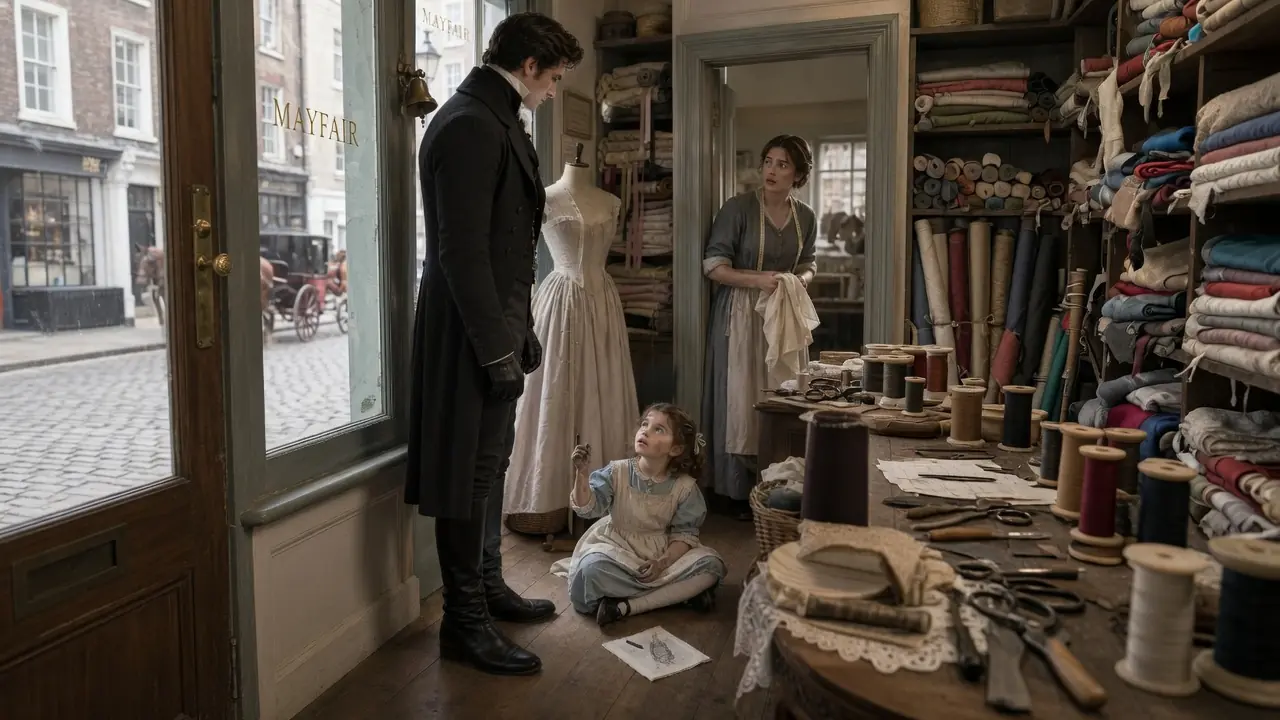
London, 1817. The war was over. Napoleon was caged on his island, and the ton had turned its restless energy back to the only battlefield that truly mattered, the marriage market. Every drawing room hummed with the same question, who would marry whom this season? But in the quiet corner of a modest dress shop on the edge of Mayfair, a very different question was about to change everything.
The bell above the door chimed as Gabriel St. Clair, the sixth duke of Ashworth, stepped inside. He moved the way all powerful men moved, as though the room had been expecting him and was now relieved he had arrived. His presence swallowed the small shop whole. He did not belong here, among bolts of muslin and half-finished bonnets, and every inch of him announced it. He had come for a simple errand.
His mother, the Dowager Duchess, had mentioned a seamstress whose work surpassed anything on Bond Street. She needed new gloves for Lady Harrington's ball. Gabriel had offered to place the order himself, not out of filial devotion, but because the alternative was another afternoon of his mother asking why he had not yet taken a wife. He would rather face a thousand seamstresses than that question one more time. The shop appeared empty.
Fabric samples lay across a work table, and a measuring tape hung from a dress form like a sleeping serpent. Gabriel cleared his throat. No one came. He was about to leave, gratefully, when he looked down. A child sat on the floor.
She could not have been older than five. She sat cross-legged on the worn wooden boards, a piece of charcoal in her fist, drawing on a scrap of paper with the intense concentration of an artist working on a masterpiece. Her tongue poked out from the corner of her mouth. She had not looked up when he entered. She had not even flinched at the bell.
Gabriel stared at her. She continued drawing. After a long moment, the child looked up. Her eyes swept over him with the frank, unimpressed assessment that only children and cats are capable of. She studied him the way one might study a new piece of furniture, with curiosity, but no particular awe.
"Are you married?" The question landed like a stone in still water. Gabriel blinked. In 28 years of life, through Eton and Oxford, and five seasons as the most pursued bachelor in London, no one had ever asked him that question so directly. Certainly not a person whose feet did not yet reach the ground when she sat in a chair.
"I beg your pardon." "Married?" the child repeated, as though he were very slow. "Do you have a wife? It is not a difficult question."
"No, I do not have a wife." The girl nodded, satisfied, as though he had just passed an examination she had been administering. She set down her charcoal and stood, brushing her hands on her pinafore with the business-like air of a woman twice her size. "Good. Because my mama needs a husband.
And you look very tall." A pause. "Tall is important." Before Gabriel could formulate any response to this extraordinary declaration, a door at the back of the shop flew open and a woman appeared. She was wiping her hands on a cloth, her sleeves pushed to her elbows, and the look on her face when she saw a duke standing in her shop with her daughter apparently interviewing him for the position of husband was something Gabriel would remember for the rest of his life.
Horror. Pure, exquisite, soul-deep horror. "Lily. What did you say to the gentleman?" "I asked if he was married, Mama.
He is not. This is very good news." The woman, Alice Waters, as Gabriel would soon learn, closed her eyes. When she opened them, two spots of color burned on her cheeks, and her voice carried the quiet, strained dignity of a woman who had learned to survive embarrassment the way soldiers survived cannon fire, by refusing to fall. I'm so terribly sorry, sir.
She is five. She has not yet learned that one does not interview strangers for matrimony. "I am almost six," Lily corrected. "You are five, Lily, emphatically, devastatingly five." Something happened in Gabriel's chest.
A crack, not large, barely perceptible, like the first fracture in a frozen lake before the spring thaw. It was so small he almost missed it. But it was there. For the first time in four years, since the night his sister Charlotte had died while he was 100 miles away in London, something shifted behind his ribs. He did not smile.
The Duke of Ashworth did not smile. The ton called him the Stone Duke, and they were not wrong. But the corner of his mouth moved, just barely, just enough, and Lily saw it. "See, Mama? He almost smiled.
That means he likes us." Gabriel placed his order for the gloves. He paid in advance, twice the asking price, which Alice tried to refuse, and he pretended not to hear. And he left the shop with the unsettling feeling that a five-year-old girl had just reached inside his chest and rearranged something he had spent years cementing into place. He came back three days later.
He told himself it was about the gloves. They were not ready, of course. He had given her a week. But perhaps he should check on the progress. Quality control, a duke's prerogative.
These were the lies he told himself as his carriage pulled up to the little shop on the edge of Mayfair, and they were poor lies, and he knew it. Lily was waiting for him. Not literally. She could not have known he would come. But when the bell chimed and she looked up from her drawing, her face broke into the kind of radiant, uncomplicated joy that Gabriel had not seen directed at him in years, perhaps ever.
I assure you." There was no need to. I have additional orders. My mother requires several things. He had not thought this through.
Handkerchiefs and ribbons. Alice's gaze was steady and clear. And in it Gabriel saw something he rarely encountered. A woman who was not intimidated by him in the slightest. She did not flutter.
She did not simper. She looked at him the way one looks at a puzzle. With interest, but no intention of being conquered by it. "Ribbons." The single word contained entire volumes of skepticism.
"Yes." "You, the Duke of Ashworth, have come personally to order ribbons." "My mother is very particular about her ribbons." Lily tugged on his coat. "Would you like to have tea?
I am having tea with my dolls, but one of them is sick today, so there is an empty chair." And that was how Gabriel St. Clair, the sixth Duke of Ashworth, the man the ton whispered about as though he were carved from marble, ended up sitting on the floor of a dress shop. His long legs folded beneath him at an angle that would have made his valet weep, drinking imaginary tea from a chipped cup the size of a thimble. Lily poured with great ceremony. She introduced each doll by name and title.
Lady Buttons, the Countess of Ribbonshire, and Miss Penelope, who was poorly and could not attend. She informed Gabriel that he would be playing the role of Lord Tall, a visiting dignitary. Lord Tall does not talk very much. Lily's tone was instructional. He is the strong and silent type.
From across the room, bent over her sewing, Alice made a sound. It might have been a cough. It might have been a laugh. Gabriel chose not to investigate. He stayed for an hour.
When he left, Lily waved from the window, and the crack in his chest grew a fraction wider. The Dowager Duchess of Ashworth was many things, formidable, shrewd, relentless in her pursuit of grandchildren. But she was not blind. When her son, who had shown no interest in anything beyond his ledgers and his parliamentary work for four years, personally delivered a pair of gloves, and then mentioned, with studied casualness, that the seamstress who had made them was quite skilled. The Dowager's instincts ignited like a match struck in the dark.
She visited the shop the following day. She examined Alice's work, and within the hour, she had commissioned an entire wardrobe for Lady Harrington's ball, gowns, underskirts, wraps, everything, with the stipulation that all fittings would take place at St. Clair House. It is simply more convenient. The Dowager delivered the line with the serene dishonesty of a woman who had been engineering social situations since before the French Revolution. And so, Alice Waters, widow, seamstress, mother of one devastatingly honest child, found herself standing in the entrance hall of one of the finest townhouses in London, her sewing basket in one hand, and Lily's hand in the other.
Lily's reaction was immediate and unfiltered. She tilted her head back, far back, because the ceiling was very high, and stared. Her mouth opened. Her eyes went wide. And then she turned to her mother with an expression of profound disapproval.
"This house is too big for one person. That is just silly." The butler, who had served three generations of St. Clare without once losing his composure, made a noise that sounded suspiciously like a snort. He recovered instantly, but the damage was done. Gabriel appeared at the top of the staircase.
He had been in his study reviewing correspondence he did not care about when he heard the commotion. He looked down and saw Alice standing in his foyer in her simple dress, her chin raised, her back straight, every line of her body communicating that she was here to work and nothing more. And the crack in his chest split open another inch. Lord Tall, Lily's voice echoed through the marble hall like a bell. I brought Lady Buttons.
Behind him, Gabriel heard his mother's sharp intake of breath, not of shock, but of delight. The Dowager Duchess had just found her weapon, and it was 4 ft tall with charcoal-stained fingers and absolutely no sense of social propriety. It began as an accident. Alice was upstairs with the Dowager pinning fabric and discussing hemlines, and Lily was supposed to be sitting quietly in the morning room with a book of fairy tales. She was not.
Gabriel found her in his library. She had dragged a footstool to the nearest shelf and was standing on her tiptoes, her small fingers stretching toward a volume just beyond her reach. The book was enormous, a leather-bound atlas of the world, far too heavy for a child her size. She was going to pull it down on top of herself. That book is nearly as large as you are.
Gabriel's voice came from the doorway. Lily did not startle. She simply turned, looked at him with those clear, knowing eyes, and declared, ""Then you should get it for me. You are tall. Tall is useful."
He got the book. He opened it on the floor because the reading tables were too high for her and they sat together, the Duke of Ashworth and a five-year-old girl, looking at maps of places neither of them had ever been. Lily asked questions with the relentless curiosity of a natural philosopher. Why was the ocean blue? Were there dragons in China?
Could you walk to France if you tried very hard? Gabriel answered each one with the same seriousness he would have given a fellow member of the House of Lords. He did not condescend. He did not simplify. And Lily, who was accustomed to being told she asked too many questions, bloomed under his attention like a flower finding sun after weeks of rain.
"Will you read to me? The atlas had been thoroughly explored. Mama reads to me every night, but she only has two books. I've memorized them both. The knight always saves the princess and the rabbit always finds his way home.
I would like a story I do not already know." Gabriel chose Robinson Crusoe. He edited as he went, removing the violence, softening the loneliness, turning it into an adventure rather than a survival story. Lily sat with her back against a shelf, Lady Buttons in her lap, and listened with her whole body. This became their ritual.
Every time Alice came to St. Clair House for a fitting, which was often because the dowager kept adding to her order with suspicious frequency, Lily would slip away to the library and Gabriel would read to her. Sometimes it was Robinson Crusoe. Sometimes it was Shakespeare, heavily adapted. Once, it was a parliamentary speech about grain tariffs because Lily had pointed to it and demanded to know what it said. Gabriel read it in his most dramatic voice and Lily pronounced it the most boring story in the whole world, which Gabriel agreed with entirely.
It was on the fourth visit that Alice came looking for her daughter and found them. Gabriel was sitting in the armchair by the window and Lily was in his lap, her head rested against his chest. She was asleep. The book lay open on the arm of the chair and Gabriel's hand rested on the child's back and he was looking down at her with an expression that Alice recognized because she wore it herself every night. The particular devastating tenderness of someone who would burn the world down for the small person in their arms.
Alice's throat tightened. Not with jealousy, not with anger, with something far more dangerous. The realization that her daughter had found in this stranger what Alice had not been able to give her. A presence. A steadiness.
The particular kind of safety that Lily had lost when her father's boat had overturned in the swollen river three years ago. She stood in the doorway and pressed her hand to her mouth and did not make a sound. Gabriel looked up. Their eyes met over the sleeping child's head. Neither of them spoke.
The moment held, stretched, became something neither could name and then, barely above a breath, "I can take her." And from him, just as quiet, "Let her sleep." In those three words, a door opened that neither of them would be able to close. Spring came to London like a held breath finally released. The gardens behind St. Clair House exploded into bloom, roses climbing the stone walls, wisteria cascading from the pergola, lavender lining the paths in fragrant rows.
Lily discovered the garden on a Tuesday and declared it the finest place she had ever seen. Which, given that her previous frame of reference consisted of a cramped courtyard behind the dress shop, was both charming and heartbreaking. Gabriel found her there one afternoon, sitting on a bench, her legs swinging because they were too short to reach the ground. She was watching a butterfly with the intense focus of a girl who had important questions to ask. ""Why do you never smile?"" Gabriel sat beside her.
The bench was small, built for ladies taking air, not for dukes, and he felt overlarge and clumsy next to this tiny philosopher. "I smile." "No. You do the thing where your mouth moves a little bit, like it is thinking about smiling but has not decided yet. That is not a real smile.
Why do you not do a real one?" The honesty of children is a scalpel. It cuts without malice, without agenda, with nothing but the pure and terrible precision of truth. Gabriel looked at this child who had known him for only weeks and had already seen through every wall he had spent years building. ""I suppose I forgot how."
Lily considered this. Her brow furrowed. Her lips pressed together. She looked, for a moment, like a tiny judge weighing a verdict, and then she delivered it. ""That is the saddest thing I have ever heard.
Even sadder than when my kitten ran away. And that was very sad." "I imagine it was." "I cried for three days. Mama let me sleep in her bed, and she told me the kitten was on an adventure and would send letters.
The letters never came, but it was still nice of her to say." Lily slid off the bench and stood in front of him. She placed her small hands on his knees and stared up at him with an expression of fierce determination, the look of a general marshaling forces for a decisive campaign. "I am going to make you smile, a real smile. Are you ready?"
She made a face. It was objectively the most absurd expression Gabriel had ever seen. Eyes crossed, tongue out, cheeks puffed like a squirrel hoarding acorns. It should not have worked. He was the stone duke.
He did not laugh at crossed eyes and puffed cheeks. She made another face, worse than the first. She added a noise, a sort of strangled honk that was apparently her impression of a goose. The laugh came from somewhere deep and forgotten, like water breaking through rock. It was rusty and strange, and it startled him.
Actually startled him, as though his own body had done something without his permission. But it was real. It was a real laugh, and Lily heard it, and her face lit up with a triumph so pure it could have powered every gaslight in London. "There, I knew it was in there. Mama, Mama."
Lord Tall laughed. Across the garden, standing at the French doors that opened from the fitting room, Alice watched. She had heard the laugh, that unfamiliar, wonderful, broken open sound, and her hand gripped the door frame, and something inside her chest rearranged itself in a way that she knew, with the calm clarity of a woman who had survived loss, was going to be a problem, because she was falling in love with a duke, which was impossible, and her daughter was already there, which was worse. The tension between Gabriel and Alice was a living thing. It grew in the silences between their words, in the spaces between their bodies, in the careful, deliberate way they avoided being in the same room without Lily as a buffer.
But the dowager duchess who was orchestrating this courtship with the subtlety of a military campaign was not about to let them hide behind a five-year-old forever. "I need your opinion on the embroidery for the ivory gown." The dowager caught Gabriel one morning, steering him toward the fitting room with the determination of a sheepdog moving a reluctant ram. "Mrs. Waters has prepared two options. Tell her which you prefer."
"Mother, I know nothing about embroidery." "Then you shall learn. Off you go." He found Alice alone, bent over a table covered in fabric samples. She looked up when he entered, and for a moment, just a moment, the mask she wore slipped, and he saw what was underneath.
Weariness, yes, but also warmth. A carefully guarded warmth, like a candle flame cupped against the wind. "The dowager sent you to evaluate embroidery." "She did." "You have no interest in embroidery."
"None whatsoever." The ghost of a smile crossed Alice's face. Quick, almost involuntary, like a bird darting across an open field. She turned back to the table and held up two samples. "Gold thread or silver?"
Gabriel stepped closer, close enough to see the way her fingers moved over the fabric. Deft, sure, the hands of a woman who had built a life from thread and needle and sheer refusal to surrender. Close enough to notice the faint scent of lavender and linen that clung to her. Close enough that when he reached for one of the samples, his hand brushed hers. They both went still.
It was the smallest touch, accidental, the kind of contact that happens a hundred times a day in crowded London streets without anyone noticing. But in the quiet of that room, with the afternoon light falling through the windows and dust motes drifting in the air like tiny golden planets, the brush of his skin against hers felt like a match touching gunpowder. Neither of them moved. Neither of them breathed. Gold, Gabriel managed, his voice lower than he intended.
And the gold thread. Alice withdrew her hand slowly, as though moving too fast might shatter something fragile that hung in the air between them. Gold it is, your grace. She turned away. And Gabriel stood there for a moment longer than necessary, staring at his own hand as though it belonged to someone else.
Then he left the room and the door closed behind him with a soft click that sounded absurdly like the turning of a key. Lady Harrington's ball was the event of the season and the dowager duchess had planned every detail of the evening with the precision of a chess grandmaster, including the seemingly offhand remark delivered at breakfast that Mrs. Waters would need to attend to make last-minute adjustments to the gowns. She cannot attend a ball, mother. She is a seamstress. She is attending as my personal guest, Gabriel.
I have already sent the invitation and I have lent her a gown. The dowager smiled. The particular smile that meant the conversation was over and had, in fact, been over before it began. It would be rude to uninvite her. Gabriel arrived at the Harrington estate braced for the usual ordeal, the whispers, the simpering debutantes, the mothers who watched him like hawks circling prey.
He stood at the edge of the ballroom, a glass of champagne untouched in his hand, and wondered how early he could leave without causing a scandal. Then Alice walked in. She stood at the entrance of the ballroom in a gown she had sewn with her own hands, ivory silk with gold embroidery that caught the candlelight and scattered it like sparks. Her chin was raised, her back was straight. She looked terrified and magnificent and utterly, completely out of place, and Gabriel could not look away.
The room noticed. Of course it did. Whispers rippled outward like stones dropped in water. Who was she? Where had she come from?
Why was the Dowager Duchess sponsoring a seamstress at Lady Harrington's ball? The ton smelled blood and it leaned in. Gabriel crossed the room. He did not think about it. He did not weigh the consequences, consider the gossip, calculate the social cost.
He simply moved, drawn by a force that was older and stronger than propriety. And when he reached her, he held out his hand. "Dance with me." It was not a question. Alice looked at his hand, then at his face, and he watched the war play out in her eyes.
Pride against longing, caution against desire, the fierce independence of a woman who had learned to stand alone battling the terrifying, exhilarating possibility of leaning on someone else. She took his hand. They danced. The waltz was a scandal in itself, too close, too intimate, the kind of dance that turned bodies into conversations and conversations into confessions. Gabriel held her as though she were made of something precious and breakable, and Alice let herself be held, and for 3 minutes and 20 seconds, there was no ton, no gossip, no impossible gulf between a duke and a seamstress.
There was only the music and the movement and the way their bodies spoke a language their mouths had not yet learned. When the dance ended, Alice stepped back. Her cheeks were flushed. Her breath came quickly. She looked up at him.
And in her eyes he saw something that made his heart stop and restart in a different rhythm. Thank you, Your Grace. The words were barely a breath. She turned and walked away. Gabriel watched her go and the crack in his chest, the one that had started as a hairline fracture in a dress shop when a five-year-old girl asked if he was married, broke wide open and what poured through was something he had not felt in four years, something he had been certain was dead. Hope.
Alice had built her life the way a shipwreck survivor builds a raft with whatever was at hand, held together by determination and the knowledge that sinking was not an option. When her husband Thomas had drowned in the autumn of 1814, she had been 21 years old with a two-year-old daughter and possessed of exactly £4 and 6 shillings, and a wedding ring she refused to sell. She had worked. Lord, how she had worked. She had sewn until her fingers bled and then sewn some more.
She had taken in mending, alterations, commissions, anything that kept food on the table and a roof over Lily's head. She had asked no one for help. She had accepted no charity. And slowly, painfully, she had built something. A small shop, a growing reputation, a life that was modest but hers.
What she had not known, what Thomas had hidden from her with the gentle, well-meaning dishonesty of a man who believed he would always be there to fix things, was the debt, £300 owed to a money lender named Pemberton. Thomas had borrowed it to support his medical practice, equipment, medicines, the supplies he needed to treat the rural families who could not afford a physician. He had intended to pay it back. He had not intended to die. Pemberton had waited.
He was a patient man, the way a spider is patient. He let Alice struggle and build and begin to believe she was safe. And then he appeared at her shop on a Thursday morning in May, just as the roses in Gabriel's garden were reaching full bloom, and he presented the bill. £300 With three years of accumulated interest, it was now 450. Alice stared at the number and felt the ground open beneath her.
"I do not have this. You know I do not have this." Pemberton was a thin man with thin lips and the satisfied expression of someone who enjoyed the power that debt gave him. He folded his hands and explained, with the oily courtesy of a predator who has cornered its prey, that there were options. He could petition the court.
He could seize her assets, the shop, the inventory, everything. Or, and here his voice dropped to a register that made Alice's skin crawl, he could apply for guardianship of the child. "Courts look favorably on stable households for orphans and children of debtors, Mrs. Waters. It would be a kindness, really. The girl would have a proper home."
The world went white. Alice gripped the edge of her worktable and held herself upright through sheer force of will. She would not collapse. She would not scream. She would not give this man the satisfaction of watching her break.
""Get out of my shop." "You have until Michaelmas, Mrs. Waters, the 29th of September. After that, I shall be forced to take appropriate action." He left. Alice stood motionless for a long time.
Then she walked to the back room, closed the door, sat on the floor, and wrapped her arms around herself. And the sound she made was not crying. It was something deeper, something more animal. The sound of a mother who has just learned that the world is trying to take her child. Alice stopped coming to St. Clair House.
She sent the finished gowns by messenger with a note explaining that the remaining work could be completed at her shop. The note was polite, professional, and completely void of the warmth that had been growing between them for weeks. It read like a door being closed, locked, and bolted from the inside. Gabriel read it three times. Then he set it down, and something cold settled in his chest.
The familiar sensation of a wall being rebuilt from the other side. He told himself it was for the best. She was a seamstress. He was a duke. The ton would eat her alive.
Whatever foolish, fragile thing had been growing between them was a fantasy. And fantasies did not survive contact with reality. He told himself all of this, and none of it helped. Because the truth, the truth he could not outrun, was that Alice Waters had made him feel like a living man again. And her absence made the world go gray.
It was Lily who shattered the stalemate. She appeared at St. Clair House on a Wednesday afternoon, alone. The butler found her standing on the front step, Lady Buttons clutched to her chest, her eyes enormous in her small face. She had walked six blocks by herself, a five-year-old child navigating the streets of London. And when asked what she was doing there, the answer came with the quiet gravity of someone delivering news of a death.
She needed to see Lord Tall. Gabriel was summoned from his study. He took the stairs two at a time, his heart hammering with a fear he did not fully understand. And when he reached the entrance hall and saw Lily, small, alone, and looking up at him with eyes that held something no child should have to carry, he dropped to one knee so that his face was level with hers. Lily, what is it? What has happened?
Her lower lip trembled. She pressed Lady Buttons tighter against her chest, as though the doll could shield her from the enormity of what she was about to say. And then, in a voice so small it was almost swallowed by the vast marble hall, "Mama cries at night when she thinks I am sleeping, but I am not sleeping. I hear her." A breath, a swallow.
"Can you make her stop?" Gabriel's hands shook. He clasped them together so Lily would not see, but it was too late. She saw everything, this child. She always saw everything.
And her small hand reached out and touched his wrist, and the gentleness of that touch from a five-year-old girl nearly brought the Duke of Ashworth to the floor. "I will try." The words came out raw, unguarded, because he could not lie to this child, and because the truth that he would do anything, anything to stop Alice Waters from crying alone in the dark, was the most honest thing he had ever said. He carried Lily back to the shop himself. He did not send a carriage or a footman.
He carried her because she was small and tired, and she had walked six blocks through London to ask a duke to save her mother. And that kind of courage deserved to be honored. Alice was frantic when they arrived. She had discovered Lily's absence 10 minutes earlier and had been tearing through the streets calling her daughter's name, her voice cracking with a terror that went beyond fear into something primal. When she saw Gabriel approaching with Lily in his arms, the relief hit her so hard her knees buckled.
Lily! Oh god! Lily! She pulled the child from Gabriel's arms and held her so tightly that Lily squirmed and protested. And then, when the relief had burned through her and left nothing but the raw, exposed nerve of a mother's fear, she turned on Gabriel.
You should not have brought her back. She should not have gone to you. None of this. Her voice broke. She pressed Lily's face against her shoulder and stared at Gabriel with eyes that blazed with something far more complex than anger.
We are not your responsibility, your grace. We are not your project. We are not the broken things you fix to make yourself feel "Tell me about Pemberton." The name landed like a slap. Alice went still.
Lily, sensing the shift in atmosphere with the uncanny radar of a child attuned to adult storms, pressed closer to her mother. How do you know that name? I asked questions. After you disappeared, I asked questions because the woman I He stopped, took a breath, recalibrated. Because a woman who has been meeting my eyes for weeks does not suddenly stop unless something has frightened her.
Tell me what he is holding over you. It is none of your concern. Alice. Her name in his mouth, not Mrs. Waters, not madam, but Alice. Spoken with a tenderness that cut through every defense she had, undid her.
She told him the debt, the interest, the threat against Lily. Every word cost her something. Pride, independence, the fierce self-sufficiency that had kept her alive for three years. And by the time she finished she was trembling with the effort of not falling apart. Gabriel listened.
He did not interrupt. He did not offer solutions or platitudes or the hollow reassurance of a man who has never known what it means to fear losing everything. He simply listened. And when she was done, he spoke. "Let me help you."
I am not a charity case for a duke with a guilty conscience. The words were sharp and deliberate aimed at the softest part of him. The guilt over Charlotte. The suspicion that he was trying to save Alice and Lily because he had failed to save his sister. And they hit their mark.
Gabriel flinched. But he did not retreat. This is not about my conscience. This is not about guilt or duty or what the ton expects of me. This is about you, Alice.
You and that child in your arms who walked six blocks alone through London because she could not bear the sound of her mother crying. If you think I can hear that and do nothing his voice broke. And the breaking of it was the most honest sound Alice had ever heard from a man. Then you do not know me at all. The room was silent.
Lily had fallen asleep against Alice's shoulder exhausted by her adventure. And in her sleep she made a small sound, a murmur, a sigh that filled the silence with something larger than words. Alice looked at Gabriel. He looked at her. And between them, in the charged and trembling air of a small shop on the edge of Mayfair, something shifted.
Not a crack this time, but a door. A door that Alice had locked and bolted and barricaded with every piece of furniture she owned, opening slowly from the inside. There was no yes. There was no thank you. Only a barely audible ""You should go."
And eyes bright with tears she would not let fall. And Gabriel nodded and left. And neither of them slept that night. It happened on a Sunday. Alice sent word to St. Clair House that she would not be delivering the final alterations as planned.
The note was brief, two lines, the handwriting unsteady. "Lily was ill." Gabriel was in his carriage before the ink on the message was dry. He told himself during the ride across London that this was a reasonable response. The child was his mother's seamstress's daughter.
He was merely being considerate. A duke checking on the welfare of a household associated with his family. Perfectly appropriate, entirely normal. The lies lasted until he walked into Alice's rooms above the shop and saw Lily. She was small in the bed.
That was what struck him first, how impossibly small she was. This child who filled every room she entered with her voice and her questions and her ferocious, unfiltered love. She lay tangled in damp sheets, her breathing shallow, her skin flushed with fever. And she looked fragile in a way that made Gabriel's blood turn to ice. Alice sat beside the bed, a damp cloth in her hand, pressing it to Lily's forehead.
She looked up when Gabriel entered. And in her eyes he saw not surprise, but something worse. Gratitude. Raw and unwanted. The gratitude of a woman who had sworn she needed no one and was discovering, in the worst possible moment, that she was wrong.
The doctor came this morning. Alice's voice was barely audible. He says it is a common fever, that it will break, that children recover from these things every day. Her hand trembled on the cloth. But she is so hot, Gabriel.
She is so terribly hot. It was the first time she had called him by his name. Neither of them noticed. Gabriel sat down on the other side of the bed. He did not ask permission.
He did not hover or hesitate. He sat, and he took Lily's hand. That tiny, burning hand that had poured him imaginary tea and made him laugh for the first time in four years. And he held it. And the past came flooding back.
Charlotte. 1three years old. Flushed with fever, calling his name from a bedroom in the country while he sat in a London club debating politics with men who did not matter. Charlotte. Who had written him a letter three days before she died.
A letter he did not read until it was too late. Asking him to come home because she was frightened. Charlotte. Who died believing her brother had chosen London over her. The guilt was a physical thing.
It lived in his chest like a second heart beating its own terrible rhythm. And now, sitting beside another bed with another fevered girl, it rose up and seized him by the throat. He would not leave. Not this time. He would not leave this room, this child, this woman who had called him by his name for the first time, until the fever broke or the world ended, whichever came first.
Night fell. Alice changed the cloths. Gabriel held Lily's hand. They did not speak because some vigils are too sacred for words, and this was one of them. They sat on opposite sides of the bed like sentinels guarding something infinitely precious.
And the only sounds were Lily's labored breathing and the distant clatter of London going about its business, oblivious to the small war being fought in the rooms above a dress shop. At midnight, Lily stirred. Her eyes opened, glassy, unfocused, and she looked at Gabriel with the confused recognition of a child caught between dream and waking. "Lord Tall." A whisper, thin as paper. "You are here."
""I am here." "Will you read to me?" His throat closed. His eyes burned. He picked up the book of fairy tales that lay on the bedside table, one of Alice's two books, the one about the knight and the princess, and he began to read.
His voice was not steady. The words blurred on the page, but he read, and Lily listened. And Alice watched them both with her hand pressed to her mouth and tears running silently down her face. The fever broke at four o'clock in the morning. One moment Lily was burning, and the next she sighed, a long, deep, releasing sigh, like a ship settling after a storm, and her skin cooled, and her breathing eased, and Alice pressed her face into the sheets and wept with relief so violent it shook the bed.
Gabriel sat motionless. His hand was still wrapped around Lily's. He stared at the sleeping child, and the relief that washed through him was so enormous, so overwhelming, that it stripped away every defense he had. There was nothing left, no walls, no stone, no carefully constructed indifference, just a man sitting beside a bed, grateful beyond words that a child he loved was going to be all right. A child he loved.
The realization landed softly, without fanfare, the way the most important truths always arrive. Not as thunder, but as dawn. Alice lifted her head. Her eyes were red. Her face streaked with tears.
And she looked at Gabriel with an openness that she had never permitted before. The kind of raw, unguarded vulnerability that only emerges when someone has been terrified and then reprieved. You stayed. Her voice was hoarse. And you did not have to stay.
Yes, I did. Why? The question was a key turning in a lock. Gabriel looked at Lily, peaceful now, breathing easily. Her small fingers still curled around his.
And he began to speak. I had a sister, Charlotte. She was eight years younger than me. A surprise, my parents called her. Though the word does not begin to capture what she was.
She was sunlight, Alice. The kind of person who made everyone around her feel warmer simply by existing. She laughed at everything. She asked questions constantly. Why is the sky blue?
Why do birds sing? Why does father frown when he reads the newspaper? She was curious about everything and afraid of nothing. He paused. The words that came next had been locked inside him for four years.
And they emerged slowly, like prisoners blinking in the light. She fell ill in the autumn of 1813. A fever. I was in London. I had business in Parliament.
Meetings I told myself were important. Obligations I convinced myself could not wait. She wrote me a letter. Three lines. In her terrible handwriting.
Dear Gabriel, I am frightened. Will you come home? Love, Charlotte. I did not read the letter for 2 days because I was busy. When I finally opened it, I left immediately.
I rode through the night. His voice dropped to a whisper. I arrived 6 hours too late. The silence that followed was the kind that changes rooms. It settled over them like snow, quiet, heavy, She was 16.
A long silence. She died believing I had chosen London over her. And she was right. I did choose London. Not because I did not love her, but because I assumed there would be time.
There is always time, we tell ourselves. There will be another day, another week, another chance. And then there isn't. And the letter sits on your desk unopened. And the horse rides through the night.
And you arrive at dawn, and the house is quiet in a way that houses are only quiet when something terrible has happened inside them. He looked at Alice. That is why I do not smile. That is why the ton calls me the stone duke, because I built a wall around myself the day I buried my sister. And I swore I would never let anyone close enough to hurt me like that again.
It was not strength, Alice. It was cowardice. The most elaborate, well-dressed cowardice in London. Alice reached across the bed, across the sleeping child who lay between them like a bridge connecting two broken shores. She took Gabriel's hand, the hand that was not holding Lily's, and she held it.
It was not cowardice. It was grief. And grief is the price we pay for having loved someone enough that their absence leaves a wound. Her thumb traced circles on his knuckle. You did not fail, Charlotte Gabriel.
You were a young man who made a human mistake. And you have been punishing yourself for four years because you believe you do not deserve to stop. His eyes closed. A single tear escaped. Just one, tracking down his cheek.
Catching the candlelight. He did not wipe it away. When Lily fell ill tonight, his voice dropped to almost nothing. I thought, "I cannot do this again. I cannot sit beside another bed and watch another."
He could not finish. But you stayed. I could not leave. Not this time. Never again.
Why? He opened his eyes, looked at her. And the answer was so simple, so plain, so stripped of pretense and performance and the thousand masks he wore for the world, that it came out as barely more than a breath. "Because I love her. Alice, I love that ridiculous, impossible, magnificent child.
And I..." A pause. A tremor. "And I love her mother." Alice did not speak.
She could not. The tears that fell were not the tears of grief or fear. They were the tears of a woman who had been carrying the world alone for three years and had just been told, for the first time, that someone else was willing to help hold it. She squeezed his hand. He squeezed back.
And they sat like that, connected across the small sleeping body of a child who had brought them together with nothing but honesty and a heart too big for her tiny frame, until the first light of dawn crept through the window and turned the room to gold. Lily woke with the sunrise. Her fever was gone. Her cheeks were cool. And she opened her eyes with a slightly bewildered expression of someone who has been on a long journey and is surprised to find themselves home.
She looked to her left. Her mother sat beside the bed, still holding Gabriel's hand across the covers. She looked to her right. Gabriel sat in a chair that was too small for him, his coat discarded, his cravat undone, his eyes rimmed with red from a sleepless night. He looked, Lily decided, like a man who had been through a war and won.
She looked at their joined hands. Then she looked at Gabriel. Then she looked at her mother. And then, with the devastating clarity of a child who has never learned to hide what she feels, she asked the question that shattered every remaining wall in the room. ""Are you going to be my papa?"" The world stopped.
The sounds of London, the carts, the street vendors, the early morning bustle of a city waking up, all of it faded to nothing. There was only this room, this bed, this child, and a question that hung in the air like a held note. Alice's breath caught. Gabriel's hand tightened around hers. And they looked at each other, not as a duke and a seamstress, not as a man of stone and a woman of steel, but as two people who had found in each other the thing they had stopped believing in.
The answer was in their eyes. It had been there for weeks, in the imaginary tea parties, in the laughter in the garden, in the dance at the ball, in the touch over the fabric, in the long night of fever and confession. It had been building, word by word, moment by moment, like a house being constructed around them without their noticing, until suddenly they looked up and realized they were already inside. Gabriel leaned across the bed. Alice met him halfway.
And the kiss, their first, was not the passionate, consuming fire of novels and operas. It was something better. It was gentle. It was careful. It was the kiss of two people who had been broken and were choosing, deliberately and with full knowledge of the cost, to be whole again.
It tasted of tears and exhaustion and the particular sweetness of a promise that had been earned, not given. They kissed over the head of a sleeping again Lily, who had closed her eyes with a small, satisfied smile the moment she saw them lean toward each other. The smile of a general whose campaign has finally triumphantly succeeded. And somewhere in the quiet of that small room above a dress shop, Charlotte St. Claire smiled, too. Not because she had been watching, but because love, when it is real, sends ripples backward through time, healing wounds that once seemed permanent.
Gabriel moved with the quiet, devastating efficiency of a man who had spent his entire adult life accumulating power and had finally found a reason to use it. Within three days of the kiss above the dress shop, Pemberton's debt had been purchased, not paid. Purchased. Gabriel bought every note, every ledger entry, every scrap of paper with Alice's name on it. He did not do this through intermediaries or solicitors.
He walked into Pemberton's office himself because there are some messages that must be delivered in person. "You will leave Mrs. Waters and her daughter alone." Gabriel stood in the center of the cramped, foul-smelling room with the calm authority of a man who owned half a county. The debt is settled. If you approach her again, if you so much as walk down the same street as her shop, I will ensure that every creditor, every magistrate, and every member of the House of Lords knows exactly how you conduct your business.
I have seen your ledgers, Pemberton. The interest rates alone would earn you a visit from the Court of Chancery. The threats against a child would earn you something considerably worse. Pemberton, who had spent a lifetime preying on the desperate and the powerless, found himself for the first time staring at someone who was neither. The Duke did not raise his voice.
He did not threaten violence. He simply stood there, and the weight of his name, his title, his unwavering gaze, pressed down on Pemberton like a stone on an insect. "Do we understand each other?" They understood each other. Pemberton's hand trembled as he signed over the documents.
Gabriel took them, folded them neatly, and left without another word. He burned the papers that evening in the fireplace of his study, and watched the flames consume three years of Alice's terror. Then, he sat in the chair where he had once read parliamentary speeches to a five-year-old girl, and he stared at the fire, and for the first time in as long as he could remember, the weight on his shoulders felt lighter. He did not tell Alice. This was deliberate, and as he would later acknowledge, a mistake.
Not because his intentions were wrong, but because Alice Waters was a woman who had survived by controlling her own fate, and discovering that someone had rearranged her world without consulting her was not a gift she could accept without question. She found out two weeks later, when Pemberton's clerk arrived at the shop to formally release the lien on her assets. The clerk handed her a document, explained in bold legal language that the debt had been acquired and discharged by the Duke of Ashworth and left. Alice read the document three times. Then she put on her coat, took Lily by the hand, and walked to St. Clair House.
Gabriel met her in the entrance hall. He saw the paper in her hand. He saw the storm in her eyes. And he braced himself. "You bought my debt."
I eliminated a threat to you and your daughter. "Without telling me. Without asking me. You simply decided. The way dukes decide things.
The way men with power decide things for women without power. As though our lives are problems to be solved rather than stories to be lived." Gabriel took a breath. "You are right. I should have told you.
I should have asked." I acted because I was afraid. Afraid that Pemberton would move before I could stop him. Afraid that if I waited for the right moment, there would be no moment left. But fear is not an excuse for taking your choices away.
I am sorry. Alice. Truly. She stared at him. The anger in her eyes shifted.
Not disappearing, but changing shape. The way a fire changes when the wind turns. She looked down at the paper in her hands. The legal release of a debt that had haunted her for three years. The end of the nightmare that had kept her awake.
That had made her cry in the dark while her daughter pretended to sleep. You burned the papers. Her voice was almost inaudible. It was not a question. I did.
You burned them because you did not want me to owe you anything. I burned them because you never owed anyone anything. You survived, Alice. You built a life from nothing. You raised the most extraordinary child I have ever met.
And you did it alone. And you did it with grace. And the fact that your husband left a debt does not diminish any of it. Not one thread. Lily tugged on Gabriel's coat.
He looked down. She held up a piece of paper, a drawing done in charcoal with the earnest imprecision of a child who sees the world not as it is, but as it should be. Three figures. One tall, one medium, one small. They stood together in front of something that looked like a house, but might have been a castle.
It was hard to tell because five-year-old architects are not known for their accuracy. The tall figure and the medium figure were holding the small figure's hands, one on each side. And underneath, in wobbly painstaking letters that must have taken Lily an eternity to form, were two words, our family. Alice looked at the drawing. Gabriel looked at the drawing.
And then they looked at each other. And everything, the anger, the fear, the pride, the walls, the £450, the years of loneliness, the grief over Charlotte, the terror over Lily, all of it dissolved, the way fog dissolves when the sun finally breaks through, leaving nothing but clarity and warmth and the unshakable conviction that some things are meant to be. Alice stepped forward. Gabriel caught her, and they held each other in the entrance hall of St. Clair House while Lily stood between them, her drawing pressed to her chest, beaming with the absolute bone-deep satisfaction of a girl who had accomplished exactly what she had set out to do on the day a tall stranger walked into her mother's shop. He proposed on a Tuesday.
This was not, he later admitted, the most romantic choice of days, but Gabriel St. Clair had never been a man of grand gestures. His love was not fireworks and decorations. It was steady and quiet and bone-deep. The kind of love that shows up at four o'clock in the morning and reads fairy tales in a shaking voice and burns £450 debt without asking for credit. He proposed in the garden because that was where Lily had made him laugh for the first time.
And it seemed right that the place where he had rediscovered joy should be the place where he asked for it permanently. Alice was sitting on the bench, the same bench where Lily had interrogated him about his smile. Lily was nearby conducting an important negotiation with a ladybug. The late afternoon light turned the garden into something from a painting, all gold and green and the soft honeyed warmth of an English summer. Gabriel sat beside Alice.
He did not get on one knee because the words he needed to say were not the kind spoken from a position of supplication. They were the kind spoken eye to eye, heart to heart, as equals. I have spent four years being the Stone Duke, cold, untouchable, unreachable. I built those walls because I believed that if I did not let anyone in, no one could leave me again the way Charlotte left. And then your daughter walked up to me in a dress shop and asked if I was married and everything I had built started to crack.
He took her hands. You did not save me, Alice. You did not fix me or heal me or any of the things poets write about. What you did was harder. You stood beside me and let me save myself.
You showed me that strength is not the absence of pain. It is the choice to love despite it. Alice's eyes were bright. Her hands trembled in his. Gabriel, I am asking you to marry me not because I am a duke and can give you a title and a house and safety, though I can and I will and I want to.
I am asking because you are the bravest woman I have ever known, and your daughter is the wisest person I have ever met. And the life I lived before I walked into your shop is not a life I want to return to. Not for a single day. Not for a single hour. Alice looked at him.
The seamstress and the duke. The widow and the broken man. The woman who had refused to let anyone save her and the man who had been afraid to save anyone. They had come to this bench by the most improbable of paths, led by a five-year-old girl with charcoal-stained fingers and a heart the size of the entire British Empire. Yes.
The word trembled in the air. Yes, you impossible, stubborn, wonderful man. Yes. From across the garden, Lily looked up from her ladybug. She studied her mother and Lord Tall for a moment, assessing the situation with the sharp eye of a seasoned matchmaker.
She saw their joined hands. She saw the tears on her mother's face, but happy tears this time. The kind that sparkled instead of burned. She saw Gabriel's smile. A real smile.
A full smile. The smile she had known was in there all along. Finally, Lily threw her hands in the air with a dramatic flourish that would have done credit to any actress on the Drury Lane stage. "I have been waiting forever." Gabriel laughed.
That deep, surprised, broken open laugh that Lily had unlocked in this very garden. He opened his arms and Lily ran to him and he lifted her up. And for a moment, they were three separate people. A duke, a seamstress, and a five-year-old girl. And then Alice stepped forward and Gabriel pulled her close and they were something else entirely.
A family. Not perfect. Not easy. Not the kind of family the ton would have predicted or approved of or understood. But real.
Forged in tea parties and fairy tales and long nights of fever. Built on honesty, on courage, on the stubborn refusal to let the world dictate who deserves love and who does not. Held together by a child who believed, with the unshakeable certainty that only the very young possess, that love was simply a matter of finding someone tall enough. She was right. Three months later, on a crisp September morning in the year 1817, Alice Waters became the Duchess of Ashworth in a ceremony at the chapel on the St. Clair estate.
She wore a gown she had sewn herself. Ivory silk with gold embroidery. The same gown she had worn to Lady Harrington's ball. Because Alice was a woman who did not need new things to mark new beginnings. She needed only the right ones.
Lily served as flower girl and took the role with the seriousness of a military appointment. She scattered petals with strategic precision, ensuring maximum coverage across every inch of the aisle. And when she reached the altar, she turned to the assembled guests and announced, "You may all sit down now. This is going to be a very good wedding." The ton talked, of course.
They always talked. A duke marrying a seamstress, a widow, a woman with a child from a previous marriage. It was scandalous, unprecedented. The kind of misalliance that would fuel drawing room gossip for years. But the ton had never met Lily Waters.
And gossip, it turned out, was no match for a five-year-old girl who walked up to every single critic at the wedding breakfast and asked each one, with perfect sincerity, "Are you happy? Because I am very, very happy. And I think you should be, too." They were, despite themselves, charmed that evening in the library at St. Clair House, their library now, all three of them. Gabriel read to Lily before bed.
It was Robinson Crusoe again, because Lily had decided it was her favorite, though she maintained that the book would be considerably improved by the addition of a talking cat. When Lily's eyes grew heavy and her arguments for the talking cat became increasingly incoherent, Gabriel closed the book and carried her to her room, the room next to theirs, the room that had once been Charlotte's and was now Lily's, and the rightness of that, the way love moves into spaces left by loss and makes them whole again, was something Gabriel felt in his bones. He tucked her in. She reached up and touched his face, a gesture she had started doing recently, as though confirming that he was real, that he was not going to vanish the way fathers sometimes did. "Lord Tall."
"Yes, Lily."
"You are not Lord Tall anymore. You are Papa." The words carried the matter-of-fact certainty of someone correcting a minor administrative error. "I decided." His throat tightened.
His eyes burned. He leaned down and pressed a kiss to her forehead. And the ghost of Charlotte seemed to drift through the room, not sad, not reproachful, but peaceful, as though she were finally, gently, letting go. "Papa it is, then." Lily smiled, closed her eyes, and was asleep within seconds, the way children are, instantly, completely, with the absolute trust that the world will still be there in the morning and the people they love will still be in it.
Gabriel stood in the doorway and watched her sleep. Behind him, he felt Alice's hand slide into his. She leaned against his shoulder. And they stood together in the quiet of a house that was no longer too big for one person because it was full. Full of laughter and fairy tales and charcoal drawings and imaginary tea and the kind of love that does not arrive with trumpets and fireworks, but with a child's question and a stranger's almost smile.
"Are you happy?" The question was barely a breath against his shoulder. Gabriel thought about this. He thought about stone walls and frozen lakes and a letter he had not opened in time. He thought about a dress shop and a chipped teacup and a butterfly in a garden and a waltz that lasted 3 minutes and 20 seconds.
He thought about a night of fever and a confession in the dark and a kiss over a sleeping child and a drawing of three figures with the words our family written underneath in wobbly letters. "Yes." The word settled into the quiet like a stone finding water. "I believe I finally am." And somewhere in the house, tucked in the drawer of Gabriel's desk next to the parliamentary speeches and the ledger books, a small piece of paper lay folded and precious.
Three figures. One tall, one medium, one small. Our family. Drawn by a girl who knew before anyone else that love was never about titles or wealth or the opinions of the ton. It was about finding someone tall enough to reach the books on the highest shelf and brave enough to sit on the floor and read them to you.