“Mom, there's a man inside the mirror,” I said. And I wasn't joking. That was the first time I saw our golden retriever, Maple, do it. She was barely three years old back then, and she had never acted like that before.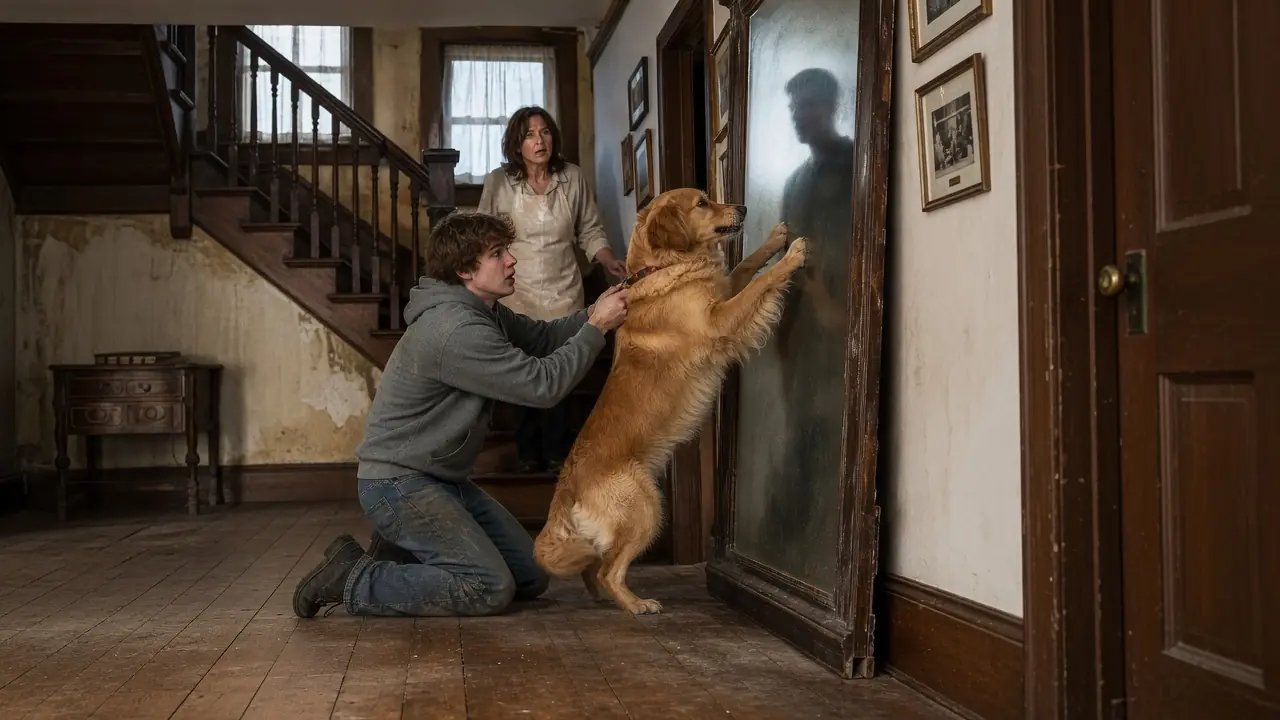
It was early November in rural Ohio, the air cold enough that our windows stayed foggy till midday. Dad had passed a few months before and Mom was finally getting the hang of being alone in the house. Well, not completely alone. She had me and Maple and a house full of things we hadn't yet figured out what to do with.
It started as a quiet afternoon. I had just gotten home from high school, kicked off my muddy boots by the kitchen door, and was halfway through microwaving leftover meatloaf when I heard the first thump from upstairs. I froze. Mom was still at work at the bakery.
No TV was on. The house was silent. Then another thump and a long low whine. I ran up the steps two at a time already calling out, “Maple, girl, you okay?”
No answer, just more thumping. I found her in the hallway, sitting in front of the mirror that had been hanging in the same spot since forever—an old full-length mirror with a wooden frame, maybe passed down from Grandma's side. Maple had one paw raised against it and was pressing gently as if she expected something to move.
She whined again, tail swishing nervously. When I stepped closer, she turned to look at me, then back at the mirror and pawed it twice more. I knelt beside her. “You see something in there?”
I asked, half laughing. I figured maybe she saw her reflection and thought it was another dog, but Maple had seen herself in mirrors before. She wasn't dumb. She knew her own face.
That's when I said it. I looked hard at the mirror and for a split second, I swear I'm not making this up. I thought I saw movement behind the glass that didn't match ours. A flicker, a shadow, like someone stepped behind me and vanished.
“Mom, there's a man inside the mirror,” I told her over dinner that night. She laughed, brushing flour off her apron. “You watched too many scary movies. It's just your reflection.”
“Maple keeps pawing at it, Mom. It's weird. She's never done that.” “She's grieving, same as us,” Mom replied. “Let her be.”
Except Maple didn't stop. Every day after school, she'd race upstairs, sit by that mirror, and paw at it. If I tried to move her, she'd whine. If I left her alone, she'd stay there for hours, unmoving, eyes fixed.
A week later, Mom gave in. “Fine,” she sighed. “We'll take it down. Maybe she's scared of it, or maybe there's something weird behind it making a smell.”
It was a Saturday, cold outside, but sunny. Mom went to grab the toolbox. I held Maple by the collar while Mom unscrewed the mirror from the wall. It came off easier than we thought.
Too easy, almost. Behind it wasn't just drywall. There was a panel, a wooden panel, painted over. “Is this a door?” I asked. Mom set the mirror down gently and stared at the wall. “I don't remember this being here. Has it always been like that?” “Not that I know of.” Maple started pawing again, this time at the newly revealed panel. We stared at each other, unsure. “Do we open it?” I asked. “Well, it's your dad's house. He grew up here. Maybe it's some old storage space. Let me get the crowbar.”
The panel creaked open with a reluctant groan, revealing a shallow cavity in the wall, about a foot deep, three feet wide, and lined with thin wood. Maple pushed her nose in immediately, sniffing like mad. She let out a short bark and backed up, tail wagging like she'd found something exciting. Inside, under a thin layer of dust, was a box.
A small wooden one with a metal latch and hinges. Mom reached in, her hands trembling. “This wasn't here when we renovated. It must have been sealed up years ago,” she said.
She opened the box carefully, lifting the lid like it might bite. Inside were a handful of things. Old photographs, folded letters, a baby's knitted cap and a tarnished medal. Everything smelled like time and wood and something older still.
“These are your dad's,” Mom whispered. “That's his brother, and that's your Grandpa Raymond.” I watched her flip through the photos, her hands growing still. Maple sat between us, tail still swishing, tongue lolling happily.
“Maple knew,” I said softly. She knew this was here. “Or maybe someone wanted her to help us find it,” Mom replied. We spent the next few hours going through everything.
The letters were written in faded ink addressed to Grandpa from a woman named June, someone none of us had ever heard of. She wrote about a child, about a promise, about losing contact during the war. One letter talked about a secret being kept for the sake of peace in the family. Mom read aloud slowly, voice trembling.
“If you ever return, tell your son the truth. He deserves to know where he came from.” I looked at Mom. “What truth?” I asked. She shook her head. “I don't know.” We kept the letters and photos out, laid them on the living room table.
Maple sat with her head resting on my knee, eyes watching us carefully. She was calm now, almost proud.
That night, we didn't put the mirror back. Instead, Mom called Uncle Rob, her older brother who moved to Michigan years ago. She told him about the letters. He went silent for a long time.
“You found June's box,” he finally said. “You know who she is?” “She was our aunt—Dad's sister, or at least we think she was.” The story that unfolded over the next week was stranger than fiction.
June was a young woman who'd lived in the same town who had a relationship with our grandfather during his deployment. Some thought she was just a kind neighbor who helped raise him when his parents passed. But others whispered that she was more than that, that she was family by blood, though no one would say how. “So why hide the box?” “Because of what's in it,” Uncle Rob said. “That medal? Our grandfather got it for something he never talked about. And the cap belonged to a baby who never came home.”
She cried when she saw the photos, then sat quietly for a long time before nodding. “I always thought there was more to Raymond than he let on. He was a good man, but secretive.” Maple never pawed at the empty wall again.
She seemed content now, done with her mission. One afternoon, I sat with her on the porch, running my fingers through her soft fur. “You brought us to the truth,” I told her. “Somehow you did.”
She gave a soft bark like she agreed. We didn't hang the mirror back. We left that wall open, put a shelf there instead. On it sat the box, now cleaned and polished.
Next to it was a photo of Grandpa Raymond, a smiling man in uniform. And beside that, a newer photo, Maple, sitting proud by the panel she'd uncovered. Mom joked we should get her a badge. I said we should just give her all the meatloaf she wanted.
But I couldn't help thinking every time I looked at her curled by the fire. Maybe some things are meant to be found. And maybe, just maybe, dogs know more about family than we think.
It started with the doorbell ringing at a strange hour. Not late at night, but right in that odd middle of the morning when people are usually either at work or still easing into their day. Maple barked twice and bolted for the front door, her tail doing that rapid side-to-side wag like it always did when someone unfamiliar showed up. Mom was in the kitchen, hands buried in a bowl of dough.
So, I went to open it. Standing on the porch was a man I didn't recognize. He looked to be in his 60s, maybe older, with silver hair, slicked back, and a long green coat buttoned to his neck. He didn't smile when I opened the door, but his eyes were kind.
“Are you Beverly's boy?” he asked. I nodded slowly. “Yeah, that's my Mom. She's here.”
Maple didn't bark again. Instead, she sat quietly by my leg, watching him closely like she was waiting for something. I'm Miles, the man said. Miles Tanner.
I used to know your grandfather. I heard you found a box behind the mirror. My stomach flipped. I hadn't told anyone outside the family, not even friends at school.
I blinked. “How did you know about that?” He gave a soft chuckle, not mocking, more like someone remembering something long buried. “Word travels, and when it does, sometimes it knocks.”
I let him in because I didn't feel afraid. And because Maple, who barked at squirrels and even the UPS guy, hadn't made a sound. That meant something. Mom came out of the kitchen, wiping her hands on a towel.
She stopped in her tracks when she saw him. “Miles, as in Raymond's unit?” He nodded. “One and the same.” She gestured him to the dining table, and we all sat, Maple curling up underneath, her chin on her paws.
The sun was starting to filter through the front windows, laying soft golden patterns across the table. The house was quiet again. “I won't stay long,” Miles began. “But if you found the letters and the photo of the baby, then you deserve to know.”
He pulled a folded sheet of paper from inside his coat and placed it gently on the table. “Your grandfather never liked to talk about it, but after the war, he wrote down everything he could remember. He gave me this years ago and said I could pass it on if the truth ever came out.”
Mom reached for the paper slowly, unfolded it, and began to read aloud. It wasn't long, just a page. Raymond had met June during a transport delay overseas. They weren't supposed to fall in love. She was on assignment, and he was shipping out again in days. But fall in love they did.
The baby came the following spring, but complications meant she didn't make it. Her name was supposed to be Lillian. “That cap,” Miles said softly, “was all they had. He kept it hidden like a wound that never closed.”
Mom's eyes glistened. “But why didn't he tell anyone?”
“Because he thought it would tear the family apart. June wasn't from here. She was adopted into a family that moved often, and no one knew much about her roots. Raymond had also just lost his brother. He felt like he couldn't bring home more heartbreak.”
I sat quietly, letting it settle in. It was strange to learn things like this about people you thought you knew inside and out. But there was a weight in the truth, and somehow it didn't feel heavy—just necessary.
“And you?” I asked. “Why are you telling us now?” “Because your dog wouldn't let you forget,” he said, his eyes on Maple. “Some animals have a nose for memory—for what lingers.” He stood slowly and deliberately. “You should keep the letters safe. And if you ever find more, look for June's initials. She signed them J.M. I believe she wrote more than what was in that box.” Then he tipped his head and left as quietly as he came. Mom and I sat in silence for a long while after. Maple snored gently under the table.
Later that afternoon, we went up to the attic. It hadn't been opened in months. The pull-down ladder creaked like always, and a thick curtain of dust rained down as we climbed. The air was dry and smelled like cedar and forgotten holidays.
Old decorations, baby clothes that didn't fit anyone anymore, boxes with dates scribbled in fading marker. Mom dug through a chest marked family heirlooms and pulled out a bundle of letters wrapped in a ribbon. “I thought these were from Grandma,” she said. “But some of them are addressed to ‘My Dearest R.’”
She sat cross-legged on the floor and began to read, her lips moving silently. I sat beside her holding a flashlight while the late afternoon light made golden slashes across the dusty floorboards. “This one mentions Lillian,” she said suddenly. “It says, ‘Our little one would have been six today.’”
Maple's ears perked up from the hallway. She didn't enter, just sat at the threshold like a silent witness. We kept going, letter after letter, dated from decades ago, some with smudged ink, others still crisp like they'd been sealed yesterday. They painted a picture of love long kept quiet, of heartbreak stitched into the edges of ordinary life, of a man who carried a daughter's memory like a sacred thing.
“We need to tell Rob,” Mom whispered. “He needs to see this too.” Uncle Rob drove in the next day, took the long way from Michigan, and brought a thermos of hot cocoa like he always did. He listened while Mom read one of the letters aloud. His jaw clenched, but he didn't interrupt. When she finished, he exhaled long and low. “I always wondered why Dad kept to himself in the spring, why he got so quiet around April. Now I know.” We spent the next hours laying everything out: photos, letters, the medal polished clean, and the cap resting gently in a glass box. Maple lay contentedly on the rug. “She led you to this,” Rob said, reaching down to scratch behind her ear. “You've got yourself a guardian angel in golden fur.”
That evening, the house felt different again. Not haunted, just full. A quiet kind of fullness, like a song had played that we never noticed before. And now it echoed gently in the walls.
Mom started writing things down. Not just notes, but stories. Memories of Dad, little quirks of Grandpa Raymond, recipes she remembered from Grandma that no one had written down. I helped her type them out after dinner, usually with Maple sprawled under the table and the smell of cinnamon tea in the air.
We decided to make a family book. Nothing fancy, just a binder with pages in plastic sleeves. Each story had a photo or letter with it. We called it the Roots Room and placed it on the shelf beside the box Maple helped us find.
Word spread. Cousins started calling. Some sent their own letters and notes, even small trinkets. Old stories about Raymond and June began surfacing.
Pieces of the puzzle no one had ever connected. A neighbor mailed us a black-and-white photo of a young woman holding a baby labeled simply, “Spring 1947.”. Mom gasped when she saw it. That's June.
I'd know those eyes anywhere. The picture found a frame next to Maple's. Then something strange happened.
One morning, Maple refused to come inside. She sat by the edge of the yard, nose pointed toward the woods behind our house. She barked once, then again. I walked over, wrapped in my hoodie, and asked her what was up.
She wouldn't budge, just barked again, then looked at me. “What do you see, girl?” She turned and trotted toward the edge of the trees. I followed.
She led me to the spot where the forest began, where the brush thinned just enough to reveal a faint trail I hadn't noticed before. It was old, overgrown, but definitely a path. I followed her down it, nerves tingling, heart quickening. After a few minutes of walking, we found it.
It was a small, worn stone, half-sunk into the earth. Carved into the top was a name, Lillian J. Ellis. No birth date, no death date, just her name.
Maple sat beside it, quiet and still. I knelt down and brushed the dirt away, revealing a small carving. A flower, maybe a daisy, chipped, but still visible. I whispered, “You brought us here too, didn't you?”
Maple gave a quiet huff, then leaned into my side. We told Mom, then Rob, then the rest of the family. No one knew it was there. No one even remembered that stretch of trail.
We cleaned the area up, put fresh flowers every week, built a small wooden bench nearby. Mom started sitting there on weekends with her tea, just talking. She said it felt like talking to the past and that somehow it listened. As for Maple, she never pawed at another mirror. Never let us down paths again. She simply lived happily and peacefully. But every time we passed that spot in the woods, she'd stop, sit for a moment, and then move on, like she was paying respects, or maybe just checking in.
Whatever it was, we followed her lead. The following spring came early that year. March warmed up quicker than usual, melting the last of the snow before St. Patrick's Day. The cherry trees on Main Street bloomed in bursts of pink and white, and our backyard, usually muddy until April, was dry enough for Maple to run across without bringing half the yard back in on her paws.
Something about the shift in season carried over into the house, too. It wasn't just warmer. It felt lighter.
One Saturday morning, Mom came down the stairs holding an envelope yellowed at the edges, but sealed and marked with bold cursive. “To Be Opened If You Find Her.” “It was in that stack of papers from the attic,” she said, her voice tight with emotion. “I missed it the first time.”
“It was tucked behind another letter. I think it's from June.” We sat together on the couch, sunlight spilling in through the windows. The sound of birds outside chirping like background music.
Maple settled on the floor in front of us, head tilted as if she understood the weight of the moment. Mom opened the envelope slowly. Inside was a single letter. The ink faded but legible.
It was addressed not to Grandpa Raymond, but simply to the family. It read, “If you found this, it means you found her. My Lillian, I don't know how or when it will happen, but I believe you will. There are things I could not say in my lifetime. Not for shame, but for the sake of peace.”
Raymond loved her. He loved me. But he had obligations, and the war made everything fragile. I left her resting place near the old trail where we used to walk under the wild daisy trees.
It was the only gift I could give her. Peace and privacy. She never knew pain. Only love.
If this reaches you, tell her story. Let her be known. Mom read the last line aloud, her voice shaking. “Let her be known.”
We sat in silence for a while after the letter resting gently between us like a bridge between decades. Maple, never one for long naps during the day, seemed especially still. I wondered if she understood if she knew what we were unfolding bit by bit.
Later that week, Mom started calling the local historical society. Then the town records office. She wanted to know if Lillian's grave could be officially registered. The woman on the other end of the line, a kind-sounding woman named Denise, said she'd look into it.
A week later, she called us back. “There's no death certificate for a Lillian Ellis in this county,” she said. “But there's a hospital record of a stillborn girl delivered in April 1947 to a June M. Ellis. The father is listed as unknown.”
“Can we list her officially?”
Denise paused. “It'll take some work, but we can try. I'd recommend speaking with the county registrar too. We'll support you however we can.” Mom hung up and looked at me. “We're going to give her a name again.”
“Not just on a rock in the woods, but in the records.” The next few days turned into a blur of paperwork, calls, and scanned documents. Uncle Rob sent in statements. Miles Tanner, surprisingly tech-savvy, emailed a signed letter affirming the identity of June and the story surrounding Lillian.
Even Grandma wrote something brief, handwritten, full of quiet grace. I saw something change in Mom through it all. She was always kind, but now she carried a sense of mission. Every spare minute she had went into this.
Evenings became a rhythm of dinner, tea, then papers spread across the dining table. Maple sat nearby like a furry secretary. Then something unexpected happened. The local paper reached out.
“We heard from the records office that you're trying to document a historical burial site,” the reporter, a young man named Thomas, said. “Would you be open to telling the story?” Mom hesitated. “We're not doing this for attention.” “Of course,” Thomas said. “But this could help other families with unrecorded histories and forgotten children. We'd like to write it with respect.” She agreed carefully. When the article came out the following Sunday, it was on the front page of the community section. The headline read, “Family Dog Uncovers Forgotten Chapter of Local History.”
The article talked about Maple, the box behind the mirror, the letters, and the grave. It didn't go into every detail, but it was enough. Enough to spark something. Over the next month, strangers started sending letters. Some mailed old photos saying they might have known June from her time in neighboring towns. Others shared their own stories of lost relatives, hidden adoptions, secrets buried by time. One letter in particular stood out. It came from a woman named Georgia living in Dayton. She said her mother, long past, had once spoken of a young woman named June, who'd lived with them briefly in the late 1940s. “She had golden hair and eyes that looked like spring,” the letter read. “She left in the middle of the night one April and said she had to go find peace. My mother always wondered what happened to her.” We wrote back, sent copies of the letters, and a photo of the grave. Georgia replied with more memories and even mailed us a pair of earrings. She said June had left behind a simple silver pair with small daisies carved into the sides. She said they were her daughter's flower. Georgia wrote, “Now I know why.” We added the earrings to the display shelf beside the box. The little corner of our house had now become something sacred.
One Saturday, we hosted a small gathering near Lillian's grave. Not a ceremony, not really. Just family, a few neighbors, and the folks who had helped us along the way. Denise from the records office came along with Thomas, the reporter, and even George's granddaughter, who brought fresh daisies.
Mom spoke quietly, telling the story of June and Lillian, of how Maple had started it all. Then she read June's letter aloud. Nobody spoke during it. The only sound was the breeze and a few birds calling above.
When it ended, we all placed a daisy on the grave. Maple stood by my side, her head raised toward the trees, calm as ever. Afterward, as people trickled away, one older man remained. He introduced himself as Harold Bell and said he was June's cousin.
He'd seen the story in the paper and driven in from Indiana. “I hadn't seen her since I was twelve,” he said, “but she was kind to me. She taught me how to tie a tie. My folks didn't like her much and said she brought shame, but I never believed that.”
He handed Mom a folded sheet of paper. “This was hers—a poem she used to carry. I found it in one of my old books and thought you'd want it.”
It was short, handwritten in looping script. Bury me not in marble bright, but under trees in morning light. Let daisies grow where I once lay, and love remember me that way. Mom framed the poem and placed it by the earrings.
That night, she cried for the first time in weeks, not from grief, but from something softer. Later, we sat by the fire, Maple at our feet. The air smelled like woods smoke and cinnamon. The kind of night that made you feel like everything was just where it was supposed to be.
“It still amazes me,” I said, “that all of this came from a dog pawing at a mirror.” Mom nodded. “Sometimes answers come in fur and four paws.” I leaned back, staring at the ceiling. “Do you think Maple knows? Like, really knows?” She looked down at Maple, who blinked up at her with that steady, gentle look. “I think she knows enough. And I think she's still got more to show us.”
I didn't know what she meant then. Not really, but I would soon. Because Maple's journey wasn't over. Not yet.
Summer arrived like a long-held breath finally let go. The sun lingered late into the evenings, casting golden slants through our kitchen windows, and Maple spent most afternoons sprawled on the porch, eyes half-closed, nose twitching at every passing breeze. Life had settled into a peaceful rhythm again. And if you'd asked me then, I would have told you things had finally come full circle.
But like always with Maple, there was more. It began on a Tuesday. I was home from school early, some kind of faculty training day, and I decided to clean out the garage. Maple followed me out like she always did, tail swaying, nose poking around every old box I touched.
A storm had been forecasted for later that night, so the air was heavy with that strange kind of calm that makes you feel like something is just beneath the surface. In the far corner of the garage was an old cedar chest that had belonged to Grandpa Raymond. We'd moved it out there during the kitchen remodel years ago and never brought it back in. I'd always thought it just had tools or cables inside, but something about the way Maple kept nosing at it made me curious.
I opened it. The first layer was nothing special. Old extension cords, brittle gardening gloves, a broken umbrella. But below that, tucked under a folded military jacket, was a leather-bound notebook.
The cover was cracked with age, and the pages had that yellow tint paper gets when it's been forgotten. I sat on an overturned bucket and began to read. It was a journal. Grandpa's.
The entries weren't daily, more like scattered reflections over the years. Some were mundane, weather reports, town gossip, fishing trips, but others were raw, even poetic in their simplicity. One entry read, “I see her sometimes in dreams—June by the lake, holding Lillian. I want to go to them, but I promised I'd stay. I promised to keep the peace. And peace, it seems, is a quiet ache you learn to live with.” Another entry, dated two weeks before he passed, was even shorter.
If anyone ever finds this, tell her story. Let them know. Let her be real again. I ran my fingers over the ink like touching it could somehow take me back there.
Let me ask him the questions he'd carried for decades. Maple rested her chin on my foot, watching me like she knew. Mom cried when I showed her the journal. She read every word like it was a final conversation with the man she'd grown up with.
That night, the storm hit hard. Thunder shook the windows and rain lashed against the house like it was trying to scrub it clean. We sat in the living room, power flickering now and then, candles casting soft halos across the walls. Maple didn't seem scared.
She never did. She just watched the windows, alert like she was expecting someone. When the power finally went out for good, we stayed up talking about Grandpa, about June, about how much had changed because one dog refused to stop scratching at a mirror. “What if there are more?” Mom asked suddenly. “Not journals, maybe, but things. Hidden things we were meant to find.”
She wasn't wrong. The next week, Mom got a call from the town's small museum. Thomas, the reporter who had covered our story, had shared a copy of the journal with them. They wanted to create a small exhibit, something to honor the local history and its forgotten stories. “Would you be open to displaying some of the items?” the curator, Miss Carmichael, asked over the phone.
“The medal, the letters, maybe a photo or two.” We agreed carefully—not everything. Some things were still too personal, but we lent them the first letter, the photo of June with baby Lillian and a framed copy of the daisy poem. Maple's picture, of course, sat front and center.
When the exhibit opened, it drew more people than the museum expected. Folks came from nearby towns, some from farther out. A man in his seventies stopped by just to say, “I served with Raymond. He was a good man—quiet, but good.” Kids stared at the old photographs like they were peering into another world.
And in a way, they were. Maple went with us on the first day, sitting patiently beside the bench outside while people trickled in and out. She didn't bark or fuss, just sat there like she was on duty. Later that evening, as we were packing up to go, a woman approached us.
She was in her fifties, dressed plainly, with a wide-brimmed hat and a lanyard that said “Visitor.” “Excuse me,” she said gently. “I'm so sorry to intrude, but I saw the exhibit. The name Lillian means something to me.” Mom and I glanced at each other. “I think,” the woman continued, “that my mother may have known June or been related to her. We never had many answers growing up, but seeing her picture is like looking at my aunt.”
We invited her to sit with us at the bench. Her name was Meredith, and she had grown up in a foster system after her own mother passed away young. But she'd once found old letters in a box labeled simply, “Do Not Open.” Of course, she opened it years later. It held notes signed J.M. and references to a baby girl. “I always thought it was fiction,” Meredith said, “some romantic daydream my Mom wrote. But now I wonder if she was June's niece, maybe even Lillian's cousin.”
We didn't jump to conclusions, but we exchanged numbers, promised to follow up, and once again, I watched as Maple sniffed the woman's hand gently and then lay down by her feet like she'd known her forever. Back home, we added the new name to the family tree we'd started taping to the wall. It was big now, spanning nearly a whole side of the dining room. We didn't color code it or make it fancy.
We just let it grow, one name at a time. Every new branch felt like a reunion.
That fall, Maple slowed down a little. She wasn't old, just seven, but she started sleeping more. Her vet said she was healthy, just mellow. Still, I noticed the way she watched us, listened, as if she was observing more than she ever had before.
One night, I found her sitting in front of the hallway where the mirror used to hang. She wasn't pawing it. Not this time, just sitting, watching the space. Her head tilted, eyes calm.
I sat beside her. “There's more, isn't there?” She didn't move, just blinked slowly. That weekend, Mom asked if we wanted to take a trip, not far, just a few hours south to a town where June was believed to have lived for a short time during the early fifties.
It was mostly a hunch based on one of the letters we hadn't yet deciphered fully. We booked a small cabin. Maple came too, of course. The town was quiet, nestled between tree-covered hills and wide open sky.
We stopped at the local library, talked to the elderly clerk, and spent hours going through old registry books. It paid off. We found a record of a June M. Ellis renting a room above a bakery for six months in 1952.
The bakery was long gone, but the building still stood. An antique shop now. Maple led us to the door. She sniffed the ground, circled once, and then sat firmly by the entrance.
The shopkeeper led us in with a curious smile. “Looking for anything in particular?” We explained the story, told him about June, about Lillian, about the trail that had started with a mirror and a dog. He listened quietly, then disappeared into the back for a long moment. When he returned, he was holding a small wooden box.
““This was found in the attic during renovations. No one claimed it.”” “It had initials carved inside: J.E.M. I kept it because it was pretty. You can take it. Maybe it belongs to your story.” Inside the box was a pressed daisy, yellowed but intact, and beneath it a small drawing, a woman, a man, and a baby. The lines were rough, but the love was clear. Maple sniffed it gently, then rested her chin on the box.
We brought it home and placed it on the shelf beside the others. Another piece returned and I realized then it was never just about a box or letters or lost history. It was about connection, about listening, about paying attention when someone, human or not, tries to show you something important. And Maple, she wasn't done teaching us that yet.
We didn't realize it at the time, but Maple had already begun drawing us toward the next chapter. Subtle things like the way she started sleeping near Dad's old chair in the den. Not just at night, but during the day, too, like she was guarding something. The chair hadn't moved in years, one of those sturdy recliners that had grooves perfectly shaped by long evenings and old paperbacks.
Maple hadn't paid it much mind since Dad passed, but suddenly it became her favorite spot. At first, we thought she was just getting older and choosing quiet corners, but she kept doing something odd. She'd press her nose into the seat cushion, sniffing along the seams like she was trying to find a scent. Then she'd lift her head, glance toward us, and wag her tail once.
Slow, deliberate. It wasn't excitement. It felt more like encouragement, like she was saying, “Come look.” Mom was the one who finally said it out loud. “Maybe there's something under the cushion.” We looked at each other. Then I knelt and pulled up the cushion. Nothing at first, just some crumbs and a nickel, but then I noticed a slight bulge beneath the lining of the seat base.
I peeled it back carefully, and there it was, a small cloth pouch. Inside was a pocket-sized notebook, different from Grandpa's earlier journal. This one was Dad's. The first page held his name, written in neat block letters.
Mom sat down hard on the edge of the coffee table, her hand covering her mouth. I flipped the pages slowly. Each one held a few lines. Thoughts, memories, reflections.
Some were mundane, like what he had for breakfast. Others cut deep. Maple knows when I'm hurting. She lays beside me like she's holding me together.
I never thought a dog could understand sadness, but she does. I dreamt of my father again. He was younger this time. He smiled and said, “You're closer than you think.” What did he mean?
Sometimes I hear music from the hallway late at night, faint like someone's humming a lullaby. I go to look and find Maple sitting in front of the mirror. Watching, always watching. Mom wiped her eyes, silent.
The last entry was dated two days before Dad passed. It was short. If Maple ever leads you somewhere, follow her. She knows where the truth is buried.
We sat there for a long time. The room had gone quiet, the clock ticking loud in the background. Maple, now curled beside the recliner, lifted her head briefly, then settled again. “How did we miss this?” I asked quietly. Mom shook her head. “We weren't ready to see it.” In the days that followed, we began to look at the house differently, like it had layers, not just of dust or paint, but of memory, of intent.
One morning, while cleaning out the linen closet upstairs, I found a photograph tucked behind a stack of old pillowcases. It showed Dad as a teenager sitting on the porch steps with a girl about the same age. I didn't recognize her. On the back was a message in looping handwriting to Ray Jr. For the summer we never forgot.
E I showed Mom. Her eyes scanned the photo then widened. That's Evelyn. She used to live next door to your grandparents.
Moved away after high school. They were close. I had no idea they kept in touch. We called Uncle Rob.
Yeah, he said over the phone. Dad always liked Evelyn. They were like twins almost, but I don't think anything ever happened between them. Just a bond, you know.
“Do you think she'd know more about June or Lillian?” “Possibly. I think she lives up in Sandusky now. Want me to reach out?” Two days later, he called back.
She wants to meet you. Says she has something you should see. We made the trip on a sunny Saturday. Sandusky was quiet that time of year, the lake calm and dotted with sailboats.
Evelyn lived in a modest white house with blue shutters, flowers blooming along the walkway. She greeted us with a hug, her eyes warm, her movements slow but full of purpose. “You look just like him,” she said to me. “The same thoughtful eyes.” She invited us into a cozy living room filled with books, photos, and the scent of fresh lavender.
Maple curled up by the doorway, watching with quiet curiosity. “I was hoping someone would come one day,” Evelyn said, settling into a rocker. “I always felt there were things left unsaid.” She handed Mom a sealed envelope.
“Raymond gave this to me before he died. He told me to hold on to it in case your father ever needed answers, but he passed too soon. I suppose now it's yours.” The letter inside was addressed to Ray Jr. It was Grandpa's handwriting again. “My son, there are things I didn't know how to explain. I made choices that left gaps in your story. I never stopped loving you or your mother, but I loved others too—quietly, secretly. June was one of those. Lillian was my child, as are you. Two different lives born of the same heart. If you're reading this, I hope you found her. I hope Maple led you. She has always been sensitive to what matters. Tell the truth, even if it's late—especially then. Love, Dad.” Mom read it aloud, her voice shaking again. Evelyn wiped her eyes. “Raymond was a complicated man,” she said. “But he wanted the truth to live on.” We thanked her, left her with a photo of Lillian's grave, and promised to visit again. On the drive home, Maple rode in the back seat, head out the window, the wind tugging gently at her ears. She looked content. The letter was placed with the rest. Another link in a growing chain of memory. That week, we began organizing a family archive, not just for us, but for the future. A digital library of everything we'd gathered. Letters, photos, journal entries. We scanned, labeled, uploaded. Uncle Rob helped. So did Georgia and Meredith. Even Thomas, the reporter, volunteered his time. It felt like building a map of something vast and beautiful. And Maple. She stayed close, always near, watching, listening. One night, after scanning the last of Evelyn's photos, I sat with Maple by the fireplace. The room was warm, filled with soft shadows and quiet crackling. “You knew it all, didn't you?” I said. “You knew where to take us, what we needed to find.” She blinked slowly, then leaned her head against my leg. Somehow that was the answer I needed. Because Maple wasn't just part of the story.
She was the one who made sure it kept going. By the time October rolled around, the leaves in our town had turned every shade of fire. Deep reds, burnt oranges, golden yellows. It was the kind of beauty that snuck up on you while you were driving or sipping a warm drink on the porch.
Maple loved it most. She'd roll in the piles like a pup again, then look up with her tongue lolling, eyes bright. It had been nearly a year since she pawed at that mirror, and it felt like we were still unraveling the thread she'd pulled loose. That thread led us next to the shed.
It sat behind the house, mostly unused, its slanted roof covered in moss. We kept some old lawn chairs in there, a few rusted tools, but we hadn't touched it since spring. I only went out there because I thought I heard a sound, scratching or maybe a soft thump, and I thought maybe a squirrel had gotten in again. Maple followed me, of course.
She stopped right at the door and pressed her nose against the bottom edge, letting out a soft whine. Then she looked at me. “All right, all right,” I muttered, pulling the key from the hook inside the back porch door. The metal creaked as I turned it, and the hinges groaned like the shed hadn't been opened in decades instead of just months.
Dust filtered in the sunlight like smoke, and the air inside smelled of pine and rust. Maple didn't wait. She darted in, heading to the far left corner behind an oldfolded table. She sat, tail gently brushing the floor, and stared at the wall.
I knelt beside her. The wooden wall looked solid, but when I pressed my hand against it, I felt a small give. A panel, maybe loose. I pushed and a square section of wood shifted with a low pop.
Behind it was a shallow niche just big enough to hold a small metal tin about the size of a lunchbox. It was heavy when I pulled it out. The latch stuck and it took some effort to open. Inside, wrapped in oil cloth, were several small items.
A set of dog tags, a badge from a fire department in Indiana, a stack of postcards bound in string, and a folded American flag, smaller than the standard size, maybe ceremonial. I called for Mom. We sat on the porch swing, the tin between us. Maple curled on the steps below like she was giving us space.
The dog tags were old. The name on them wasn't Raymond Ellis or June Ellis. It read James E. Milton.
The fire department badge had the same name engraved. None of us knew who that was. The postcards were postmarked between 1951 and 1954. Most were sent from Indiana.
All were addressed to J.M. The handwriting was neat and unfamiliar. Mom flipped through them, her brows furrowed. This isn't Grandpa, and it's not June, but these were hidden here.
Why? I picked up one of the cards dated 1952. It read, “Still dreaming of Ohio skies. I hope the daisy trees are still blooming. Write when you can. Yours, M.” We looked at each other. It was a stretch, maybe, but we both knew who that initial could be. Meredith, the woman who thought she might be related to June. We dug out her number. She answered after two rings. “Yes,” she said when we read her the name. “James Milton was my grandfather. My mother never talked about him much, only that he was the one person June confided in after she left town.” She called him Jimmy. She offered to come by that weekend. When she arrived, she brought more documents, an old journal of her mother's, photographs, and a copy of a letter she'd found that mentioned June and a child named Lillian.
She hadn't been sure what it meant, but now everything clicked into place. The journal was a treasure trove. It talked about visits to a quiet lake, days spent in silence with June, and letters sent to someone only referred to as my northern firemen. They were in love, Meredith said, her voice tinged with awe.
But they never lived in the same place for long. She always said she was waiting for the right time. We placed the badge and the postcards next to June's letters in the display shelf. The tin itself we cleaned and set beside the folded cap that once belonged to Lillian.
That night, Maple lay on the floor in front of the fireplace again. Her tail gave a lazy thump as I sat next to her. “Did you know even this—that there was more buried out back?”
She just blinked slowly, the way she always did when she seemed proud of us. October gave way to November. The first frost came earlier than usual. I caught Maple one morning, sitting in front of the blank space where the hallway mirror used to be, just watching it in total silence.
I sat with her. We didn't speak, not that there was anything to say. But after a moment, she turned, trotted to my room, and sat down beside the bottom drawer of my desk. I pulled it open.
Inside, buried under some old homework, was a drawing I didn't remember making. A picture of Maple standing by a tree, a daisy tree. I must have drawn it months ago and forgotten. But here it was.
The shape of the tree matched the ones we'd found near Lillian's grave. It felt like a nudge. We decided to go out to the grave again that weekend, just the three of us. Mom packed a thermos of tea.
I brought a book, and Maple led the way down the trail. We reached the clearing, placed a new bunch of daisies by the stone, and sat in the chilly sunlight, our breath fogging gently in the morning air. Maple walked to the far end of the clearing and began sniffing the edge of a tree stump. Then she sat, tilted her head, and waited.
We followed. Behind the stump was a patch of soil disturbed, not freshly dug, but softer, like it had been turned years ago and only recently shifted. We began clearing it gently, unsure of what we were even looking for. About six inches down, we found a small wooden box, water-stained but intact.
Inside was a brooch, silver, shaped like a daisy, and a letter sealed in wax. It was from June. To whoever finds this, this is my final gift. I leave no riches, only memory.
Tell Lillian's story not as a tragedy, but as a song. She lived in the hearts of everyone who knew her, even if only for a moment. Love is not always loud. Sometimes it is a quiet blooming in the woods.
Thank you for bringing her back into the light. June, we cried, not from sadness, but from something larger. A circle closing, a song finishing its final note. Maple sat beside us the whole time, calm, peaceful.
Back home, we added the brooch to the shelf. The display was more than just objects now. It was a living timeline, a tribute, a testament, and it kept growing.
That winter, we hosted a small event at the local museum. Not a celebration, not exactly, more like a remembrance. Families shared stories of their own lost relatives, strangers connected over shared histories. And Maple sat near the front the whole time, like she was overseeing it all.
Later that night, I tucked her into her blanket and whispered, “Is there more? Are we still not done?” She just gave me a look, the same one she had the first day by the mirror. A quiet knowing gaze, the kind that said, “Keep listening.” So we did.
The new year rolled in on a quiet snow. It dusted the window sills like powdered sugar and softened every street in town. The museum closed for the holidays, but the exhibit remained up, gathering silent attention from those who passed through. A little laminated sign in the corner told the condensed version how a golden retriever helped a family rediscover its roots.
At home, Maple seemed different. Not sick, not slow, exactly, just more introspective if a dog could be. She'd sit and watch snowfall for hours. She didn't want to run through the drifts like she used to.
Instead, she seemed content to sit by the back door, eyes steady, as though waiting for a signal only she could understand. One morning, I came downstairs to find Mom sorting through a stack of Christmas cards. Some were from old neighbors, others from people we'd met through the exhibit. Georgia, Thomas, even Evelyn had sent a card with a photo of her grandkid standing beside a tree with a tiny daisy ornament hanging front and center.
But there was one card that didn't have a return address. It was a plain white envelope with handwriting we didn't recognize. Inside was a single photograph, old and sepia toned, showing a group of children in front of what looked like a schoolhouse. On the back, someone had written, “Class of '51. Find her.”
Mom turned the photo over again and again. She's in here. June. I'd know that smile.
We scanned the photo, emailed it to the county historical society, posted it to a local genealogy board. Someone responded the next day, a man named Curtis, who had taught history for 30 years and now ran a tiny local archive out of his garage. That schoolhouse, it used to stand about eight miles west of town, torn down in the late 1960s. But I've got a partial list of students from that year.
One of them might be your match. We set up a time to meet him. He lived out in the hills on a dirt road flanked by frozen corn fields. The wind whipped around us as we stepped out of the car, but inside his house was a wall-to-wall wonderland of yellowed files and curled photographs.
He sat us at a long table and spread out a few class rosters, pointing with a gnarled finger. Here. June Ellis, sixth grade, lived with her aunt and uncle on a farm near Kraton Road. Transferred in that year, left the next.
Do you know who her aunt and uncle were? Mom asked. Curtis nodded slowly. That would be the Wentz family.
They had no children of their own. June was a niece through the husband's side. Quiet girl from what I hear. We wrote the name down, him, and drove back through the snow with the heater humming and Maple nestled between us in the back seat.
Back home, we began searching records, property deeds, census logs, anything with the Went's name. We found a house still standing, owned now by a younger couple who had turned the old farm into a working goat sanctuary. When we called, the woman who answered was delighted. Oh, you're talking about Miss June.
We found a few of her things in the attic. You're welcome to come by. We did. The goats greeted us before the people did, bleating from the pen near the barn while Maple sniffed politely and wagged once.
The couple showed us up to the attic where a few cardboard boxes sat stacked neatly in the far corner. Inside was a treasure. Old notebooks with doodles of wildflowers, letters written but never sent, addressed to someone named M, and a single page torn from a journal. I dreamed of Lillian last night.
She was older this time, running through the daisies, laughing. I didn't want to wake up. Maple sat beside the box, unmoving. Her ears were up, her whole body alert.
She knows, the woman said softly, watching Maple. I don't know how, but she knows this mattered. It's this. We left with permission to borrow the boxes, promising to return everything once we'd digitized it.
That night, our dining table looked like a tiny museum all its own. Mom stayed up late, reading the letters, her voice quiet and warm. “They were in love,” she murmured. Even if they were never in the same place, it was real.
We placed the page about Lillian next to the brooch and the tiny silver earrings. A corner of the shelf had been reserved now just for June. A growing memorial not made of marble or stone, but of memory and love. That week, the snow deepened.
Maple stopped going out as often, except when called. One morning, she didn't even lift her head when I opened the back door. “You okay, girl?” She gave a soft huff and rested her head again.
That afternoon, Mom brought home a box of old cassette tapes. One of her friends from church had heard about our search and remembered that her father used to record local events, graduations, reunions, even church services. We spent hours playing them back on an old tape deck from the basement, listening to garbled voices and piano music. And then in a crackly recording labeled Kraton Road Sunday, 1953, we heard it.
A voice light, gentle, and unmistakably Junes. Let us remember those we've lost, not with sorrow, but with gratitude. Their love remains in wind and trees, in song and silence. We carry them in every step we take.
The room fell still. Even Maple lifted her head. We rewound it, played it again and again. It became part of our new routine.
Every night before bed, we'd play that tape. Sometimes just that one segment, sometimes the whole service. It became a ritual, like lighting a candle, like saying good night to someone who never left. One night, Maple wandered into the hallway and sat in front of the space where the mirror used to hang.
She stared again, quiet, focused. I stood behind her. Do you want us to put it back? She didn't react.
We never did hang the mirror again, but we placed a framed photo of Lillian's resting place there with June's poem written below it. A daisy pressed between the glass. January passed in slow, thoughtful days. We heard from more people, descendants of friends, caretakers of old buildings, even a former mail carrier who remembered delivering letters to June in the early 60s.
Every story added a brush stroke. And through it all, Maple stayed close, watching, guiding, present. One afternoon, I found a notebook in the kitchen. Mom had been jotting things down again.
A new project, a book, maybe. I'm calling it Letters from the Mirror, she said. It won't be fancy, just a collection, a way to keep it all together. I offered to help.
We scanned every letter, typed up every journal entry, paired photos with dates. Georgia helped proofread. Thomas offered to write a forward. The museum said they'd host a launch event when it was ready.
By early March, the daisy trees were budding. It was early, too early, but we took it as a sign. Life blooming again. Maple sat under one of them, watching the breeze move through the branches.
She looked older somehow, but proud, like someone who'd finished a hard day's work and could finally rest. I sat beside her. “What do you think, girl? Did we do it right? Did we tell it all?”
She didn't answer, of course, but I thought I saw something in her eyes. That quiet, familiar look, the one that always meant keep going.
March gave way to a rainy April, and our house settled into a rhythm of slow mornings and quiet purpose. The manuscript for Letters from the Mirror was nearly done. The last pieces of editing trickling in like the final guests to a party. Mom spent hours at the dining table rereading sections, matching photographs with journal entries.
Every few days, another person sent something in. A new photo, a scribbled memory, or a scanned document from a forgotten family drawer. Maple had grown softer in her steps. She still moved with that purposeful gait, still found her way beside us whenever something meaningful happened.
But she spent more time resting, her breaths deeper, her eyes slower to open when we called. The vet said it was just age, nothing urgent, but we felt it like the slow dimming of a porch light after sunset. One day, I came home from school to find a package on the porch. No return address.
Inside was a faded blue shoe box. Tucked beneath a thin sheet of tissue paper was a single cassette tape and a yellowed note that simply said, “Play me.” We didn't hesitate. The tape player had become part of our daily routine by now.
We slid the tape in, pressed play, and waited. At first, static, then the crackle of someone adjusting the mic. A woman's voice, older, raspier than June's had been in the church recording began to speak. If you're hearing this, then you found the last piece.
My name is Clara. I was June's nurse in her final year. She made me promise I'd record her story, her real story, because she wasn't sure anyone would read just the letters. She wanted to speak it.
Mom and I exchanged wide-eyed glances. Maple raised her head. The voice continued. June told me about Lillian, about Raymond, about the daisy trees.
She said she spent her life writing about love in pieces, but never the whole thing. She said there was something sacred about secrets, that they protect but also isolate. She didn't want hers to become just whispers. The tape played on, a halting but heartfelt monologue that wove together everything we had pieced out of scraps and silence.
June spoke about her hopes, her regrets, her love for a daughter she barely held. She spoke about the firemen, the teacher, the boy who used to bring her wildflowers and swear one day they'd both live by a lake. “Tell them,” she said near the end. “Tell them I remembered. Tell them I forgave. Tell them I never stopped watching over her, even when the world forgot.”
By the time the tape clicked off, Mom was holding Maple close, tears falling silently. We transcribed every word that night, adding it as the final chapter of the book, a voice from the past, now part of the permanent story.
A few days later, Thomas from the museum called again. We've had visitors asking if the story is going to become a documentary. There's been talk, public interest. A regional filmmaker contacted me about it.
Mom hesitated. She didn't care about fame. None of this had ever been for recognition, but the chance to share June and Lillian's truth on a wider scale. That felt right.
We met the filmmaker the next weekend. Her name was Anna, soft-spoken, with a thick scarf and a notebook full of ideas. This isn't just your story, she said. It's everyone's family, legacy, memory, the quiet voices that never got heard.
She proposed filming in stages, interviews, readings from the letters, scenes of the woods, the daisy trees, the old schoolhouse, and of course, Maple. She's the heart of it, Anna said. She's the thread. Maple took it all in stride.
She sat calmly through the camera setups, nuzzled Anna's hand during breaks, and followed me on every walk like it was the first. She didn't bark once during the interviews, just watched. The shoot lasted three weekends. They filmed Mom at the museum, me reading June's poem under the trees, Uncle Rob walking the trail to Lillian's resting place.
They even recreated the day we found the mirror. Used the actual hallway, the real box, our real voices. It felt strange to live moments twice, like stitching time together. One night after filming, Anna stayed late.
She sat on the porch with us, the tape recorder in her lap, and asked one last question. “What do you think Maple sees when she looks at that spot in the hallway? The one where the mirror used to hang?” Mom smiled, stroking Maple's head.
I think she sees all of it. The past, the pieces, the people we forgot, and I think she's waiting to see if we'll keep remembering. That weekend, something new arrived. A letter postmarked from Arizona.
Inside was a single photograph of a woman holding a toddler in front of a train station. On the back, 1954, Evelyn with Maddie. Love always, Jay. We didn't recognize the names, but we added them to the tree anyway.
The family tree now filled the entire wall beside the dining table. Branches twisted around photographs, initials, and quotes. Every week, we added more. Visitors would pause mid-sentence, trace the lines with their fingers, and whisper, “That's her. That's him. I know that name.”
One visitor stood silently for almost an hour. When we approached, he introduced himself as Carl. He'd grown up in the same neighborhood as Raymond, had served in the same fire station as James Milton. “I remember the dog,” he said suddenly.
“Raymond had a retriever. Looked just like her. Would sit outside the station and wait for him to finish shifts. Always knew when he was coming home.”
We'd never seen a picture of that dog. But when Carl pulled out an old photo, there it was. Sepia-toned, but unmistakable. A golden retriever sitting proud on a fire station step.
We placed the photo above Maple's bed. A legacy inside a legacy. And still Maple watched. Still she listened.
That spring a little boy named Jonah came to visit. He was seven, quiet, carried a toy train everywhere. His family had read the article, wanted to see the shelf. He was shy until he saw Maple.
Then he knelt beside her, hugged her without fear, and whispered, “She's like the dog in my dreams.” We asked him what he meant. She always leads me through the woods. We find a tree with flowers.
She digs and there's a box. He didn't know our story, but it didn't matter. Somehow, Maple connected things the rest of us couldn't. He drew a picture before he left.
A golden retriever, a boy, and a daisy tree. We hung it beside the tree.
That night, I watched Maple sleep. Her chest rose and fell slowly. Her paws twitched like she was chasing something in her dreams. I sat beside her, whispering things I didn't even understand yet.
Because I knew this wasn't just about memory anymore. It was about what came next. And I had a feeling Maple already knew the way.
Maple's last spring began like all the others, with the daisy trees blooming before their time, and the house filled with the smell of warm biscuits, sunlight on the floors, and the quiet rustle of paper as we edited the final chapter of our book for printing. Letters from the Mirror had become something much larger than we ever imagined. What began with a dog's paw and a whisper of the past had grown into a project that spanned states, crossed decades, and brought strangers together who'd once been separated by silence. We were nearly ready for the book's launch.
The museum planned a small reception. The local paper wanted an update. The filmmaker, Anna, had finished a rough cut of the documentary. Everything had built to this moment, and yet all I could think about was the way Maple had started sleeping with her head in my lap more often.
Now, her breathing was slower. She moved a little less each day.
One morning, I woke to find her sitting in the hallway again, the exact same spot where the mirror used to be. She wasn't staring like before, just sitting calmly as if waiting for the light to shift a certain way. I sat with her for an hour. She didn't move, just leaned into me and let out a breath that sounded like peace.
Later that day, a package arrived from Evelyn. It wasn't big, just a manila envelope with a note inside. “Found this in an old hymn book. Thought it might belong with the others.”
Inside was a short story handwritten on thick paper. The ink faded but still legible. It was titled The Girl Who Lived in Flowers. The story followed a child named Lillian who wandered through woods where every tree whispered her name.
She met animals who spoke in riddles, a grandmother who wore a coat made of sunlight, and a golden dog who led her home. At the end, the girl looked into a mirror and saw not her reflection, but the faces of those who loved her waiting. We included it as the book's final story. The launch was scheduled for the second Saturday of May.
We cleaned the house, pressed the pages into display copies, set out lemonade and shortbread for guests. Maple lay in the front room on a new cushion, surrounded by daisies from the yard and one of Dad's old shirts we'd kept because she loved curling into it. People came, neighbors, old friends, folks who had mailed us notes months ago and now wanted to shake our hands. The hallway buzzed with quiet conversations, fingers tracing the family tree, children pointing to Maple's picture.
Anna played a short preview of the documentary in the living room. It ended with a simple scene. Maple sitting under a blooming tree, breeze in her fur, looking out across a field of wildflowers. After the crowd left, we sat quietly.
Mom poured tea. Uncle Rob lit a candle. Maple rested near the shelf, now full of the story she had uncovered. June's letters, Raymond's journal, the cap, the brooch, the badge, the firehouse photo, Jonah's drawing, and now Evelyn's tale.
I reached down to scratch behind her ear. “We did it, girl. We told them all—every piece you gave us.” She didn't lift her head this time, but her tail gave a soft, steady thump.
The next morning, she didn't come when called. We found her still curled in her favorite spot by the daisy photo, her breathing slow but shallow. The vet came. Maple was calm through it all, peaceful.
She passed that afternoon wrapped in the old shirt with my hand resting over her heart. We buried her beneath the daisy tree in the clearing where it had all started. The museum donated a small plaque that read Maple, the one who remembered. The town turned out for her memorial.
People brought flowers, photographs, and stories. Some about their own pets, others about what Maple had brought into their lives. Someone brought a loaf of fresh bread. A child painted a picture of a field where golden retrievers ran beneath the clouds.
Anna included the memorial in the final cut of the film. She added a title card after the credits. For Maple, who showed us how to listen, the book sold modestly, but meaningfully. Schools asked to include parts in their curriculum.
Libraries featured it during local history month. A few families started their own mirror projects, digging into their histories, writing down the things they hadn't said out loud until now. Every spring we visit the tree. We leave a daisy, sometimes a drawing, sometimes just a moment of silence.
And every time it feels less like saying goodbye and more like saying thank you. Mom still bakes on Sundays. Uncle Rob still writes letters to people he used to think were strangers. I've started studying history.
Not the textbook kind, but the kind that lives in walls and attics and the soft pad of a dog's paw against glass. The hallway where the mirror once hung is still bare, but it doesn't feel empty. It feels full of something waiting. And sometimes when the wind moves just right through the window, I hear her soft nails tapping the floor.
Tail brushing a doorway, a breath warm against my knee. We were never meant to keep everything. Just the things that matter. Just the things that help us find our way back.
And Maple, she helped us find everything.