Under the warm glow of string lights draped across a garden overlooking the Savannah River, I stand at the podium. The microphone hums against my fingertips, alive with a faint electrical pulse that mirrors the one thrumming beneath my ribs. Before me isn’t a crowd of strangers. These are the familiar faces of aunts who pinched my cheeks at christenings, uncles who snuck me sips of bourbon at barbecues, cousins who know the exact pitch of my mother’s disapproval. They watched me grow up.
They know every piece of dirty laundry this family has ever aired, and still they show up because in the South, loyalty to the family table is a religion unto itself. A year ago, at a gathering just like this one, my wedding day was hijacked and turned into my younger sister’s personal stage. Tonight, I’m flipping the script. I lean into the microphone. The chatter, that rowdy magnolia-scented wall of small talk and clinking glasses, dies the instant I open my mouth.
That moment was not just about news. It was a guided missile aimed at the years I spent living as someone else’s background noise. My name is Emery Hamilton. I’m 32 years old. I’m a tech project manager by trade, composed, rational, fluent in the language of timelines and deliverables.
But my real expertise? I’m the designated emotional janitor of this family. The one who mops up the messes, smooths over the fights, and smiles through the wreckage so everyone else can pretend the house isn’t on fire. My parents are retired, comfortably middle class, the kind of people whose lawn is always trimmed and whose Christmas card always arrives on time. My sister Kimberly is 27, undeniably stunning, and works at a high-end bespoke boutique in town.
She has been the apple of my parents’ eye since the day she drew her first breath, and I have been the tree they expected to hold that apple up without complaint. But to understand why I’m standing here tonight with a grenade in my hand, you need to rewind exactly 1 year. My wedding venue was the kind of place that makes you believe the world can still be gentle. Ancient live oaks arched overhead, their limbs heavy with Spanish moss that swayed like the hems of old ghosts.
Candlelight flickered inside Mason jars lining the brick aisle. George and I had just finished our vows. His voice had cracked on the word “always,” and I’d pressed my thumb into his palm to steady him. A private language we’d built over 6 years together. The officiant smiled.
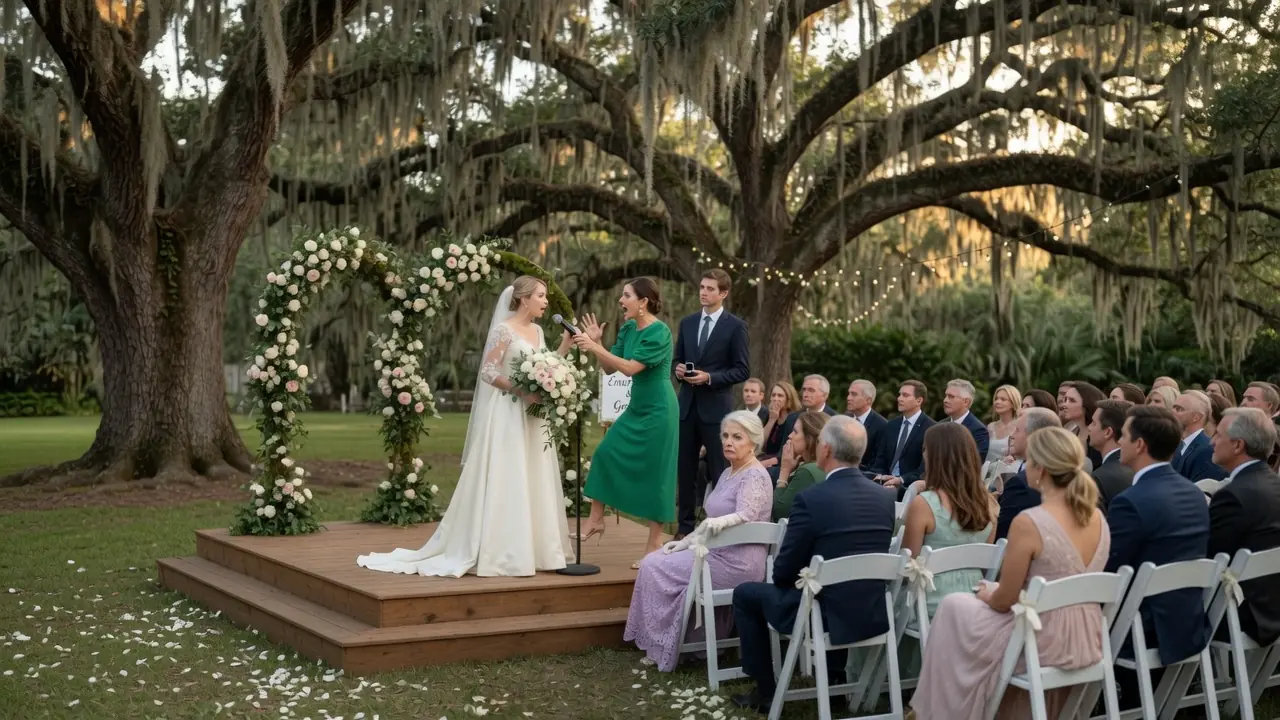
The guests rose. We were about to raise a toast to the rest of our lives. Then Kimberly stormed the stage. She didn’t sidle up or wait for a lull. She cut through the crowd like a blade through silk. Her blush pink bridesmaid dress caught the candlelight as if the flames themselves were bending toward her.
She snatched the microphone clean out of the MC’s hand. He blinked at his empty fingers like a man who’d just been pickpocketed, and turned to the crowd with that sugar-glazed smile she’d been perfecting since girlhood. “Emery loves me more than anything in the world, so I’m sure she won’t mind if I borrow her stage for just a second for this special moment, right?” Before the last syllable left her lips, her boyfriend stepped out from behind the lattice archway and dropped to one knee on the red brick aisle.
My aisle. The one I had walked down 40 minutes earlier, my father’s arm threaded through mine. My heart so full I thought it might crack my sternum. Thunderous applause. The crowd surged to its feet, the same crowd that had been clapping for me moments before, and suddenly every phone was out, every camera angled toward Kimberly’s tearful practiced gasp of surprise.
The string quartet, bless their confused souls, launched into a tentative rendition of something romantic, unsure whose moment they were scoring anymore. I stood there, rooted. My bouquet still clutched in one hand, the ribbon cutting into my palm. Beside me, George’s grip on my other hand tightened until his knuckles blanched white.
I could see the vein in his temple pulsing, his jaw locked so hard the muscles twitched. He shifted his weight half a step toward the microphone, and I knew he was about to say something that would split this evening down the middle, but the reflex was faster than my rage. 30 years of keeping the peace had been baked so deep into my nervous system that my body moved before my pride could catch up.
I caught his arm, shook my head. A tiny, pathetic gesture, just enough to save the family’s face while my own crumbled behind my smile. The worst part wasn’t the applause. It was my mother. Lorraine stood in the third row, her dove-gray dress pressed to perfection, and she was smiling.
Not the tight, polite smile she wore for acquaintances. This was satisfaction, pure, undiluted, radiating from her like heat off summer asphalt. When my eyes found hers, brimming with a hurt so sharp it tasted metallic, she simply gave me a calm, dismissive shake of the head, so subtle that only I could read it. The look she had always reserved exclusively for me.
“Don’t you dare make a scene.” I should have seen it coming. A month before the wedding, Kimberly and I had been in my mother’s living room. Kim was curled on the sofa, twirling a lock of hair around one manicured finger, chattering about how she needed a fitting space for a proposal, and wouldn’t my venue be just perfect?
I’d set my tea down carefully, the porcelain clicking against the saucer, and begged her, just begged, “Please, Kim, just let me have my one day.” She shrugged, a gesture so casual it bordered on cruelty. And my mother, without lifting her gaze from the magazine in her lap, said, “If you embarrass your sister, I am walking out of that ceremony immediately.”
I was wrong. Standing on that stage, the applause still echoing for someone else’s love story, the memories unspooled like film from a broken reel. My 15th birthday, the cake had barely been cut before Mom clinked her glass and pivoted the entire party into a celebration of Kimberly’s first pageant win.
My college graduation dinner, I was mid-sentence thanking my parents for their support when Lorraine interrupted to announce Kimberly’s art scholarship. And suddenly, every raised glass was aimed in my sister’s direction. It wasn’t carelessness. It wasn’t coincidence. It was architecture.
I swallowed my tears that night. Smiled for the photographer. Let George lead me to our first dance while Kimberly’s ring caught the light from across the room like a small triumphant star. But beneath the silk of my wedding dress, something shifted. A door I’d kept locked for 30 years cracked open, and what stepped through wasn’t grief. It was clarity.
That was the last time I would ever let them turn me into a ghost at my own celebration. The very last time I would rearrange myself into something small and quiet so Kimberly could take up all the air in the room. I didn’t know yet what the plan would look like. All I knew, standing on that stage with confetti meant for someone else drifting into my hair, was that the woman who had spent her entire life keeping the peace had just declared a silent, private war.
The sun had barely begun to burn through the coastal fog the following morning when I sat at the kitchen island in the rental cottage George and I had booked for our honeymoon weekend, a modest little bungalow on Tybee Island with salt-crusted windows and a ceiling fan that ticked like a tired metronome. The coffee in my mug had gone cold. I had not taken a sip.
My phone lay face up on the counter, the screen bright with a text I had sent to my mother at 6:00 a.m. when the sky was still bruised purple and George was still asleep beside me. His arm draped across the empty space where my peace of mind used to be. “Mom, why did you let Kim do that? That was my wedding.”
Simple, direct, the kind of message I had spent 32 years learning not to send. Lorraine did not reply until nearly noon. I watched the minutes bleed past on the microwave clock, each one tightening the wire between my shoulder blades another quarter turn. When the notification finally chimed, I grabbed the phone so fast I nearly knocked the mug off the counter.
No apology, not even a pause that might have suggested she had considered one. “You’re being too sensitive, Emery. Being the older sister means making sacrifices. Are you really so selfish that you’re jealous of your sister’s happiness?” I read it three times.
Each pass stripped something away, first the shock, then the hurt, then the last brittle membrane of hope that maybe she would see what she had done. What was left underneath was something clean and cold, like bone exposed to air. George’s footsteps creaked on the hardwood behind me.
He was still in his undershirt and pajama pants, his hair flattened on one side, and he reached past me for my coffee mug the way he always did, stealing my cup instead of pouring his own. A small domestic theft I had loved since our first apartment, but halfway through the reach, he stopped. He had seen my face.
I turned the phone toward him without a word. He read it. His jaw tightened, not the explosive clench from the wedding stage, but something slower, more deliberate, like a man carefully setting down something heavy before it broke. He placed the mug back on the counter and leaned against the edge, arms folded, eyes fixed on the floor.
For a long time, he did not speak. The ceiling fan ticked. A pelican screamed somewhere over the dunes. “I’ve seen this favoritism since the day we started dating,” he said finally. His voice was low and even. “I stayed quiet out of respect for you because it was your family, and I figured you’d tell me when you were ready to deal with it.”
He looked up. “But they are eating you alive, Emery. And I’ve been standing here watching it happen like it’s none of my business, and it is my business because you are my business.” The sentence cracked something open in my chest.
It was the weariness of a man who had swallowed someone else’s poison for years to spare the woman he loved. I realized, sitting in that salt-aired kitchen, that I was not just letting my family diminish me. I was forcing the man I loved to stand in the blast radius and pretend the shrapnel was not hitting him, too.
Once the honeymoon was over, I drove to BB Cafe to meet Sterling. He had been my best friend since our freshman orientation at Georgia Tech, where we had bonded over a mutual contempt for group icebreakers. He had since become a litigation attorney, the kind who could dismantle a witness with three quiet questions and a raised eyebrow, and even in a coffee shop, that clinical precision never left him.
We ordered two espressos out of old habit, and I told him everything that had happened before and after the wedding, the text, the birthday, the graduation. Every stolen moment was laid out like evidence in a case I had not known I was building. Sterling listened without interrupting.
When I finished, he pulled a yellow legal pad from his bag and started writing. Not notes, a diagram. He drew a horizontal line across the center of the page and began plotting points along it. Dates, events, names. My 15th birthday on the left, the graduation dinner in the middle, the wedding on the far right.
Above each point, he wrote what was taken. Below each, he noted who had enabled it. He turned the pad toward me. “This isn’t a pattern of favoritism, Emery. This is systematic attention hijacking. Every milestone you’ve ever had has been intercepted, and every time the same person authorized it.”
He tapped the name written below every single entry. Lorraine. “This isn’t motherly love. This is control, and you’ve been a willing participant for 30 years.” The word “willing” stung. He meant it, too.
“So, what do I do?” “You stop being willing.” That weekend, Grandma Margaret came to visit. She arrived the way she always did, without announcement, in her pearl gray Cadillac, with a tin of homemade pralines on the passenger seat and an expression that suggested she had already decided how this conversation would go before she turned the key in the ignition.
Margaret Hamilton was 81 years old and the true matriarch of our family in every sense that mattered. She’d built a real estate business from a folding table in her garage, buried a husband she adored without shedding a public tear, and raised four children with a philosophy that could be summarized in five words: Stand up or step aside.
She did not bother with small talk. We sat on my back porch, the late afternoon light turning the Spanish moss into gold thread, and she fixed me with a gaze that could have drilled through granite. “I’ve watched this play out for years, Emery. Your mother handing everything to Kimberly like she’s settling a debt only she understands. I stayed quiet because I thought eventually you’d stand up for yourself.”
She paused, her thin fingers wrapped around her teacup. “But you’re too kind. And I know you’ve been pushed past your breaking point. So, I’m going to ask you once, are you ready to stop being the family doormat, or do you need me to keep watching you lie down?” “I’m ready,” I said.
She nodded once as if I had simply confirmed something she already knew. That night, I opened my laptop and created a new folder in my cloud storage. I typed two words and hit enter: Project Liberty.
I started with the texts. Every message from my mother, the guilt trips, the deflections, the casual cruelties, then the emails. Then I called the wedding venue and, after a polite but persistent conversation with the events manager, requested a copy of the security camera footage from the reception.
I bought a call recording app and tucked it into a folder on my phone labeled “utilities.” I was not building a case for a courtroom. I was building a case for a reckoning. Sterling had given me the framework. Margaret had given me the permission. George had given me the reason.
But the decision, the quiet, irreversible turning of a key in a lock that was mine. Patience, the very trait my family had exploited to keep me compliant, could be sharpened into something they would never see coming.
The seasons shifted and 10 months after the wedding, a pregnancy test sat on the bathroom counter between my toothbrush and a bottle of moisturizer, as ordinary as a grocery receipt, as loud as a siren. Two pink lines. I stared at them until my vision swam, gripping the edge of the vanity with both hands.
I picked it up and walked downstairs. George was at the kitchen table, a spreadsheet glowing on his screen. He was mid-sip of his morning coffee when I set the test down next to his keyboard without a word. He looked at it, then at me, then back at it. “Emery.”
“Eight weeks,” I said. He stood, crossed the distance between us in two steps, and wrapped his arms around me so tightly that my feet nearly left the floor. I felt the wetness before I heard it, a shuddering, full-bodied exhale.
George was crying into the crown of my head with the uncomplicated joy of a man who had just been handed a reason to believe the future could be different. “This is our fresh start,” he said. “Ours. Nobody else’s.” I held him there in the kitchen, and for a few perfect minutes, the world shrank to a radius of two soon-to-be three.
No mother, no sister, no stolen stages, just us. We decided to share the news at the family dinner that weekend. In hindsight, I should have known better. But some part of me, the part that still believed in the possibility of a mother’s joy, wanted to give Lorraine one last chance, a final unspoken test.
If she reacted with warmth, then maybe the war could be called off. The dinner was at my parents’ house, the same split-level ranch where I had grown up. The dining room smelled of the slow-smoked beef brisket Lorraine had prepared, mingling with the sting of furniture polish.
Kimberly was already seated, her engagement ring catching the overhead light every time she lifted her fork. Her wedding was 6 weeks away. The entire household had been orbiting that event like planets around a sun. I waited until the plates were cleared and the conversation had settled.
George reached under the table and squeezed my knee. “I have some news,” I said. “George and I are expecting.” The silence that followed was not the joyful kind. It was the silence of a room recalculating.
My father looked up and smiled a real, reflexive smile. He stood up quickly. “I’ve got a little something,” he said. “I made it myself last year after watching some YouTube tutorial. I’ve been waiting for a reason to give it to my grandchild. Hang on, I’ll be right back.”
With that, he maneuvered around the dining chairs and headed straight for the stairs. My mother’s face did the freeze and redirect. Her features went momentarily blank and then rearranged themselves into something that resembled concern, but was actually arithmetic.
I could practically see the mental math scrolling behind her eyes. Due dates, timelines, how far along I would be on the day that mattered. “That’s nice,” she said. The word “nice” arrived with all the warmth of a form letter.
“But you absolutely cannot announce this now. Kimberly’s wedding is right around the corner. You know how sensitive your sister is.” She paused, and I watched the knife come out before she even opened her mouth again.
“On the wedding day, make sure you wear something baggy, or maybe a blazer. You’ll only be 4 months along then, and you’re thin enough that you won’t show if you don’t wear anything form-fitting.” She delivered this the way she delivered all her cruelest instructions, wrapped in the language of practical advice, her tone suggesting she was doing me a favor by thinking it through.
“Don’t let the guests get distracted by your stomach.” Your stomach, not your baby, not your child, not the first grandchild she would ever hold, your stomach. As if the life inside me were a wardrobe malfunction to be concealed with the right blazer.
Kimberly, seated beside her, stroked a lock of hair behind her ear with a polished proprietary calm. She tilted her head that same feline angle she used when she wanted something to sound sweet while the claws were out. “You wouldn’t want to steal my spotlight, right, sis? You know how long I’ve waited for this day.”
I looked at them, mother and daughter, mirror images of entitlement framed in the warm light of a dining room I’d spent my childhood tiptoeing through. The absurdity had finally, mercifully, reached its peak.
They weren’t just asking me to dim myself anymore. They were asking me to hide my own child, to compress the biggest, most luminous thing that had ever happened to me into something invisible. Something that fit neatly beneath a blazer so Kimberly could occupy every square inch of the room without obstruction.
And in that moment, the last flicker of the test I’d been running, the final chance I’d offered without them knowing, guttered out like a candle in a draft. I smiled. Not the old smile. Not the peacekeeper’s reflex, the tight-lipped downcast surrender they’d trained into me like a dog learns to heel.
This smile was something new, cold, sharp, and luminous with a certainty that must have unsettled them because Kimberly’s fingers paused mid-stroke in her hair, and my mother’s eyes narrowed a fraction. “Of course,” I said, my voice smooth as riverstone. “I’ll keep that in mind.”
Back home that night, I waited for George to drift off before opening my laptop. I added a supplement to Project Liberty, the keys clicking softly in the dark. Entry: Demand to conceal pregnancy. Instruction: Wear baggy clothing to hide existence of first grandchild. Reason: To avoid distracting from Kimberly’s wedding. Witness: George Grant.
When Grandma Margaret heard about the baggy dress demand the next morning, the silence on the other end of the line lasted exactly 4 seconds. Then I heard the sharp percussive crack of her palm slamming flat against a surface. “You have every right to celebrate, Emery. Every right. No one, not even Lorraine, has the right to turn my great-grandchild into a shameful secret. Do you hear me? Not a secret. Not an inconvenience.”
That evening, George found me in the nursery, the spare room we had started clearing out. He leaned in the doorway. “This time,” he said quietly, “you don’t have to take it. Do what you have to do.” I looked down at a tiny folded onesie, then back at him.
I closed the laptop and pressed my palm flat against my belly. Still secret. Still mine. Six weeks until Kimberly’s wedding. The countdown had begun.
The Magnolia Grand Hotel sat on the Savannah riverfront like a wedding cake someone had carved out of limestone and good intentions. Paper lanterns hung from the live oaks lining the promenade, their warm glow doubling on the dark water below. A jazz trio played something slow and amber-toned from the corner of the terrace, the trumpet curling through the humid evening air like smoke from a cigarette nobody wanted to put out.
Magnolia blossoms floated in crystal bowls on every table, their scent so thick and sweet it clung to the back of your throat. Everything was perfect. Everything was staged. Kimberly’s wedding.
I arrived in the blazer. It was camel-colored, structured, expensive. A deliberate concession that I’d selected with the precision of a chess player sacrificing a pawn. Beneath it, I wore a fitted ivory dress that no one would see until the moment I wanted them to.
My mother had inspected me at the entrance, her gaze traveling from my collar to my hemline with the efficiency of a customs officer. She lingered on my midsection. The blazer did its job. She gave a small, satisfied nod, the kind you give a dog that has finally learned to sit, and turned back to adjusting the centerpiece on the head table.
Lorraine was running this reception the way a field general runs a campaign. She’d been up since dawn, I was told, repositioning chairs, terrorizing the florist, and making the catering manager repeat the timeline of toasts back to her three times. Every detail calibrated to ensure the spotlight hit Kimberly and Kimberly alone.
She moved through the venue with a clipboard she didn’t actually need. Her real authority carried in the set of her shoulders and the way the staff parted for her like water around the prow of a ship. But she wasn’t the only one working the room.
Grandma Margaret had arrived an hour before the ceremony. I watched her from across the terrace as she made her rounds table by table, handshake by handshake, leaning on her cane with one hand and patting forearms with the other. To anyone watching, she was simply a beloved matriarch making her greetings, but I knew the script.
She’d been planting seeds all afternoon, her voice carrying just enough warmth to disguise the intent beneath. “Family joy should always be shared, don’t you think?” “The truest sign of good breeding is how you celebrate someone else’s happiness.” “I’ve always believed that real etiquette means making room at the table, not shrinking someone else’s plate.”
She wasn’t preparing a court of public opinion. She was seating one. The ceremony went off without a hitch. Kimberly was radiant, floating down the aisle in a gown that probably cost more than $5,000, her smile wide and practiced. Her groom waited at the altar with the slightly dazed expression of a man who had not fully grasped what he had signed up for.
Lorraine wept on cue. The guests applauded. I sat in the second row, hands folded in my lap, the blazer buttoned. Then came the toasts. The best man went first, a rambling, good-natured speech full of college football anecdotes that made the groom’s side roar with laughter.
Then the maid of honor, one of Kimberly’s boutique colleagues, delivered a polished tribute that name-dropped three luxury brands and used the word “iconic” four times. The crowd clapped politely. Then I was invited up.
I felt my mother’s eyes on me before I reached the podium. She had positioned herself at the base of the short staircase, her body angled just enough to block an easy exit, her gaze locked on mine with an intensity that carried a single, unmistakable instruction. Praise your sister. Stay in your lane. Do not improvise.
I climbed the steps, took the microphone from the stand. The ballroom stretched before me, 200 guests arranged in concentric arcs of white linen and candlelight, their faces turned upward, expectant, politely attentive in the way people are when they’re already thinking about the dessert course.
I found Kimberly at the head table. She was glowing, her chin tilted at that angle she used when she knew she was being admired. I smiled at her, a real, radiant, full-wattage smile that made her sit up a little straighter with satisfaction. “Kim,” I said, my voice warm and projected, the microphone carrying it to every corner of the room.
“You’ve always taught me that joy is better when it’s shared, haven’t you?” A ripple of approving murmurs. Kimberly nodded, her smile widening, basking in what she assumed was the opening line of her tribute. She had no idea.
“So today, in the spirit of your wonderful philosophy,” I paused. Let the silence build for exactly one beat, the way Sterling had coached me during a phone call two nights earlier. “George and I wanted to give you the ultimate wedding gift.”
I unbuttoned the blazer, let it fall open, placed one hand firmly, unmistakably, on the gentle curve of my belly. “I’m going to be a mother. Congratulations, Kim, you’re officially an aunt.”
The ballroom didn’t go quiet. It detonated. A wave of gasps through a wheat field. Silverware clattered against China. Someone’s champagne flute hit the tablecloth with a muffled thud. Aunt Pauline let out a shriek that could have shattered the crystal bowls.
Three of my older cousins leapt to their feet, hands over their mouths. And from the back of the room, carried on decades of impeccable southern propriety, came the most devastating sound in the Georgia lexicon, a chorus of older aunts delivering a slow, pointed, utterly annihilating “bless her heart.”
Every eye shifted. Every congratulation redirected. The gravitational center of the room, the thing Lorraine had spent months engineering, calibrating, defending lurched sideways and settled squarely on me.
I signaled George. He rose from our table, crossed the dance floor with that steady, unhurried stride I loved, and climbed the steps to stand beside me. He took my hand, and for the first time in the entire history of this family, we were the center of the universe. Not by accident. Not by permission. By design.
At the head table, Kimberly sat frozen. Her smile hadn’t disappeared. It had calcified, cracking at the edges like dried plaster. Her eyes darted between me and the crowd with the bewildered fury of someone who has just realized the rules she invented have been used against her.
Lorraine moved. I saw it in my peripheral vision. A sharp forward lunge toward the stage. Her face flushed. Her composure finally, beautifully fractured. But she made it exactly two steps before a pearl-gray cane swung into her path like a railroad crossing gate.
Grandma Margaret didn’t say a word. She didn’t need to. She simply stood there, blocking the aisle with her 81-year-old frame, and fixed her daughter-in-law with a look so lethally calm that Lorraine actually stepped backward. Lorraine stopped. Her mouth opened then closed.
For the first time in my life, I watched my mother search for words and come up empty. I looked down at them from the podium, my mother and my sister, standing in the shadows they had kept me in for three decades, and gave them a slight knowing nod, not cruel, not gloating, just a quiet acknowledgement that the architecture of this family had been redesigned and they were no longer the ones holding the blueprints.
The jazz trio, bless them, started playing again, something bright and celebratory, a tune that swelled through the magnolia-scented air as if the evening itself had decided whose side it was on. For the first time in her life, my mother had lost control of the room and I hadn’t raised my voice once.
The private lounge off the hotel’s east wing smelled like old leather and dying gardenias. Someone had left a vase of them on the credenza, their petals curling brown at the edges, and the sweetness had turned sour in the closed air, thick, cloying. A scent that couldn’t decide whether it was beautiful or rotting.
It seemed fitting. The guests had cleared out 20 minutes ago, shepherded toward the valet stand by the groom’s family with the efficient politeness of people who could feel a storm building and wanted no part of it. What remained was the Hamilton inner circle, aunts, uncles, a handful of cousins who’d earned their seats through decades of proximity to the family’s private theater.
They lined the couches and armchairs like a jury that hadn’t yet decided its verdict and at the center of it all, still in her wedding gown, mascara tracking faint gray lines down her cheeks, stood Kimberly. My mother fired first.
“You are a saboteur.” Lorraine’s voice came out high and cracked, stripped of every layer of composure she’d spent a lifetime lacquering into place. She stood in the middle of the room, her dove-gray dress wrinkled at the hip where she’d been gripping it, her finger leveled at me like a weapon.
“A selfish, cruel, ungrateful saboteur. I gave you everything. I held this family together for 30 years, and this is how you repay me by humiliating your sister on the most important day of her life?” Kimberly followed on cue.
The tears arrived with practiced precision, her chin trembling, her hands pressed to her chest, her voice a wounded whisper designed to make every person in the room want to wrap her in a blanket and bring her cocoa. “I can’t believe you’d do this to me, Emery. I’ve never done anything to hurt you. All I’ve ever wanted was for us to be close.”
For 32 years, that performance would have worked. The tears, the trembling, the wide eyes, it was a language I’d been trained since childhood to respond to with immediate capitulation. Apologize, absorb, smooth it over, let the peace settle back into its familiar, suffocating shape.
But that woman didn’t live here anymore. I looked Lorraine dead in the eye before scanning the faces lingering in the room. “You call me a saboteur?” I laughed, a dry, mirthless sound that didn’t reach my eyes.
“No, sabotage is an impulse. What I did tonight, this was a reckoning.” I took a step forward, the click of my heels against the hardwood sounding like the countdown to a sentence.
“You and Kim love to talk about family loyalty. So let’s talk about everyone’s loyalty here.” I turned toward Aunt Pauline and Uncle Henry. “Aunt Pauline, do you remember my 15th birthday? When Mother told me to set aside my cake so Kim could announce her homecoming queen title?”
“Uncle Henry, do you remember my graduation? When Mother cut me off mid thank-you speech to brag about Kim’s art scholarship?” The room fell into a deathly silence.
I watched Aunt Pauline stare uncomfortably into her empty cocktail glass. “I don’t need physical evidence because everyone in this room is a witness,” I said, my voice low but carrying every syllable.
“You’ve all been watching this play for 30 years. You saw Kim snatch the microphone from me at my own wedding last year, and you all clapped. Why? Because mother trained you to believe that my happiness is the price of Kim’s smile.”
I turned back to Lorraine. She was trembling, not with fear, but because control was slipping through her fingers. “And here is the final blow,” I said, my eyes narrowing.
“You told me to wear baggy clothes to hide my child. You told me the existence of this little one was a distraction from Kim’s big day. You wanted to turn your own grandchild into a shameful secret just to keep the spotlight on your golden girl.”
A wave of horrified murmurs broke out. This was no longer just sibling rivalry. This was cruelty toward an unborn child, an unforgivable sin in the Hamilton code.
My father, a man who had always traded his silence for peace, suddenly stood. His face was flushed crimson. He looked at his wife. “Lorraine,” his voice was quiet and raw, sandpaper dragged across old wood.
“I kept my mouth shut for the sake of peace. I told myself it was just your way, that the girls would work it out, that it wasn’t my place.” He swallowed hard, his Adam’s apple bobbing.
“But when you tried to force our daughter to hide my grandchild, to treat that baby like something shameful, you went too far. I won’t let you ruin this child the way you ruined Emery.”
The word “ruined” landed in the room like a stone in still water. Lorraine flinched, actually, physically flinched, as if he’d struck her. I understood, watching him, that this wasn’t a father standing up for his daughter, not exactly.
This was a man acting on the animal instinct to protect his legacy, his bloodline, the grandchild who represented a future he could still shape. It wasn’t the heroism I’d spent a lifetime wishing for, but it was enough.
Enough to crack the last remaining wall Lorraine had left to hide behind. Grandma Margaret rose next. She didn’t need to raise her voice. She never did.
“I’ve made a decision,” she addressed the room, but her eyes were fixed on Kimberly. “Tomorrow morning, I’m meeting with my attorney to revise my will. Kimberly, your portion is being removed.”
A gasp from somewhere near the window. Margaret continued without pause, her voice carrying the absolute unhurried authority of a woman who had earned every syllable.
“That money will be placed in a trust for my first great-grandchild, Emery’s child. Someone as self-centered as you, Kimberly, doesn’t deserve my legacy. Legacy is for people who understand that family means more than a mirror.”
Kimberly’s composure didn’t crack. It shattered. The elegant bride, the golden child, the protected one, the girl who had never once been told no by the only people whose opinion she valued, dropped every mask at once.
Her face contorted. A scream tore out of her, raw and jagged, nothing like the polished sobs she’d been performing minutes earlier. She spun on her new husband, who had been standing near the door with the stunned expression of a man watching a building collapse, and snapped at him when he reached for her arm, a vicious, cornered sound that made him withdraw his hand as if he’d touched a hot stove.
Mercifully, his family had already departed. The audience for her unraveling was limited to the people who had helped create her. My mother sank into the nearest chair, not dramatically, not the way she’d have done it if she thought anyone was watching with sympathy.
She just folded. Her spine curved, her shoulders dropped, and for the first time in my life, I saw Lorraine Hamilton look small. She had lost the room, lost her husband’s silence, lost the inheritance she’d been banking on for her favorite child, and somewhere in the wreckage, I think she was beginning to understand, though she’d never admit it, that the architecture of control she’d spent three decades building had been demolished with her own materials.
I looked at both of them. My mother in her chair, diminished. My sister in her white gown, unraveled. The room bearing witness. “I’m just playing by the rules you two taught me,” my voice was steady. My hands were still.
George appeared at my side. I hadn’t seen him move, but he was there the way he was always there, quietly, at exactly the right moment, and placed his hand on the small of my back. I turned toward the door.
Behind me, the empire of silence was in ruins, and the scent of dying gardenias followed us out into the night air, where the river moved dark and steady beneath the lanterns, carrying everything downstream that no longer had the weight to hold its ground.
The week after Kimberly’s wedding, George and I sat at our kitchen table, the same table where we had first shared the news of the baby, and drafted formal lines as a strict no-contact policy, no phone calls, no drop-ins, no reconciliation lunches brokered by well-meaning cousins.
Lorraine and Kimberly were severed cleanly, the way one cuts a thread that has been slowly strangling them. “I’ve been waiting years for this,” he said. Not with triumph, but with the quiet relief of a man who could finally set down a heavy weight.
The consequences arrived for Kimberly like weather, slowly at first, then all at once. The relatives pulled back. Invitations stopped coming. Group texts went quiet. At a cousin’s baby shower 3 weeks later, I was told Kimberly walked in and the room rearranged itself around her, conversations thinning, chairs angling subtly away.
Her new husband was beginning to understand the architecture he had married into. Friends reported he had grown quiet and distant, arriving at work with the hollowed look of a man replaying a decision he could not undo.
And my mother. Lorraine called incessantly from her own phone at first, then from numbers I did not recognize. I suspect she even used a prepaid phone from a drugstore because the desperation was unmistakable.
She never left voicemails. I knew exactly what she would say, some cocktail of guilt and revision. I never picked up, not once. A month after the world shifted, Grandma Margaret came by on a Tuesday afternoon.
She arrived without fanfare, carrying a leather-bound photo album. We sat on the porch together, and she placed it in my lap. Inside were photographs I had never seen, me as a toddler, standing in a garden with my arms outstretched.
And then, a few pages later, both of us, Emery and Kimberly, two small girls in matching sundresses, laughing on a porch swing. We were holding on to each other as if the other one was the only solid thing in the world.
I stared at that photograph for a long time. “Do you think those girls could ever exist again?” I asked. Margaret was quiet for a moment. The porch swing creaked beneath us.
“Maybe,” she said, “but that’s a question for a very distant future, and it’s not yours to answer alone.” I closed the album and held it against my chest.
She was right. Maybe those girls were gone, or maybe they were just sleeping somewhere beneath the scar tissue. For now, I was living for my own family. For George, for the baby, and for Grandma Margaret, who had taught me that love without backbone is just another word for surrender.
That afternoon, after Margaret had left and the street was quiet, I sat alone on the porch. The oak shadow stretched long across the sidewalk. Somewhere down the block, a neighbor’s sprinkler ticked in lazy arcs.
My phone buzzed on the armrest. I glanced at the screen, unknown number, local area code. I knew who it was. Without a second of hesitation, without the old flinch or the old reflex to pick up, I pressed decline.
I turned the phone face down on the table and left my hand resting on my belly, where a new heartbeat was learning its rhythm. The quiet was finally mine. Not a silence imposed, but a stillness I had chosen, vast, warm, and unmistakably free.