The wedding dress did not belong to her. It had belonged to her mother once, then to a cousin who had married well, then to another cousin who had not, and now it hung on Cecilia Wentworth’s thin frame like a ghost refusing to leave. The lace was yellowed at the edges. The seams had been let out twice, and the veil, pinned too tightly to her hair, pulled at her scalp with every breath she took. “Hold still,” the maid muttered, tugging at the fabric. “You’ll tear it.”
Cecilia did not respond. She was looking at her reflection in the mirror, but she was not seeing herself. She was seeing a stranger, a woman dressed for sacrifice, her face pale, her hands steady only because she had learned long ago that trembling changed nothing. Three weeks earlier, her father had called her into his study. He had not offered her a seat. He had not even looked at her when he spoke.
“The Duke of Ashworth has agreed to clear my debts,” he said, shuffling papers on his desk. “In exchange, you will marry him. The ceremony is in three weeks.” Cecilia had stood there frozen, waiting for more. An apology, an explanation, even a lie dressed as justification. But Theodore Wentworth was not a man who explained himself to women.
“Father,” she had finally managed. “I’ve never even met him.” “You’ll meet him at the altar. He’s forty-six years old. He’s a duke.” Her father had looked up then, and his eyes held nothing. No guilt, no regret, not even the decency of discomfort. “You should be grateful. Women in your position don’t often marry so well.”
“Women in your position,” as though she were damaged goods, as though being his daughter was something to overcome. “And if I refuse,” the words had escaped before she could stop them. Her father had smiled, a cold, thin expression that never reached his eyes. “Then I will be ruined. Your brother will lose his commission, and you will be thrown into the street without a penny or a reference.” He had waved his hand toward the door. “The choice, as you see, is entirely yours.”
Now, standing before the mirror, Cecilia thought of all the things she might have said. She might have begged. She might have screamed. She might have asked her father if he had ever loved her, even once. But she had done none of those things, because she already knew the answer. Love was a luxury the Wentworths could not afford, and apparently so was dignity.
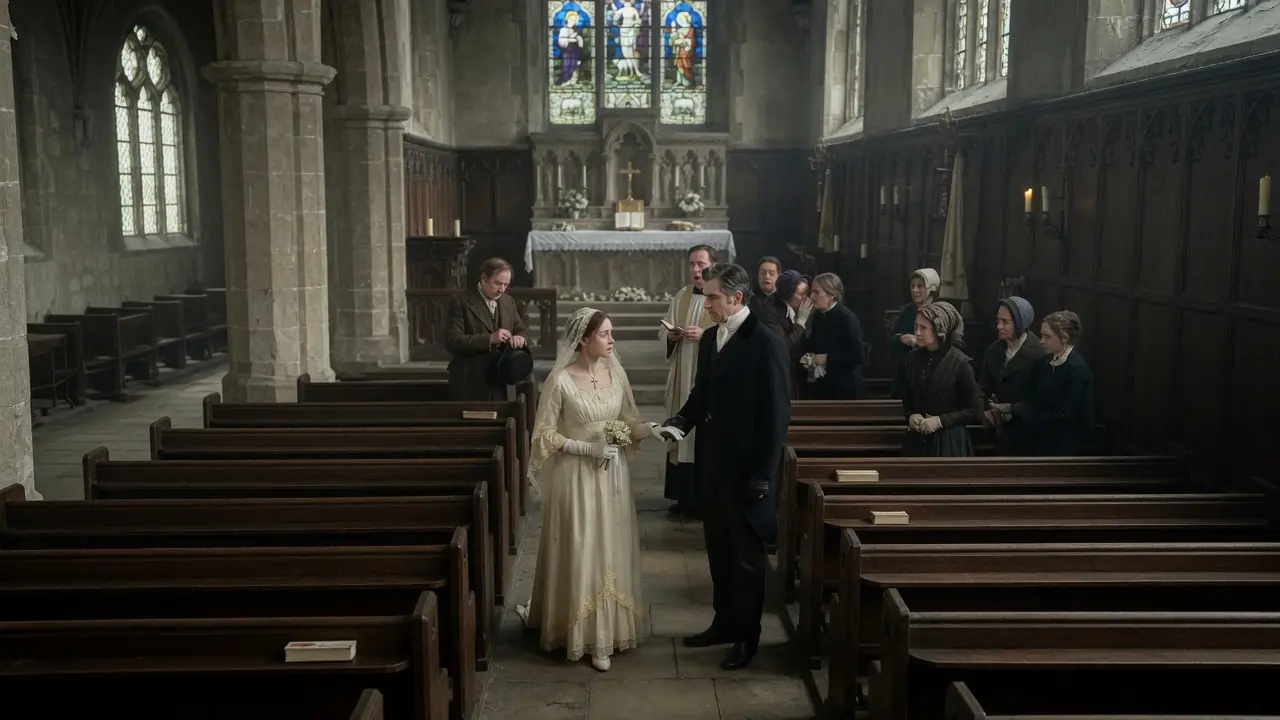
The church was nearly empty when she arrived. A few distant relatives sat in the back pews, whispering among themselves. Her father stood near the altar, looking impatient, checking his pocket watch, as though the ceremony were an inconvenience delaying his afternoon brandy. And there, at the end of the aisle, stood the man who would become her husband.
Marcus Ashworth, Duke of Ashworth, was not what she had expected. The rumors had painted him as ancient, decrepit, a walking corpse with one foot in the grave. But the man before her was none of those things. He was tall, broad-shouldered, his dark hair streaked with silver at the temples. His face was hard, angular, carved by years she could not imagine, and his eyes, God, his eyes, were the color of a winter storm, so dark they seemed almost black in the dim light of the church.
He did not smile when he saw her. He did not frown. He simply watched her approach with an intensity that made her want to look away. But she did not. She kept her chin raised and her steps measured because if this was to be her end, she would meet it with whatever grace she had left. The ceremony was brief. The priest spoke words she barely heard. Marcus said his vows in a voice like gravel over stone, low, controlled, utterly without emotion.
When it was her turn, Cecilia’s voice did not waver. She had practiced this. She had practiced being empty. He slid the ring onto her finger, and she noticed his hands. They were not the hands of an idle aristocrat. They were calloused, scarred, the hands of a man who had worked, who had suffered, who had stories he would never tell. “You may kiss the bride,” the priest said. Marcus leaned forward. His lips brushed her forehead, not her mouth, not even her cheek, and the touch was so brief, so impersonal that it was over before she could react.
But in that fraction of a second, she felt something. A tremor in his hand as it touched her arm, a hesitation that was gone as quickly as it came. Then he stepped back, offered her his arm, and they walked out of the church together. The carriage ride to Yorkshire took seven hours. Marcus sat across from her, his gaze fixed on the window, his body utterly still. He did not attempt conversation. He did not ask if she was comfortable, if she was hungry, if she was afraid. He simply sat there, a monument of silence, while the world outside changed from London gray to countryside green.
Cecilia watched him without watching. She studied the line of his jaw, the tension in his shoulders, the way his fingers rested on his knee, not clenched, but not relaxed either. He was a man holding something in. She could see it in every rigid line of his body. Twice she opened her mouth to speak. Twice she closed it again. What was there to say? They were strangers bound by contract, not choice.
Small talk would only emphasize how little they knew each other. But three hours into the journey, he surprised her. “You’re cold,” he said quietly, not looking at her. Cecilia blinked. She hadn’t realized she was shivering. “I’m fine.” Marcus removed his coat without another word and held it out to her. When she hesitated, something flickered in his eyes. “Impatience, perhaps, or frustration. Take it,” he said. “You’ll make yourself ill.”
When Thornwood Hall finally emerged from the mist, Cecilia’s breath caught. The estate was enormous, a sprawling mansion of dark stone and ivy, surrounded by gardens that had long since gone wild. It looked like something from a Gothic novel, the kind her mother used to read to her before she died. Beautiful, haunted, forgotten. “Welcome home,” Marcus said quietly. They were the first words he had spoken in hours.
Cecilia did not answer. She stepped out of the carriage and looked up at the house that would now be her prison. The windows stared back at her, empty and dark, and she thought, “This is where I will spend the rest of my life.” She followed Marcus inside through corridors lined with portraits of people she did not know, past doors that led to rooms she could not imagine. The servants watched her pass with expressions she could not read, curiosity perhaps, or pity. She wondered which was worse.
Finally, they stopped before a set of double doors. Marcus pushed them open and stepped aside. “These are your chambers,” he said. “The Duchess’s quarters. They have not been used in some time, but the staff has prepared them for you.” Cecilia entered slowly. The room was beautiful. High ceilings, silk curtains, a massive four-poster bed draped in velvet, but there was dust in the corners, cobwebs in the chandelier. The air smelled of roses and decay, as though someone had tried to mask years of neglect with fresh flowers.
“It’s lovely,” she said, because she did not know what else to say. Marcus nodded once. “Dinner is at eight. You may rest until then.” He turned to leave, then paused at the door. His back was still to her when he spoke again. “If you need anything, anything at all, ring for Mrs. Blackwood. She will see to your comfort.” There was something in his voice, something that sounded almost like concern. But before Cecilia could respond, he was gone, and she was alone.
She sat on the edge of the bed and stared at the closed door for a long time. Outside, the sun was setting, painting the sky in shades of blood and gold. Inside, the shadows were growing longer, creeping across the floor like fingers reaching for her. “This is my life now,” she thought. This empty room, this silent house, this stranger who calls himself my husband. She did not cry. She had promised herself she would not cry, but when the darkness finally swallowed the last of the light, she lay down on the bed, still wearing his coat, and closed her eyes. She wondered if she would ever feel warm again.
The maids came for her at nightfall. They dressed her in a nightgown of white silk, brushed her hair until it shone, and dabbed perfume behind her ears. Their hands were gentle, but their eyes were sad, and Cecilia understood exactly what was happening. They were preparing her for slaughter. The youngest maid, a girl who couldn’t have been more than sixteen, squeezed her hand before leaving. “Good luck, Your Grace,” she whispered. And then they were all gone, and the door clicked shut, and Cecilia was alone with the silence and the candlelight, and the terrible weight of expectation.
She sat on the edge of the bed and waited. Her heart was beating so hard she could feel it in her throat, in her fingertips, in the soles of her feet. She had heard stories about wedding nights, whispered warnings from married women, half-truths and innuendo that had left her more confused than informed. All she knew for certain was that it would hurt and that she was supposed to endure it in silence. The clock on the mantel ticked away the minutes. Nine o’clock. Ten. Eleven. And still Marcus did not come.
By midnight, Cecilia had convinced herself that he had forgotten about her. Or perhaps he had simply changed his mind. Perhaps he had looked at her more closely and realized that she was too young, too plain, too unremarkable to interest a man like him. The thought should have relieved her. Instead, it stung in ways she could not explain. Then she heard footsteps in the corridor. The door opened slowly, and Marcus entered.
He was still dressed in his evening clothes, but his cravat was loosened, his hair slightly disheveled. He looked tired. Not the kind of tired that came from lack of sleep, but something deeper. Something that had lived in his bones for a very long time. Cecilia stood. She did not know why. It seemed like the thing to do. Marcus stopped several feet away from her. His eyes moved over her face, her hair, the thin fabric of her nightgown, and then he looked away as though the sight of her pained him.
“Sit down,” he said quietly. “Please.” She sat. He did not join her on the bed. Instead, he walked to the window and stood there, his back to her, his hands clasped behind him. The moonlight caught the silver in his hair, and for a moment he looked almost spectral. “A ghost haunting his own home.” “I know what you’re expecting,” he said finally, his voice rough. “I know what you have been told about this night, about your duties.”
Cecilia’s hands clenched in her lap, but she did not speak. “I will not touch you.” The words hung in the air between them, heavy and impossible. Cecilia was certain she had misheard. “I’m sorry.” Marcus turned to face her. His expression was unreadable. Not cold exactly, but guarded. Heavily guarded, like a fortress that had been under siege for so long it had forgotten how to open its gates. “This marriage was arranged for reasons that had nothing to do with you,” he said slowly. “Your father needed money. I needed—” He stopped, shook his head. “It doesn’t matter what I needed. The point is, you did not choose this. You did not choose me, and I will not add to the injustices already done to you by claiming something you have not freely given.”
Cecilia stared at him. She could feel her heart pounding again, but this time it was not fear. It was confusion, disbelief, something that felt dangerously close to hope. “I don’t understand,” she whispered. “You’re my husband. You have every right.” “No,” the word was sharp. Final. “Having a legal right does not make something right. There is a difference.” He crossed the room and sat in a chair near the fireplace, deliberately distant, deliberately separate. He leaned forward, his elbows on his knees, and for the first time Cecilia saw something crack in his composure, something that looked almost like shame.
“You are safe here,” he said, the words coming slower now, as though each one cost him something. “You are safe with me. I will never demand anything from you that you do not wish to give. Not your body, not your affection, not your trust. Nothing.” He paused, met her eyes. “Do you understand?” She nodded even though she did not understand. Not really. Men did not say things like this. Husbands did not offer their wives freedom on the first night of marriage. It was unnatural. It was impossible. It was the kindest thing anyone had ever said to her.
“Why?” she heard herself ask. “Why would you do this?” Something flickered in his eyes. Pain, perhaps, or memory. “Because I know what it is to be trapped,” he said quietly, “and I would not wish it on anyone, least of all you.” Before she could respond, he stood. He walked to the connecting door between their chambers and paused with his hand on the handle. “Good night, Cecilia,” he said softly, and then he was gone, and she was alone again.
She sat there for a long time, staring at the place where he had stood. The candles burned low, the fire crackled and hissed, and somewhere deep inside her, in a place she had thought long dead, something stirred. She did not know what to call it yet. She only knew that when she finally lay down to sleep, she felt something she had not felt in years. She felt safe. But she also felt something else, a strange, aching curiosity about the man who had just walked away. A man who had every right to take what he wanted and had chosen not to. A man whose eyes held so much pain that looking into them felt like looking into an open wound.
“Who are you, Marcus Ashworth?” she thought, as sleep finally claimed her. “And what happened to you that made you this way?” A week passed, and Cecilia learned the rhythms of Thornwood Hall. She learned that breakfast was served at eight, that Marcus preferred coffee to tea, that the servants moved through the house like shadows, silent, efficient, loyal to a master they seemed to both respect and pity. She learned that the east wing was forbidden, that the stables housed seventeen horses, and that the gardens had not been properly tended in over a decade.
What she did not learn was anything real about her husband. Marcus was unfailingly polite. He asked after her health each morning, inquired if she needed anything, ensured that her meals were to her liking, but he never touched her. He never lingered, and he never, ever spoke of anything that mattered. It was like living with a ghost who happened to have excellent table manners. “You’re settling in well, I hope,” he asked one morning, not looking up from his newspaper. “Yes, thank you.” “The staff is treating you well?” “Very well.” “Good.” And that was it. That was every conversation. Polite. Empty. Maddening.
One afternoon, while exploring the house, Cecilia stumbled upon the portrait gallery. The room was long and narrow, its walls lined with paintings of Ashworths stretching back centuries. Stern-faced men in powdered wigs, women in elaborate gowns, children clutching toys that looked older than the furniture. And there, at the very end of the gallery, illuminated by a shaft of afternoon light, was her. The woman in the portrait was beautiful, golden-haired and pale-skinned, with eyes the color of spring violets. She wore a gown of cream silk, and around her throat hung a pearl necklace that seemed to glow in the painted light. There was something in her expression, a sadness perhaps, or a secret, that made Cecilia’s breath catch.
A small plaque beneath the painting read, “Elellanena Ashworth, Duchess of Ashworth, 1820–1852.” Dead at thirty-two, younger than Marcus was now. “She was beautiful, wasn’t she?” Cecilia spun around. Mrs. Blackwood stood in the doorway, her hands folded at her waist. The housekeeper was a woman of sixty with sharp eyes and a mouth that rarely smiled, but there was something almost gentle in her expression. “I didn’t mean to intrude,” Cecilia said quickly. “You’re not intruding. This is your home now.” Mrs. Blackwood walked closer, her gaze fixed on the portrait. “Lady Elellanena was the first Duchess. His Grace’s first wife.”
“What happened to her?” Mrs. Blackwood was silent for a long moment. When she spoke, her voice was carefully neutral, as though she were reciting facts she had repeated many times. “She died in childbirth. The baby, a boy, lived only a few hours. His Grace was with her until the end. Held her hand as she slipped away.” Cecilia felt something cold settle in her chest. “He loved her more than I’ve ever seen a man love anything.” The housekeeper turned to look at her, and for the first time, Cecilia saw something like sympathy in those hard eyes. “He was different before she died. Lighter. He used to laugh. Can you imagine that? The Duke of Ashworth laughing.” She shook her head. “When we lost her, we lost him, too. The man you married is what remained after the grief burned everything else away.”
Cecilia looked back at the portrait. At the woman who had come before her, at the ghost she would never escape. “Does he—” She stopped, unsure how to ask. “Does he still love her?” Mrs. Blackwood considered the question. “I don’t think it’s love anymore. Not exactly. I think it’s guilt. He blames himself for her death. You see, he was the one who wanted a child. She was fragile. The doctors warned against it. But he wanted an heir.” She paused. “He’s been punishing himself ever since.”
Before Cecilia could respond, the housekeeper turned and walked away, her footsteps echoing in the empty gallery. Cecilia remained staring at the portrait until the light began to fade. That evening she watched Marcus from across the dinner table with new eyes. He ate methodically, spoke when spoken to, excused himself early, but she saw now what she had not seen before. The weight he carried, the shadows beneath his eyes, the way his gaze sometimes drifted to places she could not follow. He was not cold, she realized. He was drowning. And for reasons she could not explain, that made her want to reach for him even more.
One month after her arrival, Thornwood Hall began to wake. Cecilia had started small, opening curtains that had been closed for years, coaxing the gardener into clearing the overgrown paths, placing fresh flowers in rooms that smelled of dust and memory. She had not asked permission. She had simply done it because doing nothing was slowly driving her mad. And Marcus, to her surprise, did not object.
She first noticed his attention one afternoon when she was rearranging the library. She had found a stack of books that clearly hadn’t been touched in decades, and she was sorting them by subject when she felt eyes on her back. He was standing in the doorway, watching her with an expression she couldn’t read. “I hope you don’t mind,” she said, suddenly uncertain. “I thought the space could use—” “It’s fine,” his voice was quiet. “It’s good. This room has been neglected for too long.” He left before she could respond. But the next day she noticed that he had spent several hours in the library. And the day after that. And the day after that.
Something shifted in their rhythm after that. Their breakfast became slightly longer. Their conversations, though still careful, began to touch on real things. Books they had read. Places they had seen. Memories that weren’t quite as painful to share. Once Marcus almost smiled at something she said. Almost. Then came the flowers. She placed a small vase of wildflowers on his desk while he was out riding. Nothing grand, just some daisies and lavender she had picked from the garden. A small gesture. A tiny bridge.
That evening she passed his study and glanced inside. The flowers were still there, perfectly positioned beside his papers. He had not moved them. If anything, he had arranged them more carefully. Something was building between them. Something neither of them acknowledged, but she felt it. Attention in the air. A weight in every glance. A current running beneath the surface of every polite exchange.
Then came the storm. It struck without warning. A fury of wind and rain that shook the windows and turned the sky black at midday. Cecilia was in the library when it hit, curled in a chair with a book she had stopped reading hours ago. The fire had burned low, and the shadows pressed close, and when a sudden gust blew the window open, she leapt to her feet with a startled cry. She was struggling with the latch, rain soaking her dress, when she felt him behind her.
Marcus reached past her, his arms bracketing her body, and pulled the window shut with a force that made the glass rattle. For a moment, just a moment, neither of them moved. His chest was against her back. His breath was warm on her neck. She could feel the heat of him through the thin fabric of her dress, could smell rain and leather and something darker, something that made her pulse quicken. “Are you all right?” His voice was rough. Close. Too close.
Cecilia turned, and suddenly they were face to face, inches apart. She could see the rain in his hair, the drops clinging to his jaw. She could see the lines around his eyes, the faint scar on his cheekbone, the way his chest rose and fell with each rapid breath. “I’m fine,” she whispered. But she wasn’t fine. She was trembling, and not from the cold. He did not step back. His eyes searched her face, her lips, her cheeks, the strand of wet hair clinging to her temple, and she saw something there she had not seen before. Something hungry. Something desperate. Something he was fighting with every ounce of his control.
“You should go upstairs,” he said hoarsely. “Change into dry clothes. You’ll catch your death.” But he did not move. Neither did she. “Marcus,” she breathed, and the sound of his name on her lips seemed to break something in him. His hand lifted. She thought he would touch her face. She wanted him to touch her face. The air between them crackled with possibility, with need, with fifteen years of loneliness meeting twenty-one years of never being touched with tenderness.
But at the last moment he pulled back as though burned. “Forgive me,” he said, his voice strangled. And before she could respond, he turned and strode from the room, disappearing into the storm-darkened house like a man fleeing his own demons. Cecilia stood alone in the library, her heart pounding, her skin still tingling where his arms had been. She pressed her hand to her chest and felt it there, the truth she could no longer deny. She wanted him. God help her. She wanted this broken, silent man who treated her like a guest and looked at her like she was both his salvation and his damnation.
But he was running from her. And she was beginning to understand why. He thought his love was a curse. He thought everyone he cared for was destined to suffer. And he was determined to protect her from himself, even if it destroyed them both. The carriage arrived without warning on a cold October morning. Cecilia was in the garden, cutting roses to bring inside, when she heard it. The clatter of wheels on gravel, the snort of horses, the sound of a woman’s laughter drifting through the autumn air.
She set down her basket and hurried to the front of the house just in time to see her descend. Lady Arabella Sinclair was everything Cecilia was not. Tall, elegant, commanding, with the kind of beauty that seemed designed to make other women feel invisible. Her hair was dark as midnight, her lips painted crimson, her figure displayed to perfection in a traveling gown of emerald velvet that probably cost more than Cecilia’s entire trousseau. She moved like a woman who expected the world to part before her.
And when she saw Marcus emerging from the house, her face lit up with a smile that was both dazzling and predatory. “Marcus, darling!” Arabella swept toward him with arms outstretched, and Cecilia watched as she kissed both his cheeks with an intimacy that made something twist in her stomach. “It’s been far too long. When I heard you had finally remarried, I simply had to come see for myself.” Marcus’s expression was unreadable, but Cecilia noticed that he did not return the embrace.
“Arabella. This is unexpected.” “Isn’t it wonderful?” she laughed, a musical sound that somehow managed to be both charming and condescending. “You know, I could never resist a surprise.” Her eyes found Cecilia across the drive, and her smile sharpened into something that was no longer quite friendly. “And this must be the new Duchess! How sweet!” Cecilia curtsied, her movement stiff. “Lady Sinclair. Welcome to Thornwood.”
“Oh, please call me Arabella. We’re practically family after all.” She linked her arm through Marcus’s, a casual gesture that screamed ownership, and began walking toward the house. “I was Elellanena’s dearest friend, you know. I’ve known Marcus since before you were born. We have so much history together.” The words were casual. The implication was anything but.
Over the following days, Arabella made herself at home with a confidence that bordered on territorial. She appeared at every meal, dominated every conversation, and found endless reasons to touch Marcus. A hand on his arm. A brush against his shoulder. A laugh that required her to lean close to his ear. And always, always, she watched Cecilia with those knowing, calculating eyes.
“She was extraordinary, you know,” Arabella said one evening at dinner. They had finished the main course, and she was swirling wine in her glass, her gaze fixed on Marcus with obvious admiration. “Elellanena, I mean. So cultured, so refined. The parties she used to throw. Everyone in London clamored for an invitation. She could command a room simply by entering it.” She turned to Cecilia with a smile that didn’t reach her eyes. “She was quite simply irreplaceable. But I’m sure Marcus is happy to have companionship again, even if it’s not quite the same.”
Cecilia felt the words like a blade slipping between her ribs. She kept her expression neutral, but her hand tightened on her fork. “Tell me, dear,” Arabella continued sweetly. “Do you play the pianoforte? Elellanena was an absolute virtuoso. She used to perform for guests, and the sound would bring people to tears.” “I play a little,” Cecilia said carefully. “Nothing exceptional.” “Ah,” Arabella’s smile widened. “Well, one can’t be talented at everything, can one? I’m sure you have other qualities.”
Marcus set down his glass with more force than necessary. “That’s enough, Arabella.” “Oh, darling, I meant nothing by it.” She reached out and touched his hand. Right there in front of Cecilia, as though she had every right. “I’m simply getting to know your new wife. Isn’t that what friends do?”
Later that night, alone in her chambers, Cecilia stood before the mirror and studied her reflection. Plain brown hair that wouldn’t hold a curl. Ordinary gray eyes that held no mystery. A face that no one would call beautiful, no matter how kind they tried to be. “Irreplaceable,” Arabella had said about Elellanena. But Cecilia was not meant to replace anyone. She was meant to fill a space, to serve a purpose, to be convenient.
She pressed her palm flat against the cool glass and felt the familiar ache of not being enough. That was when she heard them. Voices in the corridor outside her door. Arabella’s low, intimate laugh. Marcus’s murmured response, too quiet to make out the words. Footsteps pausing right there, just feet from where she stood, and then moving on together. Cecilia stood frozen, her hand still on the mirror, something cracking in her chest.
She had been foolish to hope. Foolish to imagine that those moments, the storm, the flowers, the way he looked at her when he thought she wasn’t watching, meant anything at all. He was a man haunted by his past, and Arabella was part of that past in ways Cecilia could never compete with. She was nothing. She would always be nothing.
But even as despair closed around her, something else stirred beneath it. Something hot and fierce and utterly unexpected. Jealousy. Pure, consuming, irrational jealousy that burned through her chest like wildfire. And with it came a realization that changed everything. She was not just curious about Marcus Ashworth anymore. She was not just grateful for his kindness or intrigued by his mystery. She was falling in love with him. Desperately. Completely. Against all reason. And she had absolutely no idea what to do about it.
The days that followed were a special kind of torture. Cecilia withdrew into herself, building walls she had not known she possessed. She smiled at breakfast. She made polite conversation. She played the role of the perfect hostess, ensuring Arabella’s comfort with a graciousness that cost her everything. And she avoided Marcus as though her life depended on it.
It was not difficult. The house was large, and she had learned its rhythms well enough to predict his movements. When he was in the library, she was in the garden. When he took his evening brandy in the study, she retired early to her chambers. She became a ghost, haunting her own home. Present, but untouchable. Smiling, but hollow.
Marcus noticed. She could see it in the way his eyes followed her across rooms, in the furrow between his brows when she excused herself from dinner early, in the way he started to speak and then stopped as though the words kept dying in his throat. Once she caught him standing outside her door at midnight, his hand raised as if to knock. He never did, and she never opened the door.
On the fifth day he found her. She was in the garden, kneeling in the dirt, pulling weeds with a ferocity that had nothing to do with horticulture. The roses she had planted were beginning to bloom, small victories of color against the gray Yorkshire sky, and she focused on them with desperate intensity, as though beauty could save her from heartbreak.
“You’ve been avoiding me.” His voice came from behind her, and Cecilia’s hands stilled on the soil. She did not turn around. She could not bear to look at him. Not now. Not when every part of her wanted to run into his arms and simultaneously run as far away as possible. “I’ve been busy,” she said carefully, her voice perfectly controlled. “There’s much to do in the garden before winter comes.”
“Cecilia,” he said her name like it hurt him, like the syllables themselves were made of broken glass. “Look at me. Please.” She stood slowly, brushing the dirt from her skirts with hands that trembled despite her best efforts. When she finally turned to face him, she was careful to arrange her features into pleasant neutrality. She had practiced this expression in the mirror. She had practiced being empty.
He looked terrible. Dark circles shadowed his eyes. His jaw was tight with tension. His cravat was carelessly tied. His hair disheveled. His entire body radiating a restlessness she had never seen in him before, as though something inside him was pacing like a caged animal. “What do you want, Marcus?” The coldness in her voice made him flinch visibly, unmistakably, as though she had struck him across the face.
“I want to know what’s wrong,” he said, stepping closer. “You’ve barely spoken to me in days. You leave every room I enter. You look at me like I’m a stranger. No, worse than that. Like I’m someone who has wounded you deeply, and you’re too proud to admit it.” “I don’t know what you mean.” “Don’t.” His voice cracked on the word. “Don’t lie to me. We may not have a conventional marriage, but I thought, I believed, that we at least had honesty between us.”
Cecilia felt something splinter in her chest. Honesty? He wanted honesty. Very well. She would give him honesty, since apparently that was all she had left to give. “I don’t want to interrupt your reunion,” she said, her voice dropping ice crystals with every word. “You have a guest. A dear old friend. I’m sure Lady Sinclair would appreciate your undivided attention far more than I do.”
Something flickered in his eyes. Confusion, then understanding, then something that looked almost like anger. Or perhaps it was anguish. She couldn’t tell anymore. She couldn’t trust herself to read him. “Is that what this is about? Arabella?” Cecilia laughed, but there was no humor in it. Only the sharp edge of pain she could no longer hide. “What else would it be about?”
“She is nothing to me,” he stepped closer, and she stepped back. The distance between them felt like miles, like oceans, like the space between stars that would never touch. “She was Elellanena’s friend. Supposedly. Nothing more. I tolerate her presence out of courtesy, not affection, not desire, not anything.” “Courtesy,” Cecilia repeated the word like it tasted of ash and bitter almonds. “Is that what you call it? When she touches you constantly. When she speaks of your shared history with that knowing smile. When she walks with you through the corridors at midnight while I lie awake in my room alone wondering—” She stopped, horrified at how much she had revealed.
Marcus went very still. “You heard that?” “I heard enough.” “Cecilia, nothing happened. She asked to speak with me privately about a financial matter concerning Elellanena’s estate. I was escorting her back to her chambers. Nothing more. I swear to you.” “And I’m supposed to believe that?” The words came out sharper than she intended. “When she looks at you like she owns you. When she speaks of Elellanena like a weapon designed specifically to remind me that I will never—” She stopped again. She had said too much.
“Never what?” Marcus moved toward her, and this time she had nowhere to retreat. Her back met the garden wall, and he stood before her. Close enough that she could see the pulse hammering in his throat. Close enough to feel the heat of his body. “Tell me. Please. I’m begging you.” “Never be her.” The words escaped before she could stop them, and with them came the tears she had been fighting for days. “Never be enough. Never be the one you actually want. Never be anything but a convenient replacement for a woman I can never compete with because she’s perfect and dead and I’m—” Her voice broke. “I’m just me.”
The sound Marcus made was something between a groan and a prayer. He reached for her face, cradling it in his hands, forcing her to meet his eyes. His thumbs brushed away her tears with impossible gentleness. “You think I want Elellanena?” His voice was rough, incredulous. “You think I’m pining for a ghost while the most extraordinary woman I’ve ever known is standing right in front of me crying because she thinks she’s not enough?”
“I haven’t thought about Elellanena, not the way you mean, in months. Not since the moment you walked into that church looking like you were preparing for your own execution. Because every thought I have is consumed by you.” His voice dropped, becoming something raw and honest and terrifying. “I think about the way you laugh. The way you’ve brought this house back to life. The way you looked at me during that storm, like you saw something in me worth saving. I think about you constantly, Cecilia. Every moment. Every hour. And it terrifies me.”
She was trembling now, but not from cold. “Why would it terrify you?” “Because I’ve been trying so hard to stay away from you.” The confession came out like it had been torn from somewhere deep inside him. “I spent fifteen years convincing myself that I am not capable of feeling this way again. That my love is a curse. That everyone I care for is doomed to suffer. And then you appeared, and everything I believed became a lie, and I didn’t know how to—” He broke off, his forehead dropping to rest against hers.
They stood there breathing each other’s air, suspended on the edge of something neither of them could name. “I love you,” he whispered. “God help me, Cecilia. I love you. I’ve tried not to. I’ve tried to protect you from myself, but I can’t anymore. I can’t.” Before she could respond, a voice cut through the moment like a blade of ice. “Oh, how touching.”
They sprang apart. Arabella stood at the edge of the garden path, her smile sharp as broken glass, her eyes glittering with malice. “Please don’t let me interrupt this charming little scene,” she said sweetly. “I was just coming to tell you that tea is served, but I can see you’re otherwise occupied.” She turned and walked away, but not before Cecilia saw the triumph in her eyes, the calculation, the promise of retribution. And she knew, with a cold certainty, that this was far from over.
Arabella found her alone the next morning. Cecilia was in the library, sitting in a window seat, staring at a book she hadn’t read a single word of. Her mind was still spinning from yesterday. From Marcus’s confession. From the almost-kiss. From the way he had looked at her like she was both his salvation and his destruction. The door clicked shut, and she looked up to find the other woman standing before her with a smile that promised nothing good.
“We need to talk,” Arabella said, settling into the chair across from her with the easy confidence of a predator who has cornered her prey. “Woman to woman. About certain realities you seem to have forgotten.” Cecilia set down her book. Her heart was already racing, but she kept her voice calm. “About what?” “About Marcus, of course.” Arabella’s voice was honey poured over poison. “About what you think you know, and what you so clearly don’t understand. About the difference between pretty words spoken in a garden and the truth of fifteen years of history.”
“I don’t think I need advice about my own husband.” “You’re in love with him.” It wasn’t a question. “I can see it in every pathetic glance, every hopeful smile, every trembling breath when he walks into a room. You think because he said some romantic nonsense yesterday, he actually feels something for you?” She laughed softly. “Oh, my dear, you really don’t understand him at all.”
Cecilia’s hands tightened in her lap, but she kept her voice steady. She would not give this woman the satisfaction of seeing her crumble. “I think I understand him better than you imagine.” “Do you?” Arabella leaned forward, her eyes glittering with malice. “Then let me enlighten you about certain things he will never tell you himself. Marcus Ashworth has never stopped loving Elellanena. He never will. You are a placeholder. Nothing more. A young body to warm his bed and eventually produce an heir. That’s all he wanted when he bought you from your father like livestock at auction.”
The words hit their mark, but Cecilia refused to flinch. “If that were true, he would have claimed his rights on our wedding night. He didn’t.” Something flickered in Arabella’s expression. Surprise, perhaps, or calculation. But she recovered quickly, her smile turning knowing, almost pitying. “How noble of him. How very restrained. But nobility fades, doesn’t it? Once the novelty of your youth wears off. Once he realizes you’ll never be her. Never match her brilliance or her beauty.” She paused, letting the words sink in like venom. “He came to me once, you know. After Elellanena died.”
Cecilia felt ice spreading through her veins. “What?” “He was so broken. So desperate for comfort. So lost without his precious wife.” Arabella’s voice dropped to a conspiratorial murmur, as though sharing a delicious secret. “I found him in London the winter after Elellanena was buried. He was drinking himself to death, haunting the clubs like a spectre. And I offered him solace. The kind of solace only a woman can give a grieving man.”
“You’re lying.” “Am I?” Arabella stood, smoothing her skirts with casual elegance, her victory assured. “Ask him if you dare. Ask him what happened between us during those dark months. See if he can look you in the eye and tell you nothing happened. See if he can explain why he’s never mentioned those weeks to you.” She walked to the door, then paused with her hand on the handle, delivering her final blow with practiced cruelty.
“He will never love you the way he loved her,” she said quietly, almost gently now, as though breaking terrible news. “He doesn’t know how anymore. The best you can hope for is tolerance. Perhaps even affection in time. But love. True, passionate, consuming love.” She shook her head. “That died with Elellanena. And eventually even his tolerance will fade into indifference. I’m only telling you this to spare you pain in the long run. Someone should.”
And then she was gone, and Cecilia was alone with the wreckage of everything she had begun to hope for. She sat there for a long time, the tears she refused to shed burning in her throat like acid. The book lay forgotten in her lap. The fire crackled and hissed, and slowly, quietly, something inside her began to harden into a decision. She would not stay here and be humiliated. She would not compete with a ghost and a woman who claimed to have already possessed him. She had survived being sold into marriage. She had survived expecting nothing and finding hope. She could survive leaving.
That night, after the house had fallen silent, she sat at her writing desk and began a letter to Marcus. Her hand trembled, but her resolve did not. She had written only a single sentence. “I believe it would be best for both of us if I returned to London.” When the sky outside her window turned orange, somewhere in the house someone began to scream.
The stables were on fire. Cecilia saw it from her window. Flames leaping toward the black sky like grasping fingers, sparks swirling like hellish snow, the horrible sound of horses screaming in terror cutting through the night. In the courtyard below, servants were running, shouting, forming a bucket line that seemed pitifully inadequate against the inferno.
She was halfway down the stairs before she realized she was still in her nightgown. She didn’t care. The heat hit her face the moment she reached the courtyard, along with the acrid smell of smoke and fear and chaos. “Where is he?” She screamed at a passing footman, grabbing his arm hard enough to bruise. “Where is the Duke?” The man’s face was ashen, streaked with soot. “He went in, Your Grace. The horses. He couldn’t bear to hear them suffering. He went in to save them.”
She didn’t wait for him to finish. The stable doors were half collapsed, flames licking at the frame like hungry tongues. Heat poured out in waves that made her skin feel like it was melting. She could hear Marcus inside, his voice thick with smoke, calling to the horses, trying to calm them enough to lead them out. “Marcus!” she screamed.
A crash. A groan of timber. And then silence. Cecilia didn’t think. She grabbed a horse blanket from a terrified groom, soaked it in the nearest water bucket, and wrapped it around herself. Someone shouted at her to stop. Someone grabbed at her arm. She tore free and ran into the flames.
The smoke was blinding. She couldn’t see, couldn’t breathe, could only stumble forward with her arms outstretched, calling his name over and over. The heat was unbearable. Her lungs burned. Her eyes streamed. And still she kept going because somewhere in this hell was the man she loved, and she would not, could not let him die alone.
She found him crumpled beneath a fallen beam, unconscious but breathing. Blood ran from a gash on his forehead, and his left shoulder was twisted at an angle that made her stomach turn, but his chest rose and fell. He was alive. He was alive. “Marcus.” She slapped his face, gentle at first, then harder. “Wake up. Please. God, wake up. Don’t you dare leave me.”
His eyes fluttered open. Confused. Dazed. Then widening with horror as he realized where they were. As he realized who was with him. “Cecilia—what? You can’t be here.” “What? You have to go.” “Shut up and move.” She hauled him to his feet, taking his weight on her shoulder, ignoring the scream of her muscles, the sob building in her chest. “We’re getting out together. Now.”
They staggered toward the light. Behind them, the roof groaned like a dying animal. Ahead, the door seemed miles away. Cecilia’s legs were failing. Her lungs were full of smoke. Marcus was barely conscious, leaning on her so heavily she thought her spine would snap, but she kept going. Step by step. Breath by burning breath. And then they were through. Out. Falling into the mud as the stable roof collapsed behind them in a shower of sparks and flame and destruction.
For a long moment, neither of them moved. They lay there in the rain that had finally begun to fall, gasping for breath, covered in soot and blood and ash. Around them, servants shouted and scrambled, but all Cecilia could hear was Marcus’s heartbeat beneath her cheek. Strong. Steady. Miraculous.
“You could have died,” he said finally, his voice wrecked. “You ran into a burning building for me.” “So did you.” She lifted her head and looked at him. Really looked at him. His face was black with soot. His hair singed. His eyes bright with something that looked like wonder. “You ran in for the horses.” “That’s different.” “How? How is that different?”
“Because I’m—” He stopped, searching for words. “Because my life isn’t worth more than yours?” She grabbed his face with both hands, forcing him to meet his eyes. “Is that what you were going to say? That your life is worth less?” “Cecilia—” “You listen to me, Marcus Ashworth.” Her voice was fierce. Raw. Stripped of every pretense she had ever worn. “You are worth everything. Do you understand me? Everything. I didn’t run into that fire because I’m brave. I ran in because the thought of living in a world without you is unbearable. Because somewhere between that first night when you promised me safety and right now, I fell so completely in love with you that—” He kissed her.
It was not a gentle kiss. It was desperate. Hungry. Fifteen years of loneliness crashing against her like a wave. His hands cradled her face like she was precious beyond measure. Her fingers tangled in his hair, pulling him closer, needing him closer. The rain fell around them, washing away the ash and the blood and the fear. And for that perfect, impossible moment, nothing existed but the two of them.
When they finally broke apart, they were both trembling. Both crying. Both smiling through it all. “I love you,” he said, and the words sounded like they had been waiting his whole life to be spoken. “I love you, Cecilia. I’ve tried not to. I’ve tried to protect you from myself, but I can’t anymore. I can’t.”
She smiled through her tears. The next morning, Marcus sent Arabella away. Cecilia was not present for the conversation. She was upstairs being fussed over by Mrs. Blackwood and a doctor who seemed personally offended by her recklessness, but she heard about it later in satisfying detail. “He was quite thorough,” Mrs. Blackwood reported, failing entirely to hide her satisfaction. “When Lady Sinclair attempted to suggest that Your Grace was somehow responsible for the fire through carelessness—” She said what? “His Grace did not allow her to finish the sentence.” The housekeeper’s eyes gleamed. “He informed her that the carriage would take her to the station within the hour, and that if she ever spoke your name again to anyone, anywhere, for any reason, she would find herself unwelcome in every drawing room in England. He was very specific about the consequences. Very detailed.”
That afternoon, Cecilia watched from her window as Arabella’s carriage disappeared down the drive. The woman’s back was rigid with humiliation, but she did not look back. She would not be returning to Thornwood Hall. She would not be returning to their lives. Marcus found her there an hour later. His shoulder was bandaged. His face still bearing the marks of the fire. But his eyes were clearer than she had ever seen them. Lighter. As though a weight he had carried for fifteen years had finally been set down.
“She told me things,” Cecilia said quietly before he could speak. “About you and her. About what happened in London after Elellanena died.” Marcus went very still. “I see.” “She said you were together. That she comforted you in your grief.” Cecilia turned from the window to face him fully. “I need to know if it’s true.”
For a long moment he was silent. Then he crossed the room and took her hands in his, and his touch was steady, certain, without any trace of deception. “I’m not going to lie to you,” he said. “After Elellanena died, I was lost. I spent months drunk, angry, wanting to die myself. Arabella found me in that state. Or rather, she sought me out. She offered comfort. I almost accepted.” He met her eyes steadily, unflinching. “But I didn’t. I couldn’t. Because even in my worst moment, I knew it would be wrong. Not because of Elellanena, but because I knew Arabella wanted something from me that I couldn’t give. My name. My title. My fortune. She didn’t want me. She wanted what I represented.”
“And now?” Now he lifted her hands to his lips and kissed them gently. “Now I have something she could never understand. I have someone who ran into a burning building for me. Someone who sees past the title and the money and the reputation to the broken man underneath. Someone who loves me not for what I can give her, but for who I am.” His voice cracked with emotion. “I have you, Cecilia. And I will spend the rest of my life making sure you never regret choosing me.”
She kissed him then. Softly. Tenderly. Sealing a promise neither of them needed to speak aloud. The weeks that followed transformed Thornwood Hall into something it had never been. A home. Curtains were thrown open to let in the light. Rooms that had been shuttered for years breathed again with life and purpose. Laughter echoed in corridors that had known only silence, and the servants moved through the house with expressions of wondering disbelief. The Duke was smiling. The Duke was laughing. The Duke was, against all odds and expectations, happy.
Marcus courted his own wife as though they were just beginning their story. He brought her flowers from the garden she had planted. He read to her by the fire on cold evenings. He stole kisses in corridors and held her hand during dinners and looked at her across crowded rooms like she was the only person in existence.
When spring arrived, they traveled to London for the season. Society, predictably, was agog. The reclusive Duke of Ashworth, the man who had refused every invitation for fifteen years, was suddenly appearing at balls and dinners and the opera, always with his young wife on his arm, always looking at her like she had hung the moon and stars. The gossips whispered. The matrons speculated. But the knowing ones, the wise ones, simply smiled, because they recognized something rare when they saw it.
At one particularly grand ball, a young debutante approached Cecilia with wide, curious eyes. “How did you do it?” the girl whispered. “Everyone says the Duke was impossible. Cold. Unreachable. And yet here he is, dancing with you three times in one evening, refusing every other partner.” Cecilia smiled, watching Marcus across the room as he declined yet another invitation to dance with someone who was not her. “I didn’t do anything extraordinary,” she said. “I simply saw him for who he truly was, and I refused to let him hide from it.”
Three years later, on a summer afternoon that smelled of roses and fresh-cut grass, Cecilia sat in the garden she had planted and watched her daughter chase butterflies across the lawn. Elellanena Rose Ashworth was two years old, with her father’s storm-dark eyes and her mother’s stubborn chin. She ran on unsteady legs, shrieking with delight every time a butterfly escaped her grasp. Utterly fearless. Utterly joyful. Utterly perfect.
Marcus appeared beside her, lowering himself onto the bench with the careful movements of a man who had learned to treasure quiet moments. His hair was grayer now at the temples. His face more lined with laughter. But his eyes, those eyes that had once held only shadows, were bright with contentment. “She’s going to exhaust herself,” he observed. “She’s your daughter. She doesn’t know how to stop.” He laughed, that sound that still surprised the servants even after three years of hearing it daily, and took her hand, their fingers intertwining with the ease of long practice.
“I was thinking about that first night,” he said. “When I walked into your chambers and found you waiting for something terrible.” Cecilia leaned her head on his shoulder. “I remember.” “I told you that you were safe. That I would never demand anything from you.” “You did.” He turned to look at her, and she saw in his face everything he had become. The grief transformed into gratitude. The guilt released into grace. The walls fallen to reveal a heart that had only needed permission to love again.
“I thought I was being noble,” he said softly. “Protecting you from my curse. But you didn’t need protection, did you? You needed partnership. Trust. Love. And I nearly missed it all because I was too afraid to reach for what I wanted.” Cecilia touched his face, tracing the familiar lines she had come to love more than any perfect smoothness. “You reached eventually. Only because you refused to let me hide.” He kissed her palm. “You saved me, Cecilia. In every way that matters.”
“You saved me, too.” She smiled, pressing his hand to her belly where their second child grew, a secret they had not yet shared with anyone else. “You just don’t know it yet.” Elellanena came running toward them then, clutching a handful of dandelions and demanding attention with the imperious confidence of a duke’s daughter. Marcus scooped her up, and she immediately began decorating his hair with flowers while he accepted her ministrations with the solemn dignity of a man being crowned.
Cecilia watched them, her heart so full it ached, and thought about the girl who had stood before a mirror three years ago, wearing a borrowed dress, expecting nothing but survival. Expecting nothing but loneliness and endurance and the slow death of hope. That girl had walked into Thornwood Hall believing it would be her tomb. She had found a home instead.
The afternoon light turned golden, painting the garden in shades of amber and rose. Elellanena’s laughter rang across the lawn like bells. Marcus caught Cecilia’s eye and smiled. That private smile that belonged only to her. That meant I love you and I’m grateful and how did I get so lucky all at once? And she smiled back, thinking of words spoken on a dark night in a room full of fear. “You are safe.” She had been. She always would be. Because she had found something rarer than safety. Rarer than comfort. Rarer even than love itself. She had found a man brave enough to let himself be saved.