The evening sun cast long shadows through the tall windows of the Riverside Music Academy. Inside, the sounds of practicing students slowly faded as they packed up their instruments and headed home. In the quiet that followed, a woman in a gray uniform pushed her cleaning cart down the polished marble hallway. Her name was May, and to everyone at the academy, she was simply the cleaning lady.
May showed up every evening at six, worked silently until midnight, and disappeared without a trace. Students walked past her as if she were invisible. Teachers nodded politely but never really looked at her face. To them, she was just part of the building, like the walls or the floors she mopped every night.
May didn’t mind being invisible. In some ways, she preferred it. Being invisible meant people didn’t ask questions about her past, her credentials, or why a woman in her late forties was scrubbing floors instead of doing something else with her life. They just let her work in peace, and peace was something she had learned to appreciate.
But invisibility came with its own kind of loneliness. Every evening, May followed the same routine. She started on the third floor, emptying trash cans in the practice rooms. Then she worked her way down, mopping hallways and wiping mirrors in the bathrooms. The students left behind their candy wrappers, sheet music marked with coffee stains, and sometimes encouraging notes they’d written to themselves.
She read them sometimes while throwing them away. One said, “You can do this.” Another read, “Keep going. The recital is only two weeks away.” May smiled at these notes. She remembered that feeling—the nervousness before a big performance, the hours of practice until your fingers ached, the moment when you finally got a difficult passage right and it felt like the whole world made sense.
She remembered all of it because fifteen years ago in Beijing, she had been one of them. Not a student, but a teacher, a performer, a concert pianist whose name appeared on posters and whose recordings sold in music stores across China. But that was a lifetime ago—a different person, a different world. Now she was just May, the cleaning lady, and that was fine. It had to be fine.
The Riverside Music Academy was one of the most expensive music schools on the West Coast. The building itself looked like something from a European palace, with its high ceilings, crystal chandeliers, and grand staircases. The students who studied here came from wealthy families. Their parents were doctors, lawyers, tech executives, and sometimes celebrities. They drove expensive cars and wore designer clothes to their lessons.
May had learned early on not to compare her life to theirs. Comparison only brought pain. She had arrived in America six years ago with her seventeen-year-old daughter, Lily. They came with two suitcases, a few hundred dollars, and a heart full of hope that had slowly been crushed by reality.
May had thought her reputation as a pianist in China would mean something here. She had brought her certificates, her letters of recommendation, and her recordings. She had prepared an entire portfolio. But America didn’t care about certificates from Chinese conservatories. They wanted credentials from American institutions. They wanted perfect English, which May didn’t have. They wanted someone who fit into their idea of what a piano teacher should look like. And apparently, she didn’t fit that image.
After six months of rejections, May’s savings had run out. Lily needed to eat. They needed to pay rent. So May took the first job she could find—a night cleaning position at the very academy where she had hoped to teach. The irony wasn’t lost on her.
Every night, she walked through halls where other people taught music while she emptied their trash cans. She cleaned practice rooms where students half her age struggled with pieces she could play in her sleep. She polished the concert hall stage where she had dreamed of performing. But she never touched the pianos, never sat at the benches, never let her fingers press down on the keys. That part of her life was over, and she had made peace with it. Or at least that’s what she told herself.
Tonight, as May cleaned the fourth practice room on the second floor, she found herself lingering a bit longer than usual. Someone had left sheet music on the piano—not just any music, but Rachmaninov’s Piano Concerto No. 3, one of the most difficult pieces in the classical piano repertoire. The kind of piece that could make or break a career.
May set down her cleaning spray and walked closer to the piano. Her fingers tingled with an old familiar feeling. She looked at the sheet music, her eyes quickly scanning the notes. Even after all these years, she could hear the music in her mind just by looking at the page. She could feel where her fingers would need to stretch, where the tempo would need to shift, where the emotion would need to pour through.
She had performed this concerto seventeen times in her career, twice with the China Philharmonic Orchestra. Once in a concert hall so packed that people sat in the aisles. The memory felt like it belonged to someone else. Now May reached out, her hand hovering just above the keys. She was alone. No one would see. She could just touch them—just for a moment—just to remember what it felt like.
But she pulled her hand back. No. That door was closed. Opening it, even a crack, would only make things harder. She picked up the sheet music, organized it neatly, and placed it on the stand. Then she returned to her cart and continued cleaning.
The truth was May still played piano. Not here—never here—but at home. After Lily went to bed and the apartment was quiet, May would sit at the old electric keyboard she had bought at a thrift store for thirty-five dollars. It had broken keys and a buzzing speaker, but it worked well enough. She would play softly with headphones on so the neighbors wouldn’t complain.
Those midnight practice sessions were her secret—her therapy, her way of staying connected to the person she used to be. Lily knew, of course. Daughters always know. Sometimes May would catch her standing in the doorway, watching with sad eyes. Lily had asked more than once why her mother didn’t try harder to get a teaching position, why she had given up so easily.
But May hadn’t given up. She had simply chosen survival over dreams. She had chosen paying rent over pride. She had chosen giving her daughter a chance at a better life over holding on to her own past glory. That was what parents did. They sacrificed. They endured. They became invisible so their children could be seen.
May continued her work, staying out of sight. That was her job: clean the rooms, stay invisible, go home. Simple. But as she would soon discover, some nights don’t go according to plan. Some nights the past you’ve been running from catches up to you. And some nights being invisible becomes impossible, no matter how hard you try to fade into the background.
Tonight was going to be one of those nights. The voices down the hall were getting louder. May tried to focus on her work, wiping down the mirrors in the practice room, but the argument was impossible to ignore. She recognized the tone. It was the kind of fight that happened when talented young people let their egos get in the way of the music.
She pushed her cart toward the supply closet, trying to give them space. The last thing she wanted was to get caught in the middle of student drama. But as she passed by the main rehearsal room, the door suddenly flew open and a young man stormed out.
His name was Brandon. May knew this because his name was on a plaque outside one of the practice rooms reserved for Brandon Chen, senior performance major. He was in his early twenties, tall and confident in the way that came from never being told no. His father was some kind of tech millionaire who had donated an entire wing to the academy.
Brandon nearly knocked into May’s cleaning cart. He didn’t apologize, didn’t even look at her, just kept walking, his footsteps echoing angrily down the marble hallway. Behind him, a girl appeared in the doorway. She looked stressed, holding sheet music in trembling hands.
“Brandon, come on. We need to practice. The gala is in five days.” “Find someone else,” Brandon shouted back without turning around. “I’m done dealing with incompetent accompanists.”
The girl’s face went red. May saw tears forming in her eyes. The girl’s name was Rachel, and she was one of the kinder students at the academy. She always said good evening to May, actually looking at her when she spoke. Small kindnesses like that stuck with you when you were invisible most of the time.
Rachel stood there for a moment, looking lost. Then she noticed May and quickly wiped her eyes. “Sorry,” she mumbled. “Sorry you had to see that.” “Is okay,” May said quietly, keeping her English simple like always. People expected her English to be broken, so she gave them what they expected. It was easier that way.
Rachel disappeared back into the rehearsal room, and May continued down the hall. But she had only made it a few steps when she heard more voices. More people were arriving. This wasn’t good. The more people around, the more complicated things got. May had learned to avoid crowds.
She turned her cart around, planning to come back later, but it was too late. Professor Davis appeared at the top of the stairs with three other faculty members. They looked concerned, probably alerted by Brandon’s dramatic exit.
“What happened?” Professor Davis asked, looking into the rehearsal room where Rachel was now sitting on the piano bench crying. Within minutes, the hallway was full of people. Students who had been practicing in other rooms came out to see what the commotion was about. More teachers arrived. Everyone was talking at once, and in the center of it all stood Brandon, who had returned to defend himself.
“She can’t keep up with the tempo changes,” Brandon was saying, gesturing dramatically. “The Rachmaninov concerto is the most technically demanding piece in the repertoire. I need an accompanist who can actually play it.” Rachel’s voice was small but firm. “I can play it. You keep changing the tempo without warning. You’re not following what we rehearsed.”
“Maybe if you were more talented, you could follow me,” Brandon shot back. Professor Davis held up his hand. “Brandon, that’s enough. Rachel is one of our finest accompanists. If there’s a problem with the performance, we can work through it together.”
But Brandon wasn’t interested in working through anything. He was angry, and in May’s experience, angry young men with too much privilege often looked for someone to take it out on. She tried to back away quietly, to disappear into the shadows like she always did, but her cart bumped into a music stand. The small crash made everyone turn.
Suddenly, all eyes were on May. She felt her face grow hot. This was exactly what she had tried to avoid—being seen, being noticed. “Oh, perfect,” Brandon said, his voice dripping with sarcasm. “The cleaning lady wants to join the conversation.”
May shook her head quickly. “Sorry. I go. I clean later.” But as she turned to leave, she saw it. The sheet music from earlier—Rachmaninov’s Piano Concerto No. 3—was scattered across the floor. It must have fallen during the argument. The pages were out of order, some stepped on, one torn at the corner.
Without thinking, May set down her cleaning spray and knelt down. She began gathering the pages carefully, her fingers automatically organizing them. First movement, second movement, third movement, the cadenza section, the coda. Even scattered and messy, she knew exactly where each page belonged. She had performed this piece so many times that the music was written in her memory like a map of her own hometown.
“What are you doing?” Brandon’s voice came from above her. “Leave it. That’s expensive sheet music.” May continued organizing, carefully smoothing out a bent corner. These were the pages. These were the notes. Someone had made marks on them—fingering suggestions, tempo notes. She could see where the student was struggling. The annotations told the whole story.
A younger student, a girl named Amy, watched May with curiosity. “She’s organizing them in order,” Amy said, surprised. “How does she even know what order they go in?” Brandon laughed. “She probably can’t even read English, let alone music.”
May felt something flicker inside her chest—a small flame of anger that she usually kept buried deep. She had spent six years swallowing her pride, accepting disrespect, staying quiet. But there was something about the way he said it—the casual cruelty, the assumption that she was less than human.
She stood up slowly, holding the organized sheet music. Her hands were shaking slightly, but not from fear—from something else, something she hadn’t felt in a long time. Professor Davis stepped forward. “Thank you for organizing those. I apologize for the mess.” He reached for the papers, but May found herself holding them for just a moment longer.
Her eyes scanned the pages. She saw the passages marked as difficult. She saw the sections where the student had written “practice more” and “impossible.” None of it was impossible. Not if you knew what you were doing. “She’s very interested in my music,” Brandon said mockingly. “Maybe the cleaning lady is secretly a music critic.” More students laughed.
May felt her face burning. She should leave. She should hand over the music, bow her head, and disappear. That was the smart thing to do, the safe thing. But then Brandon said something that changed everything.
“You know what? If she’s so fascinated by the music, why don’t we give her a chance to play it?” He was grinning now, enjoying himself. “Come on, cleaning lady. Show us what you’ve got. Unless you’re too scared to embarrass yourself in front of real musicians.”
The hallway went quiet. Even the students who had been laughing looked uncomfortable now. They knew Brandon was being cruel, but nobody stopped him. Professor Davis tried to intervene. “Brandon, that’s inappropriate. She’s staff, not a student.”
“I’m just offering her a chance to try,” Brandon said innocently. “Unless she doesn’t want to—unless she knows she can’t do it.” May looked at him. Really looked at him. She saw a young man who had been given everything and learned nothing—a talented player with no soul in his music. Someone who would go his whole life thinking skill was the same as artistry.
Then she looked at the piano in the rehearsal room. The beautiful Steinway grand, its black surface gleaming under the lights. She hadn’t touched a real piano in six years. Only her cheap electric keyboard at home with its broken keys and tiny sound. Her daughter’s voice echoed in her memory. Why don’t you try harder, Mom? Why did you give up?
Maybe she had given up. Maybe she had let fear win for too long. May walked slowly to the piano. Behind her, she heard murmurs of disbelief. Students were pulling out their phones. Someone laughed nervously. Professor Davis called her name, but she didn’t stop.
She set the sheet music on the stand carefully. Then she sat down on the bench. The piano keys stared back at her like old friends she had abandoned. Her reflection in the polished black surface showed a tired woman in a gray uniform—not the confident performer she used to be.
But when she placed her hands on the keys, something shifted. Her posture straightened. Her shoulders relaxed. Her fingers curved into position with muscle memory that six years couldn’t erase. Brandon leaned against the wall, arms crossed, smirking. “This should be entertaining.”
May closed her eyes. In her mind, she was back in Beijing, back in the concert hall, back when she was someone who mattered. She took one deep breath, and then she began to play.
The first notes that came from the piano weren’t what anyone expected. They weren’t hesitant or fumbling. They weren’t the sounds of someone who had never played before. They were clear, precise, and powerful. The opening measures of Rachmaninov’s Piano Concerto No. 3 filled the hallway with a richness that made everyone freeze.
Brandon’s smirk started to fade. May’s fingers moved across the keys like water flowing over stones—smooth, natural, effortless. The piece began softly, almost gently, the way it was meant to. But there was something in the way she played those opening notes that told a story. Not just the story in the music, but her own story—years of loss, years of silence, years of pretending to be less than she was.
Students in the hallway stopped talking. The ones who had been on their phones lowered them slowly. Professor Davis took a step closer, his eyes widening. The music built gradually, the way a sunrise builds from darkness into light. May’s hands moved faster now, dancing between the lower and higher registers of the piano.
Her fingers stretched across impossible intervals, reaching notes that most players struggled to hit cleanly. She hit every single one perfectly. Rachel, the accompanist who had been crying minutes earlier, covered her mouth with her hand. She knew this piece. She had been practicing it for months, and what she was hearing now was something she had never heard before—not even in recordings.
This was beyond technical perfection. This was art. The piece moved into its first challenging section, a cascade of notes that rushed down the keyboard like a waterfall. Brandon had been practicing this section for weeks and still couldn’t get it quite right. His version was fast but clumsy, hitting the notes but missing the music. May played it like breathing, like it was the most natural thing in the world.
Her eyes were closed now. She wasn’t reading the sheet music. She didn’t need to. Every note, every rhythm, every dynamic marking was stored somewhere deep in her memory. Stored from the seventeen times she had performed this piece in concert halls across China. Stored from the hundreds of hours she had practiced it as a younger woman. Stored in her fingers, in her arms, in her body.
The music grew louder, more intense. This was the section where the pianist had to dig deep, where power and precision had to combine. May’s whole body moved with the music now—her shoulders, her back, her feet on the pedals. She wasn’t just playing the piano. She was inside the music. And the music was inside her.
Amy, the young student who had questioned how May could even organize sheet music, felt tears running down her cheeks. She didn’t know why she was crying. She just knew that what she was hearing was changing something inside her. This was why she had wanted to study music in the first place—this feeling, this power.
More people were gathering now. Students from the upper floors had heard the music and come down to investigate. A janitor from another building stood in the doorway, his mop forgotten. Even the security guard had left his post to see what was happening.
But May didn’t notice any of them. For the first time in six years, she was home. Her real home. Not the tiny apartment she shared with Lily, not Beijing, not anywhere physical. She was home in the music, in the place where language didn’t matter and credentials didn’t matter and nothing mattered except the sound and the feeling and the connection between her soul and the keys.
Because the piece reached its infamous cadenza, the solo section that separated the amateurs from the masters. This was where a pianist showed what they were truly made of. Where there was no orchestra to hide behind, no accompanist to support you—just you and the piano and several minutes of the most technically demanding music ever written.
Brandon had tried to play this section during his rehearsal earlier. He had made it about thirty seconds before his fingers got tangled and he had to stop. That’s when he had started blaming Rachel, even though the cadenza was a solo section that had nothing to do with her.
May played it flawlessly. Her fingers flew across the keys so fast they became a blur. The notes came so quickly that they seemed to overlap, creating layers of sound that shouldn’t have been possible from just two hands. Octave runs that stretched her hands to their limit. Chord progressions that required incredible strength. Delicate passages that demanded feather-like touch. She played all of it—every impossible note, every ridiculous technical challenge.
She played it the way Rachmaninov himself might have played it—with both the technique of a master and the emotion of someone who had lived through real pain. Professor Davis felt his chest tighten. He had been teaching at this academy for twenty-three years. He had heard thousands of students play. He had heard professional concerts. He had heard famous recordings.
But he had never, in all those years, heard anyone play this piece quite like this. Not in person. Not live. Not with this much raw feeling behind it. The music reached its emotional peak. This was the moment where the pianist had to pour everything into the keys—all the joy and sorrow and triumph and defeat.
May thought of her late husband, of leaving her career in Beijing, of scrubbing floors in the building where she should have been teaching, of Lily sacrificing her own dreams to work two jobs to help pay bills while going to community college. She thought of every time someone had looked through her as if she didn’t exist. Every time someone had assumed she was less capable because of her accent or her uniform or the color of her skin. Every time she had swallowed her pride and stayed silent.
All of it poured through her fingers into the music. The piano sang. It wept. It shouted. It whispered. It told a story that everyone in that hallway could feel. Even if they didn’t understand it intellectually, they felt it in their bones, in their hearts.
Brandon wasn’t leaning against the wall anymore. He was standing up straight, his face pale. The smugness was completely gone. He looked like someone who had just realized they had made a terrible mistake, that they had severely underestimated something important—someone important.
The cadenza ended, and May moved into the final section of the first movement. The music became triumphant, powerful, declaring victory over all obstacles. Her hands crashed down on the final chords with a force that made the piano ring.
And then—silence. Complete, absolute silence. May’s hands stayed on the keys for a moment, trembling slightly. She opened her eyes and looked at the piano as if seeing it for the first time, or seeing an old friend after many years apart.
Slowly, she became aware of where she was. The rehearsal room. The academy. The people staring at her. She turned on the piano bench and saw at least thirty people crowded in the doorway and hallway. All of them were staring at her with expressions she couldn’t quite read—shock, awe, confusion, disbelief. Nobody spoke. Nobody moved.
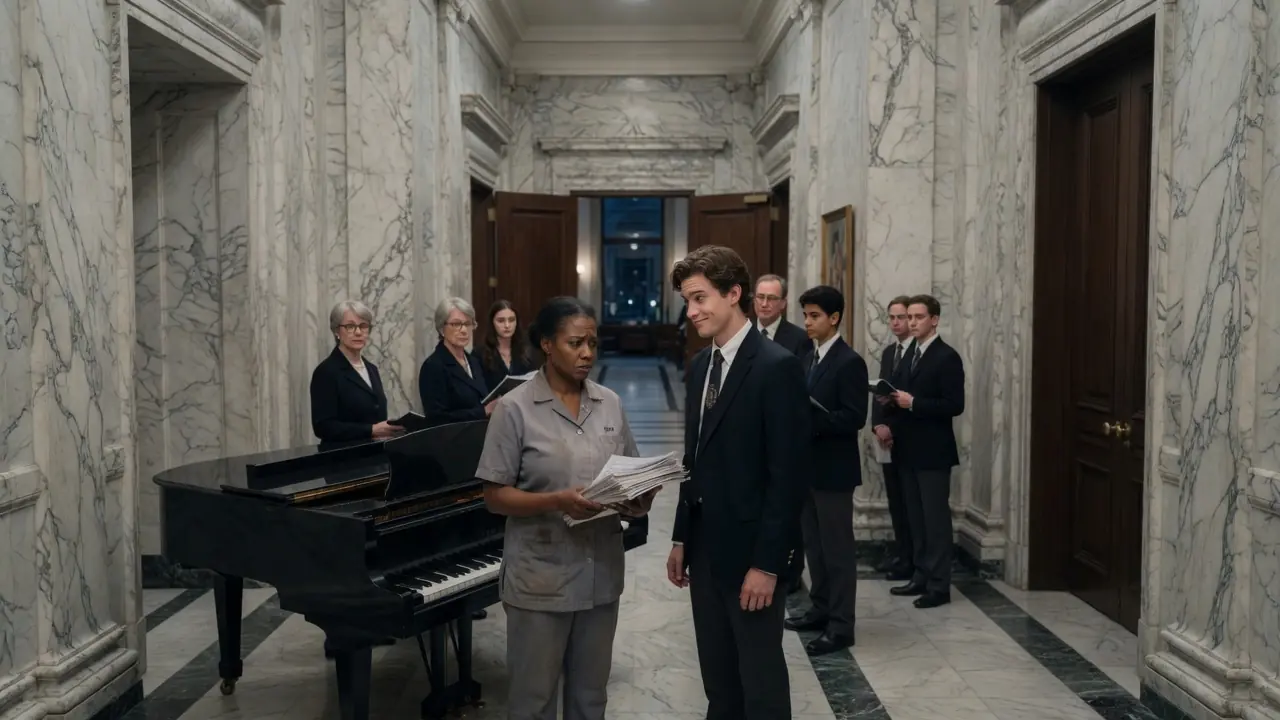
May stood up slowly. Her legs felt shaky. Her heart was pounding. What had she done? She had broken her own rule. She had revealed herself. She had stopped being invisible. She looked at Brandon. He wasn’t clapping. He was just staring at her with his mouth slightly open, looking like someone had just told him the sky was actually green.
Professor Davis pushed through the crowd. “Who are you?” he asked quietly. “I mean, who are you really?” May’s voice was barely a whisper. “I am just cleaning lady.”
“No,” Professor Davis said firmly. “Nobody plays like that by accident. Nobody plays Rachmaninov’s third like that without years of professional training—decades even. Please tell me who you are.” May looked at all the faces staring at her. Young faces. Old faces. All waiting for an answer.
She took a deep breath. “In Beijing,” she said slowly, carefully, “I was concert pianist. I play with China Philharmonic Orchestra. Seventeen times I performed this concerto. But that was long time ago. Different life.”
The silence that followed was even deeper than before. And that’s when everything changed.
The news spread through the academy like wildfire. By the next morning, everyone knew the cleaning lady wasn’t just a cleaning lady. She was May Lynn, a concert pianist who had performed with some of the most prestigious orchestras in China. Students were pulling up old recordings on their phones, finding grainy videos of her performances from years ago.
There she was—younger, wearing elegant concert gowns, playing in packed auditoriums in Beijing and Shanghai. “That’s really her,” someone whispered in the cafeteria. “That’s actually her.”
May arrived for her evening shift as usual, but everything felt different. Students who had never looked at her before now stared openly. Some smiled. Some whispered to their friends. A few brave ones approached her in the hallway.
“Miss Lynn, could you maybe listen to me play sometime? Give me some advice?” May didn’t know what to say. She just nodded and hurried past, pushing her cleaning cart faster than usual.
This attention was exactly what she had been trying to avoid for six years. Being seen meant being vulnerable. It meant people would ask questions. It meant her carefully built walls of invisibility were crumbling.
She made it to the supply closet and closed the door behind her, leaning against it. Her hands were shaking—not from fear exactly, but from the weight of everything changing so fast.
There was a knock on the door. May closed her eyes. She wanted to pretend she wasn’t there, but that was impossible now. “Miss Lynn, it’s Professor Davis. May I speak with you?”
May opened the door slowly. Professor Davis stood there with a kind expression, holding a folder. He looked nervous, which was strange. He was usually so confident.
“I’m sorry to bother you during your shift,” he said, “but could we talk just for a few minutes?” They sat in an empty practice room. Professor Davis opened his folder and pulled out several printed pages. May recognized them immediately—articles about her performances, reviews from Chinese newspapers, programs from concerts she had played years ago.
“I spent half the night researching,” Professor Davis said. “You weren’t just any pianist in China. You were extraordinary. Critics called you one of the finest interpreters of romantic repertoire in your generation. You won the Shanghai International Piano Competition. You recorded three albums. You were a professor at the Central Conservatory of Music.”
May looked down at her hands. “That was long time ago.” “Six years isn’t that long ago,” Professor Davis said gently. “Miss Lynn, why are you working as a custodian here? With your credentials, you could be teaching, performing. Why didn’t you tell anyone?”
The question hung in the air. May had asked herself the same thing many times. Why had she accepted this? Why had she given up so easily?
“When I come to America, I try,” she said quietly. “I bring all my certificates, my recordings, my letters. But nobody care about certificate from China. They say I need American degree, American credentials. They say my English not good enough. After six months, no job, no money, my daughter need to eat. We need apartment. So I take this job.”
Professor Davis leaned forward. “I’m so sorry. That shouldn’t have happened. Your talent speaks for itself. Anyone who heard you play last night knows that.” “Is okay,” May said, though it wasn’t really okay. “I have job. I have apartment. My daughter is safe. That is most important.”
“But what about you?” Professor Davis asked. “What about your gift? The world needs to hear you play.” May smiled sadly. “The world move on without me. Is okay.”
Professor Davis was quiet for a moment. Then he said something that made May’s heart skip. “What if it didn’t have to? What if you could teach here? What if you could perform again?”
May shook her head. “I am cleaning lady. I have no American credentials.” “We can work around that,” Professor Davis said quickly. “The academy has provisions for hiring based on demonstrated expertise. What you played last night was better than any credential. The dean watched the video this morning. So did half the board. They want to meet you.”
“Video?” May felt her stomach drop. “Several students recorded it on their phones. It’s been shared all over social media. You have thousands of views already.” He pulled out his phone and showed her.
There she was in her gray uniform, playing the Rachmaninov concerto. The comments were in English, Chinese, and other languages she didn’t recognize. All of them were positive, amazed, moved. May felt tears forming. She didn’t know if they were happy tears or scared tears. Maybe both.
“I need to think,” she whispered. “Of course,” Professor Davis said. “Take all the time you need. But please think about it. Really think about it.”
After he left, May sat alone in the practice room for a long time. She looked at the piano. For six years, she had avoided these instruments. Now, after playing just once, everything was different.
Her phone buzzed. A text from Lily. “Mom, everyone at my college is talking about you. They found the videos. I’m so proud of you. Why didn’t you tell me you were this good?”
May smiled through her tears. Lily had heard her play at home on the cheap keyboard, but she had never heard her mother play a real piano. Never understood the full extent of what May had given up.
Another text came. “Mom, you have to teach again. You have to play again. Please don’t waste your talent just because you’re scared.”
Scared? Was that what she was? May thought about it. Yes, she was scared. Scared of failing. Scared of being rejected again. Scared of hoping for something better and having that hope crushed.
But she was also tired. Tired of hiding. Tired of pretending to be less than she was. Tired of silencing the music that lived inside her.
The next knock on the door surprised her. It was Brandon, the arrogant student who had mocked her, who had challenged her to play. He looked different now—smaller somehow, humbled.
“Miss Lynn,” he said, standing awkwardly in the doorway. “Can I talk to you?” May nodded, curious. Brandon sat down, not quite meeting her eyes.
“I owe you an apology. A big one. What I said yesterday, how I treated you—it was awful. Inexcusable. I was being a spoiled brat, and I took it out on you.”
May waited. She had heard apologies before that didn’t mean anything. “I watched myself in the video,” Brandon continued. “I saw how I acted, heard what I said, and I was disgusted with myself. My whole life, I’ve thought I was this amazing pianist because everyone told me I was—my parents, my teachers, everyone. But hearing you play, I realized something. I don’t know anything. I can hit the notes, but I don’t understand the music. Not like you do.”
He finally looked up at her. “Would you teach me? Not just technique, but how to actually play—how to make it mean something?”
May was quiet for a long moment. Then she said, “You have talent. Good talent. But talent is not enough. You need to respect the music. Respect the people around you. The piano does not care how much money your father has. The piano only care about what is in your heart.”
“I know,” Brandon said. “I’m starting to understand that. Will you help me learn?”
May thought about it. Teaching Brandon would mean accepting that she was a teacher again. It would mean stepping back into the role she had abandoned. It would mean taking a risk.
“The gala is in four days,” she said slowly. “You still want to perform?” Brandon nodded. “But I’m not ready. Not even close.”
“Then we work hard,” May said. “Every day. Every night. If you want to learn, I teach you. But you must listen. You must be humble. You must work harder than you ever worked before.”
“I will,” Brandon promised. “I swear I will.”
Over the next three days, May and Brandon worked together every evening. She still did her cleaning job, but now she spent hours afterward coaching him—not just on the notes, but on the feeling behind them. The story the music was trying to tell.
“Here,” she would say, pointing to a passage. “This part is not angry. Is desperate. You play like you are demanding something. But Rachmaninov is begging. He is pleading. You feel the difference.”
Brandon would try again. And slowly, his playing began to change. The technical skill was already there. But now something else was emerging—understanding, emotion, truth.
Rachel, the accompanist, joined their practice sessions. She and Brandon worked on their coordination, learning to listen to each other instead of fighting for control. May taught them both that making music together meant trusting each other, supporting each other.
“Music is like conversation,” May explained. “You must speak, yes, but you must also listen. Otherwise, it’s just noise.”
Other students started gathering outside the practice room during their sessions, listening through the door. Word spread quickly. The cleaning lady was teaching Brandon, and he was actually getting better.
On the fourth day, Brandon played through the entire concerto without stopping. When he finished, he looked at May with hope and fear in his eyes. “Well?” he asked.
May was quiet for a moment. Then she smiled. “Now you are ready.”
The night of the gala arrived faster than May expected. The Riverside Music Academy’s concert hall was packed. Donors in expensive suits and elegant dresses filled the velvet seats. Parents with cameras ready sat in the front rows. Students who had performed earlier in the evening now waited backstage, their part of the show complete.
May stood in the back of the hall wearing her gray uniform. She had thought about changing into something nicer. But this felt right. This was who she was now—or at least who she had been for the past six years.
Lily sat beside her, squeezing her mother’s hand. “I’m so nervous for you,” Lily whispered. “I am not performing,” May reminded her. “Brandon is.”
“But you’re nervous too. I can tell.” May smiled. Her daughter knew her too well. Yes, she was nervous. Not for herself, but for Brandon. She had given him everything she could in four days. Whether it was enough, they would soon find out.
The lights dimmed. Dean Patterson walked onto the stage, his voice booming through the microphone. “Ladies and gentlemen, for our final performance of the evening, we have a very special treat. Senior piano performance major Brandon Chen will be playing Rachmaninov’s Piano Concerto No. 3, one of the most challenging works in the piano repertoire.”
The audience applauded politely. Many of them knew Brandon’s father, the tech millionaire who had donated generously to the academy. They expected a competent performance from the privileged son of a wealthy man. They had no idea what was actually about to happen.
Brandon walked onto the stage. May noticed immediately that he carried himself differently. His usual swagger was gone. Instead, he moved with quiet confidence—the kind that came from real preparation, not entitlement. He bowed to the audience, sat at the piano, and looked toward Rachel, who was positioned at the second piano to play the orchestral parts.
Brandon caught May’s eye in the back of the hall. She gave him a small nod. You can do this. He took a breath and placed his hands on the keys.
The opening notes filled the concert hall—soft, gentle, perfect. The audience settled into their seats, expecting a standard student performance. But as Brandon continued to play, something shifted in the room. People sat up straighter. Parents put down their phones. Even the other students backstage stopped talking.
This wasn’t a standard student performance. This was something else entirely. Brandon played with a depth of feeling that nobody had heard from him before. His technical skills had always been impressive, but now there was soul behind the notes. He wasn’t just playing the music. He was understanding it, living it, feeling it.
May felt tears forming in her eyes. He had listened. Really listened. Everything she had taught him about the music, about humility, about letting the composition speak through you rather than imposing yourself on it—he had absorbed it all.
Rachel’s accompaniment was equally transformed. She followed Brandon’s lead perfectly, supporting him without overpowering. They had become a true ensemble, working together instead of against each other.
The first movement built to its climax, and Brandon attacked the difficult passages with controlled power. His fingers flew across the keys, hitting every note clearly. But more importantly, he made it mean something. Every phrase told part of the story. Every dynamic change served the emotional arc.
The audience was completely silent, transfixed. When the first movement ended, there was a pause. Then spontaneous applause erupted—which was unusual in the middle of a concerto, but people couldn’t help themselves. What they were hearing was extraordinary.
Brandon smiled slightly but stayed focused. He moved into the second movement, the beautiful and melancholic section that required deep emotional maturity. This was where May had worked with him the most—teaching him to let the sadness breathe, to not rush through the pain.
He played it beautifully, with restraint, with wisdom beyond his years. Lily whispered to her mother, “He sounds like you.” May shook her head. “No. He sounds like himself.”
Finally, the third movement arrived—the technical showcase that demanded both speed and precision. This was where Brandon had always stumbled before, trying to play it faster than he was capable of controlling. But May had taught him that speed without clarity was just noise.
He played it at the perfect tempo—fast enough to be exciting, controlled enough to be musical. The notes cascaded through the hall like a mountain stream—clear and powerful and beautiful.
The infamous cadenza section approached—the moment where many pianists failed, where Brandon himself had failed countless times in practice. May held her breath. Brandon closed his eyes for just a moment. Then he dove in.
His fingers danced across the keys with astonishing precision. The difficult runs that had tripped him up for months now flowed smoothly. The enormous chords rang out clearly. The delicate passages whispered with perfect touch. He played it all flawlessly. And more than that—he played it with confidence and joy.
The audience leaned forward in their seats, many with their mouths open. This was not what they had expected from a student performance. This was concert-level playing.
The concerto rushed toward its final triumphant conclusion. Brandon and Rachel locked eyes, perfectly synchronized, driving toward the finish together. The final chords crashed through the hall with glorious power.
Silence. Then the entire audience erupted. People leaped to their feet. The applause was deafening. Parents were crying. Students were cheering. Even the other faculty members looked stunned.
Brandon stood and bowed, his face flushed with emotion. Then he did something that surprised everyone. He gestured toward Rachel, bringing her forward to share the applause. She joined him, and they bowed together.
But Brandon wasn’t finished. He walked to the microphone that Dean Patterson had used earlier. “Thank you,” he said, his voice shaking slightly. “But I need to say something.”
“A week ago, I couldn’t play this piece. Not really. I could hit the notes, but I didn’t understand the music. I was arrogant and foolish and cruel to people who were trying to help me.”
The audience went quiet, curious where this was going. “Then someone showed me what real musicianship looks like. Someone who had every reason to stay silent chose to speak through music instead. Someone I had treated terribly showed me kindness I didn’t deserve.”
He turned to face the back of the hall, looking directly at May. “Miss Lynn, could you please stand up?”
May’s heart jumped. She shook her head slightly, but Lily was already pulling her to her feet. The spotlight swung around, illuminating her in her gray custodian uniform.
Brandon continued. “This woman is one of the finest pianists I have ever heard. She was a professor and concert performer in China. And for the past week, she has been teaching me—not just how to play the piano, but how to be a musician. Everything you heard tonight is because of her.”
The audience turned to look at May. The applause started again, directed at her now. She felt her face burning—not from embarrassment, but from an emotion she couldn’t quite name.
Dean Patterson appeared on stage, taking the microphone from Brandon. “Miss Lynn, would you please join us on stage?”
May wanted to refuse, wanted to disappear, but Lily pushed her gently forward. “Go, Mom. This is your moment.”
May walked down the aisle, her legs shaking. When she reached the stage, Dean Patterson shook her hand warmly.
“Ladies and gentlemen,” the dean announced, “I’m pleased to share some news. After this week’s extraordinary revelation, the board and I have unanimously decided to offer Miss Lynn a position on our faculty. She will be joining us as a piano instructor starting next semester.”
More applause. More cheering. The dean continued. “And for tonight, we have one more surprise. Miss Lynn, would you honor us with a performance?”
May looked at the piano—the beautiful Steinway grand, still warm from Brandon’s performance. She looked at the audience—at Lily crying happy tears in her seat, at the students backstage watching with admiration, at Brandon smiling with genuine gratitude.
She thought about the six years she had spent being invisible. About the dreams she had buried. About the music she had silenced.
Maybe it was time to stop being invisible. Maybe it was time to be seen again.
May sat at the piano. She didn’t need sheet music. The piece she wanted to play was written in her heart. She chose Chopin’s Nocturne in C minor—a piece about longing and loss and hope and home. A piece about everything she had been through and everything she was becoming.
As her fingers touched the keys, May felt something inside her unlock. The music poured out—honest and raw and beautiful. She played for her late husband. For Lily. For the years of struggle. For the dreams that had died and the new dreams being born. She played for herself.
When the final note faded, May opened her eyes. The audience was on their feet again. But this time she saw them differently—not as judges, not as people who could reject her, but as people who understood. People who had been moved by the same force that moved her. Music.
Lily ran up to the stage and hugged her mother tightly. “I’m so proud of you, Mom,” she whispered. “Welcome home.”
And for the first time in six years, May felt like she truly was home. Not in a building or a country, but in the music—where she had always belonged.
The cleaning lady uniform would come off tomorrow. But the lessons she had learned while wearing it—those would stay forever. Humility. Resilience. The understanding that dignity doesn’t come from what others see, but from what you know about yourself.
She had been invisible. But she had never been nothing.
And now, finally, the world could see what she had known all along.
She was May Lynn—concert pianist, teacher, survivor.
And she was just getting started.