Malik Johnson was eleven years old the first time he understood that hunger had a sound.
It was not loud.
It did not always come as a stomach growling in the middle of class or a baby crying in the next apartment. Sometimes hunger sounded like coins sliding across a grocery counter, one by one, slower and slower, while the person counting them tried not to let their hands shake.
That was the sound Malik heard on a rainy Thursday afternoon inside Harper’s Market, the small neighborhood grocery store on the corner of Beech Street and 9th Avenue.
Outside, the sky hung low and gray over the city. Rainwater ran along the curb in thin silver streams, carrying leaves, gum wrappers, and little pieces of paper toward the storm drains. Cars passed with wet tires hissing against the street. The old red awning above Harper’s Market dripped steadily, and every time the front door opened, the bell gave a tired little ring.
Malik stood near the candy rack with a folded ten-dollar bill in his pocket.
It was not just any ten dollars.
He had earned it himself.
For three Saturdays, he had helped Mr. Alvarez from apartment 2B carry boxes down to the basement. He had swept the sidewalk in front of Mrs. Carter’s beauty salon. He had taken out trash bags for the man who owned the laundromat. Each person had given him a dollar or two, sometimes a handful of quarters, and Malik had saved every bit of it in an old peanut butter jar under his bed.
That morning, his mother had smiled when he told her he was going to buy himself something after school.
“Not too much candy,” she had warned, tying her work shoes by the door.
“I know, Ma,” Malik had said.
His mother, Renee Johnson, worked long shifts at a senior care center across town. She left before sunrise most days and came home with tired feet, but she always had enough energy to check Malik’s homework, ask about his day, and remind him to keep his heart clean in a world that would not always be fair.
Malik had promised himself he would buy a small pack of chocolate cupcakes, a bottle of orange soda, and maybe, if the price was right, one of the little toy cars hanging near the register.
But now, as he stood in Harper’s Market with his hood damp from the rain, he forgot all about the cupcakes.
At the register, an old woman was counting coins.
She was small, with thin shoulders under a faded navy coat. Her gray hair was tucked beneath a knitted hat that had seen too many winters. One of her gloves had a hole near the thumb, and she held her purse close to her chest as if it contained everything she had left in the world.
On the counter in front of her were simple groceries: a loaf of wheat bread, a small carton of milk, a can of soup, a bag of apples, and a pack of oatmeal.
Nothing fancy.
Nothing extra.
The cashier, a young man named Trevor, scanned the items and looked at the screen.
“That’ll be twelve forty-six,” he said.
The old woman nodded as if she had expected that number, but the way her mouth tightened told Malik she had not.
She opened her little coin purse and began counting.
A dollar bill.
Another dollar bill.
Four quarters.
Two dimes.
A nickel.
Then more coins.
Trevor sighed quietly. It was the kind of sigh grown-ups thought children did not hear.
Behind the old woman, a man in a business jacket shifted impatiently, holding a basket filled with bottled water and microwave dinners. A woman in workout clothes glanced at her phone and rolled her eyes.
The old woman kept counting.
“I’m sorry,” she said softly. “I thought I had more.”
Trevor looked at the line forming behind her.
“You’re short,” he said. “You got seven dollars and eighty-three cents.”
The old woman blinked.
“Oh,” she whispered.
She looked down at the groceries.
The line seemed to grow quieter, but not in a kind way. It was the kind of quiet that made shame feel larger.
“I can put something back,” the old woman said.
Trevor reached for the bag of apples first.
“No,” she said quickly, then looked embarrassed by how sharp her voice had sounded. “I mean… perhaps the milk.”
“The milk is two ninety-nine,” Trevor said.
She looked at the oatmeal.
The bread.
The soup.
Malik watched her face carefully. He had seen that look before.
He had seen it on his mother’s face when she stood at the kitchen table, sorting bills into piles. Rent. Electric. Phone. Groceries. The pile for groceries was always the one that got smaller first.
The old woman touched the loaf of bread with two fingers.
“Take off the apples,” she said.
Trevor removed them from the total.
“Still short.”
“Then the soup.”
He removed the soup.
The man in the business jacket muttered something under his breath.
The old woman’s cheeks turned pink.
Malik felt something twist inside him.
He reached into his pocket and touched the folded ten-dollar bill.
His cupcakes disappeared in his mind.
So did the orange soda.
So did the little toy car.
He thought of his mother’s voice.
Keep your heart clean.
Malik stepped forward.
“I got it,” he said.
Everyone turned.
Trevor looked over the old woman’s shoulder. “What?”
Malik walked up to the counter and pulled the ten-dollar bill from his pocket. It was soft from being folded and unfolded too many times.
“I said I got it,” Malik repeated.
The old woman turned toward him.
Up close, Malik could see the lines around her eyes. They were not hard lines. They were tired lines.
“Oh, sweetheart, no,” she said. “I can’t take a child’s money.”
“It’s okay,” Malik said.
“It is not okay,” she replied gently. “You earned that.”
Malik shrugged, trying to act like it was nothing, though his fingers were still holding the bill tightly.
“My mom says food is important,” he said. “And you picked good stuff. Not even candy.”
A tiny smile moved across the woman’s face, but it trembled.
Trevor took the bill after Malik placed it on the counter.
The man in the business jacket looked away.
The woman in workout clothes suddenly became very interested in her phone.
Trevor finished the transaction and handed the old woman her receipt. Malik picked up the bag of apples and put it back with the rest of her groceries.
“You forgot these,” he said.
The old woman looked at the apples, then at Malik.
“What’s your name?” she asked.
“Malik.”
“Malik,” she repeated, as if she wanted to remember the sound exactly. “My name is Eleanor Whitcomb.”
Malik nodded. “Nice to meet you, Miss Eleanor.”
Her eyes softened.
“Nice to meet you too.”
She took her grocery bags, but they were too heavy for her hands. Malik noticed right away.
“I can carry those,” he said.
“No, no. You have done enough.”
“I’m walking that way anyway.”
He was not entirely sure which way she was walking, but he said it with enough confidence that she believed him.
Outside, the rain had slowed to a mist. Malik lifted both bags carefully and followed her beneath the red awning. Miss Eleanor moved slowly, one careful step at a time. She did not complain, but Malik saw how she paused near the curb before crossing.
“You live far?” he asked.
“Three blocks,” she said. “The brick building near the church.”
“I know that one,” Malik said. “My friend Isaiah lives across from there.”
They walked together under the gray afternoon sky.
For a while, Miss Eleanor did not say much. Malik did not mind. He was used to quiet. Sometimes his mother was too tired to talk after work, and they would sit at the kitchen table together, eating spaghetti or rice and beans in comfortable silence.
After half a block, Miss Eleanor said, “You should not have had to do that.”
Malik looked up at her. “Do what?”
“Help an old woman who should have been able to buy her own groceries.”
Malik frowned.
“My grandma says everybody needs help sometimes.”
“Your grandmother sounds wise.”
“She lives in Georgia,” Malik said. “She sends me birthday cards with five dollars inside.”
Miss Eleanor smiled. “That is a grandmother’s finest tradition.”
Malik laughed.
At the corner, a bus rolled past, spraying water near the curb. Malik moved closer to the building, keeping the grocery bags away from the splash.
Miss Eleanor noticed.
“You are very thoughtful,” she said.
Malik shrugged again. He did that when compliments made him uncomfortable.
“My mom says pay attention to people,” he said. “Most folks tell you what they need without saying it.”
Miss Eleanor stopped walking for just a second.
Then she looked down at him with an expression Malik did not understand.
“That is one of the truest things I have heard in a long time,” she said.
Her building was old but neat, with black railings and flowerpots near the entrance. Malik carried the groceries up two steps and waited while she found her keys.
“You don’t have to come in,” she said.
“I can set them inside the door.”
She hesitated, then nodded.
Her apartment was on the first floor. It smelled faintly of lavender soap and old books. The living room was small, with lace curtains, a brown sofa, a wooden table, and photographs lined along the wall. In one picture, Miss Eleanor stood beside a tall man in a dark suit, both of them much younger. In another, she held a baby with a pink blanket.
Malik set the bags on the kitchen counter.
“Thank you,” she said.
“You’re welcome.”
She opened a drawer and searched inside.
“I want to give you something.”
Malik shook his head. “You don’t have to.”
“I know I do not have to. I want to.”
She found a small wrapped peppermint candy and placed it in his palm.
“It is not much,” she said.
Malik smiled. “I like peppermint.”
Miss Eleanor looked relieved.
Then she took a small notebook from beside the phone.
“Would you write your last name for me?” she asked. “Only if your mother would not mind.”
“Johnson,” Malik said. “Malik Johnson.”
She wrote it slowly.
“Malik Johnson,” she repeated.
He pulled his hood back up. “I gotta go. My mom gets worried.”
“Of course. Go straight home.”
“Yes, ma’am.”
At the door, Miss Eleanor said his name once more.
“Malik?”
He turned.
“You gave me more than groceries today.”
Malik did not know what to say to that.
So he smiled, waved, and stepped back into the rain.
That evening, his mother noticed right away that he had not bought anything.
“No cupcakes?” she asked as he took off his sneakers near the door.
Malik tried to look casual. “Nah.”
Renee narrowed her eyes playfully. “You been talking about those cupcakes all week.”
“I changed my mind.”
His mother knew him too well.
“Malik.”
He sighed and told her the whole story.
Renee listened without interrupting. When he finished, she sat quietly for a moment, her work uniform still on, her tired hands folded in front of her.
Then she reached out and pulled him into a hug.
At first Malik laughed, embarrassed.
“Ma, I’m not a baby.”
“I know,” she said, holding him tighter. “That’s why I’m proud.”
He stopped laughing.
She kissed the top of his head.
“Don’t ever let this world make you ashamed of being kind,” she said. “Some people will call it foolish. Some people will take advantage. But kindness with wisdom is strength, baby.”
Malik remembered those words.
He remembered them the next week when Isaiah teased him for spending ten dollars on an old lady instead of snacks.
He remembered them when he passed Harper’s Market and saw Trevor at the register, looking bored as usual.
He remembered them whenever he saw Miss Eleanor after that.
Because after that rainy Thursday, Malik started seeing her everywhere.
He saw her at the bus stop, holding a brown purse in both hands.
He saw her outside the church, speaking softly to the pastor’s wife.
He saw her at Harper’s Market again, buying only a few things at a time.
Whenever he saw her, she smiled.
“Good afternoon, Mr. Johnson,” she would say, as formal as if he were grown.
“Good afternoon, Miss Eleanor,” he would answer, standing a little taller.
Sometimes he carried her groceries.
Sometimes he helped her cross a busy street.
Once, in December, he noticed her standing outside her building with a confused look on her face while snowflakes drifted onto her hat.
“You okay?” he asked.
“My door lock is sticking,” she said.
Malik looked at the key, then at the lock. He had watched the building superintendent fix it before. He jiggled the key gently, lifted the handle a little, and turned it.
The lock clicked.
Miss Eleanor clapped her gloved hands once.
“My goodness. You are becoming indispensable.”
Malik did not know what indispensable meant, but it sounded important.
He looked it up later.
It became one of his favorite words.
Over time, Miss Eleanor became part of Malik’s life in the quiet way some people do. Not loudly. Not all at once. But steadily.
She came to his school bake sale and bought two chocolate chip cookies, even though Malik knew she had to count her money carefully.
She sent him a birthday card with a dollar bill inside and a note written in beautiful cursive.
To Malik Johnson,
A young gentleman of rare character.
May your heart remain brave.
E.W.
Malik kept the note in his desk drawer.
When his mother worked late, Miss Eleanor sometimes called to check that he had gotten home safely. She never stayed on the phone long. She simply asked if the door was locked, if he had eaten, and if his homework was finished.
“You sound like my mom,” Malik told her once.
“Then I am in excellent company,” she replied.
By the time Malik turned thirteen, he had grown taller, though he was still skinny. He helped at Harper’s Market after school for a few dollars a week, sweeping aisles, carrying boxes, and restocking shelves.
The owner, Mr. Harper, was a heavyset man with silver hair and a pencil always tucked behind his ear. He had known Malik since Malik was little, and though he complained about everything from delivery prices to teenagers touching fruit, he trusted Malik with small jobs.
“You got good hands,” Mr. Harper said one afternoon while Malik stacked cans of tomato soup. “Careful hands. That matters.”
Malik liked working at the store.
He liked the smell of fresh bread near the back.
He liked the rhythm of the place: morning coffee buyers, afternoon mothers, older men picking up newspapers, kids with coins for candy. He liked knowing where everything belonged. Rice on aisle two. Laundry soap on aisle four. Canned peaches on the third shelf down.
One day, he wanted a store of his own.
Not a big supermarket with shiny floors and bright signs, but a neighborhood store where people knew each other’s names. A place where an old woman short on groceries would never have to feel small.
He told Miss Eleanor that dream one spring afternoon while carrying a bag of potatoes to her apartment.
“A store?” she said.
“Yes, ma’am. Maybe groceries. Maybe sandwiches too. My mom says I make good grilled cheese.”
Miss Eleanor smiled. “A grocery store that serves grilled cheese sounds like a place people would remember.”
“I’d call it Johnson’s Corner.”
“Excellent name.”
“You think so?”
“I do.”
Malik grinned.
Most adults smiled at children’s dreams the way they smiled at drawings taped to refrigerators. Kindly, but not seriously.
Miss Eleanor smiled differently.
She made his dream feel like something with walls, lights, a front door, and a real sign.
Years passed.
The neighborhood changed.
The laundromat became a phone repair shop. The old bakery closed and reopened as a coffee place with tiny tables. Rent went up. Familiar faces moved away. New people arrived with expensive strollers and dogs wearing sweaters.
Harper’s Market struggled.
Large chain stores opened nearby, offering lower prices and longer hours. Mr. Harper grew older and more tired. Some shelves stayed empty longer than they used to. The red awning faded from red to a tired pink.
Malik kept working there through high school.
He became the boy everyone called when they needed something from the top shelf or help carrying bags to the car. He knew which customers liked ripe bananas and which ones wanted green ones. He knew Mrs. Patel always bought ginger tea on Fridays. He knew Mr. Grady liked his newspaper folded under his left arm because his right shoulder bothered him.
And he still knew Miss Eleanor’s list before she said it.
Oatmeal.
Milk.
Wheat bread.
Apples.
Soup.
Sometimes chicken if it was on sale.
Miss Eleanor grew slower with the years, but her mind stayed sharp. Her cursive remained perfect. Her manners never faded.
When Malik graduated from high school, she came to the ceremony wearing a pale blue dress and the same navy coat from years before. Renee sat beside her, both of them cheering when Malik’s name was called.
Afterward, Miss Eleanor gave him a card.
Inside was no money.
Just a note.
To Malik Johnson,
You have already begun building your life. Do not be afraid of the size of your dream. Every worthy thing begins as a small act done faithfully.
E.W.
Malik read the note three times that night.
He wanted to go to community college for business, but money was tight. His mother helped as much as she could. Malik worked mornings at Harper’s Market, took classes in the afternoon, and studied at night.
He was tired often.
Sometimes he wondered if dreams were easier when people had someone to pay for them.
Then he would think of Miss Eleanor counting coins at the register.
He would get up the next morning and keep going.
At twenty-two, Malik became assistant manager of Harper’s Market.
At twenty-five, he knew the store better than anyone except Mr. Harper himself.
At twenty-six, Mr. Harper called him into the back office.
The office was cramped, with a metal desk, old invoices, a humming refrigerator, and a calendar from three years ago still hanging on the wall.
Mr. Harper sat behind the desk, rubbing his forehead.
“I’m selling,” he said.
Malik stood still.
“The store?”
“What else would I be selling, the moon?”
Malik tried to smile, but he could not.
“Who’s buying it?”
“Some development company. They want the whole corner. Market, phone shop, maybe the church annex if they can get it.”
Malik felt the words land heavily.
“What will they do with it?”
“Luxury apartments. Retail downstairs. Juice bar maybe.” Mr. Harper shook his head. “Everything becomes a juice bar eventually.”
Malik looked through the small office window toward the aisles.
Mrs. Patel was choosing tea. Mr. Grady was reading the newspaper by the front. A mother was guiding her little boy away from the candy rack.
“This place matters,” Malik said.
Mr. Harper sighed.
“Places matter until bills come due.”
“I could buy it.”
The words came out before Malik had fully thought them.
Mr. Harper stared at him.
“You?”
Malik swallowed.
“Why not me?”
“You got that kind of money?”
“No.”
“Then that is why not.”
The words were not cruel, but they were honest.
Malik left the office feeling like someone had turned the lights down inside him.
That evening, he went to see Miss Eleanor.
She was eighty-four then, still living in the same first-floor apartment with lace curtains and photographs on the wall. Her hands had become thinner, but her eyes were clear.
She listened while Malik explained everything.
The development company.
Mr. Harper selling.
The impossible price.
His dream slipping away before he had even reached it.
When he finished, she was quiet.
Then she asked, “How much?”
Malik told her.
She did not react.
Instead, she looked toward the window, where evening light rested softly against the curtains.
“Do you remember the first day we met?” she asked.
“Of course.”
“You paid for my groceries.”
Malik smiled faintly. “You gave me a peppermint.”
“It was all I had to give.”
“You didn’t owe me anything.”
“No,” she said. “But I remembered.”
Malik leaned back in his chair.
Miss Eleanor looked at him carefully.
“I have something to tell you,” she said. “And I need you to listen without interrupting.”
Malik straightened.
“Yes, ma’am.”
She folded her hands.
“My late husband, Arthur, owned property in this neighborhood many years ago. Not much by the standards of wealthy people, but enough. After he passed, I sold most of it. I kept some savings. I lived simply. Some people assumed I had nothing because I dressed plainly and counted every coin.”
Malik stared at her.
She continued.
“They were wrong.”
The room felt very still.
“I was not rich in the way people imagine. I did not have mansions or cars. But I had enough to make choices. Over the years, I watched this neighborhood change. I watched people leave because they could not afford to stay. I watched small businesses close. I watched kindness become treated like an old-fashioned thing.”
Her eyes softened.
“And I watched you.”
Malik did not speak.
“I watched you grow from a boy who gave up cupcakes for an old woman into a man who knows the name of every customer who walks into that store. You did not become kind for show. You stayed kind when life became difficult. That is rare.”
Malik’s throat tightened.
Miss Eleanor reached beside her chair and picked up a folder.
“I spoke to an attorney some time ago,” she said. “I also spoke to Mr. Harper last week.”
“You what?”
She raised one eyebrow.
“I asked you not to interrupt.”
Malik closed his mouth.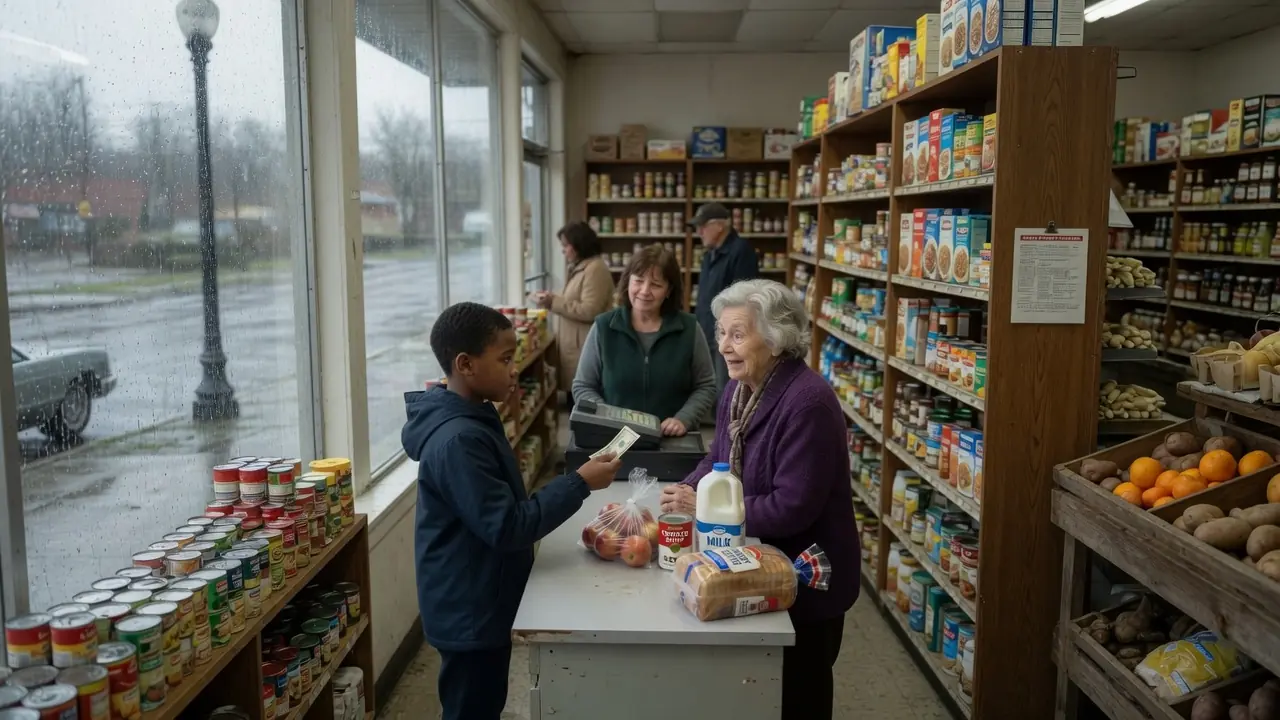
A small smile appeared.
“I have arranged to help you purchase Harper’s Market,” she said. “Not as a gift thrown carelessly into your lap. As an investment in what you have already proven you can carry.”
Malik could not move.
He looked at the folder in her hands, then back at her face.
“I don’t understand.”
“Yes, you do,” Miss Eleanor said gently. “You are frightened to understand.”
His eyes burned.
“Miss Eleanor…”
“The store would be yours,” she said. “With proper paperwork. Proper guidance. You would still need to work hard. Harder than ever, perhaps. You would need to learn what you do not know. You would need to be careful, disciplined, honest, and patient.”
Malik let out a shaky breath.
“I can’t take your money.”
“Why not?”
“Because it’s too much.”
She smiled sadly.
“When you were eleven years old, ten dollars was too much.”
He looked down.
“But you gave it anyway,” she said.
“That was different.”
“How?”
“You needed food.”
“And this neighborhood needs a place where people are seen.”
Malik wiped his face quickly with one hand.
Miss Eleanor pretended not to notice.
“I am not asking you to repay kindness like a debt,” she said. “Kindness is not a debt. I am asking you to let one small good thing grow into a larger one.”
He sat there, unable to speak.
Then Miss Eleanor opened the folder and took out a brass key.
It was old, heavier than modern keys, with a round top worn smooth.
“This was the key to Arthur’s first shop,” she said. “He kept it long after the shop was gone. He said a business was not walls and shelves. It was a promise to the people who walked through the door.”
She placed the key in Malik’s palm.
His fingers closed around it slowly.
“I want you to build your promise,” she said.
Malik bowed his head.
For a moment, he was eleven again, standing in Harper’s Market with a ten-dollar bill in his hand, afraid and certain at the same time.
Then he was twenty-six, sitting in a small apartment with a brass key in his palm, feeling the weight of a future he had almost stopped believing in.
“Thank you,” he whispered.
Miss Eleanor reached across and touched his hand.
“No, Malik,” she said. “Thank you for seeing me before anyone knew there was anything to gain.”
The process took months.
There were meetings with attorneys, bank officers, city inspectors, accountants, and people who used words Malik had to write down and study later. There were nights when he sat at his mother’s kitchen table surrounded by forms, wondering if he was smart enough to do this.
Renee sat with him through many of those nights.
“You are smart enough to ask questions,” she said. “That matters more than pretending you know everything.”
Miss Eleanor insisted on structure. She did not simply hand Malik a check and disappear. She helped create a plan. Part of the money became a low-interest private loan. Part became a community trust arrangement tied to keeping the market affordable and locally owned. Malik would earn full ownership over time by meeting clear responsibilities.
“That way,” Miss Eleanor told him, “your pride remains intact, and my purpose remains protected.”
Malik laughed through his stress.
“You always talk like a book.”
“And you always listen like a man who intends to learn.”
Mr. Harper was gruff during the sale, but on the day the papers were signed, his eyes looked suspiciously wet.
“Don’t ruin my store,” he said.
Malik smiled.
“I won’t.”
“And fix the freezer in aisle three. Thing sounds like a dying lawn mower.”
“I know.”
“And don’t trust every vendor who smiles at you.”
“I know.”
“And keep the bell on the door.”
Malik looked toward the entrance.
The little bell had rung above generations of customers.
“I will,” he said.
Three weeks later, Harper’s Market closed for renovation.
Not a fancy renovation.
Malik did not want polished floors that made the place feel unfamiliar. He repainted the walls cream, replaced broken shelves, fixed the freezer, updated the lights, and repaired the red awning outside. But he kept the wooden counter near the register. He kept the bell. He kept the old neighborhood bulletin board where people posted babysitting flyers, church dinners, lost keys, and rooms for rent.
The new sign above the entrance read:
Johnson’s Corner Market
Under it, in smaller letters:
Groceries. Sandwiches. Neighbors.
On opening morning, Malik arrived before sunrise.
He wore a clean button-down shirt, dark jeans, and the apron his mother had embroidered with the store name. He stood outside for a moment, looking up at the sign.
Renee stood beside him, crying openly.
“Ma,” he said softly.
“I’m allowed,” she replied.
Miss Eleanor arrived in a taxi at nine o’clock.
Malik had asked someone to pick her up, but she insisted on coming properly, as she put it. She wore her navy coat, a pearl necklace, and polished black shoes. Her hair was neatly pinned, and in her hands she carried a small bouquet of yellow flowers.
When she stepped onto the sidewalk, people turned.
Some knew her. Some did not.
But everyone noticed Malik’s face when he saw her.
He hurried outside.
“Miss Eleanor,” he said, offering his arm.
“Mr. Johnson,” she replied, taking it.
He walked her to the front door.
The neighborhood had gathered around the entrance: old customers, new residents, families, church members, shop owners, and children peeking through the windows. Mr. Harper stood near the curb pretending not to be emotional. Isaiah, now with a beard and a delivery job, held his phone up to record.
Malik cleared his throat.
“I’m not good at speeches,” he began.
Someone shouted, “Yes, you are!”
People laughed.
Malik smiled, then looked at the crowd.
“This store raised me in a way,” he said. “I came here as a kid with coins in my pocket. I worked here after school. I learned how people shop when money is tight. I learned how older folks choose carefully. I learned how mothers stretch meals. I learned how a store can be just a store, or it can be part of a neighborhood.”
His voice grew steadier.
“Years ago, in this store, I saw someone who needed help. I was a kid. I didn’t have much. But I had enough to do one small thing.”
He looked down at Miss Eleanor.
“She never forgot. And because she never forgot, I’m standing here today.”
The crowd grew quiet.
Miss Eleanor squeezed his arm.
Malik continued.
“Johnson’s Corner Market is going to be a place where people are treated with dignity. If you’re short one dollar, we’ll figure it out. If you’re elderly and need help carrying bags, we’ll carry them. If you’re a kid with a dream, we’ll take you seriously. That’s the promise.”
He reached into his pocket and pulled out the brass key Miss Eleanor had given him.
“This key belonged to Miss Eleanor’s husband’s first shop,” he said. “Today, she told me to build my promise with it.”
His hand trembled slightly as he unlocked the door.
The bell rang.
Everyone clapped.
Miss Eleanor was the first customer.
Malik had arranged it that way.
She walked slowly through the aisles, touching the shelves with her fingertips. She paused at the oatmeal. The wheat bread. The apples.
At the front counter, Malik had already placed a small basket for her.
Inside were the same items she had tried to buy years ago.
Bread.
Milk.
Soup.
Oatmeal.
Apples.
She looked at the basket.
Then at Malik.
“You remembered,” she said.
“I remember everything important.”
Her eyes filled with tears.
He rang up the items, then pressed a button on the register.
The receipt printed.
Total: $0.00
Miss Eleanor looked at him sternly through her tears.
“Malik.”
He smiled.
“Opening day discount.”
“That is not a real thing.”
“It is today.”
She laughed, and everyone nearby laughed with her.
But then Malik reached under the counter and took out a small framed sign.
He turned it around so she could read it.
The Eleanor Shelf
Free basic groceries for seniors in need.
Take what you need. Give when you can.
Miss Eleanor covered her mouth.
Malik’s voice softened.
“You said kindness should grow.”
She reached for his hand.
Around them, the store continued to fill with people. The bell kept ringing. Customers moved through the aisles. Children pressed their faces near the sandwich counter. Mr. Harper complained that the tomatoes were stacked wrong, though he was smiling while he said it.
Life entered the store.
Real life.
Messy, ordinary, beautiful life.
In the months that followed, Johnson’s Corner Market became exactly what Malik had imagined and more.
He hired local teenagers after school and taught them how to count change, stock shelves, greet customers, and show respect even when people were difficult.
He started a sandwich special named after his mother: Renee’s Grilled Cheese, served with tomato soup on Fridays.
He kept prices fair, even when it meant smaller profits.
He created a delivery list for seniors who had trouble walking to the store.
Every Thursday afternoon, he personally delivered groceries to Miss Eleanor.
Sometimes she paid.
Sometimes she argued.
Sometimes he let her win.
Often, they sat at her kitchen table afterward, drinking tea while she told stories about the old neighborhood. She told him about Arthur’s shop, about the first apartment she ever rented, about the baby daughter she had lost many years before, and about the loneliness that had followed her after Arthur passed.
“I was not always poor,” she said one afternoon. “But I was often alone. People confuse the two.”
Malik nodded.
He had learned that need wore many faces.
Sometimes it looked like an empty wallet.
Sometimes it looked like a quiet apartment.
Sometimes it looked like an old woman who had enough savings to change a young man’s life but still stood in a grocery line counting coins because grief had made her world small.
“You made my world larger,” Miss Eleanor told him.
Malik looked at her.
“I was just a kid.”
“You were a door,” she said. “God sends doors in all sizes.”
He smiled.
“You still talk like a book.”
“You still listen.”
Years later, people would tell the story many ways.
Some said Malik Johnson bought a grocery store because an old woman secretly had money.
Some said he got lucky.
Some said it was a miracle.
But Malik knew the truth was simpler and deeper than that.
A boy had paid attention.
An old woman had remembered.
A neighborhood had been given proof that kindness did not disappear when the moment passed. It waited. It grew roots. It came back in forms no one could predict.
On the tenth anniversary of Johnson’s Corner Market, Malik stood behind the counter with a little boy of his own sitting nearby, coloring on receipt paper.
His son, Caleb, was six years old, with bright eyes and endless questions.
“Daddy,” Caleb asked, “why is that shelf named Eleanor?”
Malik looked toward the framed sign.
The Eleanor Shelf was still there.
It had helped hundreds of seniors over the years. Some took groceries quietly. Some left coins in the donation jar. Some returned later with bags of rice or canned vegetables. Some simply whispered thank you.
Miss Eleanor had passed away two years earlier, peacefully, with Malik and Renee sitting beside her.
In her will, she left Malik the brass key permanently, along with a letter.
He kept both in the store office.
Malik lifted Caleb onto his hip and carried him to the shelf.
“When I was about your age,” Malik said, “I met an old woman right here in this store.”
“Was she nice?”
“She was very nice. But she was having a hard day.”
“What happened?”
“She didn’t have enough money for her groceries.”
Caleb’s eyes widened. “What did you do?”
Malik smiled.
“I helped her.”
“With lots of money?”
“No. Just ten dollars.”
Caleb thought about that.
“Was ten dollars a lot?”
“To me, back then? It was everything.”
Caleb looked at the shelf again.
“And then she made this?”
“In a way,” Malik said. “We made it together.”
Caleb leaned his head on his father’s shoulder.
“Can I help somebody one day?”
Malik kissed his son’s forehead.
“You can help somebody today.”
That afternoon, an elderly man came into the store wearing a brown cardigan and holding a shopping list. He moved slowly down the aisles, choosing soup, crackers, bananas, and tea. At the register, he searched his pockets and frowned.
Malik watched from behind the sandwich counter.
Caleb watched too.
The cashier, a teenage girl named Amara, looked toward Malik, unsure.
The old man’s ears turned red.
“I may need to put something back,” he said.
Before Malik could move, Caleb climbed down from his stool and ran to the counter with a dollar bill from the little jar where he kept his allowance.
“I can help,” Caleb said.
The old man looked down in surprise.
Malik stood still.
For a second, the store seemed to fold time in half.
He saw himself at eleven years old.
He saw Miss Eleanor in her navy coat.
He heard coins on the counter.
He felt the worn ten-dollar bill in his hand.
Then he heard his mother’s voice.
Don’t ever let this world make you ashamed of being kind.
The old man smiled at Caleb.
“Well,” he said softly, “aren’t you a fine young gentleman?”
Caleb stood taller.
“My daddy taught me.”
Malik turned away for a moment, pretending to check the sandwich press.
But Amara saw him wipe his eyes.
So did Renee, who had come in for lunch and now stood near the door, smiling with one hand over her heart.
The bell above the entrance rang again.
Rain began tapping lightly against the red awning outside.
And inside Johnson’s Corner Market, under clean lights and between shelves filled with bread, apples, soup, and oatmeal, kindness kept moving.
Not loudly.
Not proudly.
Just steadily.
From one hand to another.
From one generation to the next.
Like a key passed forward.
Like a promise kept.