The night Marcus Reed turned twelve, his mother took him to Rosewood Diner with eleven dollars, a tired smile, and a promise she had worked all week to keep.
Rosewood Diner sat on the corner of Maple Avenue and 6th Street in Cleveland, Ohio, between a small barber shop and a closed-down movie rental store with faded posters still taped inside the windows. The diner had red booths with silver edges, round stools at the counter, a jukebox near the back that only worked when it felt like it, and a bright blue sign above the door that buzzed softly whenever the weather got cold.
Marcus loved that sign.
He loved the way it made the sidewalk glow at night.
He loved the smell of coffee, pancakes, burgers, onions on the grill, and fresh pie behind the counter. He loved the sound of plates sliding onto tables and waitresses calling orders through the little kitchen window.
Most of all, he loved that Rosewood Diner felt like a place where regular people could sit down and feel important for a little while.
Marcus did not go there often.
His mother, Angela Reed, worked at a dry-cleaning shop during the day and cleaned offices at night. Money in their apartment never moved freely. It had places to go before it even arrived. Rent. Electric bill. Bus passes. Laundry. Groceries. School shoes. Medicine. Everything had a name before Marcus could ask for anything extra.
But every year on his birthday, if things were not too tight, Angela took him somewhere for dinner.
Not fancy.
Never fancy.
But somewhere with a menu and a waitress and a glass of soda with ice.
That year, Marcus had chosen Rosewood Diner.
“You sure?” Angela had asked that morning while tying her work shoes. “We can get pizza slices instead. Might stretch farther.”
Marcus shook his head.
“I want the diner.”
Angela studied him, then smiled.
“The diner it is.”
Now they sat in a booth near the window while cold November rain tapped against the glass. Marcus wore his best shirt, a navy button-down that was a little too short at the wrists. His dark brown skin looked warm under the diner lights, and his close-cropped hair had been brushed carefully before they left the apartment. He sat up straight because birthdays made him feel like he should.
Across from him, Angela looked exhausted but beautiful to him. She had changed out of her cleaning uniform into a soft gray sweater, though her hands still smelled faintly of soap. Her eyes carried the heaviness of someone who had worked too long, but whenever she looked at Marcus, they brightened.
A waitress named Brenda came over with two menus.
“Evening, folks,” she said. “What can I get you to drink?”
Angela looked at Marcus.
He knew what that meant.
Drinks cost extra.
“Water’s fine,” he said quickly.
Brenda nodded. “Two waters.”
When she left, Angela leaned across the table.
“It’s your birthday. You can get a soda if you want.”
Marcus wanted one.
He wanted a cherry cola with ice and a straw he could chew on.
But he had seen his mother count money before they left. He had seen her smooth the eleven dollars on the kitchen table and tuck it carefully into her purse. He knew she was trying to make the night feel bigger than the budget.
“Water’s good,” he said.
Angela looked at him for a long moment.
“You’re twelve, not forty.”
“I know.”
“Sometimes you act like you’re helping me raise you.”
Marcus smiled a little. “Am I doing okay?”
Angela laughed softly, then reached across and squeezed his hand.
“You’re doing too much. But yes, baby. You’re doing okay.”
Marcus opened the menu even though he already knew what he wanted.
The Rosewood Burger.
It came with fries and a pickle spear. The picture on the menu showed melted cheese falling over the sides, lettuce crisp and green, tomato red and thick, and fries piled high beside it. Marcus had been thinking about that burger since Monday.
Angela ordered first.
“Just coffee for me,” she told Brenda when the waitress returned.
Marcus looked up sharply.
“Ma.”
“I had something at work.”
“You had crackers.”
Angela gave him a warning look.
“Marcus.”
He looked back down.
Brenda turned to him. “And for the birthday boy?”
Marcus blinked. “How’d you know?”
Angela smiled. “I told her when you were reading the menu.”
Brenda tapped her pen against her pad. “Well, happy birthday, sweetheart.”
“Thank you.”
“What’ll it be?”
Marcus looked at his mother again.
Angela nodded.
“The Rosewood Burger,” he said. “With fries.”
“Good choice.”
Brenda wrote it down.
When she left, Marcus felt a warm glow in his chest.
A birthday burger.
His mother sitting across from him.
Rain outside, warmth inside.
For a few minutes, life felt generous.
Then the old man came in.
The bell above the diner door rang, and a gust of wet air swept across the floor. Marcus looked up from the sugar packets he had been stacking into a little tower.
The man who stepped inside was elderly and thin, with pale brown skin, a gray mustache, and a dark green coat that had lost one button near the middle. His hat was damp from the rain, and he held it in both hands as he stood near the entrance, looking around as if he was not entirely sure he belonged there.
His shoes were old but polished. His trousers had careful creases. His face was lined deeply, but there was dignity in the way he stood, even with rainwater dripping from his sleeves.
Brenda glanced toward him from the counter.
“Sit wherever,” she called.
The old man nodded politely.
“Thank you.”
His voice was quiet, smooth, and tired.
He moved slowly toward the counter, choosing the stool nearest the end. Marcus watched him hang his wet hat on his knee instead of placing it on the counter. He took off his gloves, folded them together, and set them beside his hand.
A different waitress, younger and impatient-looking, approached him.
Her name tag said Kelsey.
“What can I get you?” she asked.
The old man looked at the menu.
“May I have a bowl of vegetable soup and coffee, please?”
Kelsey wrote it down.
“Anything else?”
“No, thank you.”
She walked away.
Marcus looked back at his mother.
Angela was watching too, though she tried not to stare.
“He reminds me of Grandpa Louis,” Marcus said.
Angela’s face softened.
“My father would have worn a tie to eat soup at a diner.”
Marcus smiled. “He wore ties to watch TV.”
“He believed a man should be ready for respect, whether or not the world offered it.”
Marcus looked back at the old man.
He wondered if the man had once believed the same thing.
The diner filled slowly as the rain got heavier. A couple came in sharing an umbrella. Two construction workers sat at a booth near the back. A mother with three children ordered pancakes for dinner because the kids begged loudly enough. The kitchen window kept opening and closing, releasing bursts of heat and the smell of grilled onions.
Brenda brought Marcus his burger.
It looked even better than the picture.
The cheese was melted perfectly. The fries were hot and crisp. The pickle spear shone bright green beside the plate. Brenda had stuck a small birthday candle into the top bun, unlit, because diners had rules about open flames near paper napkins.
“There you go,” she said. “Best burger in the house.”
Marcus stared at it like it was treasure.
“Thank you.”
Angela watched his face, and for a moment all her tiredness seemed worth it.
“Happy birthday, Marcus.”
He picked up a fry and offered it to her.
“First one.”
She shook her head. “That’s yours.”
“Birthday rule. Mom gets first fry.”
“There is no such rule.”
“There is now.”
Angela took the fry and smiled.
Marcus was about to pick up the burger when he heard Kelsey’s voice from the counter.
“Sir, your card declined.”
The old man looked up.
“I’m sorry?”
Kelsey held the card between two fingers.
“It declined.”
He reached into his coat pocket slowly.
“Perhaps try it again.”
“I did.”
The words were louder than necessary.
A few people turned to look.
The old man’s shoulders became very still.
Marcus felt the warmth of his burger fade from his mind.
At the counter, the old man searched his pockets. First the right coat pocket. Then the left. Then inside his jacket. Then his trousers.
“I had some cash,” he said softly.
Kelsey sighed.
“Sir, the total is eight seventy-five.”
“Yes, I understand.”
He searched again, slower now, as if patience might make money appear.
“I must have left my envelope at home.”
Kelsey looked toward the register, then toward the kitchen.
“You already ate the soup.”
The old man’s face changed.
It was not fear exactly.
It was shame.
Deep, quiet shame.
“I can return tomorrow,” he said. “I live not far from here.”
Kelsey crossed her arms.
“That’s not how this works.”
The construction workers stopped talking. The mother with the children looked down at her plate. The couple near the door whispered.
No one moved.
Marcus looked at his mother.
Angela’s eyes had narrowed, not at the old man, but at the room.
Marcus knew that look.
It was the look she got when people were being unkind and calling it business.
The old man placed both hands on the counter.
“I have eaten here for many years,” he said. “Perhaps not recently, but many years. There used to be a waitress named Carla who knew me.”
“Carla hasn’t worked here in a decade,” Kelsey said.
“I see.”
His voice became smaller.
“I can leave my watch.”
Kelsey blinked.
“What?”
“As assurance. Until I return with payment.”
The old man began removing a worn gold watch from his wrist.
Marcus looked at the watch.
It did not look expensive.
It looked old.
Important.
Something given, not bought.
Angela whispered, “Oh, Lord.”
Marcus looked down at his burger.
Steam still rose from the fries.
His stomach tightened painfully.
He had eaten only one fry.
The birthday candle leaned slightly in the bun.
He thought about the eleven dollars.
He thought about his mother ordering only coffee.
He thought about the old man standing in the rain before coming inside, trying to sit with dignity at the counter.
He thought about Grandpa Louis, whom he barely remembered except through stories and photographs. A man who wore ties to watch television because he believed respect mattered.
Marcus stood.
Angela looked at him.
“Marcus.”
He did not answer right away.
He picked up his plate with both hands and walked toward the counter.
The diner grew quiet in the strange way public places do when people sense something is happening but do not yet know what.
Marcus stopped beside the old man.
“Sir?”
The old man turned.
Up close, Marcus could see that his eyes were deep brown and tired, but kind.
“Yes, young man?”
Marcus held out the plate.
“You can have this.”
The old man looked at the burger, then at Marcus.
“I beg your pardon?”
“It’s my birthday dinner,” Marcus said. “But I’m not that hungry.”
That was a lie.
His stomach objected immediately.
Angela closed her eyes for one second.
The old man shook his head.
“No. I could never take a child’s birthday meal.”
“You already had soup,” Marcus said. “But you probably need more. And they’re making a big deal about eight dollars.”
Kelsey frowned. “Excuse me?”
Marcus looked at her, then quickly remembered his mother’s rule about tone.
He turned back to the old man.
“I mean, you can have the burger, and I’ll pay for the soup with this.”
He reached into his pocket and pulled out the three dollars his grandmother had mailed in his birthday card. He had planned to save it. Maybe buy a comic book. Maybe put it in his shoebox.
He placed the bills on the counter.
“It’s not enough,” Kelsey said.
Angela stood then.
Her chair scraped the floor.
“Put his soup on my bill,” she said.
Marcus turned.
“Ma, no.”
Angela walked to the counter, purse in hand.
“Marcus Reed, do not argue with me in a diner.”
“But you only have—”
“I know what I have.”
She looked at Kelsey.
“Add his soup and coffee.”
Kelsey’s face flushed.
Brenda came from behind the counter quickly.
“I’ll handle it,” she said to Kelsey, her voice firm.
The old man looked overwhelmed.
“Ma’am,” he said to Angela, “please. I did not mean to cause any hardship.”
Angela looked at him gently.
“Sir, hardship is letting someone give up his watch over soup.”
Brenda took the old man’s bill and quietly adjusted something on the register.
“It’s covered,” she said. “All of it.”
Kelsey opened her mouth.
Brenda gave her a look.
Kelsey walked away.
The old man still had not taken the burger.
Marcus held it out again.
“Please,” he said. “The fries are still hot.”
The old man stared at him.
Then slowly, carefully, he accepted the plate.
“What is your name?” he asked.
“Marcus Reed.”
The old man repeated it like a promise.
“Marcus Reed.”
“My mother is Angela.”
The old man turned toward her.
“Mrs. Reed.”
“Ms. Reed,” Angela corrected gently.
“Ms. Reed,” he said. “My name is Thomas Avery.”
Brenda set a fresh cup of coffee beside him.
“Mr. Avery,” she said softly, “you take your time.”
Thomas Avery nodded.
“Thank you.”
Marcus started to return to the booth, but Mr. Avery stopped him.
“Young man.”
Marcus turned.
“Are you certain?”
Marcus looked at the burger.
Then at his mother.
Then at Mr. Avery’s watch, still half undone on his wrist.
“Yes, sir.”
Mr. Avery’s eyes shone.
“I will not forget this.”
Marcus shrugged because he did not know what to do with the heaviness of the words.
“It’s just a burger.”
Mr. Avery looked down at the plate.
“No,” he said. “It is much more than that.”
Angela ordered a side of toast for Marcus and told Brenda to bring one plate and two forks. Brenda quietly added a small bowl of soup “by mistake,” placing it in front of Marcus with a wink.
Nobody sang happy birthday. There was no cake. No soda. No extra fries.
But Marcus never forgot that dinner.
He remembered sitting across from his mother, eating toast and soup, while Thomas Avery ate the Rosewood Burger slowly at the counter as if it were something sacred.
He remembered the way the old man wiped his mouth with a napkin and looked around the diner, not bitterly, but sadly, like he was seeing a place he had once loved from very far away.
He remembered Mr. Avery coming to their booth before leaving.
The rain had slowed outside. His hat was dry enough to wear again. His watch was back on his wrist.
“I would like to repay you,” Mr. Avery said.
Angela shook her head.
“That isn’t necessary.”
“Necessary and right are not always the same.”
Marcus liked that sentence.
Mr. Avery reached into his coat pocket and pulled out a folded paper.
It was not money.
It was a recipe card.
The card was old, yellowed at the edges, written in careful handwriting.
“My wife’s cornbread recipe,” he said. “Best in the state, though she would have scolded me for bragging.”
Marcus took the card carefully.
“You’re giving me a recipe?”
“For now,” Mr. Avery said. “It is what I have with me that is worth something.”
Angela looked at the card with surprise.
“Are you sure?”
Mr. Avery nodded.
“My wife believed recipes were not secrets. She said good food should travel.”
Marcus looked at the handwriting.
Avery Family Cornbread.
“Thank you,” he said.
Mr. Avery put on his hat.
Then he looked at Marcus with an expression that made the boy sit up straighter.
“You gave me your birthday dinner,” he said. “One day, I hope life sets a table for you.”
Then he stepped into the wet night and walked away beneath the blue diner sign.
For weeks after that, Marcus thought about Thomas Avery.
He thought about him whenever he passed Rosewood Diner on the bus.
He thought about him when his mother made soup from leftover vegetables and stretched it over two nights.
He thought about him when he placed the recipe card inside a shoebox with his birthday cards, school certificates, and the three-dollar envelope from his grandmother.
A month later, Angela tried making the cornbread.
The first attempt came out too dry.
The second sank in the middle.
The third filled the apartment with a smell so warm and rich that their neighbor Mrs. Jenkins knocked on the wall and shouted, “Whatever that is, bring me some!”
Marcus carried a square of cornbread to her apartment on a paper plate.
Mrs. Jenkins took one bite, closed her eyes, and said, “Baby, this tastes like somebody’s grandmother is watching over it.”
Angela laughed when Marcus told her.
After that, the Avery cornbread became something special in their home.
Angela made it for church potlucks when she could afford the ingredients. She made it for Marcus after hard school weeks. She made it once for Mr. Daniels, the building superintendent, after he fixed their kitchen sink without charging them.
Food, Marcus learned, could do more than fill a stomach.
It could carry memory.
It could say what people did not know how to say.
By the time Marcus was fourteen, he had begun cooking with his mother regularly. At first, it was because Angela needed help. She came home tired, and he could chop vegetables, stir pots, wash rice, and season beans.
Then he started enjoying it.
He liked the order of recipes.
He liked the way simple ingredients changed when heat and time worked on them.
He liked tasting something and knowing it needed salt, pepper, onion, or patience.
Most of all, he liked how his mother relaxed when they cooked together.
Their kitchen was small, with peeling paint near the window and one cabinet door that never closed right. But when cornbread baked and beans simmered, the apartment felt richer than it was.
One evening, while Marcus stirred a pot of chili, Angela leaned against the counter and watched him.
“You know,” she said, “you move around a kitchen like you belong there.”
Marcus smiled.
“I belong wherever food is.”
“I’m serious.”
“So am I.”
She shook her head.
“You ever think about cooking for real?”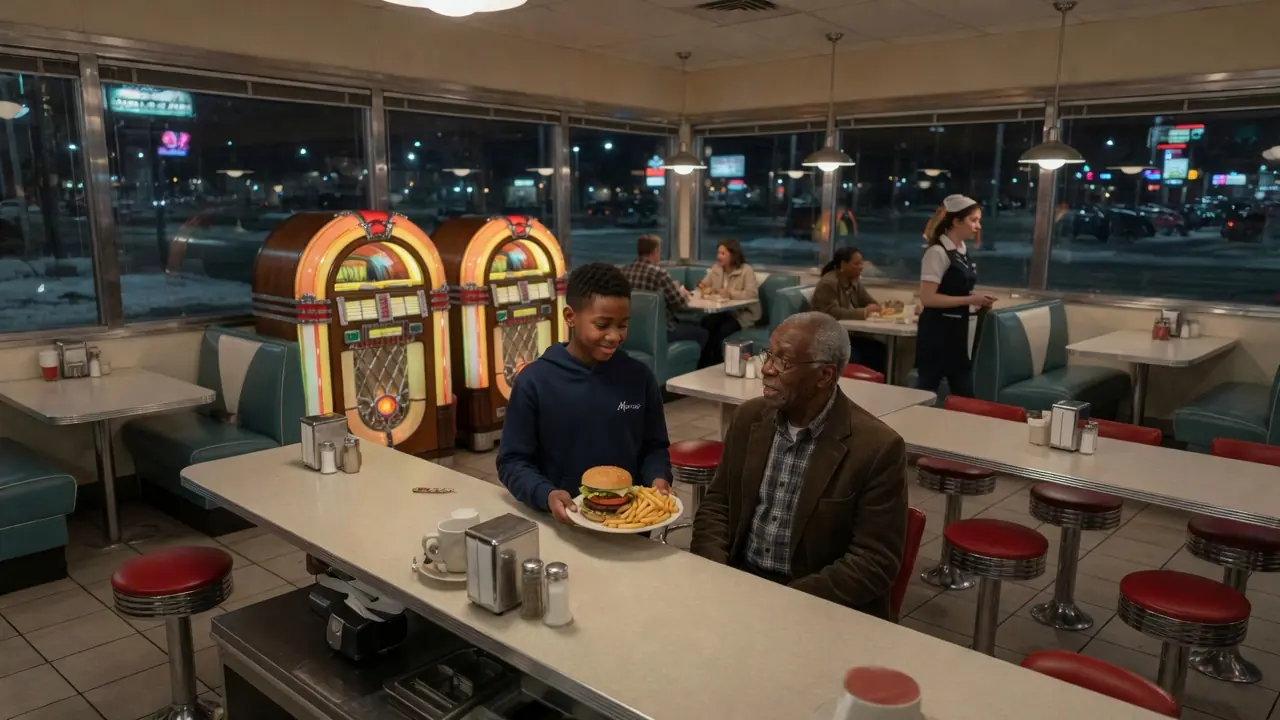
“You mean like a chef?”
“Maybe.”
Marcus stirred slowly.
Chefs on television wore clean jackets and worked in shiny kitchens. They shouted words in French and made tiny food on huge plates. That did not feel like him.
“I don’t know,” he said. “I like cooking food people actually eat.”
Angela smiled.
“Then cook that.”
At fifteen, Marcus got a weekend job washing dishes at Rosewood Diner.
He had avoided the place for a while after his birthday, not because he was ashamed, but because the memory felt too big. But Brenda still worked there, and when she saw him come in asking about work, she smiled like she had been expecting him.
“Birthday boy,” she said.
Marcus laughed. “That was three years ago.”
“I remember customers who give away burgers.”
The owner, Mr. Harlan, hired him for Saturdays.
Dishwashing was harder than Marcus expected. Hot water, soap, stacks of plates, slippery floors, cooks yelling for clean pans, and endless cups with lipstick marks and coffee stains. His hands stayed wrinkled for hours after his shifts.
But he loved being near the kitchen.
He watched the cooks move.
He learned which orders took longest.
He learned how to flip pancakes, toast buns, refill soup, chop onions fast, and plate food neatly. Brenda slipped him tips when customers complimented clean tables. One cook named Luis taught him how to season home fries properly.
“Most people under-season potatoes,” Luis said. “Potatoes need confidence.”
Marcus wrote that down in a notebook.
At sixteen, he was allowed to work the prep line.
At seventeen, he could run the grill during slow hours.
By then, Rosewood Diner had changed. The blue sign flickered more often. The booths were cracked. Mr. Harlan cut corners. Brenda complained that the place had lost its heart. Kelsey had left long ago. New waitresses came and went.
Marcus still loved the diner, but sometimes he felt like it was forgetting itself.
One rainy evening after school, Marcus found Thomas Avery’s recipe card in his shoebox and asked Brenda if she remembered him.
“The old man from your birthday?” she asked.
“Yes. Did he used to come here a lot?”
Brenda’s face grew thoughtful.
“He did, years before that. He and his wife. Every Friday night, same booth near the window. Sweet couple.”
“What happened?”
“His wife passed, I think. Then he stopped coming.”
Marcus looked toward the window booth.
It was empty.
“Do you know where he lives?”
Brenda shook her head.
“I wish I did.”
Marcus tried searching online at the public library. Thomas Avery was not an uncommon name. He found several, none clearly the right one. He asked old customers. Some remembered him, but no one knew much.
Life kept moving.
Marcus graduated high school with decent grades, strong kitchen skills, and a dream he was almost afraid to name.
He wanted to open a place one day.
Not a fancy restaurant.
A neighborhood table.
A small restaurant where elders could eat affordably, kids could get a warm meal after school, and people short on cash would not be made to feel small. A place where birthday dinners mattered, but so did soup on ordinary nights.
Angela cried when he told her.
Not because she doubted him.
Because dreams cost money, and she knew how heavy that truth could be.
Marcus attended community college for culinary arts while working nearly full-time. He studied food safety, menu planning, baking, budgeting, inventory, nutrition, and business math. He learned that good intentions could not pay suppliers, but bad numbers could destroy good intentions.
He worked in catering kitchens, diners, and a hotel breakfast service. He learned from every place.
At twenty-two, he started a small weekend meal program at a church basement with help from Angela, Brenda, Luis, and a few volunteers. They called it Sunday Table.
Nothing complicated.
Soup.
Cornbread.
Rice dishes.
Roasted vegetables.
Chicken when donations allowed.
Fresh fruit for children.
Coffee for seniors.
The rule was simple: pay what you can, eat what you need.
Marcus made the Avery cornbread every week.
People loved it.
An elderly woman named Miss Darlene said it tasted like “a hug with crispy edges.” A little boy named Andre once put two pieces in his coat pocket to take home, and Marcus pretended not to see until he could wrap them properly.
Sunday Table grew.
So did the problems.
They needed more space. More money. More equipment. More refrigerators. More volunteers. More everything.
Marcus applied for grants and got rejected.
He met with local business owners and received polite smiles.
One man in a suit told him, “Free meals don’t build a serious restaurant brand.”
Marcus looked at him and thought of Thomas Avery removing his watch over soup.
“Maybe not your kind,” Marcus said.
Angela scolded him later for the tone but admitted she was proud.
At twenty-five, Marcus found out Rosewood Diner was closing.
Mr. Harlan had fallen behind on bills, and a developer wanted the corner. The diner’s blue sign would come down. The red booths would be sold. The kitchen would be stripped. Another familiar place would become glass apartments and expensive coffee.
Marcus stood outside the diner after hearing the news, looking up at the flickering sign.
It had been years since his twelfth birthday, but he could still see that night clearly.
His mother across from him.
The burger in front of him.
Thomas Avery at the counter.
A recipe card passing from old hands to young hands.
Brenda came outside and stood beside him.
“Hurts, doesn’t it?” she said.
Marcus nodded.
“This place could still matter.”
“It did matter.”
“It could again.”
Brenda looked at him carefully.
“You thinking what I think you’re thinking?”
“I don’t have the money.”
“That’s not what I asked.”
Marcus smiled sadly.
“I want to buy it.”
Brenda exhaled.
“Then we better start praying and making phone calls.”
For three months, Marcus tried everything.
He made a proposal for turning Rosewood into a community restaurant connected to Sunday Table. He found a nonprofit partner. He gathered letters from neighbors, churches, schools, and senior centers. He created a budget so detailed Angela said it looked like homework with ambition.
Still, the price was too high.
The developer had cash.
Marcus had hope, paperwork, and a cornbread recipe.
One cold afternoon in March, he received a letter at the church where Sunday Table operated.
The envelope was cream-colored, thick, and addressed in careful handwriting.
Mr. Marcus Reed
Sunday Table Community Meal Program
Inside was a note from a woman named Clara Avery.
Dear Mr. Reed,
My name may not be familiar to you, but my grandfather’s name was Thomas Avery. I believe you met him years ago at Rosewood Diner on your birthday.
He passed away last winter. Among his belongings, we found a letter addressed to “the boy who gave me his birthday dinner.” It took time to find you. A waitress named Brenda helped.
My grandfather asked that I deliver the enclosed letter and speak with you about Rosewood Diner.
If you are willing, I would like to meet.
With gratitude,
Clara Avery
Marcus sat down slowly.
Angela, who was helping sort donated vegetables nearby, noticed his face.
“What is it?”
He handed her the letter.
She read it, then covered her mouth.
“Oh, Marcus.”
Brenda was there too, wiping tables after the lunch service. When Marcus looked at her, she lifted both hands.
“I may have given your name to a woman who asked the right questions.”
“You knew?”
“Not everything. Just enough to hope.”
Marcus met Clara Avery two days later at Rosewood Diner, which was nearly empty by then.
Clara was in her thirties, with kind eyes, a neat coat, and a folder tucked under one arm. She looked around the diner as if she had heard stories about it her whole life.
“My grandparents loved this place,” she said.
Marcus nodded.
“Brenda told me.”
Clara smiled.
“My grandmother’s name was Evelyn. She made cornbread that my grandfather considered a public service.”
Marcus pulled the old recipe card from his notebook.
“Was this hers?”
Clara looked at it and instantly began to cry.
“Yes,” she whispered. “That’s her handwriting.”
Marcus placed it gently on the table between them.
“He gave it to me the night we met.”
Clara wiped her eyes.
“He told that story for years. The boy who gave him his birthday burger. He said you made him feel visible on the loneliest night of his life.”
Marcus looked down.
“I was just a kid.”
“Children can still change the direction of a life,” Clara said.
Then she opened the folder.
“My grandfather owned a small share of this property years ago. Most people forgot that. He and my grandmother invested in the diner when it was struggling in the 1980s. Over time, ownership changed, paperwork got complicated, and his share became more of a legal footnote than anything active. But when the sale process started, my attorney found that his approval, or now his estate’s approval, matters more than the developer expected.”
Marcus stared at her.
“I don’t understand.”
Clara smiled.
“It means the sale is not as simple as the developer hoped. It also means I have leverage.”
“Leverage for what?”
“For you.”
Marcus could not speak.
Clara continued.
“My grandfather left instructions. If Rosewood Diner ever became available and if the boy from that night could be found, he wanted his share used to help that boy create something worthy of Evelyn’s recipe.”
She slid an envelope across the table.
“This is his letter.”
Marcus opened it with careful hands.
Dear Marcus Reed,
If this has reached you, then Clara has done what I asked, and you are no longer the twelve-year-old boy who stood beside me with a burger in his hands.
I hope life has been kind to you. More importantly, I hope you have remained kind to life, even when it was not gentle with you.
The night we met, I was an old man with an empty pocket and a full heartache. My Evelyn was gone. I had returned to the diner where we once spent our Fridays because I wanted to sit where memory still knew my name. Then my card failed, my pride failed, and I nearly gave up the watch she had given me.
You saw me.
Not as a problem. Not as an old fool. Not as an embarrassment.
You saw me as hungry.
You gave me your birthday dinner.
I gave you Evelyn’s cornbread recipe because it was the most precious thing I had with me. If you still have it, then you already understand that food carries more than flavor.
Clara tells me you cook for people now. This does not surprise me.
I have asked that what remains of my interest in Rosewood Diner be used to help you if you wish to build a table there. Do not make it a monument to me. Make it useful. Feed children. Respect elders. Charge fairly. Forgive quietly when needed. Keep coffee hot. Keep one booth open for someone who looks lonely but says he is fine.
And if you serve Evelyn’s cornbread, do not overbake it.
With gratitude,
Thomas Avery
Marcus pressed the letter flat against the table and tried to breathe normally.
Angela read it next and cried openly.
Brenda read it and said, “That old man had style.”
Clara laughed through her tears.
The legal process was not easy. Nothing important ever seemed to be easy.
The developer fought.
Mr. Harlan hesitated.
The building needed repairs.
The kitchen needed updates.
Money still had to be raised.
But Thomas Avery’s share bought time, and time gave Marcus room to gather support. Clara helped connect him with an attorney. Brenda organized former customers. Angela spoke at community meetings. Luis offered to return as kitchen manager if the plan worked.
The neighborhood showed up.
People donated twenty dollars, fifty dollars, five dollars. A retired teacher donated her late husband’s coffee urns. A contractor offered discounted repairs. A church raised money for new booths. The local community college sent culinary students to help design a training program.
The city, seeing public support, offered a small business revitalization grant.
A foundation that had once rejected Sunday Table called back.
Six months after the first letter arrived, Marcus signed the papers.
Rosewood Diner would not become apartments.
It would become something new.
They closed for renovation in September.
Marcus refused to erase the diner’s history. He kept the counter. He restored the red booths instead of replacing them. He repaired the jukebox. He cleaned the old blue sign and had the buzzing electrical parts fixed, but he kept the original shape.
The menu changed.
Affordable breakfasts.
Daily soup.
Sunday Table specials.
Pay-it-forward meal cards.
Senior lunch plates at reduced prices.
After-school meals for children.
And Evelyn Avery’s Cornbread served with nearly everything.
The new name went up two weeks before opening.
Rosewood Table
Under it, in smaller letters:
A neighborhood diner for anyone who needs a seat.
Opening day came on Marcus’s twenty-sixth birthday.
Angela insisted on that.
“You gave away your birthday dinner here,” she said. “You get to open your restaurant here on your birthday. That is called full circle.”
Marcus wore a clean white chef coat, dark pants, and the most nervous expression Brenda had ever seen.
“Stop looking like the grill owes you money,” she told him.
“I’m not nervous.”
“Baby, you rearranged the napkins by emotional category.”
Angela laughed.
Clara arrived carrying her grandfather’s watch in a small velvet box.
“I wanted it here today,” she said.
Marcus looked at the watch.
The same one Thomas Avery had almost left at the counter years before.
“I can’t take that.”
“I’m not giving it to you. I’m placing it where it belongs.”
They set the watch in a small glass case near the register beside a framed copy of Evelyn’s recipe and Thomas Avery’s letter.
Above it, Marcus placed a sign:
The Avery Booth Fund
Helping neighbors eat with dignity.
The first customer on opening day was Angela.
Marcus had arranged it that way.
She sat in the same booth where they had sat on his twelfth birthday.
Brenda brought her coffee.
Marcus brought out a plate.
A Rosewood Burger.
Fries.
A pickle spear.
And beside it, a small square of Evelyn’s cornbread.
Angela looked at the plate, then at him.
“You remembered.”
“I remember everything important.”
She touched his cheek.
“Happy birthday, Marcus.”
He sat across from her for one minute, though the kitchen was already busy.
This time, there was enough food for both of them.
Soon the diner filled.
Seniors from the neighborhood came in slowly, some dressed like church, some leaning on canes, some carrying exact change in little envelopes. Children came after school with backpacks. Former customers cried when they saw the restored booths. Brenda moved between tables like she had been waiting years to serve a place with its heart returned.
At noon, Marcus stepped out from the kitchen to speak.
He hated speeches, but Angela told him some moments deserved words.
He stood near the counter, holding Thomas Avery’s recipe card.
“When I was twelve,” he began, “my mother brought me here for my birthday. We did not have much money, but she wanted me to feel celebrated.”
Angela wiped her eyes before he even continued.
“That night, an old man had trouble paying for soup and coffee. People looked. Most stayed quiet. I had a burger I wanted badly. I gave it to him. My mother helped cover his bill, even though she had counted every dollar before we came.”
The diner grew still.
“That man was Thomas Avery. He gave me his wife Evelyn’s cornbread recipe. I didn’t know then that a recipe could become a road. But it did. It led me to cooking. It led me to Sunday Table. It led me back here.”
He looked toward Clara.
“Mr. Avery helped save this diner because he remembered one meal. So Rosewood Table is built on a simple promise: no one should lose dignity over hunger.”
Applause rose, but Marcus lifted a hand.
“I mean that. If you can pay, pay. If you can pay a little, pay a little. If today is hard, eat anyway. If you are lonely, sit anyway. If you are a kid with a birthday and only water to drink, we see you too.”
Brenda laughed through tears.
Marcus smiled.
“And yes, the cornbread is not overbaked.”
The diner burst into warm laughter.
Years passed.
Rosewood Table became the kind of place people described with their hands over their hearts.
It was not perfect.
The freezer broke twice. A delivery truck missed three Mondays in one year. Sometimes customers complained. Sometimes donations ran low. Sometimes Marcus went home so tired he fell asleep sitting at the kitchen table.
But the place lived.
Every weekday afternoon, children could get a simple meal and homework help in the back room. Every Tuesday, seniors received discounted lunch plates. Every Friday night, one booth near the window was reserved for anyone eating alone who wanted company. They called it the Avery Booth.
Marcus trained teenagers from the neighborhood in kitchen work, customer service, budgeting, and basic cooking. He taught them that feeding people required skill, not pity.
“Never slide a plate at someone like you are doing them a favor,” he said. “Set it down like they belong at the table.”
The Avery cornbread became famous in the neighborhood. People ordered pans for holidays. Local newspapers wrote about it. One food blogger called it “the best cornbread in Cleveland,” and Marcus laughed because Thomas Avery had already made that claim years before.
Clara became part of the Rosewood family. She brought her children on weekends and told them stories about their great-grandmother Evelyn. Angela worked fewer cleaning shifts and eventually managed the diner’s community meal fund. Brenda trained every new server with strict rules.
“If someone’s card declines,” she told them, “you come get me or Marcus. You do not raise your voice. You do not shame people. You do not make hunger a performance.”
One winter evening, nearly fifteen years after Marcus first gave away his burger, a boy came into Rosewood Table alone.
He was Black, maybe twelve, with a thin coat, careful eyes, and a backpack held close. He sat at the counter and studied the menu like it was a math test.
Marcus noticed from the kitchen window.
He always noticed children who counted prices before choosing food.
Brenda approached the boy gently.
“What can I get you, sweetheart?”
The boy looked embarrassed.
“How much is just fries?”
“Three dollars.”
He checked his pocket.
“Can I get half?”
Brenda glanced toward Marcus.
He nodded.
Then he came out himself.
“What’s your name?” Marcus asked.
“Jalen.”
“You hungry, Jalen?”
The boy hesitated.
“A little.”
Marcus smiled.
“A little hungry usually means very hungry when somebody says it like that.”
Jalen looked down.
Marcus leaned on the counter.
“How about this? We have a birthday special today.”
“It’s not my birthday.”
“That’s okay. It’s mine.”
Jalen looked confused.
Marcus turned toward the kitchen.
“Luis, one Rosewood Burger, fries, and cornbread.”
Jalen’s eyes widened.
“I can’t pay for that.”
Marcus looked toward the glass case by the register, where Thomas Avery’s watch still rested beside Evelyn’s recipe.
“Already covered,” he said.
“By who?”
Marcus thought of an old man in a wet coat, a birthday burger, and a promise spoken under a blue sign.
“By someone who remembered what it felt like to be hungry,” he said.
Jalen did not fully understand.
But he ate.
And Marcus watched the boy take the first bite with the same quiet reverence Thomas Avery had shown years before.
Outside, rain began to tap against the windows.
The blue sign glowed above the sidewalk.
Inside, Rosewood Table hummed with voices, plates, coffee cups, laughter, and the warm smell of cornbread.
Angela sat in the corner booth, older now, silver showing in her hair, watching her son move through the diner he had built from one act of kindness and one old recipe.
Marcus looked around the room.
At the children doing homework.
At the seniors drinking coffee.
At Clara’s kids arguing over the last piece of cornbread.
At Brenda correcting a new server’s napkin folding.
At Jalen eating like someone had opened a door.
Then he looked at the empty seat across from him in the Avery Booth.
Some promises, he had learned, were not kept all at once.
They were kept plate by plate.
Cup by cup.
Name by name.
A boy had given away his birthday dinner.
An old man had given away a recipe.
Years later, a neighborhood had a table.
And nobody who walked through the door had to feel invisible while they were hungry.