The night Devin Brooks gave away his dinner, he was twelve years old, cold to the bone, and trying very hard not to look hungry.
Outside the Greyhound station in Columbus, Ohio, rain fell in long silver lines against the windows. It was late November, the kind of night when the air felt wet and sharp at the same time. Cars moved slowly through the street, their headlights stretching across puddles, and every time someone opened the glass doors, a gust of cold wind swept through the waiting area and made the old ceiling lights flicker.
Devin sat on a hard plastic chair near Gate 4 with his backpack hugged against his chest.
His mother had told him to wait inside where it was safe and bright.
“Don’t wander outside,” she had said that morning before leaving for work. “You hear me, baby?”
“Yes, ma’am.”
“And keep your phone charged.”
“Yes, ma’am.”
“And if your Aunt Tasha’s bus is delayed, you call me.”
“I know, Ma.”
He had said it the way twelve-year-old boys say things when they think they already understand the world.
But that evening, waiting alone in the bus station, Devin did not feel as grown as he had sounded.
His aunt’s bus from Dayton was supposed to arrive at 6:15. It was now 7:48. The schedule board kept changing. The station smelled like wet coats, vending machine coffee, old fries, floor cleaner, and the faint rubber smell of bus tires. People sat scattered across the rows of chairs, some sleeping against their bags, some staring at phones, some arguing quietly with ticket agents.
Devin’s stomach tightened again.
He looked toward the small food counter near the far wall. A woman in a red apron was serving chili, hot dogs, coffee, and little cardboard trays of fries. The smell drifted through the station every few minutes, especially when she opened the warmer.
Devin had six dollars in his pocket.
His mother had given it to him before school.
“For dinner if Aunt Tasha runs late,” she had said. “Don’t spend it all on candy.”
He had promised he would not.
Now he had spent almost two hours pretending he was not hungry, because six dollars felt like a lot and not enough at the same time. If he bought chili, he might not have enough for a drink. If he bought fries, he would still be hungry. If Aunt Tasha came soon, maybe she would take him home and his mother would have soup waiting.
But the bus board still said delayed.
Devin pulled out his phone.
Battery: 18%.
He had already texted his mother twice.
Auntie bus still late.
Still inside.
I’m okay.
His mother had replied between shifts at the nursing home.
Stay put. I’ll call when I can.
Devin slipped the phone back into his hoodie pocket and looked around the station.
That was when he noticed the old man.
He was sitting two rows away, near a vending machine that hummed loudly. He looked as if he had been placed there by the storm and forgotten. His coat was thin and brown, too light for the weather. His shoes were polished but old, the leather cracked near the toes. A gray wool cap rested in his hands instead of on his head, and rainwater had darkened the shoulders of his coat.
He was Black, with deep brown skin, a narrow face, and a white mustache trimmed carefully above his lip. His hands were large, but they trembled slightly as he searched through a small canvas bag on his lap.
He checked one pocket.
Then another.
Then he opened the bag again.
Then he closed it.
Then he touched his coat pocket as if hoping something had appeared there by miracle.
Devin watched without meaning to stare.
The old man stood slowly and walked toward the ticket counter.
The young ticket agent behind the glass looked tired before the old man even spoke.
“Excuse me,” the old man said. His voice was soft but clear. “I believe there has been some confusion with my ticket.”
The ticket agent did not look up from her screen. “Name?”
“Samuel Whitaker.”
She typed.
Devin leaned slightly, listening without trying to be obvious.
“I was scheduled to ride to Pittsburgh tonight,” Mr. Whitaker said. “But my connection from Indianapolis was late, and I missed the coach. The gentleman earlier said I would be placed on the next one.”
The agent frowned at her computer.
“Next Pittsburgh bus leaves tomorrow morning at 8:10.”
“I understand,” the old man said. “But I was told there would be no additional charge.”
The agent typed again.
“I don’t see that note.”
Mr. Whitaker blinked.
“I see. Well, perhaps I can speak to the gentleman who helped me.”
“He left at seven.”
“Oh.”
The old man looked down at his canvas bag.
The agent’s voice softened a little, but not much.
“You can buy a new ticket in the morning.”
“I’m afraid my wallet is missing,” Mr. Whitaker said quietly.
The agent stopped typing.
“I had it when I left Indianapolis,” he continued. “I believe I may have dropped it during the transfer. Or perhaps it was taken. I do not wish to accuse anyone.”
The people in line behind him shifted impatiently.
The ticket agent sighed.
“Sir, I can’t issue a ticket without payment or ID.”
“I have my Medicare card in my coat pocket,” he said, reaching carefully inside.
“That’s not enough.”
“I have a daughter in Pittsburgh,” he said. “If I could call her…”
“There’s a phone over there.”
“I tried. I do not remember the number. It is in my wallet.”
The agent looked at him through the glass.
For one second, Devin thought she might help.
Instead, she said, “You’ll need to step aside. I have other customers.”
Mr. Whitaker stood still.
Not because he was trying to cause trouble.
Because the words seemed to take a moment to reach him.
Then he nodded.
“Yes,” he said. “Of course.”
He turned away from the counter and walked back toward the row of plastic chairs.
Devin looked down at his sneakers.
His stomach growled.
He pressed his backpack closer to his body.
The old man sat down again, slower than before. He put his canvas bag on the chair beside him and looked toward the food counter. For a long time, he did not move. Then he opened the bag and removed a small paper napkin, folded it carefully, and placed it back inside.
Devin knew that kind of movement.
It was the movement of someone trying to do anything except admit they needed help.
The woman at the food counter called out, “Next!”
A construction worker bought coffee and a hot dog.
Two college students bought fries.
A mother bought a cup of soup for a little girl in a pink coat.
Devin’s stomach tightened again.
He reached into his pocket and touched the six dollars.
His mother worked hard for every dollar.
He was supposed to use it for his dinner.
But then Mr. Whitaker shifted in his chair and pressed one hand against his stomach so quickly that most people would not have noticed.
Devin noticed.
His mother always said that was one of his gifts and one of his burdens.
“You see too much,” she told him once. “Just make sure you do something good with what you see.”
Devin stood.
His legs felt stiff from sitting so long.
He walked to the food counter and studied the menu taped to the wall.
Chili: $4.50.
Hot dog: $3.00.
Fries: $2.75.
Coffee: $1.50.
He counted in his head.
If he bought chili and coffee, that would be six dollars exactly if the cashier did not charge tax.
But adults always charged tax.
He swallowed.
The woman in the red apron looked at him.
“What can I get you, sweetheart?”
Devin hesitated.
Then he pointed toward the chili.
“One chili, please.”
“Anything else?”
He thought about the old man’s wet coat.
“Coffee too.”
“That’ll be six thirty-eight.”
Devin’s heart dropped.
“I only got six.”
The woman looked at him for a second. Then she glanced at the station, at the rows of tired passengers, at the old man sitting alone near the vending machine.
Something in her face changed.
“Tonight it’s six,” she said.
Devin looked up.
“For real?”
“For real. But don’t tell my manager.”
Devin gave her the money.
She filled a paper bowl with chili, placed a plastic lid on top, and poured coffee into a small cup. She added two sugar packets, a little creamer, and a plastic spoon.
“You be careful carrying that,” she said.
“Yes, ma’am.”
Devin took the tray with both hands.
For one second, the smell of the chili nearly broke him.
It was hot and rich and full of beans and beef. His stomach squeezed so hard it almost hurt.
He carried the tray to the old man.
Mr. Whitaker looked up, surprised.
Devin stopped in front of him.
“Sir?”
“Yes?”
Devin held out the tray.
“This is for you.”
The old man stared at the chili and coffee.
Then he looked back at Devin.
“I beg your pardon?”
“You looked cold,” Devin said. “And maybe hungry.”
Mr. Whitaker’s mouth opened slightly, but no words came.
Devin shifted his weight.
“I got chili. And coffee. The coffee’s hot, so be careful.”
The old man looked toward the food counter, then toward the ticket counter, then back at the boy in front of him.
“You bought this for me?”
“Yes, sir.”
“With your own money?”
Devin nodded.
Mr. Whitaker’s eyes became shiny.
“Oh, young man,” he said softly. “I cannot take your supper.”
“It’s okay.”
“No, it is not.”
“My aunt’s bus is coming,” Devin said, though he did not know when. “I’ll eat at home.”
The old man studied him carefully.
“What is your name?”
“Devin Brooks.”
“Devin Brooks,” he repeated. “My name is Samuel Whitaker.”
“I heard.”
A little smile touched the old man’s face.
“Then you also heard I am in a bit of trouble.”
“Yes, sir.”
Devin held the tray out farther.
Mr. Whitaker took it at last, but his hands trembled, and Devin quickly moved closer to steady the coffee.
“Thank you,” Mr. Whitaker said.
He said it in a way that made Devin feel older than twelve.
He sat down one chair away, giving the old man space but staying close enough in case he needed help.
Mr. Whitaker removed the lid from the chili. Steam rose into the cold station air. He closed his eyes for a moment before taking the first bite.
Devin looked away, not wanting to embarrass him.
For a few minutes, neither of them spoke.
The bus station continued around them. People walked past with rolling suitcases. A baby cried near Gate 2. The vending machine hummed. Rain tapped the windows. The schedule board clicked and changed another arrival time.
After several bites, Mr. Whitaker said, “You have excellent judgment.”
Devin turned. “About what?”
“Chili.”
Devin smiled.
“It was the biggest thing for the money.”
“That is also excellent judgment.”
They both laughed quietly.
Mr. Whitaker ate slowly, as if he wanted to make the meal last. When he finished, he folded the napkin carefully and placed the empty bowl back on the tray.
“Your mother raised you well,” he said.
Devin looked down. “She tries.”
“Does she know you are here?”
“Yes, sir. I’m waiting for my aunt. She’s coming from Dayton.”
“And she is delayed?”
“Real delayed.”
Mr. Whitaker nodded.
“I know something about delayed journeys tonight.”
Devin asked, “You really don’t know your daughter’s number?”
The old man’s face tightened with embarrassment.
“I used to know every number,” he said. “My daughter’s, my church, my doctor, the shop where I worked for thirty years. But now everyone puts numbers in little machines and stops carrying them in the head.”
Devin pulled out his phone.
“What’s your daughter’s name?”
“Caroline Whitaker. She lives in Pittsburgh.”
“Do you know her address?”
“No. She moved last spring. I have it written down.”
“In your wallet?”
“Yes.”
Devin looked at the phone battery.
15%.
He opened the browser and typed carefully.
Caroline Whitaker Pittsburgh.
Several names appeared, but none seemed certain.
“What does she do?” Devin asked.
“She is a school principal.”
That helped.
Devin typed again.
Caroline Whitaker principal Pittsburgh.
A school website came up.
He opened it.
There was a photo of a smiling woman with glasses standing in front of a school sign.
“Is this her?” Devin asked.
Mr. Whitaker leaned close.
His face changed.
“Yes,” he whispered. “That is my Caroline.”
Devin tapped the school website, found a staff directory, and saw the main office number. The school was closed, but there was an emergency contact line for weather delays and family messages.
He called.
The phone rang four times.
A recorded voice answered.
Devin listened, pressed two, then waited.
No one picked up.
He tried again.
Still nothing.
His battery dropped to 12%.
“I’m sorry,” Devin said.
Mr. Whitaker shook his head. “No. You have already done more than enough.”
But Devin did not feel finished.
He opened a message screen and typed the school email listed under Caroline’s name.
Hello Ms. Whitaker. My name is Devin Brooks. I am at the Greyhound station in Columbus with your father Samuel Whitaker. He missed his bus and lost his wallet. He is safe but needs help. Please call this number if you get this tonight.
He showed the message to Mr. Whitaker before sending it.
The old man read it slowly.
“You write very clearly,” he said.
“My teacher says I use too many commas.”
“Commas are useful. They give a sentence room to breathe.”
Devin smiled and sent the email.
Then his phone showed 9%.
He put it away to save power.
Mr. Whitaker leaned back in the plastic chair and pulled his thin coat closer.
Devin noticed.
He unzipped his backpack and took out his folded hoodie from gym class. It was not thick, but it was dry.
“Here,” he said.
The old man looked alarmed.
“No.”
“It’s just my gym hoodie. I got this one on.”
“You need your belongings.”
“You’re cold.”
“So are you.”
“I’m younger.”
Mr. Whitaker laughed once, surprised.
“That is not a complete argument.”
“It’s the one I got.”
The old man accepted the hoodie only after Devin placed it on the chair beside him and refused to take it back.
He draped it over his lap like a blanket.
For a while, they sat together watching rain slide down the windows.
Then Mr. Whitaker began to talk.
Not all at once. Not in a way that felt forced. Just small pieces of a life offered into the station air.
He told Devin he had worked as a mechanic for a city bus company in Pittsburgh for thirty years.
“I knew engines by sound,” he said. “A healthy bus has a rhythm. A troubled one coughs before it fails. Most machines tell you what is wrong if you listen long enough.”
Devin liked that.
He told Mr. Whitaker he loved taking things apart but was not always good at putting them back together.
“My mom says one day she’s gonna come home and find the toaster in pieces.”
“Have you taken apart the toaster?”
“Not yet.”
“Then your mother still has hope.”
Devin laughed.
Mr. Whitaker told him about old buses with green seats, drivers who carried thermoses of coffee, winter mornings in garages, and the satisfaction of fixing something everyone else had given up on.
Devin told him about school, about how he liked science but hated standing in front of the class, about his mother’s long hours, about wanting to build something one day that would make life easier for people who did not have cars.
“People talk like everybody can just drive somewhere,” Devin said. “But my mom takes two buses to work. My grandma misses appointments sometimes because the bus stop is far. Old people in our building wait outside forever in the cold.”
Mr. Whitaker listened very carefully.
“That is a problem worth solving,” he said.
Devin shrugged. “I’m just saying.”
“Most important ideas begin that way.”
Around 9:30, the station grew quieter. Some passengers left on late buses. Others curled up against their bags. The food counter closed. The ticket agents changed shifts.
Devin’s aunt still had not arrived.
His phone buzzed.
For a moment, he thought it might be Mr. Whitaker’s daughter.
It was his mother.
Where are you? Tasha said her bus got rerouted. I’m coming.
Devin’s heart jumped.
He typed quickly.
Still inside. Gate 4. I’m with an old man who needs help. Phone almost dead.
His mother called immediately.
He answered.
“Devin Brooks,” she said, her voice tight with worry, “what do you mean you are with an old man?”
“He missed his bus, Ma. He lost his wallet. I bought him food. I emailed his daughter.”
There was silence.
Then his mother said, “Is there staff nearby?”
“Yes.”
“Are you in the open where people can see you?”
“Yes, ma’am.”
“Do not leave that station. I’m on my way.”
“I won’t.”
“And Devin?”
“Yes?”
Her voice softened.
“I’m proud of your heart. But stay where people can see you.”
“Yes, ma’am.”
His phone died seconds after the call ended.
Devin put it in his pocket.
Mr. Whitaker looked at him.
“Your mother is coming?”
“Yes, sir.”
“Good.”
“She sounded worried.”
“That is part of a mother’s occupation.”
At 10:05, Renee Brooks came through the glass doors with rain on her coat and worry on her face.
She was still wearing her nursing home uniform under a heavy jacket. Her hair was pulled back, and her work shoes squeaked slightly on the station floor. Devin stood as soon as he saw her.
She hugged him hard.
“Boy, you scared me.”
“I’m sorry.”
She held his face in both hands, checked him the way mothers do, then looked at Mr. Whitaker.
The old man stood slowly.
“Ma’am,” he said. “My name is Samuel Whitaker. Your son has been a blessing to me tonight.”
Renee’s expression changed. She was still cautious, but kindness entered her eyes.
“He told me you lost your wallet.”
“Yes. And my way, for a moment.”
Renee nodded.
She spoke with the ticket agent. She asked direct questions, wrote down names, and made it clear that Mr. Whitaker would not be treated like furniture in the corner of the station.
Then she called the school emergency line from her own phone and left a message. She searched Caroline Whitaker’s school profile and found a district contact number. She called that too.
By 10:40, Caroline Whitaker called back.
Mr. Whitaker held Renee’s phone with both hands.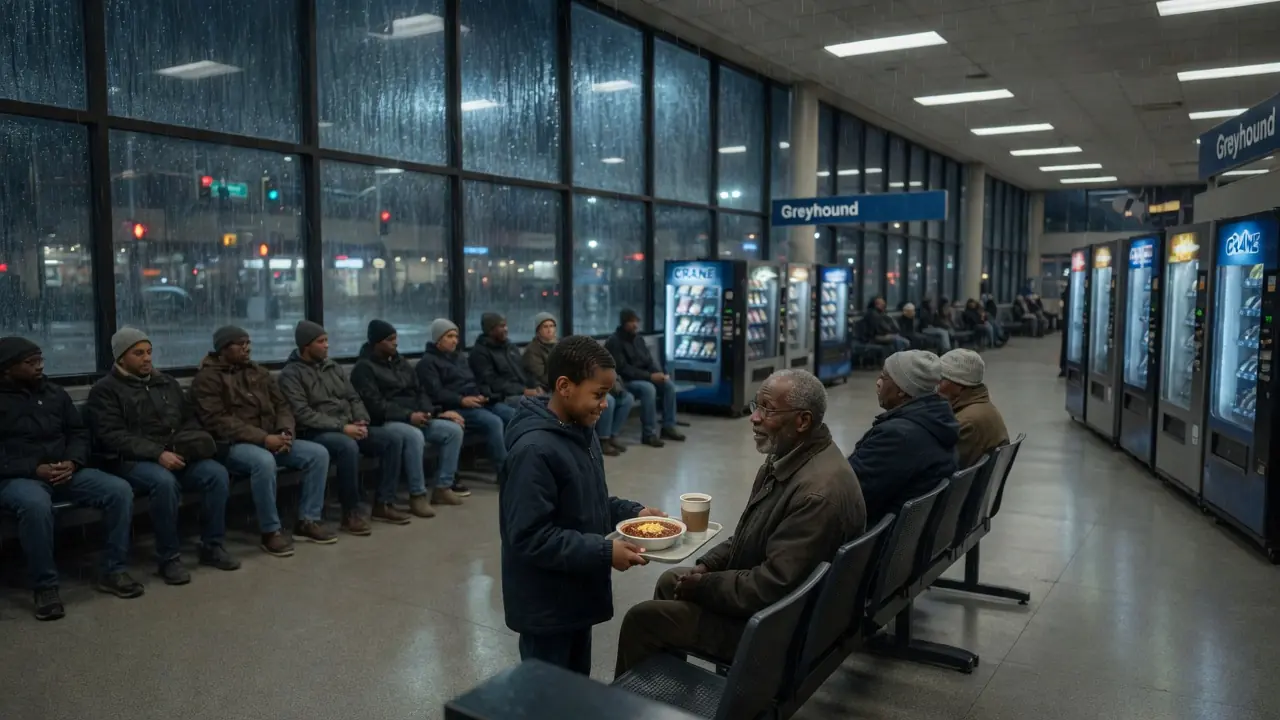
“Caroline,” he said.
The moment he heard his daughter’s voice, he closed his eyes.
“No, no, I am safe,” he said. “A young man helped me. Yes. A boy. His mother is here now.”
His voice broke slightly.
“I am sorry, baby. I did not mean to worry you.”
Devin looked down at his sneakers.
Renee placed a hand on his shoulder.
Caroline arranged everything quickly. She paid for a morning ticket over the phone. She spoke to the station supervisor. She booked her father a discounted room at a nearby motel, but when Renee heard the location, she frowned.
“That’s too far to walk in this weather,” she said.
Mr. Whitaker protested.
Renee ignored him.
“You can sit with us at the diner across the street until your daughter confirms the room and the shuttle gets here,” she said. “I’m not leaving you alone in this station all night.”
“Mrs. Brooks, you have already done enough.”
“My son gave away his dinner,” Renee said. “At this point, we’re committed.”
Devin grinned.
Mr. Whitaker laughed softly.
They crossed the street together under Renee’s umbrella, moving slowly through the rain. The diner was open late, glowing with clean white light through the windows. A waitress led them to a booth near the back.
Renee ordered Devin pancakes.
He tried not to look too grateful.
Mr. Whitaker ordered tea, then looked embarrassed when Renee added toast and eggs.
“You need food with that tea,” she said.
“Yes, ma’am,” he replied, and Devin laughed because Mr. Whitaker sounded just like him.
They sat in the diner until the shuttle came.
Before Mr. Whitaker left, he asked Renee for their address.
Renee hesitated.
“I understand your caution,” he said. “Then perhaps an email?”
He wrote his daughter’s email on a napkin and handed it to her.
Then he turned to Devin.
“Young man,” he said, “I will not forget tonight.”
Devin had heard adults say things like that before. Usually, they forgot.
But Mr. Whitaker’s voice made the words feel different.
Devin shrugged because he did not know what else to do.
“It was just chili.”
Mr. Whitaker shook his head.
“No,” he said. “It was shelter. It was dignity. It was someone seeing an old man before the world walked past him.”
Devin swallowed.
The old man reached into his canvas bag and pulled out a small metal object. It was a worn silver bus token, scratched around the edges.
“This is from my old company,” he said. “They do not use these anymore. I kept it for luck.”
He placed it in Devin’s hand.
“One day, when you build that idea of yours, remember that transportation is not only about moving bodies. It is about carrying people toward their lives.”
Devin stared at the token.
“Thank you,” he said.
The shuttle arrived.
Mr. Whitaker stepped into the rain, then looked back once.
“Goodnight, Devin Brooks.”
“Goodnight, Mr. Whitaker.”
The door closed.
The shuttle pulled away.
For a long time, Devin kept the bus token in his hand.
Years passed, but he never lost it.
He kept it through middle school, through high school, through the summer his mother’s car broke down and they had to plan their lives around bus routes. He kept it when kids at school teased him for carrying an old coin in his pocket.
“What is that?” one boy asked.
“A reminder,” Devin said.
“Of what?”
“To pay attention.”
The boy rolled his eyes, but Devin did not care.
He became the kind of teenager who noticed things.
He noticed elderly neighbors waiting too long in bad weather.
He noticed mothers carrying groceries and toddlers at the same time.
He noticed people missing appointments because a bus came early, late, or not at all.
He noticed how the world punished people for not owning a car.
In high school, he joined an after-school engineering club. He learned basic mechanics from YouTube videos and a patient teacher named Mr. Daniels. He took apart donated bicycles and repaired them for neighborhood kids. He volunteered with a community center that delivered groceries to seniors.
When he was sixteen, he started a weekend project called Ride Along Saturdays. It was simple at first. He and two friends helped older neighbors plan bus routes, carry bags, and get to appointments. They made paper schedules with large print. They walked people to stops. They called ahead when someone needed help getting off a bus.
Some adults praised him.
Some said it was nice but small.
Devin remembered what Mr. Whitaker had said.
Most important ideas begin that way.
When Devin was eighteen, he wrote his college application essay about the night in the Greyhound station. He wrote about the sound of rain against the windows, the smell of chili, the old man’s trembling hands, and the feeling of a bus token pressed into his palm.
He wrote that transportation was not just a system. It was independence. It was medicine. It was groceries. It was family. It was dignity.
He received a scholarship to study urban planning at Ohio State.
Renee cried so hard when the letter came that Devin had to read it aloud twice because she missed half of it the first time.
Before leaving for college, Devin searched online for Samuel Whitaker.
He found very little.
A church newsletter from Pittsburgh.
An old transit workers’ retirement banquet.
A photo of Mr. Whitaker standing beside a green city bus, younger but unmistakable, smiling with one hand resting on the hood.
Devin printed the photo and placed it in a folder with the bus token.
He emailed Caroline Whitaker once, using the address from the napkin his mother had saved. The message bounced back.
He tried the school website, but Caroline had moved to another district.
Life, as it does, continued.
College was hard.
Not because Devin was not smart enough, but because everything seemed to cost more than expected. Books, bus fare, laundry, meals between classes. He worked part-time in the campus transportation office, answering phones and filing route complaints.
He learned how cities made decisions. He learned about budgets, zoning, bus deserts, aging populations, accessibility laws, and all the quiet ways systems could leave people behind.
The more he learned, the more he thought about the people in his old neighborhood.
People like his grandmother.
People like Mr. Whitaker.
People like every senior who stood at a curb with grocery bags and hoped the bus would come before the weather changed.
By twenty-four, Devin had a plan.
He wanted to create a nonprofit shuttle service for seniors in underserved neighborhoods. Not an ambulance. Not a taxi. Something simpler and warmer. A small fleet of accessible vans and buses that would take elderly residents to grocery stores, clinics, community centers, churches, and family visits.
He called it Silver Route.
The name came to him one morning while holding the old bus token.
Silver for age.
Route for movement.
Hope for everyone in between.
But ideas needed money.
Money for vehicles.
Money for insurance.
Money for drivers.
Money for permits.
Money for repairs.
Money for the thousand things people did not see when they praised a dream.
Devin applied for grants. He pitched local businesses. He spoke at community meetings. He made presentations with charts and maps. He wore his only good suit until the elbows began to shine.
Some people liked him.
Most people said no.
One foundation director smiled politely and told him, “Your story is moving, but the model needs stronger backing.”
A city official said, “Transportation is complicated.”
A businessman said, “Seniors are not exactly a growth market.”
That one stayed with Devin.
He walked home afterward in the rain, angry in a quiet way.
Seniors were not a market.
They were people.
He almost gave up that winter.
His mother knew.
One evening, she found him at the kitchen table with papers spread around him, the bus token lying near his laptop.
“You tired?” she asked.
“More than tired.”
She sat across from him.
“Then rest.”
“I don’t need rest. I need money.”
“You need both.”
Devin rubbed his eyes.
“Maybe it’s too big.”
Renee looked at him for a long moment.
“When you were twelve,” she said, “you had six dollars, a dead phone, and no plan. But you still helped that man.”
“That was different.”
“No. It was smaller. That doesn’t mean it was different.”
Devin picked up the bus token.
“I wonder if he remembered me.”
His mother smiled softly.
“Some people remember kindness longer than they remember names.”
Two weeks later, Devin received a letter.
Not an email.
A real letter.
The envelope was cream-colored, thick, and addressed in careful handwriting.
Mr. Devin Brooks
Columbus, Ohio
He opened it at the kitchen table.
Inside was a short note.
Dear Mr. Brooks,
My name is Caroline Whitaker Hayes. I believe you once helped my father, Samuel Whitaker, in a bus station during a storm. I have been trying to find you for some time. If you are the same Devin Brooks, please call me at the number below.
With gratitude,
Caroline
Devin stared at the page.
His mother leaned over.
“Is that…”
“Yes.”
He called the number with shaking hands.
Caroline answered on the second ring.
“This is Caroline.”
“My name is Devin Brooks. I think I helped your father once. In Columbus. At the Greyhound station.”
There was silence.
Then Caroline exhaled sharply.
“Oh my goodness,” she said. “It is you.”
They spoke for nearly an hour.
Caroline told him her father had never forgotten that night. He had told the story at church, at family dinners, at doctors’ appointments, to anyone patient enough to listen.
“The boy bought me chili,” he would say. “The boy gave me shelter when grown people gave me instructions.”
Devin covered his eyes with one hand.
Caroline’s voice softened.
“My father passed away last spring.”
“I’m sorry,” Devin whispered.
“He went peacefully,” she said. “And he left something for you.”
“For me?”
“Yes. But first, he made me promise to find out what kind of man you became.”
Devin almost laughed through the tears in his throat.
“That sounds like him.”
“He was very particular.”
“He gave me a bus token.”
“I know,” Caroline said. “He mentioned that in the letter.”
“What letter?”
“The one he left for you.”
Three days later, Caroline drove to Columbus.
She was in her fifties, with glasses, a calm voice, and her father’s careful way of listening. She met Devin and Renee at a community center where Devin held Silver Route planning meetings.
After introductions, Caroline looked around the room at the maps taped to the wall, the senior transit surveys, the volunteer sign-up sheets, and the hand-drawn Silver Route logo.
“My father would have loved this,” she said.
Devin’s throat tightened.
Caroline opened a leather folder.
“My father did not have great wealth,” she said. “But he was careful. He saved. He also owned, with two former coworkers, a small retired shuttle bus they used for church trips and community outings. After the others passed, it became his responsibility.”
She slid a photograph across the table.
It showed a short white-and-blue shuttle bus parked in front of a garage.
“It needs some work,” Caroline said. “But it runs.”
Devin stared at it.
Caroline continued.
“My father left instructions that the bus be transferred to you if you were still the kind of person he believed you were. He also left a small fund for repairs, registration, and insurance.”
Renee covered her mouth.
Devin could not speak.
Caroline took out a sealed envelope.
“And he left this letter.”
Devin opened it carefully.
The handwriting was a little shaky, but clear.
Dear Devin Brooks,
If this letter has reached you, then my Caroline has found the boy from the storm.
Perhaps you are no longer a boy. Perhaps you have become busy, tired, important, or all three. I hope you have become kind. Not soft. Kind. There is a difference.
On the night we met, I was an old man with no wallet, no ticket, no phone number, and no plan. Many people saw me. You noticed me.
You gave me chili when you were hungry. You gave me warmth when you were cold. You gave me dignity when I was embarrassed. You reminded me that a person is not finished simply because he needs help.
I heard from Caroline that you once spoke of making transportation better for people who are often forgotten. If you still carry that dream, I would like my old bus to carry it with you.
A bus is more than an engine and seats. It is a promise that someone will not be left standing alone.
Take the bus. Fix what needs fixing. Paint it whatever color hope looks like to you. Then use it well.
And if you still have the token, keep it. It was never luck. It was a reminder.
With gratitude,
Samuel Whitaker
Devin pressed the letter to his chest.
Nobody spoke for a while.
Outside the community center, traffic moved along the avenue. A city bus sighed at the curb. An elderly woman with a cane waited beneath the stop sign, looking down the street.
Devin looked at her through the window.
Then he looked back at Caroline.
“I still have the token,” he said.
Caroline smiled.
“I thought you might.”
The shuttle arrived in Columbus two weeks later.
It came on a flatbed truck from Pittsburgh, dusty and tired-looking, with faded paint and seats that smelled faintly of vinyl and old church bulletins. To most people, it might have looked like a worn-out vehicle.
To Devin, it looked like a beginning.
He spent evenings and weekends repairing it with help from Mr. Daniels, his old teacher, and a few mechanics who volunteered after hearing the story. They changed belts, repaired the lift, replaced tires, checked brakes, cleaned the seats, updated the lights, and installed grab bars.
Devin insisted on doing as much work himself as he could.
“When people ride this,” he said, “I want to know what is carrying them.”
The painting took the longest.
He chose a clean blue and white design with silver lettering.
On one side, it read:
Silver Route
On the other side, beneath the windows, it read:
The Samuel Whitaker Community Shuttle
Near the door, in smaller letters, Devin added:
Founded from one act of kindness in a storm.
The first official ride happened on a bright Saturday morning in spring.
The whole neighborhood seemed to gather outside the community center. Seniors came with walkers, church hats, grocery carts, and careful smiles. Children waved paper signs. Local reporters showed up after Caroline contacted them. Renee stood near the front, wearing her best blouse, crying before anything even happened.
Devin wore a navy jacket and held the old silver bus token in his palm.
Caroline stood beside him.
So did Mr. Daniels.
So did the woman from the old Greyhound food counter.
Devin had found her too.
Her name was Miss Linda, and she laughed when he reminded her that she had lowered the price of chili.
“I knew you were feeding somebody else,” she said. “Kids buying chili for themselves don’t look that serious.”
Before the ribbon cutting, Devin stepped onto the shuttle’s first step and turned toward the crowd.
“I was twelve years old when I learned that being stranded is not always about distance,” he said. “Sometimes people are stranded inside systems that don’t see them. Sometimes they are stranded by age, money, illness, bad weather, or pride. Sometimes they are just waiting for someone to notice.”
The crowd grew quiet.
“Mr. Samuel Whitaker taught me that transportation is about dignity. My mother taught me that kindness needs wisdom. This shuttle is here because an old man remembered a hungry boy’s small act, and because a community believed that small things can grow.”
He looked toward the seniors waiting for the first ride.
“Silver Route is for you. Grocery stores, clinics, community centers, visits with family, church lunches, pharmacy trips, and anywhere else that helps you keep living your life.”
Applause rose across the sidewalk.
Devin climbed down and handed the scissors to Caroline.
“No,” she said, smiling. “You do it.”
He shook his head.
“Your father gave us the bus.”
“And you gave him hope first.”
So they cut the ribbon together.
The first passengers boarded slowly.
Devin greeted each one by name.
“Good morning, Mrs. Lewis.”
“Watch your step, Mr. Grant.”
“We’ve got room for your cart, Miss Alma.”
Renee watched him help an elderly man settle into a seat near the front, and for a moment she saw him at twelve years old again, standing in a bus station with a tray of chili in his hands.
The shuttle’s engine started with a deep, steady sound.
Devin smiled.
A healthy bus has a rhythm.
He took the driver’s seat for the first ride, though he already had trained volunteer drivers ready for future routes. He adjusted the mirror and looked back at the passengers.
“You all ready?”
Miss Alma lifted one hand.
“Baby, I’ve been ready since 1987.”
Everyone laughed.
The shuttle pulled away from the curb.
People clapped as it rolled down the street, blue and white paint shining in the morning light, silver letters clear against the side.
The first stop was a grocery store.
Then a pharmacy.
Then a senior center.
Then an apartment building where three older residents had not been able to attend church lunch in months because the regular bus stop was too far.
By the end of the first day, Silver Route had carried twenty-eight seniors.
By the end of the first month, it had carried more than three hundred.
By the end of the first year, Devin had secured two grants, three business sponsors, and enough donations to add a second vehicle.
The city officials who had once called transportation complicated now invited him to meetings.
The foundation director who had said his model needed stronger backing sent an email asking to talk.
The businessman who said seniors were not a growth market appeared at a fundraiser and tried to shake Devin’s hand.
Devin shook it politely.
But he never forgot.
He built Silver Route carefully.
He hired drivers who knew how to be patient.
He trained volunteers to carry groceries without rushing people.
He made sure every senior was greeted by name whenever possible.
He placed a small sign inside each vehicle:
No one rides invisible here.
Years later, when Devin was thirty-two, Silver Route had six vehicles serving three neighborhoods. The program had become a model other cities studied. Reporters wrote articles about him. Schools invited him to speak. People called him a community leader.
But on the wall of his office, above awards and newspaper clippings, he kept three things framed together.
A photo of Samuel Whitaker beside an old green bus.
A copy of the letter.
And the silver bus token.
One rainy evening in November, Devin stayed late at the office after a board meeting. The rain tapped against the window in a familiar rhythm. For a while, he sat alone, listening.
Then his phone buzzed.
It was a message from one of the drivers.
Elderly man at downtown terminal. Missed connection. No wallet. Says he needs to get to Cleveland. What should we do?
Devin stared at the words.
The years fell away.
He was twelve again.
Cold.
Hungry.
Watching an old man search empty pockets.
He grabbed his jacket and keys.
I’m coming, he replied.
At the terminal, the driver stood beside a thin elderly man in a gray coat. The man looked embarrassed, tired, and afraid of being a burden. Travelers moved around him, busy with their own destinations.
Devin approached slowly.
“Sir,” he said gently, “my name is Devin Brooks. I hear you’ve had a hard night.”
The old man nodded.
“I do not want to trouble anyone.”
Devin smiled.
“You’re not trouble.”
The man looked at him with uncertain eyes.
Devin turned to the driver.
“Get him something hot to eat. Chili if they have it. Coffee too.”
The driver nodded and hurried toward the food counter.
The old man blinked.
“You don’t have to do that.”
“I know,” Devin said. “Someone taught me that’s exactly why it matters.”
He helped the man sit where the station lights were bright and people were nearby. Then he made calls, found the man’s family, arranged a safe ride, and stayed until everything was settled.
Hours later, after the old man was safely on his way, Devin walked back outside.
The rain had softened.
The Silver Route shuttle waited at the curb, engine humming.
On its side, under the clean silver letters, Samuel Whitaker’s name shone beneath the station lights.
Devin stood there for a moment, thinking of a bowl of chili, a dead phone, a worried mother, and an old bus token that had never really been luck.
Then he climbed into the shuttle and drove home through the rain, carrying the promise forward.
Not because the world had become easy.
Not because every act of kindness returned as a bus, a grant, or a miracle.
But because some people were still standing in storms.
And someone had to notice.