The vinyl on the booth seat was cracked. A web of tiny black fissures spreading from a single deep wound in the red plastic. From this booth, John, known to everyone who mattered as Preacher, watched the world through the greasy glass of the diner window. He saw the heat rising in waves off the asphalt of the parking lot. Saw the weary slump of people getting out of their cars, their faces already defeated by the Tuesday afternoon sun.
Inside the air was thick with the smell of old coffee and frying onions. A smell Preacher associated with long roads and longer nights. His men flanked him. Four of them crammed into a space meant for two. They were a study in leather and denim, a collection of scars and faded tattoos that told stories better than words ever could.
Silence was their currency. They didn't need to talk. They sat a silent, immovable island in the sea of clattering cutlery and low chatter. The other patrons gave them a wide berth. Waitresses approached their table with a practiced mixture of caution and feigned indifference. It was a dance Preacher knew well. They were lions in a field of sheep, and everyone was acutely aware of it.
Then the bell above the door chimed, a tiny, cheerful sound that was immediately swallowed by the tension that followed the man who walked in. He was old, not just elderly, but ancient, as if carved from a piece of driftwood left too long in the sun. His back was a frail curve inside a dark green jacket. The fabric worn thin at the elbows and collar, but impeccably clean. On the breast was a faded patch, an eagle with its wings spread, barely visible.
He moved with a slow, deliberate shuffle, his worn-out loafers whispering against the linoleum. His hands trembled, a constant, gentle tremor that made the simple act of walking seem like a monumental effort. Every eye in the diner followed him. People paused with forks halfway to their mouths. The waitress at the counter froze, her hand hovering over the coffee pot. They all expected him to take a seat at one of the empty single tables by the wall.
Instead, he walked straight toward the island of leather in silence. He didn't hesitate. He didn't look around for approval. He walked right up to their booth, his gaze fixed on Preacher. The air grew thick, heavy. One of Preacher's men, a mountain of a man named Bear, tensed, his hand instinctively dropping to his side. Preacher gave a nearly imperceptible shake of his head, and Bear's hand relaxed.
Preacher said nothing. He just watched, his expression unreadable. "I don't like eating alone," Arthur continued, his voice wavering just slightly. "It doesn't feel right." He took a small, shaky breath and asked the question that would change everything. "I was wondering, could you eat lunch with me?"
The silence that followed was absolute. It was so profound that the hum of the fluorescent lights overhead sounded like a roar. The other bikers looked at Preacher, waiting for the signal. They expected a dismissal, a gruff rejection, a cold stare that would send the old man shuffling away. Preacher held Arthur's gaze. He saw the loneliness there, a canyon carved by years of silent meals and empty rooms. He saw the flicker of fear, but beneath it, an incredible, desperate bravery. It took guts to walk up to five Hell's Angels and ask for company. It took a kind of strength most people lost by 30.
After a moment that stretched into an eternity, Preacher gave a slow, deliberate nod. He gestured with his chin to the empty space on the bench beside him. "Sit down, Arthur," he said. His voice was a low rumble, like distant thunder. "We'd be honored."
The collective exhale in the diner was almost audible. Arthur's shoulders, which had been hunched with tension, sagged with relief. He carefully maneuvered his frail body into the booth, sitting next to Preacher. The vinyl sighed under his weight. A young waitress, Sarah, approached the table, her notepad clutched in a white-knuckled grip. She'd been watching the whole exchange from behind the counter, her heart lodged somewhere in her throat. "What can I get for you folks?" she asked, her voice a little too high.
The bikers ordered with grunts and nods. Burgers, fries, black coffee, standard fare. Then all eyes turned to Arthur. He picked up the plastic-coated menu, his trembling hands making it difficult to hold steady. He squinted at the text. "I'll have the meatloaf special," he said finally, his voice regaining some of its strength. "And a glass of milk." Sarah scribbled it down and practically fled from the table.
The initial silence at the booth was awkward. Arthur seemed to shrink into himself as if suddenly realizing the absurdity of his situation. He was an old soldier sitting with a pack of modern-day outlaws. It was Bear who broke the ice. "That's a nice jacket, Arthur," he said, his voice a surprising baritone, much gentler than his appearance suggested. Arthur looked down at his old uniform jacket, a faint smile touching his lips. "This old thing served with me in Korea. It's seen better days. So have I, for that matter." The men chuckled, a low rumbling sound.
The tension began to dissolve, replaced by a strange, tentative curiosity. Arthur, emboldened, started to talk. He spoke of Eleanor, of the garden she used to keep, of the way she'd hum when she cooked. He didn't talk about the war, not the fighting part. He talked about the long boat ride home, the feeling of seeing American soil again. He spoke of a life lived, of love and loss, his words painting a picture of a man left behind by time. The bikers listened. They didn't interrupt. They didn't offer platitudes. They just gave him the one thing he'd been starving for. An audience.
Preacher watched him, noticing the small things. The way Arthur carefully pulled out a worn leather wallet, opening it to reveal just a few crumpled bills. The way he meticulously counted out enough for his meal and a small tip, setting it on the table as if to prove he could pay his own way. He saw the pride warring with the loneliness in the old man's eyes. Their food arrived, and for a while the only sounds were the scraping of forks and the clinking of glasses. Arthur ate his meatloaf slowly, methodically, as if it were the finest meal he'd ever had.
They were halfway through the meal when the bell on the door chimed again. A man walked in, his smile too wide, his clothes too expensive for the humble diner. He was in his late 30s with slicked-back hair and a predatory grace. He scanned the room and his smile tightened when he saw Arthur sitting in the bikers' booth. He strode over, his polished shoes clicking on the floor. "Uncle Art," he said, the word "uncle" dripping with false affection. "There you are. I was getting worried. You shouldn't be wandering off like this."
Arthur stiffened. The light in his eyes dimmed. "Hello, Rick," he said, his voice barely a whisper. Rick placed a hand on Arthur's shoulder, his grip deceptively strong. Preacher saw Arthur wince, a flicker of pain crossing his face. "You shouldn't be bothering these gentlemen," Rick said, his eyes flicking over the bikers with a dismissive sneer. "Come on, let's get you home. You've got those papers to sign, remember?"
Preacher didn't move a muscle. He simply raised his eyes and met Rick's gaze. The air turned to ice. "He's eating with us," Preacher said, his voice flat and cold. It wasn't a request. It was a statement of fact. Rick's smile faltered. He was used to intimidating old men, not men who looked like they could tear him apart with their bare hands. He tried to bluster. "Look, I'm his nephew. I'm responsible for him." "He's a grown man," Preacher replied, his voice dropping even lower. "He can decide for himself who he eats with. And right now, he's eating with us."
The challenge hung in the air, thick and heavy. Rick's eyes darted around, looking for support that wasn't there. He saw only the cold, hard stares of the other bikers. Defeated for the moment, he let go of Arthur's shoulder, his fake smile returning like a mask. "All right, all right, no problem," he said, raising his hands in mock surrender. "Finish your lunch, uncle. I'll come back for you in an hour. We've got business to take care of." He shot one last venomous glare at Preacher before turning and walking out, the bell on the door sounding like a death knell in his wake.
After Rick left, a heavy silence descended on the table. Arthur stared down at his half-eaten meatloaf, his appetite gone. The tremor in his hands was worse now, his whole body seeming to vibrate with a quiet fear. He looked smaller, frailer than he had just minutes before. Preacher waited. He didn't push. He let the silence do the work. Finally, Arthur looked up, his eyes swimming with unshed tears. "He's not my nephew," he whispered, the admission costing him dearly. "He's the son of a man who used to live next door. He started coming around after Eleanor passed."
Bear leaned forward slightly. "What kind of business, Arthur?" he asked gently. Arthur shook his head, a gesture of shame and helplessness. "My pension. He helps me cash the checks," he swallowed hard. "Or he used to. Now the money just disappears. He says it's for expenses. For my care." He looked at his worn-out jacket, at his scuffed shoes. "He wants me to sign the house over to him. Says it's too much for me to manage. He says he'll put me in a nice home."
The pieces clicked into place. It was a story as old as time. A predator circling a vulnerable old man, isolating him, draining him of his resources, waiting for the final kill.
Preacher's jaw was a tight line. He looked at Arthur, at this proud veteran who had fought for his country now being cornered in his own life by a common vulture. He felt a cold, slow, burning rage begin to build in his chest. He had seen bullies like Rick his whole life. They preyed on the weak because they were cowards. And there was nothing Preacher hated more than a coward. He exchanged a single silent look with his men. It was all that was needed. An entire conversation passed between them in that one glance. Understanding, agreement, resolve. They were in this now, all the way.
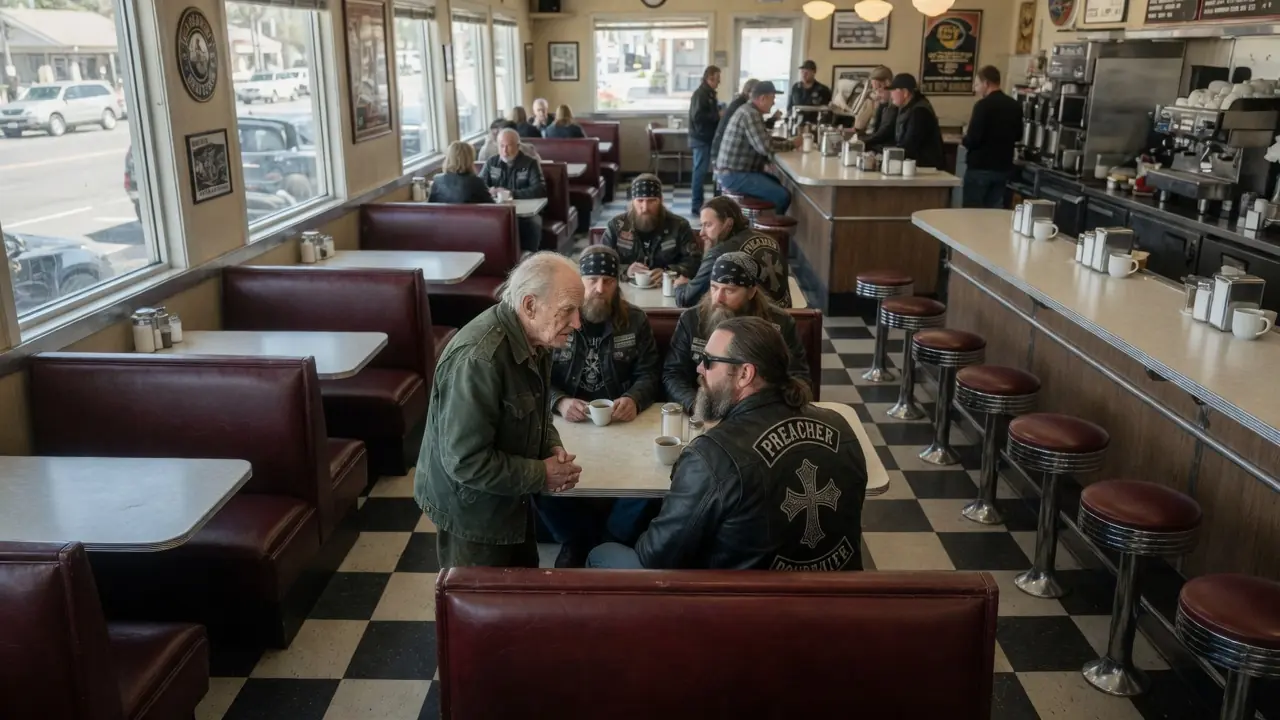
He turned his full attention back to Arthur. The old man was looking down, defeated, as if he expected them to get up and leave, to not want to be involved in his messy, pathetic life. "Arthur," Preacher said, his voice calm, cutting through the old man's despair. "Look at me." Arthur slowly raised his head. "What time does he come back for you?" Preacher asked. "An hour," Arthur mumbled. "He said an hour." Preacher nodded once. He took a sip of his cold coffee, his eyes never leaving Arthur's. "We'll be here," he said. The words were simple, but they landed with the force of a promise forged in steel. It wasn't just a statement. It was a shield. It was a declaration of allegiance.
For the first time that day, a real genuine tear escaped Arthur's eye and traced a path through the wrinkles on his cheek. It wasn't a tear of sadness, but of profound, overwhelming relief. He had asked for lunch companions and he had found guardians.
The hour passed in near silence. The diner slowly emptied out as the lunch rush ended, leaving just a few stragglers in the strange party in the corner booth. Sarah moved around the empty tables, wiping them down with a damp cloth, her movements slow and deliberate. She kept refilling the bikers' coffee mugs without being asked, her own small act of solidarity. They were no longer just customers. They were a fortress and she was a sentry.
Arthur didn't say much. He just sat there occasionally taking a sip of his milk. The constant tremor in his hand seeming to have lessened. The presence of the men around him was a tangible thing. A wall of quiet strength that held his fear at bay. Preacher sat like a statue watching the door. He was calm, his breathing even. This was a different kind of battle than the ones he was used to, but the principles were the same. You hold your ground. You protect your own. And in the space of a single lunch, Arthur had become one of his own.
The bell on the door chimed, and the temperature in the room dropped 10 degrees. Rick was back. And this time, he wasn't alone. The man with him was shorter, but twice as wide, with a shaved head and a flat, broken nose. His neck was a column of muscle that strained against the collar of his tight black t-shirt. He was the muscle, the unspoken threat Rick used to get his way.
Rick's eyes widened in disbelief when he saw the bikers were still there, sitting in the same booth, flanking Arthur like a royal guard. His face, usually a mask of oily charm, twisted into an ugly snarl. "I thought I told you to be ready," he snapped at Arthur, ignoring the others. He took a step forward and grabbed Arthur's arm, yanking him. "Let's go, old man. You've wasted enough of my time."
The sound of Preacher's chair scraping against the linoleum was like a crack of thunder in the quiet diner. He rose to his full height and seemed to fill the entire room. He didn't shout. He didn't need to. His voice was a low, deadly whisper. "Take your hand off him."
Time seemed to slow down, to stretch like taffy. Every detail became razor sharp. The way Rick's knuckles turned white as he tightened his grip on Arthur's thin arm. The faint sheen of sweat on Rick's forehead. The way the heavy man shifted his weight from one foot to the other, preparing for violence. Sarah froze by the counter, her hand over her mouth.
Rick, emboldened by his backup, tried to stare Preacher down. "This is a family matter. It's none of your business." "You made it our business when you put your hands on our friend," Preacher said, his eyes as cold and hard as chips of granite. Mark took a menacing step forward. In perfect silent unison, the other four bikers stood up. They didn't move forward. They just stood. A solid wall of leather and muscle that blocked the path to the door. The diner, which had felt spacious moments before, now felt like a cage.
Rick's bravado began to crumble. This wasn't going according to plan. He let go of Arthur, giving him a slight shove. "Fine, stay with your new friends. But you'll regret this, old man." "No," Preacher said. "You will." He took a slow step forward, closing the distance between them. Rick and his goon took an involuntary step back. "We know about the pension checks, Rick. We know about the house. We know you've been bleeding this man dry."
Rick's face went pale. "You don't know anything," he stammered. "He's a confused old man. He makes things up." "He's a Korean War veteran," Preacher countered, his voice laced with contempt. "He's forgotten more about honor than you'll ever know, and we believe him." He paused, letting the weight of his words sink in. "So, here's what's going to happen. You're going to walk out that door. You're never going to contact Arthur again. You're never going to come within 100 yards of his house. If we see you, if we hear about you, we will find you. Are we clear?"
Rick's eyes darted towards Mark, but his enforcer looked uncertain. He was big, but he wasn't stupid. He could maybe take one of them, but not five. This was a losing fight. Desperate, Rick played his last card. "I'll call the cops. I'll tell them you're threatening me." A dry, humorless smile touched Preacher's lips. "Please do," he said softly. "I'm sure the sheriff would be very interested to hear a report on elder abuse and financial fraud. We'd be happy to give a statement. All of us concerned citizens just trying to help a veteran."
The fight drained out of Rick completely. He was beaten. He looked from Preacher's unyielding face to the wall of bikers. And he knew it was over. Without another word, he and Mark turned and practically scrambled out of the diner, the bell on the door mocking their hasty retreat.
The tension in the room snapped. Arthur, who had been standing, swayed on his feet. Bear reached out and gently guided him back down into the booth. The old man buried his face in his trembling hands and began to cry. Deep, ragged sobs of fear and relief that shook his entire body. Sarah rushed over with a glass of water, her own eyes wet. She placed it on the table, her hand briefly covering Arthur's. It was a small gesture of comfort, but it was everything.
Preacher sat down next to Arthur. He placed a large, calloused hand on the old man's shaking shoulder. The touch was surprisingly gentle, firm, and reassuring. "It's over, Arthur," Preacher said, his voice back to its low rumble. "You're safe now."
They didn't just leave him at the diner. They paid his bill and theirs, and walked him out to the parking lot. They helped him into the sidecar of Bear's bike, and the procession of motorcycles rumbled through the quiet suburban streets to Arthur's small, neat house. When they arrived, they saw the full extent of the neglect. The lawn was overgrown. The paint was peeling on the porch, and a shutter hung crookedly from a single hinge. Inside, it was clean but barren. The fridge held little more than a carton of milk and a half-empty jar of pickles. Rick had been taking the money, but none of it was going toward Arthur's care.
Preacher made a phone call. The next morning, a Saturday, Arthur woke to the sound of engines. He looked out his window and saw not five but 15 motorcycles parked along his curb. For a moment, fear seized him, but then he saw the men getting off their bikes. They weren't carrying weapons. They were carrying tool boxes, hedge trimmers, and bags of groceries.
For the rest of the weekend, the quiet street was filled with the sounds of hammers, saws, and laughter. The bikers descended on Arthur's house like a benevolent army. They mowed the lawn, fixed the shutter, painted the porch. They filled his fridge and pantry. And one of them, a surprisingly good cook named Slim, made a massive pot of stew that filled the house with a warmth it hadn't known in years.
That was just the beginning. The bikers didn't just fix Arthur's house, they fixed his life. They became his family. Preacher helped him get his finances in order, reporting Rick to the authorities. Sarah, finding a courage she never knew she had, went to the police and gave a statement corroborating Arthur's story. An investigation was launched and Rick and his associate were eventually arrested and convicted for fraud and elder abuse.
Arthur was never lonely again. Every Sunday, a few of the bikers would show up for dinner. Arthur would tell his stories and they would listen. He taught a young prospect how to rebuild the carburetor on a vintage motorcycle, his gnarled hands steady and sure as he worked. They took him to his doctor's appointments. They took him to the VFW Hall. They gave him a new reason to wake up in the morning. He had a family, a loud, unconventional, fiercely loyal family clad in leather.
Arthur Pendleton lived for eight more years. He passed away peacefully in his sleep at the age of 91, in his own bed, in his own home. His funeral was a sight to behold. The small local cemetery was filled with the rumble of over 50 motorcycles. Hell's Angels from three different states had ridden in to pay their respects. They stood in silent formation as the honor guard folded the flag from his casket, their leather vests, their cuts, a stark contrast to the somber suits of the other mourners.
When the service was over, Preacher stood before the grave. He held a small glass of milk just like the one Arthur had ordered on the first day. He raised it high. "To good company," he said, his voice thick with an emotion he rarely showed. The other bikers raised their hands in a silent toast. "To good company," a simple phrase that had come to mean everything. It meant loyalty. It meant family. It meant that a lonely old man had walked into a diner and found an army of angels disguised in leather and riding machines of thunder.