The bell above the door at Brooks Family Shoes had a sound unlike any other bell on Maple Street.
It did not ring sharply or brightly. It gave a tired little chime, soft and familiar, as if it had been greeting the same people for so many years that it no longer needed to announce itself loudly. It simply said, Come in. You are known here.
For thirty-eight years, that bell had hung above the narrow glass door of the small shoe store in Chattanooga, Tennessee. The store sat between a laundromat with humming machines and a corner diner that smelled of coffee, bacon, and fried onions from morning until night. Across the street stood Maple Street Elementary, a red-brick school with a cracked basketball court, a flagpole, and a playground where children shouted through recess no matter how cold the wind was.
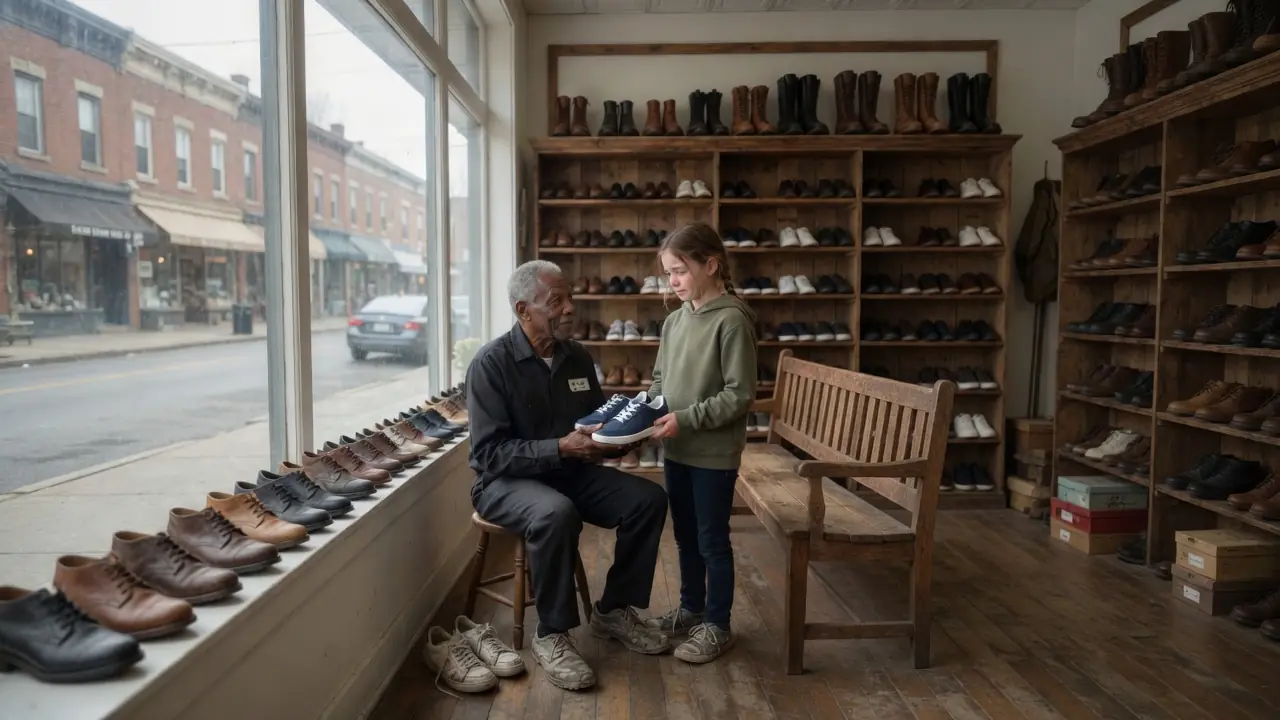
Brooks Family Shoes was not fancy. It had no glowing sign, no music playing from hidden speakers, no walls covered in brand posters. Its shelves were made of dark wood polished by time and careful hands. Rows of children’s sneakers, church shoes, work boots, and school shoes lined the walls. Near the front window sat a wooden bench with a small brass shoehorn hanging from one side. Behind the counter stood an old cash register that still made a heavy clicking sound whenever it opened.
And behind that counter, most days from eight in the morning until six in the evening, stood Mr. Elijah Brooks.
He was seventy-four years old, a tall Black man with broad shoulders that had softened with age but not lost their strength. His hair had turned silver-white at the temples, and his face held deep lines around the eyes from years of smiling, squinting, worrying, and watching people more carefully than they realized. He wore pressed shirts, brown suspenders, dark trousers, and polished leather shoes every day, even when the store was empty.
Some people in the neighborhood called him Mr. Brooks. Older customers called him Elijah. Children called him the Shoe Man.
He did not mind any of those names.
He had opened the store with his wife, Ruth, when they were still young enough to believe that hard work could protect a family from every storm. Ruth had chosen the yellow curtains for the front window. Ruth had written the first sign by hand: Children’s shoes measured for free. Ruth had been the one who said a shoe store was not really about shoes.
“It is about dignity,” she had told him the night before the grand opening, standing in the middle of the empty shop with a broom in one hand and hope in her eyes. “When people have decent shoes, they walk differently.”
Elijah had never forgotten that.
Ruth had been gone seven years now. The yellow curtains had faded. The neighborhood had changed. A new shopping plaza had opened twenty minutes away, and most people went there when they wanted bright lights and weekend sales. Brooks Family Shoes survived on loyal customers, repaired soles, school-season rushes, and Elijah’s stubborn refusal to close a place that still mattered to people who could not always explain why.
Every morning, he unlocked the door, swept the sidewalk, turned the sign to OPEN, and stood behind the counter as if the whole world might still need exactly what he had to offer.
One Tuesday in early September, the kind of Tuesday that felt ordinary enough to be forgotten, Elijah noticed a little girl standing outside his shop window.
She was small, maybe nine years old, with a faded purple backpack hanging from one shoulder and a stack of school papers held tightly against her chest. Her dark brown hair was pulled into two uneven braids, and her face had the thin, careful look of a child who had learned not to ask for much. She stood close to the window, not touching the glass, just looking at the shoes inside.
Elijah watched her from behind the counter.
Children often stopped to look at the display, especially at the sneakers with bright laces or the shiny black shoes parents bought for Sunday service. But this girl was not looking the way children usually looked. She was not pointing, smiling, or pressing her nose to the window.
She was studying the shoes quietly, as if trying to imagine what it would feel like to own something that still had shape.
Then Elijah looked down.
Her shoes were old canvas sneakers, once white but now gray with dirt and rain stains. The rubber had separated from the toe of the left shoe, leaving a small open mouth that widened whenever she shifted her weight. The right shoe had a lace that had been tied back together in the middle where it had snapped. The soles were so thin that Elijah could tell, even from inside the store, that the child must feel every pebble beneath her feet.
He had seen worn shoes before. He had grown up with them. But something about the way the girl kept curling her toes inside those broken sneakers made his heart tighten.
The bell chimed.
The girl stepped inside quickly, as if afraid she had already done something wrong.
Elijah smiled gently.
“Afternoon,” he said. “You looking for somebody, sweetheart?”
The girl shook her head, then seemed to remember manners.
“No, sir.”
Her voice was soft.
Elijah came around the counter slowly, not wanting to make her nervous. “School let out already?”
“Yes, sir.”
“Maple Street Elementary?”
She nodded.
“What grade?”
“Fourth.”
“That is a serious grade,” Elijah said. “Fourth grade is when teachers stop letting you get away with guessing.”
A small smile appeared on her face, then disappeared just as fast.
Elijah noticed how she kept one foot slightly behind the other, trying to hide the worst tear in her shoe.
“What is your name?” he asked.
“Ava.”
“Ava,” he repeated. “That is a pretty name. I am Mr. Brooks.”
“I know,” she said. Then she looked embarrassed. “I mean, people know you. My teacher said you fixed her son’s shoes one time.”
“That sounds like me.”
Ava looked around the store, her eyes moving over the rows of shoes. She was trying not to stare too long at anything.
Elijah had learned over the years that there were many kinds of wanting. Some people wanted loudly, with demands and complaints. Some wanted with calculation, trying to get the most for the least. And some wanted silently, because wanting had already disappointed them too many times.
Ava wanted silently.
“Can I help you find something?” Elijah asked.
She shook her head again.
“I was just looking.”
“That is allowed.”
“My mama says not to waste people’s time.”
Elijah gave a quiet laugh. “Looking is not wasting time. Sometimes looking is how you learn what you need.”
Ava’s fingers tightened around her papers. One sheet slipped loose and floated down near the bench. Elijah bent and picked it up. Before handing it back, he noticed the words printed at the top.
Maple Street Elementary Fall Showcase
Student Speakers and Music Program
Friday Evening, 6:00 PM
“That is nothing,” she said.
“Looks like something.”
She stared at the floor.
Elijah handed the paper back without pushing. “You in the program?”
Ava nodded.
“What are you doing?”
“I have to read my essay.”
“That is a big thing.”
“It is not that big.”
“Standing in front of people is always big.”
Ava did not answer.
Elijah glanced again at her shoes. “And you came to look at shoes for Friday?”
Her face changed immediately. Not anger. Not exactly shame. More like a door closing from the inside.
“I was just looking,” she repeated.
Elijah heard Ruth’s voice in his memory. Do not make people feel poor just because you notice they need help.
He walked to the children’s section and took a box from a low shelf.
“Well,” he said, keeping his tone casual, “you picked a good day to look. I have been trying to clear out some pairs from last season.”
Ava lifted her eyes.
“These are not used,” he added. “Just been sitting awhile.”
He opened the box. Inside was a pair of simple navy-blue sneakers with white soles. Not flashy. Not expensive-looking. Strong enough for school, clean enough for a program, soft enough for a child who walked home every day.
Ava stared at them.
Elijah had guessed her size by sight, but he still asked, “You mind if I measure your feet? Just so I know I am not wasting your time.”
She hesitated.
“I do not have money,” she whispered.
There it was.
Not an excuse. Not a complaint. Just the truth, placed carefully between them.
Elijah nodded as if she had told him the weather.
“I did not ask if you had money.”
Her eyes widened.
He sat on the measuring stool and tapped the foot scale. “Come on. Let an old man do his job.”
Ava stayed where she was.
“My mama would say no.”
“Your mama sounds like a woman with pride.”
“She works hard.”
“I believe it.”
“She says we do not take things.”
Elijah leaned back slightly. “Then you will not take anything. You will help me solve a problem.”
Ava looked confused.
“I have shoes in my store that need feet,” he said. “Shoes sitting in boxes too long get lonely.”
For the first time, Ava looked at him as if he might be joking.
“That is not true.”
“You ever been a shoe in a box?”
“No.”
“Then you cannot be sure.”
Ava tried not to smile.
Elijah pointed gently toward the foot scale. “Let us see if those shoes have been waiting for you.”
Slowly, she came forward.
When she slipped off her old sneakers, Elijah saw the truth more clearly. One sock had a hole near the big toe. The other was stretched thin at the heel. He pretended not to notice. That was part of dignity too.
He measured both feet carefully.
“Just as I thought,” he said. “Growing feet.”
Ava looked nervous. “Is that bad?”
“Only if you are a parent buying shoes every six months.”
She sat on the bench while he loosened the laces of the navy sneakers and guided them onto her feet. They fit almost perfectly, with just enough room to grow. Ava stood, took one step, then another.
Children often reacted to new shoes with excitement. They jumped, ran, spun, or asked to see themselves in the mirror.
Ava did none of that.
She stood very still.
Then she looked down at her feet as if afraid the shoes might vanish if she moved too quickly.
“How do they feel?” Elijah asked.
She swallowed.
“Like the floor got softer.”
Elijah turned away for half a second, pretending to check the box. He needed that half second.
“That is what good shoes are supposed to do,” he said.
Ava looked at the price sticker on the side of the box. Her expression fell.
“I cannot,” she said, stepping back. “I cannot take these.”
Elijah took the sticker off and folded it into his palm.
“These are part of my school program.”
“What school program?”
“The one I just decided I have.”
Ava frowned. “That is not real.”
“It is real now.”
“My mama will know.”
“Then tell your mama the truth,” Elijah said. “Tell her Mr. Brooks from the shoe store had a pair from last season that could not be sold regular, and he asked if you would help him by wearing them to your school program.”
Ava’s eyes filled, but she blinked quickly.
“She might make me bring them back.”
“Then bring her here. I will explain.”
Ava looked toward the door, then back at the old shoes on the floor.
Elijah picked them up and set them gently in the new shoebox.
“You keep these for muddy days if you want,” he said.
Ava shook her head. “They are ugly.”
“They carried you a long way.”
That made her quiet.
She sat down again and touched the navy-blue laces.
“My old shoes make noise when I walk in the hallway,” she whispered. “Some kids hear it.”
Elijah said nothing.
“They do not say much. Just look.” She rubbed one thumb over the clean white sole. “On Friday, everybody’s parents will be there. My mama asked if I could maybe stand behind the podium so nobody sees my feet.”
Elijah felt something old and familiar move inside him. He remembered being eleven years old with cardboard tucked inside his own shoes because the soles had worn through. He remembered walking differently so nobody would hear the slap of loose rubber. He remembered how poverty taught children to plan every step.
“You listen to me, Ava,” he said gently. “When you stand up Friday, you do not hide your feet. You plant them.”
She looked at him.
“You put both feet on that floor like you belong there, because you do.”
A tear escaped down her cheek. She wiped it fast.
“Yes, sir.”
“And read your essay loud enough for the people in the back.”
She nodded.
The bell chimed again as a woman hurried in from the sidewalk.
She wore a laundromat apron under her jacket, and her hair was pinned messily at the back of her head. Her face was tired in the way working mothers’ faces get tired, not from one long day but from many days stacked on top of one another. When she saw Ava in the new shoes, she stopped.
“Ava Grace Miller.”
The girl froze.
“Mama,” she said quickly, “I did not ask. I promise I did not ask him.”
The woman looked from Ava to Elijah.
Elijah stepped forward.
“Mrs. Miller?”
“Danielle,” she said, guarded.
“Elijah Brooks. Your daughter helped me today.”
Danielle’s eyes moved to the shoes again. “Helped you how?”
“I had a pair from last season sitting in the back. Good shoes, but I needed them out of inventory. Ava tried them on. They fit. Saved me the trouble of boxing them again.”
Danielle did not believe him. Not fully.
“How much?”
“No charge.”
Her expression hardened, not with rudeness, but with defense. “We cannot accept that.”
Elijah nodded. “I respect that.”
Ava lowered her head.
Elijah went behind the counter and took out a small paper card. He wrote something on it, then placed it on the counter.
“Then let us call it a store credit,” he said. “Whenever you are able, whenever it does not press on your household, you can pay any amount you choose toward the Maple Street School Shoe Fund.”
Danielle looked at the card.
“There is a fund?”
“There is now.”
Ava looked up.
Danielle read the card. Her fingers trembled slightly.
Maple Street School Shoe Fund
For children who need a good pair to stand tall
No amount due today.
Danielle’s mouth tightened. Elijah could see pride, exhaustion, gratitude, and fear all fighting inside her.
“I do not want my daughter thinking people will just give her things,” she said.
“Then teach her what my wife taught me,” Elijah said. “A gift is not the same as pity. Sometimes a gift is somebody saying, I see where you are going, and I want your feet to make it there.”
Danielle looked away.
Ava whispered, “Mama, they do not hurt.”
That broke something small in the room.
Danielle closed her eyes.
When she opened them, she looked at Elijah with less suspicion and more pain.
“I get paid next Friday,” she said.
“No rush.”
“I said I get paid next Friday.”
Elijah nodded, understanding that accepting help was sometimes easier when a person could hold on to a plan.
“Yes, ma’am.”
Danielle turned to Ava. “Say thank you.”
Ava looked at Elijah. “Thank you, Mr. Brooks.”
“You are welcome, Miss Ava.”
Danielle took Ava’s old shoes in the box and held them under one arm. At the door, she paused.
“What was your wife’s name?” she asked.
Elijah was surprised. “Ruth.”
Danielle looked back at the small card on the counter. “She sounds like she knew things.”
Elijah smiled softly. “She did.”
The bell chimed as mother and daughter stepped out into the afternoon.
Elijah watched Ava walk down the sidewalk. Her steps were careful at first. Then, little by little, they became lighter. She did not run. She did not skip. But she stopped looking down.
That Friday evening, Elijah closed the store early.
He told himself he was going only because Maple Street Elementary was across the street and because he had always liked school programs. But the truth was, he wanted to see whether Ava planted her feet.
The school auditorium smelled like floor wax, paper programs, and cafeteria pizza. Parents filled the folding chairs. Children in clean shirts and dresses whispered behind the curtain. Elijah stood near the back, not wanting to take a seat from any family member.
He saw Danielle Miller in the third row, still wearing her work shoes, her hands folded tightly in her lap.
Then Ava stepped onto the stage.
She wore a simple yellow dress and the navy-blue sneakers.
For a moment, her eyes searched the room. She found her mother first. Then, somehow, she found Elijah standing in the back.
He gave one small nod.
Ava walked to the microphone.
She looked terrified.
Then she placed both feet firmly on the stage floor.
“My essay is called ‘The Place I Come From,’” she began.
Her voice shook at first, then grew stronger.
She spoke about Maple Street. She spoke about the laundromat where her mother worked, the diner where the cook gave extra napkins, the crossing guard who knew every child’s name, the school janitor who fixed the broken swing, and the shoe store with yellow curtains where people were measured carefully so they could walk comfortably.
She did not mention the gift directly.
But near the end, she said, “Some places look old from the outside, but inside them are people who remember that kids are still becoming who they are. And when grown-ups help us stand, we learn how to stand for somebody else one day.”
The auditorium became very quiet.
Elijah looked down.
When the applause came, it was loud. Danielle cried openly, wiping her cheeks with both hands.
Ava stepped away from the microphone, and before leaving the stage, she looked once more toward the back of the room. Elijah placed one hand over his heart.
After that night, the Maple Street School Shoe Fund became real.
Not big. Not official. Not the kind of thing that had a website or a board of directors. It was just a coffee can on Elijah’s counter with a handwritten label. A few customers dropped in coins. Some left five-dollar bills. Once, a man who bought work boots placed a twenty in the can and said, “For a kid who needs to stop pretending their shoes fit.”
Danielle brought twelve dollars the next Friday. Elijah tried to tell her she did not need to, but she gave him a look that stopped him.
“This is for the fund,” she said.
“Yes, ma’am,” he replied.
Ava came with her. She was still wearing the navy sneakers.
“I got an A on my essay,” she said.
“I expected nothing less.”
“My teacher asked if she could put it in the hallway.”
“Did you say yes?”
Ava nodded. “But I fixed one sentence first.”
“A writer and an editor.”
She smiled.
Weeks became months. Ava came into the store often after school, sometimes to wait for her mother’s shift to end at the laundromat. Elijah let her sit at the small table near the back where Ruth used to keep catalogs. She did homework there while he helped customers.
She learned the language of shoes.
She learned that children often said shoes were fine when they were too tight because they did not want parents to worry. She learned that elderly people sometimes needed a longer shoehorn but refused to admit bending had become hard. She learned that work boots had to be chosen not just by size, but by the kind of ground a person stood on all day.
Most of all, she learned how Elijah treated people.
He never announced anyone’s need in front of others. He never made a child hold out a worn shoe for inspection like evidence. He spoke to every customer as if they had come in with dignity already intact.
If a mother could not afford the best pair, he did not say, “This one is cheaper.” He said, “This one is strong and sensible.”
If a child wanted bright shoes but needed plain ones for school, he would say, “A good everyday shoe can still have personality,” and offer colorful laces from a drawer.
If someone came in ashamed, Elijah gave them time.
Ava noticed all of it.
One afternoon in December, a boy from Ava’s class came in with his grandmother. His shoes were splitting at the sides. The grandmother kept asking the price of everything before touching it.
Ava watched from her homework table as Elijah measured the boy’s feet.
The boy muttered, “I do not need new ones.”
His grandmother sighed. “Marcus, stop.”
Elijah looked at the boy seriously. “You run?”
Marcus shrugged. “Sometimes.”
“You cannot run properly if your shoes are arguing with your feet.”
Marcus looked confused. Ava almost laughed.
Elijah found a pair of black sneakers with sturdy soles.
The grandmother checked the price and went still.
Elijah lowered his voice, but Ava could still hear. “The fund can help with these.”
The grandmother shook her head. “We are not charity.”
“No, ma’am,” Elijah said. “You are family on Maple Street.”
The grandmother’s face changed.
Ava understood something then. She understood that Mr. Brooks had not just given her shoes. He had given her a way to receive help without feeling smaller.
Years passed.
Ava outgrew the navy sneakers. Elijah kept them in the back after Danielle asked if he wanted them for the fund. He did not give them away. He cleaned them, tied the laces neatly, and placed them on a high shelf in his office.
“For memory,” he told Ava when she asked.
“Memory of what?”
“Of the day the fund started.”
Ava was twelve then, taller, sharper, more confident. She still came by the store, though not as often. Middle school kept her busy. Then high school did. She joined debate club, then student council. She helped organize a winter coat drive and insisted they include shoes.
At seventeen, she stood in Brooks Family Shoes wearing a graduation gown over her dress.
Elijah was eighty-two.
His hands had begun to ache in the mornings. His knees complained when he knelt to measure children’s feet. His silver hair had turned fully white. But he still opened the store every day.
Ava hugged him carefully.
“I got the scholarship,” she said.
“I know.”
“How do you know?”
“Your mama came in yesterday and cried on my counter.”
Ava laughed, then cried too.
She had been accepted to a university in Nashville. She planned to study business and nonprofit management, though she was not yet sure what that meant exactly. She only knew she wanted to build things that helped people without making them feel ashamed.
Elijah gave her a gift that day.
It was a small leather notebook, brown and soft, with her initials stamped in the corner.
“For your ideas,” he said.
Ava opened it. On the first page, in Elijah’s careful handwriting, was a sentence.
A good pair of shoes does not change the road. It changes how a child believes they can walk it.
Ava pressed the notebook to her chest.
“I will come back,” she said.
Elijah smiled. “People say that when they are leaving.”
“I mean it.”
“I believe you.”
She did come back at first. Holidays. Summer breaks. A few weekends. Then life widened. Classes became internships. Internships became jobs. Danielle moved to another part of town after the laundromat closed. Ava called Elijah on birthdays and sometimes sent postcards from cities where she attended conferences.
Elijah kept them taped inside his office cabinet.
He never blamed her for leaving. Children were supposed to grow beyond the sidewalks that raised them. That was the point.
But Maple Street changed too.
The diner closed when the owner retired. The laundromat became a phone repair shop, then sat empty. Maple Street Elementary stayed open, but fewer families walked past the shoe store. People ordered shoes online now, guessing sizes from charts and returning boxes through the mail. New landlords bought old buildings and raised rents with polite letters.
Brooks Family Shoes became quieter.
Some days, Elijah heard only the hum of the ceiling fan and the old bell chiming for delivery drivers.
He still kept the coffee can on the counter. The Maple Street School Shoe Fund had helped dozens of children over the years. Some families paid back into it. Some could not. Elijah never kept score.
But by the time he turned eighty-seven, the store was in trouble.
He did not tell many people.
Pride was not always loud. Sometimes pride was an old man sitting alone after closing, going through bills under the yellow light of a desk lamp, trying to decide which payment could wait and which could not.
The new rent notice came in March.
It was folded in a white envelope and slid under the door before opening. Elijah picked it up, already knowing from the logo in the corner that it would not contain mercy.
The building had been sold again. The rent would increase beginning in June. There would also be required renovations, fees, and insurance adjustments.
Elijah sat behind the counter for a long time after reading it.
Outside, children crossed the street after school, laughing and dragging backpacks. A little boy stopped to look in the window at a pair of red sneakers. His mother took his hand and guided him along.
Elijah looked at the shelves Ruth had helped him build. He looked at the bench where Ava had first tried on the navy shoes. He looked at the coffee can, now dented and scratched, with the faded label still taped to the side.
For the first time in thirty-eight years, he thought, Maybe this is the end.
He tried to fight it.
He called the landlord’s office. He spoke to a woman who sounded kind but had no power. He asked whether a long-term tenant could receive more time. She said she would make a note. He wrote letters. He applied for a small business grant and never heard back. He asked the bank about a loan and was given numbers that made him feel foolish for asking.
By May, the sign appeared in the window.
STORE CLOSING SALE
THANK YOU, MAPLE STREET
Elijah wrote the words himself. His hand shook a little, so the letters were not as even as he wanted.
The neighborhood noticed.
People came in to say they were sorry. Some bought shoes they did not need. Some shared memories. A woman in her forties said he had fitted her for first-grade shoes and then fitted her son twenty-five years later. A retired teacher brought cookies. Marcus, the boy from Ava’s class, now a delivery driver with two children of his own, bought a pair of work boots and left a hundred dollars in the coffee can.
“You do not have to do that,” Elijah said.
Marcus smiled. “You told my grandma we were family on Maple Street.”
Elijah had to sit down after he left.
Near the end of May, on a rainy Thursday afternoon, the bell above the door chimed.
Elijah was in the back, sorting boxes. He called, “Be right with you.”
When he stepped out, he saw a woman standing near the front window.
She was tall and elegant in a navy suit, with a leather briefcase in one hand and rain shining on the shoulders of her coat. Her hair was pulled back neatly. Her expression was composed, but her eyes were full.
For a second, Elijah only saw the professional woman she had become.
Then she smiled.
“Hello, Mr. Brooks.”
The box in Elijah’s hands slipped slightly.
“Ava?”
She laughed through tears. “Yes, sir.”
He came around the counter slowly.
“Well, look at you,” he said, his voice rough. “Walking in here like you own the bank.”
“Not the bank.”
“Something close, then.”
She hugged him carefully, but he held on longer than he meant to.
Ava looked around the store. Her gaze moved over the closing sign, the half-empty shelves, the old bench, the faded curtains.
“I saw the sign online,” she said.
“Online,” Elijah repeated. “That is how news travels now?”
“Marcus posted a picture.”
“Of course he did.”
“Why did you not call me?”
Elijah looked away. “You have your own life.”
“You are part of my life.”
He did not answer.
Ava set her briefcase on the counter. “Tell me what is happening.”
“No need to trouble yourself.”
“Mr. Brooks.”
He heard the fourth-grade girl in her voice then, the one who had once said, My mama would say no.
So he told her.
Not everything at first. Then more. The rent increase. The building sale. The fees. The slow business. The grant rejection. The numbers that did not work no matter how he arranged them.
Ava listened without interrupting.
When he finished, she was quiet.
Then she walked to the bench and sat down in the exact place where she had sat years ago.
“I remember this bench being bigger,” she said.
“You were smaller.”
She looked at the floor. “I remember standing right there and telling you I did not have money.”
Elijah sighed. “Ava.”
“I remember you saying you did not ask if I had money.”
“That was a long time ago.”
“No,” she said. “That was the day my life changed direction.”
He shook his head gently. “It was a pair of shoes.”
“It was not just a pair of shoes.”
Ava opened her briefcase and took out a folder. Then another. Then a small printed booklet with a logo on the front.
Elijah put on his reading glasses.
The logo showed a simple outline of a child’s shoe with wings on the heel.
Beneath it were the words:
The Standing Tall Project
Elijah looked up.
Ava smiled.
“I started it three years ago,” she said. “We partner with schools to provide properly fitted shoes for children who need them. Not donation bins. Not random sizes. Actual fittings. Good shoes. Respectful process. Families can contribute if they want. Nobody is made to feel small.”
Elijah stared at the booklet.
“We are in six school districts now,” Ava continued. “Nashville, Memphis, Birmingham, Atlanta, Louisville, and parts of Chattanooga.”
“Chattanooga?”
“We were planning a launch here next year.” She glanced around the store. “But I think we found our home sooner.”
Elijah slowly lowered himself onto the chair behind the counter.
“Ava, what are you saying?”
“I am saying Brooks Family Shoes should not close.”
He gave a tired smile. “Wanting a thing does not pay rent.”
“No,” she said. “But a signed partnership, a building preservation grant, a community fund, and a long-term lease can.”
Elijah blinked.
Ava opened the folder and turned several pages toward him. “I spoke with the landlord this morning.”
“You did what?”
“I spoke with the landlord,” she repeated calmly. “Actually, my attorney spoke first, because I have learned that people listen differently when paperwork arrives before emotion.”
Elijah almost smiled.
Ava continued. “The building owner is willing to negotiate if the store becomes the Chattanooga fitting site for The Standing Tall Project. We would lease the back room as program space. That gives you guaranteed monthly income. We would also cover repairs needed for accessibility and storage. The front stays Brooks Family Shoes. Your name stays on the sign.”
Elijah said nothing.
“The school district is interested,” she said. “Maple Street Elementary already agreed to be our first partner school. The principal remembers you.”
“Elena Price?”
“Her daughter is principal now.”
“Lord,” Elijah whispered. “I am old.”
Ava laughed softly. “Experienced.”
He looked at the papers again, but the words blurred.
“I cannot run some big program,” he said.
“You do not have to. We have staff.”
“I am not good with computers.”
“You are good with children’s feet and parents’ pride. That is what matters.”
He removed his glasses.
“Ava, I appreciate all this. I do. But I will not be made into a symbol while other people do the work.”
Her expression softened. “That is not why I came.”
“Then why?”
Ava reached into her briefcase again.
This time, she took out a small shoebox.
It was old. The cardboard had softened at the corners. The label was faded, but Elijah recognized it immediately.
He stood slowly.
Ava placed it on the counter and opened the lid.
Inside were the navy-blue sneakers.
The ones from the high shelf in his office.
Elijah stared at them.
“I thought those were still in the back,” he said.
“They were,” Ava said. “You gave them to my mother before I left for college. She kept them. She gave them back to me when I started the project.”
Elijah touched the edge of the box.
Ava’s voice trembled. “Every time I sit across from a donor or a school board or a family who is embarrassed to ask for help, I think about these shoes. I think about how you did not rescue me like I was helpless. You made me feel like I was helping you. You protected my mother’s pride. You gave me language for kindness.”
Elijah closed his eyes.
“I was just doing what Ruth would have done.”
“Then Ruth is still doing it.”
The rain tapped softly against the window.
Ava pushed the folder closer. “Let me help, Mr. Brooks.”
He looked at her then.
Not at the suit. Not at the papers. Not at the grown woman with a project big enough to have a logo and attorneys.
He saw the little girl in broken sneakers, standing in his store with her papers clutched to her chest.
And he realized that all those years ago, when he gave her a pair of shoes, he had not simply helped a child walk into a school program. He had sent something forward. A kindness with legs. A kindness that had gone out into the world, grown stronger, learned business language, returned in a navy suit, and stood in front of him with both feet planted.
“What would you need from me?” he asked.
Ava smiled through tears.
“One thing.”
“What is that?”
“Stay.”
The word moved through the store like a prayer.
Elijah looked toward the yellow curtains Ruth had chosen. He imagined her standing by the window, one hand on her hip, pretending not to cry.
He nodded once.
“All right,” he said. “I can do that.”
The reopening happened in August.
They did not call it a reopening, because Brooks Family Shoes had never fully closed. Ava called it a community day. Elijah called it too much fuss. The children called it the day with the balloons.
The sign above the door had been freshly painted, still simple, still familiar.
BROOKS FAMILY SHOES
Home of The Standing Tall Project
The yellow curtains were replaced with new yellow curtains, the same shade Ruth had picked nearly forty years earlier. The shelves were repaired. The old bench was polished. The back room became a fitting space with child-sized chairs, measuring tools, storage shelves, and a wall of thank-you drawings from students.
No child was handed shoes in a line.
Each child was measured. Each child was asked what felt comfortable. Parents were spoken to quietly. Families signed what they could, whether that was a contribution, a volunteer hour, or simply a thank-you card.
Ava trained the staff herself.
“We do not say free shoes in front of a child,” she told them. “We say, ‘Let us find the pair that fits you best.’ We do not rush families. We do not make assumptions. We do not confuse need with lack of dignity.”
Elijah stood nearby, pretending not to listen.
Ava caught him smiling.
On the first official fitting day, a little boy from Maple Street Elementary came in wearing shoes with soles worn thin. His grandmother held his hand tightly and kept apologizing for being late.
Elijah stepped forward before anyone else could.
“No apology needed,” he said. “Shoes wait better than people do.”
The boy looked at him. “Are you the Shoe Man?”
Elijah’s eyes brightened.
“That is what they tell me.”
The boy sat on the bench. Elijah knelt slowly, with more effort than he used to, but Ava placed a stool behind him so he could sit while measuring.
“What is your name?” Elijah asked.
“Caleb.”
“Well, Caleb, let us see where your feet are trying to go.”
Ava watched from the counter.
Years earlier, she had sat on that bench believing new shoes were impossible. Now a line of families waited outside, not for charity, but for care.
Later that afternoon, the mayor came, and a newspaper reporter asked Elijah how it felt to be honored for his decades of service.
Elijah did not care much for speeches, but Ava nudged him toward the front.
He stood beneath the new sign, wearing his brown suspenders and polished shoes, with Ava on one side and Danielle Miller on the other. Danielle had taken the day off work. She was older now, with silver in her hair, but when she looked at the store, her face held the same fierce pride.
Elijah cleared his throat.
“I opened this store with my wife, Ruth,” he said. “She believed shoes were about dignity. I have tried to remember that. A long time ago, a little girl came into this store with shoes that had done all they could do. I gave her a pair that fit. I thought that was the end of it.”
He looked at Ava.
“But kindness is never the end of anything. It keeps walking after you forget where you sent it.”
The crowd grew quiet.
“That little girl came back,” he said. “Not because she owed me. She did not. Children do not owe adults for doing right by them. She came back because she understood the lesson better than I did. She understood that when you help a child stand, you may be helping every child that child will one day stand for.”
Ava wiped her eyes.
Elijah looked at the families gathered on the sidewalk.
“So if you ask me what this place is, I will tell you. It is a shoe store. It is also a promise. No child on Maple Street should have to curl their toes inside broken shoes and hope nobody notices. No parent should have to choose between pride and help. Not here.”
The applause rose slowly, then filled the block.
Across the street, Maple Street Elementary’s windows shone in the afternoon light. Children ran along the sidewalk, their new shoes bright against the concrete. The diner was still gone. The laundromat was still gone. The neighborhood was not what it had once been.
But the bell above Brooks Family Shoes still chimed.
And when it did, it still sounded like, Come in. You are known here.
That evening, after everyone left, Elijah and Ava sat together on the old bench.
The store smelled of new leather, floor polish, and cake from the celebration. The coffee can still sat on the counter, though Ava had placed it inside a clear case with a small plaque.
The original Maple Street School Shoe Fund can
Started with one pair
Elijah shook his head when he saw it.
“You made my old coffee can famous.”
“It deserved respect.”
“It had rust on the bottom.”
“So do many important things.”
He chuckled.
For a while, they sat quietly.
Then Ava slipped off one of her heels and flexed her foot.
Elijah looked amused. “Bad shoes?”
“Beautiful but terrible.”
“I taught you better.”
“You did.”
He pointed toward the shelves. “Second row. Black flats. Sensible.”
Ava laughed, got up, and found the pair. She tried them on and sighed with relief.
“Like the floor got softer,” Elijah said.
Ava looked at him.
The words traveled back across the years.
She sat beside him again, now wearing the simple black flats.
“Mr. Brooks,” she said, “do you ever wonder what would have happened if I had not walked in that day?”
Elijah thought about it.
Outside, the evening settled over Maple Street. The schoolyard was empty. The new sign above the door caught the last soft light. Somewhere down the block, a child laughed.
“No,” he said finally.
“No?”
He shook his head. “I wonder what would have happened if I had seen you and done nothing.”
Ava grew quiet.
Elijah leaned back against the bench.
“People think life changes because of big moments,” he said. “Sometimes it does. But most times, it changes because somebody notices something small. A shoe coming apart. A child looking down. A mother too tired to ask. Then they decide whether to step closer or turn away.”
Ava looked toward the front window.
“You stepped closer,” she said.
“So did you.”
The old bell moved slightly in the evening breeze from the air vent, giving one faint chime though no one had opened the door.
Elijah smiled.
“Ruth always said that bell had opinions.”
Ava laughed softly.
The next morning, Brooks Family Shoes opened at eight, as it always had.
Elijah turned the sign to OPEN.
Ava arrived an hour later with coffee, a stack of folders, and a pair of comfortable flats on her feet. By nine-thirty, the first family walked in.
A little girl with red ribbons in her hair hid behind her father’s leg. Her shoes were too small. Her toes pressed against the front until the canvas bent upward.
Elijah lowered himself onto the measuring stool.
“What is your name, sweetheart?”
“Lena,” she whispered.
“Well, Miss Lena,” Elijah said, “let us find the shoes that have been waiting for you.”
Ava stood behind the counter, watching.
The little girl looked worried. Her father looked embarrassed. Elijah did what he had always done. He made room for their dignity before he touched a single shoebox.
Outside, Maple Street moved through another ordinary morning. Cars passed. The school bell rang. Someone hurried into the corner store. A bus sighed at the curb.
Inside Brooks Family Shoes, an old Black shoemaker measured a child’s feet with careful hands.
And because he had once given one little girl a pair of navy-blue sneakers when her own shoes had worn out, hundreds of children would walk into classrooms, church basements, playgrounds, school programs, and uncertain futures with their feet held steady beneath them.
The road would still be hard sometimes.
Elijah knew that.
Ava knew it too.
Good shoes did not remove every stone. They did not pay every bill, heal every worry, or make the world fair overnight.
But they changed something.
They changed the way a child stood.
They changed the way a mother breathed.
They changed the way a neighborhood remembered itself.
And sometimes, many years later, they brought a little girl back through an old glass door as a grown woman, carrying not repayment, but continuation.
The bell chimed.
Another child stepped in.
And Brooks Family Shoes kept its promise.