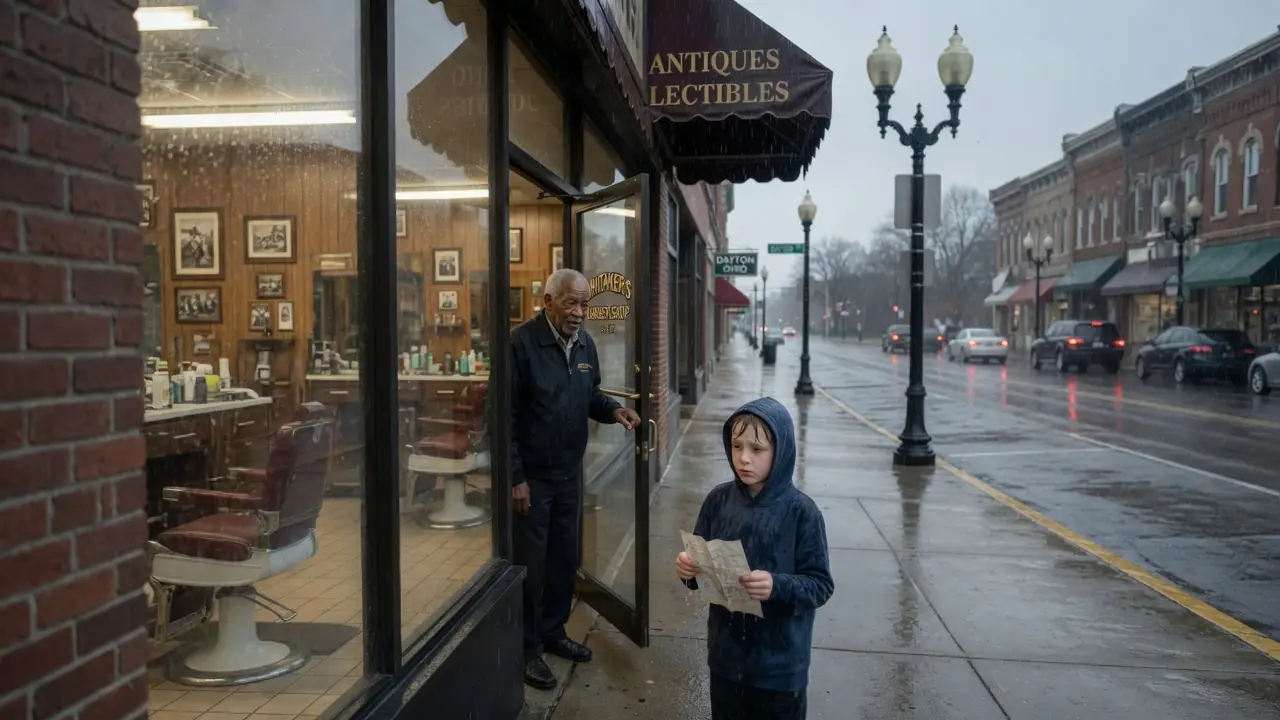
The rain came down hard over Franklin Avenue just after three o’clock, turning the sidewalks of Dayton, Ohio, into long silver ribbons and making the old storefront windows shine like mirrors.
Arthur Whitaker stood inside Whitaker’s Barbershop with a broom in his hand, watching water rush along the curb outside. He was seventy-eight years old, though most people guessed younger because he still stood straight, still wore pressed shirts, still polished his brown leather shoes every Sunday night, and still opened his barbershop at exactly eight every morning even when no customers were waiting.
His shop sat between a small grocery store and a family-owned pharmacy, across from a public library and two blocks from Franklin Elementary School. The neighborhood was the kind of place where people knew which porch belonged to which grandmother, which diner had the best pancakes, and which corner flooded first when it rained too long.
Whitaker’s Barbershop had been there for forty-four years.
The sign above the door was old, with red and blue paint faded by decades of sun. Inside, there were three barber chairs, though Arthur only used one now. The other two belonged to memory. One had been used by his brother Raymond before Raymond moved to Cleveland. The other had been used by Arthur’s son, Marcus, before life took Marcus to another state and a different career.
The walls were covered with framed photographs: little boys grinning after their first haircut, fathers holding toddlers still in the chair, young men ready for graduation, old men leaning on canes but smiling because Arthur had shaped their hair exactly the way they liked it.
A small television sat in the corner, usually turned low. A coffee pot rested on a side table beside a bowl of wrapped peppermints. Near the window was a wooden bench where customers waited, argued about basketball, read old magazines, or fell asleep while listening to the soft buzz of clippers.
Arthur loved the shop most in the late afternoon, when the day slowed down and the smell of shaving cream, coffee, rain, and old wood seemed to settle into the walls.
But that afternoon, the rain was too heavy for comfort.
He looked across the street toward the library. School had let out twenty minutes earlier, and most children had already disappeared into cars, buses, or the arms of waiting parents. A few umbrellas moved quickly along the sidewalk. Tires hissed through puddles. The traffic light changed from red to green and back again, its colors smearing across the wet street.
Arthur was about to pull the front mat farther inside when he saw the boy.
The child stood under the narrow awning of the closed dry cleaner next door.
He was small, maybe seven or eight, wearing a blue hoodie darkened by rain, khaki pants, and sneakers that looked soaked through. A backpack hung crookedly from his shoulders. He held a folded paper in one hand, but the paper had gotten wet and soft. His face was turned toward the street, searching.
At first, Arthur thought the boy was waiting for someone.
Then the child stepped out from under the awning, looked left, looked right, took a few uncertain steps, and stopped.
Arthur knew that look.
It was not ordinary waiting.
It was the look of a child who had lost the shape of the world.
Arthur put the broom aside and opened the door. The little bell above it gave a tired jingle.
“Son,” he called gently, raising his voice over the rain. “You all right?”
The boy turned fast.
He did not answer.
Arthur stayed in the doorway, careful not to come too close too quickly. He had raised children, served children, and cut enough children’s hair to know that fear could make them run even when help was standing right in front of them.
“You from Franklin Elementary?” Arthur asked.
The boy nodded once.
“You waiting on somebody?”
The boy looked down at the wet paper in his hand.
“I was,” he said.
His voice was thin and shaky.
Arthur glanced at the rainwater dripping from the child’s sleeves.
“You want to step inside a minute? Just to get out of this rain.”
The boy hesitated.
Arthur pointed through the open door. “You can stand right by the window if you want. Door stays open. I am Arthur Whitaker. This is my shop.”
The boy looked at the sign above the door, then at the empty street.
Another burst of rain blew sideways.
That decided it.
He hurried across the sidewalk and stepped inside the barbershop, bringing with him the smell of wet cotton and cold pavement.
Arthur let the door remain open for a moment, then closed it halfway so the rain would not blow in. He did not lock it. He did not move between the boy and the door.
“You can sit there,” Arthur said, pointing to the wooden bench by the window. “Or stand. Whatever feels better.”
The boy sat on the very edge of the bench.
His shoes made two dark wet marks on the floor.
Arthur pretended not to notice, because children were always more ashamed of being a problem than grown-ups realized.
“What is your name?” Arthur asked.
The boy swallowed.
“Noah.”
“Noah,” Arthur repeated. “That is a strong name. How old are you, Noah?”
“Eight.”
“Third grade?”
Noah nodded.
Arthur pulled a clean towel from a shelf and held it out, not too close.
“For your hair and your face.”
Noah took it carefully. “Thank you.”
“You are welcome.”
The boy rubbed the towel over his wet forehead and cheeks. His hands trembled slightly.
Arthur poured warm water from the kettle into a paper cup and set it on the table near him.
“Not coffee,” Arthur said. “Just warm water. Helps when the rain gets into your bones.”
Noah looked at the cup but did not reach for it right away.
Arthur sat in the nearest barber chair and turned it slightly toward the boy, leaving space between them.
“You said you were waiting on somebody,” he said. “Was someone supposed to pick you up?”
“My mom’s friend,” Noah said. “Mrs. Carla.”
“Mrs. Carla usually picks you up?”
“Only today. My mom had to work late.”
Arthur nodded slowly. “And Mrs. Carla did not come?”
Noah looked at the paper in his hand. “I think I went to the wrong place.”
Arthur did not react too strongly. He did not say, Oh no. He did not say, That is bad. A child already knew when something felt bad.
“What place were you supposed to go to?”
Noah unfolded the wet paper. The ink had blurred in places, but Arthur could still make out a few words.
Library entrance. Franklin Avenue side. 3:10.
Arthur looked across the street.
The library had two entrances. One on Franklin Avenue. One on Parker Street around the corner.
“Were you waiting at Parker Street?” he asked.
“I thought that was the front. I waited and waited. Then a lady said the library was closing early because water was coming in by the back door. Then I tried to walk to the other side, but I got turned around.”
Arthur understood. To an adult, the library was a square building with two entrances. To a child in heavy rain, it could become a maze.
“Do you know your mother’s phone number?”
Noah opened his mouth, then closed it.
“I know it,” he said, “but when I get scared, I mix up the middle part.”
“That happens.”
“I am not supposed to be scared.”
Arthur leaned back. “Who told you that?”
Noah looked at him as if the answer should be obvious.
“I am eight.”
Arthur gave a soft laugh. “Eight-year-olds are allowed to be scared. Seventy-eight-year-olds too.”
Noah studied him for the first time.
“You are seventy-eight?”
“Yes, sir.”
“You do not look seventy-eight.”
“I appreciate that. My knees disagree.”
A tiny smile appeared on Noah’s face, then faded.
Arthur pointed to the paper. “Is your school number on there?”
Noah handed it over.
The bottom of the paper had the school office number, still readable. Arthur picked up the shop phone from behind the counter. It was an old landline, the kind people teased him for keeping. That day, he was glad it was there.
He dialed.
The line rang several times before a woman answered.
“Franklin Elementary front office.”
“Good afternoon,” Arthur said. “My name is Arthur Whitaker. I own Whitaker’s Barbershop on Franklin Avenue, across from the library. I have a student here named Noah. He seems to have missed his pickup in the rain.”
There was a pause, then sudden movement on the other end.
“Noah Bennett?”
Arthur looked at the boy. “Last name Bennett?”
Noah nodded.
“Yes, ma’am,” Arthur said. “He is safe and dry in my shop. Door is open, lights are on. I just wanted someone to know where he is.”
The woman exhaled with relief.
“We have been trying to reach his mother. The pickup arrangement got confused. Please stay on the line a moment.”
Arthur waited. Noah watched him with wide eyes.
After a minute, another voice came on. Younger, breathless.
“This is Mrs. Harris, Noah’s teacher. Is he okay?”
“He is wet and worried, but he is all right,” Arthur said. “I gave him a towel and warm water. He is sitting by the window.”
Noah whispered, “Is she mad?”
Arthur covered the phone lightly. “No, son. She sounds relieved.”
He uncovered it.
Mrs. Harris said, “His mother works at Starlight Diner on North Main. I am calling there now. Can he stay with you until she gets there?”
Arthur looked at Noah, then at the rain.
“He can stay as long as he needs.”
“Thank you, Mr. Whitaker. Thank you so much.”
Arthur hung up and returned to the barber chair.
“Noah,” he said, “your teacher is reaching your mother. You did the right thing stepping inside. Nobody is mad.”
Noah stared at the floor.
“I was supposed to be at the Franklin side.”
“Well,” Arthur said, “today you learned the library has too many sides.”
Noah rubbed the towel between his hands.
“My mom is going to cry.”
“Maybe,” Arthur said gently. “Mothers sometimes cry when they are grateful and worried at the same time.”
“She already worries too much.”
Arthur heard the oldness in that sentence. Children who said things like that had been listening to adult life through closed doors.
“What does your mama do?” he asked.
“She works at the diner. Sometimes morning, sometimes night. She says tips are better when people are hungry and tired.”
Arthur smiled faintly. “That sounds true.”
“She was going to come herself, but somebody called out. So Mrs. Carla was going to get me. But I think Mrs. Carla went to the right place and I went to the wrong place.”
Arthur nodded. “Confusion is not the same as disobedience.”
Noah looked at him.
“That means you did not do something bad just because something went wrong.”
The boy seemed to sit with that thought.
Arthur stood slowly and went to the small coat rack near the back. Hanging there was an old gray cardigan he kept for cold days. He brought it to Noah.
“It may be too big, but it is dry.”
Noah looked uncertain.
“I will give it back.”
“I know.”
Noah slipped into the cardigan. It swallowed him nearly to the knees, but it stopped his shivering.
Arthur then took a wrapped peppermint from the bowl and placed it on the table.
“Do you like peppermint?”
“Yes, sir.”
“My wife used to keep that bowl filled. Said every child who had to sit in a barbershop deserved something sweet.”
“Where is she?”
Arthur’s hands paused for a second.
“She passed on some years ago.”
Noah’s face softened in the honest way children’s faces do before they learn to hide sympathy.
“I am sorry.”
“Thank you.”
“What was her name?”
“Evelyn.”
Noah unwrapped the peppermint slowly. “My grandma’s name was Evelyn.”
“Then you know it is a good name.”
Noah nodded.
For a while, they listened to the rain.
Arthur turned on the small television, but kept the volume low. A cooking show flickered on the screen. Noah watched a woman stir soup in a bright kitchen, his shoulders gradually relaxing under the old cardigan.
“You ever been in a barbershop before?” Arthur asked.
Noah nodded. “My mom cuts my hair at home now.”
“She does a decent job?”
Noah touched the side of his head. “She says decent is free.”
Arthur laughed. “Your mother sounds practical.”
“She tries.”
That answer, too, sounded older than eight.
Arthur wondered what Noah had seen in his young life. Not terrible things, necessarily. Just the daily pressure of rent, schedules, tired adults, careful spending, and the constant need to be easy. Some children learned early to make themselves small so they did not add weight to the people carrying them.
Arthur had known that kind of childhood.
He had grown up in a narrow house on Pine Street with four siblings and a mother who stretched groceries until stretching became a kind of art. He remembered standing in line for school supplies, pretending he did not care which notebook he got. He remembered adults speaking over him, around him, about him, as if children could not understand worry when it filled every room.
That was why he spoke plainly to children. Not heavily. Not frighteningly. Just honestly enough that they could breathe.
“Mr. Whitaker?” Noah asked.
“Yes?”
“Did you ever get lost?”
Arthur smiled. “More than once.”
“When you were little?”
“And when I was grown.”
“Grown-ups get lost?”
“All the time. They just use different words for it.”
Noah frowned. “Like what?”
Arthur leaned back in the chair. “They say they are figuring things out. They say they are between jobs. They say they need a fresh start. They say they took a wrong turn. But sometimes, yes, they are just lost.”
Noah thought about that.
“What do they do?”
“Same thing you did,” Arthur said. “They look for a safe place, and they let somebody help them.”
Noah stared at the peppermint wrapper in his hand.
“My mom says we do not bother people.”
Arthur’s expression grew gentle.
“Needing help is not bothering people.”
“She says people have their own problems.”
“They do,” Arthur said. “But sometimes helping with yours reminds them they can still do something good with theirs.”
Noah did not fully understand that. Arthur could tell. But the boy seemed to like the sound of it.
A knock came at the door.
Noah jumped.
Arthur looked through the glass and saw a woman in a diner uniform under a raincoat, her hair damp around her face, one hand pressed to the door as if she had run the whole way.
Noah stood so fast the cardigan slipped from one shoulder.
“Mama.”
Arthur opened the door.
The woman rushed inside, breathless, soaked, and pale with worry. The moment she saw Noah, she dropped to her knees and pulled him close.
“Noah Bennett,” she whispered, holding his face between her hands. “Baby, are you okay? Are you okay?”
“I am okay,” he said, beginning to cry now that he no longer had to be brave. “I went to the wrong side.”
“I know, I know. It is okay.”
“I tried to remember.”
“You did good. You found a safe place.”
Arthur stepped back, giving them room.
The woman held Noah for a long moment before looking up.
“Mr. Whitaker?”
“Yes, ma’am.”
“I am Lena Bennett. I do not even know how to thank you.”
“No thanks needed. He was smart enough to come in out of the rain.”
She stood, still keeping one hand on Noah’s shoulder. She looked exhausted, with tired eyes and a diner name tag that read LENA. Her shoes were wet. Her breath still came unevenly.
“I should have been there,” she said.
Arthur shook his head. “You arranged for someone to be there. The rain made confusion. That is all.”
Her face tightened. “I left work the second they told me. My manager was not happy.”
“Managers survive disappointment every day.”
A small, shaky laugh escaped her.
Noah wiped his face. “Mr. Whitaker gave me warm water.”
“And peppermint,” Arthur added.
“And a sweater.”
Lena looked at the cardigan hanging off Noah’s shoulders.
“I will wash it and bring it back.”
“No rush.”
“I mean it. I will bring it back.”
Arthur nodded, understanding pride when he heard it. “I believe you.”
Lena looked around the shop. “My father used to come here.”
“What was his name?”
“Thomas Reed.”
Arthur’s face lit with recognition. “Tommy Reed with the blue pickup?”
“That was him.”
“He always asked for a trim and then talked long enough to need another one.”
Lena smiled, and for a moment the worry left her face.
“That sounds like Daddy.”
“He was a good man.”
“He passed when Noah was three.”
Arthur nodded softly. “I am sorry.”
“Thank you.”
Noah looked between them. “Grandpa got haircuts here?”
“Sure did,” Arthur said. “Sat right in that chair. Told terrible jokes.”
Noah looked at the barber chair with new interest, as if it had become part of his family.
Lena took a breath. “How much do I owe you?”
Arthur frowned lightly. “For rain shelter?”
“For the time. For the towel. For taking care of him.”
“You owe me nothing.”
She opened her mouth to argue, but Arthur lifted one hand.
“Bring the cardigan back when you can. That will settle us.”
Lena studied him. Her eyes shone again, but she refused to let tears fall.
“All right,” she said. “Thank you.”
Arthur walked them to the door. The rain had slowed to a steady drizzle.
Before Noah stepped outside, he turned back.
“Mr. Whitaker?”
“Yes?”
“If I get lost again, can I come here?”
Lena closed her eyes, pained by the question.
Arthur answered carefully.
“If you ever need a safe place on Franklin Avenue, this door is open during shop hours. But let us hope next time you come because you want a haircut.”
Noah nodded.
Then, suddenly, he stepped forward and hugged Arthur around the waist.
It was quick, almost embarrassed, but Arthur felt it all the way through his old bones.
“Thank you,” Noah whispered.
Arthur placed one hand lightly on the boy’s back.
“You are welcome, son.”
The bell chimed as they left.
Arthur watched them hurry down the sidewalk together, Lena holding Noah’s hand tightly, Noah still wrapped in the gray cardigan.
The shop felt very quiet after that.
Arthur picked up the damp towel, wiped the wet footprints from the floor, and returned the peppermint bowl to the center of the table. Then he sat in the barber chair and looked at the rain sliding down the front window.
He thought about Evelyn.
She would have fussed over Noah even more than he had. She would have found crackers, probably soup, maybe an extra pair of socks from somewhere impossible. Evelyn had believed that every child who crossed a threshold became, for a little while, partly yours.
Arthur had not thought of the shop that way in years.
To him, lately, it had become a place he kept open because closing it felt like admitting his life had narrowed. Customers were fewer now. Younger men drove to modern places with online booking and music playing loud. Parents cut children’s hair at home to save money. The old regulars came less often, some because they had moved, some because age kept them indoors.
But that afternoon, for one hour, Whitaker’s Barbershop had become something else again.
A shelter.
A place where a frightened boy could sit near the window and learn that being lost did not make him bad.
Three days later, Lena returned with the cardigan washed, folded, and smelling faintly of lavender detergent.
Noah came with her.
His hair had been trimmed at home, uneven near one ear.
Arthur pretended not to notice until Noah climbed into the barber chair and said, “My mom says maybe you can fix it.”
Lena put a hand to her forehead. “Noah.”
Arthur smiled. “I have fixed worse.”
“How much?” Lena asked.
“First haircut for the grandson of Tommy Reed?” Arthur said. “That is on the house.”
Lena gave him a look.
Arthur sighed. “Half price, then.”
“Full price,” she said.
“Stubborn like your father.”
“I know.”
Noah sat very still as Arthur wrapped the cape around him.
“Do not take too much,” Noah said.
“Every boy says that.”
“I mean it.”
“So does every boy.”
Arthur worked slowly, carefully, making conversation as the clippers hummed. Noah asked questions about the photographs on the wall. Arthur told him stories about first haircuts, graduation cuts, wedding cuts, and one little boy who cried until Evelyn gave him three peppermints and let him hold the spray bottle.
By the time Arthur finished, Noah looked in the mirror and grinned.
“I look older.”
“Do not rush that,” Arthur said. “Being young is not a problem you need to solve.”
Lena laughed from the bench.
After that, Noah and Lena became regulars.
Not every week. They could not afford that, and Arthur knew it. But they came when Noah needed a trim, when Lena had enough extra, or sometimes simply when rain began falling and Noah wanted to make sure Mr. Whitaker was not lonely.
At first, Lena apologized for those visits.
Arthur stopped her.
“A barbershop is not only for hair,” he said. “It is for sitting.”
So they sat.
Noah did homework on the bench while Lena came after her diner shift. Arthur kept a small stack of children’s books near the magazines because Noah liked to read but said library books made him nervous after the rainy day. Arthur told him the library was not at fault. Noah said he knew, but feelings did not always listen to facts.
Arthur liked that answer enough to remember it.
As the months passed, Noah became less shy. He asked Arthur about the shop, about old photographs, about why men argued so much about sports when none of them were on the team. He asked why some people tipped and some did not. He asked why grown-ups said “one of these days” when they usually meant “not soon.”
Arthur answered what he could.
Sometimes Lena would say, “Do not bother Mr. Whitaker with all those questions.”
And Arthur would say, “Questions keep the dust off a man’s mind.”
Noah started calling him Mr. Arthur.
Then, one afternoon, simply Arthur.
Lena corrected him immediately.
“No, ma’am,” Arthur said. “It is fine.”
But Noah went back to Mr. Arthur anyway, as if respect and affection needed to stand together.
One cold November evening, Arthur was closing the shop when he found Noah standing outside, waiting with his backpack.
“Your mother running late?” Arthur asked.
Noah nodded. “The diner got a big table.”
“Come in before your ears freeze.”
Noah stepped inside and sat near the heater.
Arthur made him warm water, the way he had on the rainy day, and set a peppermint beside it.
Noah stared at the candy.
“You always give me one.”
“Do you want me to stop?”
“No.”
“Then I will continue.”
Noah turned the peppermint over in his fingers.
“Do you have kids?”
Arthur wiped the counter slowly.
“I have a son. Marcus.”
“Does he live here?”
“No. He lives in Arizona.”
“Do you see him?”
“Not as much as I would like.”
“Why?”
Arthur considered the question.
“Life grows branches,” he said. “Sometimes people end up farther from the trunk than they meant to.”
Noah frowned. “That sounds like a tree answer.”
“It is.”
“Do you miss him?”
Arthur looked at the empty chairs.
“Yes.”
Noah nodded, absorbing this with serious care.
“My mom misses my grandpa,” he said. “She does not say it, but she looks at his picture when bills come.”
Arthur understood exactly.
“Grief shows up in strange places.”
“What is grief?”
“Love that has nowhere easy to sit.”
Noah was quiet for a long time after that.
When Lena arrived, she found him asleep on the bench with his backpack under his head and Arthur’s gray cardigan over him like a blanket.
She stood in the doorway for a moment, watching.
“You do too much for us,” she said softly.
Arthur looked up from sweeping.
“No,” he said. “I do what is in front of me.”
“That is still more than most people.”
Arthur did not answer.
Lena helped Noah sit up, and the boy blinked sleepily.
“Mom,” he murmured, “Mr. Arthur says grief is love that has nowhere easy to sit.”
Lena froze.
Then she looked at Arthur with tears in her eyes.
“He said that?”
Arthur suddenly found the broom very interesting.
“It came out that way.”
Lena hugged Noah close.
“That is a good thing to remember,” she whispered.
Years gathered quietly after that.
Noah grew taller. His voice changed. He stopped needing Lena to walk him everywhere, though he still stopped by the barbershop after school. He became the kind of boy teachers called thoughtful. He did not speak first in every room, but when he did, people listened.
Arthur gave him small jobs at the shop.
At ten, Noah swept hair into neat piles after haircuts.
At eleven, he learned to fold towels.
At twelve, he was trusted to refill the peppermint bowl.
At thirteen, Arthur taught him how to clean clippers, oil them properly, and never leave a tool where a child could grab it.
“You going to make me a barber?” Noah asked.
“I am going to make you useful,” Arthur said.
Noah smiled. “My mom says I am already useful.”
“She is biased.”
Noah loved the shop most on Saturdays. Men came in and filled the room with stories. Little boys squirmed in chairs. Fathers gave instructions their sons ignored. Arthur moved through it all with calm hands and gentle authority.
When a child cried, Arthur never mocked him. When a teenager was quiet, Arthur did not force conversation. When an older man repeated the same story three visits in a row, Arthur listened as if it were new.
Noah noticed.
He had first entered the shop because he was lost. But over time, he learned that many people arrived at Whitaker’s Barbershop carrying some private kind of lostness. They came after divorces, layoffs, funerals, graduations, birthdays, arguments, long workdays, and ordinary loneliness. They sat in Arthur’s chair, and for twenty minutes, someone saw them clearly.
Noah began to understand that shelter was not always a roof.
Sometimes it was a voice.
Sometimes it was a towel.
Sometimes it was a peppermint placed on a table without explanation.
When Noah was fifteen, he wrote an essay for school called “The Safe Place on Franklin Avenue.” He did not tell Arthur at first. Lena did.
She brought a copy to the shop and placed it on the counter.
“He won first prize,” she said.
Arthur put on his glasses.
The essay began with the rainy day.
Noah wrote about going to the wrong library entrance, about the paper getting wet in his hand, about the old man who kept the door open so he would not feel trapped, about warm water in a paper cup, about being told that confusion was not the same as disobedience.
Arthur read slowly.
Halfway through, he had to stop.
Lena pretended to look at the photographs on the wall while he took off his glasses and wiped them.
“He wants to study social work,” she said quietly.
Arthur looked up.
“He says people need safe places before they can make good choices.”
Arthur swallowed.
“That boy thinks too deeply.”
“He learned from you.”
“No,” Arthur said. “He came that way. I just gave him a dry chair.”
Lena smiled. “You still do not know how to receive thanks.”
“I am seventy-eight plus some years. Too late to learn.”
“No,” she said. “It is not.”
When Noah graduated high school, he came to the barbershop first thing that morning.
He wore his cap and gown over a white shirt, and his shoes were polished. He stood in the doorway, tall now, no longer the small child in the blue hoodie, but Arthur still saw him.
Arthur was eighty-eight by then.
His hands had slowed. His back hurt more often. Some mornings, he looked at the shop key and needed a moment before turning it in the lock.
But he was there when Noah walked in.
“Well,” Arthur said. “Look at you.”
Noah grinned. “Do I look older?”
“Unfortunately, yes.”
“My mom cried three times before breakfast.”
“She is entitled.”
Noah stepped closer and handed Arthur an envelope.
“What is this?”
“Open it.”
Inside was a graduation photo. On the back, Noah had written:
To Mr. Arthur,
Thank you for giving me a safe place before I knew how to ask for one.
I will build more.
Arthur read it twice.
Then he looked at the young man standing before him.
“You are going to do good work,” he said.
“I hope so.”
“Hope is fine. But work matters more.”
“I know.”
Arthur placed the photo on the wall beside decades of other faces. But he gave Noah’s picture a special spot near the mirror, where he could see it while cutting hair.
Noah went to college in Columbus.
At first, he called every Sunday. Then every other Sunday. Then life became busy, as life does. He studied social work, then community development. He interned at youth centers, after-school programs, and family support organizations. He learned about systems, grants, case files, housing support, school partnerships, and the long complicated language adults used when talking about children who needed care.
But no textbook taught him more than the memory of Arthur keeping the door half open on a rainy day.
During college, Noah returned whenever he could.
Each time, the shop looked a little older.
The sign faded more. One barber chair cracked along the side. The floor near the sink needed repair. The street changed too. The pharmacy closed. The grocery store became a discount phone shop. The library reduced hours. New apartments appeared three blocks away with rent too high for many old residents.
Arthur changed as well.
He was thinner. His steps were slower. He still wore pressed shirts, but sometimes the collar sat unevenly. He still polished his shoes, but Noah noticed that Arthur no longer bent easily to tie them.
One winter break, Noah found him sitting in the shop with the lights off, though it was only five in the afternoon.
Noah tapped on the glass.
Arthur looked up, surprised, then smiled and waved him in.
“Why are the lights off?” Noah asked.
“Saving electricity.”
It was said lightly, but Noah heard the truth underneath.
He looked around. The shop was colder than usual.
“Arthur.”
“Do not use that voice.”
“What voice?”
“The voice of a young man about to turn concern into a project.”
Noah almost laughed, but worry held him back.
“How bad is it?”
Arthur sighed.
“Business is slow. Building rent is not. I am not in trouble today.”
“That is not an answer.”
“It is the answer I am giving.”
Noah wanted to push, but he remembered dignity. Arthur had taught him that help given without respect could feel like being cornered.
So Noah nodded.
“Then let me sit awhile.”
“That you can do.”
They sat in the dim shop together, watching evening traffic pass the window. The barber pole outside did not turn anymore. Arthur said he would fix it one day. Noah knew “one day” often meant “not soon.”
A year later, Noah graduated college.
Two years after that, he completed a master’s program focused on community services and youth support. He began working for a nonprofit that helped neighborhoods create after-school spaces, family resource rooms, and safe walk-in centers for children.
He was good at it.
Not because he had the loudest voice in meetings, but because he remembered small things. He remembered where children sat when they were nervous. He remembered that parents needed dignity as much as assistance. He remembered that a safe place had to feel safe before anyone explained its purpose.
By then, Arthur was ninety-two.
Whitaker’s Barbershop was barely surviving.
The building owner wanted to sell. The new buyers planned to renovate the block into expensive storefronts. Arthur received a letter explaining that his lease would not be renewed unless he accepted a rent increase he could never pay.
For three days, Arthur told no one.
He came to the shop, opened on time, cut the few heads that came in, swept the floor, refilled the peppermints, and went home tired.
On the fourth day, the electricity went out in the shop.
Not from a storm.
From a bill Arthur had thought he could delay one more week.
He stood in the middle of the darkened barbershop, clippers silent, coffee pot cold, the old photographs on the wall fading into shadowless gray. Outside, Franklin Avenue moved on. Cars passed. People walked by. No one knew that the shop which had sheltered so many small moments was standing quietly at its own edge.
Arthur sat in his barber chair.
For the first time in many years, he felt lost.
He thought about Evelyn. He thought about Marcus, who called when he could but had his own troubles far away. He thought about all the boys who had become men in his chair. He thought about Noah in the blue hoodie, dripping rainwater onto the floor, asking if he could come back if he ever got lost again.
Arthur closed his eyes.
Then the bell above the door jingled.
He opened his eyes.
The shop was dim, lit only by gray afternoon light through the front window.
A tall man stood in the doorway wearing a dark coat over a suit, rain shining on his shoulders just as it had on Noah’s hoodie all those years before. He carried a folder under one arm and a paper bag in the other.
For one strange second, Arthur saw both the man and the child.
“Noah?” he said.
Noah Bennett smiled.
“Door was open.”
Arthur tried to stand, but Noah crossed the room quickly and hugged him.
Not the quick, embarrassed hug of a frightened child this time. This was a grown man’s embrace, steady and full of everything years had not erased.
Arthur patted his back.
“You got taller,” he said.
“You say that every time.”
“It keeps being true.”
Noah looked around the shop. His smile faded.
“Why are the lights off?”
Arthur looked toward the window.
“Saving electricity.”
Noah’s expression changed.
This time, he did not let the answer pass.
“Mr. Arthur.”
Arthur sighed.
The old man was too tired to protect his pride with cleverness.
So he told the truth.
The lease. The bill. The slow business. The new buyers. The likelihood that Whitaker’s Barbershop would close before summer.
Noah listened the way Arthur had listened years before: without panic, without pity, without making the other person feel smaller.
When Arthur finished, Noah placed the paper bag on the counter.
“Turkey sandwich,” he said. “No onions. From Starlight Diner.”
Arthur blinked. “That place is still open?”
“Under new ownership. My mom manages it now.”
“Lena manages Starlight?”
“She does.”
“Good for her.”
“She wanted to come, but she said I should talk to you first.”
Arthur looked at the folder.
“What is that?”
Noah sat on the wooden bench by the window, the same place he had sat as a child.
“When I was eight,” he said, “I got lost in the rain.”
Arthur looked down.
“You remember.”
“I remember every detail. The towel. The warm water. The peppermint. The way you did not lock the door. The way you called the school and said I was safe before anyone could decide I was a problem.”
“You were never a problem.”
“I know that because you told me without saying it.”
Arthur’s face tightened with emotion.
Noah opened the folder.
“I work with a community foundation now,” he said. “We help neighborhoods preserve trusted local spaces and turn them into youth and family support sites. Not big institutions. Real places people already trust.”
Arthur stared at him.
Noah continued, “Franklin Avenue has no after-school drop-in space since the library cut hours. Parents are struggling with pickup schedules. Kids wait outside stores or walk too far alone. Schools know it. Churches know it. The diner knows it. Everybody knows it, but nobody had the right place.”
Arthur whispered, “Noah.”
“This shop is the right place.”
Arthur shook his head slowly. “This is a barbershop.”
“It is a shelter,” Noah said.
The word settled between them.
Arthur looked around the room.
Noah turned the papers toward him. “The foundation can lease the back half of the shop and cover utilities. The front stays Whitaker’s Barbershop. We repair the floor, restore the barber pole, update the wiring, and add a small reading table, phone station, and waiting area for students who need a safe place until their ride comes.”
Arthur’s eyes moved over the documents, but the words blurred.
“Noah, I am too old to run some youth center.”
“You do not have to run it. We will staff it. You just have to be here as long as you want to be. Cut hair when you want. Sit when you want. Tell children that confusion is not the same as disobedience.”
Arthur closed his eyes.
Noah’s voice softened.
“I have used that sentence with more kids than I can count.”
Arthur laughed once, quietly, but it broke into something close to a sob.
Noah gave him a moment.
Then he said, “The building buyers are willing to keep the shop if we sign a long-term community lease. They like the tax benefits and the neighborhood support. The school is ready to partner. My mother is organizing meals from the diner twice a week. The library wants to help with books.”
Arthur opened his eyes.
“You already talked to everyone.”
Noah smiled gently. “You once told me grown-ups get lost too. I figured I should look for the safe place before you had to ask.”
Arthur looked toward the photographs on the wall.
There was Noah’s graduation photo near the mirror, still in its special place.
“You built more,” Arthur said.
Noah’s face softened.
“I said I would.”
The power came back on that evening.
Not by miracle. Noah paid the bill before Arthur could argue, but he did it carefully.
“Call it a temporary operating advance,” he said.
“That sounds made up.”
“It is paperwork language. It protects everybody’s pride.”
Arthur looked at him sharply.
Noah smiled. “I learned from the best.”
The reopening took place three months later on a bright Saturday morning.
They did not change the name.
That mattered to Arthur.
The sign still read Whitaker’s Barbershop, freshly painted now, with smaller letters beneath:
Safe Chair Community Room
A Franklin Avenue Youth Welcome Site
The barber pole turned again outside the door.
Inside, the front of the shop remained mostly the same. The old chairs were repaired. The photographs stayed on the walls. The peppermint bowl stayed on the table. Arthur’s station stayed exactly where it had always been.
But the back room changed.
There was a round table for homework, a shelf of books donated by the library, a phone that children could use to call trusted adults, a row of hooks for backpacks, and a small sign by the door that said:
If you are waiting, worried, confused, or turned around, come in.
You are not in trouble.
You are safe here.
Arthur stared at that sign for a long time.
“Too many words,” he said.
Noah laughed. “I knew you would say that.”
“Children do not need a paragraph.”
“What should it say?”
Arthur thought.
Then he took a marker and wrote on a blank card:
Come in. We will figure it out.
Noah placed it above the longer sign.
“That is better,” Arthur said.
Families came all morning.
Some came because they remembered Arthur. Some came because Noah had called them. Some came because the school sent flyers. Some came simply because the barber pole was turning again and curiosity is a strong neighborhood force.
Lena arrived with trays of sandwiches from Starlight Diner. She hugged Arthur so tightly he complained about his ribs.
“You scared us,” she said.
“I scared myself.”
“Do not do it again.”
“I will consider your request.”
She laughed and wiped her eyes.
Children filled the back room after lunch. Not too many at once. Noah had planned carefully. There were volunteers, sign-in sheets, parent contacts, and clear rules. But the place did not feel like an office. It felt like a barbershop that had made room.
A little girl came in first, holding her younger brother’s hand.
Their mother worked at the pharmacy’s new location and could not pick them up until four. The girl looked nervous, the way responsible children often look when they have been told to manage something too big.
Arthur saw it immediately.
He walked over slowly.
“What is your name?” he asked.
“Maya.”
“And this young man?”
“Eli.”
“Well, Maya and Eli, welcome. You can sit at that table, or you can sit near the window. Peppermints are allowed after homework starts.”
Eli looked up. “Before homework?”
Arthur considered. “One before, one after. But do not tell Noah I am negotiating.”
Noah, standing three feet away, said, “I heard that.”
Arthur looked at the children. “He hears everything now. Very inconvenient.”
Maya smiled.
And just like that, her shoulders lowered.
Noah watched from the doorway.
He saw the same thing happen again and again that afternoon. Children entered guarded and uncertain, then slowly settled. Parents arrived apologetic, and Arthur or Noah or Lena told them there was no apology needed. Teachers stopped by and thanked Arthur. Old customers came for haircuts and stayed to help children read. A teenager who used to sweep the shop years earlier volunteered to fix the back fence.
By five o’clock, the place was full of ordinary kindness.
No grand speech could have explained it better.
But people wanted Arthur to speak anyway.
Noah gathered everyone near the front of the shop. Arthur stood beside the barber chair, one hand resting on its worn leather arm.
He looked uncomfortable with the attention.
“I have cut hair in this room for a long time,” Arthur began. “Long enough to see boys become fathers and fathers become grandfathers. Long enough to learn that people do not always come through a door for the reason written on the sign.”
A few people nodded.
“Some come for a haircut. Some come because they are lonely. Some come because they need to sit where somebody knows their name. And once, many years ago, a little boy came in because he was lost in the rain.”
Noah looked down, smiling faintly.
Arthur continued, “I did not do anything special that day. I gave him a towel, a cup of warm water, and a place to wait. But I have learned something since then. To a child, a small kindness from an adult is not small. It can become a map.”
The shop went quiet.
“That boy grew up and came back when this old shop was lost. He gave it a map too.”
Lena pressed a hand over her mouth.
Arthur looked at Noah.
“So this place will stay what it has always been. A barbershop. A bench. A chair. A door. But now, if a child on Franklin Avenue gets turned around, or a parent is running late, or the rain comes down too hard, they can come in. We will figure it out.”
He stopped there.
That was all he needed to say.
The applause was not loud at first. It started softly, respectfully, then grew until it filled the shop and spilled onto the sidewalk.
Arthur shook his head as if all the noise was unnecessary, but his eyes were bright.
Later, after everyone left, Noah and Arthur sat together near the window.
The sun had come out after the morning clouds, and the street glowed with the clean look that follows rain. Children’s drawings were taped to the back room wall. The peppermint bowl was nearly empty. The barber pole turned slowly outside, red and blue stripes moving in endless circles.
Arthur handed Noah a peppermint.
Noah laughed. “I am not eight anymore.”
“No,” Arthur said. “But you are still allowed something sweet.”
Noah took it.
For a while, neither of them spoke.
Then Arthur said, “Do you know what I thought that day you came in?”
“When I was little?”
“Yes.”
“What?”
“I thought Evelyn would have done better.”
Noah looked at him.
“Your wife?”
Arthur nodded. “She had a way with children. I thought she would have known what to say. I was just an old man with a towel.”
Noah turned the peppermint in his fingers.
“Mr. Arthur, I did not need perfect. I needed safe.”
Arthur looked out the window.
The words seemed to ease something in him that had been tight for years.
“I suppose safe is enough,” he said.
“It is more than enough.”
A week later, the Safe Chair Community Room began its regular hours.
Every weekday from three to six, children could come in with school permission and parent contact. Some came often. Some only once. Some did homework. Some read. Some waited quietly. Some talked Arthur’s ear off while he pretended to complain.
He kept his rules simple.
No teasing younger children.
No making fun of someone’s reading.
No touching barber tools.
No saying “I am stupid” in his shop.
That last rule became famous.
One afternoon, a boy named Jordan slammed his pencil down and muttered, “I am stupid.”
Arthur turned from trimming a customer’s beard.
“What did you say?”
Jordan froze.
Noah, working at the back table, hid a smile.
“I said the math is stupid.”
“No, you did not.”
Jordan looked embarrassed.
Arthur walked over and tapped the table once.
“In this shop, you may say the math is stubborn. You may say the pencil is suspicious. You may say the numbers are acting rude. But you may not call yourself stupid. Try again.”
Jordan stared at him.
Then he said, “The numbers are acting rude.”
Arthur nodded. “That we can work with.”
The children laughed, and Jordan did too.
The phrase spread. Soon half the kids on Franklin Avenue were saying their homework was acting rude.
Arthur loved it, though he never admitted it.
Months turned into years.
Whitaker’s Barbershop did not become rich. It did not become famous in a big way. But it became steady again. The foundation supported the back room. The community supported the shop. Customers returned, some for haircuts, some for memory, some because they wanted their children to know the kind of place that still remembered how to hold a neighborhood together.
Arthur cut less hair as he got older. Noah hired a young barber named Andre to help, a patient man with careful hands and a calm voice. Arthur trained him thoroughly.
“Clippers are easy,” Arthur said. “People are the hard part.”
Andre listened.
By ninety-five, Arthur spent most afternoons in a chair near the window, greeting children as they came in.
They called him Mr. Arthur, just like Noah had.
He knew their names, their favorite peppermints, which ones needed quiet before homework, which ones pretended not to like reading but listened closely when someone read aloud.
Sometimes a child would come in upset, embarrassed, or turned around by some small disaster that felt enormous.
Arthur would point to the chair beside him.
“Sit,” he would say. “Tell me what happened slowly.”
And they would.
One rainy afternoon, many years after Noah first entered the shop, a boy from Franklin Elementary arrived crying because he had missed his pickup and thought he was in trouble.
Arthur was very old by then, his voice softer, his hands resting on a cane.
Noah happened to be there, reviewing paperwork at the back table.
The boy stood near the door, soaked and trembling.
For a moment, time folded.
Noah saw himself.
Arthur saw him too.
The old man lifted one hand.
“Come in,” he said gently. “We will figure it out.”
Noah stood, got a towel, poured warm water into a paper cup, and placed a peppermint on the table.
The boy sat by the window.
The door stayed unlocked.
The lights stayed on.
And Arthur, watching from his chair, smiled.
Because kindness had not ended with him.
It had learned the room.
It had learned the words.
It had learned how to open the door for the next child.
Franklin Avenue kept changing. Stores came and went. New families arrived. Old families moved away. The library reopened longer hours after the community pushed for it. Starlight Diner added a “Safe Chair Sandwich” to its menu, though Arthur said that name sounded ridiculous. Lena kept it anyway.
Noah eventually became director of the community foundation’s neighborhood programs. He traveled often, spoke at conferences, and helped other cities create safe spaces in ordinary places: laundromats, corner stores, church basements, libraries, barber shops, diners, and school-adjacent businesses.
But whenever people asked where the idea started, he never began with policy.
He began with rain.
He began with a wrong library entrance.
He began with an old barbershop on Franklin Avenue and a seventy-eight-year-old man who understood that a frightened child did not need a lecture. He needed shelter.
He needed someone to say he was not in trouble.
He needed a towel, a chair, a phone call, a peppermint, and an adult who did not make fear feel like failure.
Years later, on the wall of Whitaker’s Barbershop, beside Noah’s graduation photo and dozens of children’s drawings, there hung a framed card.
It was the one Arthur had written in marker on reopening day.
Come in. We will figure it out.
The ink had faded slightly.
The message had not.
Every afternoon, the bell above the door still chimed.
Children stepped in from rain, heat, confusion, long school days, late pickups, and ordinary childhood worries. Parents came through breathless and grateful. Barbers swept hair from the floor. Volunteers helped with homework. Peppermints disappeared from the bowl faster than anyone could refill them.
And near the window, Arthur Whitaker’s old barber chair remained.
Not as a monument.
As a promise.
A lost child had once found shelter there.
Then he grew up and made sure other children could find it too.