The Harrington name was practically synonymous with scandal. Yet their final act of deception blindsided everyone. Shoved into a bridal gown by her desperate father to take the place of her runaway sister, the forgotten youngest daughter braced herself for the full force of aristocratic fury. What awaited her, however, was a twist of fate that would rewrite history itself.
In the brisk, unforgiving autumn of 1884, the Harrington estate in Somerset was a sinking ship masked by freshly painted walls and borrowed silver. Lord Henry Harrington had gambled away the last of the family’s wealth in the private card rooms of London. Ruin was not merely knocking at their grand oak doors. It had already slipped inside, breathing heavily down their necks. The only lifeline remaining was a marriage contract forged in desperation, tying his eldest daughter, Bianca, to Arthur Pendleton, the immensely powerful and notoriously ruthless Duke of Ashborne.
Bianca was the jewel of the family. With her porcelain skin, spun-gold hair, and a laugh that had charmed half the aristocracy, she was bred for one purpose: to marry into staggering wealth. Clara, on the other hand, was the shadow. Born fourteen months after Bianca, Clara possessed a quiet, understated beauty with dark chestnut hair and observant hazel eyes. While Bianca attended London seasons draped in Parisian silks, Clara remained in the damp confines of the manor, balancing the estate’s bleeding ledgers and managing the dwindling staff. She was the practical daughter, the invisible pillar keeping the roof from caving in.
The morning of the wedding was supposed to be the family’s salvation. Instead, it became a theater of absolute chaos. At exactly six o’clock, Lady Josephine’s piercing shriek shattered the morning silence. Clara, already dressed in her modest slate-gray day dress, rushed down the sweeping staircase to Bianca’s chambers. The room was a disaster of discarded ribbons and open trunks. In the center of the vanity, pinned beneath a silver hairbrush, lay a solitary piece of heavy parchment. Bianca had fled. She had not run away alone.
The letter confessed her undying, foolish love for Mr. Thomas Croft, a penniless but dashing poet who had been tutoring the local magistrate’s children. They had boarded a midnight train to Scotland bound for Gretna Green, leaving behind a family poised on the edge of utter destruction. “She has killed us!” Lord Henry gasped, collapsing into a velvet armchair, his face ashen. “The Duke of Ashborne will not just break the contract. He will ruin my name. He will call in the debts he purchased from the bank. We will be in the debtor’s prison by Tuesday.”
“Josephine,” he snapped, his voice trembling with terrifying authority. “Fetch the corset. Fetch the heavy veil.” Clara stepped back, her heart hammering wildly against her ribs. “Father, no. You cannot possibly mean—” “I mean to save this family, Clara,” Lord Henry roared, crossing the room and gripping her shoulders with bruising force. “The Duke has only met Bianca twice, both times briefly in dimly lit ballrooms. The Brussels lace veil is thick. He will not look closely until the vows are said and the registry is signed. Once it is legal, he cannot undo it without causing a scandal that even he would wish to avoid.”
“It is fraud, Father,” Clara pleaded, tears of genuine panic springing to her eyes. “He is the Duke of Ashborne. Men whisper that he is made of ice and iron. When he lifts that veil, he will destroy us.” “If you do not do this,” Lord Henry sneered, his tone turning venomous, “you will watch your mother and me dragged into the filth of the streets. Put on the dress, Clara. You owe us this much for the bread you have eaten.”
The next three hours were a blur of suffocating silk, pinching pins, and weeping. The maid, sworn to silence under threat of immediate dismissal, laced Clara into Bianca’s magnificent gown of ivory satin and seed pearls. The dress was tailored for Bianca’s fuller figure, so they padded the bodice and tightened the laces until Clara could scarcely draw a breath. When the heavy antique lace veil was finally pinned to her hair, falling to her waist in a thick, obscuring waterfall of white, Clara stared into the mirror. She looked like a ghost. She was a lamb being sent to the slaughterhouse, draped in the guise of a prize swan.
The journey to the chapel in the Duke’s crested carriage was a silent agony. Lord Henry sat across from her, his jaw set in a rigid line, refusing to meet her eyes. Clara’s hands shook so violently that she had to clasp them together in her lap until her knuckles turned white. She mentally prepared herself for the moment of discovery. She imagined the Duke’s fury, the collective gasp of the congregation, the public humiliation, and the swift vengeance that would follow. She was stepping into a trap entirely not of her making, armed with nothing but the fragile hope that the Duke’s pride would prevent a public scene.
St. George’s Chapel was an imposing structure of dark stone and towering stained glass, echoing with the soft murmurs of London’s elite. Though the wedding was relatively private at the Duke’s insistence—a small mercy for which Clara silently thanked heaven—the pews were still dotted with aristocrats, political allies, and formidable dowagers, all eager to see the woman who had managed to snare the untouchable Arthur Pendleton. As the heavy wooden doors groaned open and the organ breathed its first majestic chord, Clara felt her knees threaten to buckle. Lord Henry gripped her arm tightly, his fingers digging into her flesh in a silent warning. “Walk,” he commanded.
Clara fixed her eyes on the floor, watching the hem of her heavy ivory gown drag across the ancient stone floor. She dared not look up. She dared not breathe. At the end of the aisle stood Arthur Pendleton. Even through the thick lace of her veil, his presence was overwhelming. He was a tall man, broad-shouldered and impossibly rigid, dressed in immaculate midnight-blue evening wear. His reputation preceded him: a self-made titan within the peerage who had salvaged his own family’s ruined estate at a young age through sheer ruthlessness and brilliant industrial investments. He was cold, calculated, and possessed a gaze that could strip a person of their secrets in seconds.
When Lord Henry handed Clara over, she felt the warmth of Arthur’s gloved hand envelop hers. His grip was firm, resolute, and surprisingly steady. He did not look at her closely. His attention was respectfully directed toward the Archbishop of Canterbury, who stood before them, holding the sacred texts. The ceremony commenced. Clara’s ears rang loudly, the archbishop’s voice sounding as though it were filtering through deep water. When prompted for her vows, Clara’s voice was a meager, trembling whisper. “I do,” she breathed, praying the acoustics of the grand chapel would swallow the difference in pitch between her voice and Bianca’s melodic soprano. Arthur’s vows, by contrast, were delivered in a deep, resonant baritone that echoed off the vaulted ceilings. He spoke the words not with love, but with the solemn gravity of a man sealing an unshakable contract.
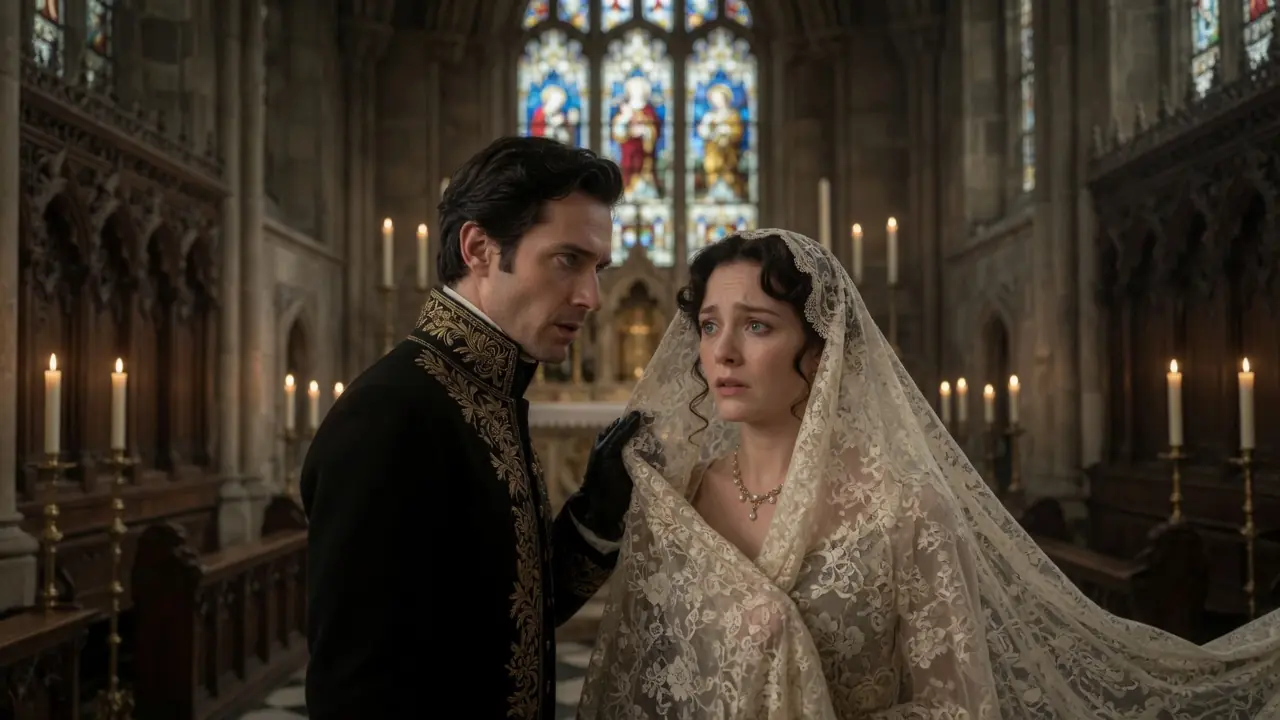
Then came the moment that would define the rest of her life. “You may now lift the veil,” the archbishop announced, smiling warmly at the Duke. Clara’s heart stopped. Time seemed to fracture, slowing to an agonizing crawl. She squeezed her eyes shut beneath the lace, bracing for the explosive rage, the immediate annulment, the ruin of her family. Arthur’s large hands reached up. His fingers grazed the edge of the Brussels lace. With a smooth, fluid motion, he lifted the veil back over her hair, exposing her face to the cold, filtered light of the chapel.
Clara kept her eyes lowered for a second longer, trembling visibly. When she finally forced herself to look up, she met the Duke’s gaze. His eyes were a startling, piercing shade of flint-gray—sharp and intelligent. He stared at her. Clara saw the exact moment the realization hit him: a minute tightening of his jaw, a brief, almost imperceptible narrowing of those gray eyes. He knew. He knew instantly that the woman standing before him was not the radiant, golden-haired Bianca he had contracted for. Clara parted her lips, a desperate apology dying in her throat. She waited for him to step back, to raise his voice, to strike her down with his wrath.
Instead, a profound, heavy silence stretched between them. It lasted only a few seconds, but to Clara, it felt like a century. Arthur’s gaze swept over her pale, terrified face, noting the trembling of her bottom lip, the dark chestnut hair, the simple panic in her hazel eyes. Then the unthinkable happened. Arthur Pendleton did not shout. He did not pull away. Instead, his expression smoothed into a mask of total, terrifying composure. He looked directly into Clara’s eyes, a faint, almost unreadable glimmer passing through his own. Without breaking eye contact, he leaned down. His breath brushed her ear as he spoke in a whisper so low, so incredibly calm that only she could hear it.
“You are not the bride I was promised,” he murmured softly. Clara squeezed her eyes shut, a single tear escaping. “I am sorry,” she whispered back, her voice breaking. “Please, my father forced me.” Arthur pulled back slightly, his thumb casually, shockingly reaching up to brush the tear from her cheek—a gesture that looked deeply romantic to the watching congregation but was filled with an intense, calculated weight. “Vicar,” Arthur said, his voice ringing out clear and authoritative, turning back to the altar. “We are finished here. Bring the registry.”
Clara gasped softly, her eyes flying open. He was going through with it. He was actually going to sign the legal documents. Ten minutes later, Clara’s trembling hand held a silver fountain pen. She signed “Clara Harrington.” Beneath his bold, sweeping signature, she officially bound herself to a man who had every right to despise her.
The carriage ride away from the chapel was suffocatingly tense. The moment the heavy carriage doors clicked shut, plunging them into the dim, velvet-lined interior, Clara shrank back into the corner, clutching her bouquet of white roses as if they were a shield. Arthur poured himself a glass of amber liquid from a crystal decanter built into the carriage wall. He took a slow sip, his eyes never leaving her face. The silence was deafening.
“I imagine,” Arthur began, his voice dripping with dark amusement, “that your father is currently celebrating his cleverness in a nearby tavern, believing he has thoroughly outsmarted the Duke of Ashborne.” Clara swallowed hard. “Your Grace, I beg you to believe me. I had no part in this scheme. Bianca ran away this morning. My father—he was terrified of the debt. He forced me into the gown.” Arthur swirled the liquor in his glass. “I know.” Clara blinked, stunned. “You—you know?” “I am a man who protects his investments, Lady Ashborne,” he said calmly, using her new title with a deliberate, heavy emphasis that sent a shiver down her spine. “I had men watching your estate. I was informed of Bianca’s midnight flight to Scotland hours before the sun rose. I knew she was gone.”
Clara’s mind reeled, trying to grasp the impossibility of his words. “If you knew she was gone, why did you come to the church? Why did you marry me?” Arthur leaned forward, the shadows of the carriage casting sharp angles across his handsome, stern face. He set the glass down and reached out gently but firmly, taking her chin between his gloved fingers, forcing her to look directly at him. “Because, Clara,” he said, softly speaking her given name for the first time—a sound that felt strangely intimate in the enclosed space—“I never wanted Bianca. I wanted you.”
“You wanted me?” Clara finally choked out, her voice barely a whisper in the dim, velvet-lined carriage. “But you asked for Bianca. The betrothal contract specifically named the eldest Harrington daughter.” Arthur leaned back against the leather squabs, resting his gold-tipped cane between his knees. “Your father insisted on Bianca. Lord Henry was desperate to offload his most expensive asset to the highest bidder. When I approached him concerning a union between our families, he immediately thrust Bianca’s portrait in my face, singing praises of her French tutors and societal graces. Had I asked for you—the daughter he treated as an unpaid scullery maid and a glorified accountant—he would have grown suspicious. He would have realized your true value and weaponized you for a much higher price. I could not risk him hiding you away.”
Clara’s mind spun helplessly. “But we have never even spoken. How could you possibly know my value?” A slow, devastatingly handsome smirk played at the corner of Arthur’s mouth. “Do you recall the dreary afternoon in November of last year at the Baring Brothers financial firm on Threadneedle Street?” Clara’s breath hitched. She remembered it vividly. Her father had been too inebriated to attend a meeting with their most aggressive creditor, Mr. Charles Cavendish. Clara had taken a hackney cab in the pouring rain, barging into Cavendish’s office. She had spent two hours fiercely auditing the man’s rigged interest rates, quoting parliamentary banking laws she had read in the library, and threatening to expose Cavendish’s fraudulent ledger practices to the magistrate. She had saved her family’s remaining tenant farms that day.
“I was in the adjoining office meeting with the senior partners,” Arthur revealed, his voice dropping to a low, admiring timbre. “The walls were exceedingly thin. I listened to a girl of nineteen absolutely dismantle one of London’s most ruthless financiers using nothing but mathematics and pure, unadulterated grit. When you left, I stood by the window and watched you walk out into the rain. You were wearing a terrible, threadbare brown coat, and you looked like a conquering queen.” Arthur reached across the space between them, his gloved fingers gently lifting her trembling hand. “I did not want a porcelain doll who quotes bad poetry and swoons at the sight of a balance sheet. Clara, I am building a railway empire that spans continents. I needed a partner with steel in her spine. I needed you.”
Tears, hot and fast, spilled over Clara’s eyelashes. For her entire life she had been the invisible foundation of a crumbling house, utterly unappreciated and unloved. To be seen so entirely, to be chosen for the very mind her father despised, broke the dam of her composure. Arthur did not offer meaningless platitudes. He simply handed her a crisp linen handkerchief and held her hand until her quiet sobs subsided.
Their arrival at Highcliffe Manor, the Duke’s sprawling ancient ancestral seat in Yorkshire, cemented the staggering reality of Clara’s new life. As the carriage crunched along the gravel drive, flanked by towering ancient oaks, the grand stone facade of the estate loomed against the twilight sky. The heavy doors swung open before they even reached the steps. A regiment of servants stood at strict attention in the cavernous, marble-floored foyer. At the head of the staff was Mrs. Hughes, the formidable housekeeper, who curtsied deeply as Clara stepped across the threshold. “Welcome home, Your Grace,” Mrs. Hughes said warmly.
Clara braced herself for the whispers, the shocked gasps, the realization that the wrong sister had arrived, but the servants did not bat an eye. As Mrs. Hughes led her up the grand staircase to the Duchess’s chambers, Clara noticed the freshly embroidered linens draped over the velvet chairs. They bore the monogram “C.P.”—Clara Pendleton. He had ordered the linens weeks ago. He had always known it would be her.
Over the next four months, the marriage of convenience transformed into something fierce, passionate, and deeply profound. Arthur proved to be nothing like the icy tyrant society whispered about. Behind the closed doors of Highcliffe Manor, he was a man of intense intellect and surprising tenderness. He did not confine Clara to the drawing room with embroidery and gossip. He brought her into his cavernous study. They spent their evenings by a roaring hearth surrounded by architectural blueprints and railway maps of the American West. Clara reviewed his ledgers, finding tax loopholes that even Arthur’s expensive barristers had missed. In return, Arthur listened to her. When he spoke to her, it was with a tone of absolute reverence. He bought her gowns of emerald silk and deep sapphire velvet, demanding she throw away the drab gray dresses of her past. When they finally consummated their marriage, it was not a cold, dutiful transaction, but a fiery collision of two equals who had finally found their sanctuary in one another.
For the first time in her life, Clara was happy. She was fiercely protected, wildly in love, and wielding real, tangible power. But a storm was gathering in the south, and the Harrington family’s reckoning had finally arrived. The illusion of peace shattered on a freezing morning in late December. Clara and Arthur were in the morning room, taking their tea, when the heavy oak doors were thrown open with a violent crash. Standing in the doorway, shivering and looking entirely unhinged, was Lord Henry Harrington. Clinging to his arm was Bianca.
Clara stood up slowly, her teacup rattling against the saucer. Bianca was virtually unrecognizable. Her spun-gold hair was matted, her face gaunt, and her once-luxurious traveling gown was stained with mud and soot. The dashing poet, Mr. Thomas Croft, was nowhere to be seen. “You,” Lord Henry bellowed, pointing a shaking, accusatory finger at Arthur. “You deceitful, blackhearted bastard.” Arthur did not even rise from his leather wingback chair. He slowly turned the page of his newspaper, taking a calm sip of his black tea. “Good morning, Henry. I see you forgot to wipe your boots before stepping on my Aubusson rug.”
“Do not mock me,” Lord Henry shrieked, his face turning a dangerous shade of purple. “You ruined us. When the Baring Bank found out the Duke of Ashborne had not officially assumed the Harrington debts, they called in the loans. My estate is gone. We were evicted yesterday.” Bianca burst into loud, theatrical sobs, collapsing onto a nearby sofa. “Thomas abandoned me. When we reached Edinburgh and he realized Papa’s accounts were frozen, he stole my jewelry in the dead of night and left me in a filthy boarding house. I had to beg for train fare back to London.”
Lord Henry marched toward Arthur, his fists clenched. “I have consulted a solicitor. This marriage is a fraud. It was a bait and switch. You signed a contract for Bianca. I will go to the magistrate. I will ruin your political standing in the House of Lords. I will tell the London Times that the Duke of Ashborne is legally bound to a runaway and the woman sharing his bed is a fraudulent impostor.” “You will do no such thing,” the voice did not belong to Arthur. It belonged to Clara. She stepped out from behind the tea table, her chin held high. She wore a tailored morning dress of rich burgundy, a string of flawless Ashborne diamonds resting against her collarbone. She looked every inch the formidable duchess she had become.
Lord Henry sneered at her. “Silence, you ungrateful wretch. You are nothing but a pawn in this. Get your things. When the annulment is finalized, you will work as a governess to pay for your sister’s upkeep.” “There will be no annulment,” Clara said, her voice dropping to a glacial, terrifying calm that mirrored her husband’s. “Because there was no fraud, Father. You signed a contract offering a Harrington daughter in exchange for a sum of £50,000. But you failed to read the addendums Arthur’s barristers drafted. The contract stated that the debts would only be cleared after the Duchess of Ashborne produced a living heir. Furthermore, Arthur never legally bound himself to Bianca’s name. The registry at St. George’s Chapel says Clara.”
Lord Henry blinked, his bluster faltering for a fraction of a second. “That—that does not matter. Bianca was the one who was supposed to be there. She was kidnapped by that vile poet.” Arthur finally set his newspaper down. He stood up, his towering frame casting a long, dark shadow across the morning room. He walked over to his mahogany desk, unlocked the top drawer, and pulled out a single sheet of watermarked bank parchment. He tossed it onto the tea table in front of Lord Henry. “He did not kidnap her, Henry,” Arthur said, his voice dripping with lethal amusement. “He courted her precisely as he was paid to do.”
Bianca stopped crying, her tear-streaked face snapping up in confusion. “What? What do you mean?” Clara looked at the paper. It was a wire-transfer receipt from Coutts Bank dated three weeks before the wedding. The sum was staggering: £10,000. The recipient was Mr. Thomas Croft. Arthur slipped his arm around Clara’s waist, pulling her flush against his side. “Did you honestly believe a destitute tutor could afford private sleeper cars to Scotland? Did you think a man who could barely afford ink suddenly had the funds to woo a spoiled aristocrat with hothouse flowers and midnight carriages?”
Lord Henry’s mouth fell open, his eyes darting frantically between Arthur and the bank receipt. “I knew the only way to get Clara out of your clutches without raising your financial demands was to make you desperate,” Arthur explained, his tone merciless. “I hired Mr. Croft to seduce Bianca. I paid him to convince her to elope on the morning of the wedding, knowing your suffocating pride and terror of debt would force you to put Clara in that dress to save your own skin. You did exactly what I calculated you would do. You gift-wrapped the woman I wanted and handed her to me at the altar.”
Clara’s heart hammered against her ribs, but it was not out of fear. A wild, electrifying thrill surged through her blood. Arthur had orchestrated an international scandal, manipulated the financial markets, and paid off a rogue poet—all to rescue her from a life of servitude. He had burned down her sister’s vanity and her father’s greed just to place a crown on Clara’s head. “You are a monster,” Lord Henry whispered, stumbling backward as if Arthur were the devil himself. “I am a businessman,” Arthur corrected coldly. “And I have concluded my business with you.”
Mrs. Hughes, the housekeeper, appeared in the doorway instantly. “Yes, Your Grace?” “Escort Mr. Harrington and his daughter off my property. If they ever step foot in Yorkshire again, release the hounds.” Arthur looked back at Lord Henry, his gray eyes devoid of any human warmth. “You have nothing left, Henry. Do not test my patience, or I will ensure you spend the rest of your miserable life in a debtor’s cell.” Bianca wailed as two burly footmen appeared, grabbing Lord Henry by the arms and dragging the ruined aristocrat out of the room. The grand oak doors slammed shut, plunging the morning room back into a heavy, luxurious silence.
Clara stood frozen, her eyes locked on the bank receipt. Arthur turned to her, his mask of cold indifference melting away into something intensely vulnerable. For the first time since she had met him, the great Duke of Ashborne looked nervous. “Clara,” he said softly, reaching out to gently cup her cheek. “If you hate me for my deception, I will understand. But I could not leave you in that house. I would do it again a thousand times over just to see you standing here as my wife.”
Clara looked up into the eyes of the man who had seen her worth when the rest of the world had treated her as a ghost. She did not see a monster. She saw her equal, her protector, her magnificent, ruthless partner. She reached up, wrapping her arms around his neck, and pulled him down into a searing, breathless kiss. “Hate you?” Clara whispered against his lips, a wicked, brilliant smile spreading across her face. “My darling Arthur, I am only annoyed that you paid Croft £10,000. I could have negotiated him down to five.”
Arthur let out a booming, genuine laugh, lifting Clara off the floor and spinning her into his arms. The empire they would build together was vast, their power unmatched. But in that moment, the greatest victory of the Duke of Ashborne’s life was the brilliant, beautiful woman laughing against his chest. She was sent as a sacrifice, but she rose as a queen, and history would never forget the name Clara Pendleton.