Duke Reginald Ashford had commanded armies, controlled vast estates, and wielded influence that could topple governments. But none of that mattered when the fever began to consume him. As his strength ebbed away, and his once-commanding voice reduced to whispered pleas for water, the grand halls of Ashford Manor emptied one by one.
His own brother fled to Scotland. His sister-in-law claimed urgent business in Bath, and even his closest advisers found pressing matters that required their immediate attention elsewhere. They feared contagion, yes, but more than that, they feared association with decline, for in their world, weakness was more dangerous than any disease.
Only Mary Collins remained, a quiet maid who had scrubbed floors and polished silver in the shadows of his magnificent home for three years, invisible to his notice until the moment she chose to stay. While others abandoned him to preserve their reputations, she abandoned her own safety to preserve his life.
And in doing so, she discovered that the greatest nobility lies not in bloodlines or titles, but in the courage to care when caring costs everything.
The fever came like a thief in the night, stealing first Reginald’s strength, then his voice, and finally his dignity. Duke Reginald Ashford, who had never known a day of illness in his forty-two years, found himself bedridden in the master suite of Ashford Manor, his powerful frame reduced to trembling weakness beneath silk sheets that felt like chains.
Doctor Peyton emerged from the sick room with the grave expression that had become all too familiar over the past week, his medical bag clutched tightly as if it contained answers he could not provide. The assembled family members, what few remained, gathered in the hallway like vultures circling carrion.
“Well,” demanded Lord Charles Ashford, Reginald’s younger brother, though he maintained a careful distance from the bedroom door. “What is your assessment?”
“I am afraid His Grace’s condition continues to deteriorate,” Dr. Peyton replied, his voice heavy with the weight of delivering unwelcome news to the powerful. “The fever shows no signs of breaking, and he has developed a persistent cough that concerns me greatly.”
“Is it?” Lady Charlotte Ashford, Charles’s wife, could not bring herself to finish the question, though her meaning was clear. The specter of consumption hung over every unexplained illness among the upper classes, a disease that showed no respect for titles or wealth.
“I cannot rule it out,” the doctor admitted reluctantly. “Though I must stress that we simply do not know enough about the nature of his affliction to make a definitive diagnosis.”
The words fell like stones into still water, sending ripples of panic through the small gathering. Charles and Charlotte exchanged meaningful glances, the kind of silent communication that passes between married couples when difficult decisions must be made.
“Perhaps,” Charlotte said carefully, “it would be wise for us to remove ourselves from the immediate vicinity for the sake of our own health, you understand, and that of our children.”
“Quite right,” Charles agreed with obvious relief. “We have that invitation to the Weatherbees’ estate in Scotland. It might be prudent to accept it, just until Reginald recovers.”
Dr. Peyton’s expression suggested he found their reasoning less than noble, but he was too diplomatic to voice his disapproval directly. “That is, of course, your decision to make. However, I must stress that His Grace requires constant care and attention. He cannot be left alone.”
“Naturally,” Charles said, though his tone suggested he had already mentally departed for Scotland. “The staff will see to his needs. That is what we pay them for, after all.”
As the family members dispersed to make their hasty travel arrangements, none of them noticed the slight figure standing in the shadows of the servants’ staircase. Mary Collins had been returning from the laundry when she overheard the conversation, and now she pressed herself against the wall, her heart pounding with a mixture of fear and indignation.
She had worked at Ashford Manor for three years, arriving as a frightened seventeen-year-old with nothing but the clothes on her back and a desperate need for employment. The Duke had been a distant figure in those early days, a tall, imposing man with steel-gray eyes and prematurely silver hair, who commanded respect through his very presence.
She had seen him only in passing, usually striding through the halls with the confident bearing of a man accustomed to having the world bend to his will. But Mary had also witnessed moments of unexpected kindness.
She had seen him quietly increase the wages of the groundskeeper when the man’s wife fell ill. She had watched him personally ensure that the children of his tenants received proper schooling, even when it meant considerable expense to the estate.
These glimpses of compassion hidden beneath his stern exterior had earned her quiet admiration over the years. Now, as she listened to his own family abandon him in his hour of greatest need, Mary felt a surge of anger that surprised her with its intensity.
How could they simply leave him? How could they speak of him as if he were already dead, a problem to be managed rather than a man to be cared for?
“Mary,” the sharp voice of Mrs. Hartwell, the head housekeeper, cut through her thoughts. “What are you doing lurking about? There is work to be done.”
“Yes, ma’am,” Mary replied, stepping out of the shadows with as much composure as she could muster. “I was just... I heard about His Grace’s condition. Is there anything special we should be doing to help with his care?”
Mrs. Hartwell’s expression softened slightly. She was a stern woman, but fair, and she had always appreciated Mary’s diligent work ethic.
“Dr. Peyton has given specific instructions for his care. Cool compresses for the fever, plenty of fluids, and someone to monitor his condition throughout the night.”
“Who will be doing that?” Mary asked, though she suspected she already knew the answer.
“Well, with the family departing tomorrow, I suppose it will fall to the staff,” Mrs. Hartwell said with a sigh. “Though I must admit, most of them are terrified of catching whatever he has. Cannot say I blame them, really.”
Mary nodded, understanding the fear that gripped the household. Disease was a constant threat in their world, and for servants who could not afford medical care, any illness could prove fatal.
But as she went about her duties that evening, she could not shake the image of the Duke lying alone in his vast bedroom, abandoned by those who should have loved him most.
That night, as the manor settled into an uneasy quiet, Mary found herself unable to sleep. The other servants had made it clear that they intended to avoid the Duke’s quarters as much as possible, performing only the most essential tasks before retreating to the safety of the lower floors.
It was a practical decision, Mary knew, but it sat uneasily with her conscience.
Finally, unable to bear the thought of him suffering alone, she rose from her narrow bed in the servants’ quarters and made her way through the darkened halls to the master suite. The door stood slightly ajar, and she could hear the sound of labored breathing from within.
Mary hesitated for a moment, knowing that entering uninvited could cost her position. But as another harsh cough echoed from the room, her decision was made.
She pushed open the door and stepped inside.
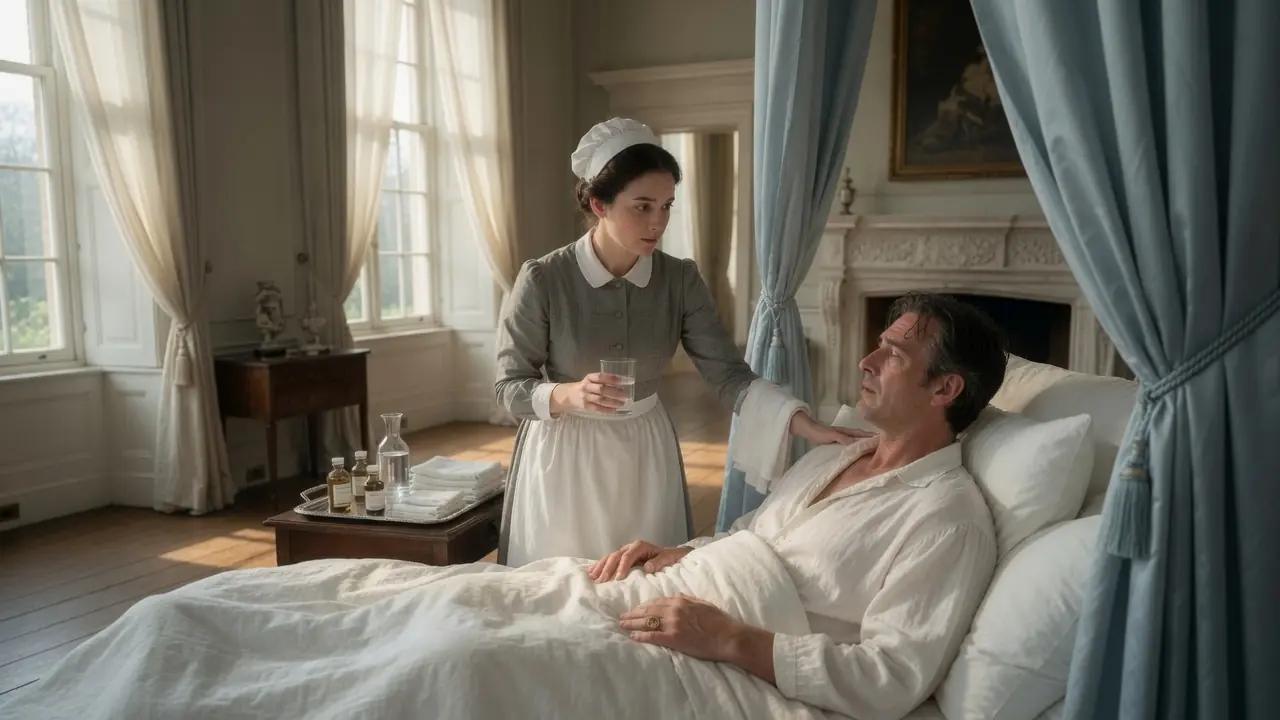
The sight that greeted her was heartbreaking. The Duke, who had always seemed larger than life, lay curled on his side, his powerful frame racked with shivers despite the fire burning in the grate. His dark hair was damp with perspiration, and his face was flushed with fever.
The water pitcher beside his bed was empty, and his lips were cracked with thirst.
“Your Grace,” Mary called softly, approaching the bed with careful steps.
Reginald’s eyes fluttered open, struggling to focus on her face.
“Water,” he whispered, his voice barely audible. “Please.”
Mary’s heart clenched at the desperation in his voice. Without hesitation, she moved to the washstand and filled a glass with fresh water from the pitcher she had brought with her.
Supporting his head gently, she helped him drink, noting how his hands shook with weakness.
“Thank you,” he managed after draining the glass. “I... who are you?”
“Mary Collins, Your Grace. I work in the laundry.” She refilled the glass and set it within easy reach. “How are you feeling?”
Reginald attempted a bitter laugh that dissolved into another coughing fit.
“Like I am dying,” he said when he could speak again. “And apparently that is exactly what everyone expects me to do.”
Mary felt her cheeks burn with shame on behalf of his family. “I am sure they are just concerned about their own health, Your Grace.”
“Are they?” Reginald’s gray eyes, though dimmed by fever, still held a sharp intelligence. “Or are they simply protecting themselves from the scandal of association with failure?”
Mary had no answer for that, because she suspected he was right. Instead, she moved to the washstand and wrung out a cloth in cool water.
“May I?” she asked, indicating his fevered brow.
Reginald nodded, too weak to maintain his usual reserve. As Mary gently placed the cool compress against his forehead, he closed his eyes and released a sigh of relief.
“Why are you here?” he asked after a moment. “Are you not afraid of catching whatever I have?”
Mary considered the question seriously.
“Yes,” she admitted. “But being afraid does not seem like a good enough reason to let someone suffer alone.”
Something in her simple honesty seemed to reach him, and for the first time since his illness began, Reginald felt a flicker of something other than despair.
“Then I suppose we will not tell her,” Mary said with a small smile, refreshing the compress. “Besides, someone needs to make sure you are taking your medicine and drinking enough water. Dr. Peyton was very specific about that.”
“You spoke to Dr. Peyton?”
“I listened when he gave his instructions to Mrs. Hartwell,” Mary clarified. “He said you needed constant monitoring, especially during the night hours when fever tends to spike.”
Reginald studied her face in the flickering firelight, taking in her earnest brown eyes and the determined set of her jaw. She was younger than he had initially thought, probably no more than twenty, with the kind of quiet prettiness that often went unnoticed in grand houses like his.
Her dark hair was neatly pinned back, and her simple gray dress marked her clearly as a member of the working class.
“What is your full name?” he asked, surprising himself with his interest.
“Mary Elizabeth Collins, Your Grace.”
“How long have you worked here, Mary Elizabeth Collins?”
“Three years, Your Grace. Since I was seventeen.”
“And in those three years, have we ever spoken before tonight?”
Mary shook her head. “No, Your Grace. I work mostly in the laundry and the lower floors. We do not often cross paths.”
“Yet here you are, risking your health and your position to care for a man you barely know.” Reginald’s voice held a note of wonder. “Why?”
Mary was quiet for a long moment, considering how to explain feelings she did not fully understand herself.
“I suppose,” she said finally, “because everyone deserves to have someone care whether they live or die. And right now, it seems like you do not have anyone else.”
The simple truth of her words hit Reginald like a physical blow. She was right, of course.
His brother and sister-in-law had fled at the first sign of serious illness. His few close friends had made polite excuses and kept their distance. Even his most trusted advisers had found pressing business elsewhere.
Only this young woman, who owed him nothing and had everything to lose, had chosen to stay.
“You are very kind,” he said quietly, “but also very foolish.”
“If I am contagious, then I will face that when it happens,” Mary interrupted gently. “But I will not leave you to face this alone.”
As the night wore on, Mary settled into a routine of care that would become familiar over the coming days. She monitored his fever, helped him drink when thirst overcame him, and changed the cool compresses that provided his only relief from the burning heat that consumed him.
When he was seized by coughing fits that left him gasping and exhausted, she supported him until the spasms passed. But perhaps most importantly, she talked to him, not with the careful deference that marked most of his interactions with servants, but with the easy conversation of one human being caring for another.
She told him about her life before coming to the manor, about the small village where she had grown up, and the circumstances that had forced her to seek employment far from home.
“My father was a blacksmith,” she said as she helped him sip some broth she had brought from the kitchen. “He died when I was sixteen, and my mother could not manage the shop alone. We lost everything within a year.”
“I am sorry,” Reginald said, meaning it. “That must have been very difficult.”
“It was,” Mary agreed. “But it taught me that life can change very quickly, and that we have to take care of each other when it does. Because sometimes caring is the only thing that stands between a person and complete despair.”
Reginald found himself thinking about her words long after she had finally convinced him to try to sleep. Here was a young woman who had lost everything, yet she spoke of caring for others as if it were the most natural thing in the world.
Meanwhile, he, a man with wealth and power beyond most people’s dreams, had been abandoned by those closest to him the moment he became inconvenient.
When dawn broke over Ashford Manor, Mary was still there, dozing fitfully in the chair beside his bed. Reginald watched her sleep and felt something shift inside his chest, a warmth that had nothing to do with fever and everything to do with gratitude for this unexpected angel who had appeared in his darkest hour.
He did not know it yet, but Mary Collins was about to change his life in ways that had nothing to do with medicine and everything to do with the healing power of genuine human connection.
The Duke, who had commanded respect through authority, was about to learn what it meant to earn devotion through vulnerability. And the maid, who had always been invisible, was about to discover that sometimes the smallest acts of courage create the most profound transformations.
Word of the family’s departure spread through the manor like wildfire, carried on whispers and worried glances. By morning, the staff had divided into two distinct camps: those who viewed the Duke’s illness as a dangerous threat to be avoided at all costs, and those who felt ashamed by the family’s abandonment but were too frightened to act on their conscience.
Mary found herself caught between these factions as she went about her regular duties, trying to maintain the pretense of normalcy while secretly planning her return to the Duke’s bedside.
Mrs. Hartwell had assigned the minimal care duties to Thomas, the youngest footman, but Mary could see the terror in the boy’s eyes every time he approached the master suite.
“He is getting worse,” Thomas whispered to Mary as they passed in the hallway. “The fever is so high he is talking to people who are not there. Mrs. Hartwell says we should send for the vicar.”
Mary’s blood ran cold. “The vicar? Surely it is not that serious.”
“Dr. Peyton came again this morning,” Thomas continued, glancing around to make sure they were not overheard. “I heard him tell Mrs. Hartwell that we should prepare for the worst. Said there is nothing more he can do except try to keep His Grace comfortable.”
The words hit Mary like a physical blow. She had left the Duke’s room at dawn, when the other servants began to stir, but he had seemed stable. Weak and fevered, but not dying.
The thought that his condition had deteriorated so rapidly filled her with desperate urgency.
“Thomas,” she said, catching the young man’s arm, “what if I took over the care duties? You could tell Mrs. Hartwell that you are feeling unwell yourself, not a lie, considering how frightened you look. I could manage his needs without anyone else having to risk exposure.”
Thomas’s relief was palpable. “You would do that? But Mary, if he really is dying...”
“Then he should not die alone,” Mary said firmly. “No one should.”
An hour later, Mary stood outside the master suite with a tray of supplies: fresh water, clean linens, the medicines Dr. Peyton had prescribed, and a bowl of the clear broth that Cook had reluctantly prepared.
She had convinced Mrs. Hartwell that consolidating the Duke’s care under one person would minimize the risk to the rest of the staff, though she suspected the housekeeper saw through her altruistic reasoning.
“You understand the risks, Mary,” Mrs. Hartwell had said, her stern expression softening with concern. “If you fall ill, we may not be able to provide you with the same level of care that His Grace receives.”
“I understand,” Mary had replied. “But someone has to do it, and I am willing.”
Now, as she pushed open the door to the Duke’s chamber, Mary was shocked by what she found. In the few hours since she had left, Reginald’s condition had indeed worsened dramatically.
He lay motionless on the bed, his breathing shallow and labored, his skin burning with fever. Most alarmingly, he seemed to be unconscious, unresponsive to her gentle calls of his name.
Mary set down her tray and moved quickly to his side, placing her hand on his forehead. The heat radiating from his skin was frightening, and she could see that his lips were moving slightly, as if he were carrying on a conversation with invisible companions.
“Your Grace,” she said softly, taking his hand in hers. “Can you hear me?”
Reginald’s eyes fluttered open, but they seemed to look through her rather than at her.
“Eleanor,” he whispered, his voice cracked and desperate. “Eleanor, is that you?”
Mary’s heart clenched as she realized he was calling for his late wife. The Duchess had died five years earlier in a riding accident, and Mary knew from household gossip that the Duke had never fully recovered from the loss.
Now, in his fevered delirium, he was reaching for the woman he had loved and lost.
“She is not here right now,” Mary said gently, not wanting to cause him additional distress by correcting his confusion. “But I am. Let me help you.”
She began the careful process of cooling his fever, replacing the warm compresses with fresh cold ones and encouraging him to drink small sips of water. It was slow, painstaking work, made more difficult by his delirium and the way he seemed to drift in and out of consciousness.
As the hours passed, Mary found herself drawn into the private world of Reginald’s fevered mind. He spoke to his late wife, apologizing for things she could not understand and making promises that broke her heart.
He relived moments from his military service, calling out orders to soldiers who existed only in his memories. Most painfully, he spoke to his brother Charles, pleading for understanding and forgiveness in a way that suggested deep wounds between them.
“I never meant for it to happen,” he whispered during one particularly intense episode. “Charles, you have to believe me. I never wanted to be the heir. I never wanted to take what should have been yours.”
Mary began to piece together a story of family tragedy and resentment. Charles had been the elder brother originally, she realized, but something had happened to change the line of succession.
Whatever it was, it had clearly created a rift between the brothers that had never healed.
As night fell, Mary settled into the chair beside his bed, determined to maintain her vigil. She had sent word to Mrs. Hartwell that the Duke’s condition was critical and that she would remain with him through the night.
The housekeeper had reluctantly agreed, though Mary suspected it was more out of resignation than approval.
“You do not have to stay,” Reginald said suddenly, his voice clearer than it had been all day.
Mary looked up to find his gray eyes focused on her face, lucid for the first time in hours.
“How are you feeling?” she asked, reaching for the water glass.
“Like I have been trampled by a cavalry regiment,” he admitted with a weak attempt at humor. “But my head is clearer. The fever seems to have broken, at least temporarily.”
Mary felt a surge of hope as she helped him sit up to drink. His skin was still warm, but the burning heat had indeed subsided, and his breathing seemed easier.
“You have been here all day,” Reginald observed, studying her face in the lamplight. “Did Mrs. Hartwell object?”
“I convinced her it was the most practical arrangement,” Mary said, not mentioning the personal cost of her decision.
She had already missed two meals and would likely face questions about her dedication to duties outside her normal responsibilities.
“Practical,” Reginald repeated with a slight smile. “Is that what you call risking your life for a stranger?”
“You are not a stranger,” Mary said, surprising herself with the admission. “I have worked in your house for three years. I have seen how you treat your staff, how you care for your tenants. You are not the cold, distant man you pretend to be.”
Reginald was quiet for a long moment, considering her words.
“You see too much, Mary Collins.”
“Perhaps you hide too little,” she replied gently. “At least from those who are paying attention.”
“And you pay attention.”
“It is hard not to when you work in someone’s home. You learn things about people, their habits, their kindnesses, their sorrows.”
“What sorrows have you observed in me?” Reginald asked, though his tone suggested he was not sure he wanted to hear the answer.
Mary hesitated, not wanting to overstep her bounds.
“I know you still grieve for your wife,” she said carefully. “And I think you carry guilt about your relationship with your brother. You spoke of it during your fever.”
Reginald’s expression darkened. “What did I say?”
“That you never wanted to be the heir, that you never meant for something to happen.” Mary watched his face carefully. “What did you mean?”
For a moment, she thought he would not answer. Then, perhaps weakened by illness and isolation, Reginald began to speak.
“Charles was the elder son,” he said quietly. “He was supposed to inherit everything, the title, the estates, the responsibilities. I was the spare, free to pursue a military career and live my own life. But when Charles was twenty-five, he was thrown from his horse during a hunt. The injury left him with a permanent limp and other complications that made it impossible for him to father children.”
Mary began to understand. “So the inheritance passed to you eventually.”
“Yes. My father lived for another ten years, hoping that Charles might recover enough to fulfill his duties, but it became clear that would not happen, and the entailment required a direct heir who could continue the line.”
Reginald’s voice was heavy with old pain.
“Charles has never forgiven me for taking what he sees as rightfully his. And I have never forgiven myself for being relieved when it happened.”
“Relieved?” Mary asked gently.
“I loved Eleanor,” Reginald said simply. “She was the daughter of a baron, suitable for a duke, but not grand enough for the heir to a dukedom. If Charles had remained the heir, I never could have married her. His accident, terrible as it was, gave me the woman I loved and the life I wanted.”
The confession hung in the air between them, raw and honest in a way that surprised them both. Mary could see the guilt that had eaten at him for years, the weight of benefiting from his brother’s misfortune.
“You did not cause his accident,” she said firmly. “And you did not choose to inherit. You simply made the best of the circumstances you were given.”
“Did I?” Reginald asked bitterly. “Because it seems to me that I have made a mess of everything. My brother hates me. My wife is dead. And now I am dying alone while my family flees to Scotland to avoid the inconvenience of my illness.”
“You are not dying,” Mary said with more confidence than she felt. “And you are not alone.”
“Why?” Reginald asked, the question that had been haunting him since she first appeared at his bedside. “Why are you here, Mary? Why are you risking everything for someone who has never even noticed you before?”
Mary was quiet for a long moment, searching for words to explain something she did not fully understand herself.
“Because,” she said finally, “I know what it is like to be abandoned when you need help most. When my father died and we lost everything, people we thought were friends disappeared overnight. They were afraid that our misfortune might be contagious, that helping us might somehow taint them.”
“And that is what my family has done to me.”
“Yes,” Mary said simply. “And I know how much that hurts. I know what it feels like to realize that the people you counted on will only stand by you when it is convenient for them.”
Reginald reached out and took her hand, his fingers still weak but warm.
“I am sorry you experienced that.”
“And I am sorry you are experiencing it now,” Mary replied, squeezing his hand gently. “But you are not alone anymore. Whatever happens, you will not face it alone.”
As the night deepened around them, Mary continued her careful ministrations, monitoring his fever and encouraging him to rest. But something had changed between them during their conversation.
The formal distance between Duke and servant had dissolved, replaced by something more fundamental: the connection between two human beings who had found comfort in each other’s presence during a time of crisis.
When dawn broke over Ashford Manor, Reginald’s fever had indeed broken. He was weak and exhausted, but the crisis seemed to have passed.
As Mary helped him wash and change into fresh nightclothes, she allowed herself to hope that the worst was over.
“Mary,” Reginald said as she prepared to leave for her other duties. “I want you to know that what you have done, I will never forget it. When I am well again, I intend to make sure you are properly rewarded for your kindness.”
Mary shook her head. “I do not want a reward, Your Grace. I just want you to get well.”
“Nevertheless,” Reginald said firmly, “you have saved my life. That deserves recognition.”
As Mary made her way back to the servants’ quarters, she reflected on the strange turn her life had taken. Three days ago, she had been invisible, just another servant going about her duties without notice or recognition.
Now she had become the sole caregiver for one of the most powerful men in England. And somehow, in the process, she had discovered a strength and purpose she never knew she possessed.
What she did not know was that Reginald was lying in his bed, thinking about her with an intensity that had nothing to do with gratitude and everything to do with a growing recognition that this remarkable young woman had not only saved his life, she had reminded him what it meant to truly live.
Recovery, Mary discovered, was a far more complex process than she had anticipated. While Reginald’s fever had broken and the immediate crisis had passed, he remained weak and prone to setbacks that required constant vigilance.
More challenging still was the emotional aftermath of his illness: the bitter knowledge that his family had abandoned him, and the growing dependence on a servant who had shown him more loyalty than his own blood.
“You do not have to stay,” Reginald said for the dozenth time, as Mary arranged his pillows to help him sit up for his afternoon meal.
It had become a ritual between them, his polite offer of release and her gentle refusal to abandon her post.
“And you do not have to keep asking,” Mary replied with a smile, settling the tray across his lap. “Cook has made your favorite soup today. She is quite pleased that your appetite is returning.”
Reginald looked down at the bowl of rich broth with vegetables, noting the care that had gone into its preparation.
“Cook has been very attentive lately. I suspect you have had something to do with that.”
“I may have mentioned that you were particularly fond of her cooking,” Mary admitted. “The staff are all quite concerned about your recovery, you know. They are not as indifferent as you might think.”
“Concerned enough to visit?” Reginald asked with a trace of bitterness.
“Concerned enough to ask me daily about your progress and to ensure you have everything you need,” Mary corrected gently. “Fear makes people do things they are not proud of, Your Grace. It does not mean they do not care.”
It was a conversation they had repeated in various forms over the past week as Reginald struggled to come to terms with his family’s abandonment. Mary had become not just his nurse, but his confessor, the repository for thoughts and feelings he had never shared with another living soul.
“Tell me about your life before you came here,” Reginald said, changing the subject as he often did when their conversations grew too heavy. “You mentioned your father was a blacksmith. What was that like?”
Mary settled into the chair that had become hers by right of constant occupation.
“Noisy,” she said with a laugh. “And hot. Our cottage was right next to the forge, so there was always the sound of hammering and the smell of hot metal. But it was good work, honest work. My father took pride in what he created.”
“You speak of him with great affection.”
“He was a good man,” Mary said simply. “He taught me that the value of a person is not measured by their station in life, but by how they treat others. He was just a village blacksmith, but he was respected by everyone who knew him because he was fair and kind and reliable.”
“Qualities that seem to run in the family,” Reginald observed, watching her face as she spoke.
Mary felt her cheeks warm at the compliment.
“I try to live by his example, though I am not sure he would approve of my current situation.”
“Why not?”
“Because I am neglecting my other duties to care for you,” Mary admitted. “Mrs. Hartwell has been very understanding, but I know it is causing problems for the other staff. They have to cover my work in the laundry and elsewhere.”
Reginald frowned. “I had not considered that. Perhaps I should speak to Mrs. Hartwell about adjusting your responsibilities.”
“Please do not,” Mary said quickly. “I do not want special treatment. I chose to take on your care, and I will manage the consequences.”
“But it is not fair to you or to the others.”
“Life is not fair,” Mary said with a philosophical shrug. “If it were, good people would not get sick and families would not abandon each other when things get difficult. We just have to do our best with the circumstances we are given.”
Reginald studied her face, marveling at her matter-of-fact acceptance of hardship.
“You are very wise for someone so young.”
“I am twenty years old,” Mary protested. “Hardly a child.”
“Twenty,” Reginald repeated, suddenly aware of the twenty-two-year gap between them. “When I was twenty, I thought I knew everything about the world. I was arrogant and entitled and completely unprepared for real responsibility.”
“What changed?” Mary asked, genuinely curious about the man behind the title.
“War,” Reginald said simply. “I purchased a commission in the cavalry when I was twenty-one, thinking it would be a grand adventure. Instead, I learned what it meant to watch good men die for causes they did not understand. To make decisions that cost lives. To carry the weight of command when you are not sure you are worthy of it.”
“Is that when you met your wife?”
Reginald’s expression softened.
“Eleanor was the daughter of a colonel in my regiment. She was visiting her father when I first saw her, and I was completely smitten. She was beautiful, yes, but more than that, she was intelligent and compassionate and completely unimpressed by my title.”
“She sounds wonderful,” Mary said, though she felt an unexpected pang of something that might have been jealousy.
“She was,” Reginald agreed. “She made me want to be worthy of her love. When we married, I thought I was the luckiest man alive.”
“How long were you married?”
“Twelve years,” Reginald said quietly. “We tried to have children, but it was not to be. Eleanor said it did not matter, that we had each other, but I know she grieved for the family we never had.”
Mary heard the pain in his voice and reached out instinctively to touch his hand.
“I am sure she was happy with the life you built together.”
“I hope so,” Reginald said, turning his hand to capture hers. “But I will never know for certain. She died before we could grow old together, before we could see what our life might have become.”
They sat in comfortable silence for a moment, their hands linked in a gesture that had become natural over the days of her care. Mary was acutely aware of the impropriety of the situation, a servant holding hands with a duke.
But somehow it felt right, a connection born of shared vulnerability rather than social convention.
“Mary,” Reginald said suddenly, “what do you want from life? What are your dreams, your ambitions?”
The question caught her off guard. No one had ever asked her about her dreams before.
“I... I am not sure I understand.”
“If you could have anything, be anything, what would you choose?”
Mary considered the question seriously.
“I suppose I would like to have a family someday, a husband who loves me, children to raise and care for, a home of my own, however modest.”
“That is all?”
“It is more than many people have,” Mary pointed out. “And more than I ever expected to achieve, given my circumstances.”
“Your circumstances,” Reginald repeated thoughtfully. “Tell me, Mary, do you ever resent your position? Do you ever wish you had been born to different circumstances?”
Mary was quiet for a long moment, considering how to answer honestly without seeming ungrateful.
“Sometimes,” she admitted, “not because I am ashamed of honest work, but because I know I am capable of more than scrubbing floors and washing linens. I can read and write better than many people of higher station. I understand numbers and can manage accounts. But none of that matters because I was born to the wrong family in the wrong circumstances.”
“It matters to me,” Reginald said quietly. “Your intelligence, your compassion, your strength of character, all of that matters very much to me.”
Mary felt her heart skip at the intensity in his voice.
“Your Grace—”
“Reginald,” he corrected. “When we are alone like this, I would like you to call me Reginald.”
“I could not,” Mary protested. “It would not be proper.”
“Nothing about this situation is proper,” Reginald pointed out. “You have seen me at my weakest, cared for me when I was helpless, listened to my confessions and fears. I think we have moved beyond the constraints of conventional propriety.”
Mary looked into his gray eyes and saw something that made her breath catch. It was more than gratitude, more than the natural affection between patient and caregiver. It was something deeper and more dangerous, something that could destroy them both if acknowledged.
“I should go,” she said suddenly, pulling her hand free and rising from her chair. “You need to rest, and I have other duties to attend to.”
“Mary, wait,” Reginald called, but she was already at the door.
“I will return this evening to check on you,” she said without turning around. “Mrs. Hartwell will send Thomas with your dinner.”
As the door closed behind her, Reginald sank back against his pillows, his heart pounding with more than the aftereffects of illness. He was falling in love with his maid, a woman so far beneath his station that even acknowledging his feelings would be scandalous.
But as he thought about her gentle hands, her kind eyes, and the way she had stayed by his side when everyone else had fled, he realized that social conventions seemed insignificant compared to the depth of his feelings.
Mary, meanwhile, hurried through the corridors with her heart in turmoil. She had seen the look in Reginald’s eyes, had felt the shift in the atmosphere between them. She was not so naive as to mistake his feelings, nor so foolish as to ignore her own growing attachment to the man she had nursed back to health.
But she was also practical enough to know that nothing could come of such feelings. He was a duke, one of the most powerful men in England. She was a servant, a nobody with no fortune, no family, no prospects beyond a life of domestic service.
Whatever was growing between them was impossible, dangerous, and potentially devastating to them both.
As she returned to her neglected duties in the laundry, Mary tried to convince herself that distance would cure what ailed them both. But deep in her heart, she knew that something fundamental had changed between them, something that could not be undone by propriety or common sense.
The maid who had stayed to care for a dying duke had discovered that healing could work both ways, and that sometimes the greatest danger lies not in disease, but in the unexpected flowering of love in the most impossible circumstances.
Three weeks had passed since Mary’s abrupt departure from Reginald’s bedside, and the careful distance she had tried to maintain was proving impossible to sustain. His recovery had progressed steadily, and he was now well enough to leave his room for short periods, which meant their paths crossed frequently as she went about her duties.
Each encounter was a study in polite formality that fooled no one, least of all themselves. Reginald would nod courteously and inquire about her health. Mary would curtsy and respond with appropriate deference.
But their eyes would linger a moment too long, and the air between them would crackle with unspoken words and suppressed emotions.
The other servants had begun to notice the tension, though they interpreted it in various ways. Some whispered that the Duke was displeased with Mary’s presumption in caring for him. Others suggested that he was planning to reward her service with a generous settlement.
None of them guessed at the truth, that two people from completely different worlds had found in each other something they had never expected to discover.
The fragile equilibrium was shattered on a gray October morning when a carriage bearing the Ashford family crest rolled up the manor’s circular drive. Charles and Charlotte had returned from Scotland, apparently confident that enough time had passed for any contagion to have dissipated.
Mary watched from an upstairs window as the couple emerged from their carriage, noting their obvious reluctance and the way they held handkerchiefs to their faces, as if the very air around the manor might still be contaminated.
Behind them came their two children, a boy of perhaps twelve and a girl of ten, who seemed more curious than fearful about their return to their uncle’s estate.
“His Grace is in the library,” Mrs. Hartwell announced to the assembled staff. “Lord and Lady Charles will want to see him immediately, I am sure. Mary, you are to make yourself available in case they have questions about His Grace’s care during his illness.”
Mary’s stomach clenched with anxiety. She had hoped to avoid any direct contact with the family, knowing that her role in Reginald’s recovery might be viewed unfavorably by those who had chosen to flee rather than help.
Twenty minutes later, she stood outside the library door, listening to the raised voices within and trying to gather the courage to knock.
“Completely inappropriate,” Charlotte’s voice carried clearly through the heavy oak. “A servant, Reginald. A common maid. Have you lost your mind entirely?”
“I fail to see what is inappropriate about being grateful to someone who saved my life,” Reginald replied, his voice calm but with an underlying steel that Mary recognized as barely controlled anger.
“Grateful is one thing,” Charles interjected. “But the staff are talking, Reginald. They are saying she spent weeks alone in your chambers, that she has been given special privileges and exemptions from her regular duties. Do you have any idea how that looks?”
“I know exactly how it looks,” Reginald said coldly. “It looks like someone cared enough to stay when my own family fled in terror.”
“We had to think of our children,” Charlotte protested. “We had to consider the risk.”
“The risk to your social standing, you mean?” Reginald interrupted. “God forbid you should be associated with illness or weakness. Much better to abandon a dying man and preserve your reputations.”
“That is not fair,” Charles said, though his voice lacked conviction. “We were advised by Dr. Peyton that isolation was the best course.”
“Dr. Peyton advised that I needed constant care and attention,” Reginald corrected. “Care that Mary Collins provided when no one else would. If you find that inappropriate, then perhaps you should examine your own consciences rather than questioning hers.”
Mary pressed her hand to her mouth, overwhelmed by the fierce defense Reginald was mounting on her behalf. But she also recognized the danger in his words.
He was protecting her, yes, but he was also revealing the depth of his feelings in a way that could destroy them both.
“Reginald,” Charles said, his voice taking on a warning tone. “I understand that you feel grateful to the girl, but you must see that your attachment to a servant is causing talk. People are beginning to question your judgment, your fitness to hold your position.”
“My fitness?” Reginald’s voice was dangerously quiet. “And who exactly is questioning my fitness? You, perhaps? The brother who has resented my very existence since the day I inherited what you believe should have been yours?”
The silence that followed was so complete that Mary could hear her own heartbeat. She knew she should knock, should interrupt this confrontation before it escalated further, but she found herself frozen by the raw emotion in the voices beyond the door.
“That is enough,” Charles said finally, his voice tight with old pain and fresh anger. “We came here out of concern for you, Reginald. But if you are determined to throw away everything our family has built for the sake of an infatuation with a servant, then perhaps we should reconsider our relationship entirely.”
“Perhaps we should,” Reginald replied with icy finality. “Because I am beginning to realize that the only person who has shown me genuine loyalty and affection in the past five years has been that servant you are so quick to dismiss.”
Mary heard footsteps approaching the door and quickly stepped aside as Charlotte emerged, her face flushed with anger and embarrassment. She swept past Mary without acknowledgment, but Charles paused when he saw her.
“You,” he said, his voice filled with contempt. “You are the maid who has caused all this trouble.”
“I am Mary Collins, my lord,” Mary replied, dropping a curtsy and trying to keep her voice steady. “I was asked to be available if you had questions about His Grace’s care.”
“Oh, I have questions,” Charles said, stepping closer in a way that was clearly meant to intimidate. “I have questions about what exactly you think you are doing, filling my brother’s head with romantic nonsense and making him forget his position and responsibilities.”
“I am afraid I do not understand, my lord,” Mary said, though her cheeks burned with the implication.
“Do you not?” Charles’s smile was cruel. “A pretty young maid alone with a sick and vulnerable man for weeks on end. Did you think no one would notice? Did you think there would not be consequences for your presumption?”
“Charles.” Reginald’s voice from the doorway was like the crack of a whip. “That is enough.”
Charles turned to face his brother, his expression a mixture of frustration and something that might have been genuine concern.
“She is a servant, Reginald. Whatever you think you feel for her, it is not real. It is gratitude and loneliness and the effects of your illness. When you come to your senses, you will thank me for stopping you from making a terrible mistake.”
“The only mistake I see,” Reginald said, moving to stand beside Mary in a gesture of unmistakable protection, “is allowing you to speak to Miss Collins with such disrespect in my own home.”
“Miss Collins,” Charles laughed bitterly. “She is a maid, Reginald. A nobody. You cannot possibly be serious about this.”
“I am serious about treating her with the respect she deserves,” Reginald replied. “Something you seem incapable of doing.”
Mary could feel the situation spiraling out of control, could see the way Charles’s face was darkening with rage and humiliation. She had to do something before the brothers said things that could never be taken back.
“Your Grace,” she said quietly, touching Reginald’s arm. “Perhaps I should go. This is a family matter, and I do not belong here.”
“You belong wherever I say you belong,” Reginald said firmly, covering her hand with his own. “And right now, that is by my side.”
The gesture was small but unmistakable in its intimacy, and Mary saw Charles’s eyes widen with shock and understanding.
“My God,” Charles breathed. “You are actually in love with her.”
The words hung in the air like an accusation, and Mary felt her world tilt on its axis. There it was, the truth that neither she nor Reginald had dared to speak aloud, laid bare by his brother’s incredulous observation.
“Yes,” Reginald said quietly, his eyes never leaving Mary’s face. “I am.”
Mary’s breath caught in her throat. She had known, of course, had seen it in his eyes and felt it in her own heart.
But hearing him say it, declaring it openly despite the consequences, was both thrilling and terrifying.
“And you,” Charles demanded, turning to Mary with a look of disgust. “What is your game in all this? What do you hope to gain by seducing a duke?”
“I never—” Mary began.
But Reginald cut her off.
“Do not answer him,” Reginald said, his voice deadly calm. “You owe him no explanations.”
“She owes this family an explanation,” Charles exploded. “She is a fortune hunter, Reginald. A scheming little nobody who saw an opportunity when you were weak and vulnerable and seized it. Can you not see that?”
“What I see,” Reginald said, his voice rising to match his brother’s, “is a woman who stayed by my side when everyone else, including my own family, abandoned me. What I see is someone who cared for me without thought of reward or recognition, who risked her own health and position out of simple human decency.”
“If that makes her a fortune hunter, then perhaps we need to reconsider what we value in this family.”
“You are making a fool of yourself,” Charles shouted. “And you are dragging the family name through the mud for the sake of a servant who is probably laughing at you behind your back.”
The accusation hit its mark, and Mary saw Reginald flinch as if he had been struck. She could not bear to see him wounded by his brother’s cruelty, could not stand to be the cause of such pain between them.
“Stop,” she said, her voice cutting through their argument with surprising authority. “Both of you, just stop.”
Both men turned to look at her, startled by her intervention.
“Lord Charles,” Mary said, addressing him directly despite the impropriety. “You are wrong about my motives. But you are right about one thing. I am a servant, and His Grace is a duke. Whatever feelings exist between us, they can never lead anywhere that would not destroy us both.”
She turned to Reginald, her heart breaking at the pain in his eyes.
“And you, Your Grace, are allowing your gratitude to cloud your judgment. I cared for you because it was the right thing to do, not because I expected anything in return. Do not let that kindness become something that damages your relationship with your family.”
“Mary,” Reginald began, but she shook her head.
“I will pack my things and leave today,” she said firmly. “That will end the gossip and allow you both to repair the damage that has been done.”
“You will not leave,” Reginald said, his voice brooking no argument. “I will not allow it.”
“You cannot stop me,” Mary replied gently. “And you should not want to. This situation is impossible, and we both know it. Better to end it now before anyone else gets hurt.”
She curtsied to both men and turned toward the door, but Reginald caught her arm.
“Do not do this,” he said quietly. “Do not let him drive you away.”
Mary looked into his eyes and saw her own pain reflected there.
“I am not leaving because of him,” she said softly. “I am leaving because I love you too much to let you destroy yourself for my sake.”
The admission hung between them like a bridge and a chasm all at once. Charles made a sound of disgust and stormed from the room, but neither Mary nor Reginald noticed his departure.
“If you love me,” Reginald said desperately, “then stay. We will find a way to make this work.”
“There is no way,” Mary said, tears streaming down her face. “You know that as well as I do. I am nobody, Reginald. I have nothing to offer you but scandal and ruin.”
“You have everything to offer me,” Reginald said fiercely. “You have love and loyalty and a strength of character that puts my entire family to shame. That is worth more than all the noble bloodlines in England.”
“Not to the world we live in,” Mary said sadly. “And not to the responsibilities you carry. You are a duke, Reginald. You have duties, obligations, a position to maintain. You cannot throw all of that away for a maid who happened to be kind to you when you were ill.”
“Watch me,” Reginald said, his jaw set with determination. “I have spent my entire life doing what was expected of me, fulfilling duties I never chose, carrying responsibilities that were thrust upon me by accident of birth. For once, just once, I want to choose something for myself. I want to choose love.”
Mary’s heart soared and broke simultaneously at his words.
“And I want that for you too,” she whispered. “But not with me. Not at the cost of everything you are and everything you have worked to build.”
“Everything I have built is meaningless without someone to share it with,” Reginald said desperately. “Mary, please do not make this decision for both of us.”
Mary reached up and touched his face gently, memorizing the feel of his skin beneath her fingertips.
“I am not making the decision,” she said softly. “Society already made it for us the day I was born in a blacksmith’s cottage, and you were born in a duke’s palace.”
Before Reginald could respond, Mary pulled away and fled from the library, leaving him standing alone among his books and his broken dreams.
Mary’s departure from Ashford Manor was swift and efficient, accomplished with the same quiet competence that had marked her three years of service. She packed her few belongings into a small carpet bag, said her goodbyes to the other servants, and accepted Mrs. Hartwell’s tearful embrace and promise of an excellent reference.
“You are making a mistake, child,” the housekeeper said as Mary prepared to board the mail coach that would take her to London. “His Grace is beside himself. He has been locked in his study since yesterday, refusing meals and visitors.”
“He will recover,” Mary said with more confidence than she felt. “And he will realize that this is for the best.”
“Will he?” Mrs. Hartwell asked skeptically. “Because from where I stand, it looks like two people who love each other are throwing away their chance at happiness because they are too afraid to fight for it.”
Mary climbed into the coach without answering, but Mrs. Hartwell’s words echoed in her mind throughout the long journey to London. Was she being noble and self-sacrificing? Or was she simply a coward who was running away from the first real chance at love she had ever known?
London was overwhelming after the quiet countryside of Ashford Manor. Mary had secured a position through an agency that specialized in placing domestic servants, and she found herself working as a lady’s maid to Mrs. Peyton, a wealthy widow who lived in a grand house in Mayfair.
Mrs. Peyton was not unkind, but she was demanding and particular, requiring Mary to be available at all hours and to maintain the elaborate wardrobe and social schedule that marked her position in society.
It was work that kept Mary busy enough to avoid dwelling on what she had left behind, though she could not escape the dreams that came to her each night. Dreams of gray eyes and gentle hands, and a voice saying her name with infinite tenderness.
Meanwhile, at Ashford Manor, Reginald was discovering that recovery from heartbreak was far more difficult than recovery from illness. He threw himself into estate business with a fervor that alarmed his staff and worried his tenants, who found their usually reasonable landlord suddenly prone to fits of temper and unreasonable demands.
“You cannot go on like this,” Dr. Peyton said during one of his increasingly frequent visits. “You have recovered completely from your illness, but you are making yourself sick with grief and anger.”
“I am fine,” Reginald said curtly, not looking up from the account book spread across his desk.
“You are not fine,” the doctor replied bluntly. “You are pining for that maid, and it is affecting your health and your judgment.”
Reginald’s head snapped up, his eyes blazing with fury.
“Do not presume to lecture me about my personal affairs.”
“Someone needs to,” Dr. Peyton said calmly. “Because you are destroying yourself over a situation that could be resolved if you had the courage to act.”
“Resolved how?” Reginald demanded. “By ruining her reputation and mine? By forcing her into a position where she would be scorned and ostracized by everyone she meets?”
“By marrying her,” the doctor said simply.
Reginald stared at him as if he had suggested flying to the moon.
“Marry her? A duke? Marry a maid? Have you lost your mind?”
“Have you?” Dr. Peyton countered. “You are one of the wealthiest men in England, Reginald. You have no heir, no close family ties worth preserving, and apparently no concern for social conventions when it comes to your own happiness. What exactly is stopping you from marrying the woman you love?”
“The fact that it would destroy her,” Reginald said quietly. “She would never be accepted by society. She would be whispered about and snubbed and made to feel like an outsider for the rest of her life. I will not do that to her.”
“Did you ask her what she wanted?” Dr. Peyton asked. “Or did you simply assume that you knew what was best for her?”
The question hit home, and Reginald fell silent, considering the doctor’s words.
“There are precedents,” Dr. Peyton continued. “The Duke of Wellington married his childhood sweetheart, who was hardly of noble birth. The Earl of Pembroke married an actress, and while there was initial scandal, they have been accepted by society and are reportedly very happy.”
“Those are different circumstances.”
“Are they?” the doctor interrupted. “Or are you simply afraid to take the risk? Because from where I sit, it looks like you are allowing pride and fear to cost you the only real happiness you have known since Eleanor died.”
That evening, Reginald sat alone in his study, staring into the fire and thinking about Dr. Peyton’s words. The doctor was right about one thing. He had not asked Mary what she wanted.
He had simply assumed that she would be better off without him, that protecting her from scandal was more important than fighting for their love.
But what if he was wrong?
What if she was sitting in some London drawing room serving tea to strangers and wondering if he had forgotten her as easily as his family had forgotten him during his illness?
The thought galvanized him into action. Reginald rang for his valet and began making preparations for a journey to London.
If Mary Collins thought she could disappear into the anonymity of the city and forget what they had shared, she was about to discover that the Duke of Ashford was not so easily deterred.
Finding Mary in London proved more challenging than Reginald had anticipated. The domestic service agency that had placed her was reluctant to divulge information about their clients, even to a duke, and Reginald found himself reduced to haunting the fashionable districts of Mayfair and Belgravia, hoping to catch a glimpse of her familiar figure.
It was Mrs. Hartwell who finally provided the crucial information, revealing that Mary had mentioned working for a Mrs. Peyton in Grosvenor Square.
Armed with this knowledge, Reginald set out to stage what he hoped would be a chance encounter.
Mary was returning from an errand for her mistress when she saw the familiar figure standing beside a black carriage across the square. Her heart stopped, then began racing as Reginald turned and their eyes met across the busy street.
For a moment, neither of them moved. Then Reginald began walking toward her with the determined stride she remembered so well, and Mary felt her carefully constructed composure begin to crumble.
“Mary,” he said when he reached her, his voice rough with emotion. “Thank God I found you.”
“Your Grace,” Mary replied, dropping a curtsy and trying to ignore the way her hands were shaking. “This is unexpected.”
“Is it?” Reginald asked, studying her face with an intensity that made her feel exposed. “Did you really think I would let you disappear without a fight?”
Mary glanced around nervously, aware that they were attracting curious stares from passersby.
“You should not be here,” she said quietly. “If Mrs. Peyton sees us together—”
“Then we will go somewhere private,” Reginald said, taking her arm. “My carriage is just there. We need to talk.”
“I cannot,” Mary protested, though her resolve was weakening with every moment she spent in his presence. “I have duties, responsibilities.”
“As do I,” Reginald said firmly. “And the most important one is making sure you understand how I feel about you.”
Against her better judgment, Mary allowed him to escort her to his carriage. The interior was luxurious and private, with heavy curtains that could be drawn to shield them from prying eyes.
As soon as they were seated, Reginald took her hands in his.
“I have been miserable without you,” he said without preamble. “Absolutely, completely miserable. I cannot eat. I cannot sleep. I cannot concentrate on anything except the memory of your voice and your smile and the way you made me feel when I thought I was dying.”
“Reginald,” Mary began, but he cut her off.
“No, let me finish. I have had weeks to think about this, weeks to consider every argument against what I am about to propose, and I have realized that none of them matter. Not society’s expectations, not my family’s disapproval, not the scandal that will inevitably follow.”
Mary’s heart was pounding so hard she was certain he could hear it.
“What are you saying?”
“I am saying that I love you,” Reginald said simply. “I love your kindness and your strength and your unwavering moral compass. I love the way you see the best in people even when they do not deserve it. I love how you made me want to be worthy of your care and attention.”
Tears were streaming down Mary’s face now, and she made no attempt to stop them.
“I love you too,” she whispered. “But that does not change anything. We still cannot.”
“We can,” Reginald interrupted. “Mary, I am asking you to marry me.”
The words hung in the air between them like a challenge to the natural order of things. Mary stared at him in shock, hardly able to process what she had heard.
“Marry you?” she repeated faintly. “But I am a servant. You are a duke. It is impossible.”
“It is unconventional,” Reginald corrected. “But not impossible. I have spoken to my solicitors, and there are no legal impediments to our marriage. Yes, there will be scandal. Yes, some people will disapprove. But I am prepared to face all of that if you are.”
Mary pulled her hands free and turned away, overwhelmed by the magnitude of what he was offering.
“You do not understand what you are asking,” she said desperately. “I would never be accepted by your peers. I do not know how to be a duchess. I would embarrass you at every turn.”
“You could never embarrass me,” Reginald said firmly. “You have more natural grace and dignity than most of the so-called ladies of my acquaintance. As for not knowing how to be a duchess, you can learn. I will teach you, or we will hire the best tutors in London. Whatever it takes.”
“And your family?” Mary asked. “Charles made his feelings quite clear.”
“Charles will come around,” Reginald said, though his tone suggested he was not entirely convinced. “And if he does not, that is his loss. I will not let his prejudices dictate my happiness.”
Mary turned back to face him, her heart breaking at the hope and determination in his eyes.
“What if I cannot do it?” she asked quietly. “What if I try to be what you need and fail? What if the scandal destroys your reputation and your position?”
“Then we will face it together,” Reginald said, reaching for her hands again. “Mary, I have spent my entire life doing what was expected of me, fulfilling duties I never chose, living up to standards set by people who do not care about my happiness. For once, just once, I want to choose love over obligation.”
“But your responsibilities—”
“Will be better fulfilled by a man who has something to live for,” Reginald said passionately. “You made me want to be better, Mary. You made me remember what it feels like to care about something beyond duty and tradition. I need that. I need you.”
Mary looked into his eyes and saw her own desperate longing reflected there. She thought about the weeks she had spent in London, going through the motions of her new life while feeling as if part of her soul had been left behind at Ashford Manor.
She thought about the dreams that haunted her nights and the way her heart leaped every time she saw a tall man with dark hair on the street.
“What if it does not work?” she whispered.
“What if it does?” Reginald countered. “What if we are so busy worrying about what might go wrong that we miss our chance at what could go right?”
Mary closed her eyes, trying to summon the strength to do what she knew was sensible and practical. But when she opened them again and saw Reginald watching her with such love and hope, she realized that she was tired of being sensible.
She was tired of protecting herself from disappointment by avoiding risk altogether.
“Yes,” she said quietly.
“Yes?” Reginald repeated, as if he could not quite believe what he had heard.
“Yes, I will marry you,” Mary said more firmly. “I do not know how we will make it work, and I am terrified of what lies ahead, but I love you too much to let fear keep us apart.”
Reginald’s face lit up with joy, and he pulled her into his arms, kissing her with a passion that left them both breathless.
When they finally broke apart, Mary was laughing and crying simultaneously.
“I must be completely mad,” she said, shaking her head in wonder.
“We both are,” Reginald agreed, grinning like a schoolboy. “But I would rather be mad with you than sane without you.”
As their carriage rolled through the streets of London, carrying them toward an uncertain but hopeful future, Mary reflected on the strange turns her life had taken. A year ago, she had been invisible, just another servant going about her duties without notice or recognition.
Now she was engaged to a duke, about to embark on a journey that would transform her from a blacksmith’s daughter into one of the most powerful women in England.
It would not be easy. There would be challenges and setbacks, moments of doubt and periods of adjustment. But as she sat beside the man she loved, feeling his hand warm and strong in hers, Mary knew that they would face whatever came together.
The maid who had stayed to care for a dying duke had discovered that sometimes the greatest courage lies not in accepting your circumstances, but in daring to change them.
And sometimes, just sometimes, love really can conquer all.
The announcement of the Duke of Ashford’s engagement to Miss Mary Collins appeared in The Times on a crisp November morning, sending shock waves through London society that reverberated from the drawing rooms of Mayfair to the coffee houses of the city.
“A maid,” exclaimed Lady Worthington over breakfast, nearly choking on her tea. “He is actually going to marry his maid.”
“Former maid,” her husband corrected mildly, though he was equally stunned by the news. “It says here that she has been elevated to the status of companion to Mrs. Peyton.”
“Companion? Maid? What is the difference?” Lady Worthington demanded. “She is still a nobody, a servant. How can he possibly think this is acceptable?”
Similar conversations were taking place throughout London as the ton struggled to process the unprecedented nature of Reginald’s choice. Some were scandalized, others intrigued, and a few, mostly those who had experienced their own struggles with society’s rigid expectations, quietly applauded his courage.
At Ashford Manor, the news was received with mixed emotions. The staff were torn between pride in Mary’s extraordinary elevation and concern about the scandal that would inevitably follow.
Mrs. Hartwell wept openly when she read the announcement, torn between joy for Mary and worry about the challenges that lay ahead.
Charles and Charlotte, who had returned to London immediately upon learning of Reginald’s pursuit of Mary, were apoplectic with rage and embarrassment.
“He has lost his mind completely,” Charles declared, pacing the drawing room of his London townhouse like a caged animal. “This will destroy the family name, ruin our children’s prospects, make us a laughingstock throughout England.”
“Perhaps we should cut all ties with him,” Charlotte suggested coldly. “Publicly distance ourselves from this alliance. Make it clear that we do not approve or support his decision.”
“And abandon any hope of reconciliation?” Charles asked, though his tone suggested he was seriously considering the option.
“What reconciliation?” Charlotte replied bitterly. “He has made his choice, Charles. He has chosen a servant over his own family. I say we let him live with the consequences.”
But not everyone in London society was prepared to condemn Reginald’s choice so readily. Dr. Pemberton, who had become something of a champion for the match, used his considerable influence to spread a different narrative, one that emphasized Mary’s character and the circumstances that had brought them together.
“She saved his life,” he told anyone who would listen. “Literally saved his life when his own family abandoned him. If that is not worthy of reward, I do not know what is.”
The story of Mary’s devotion during Reginald’s illness began to circulate, growing more romantic and heroic with each telling.
By the time it reached the newspapers, it had been transformed into a tale of true love triumphing over social convention, complete with dramatic deathbed scenes and tearful declarations of eternal devotion.
The Duke’s Angel, proclaimed one particularly florid headline. How a Humble Maid’s Love Saved a Noble Life.
Mary, meanwhile, was discovering that being engaged to a duke involved far more than simply planning a wedding. Reginald had insisted on hiring the finest tutors in London to prepare her for her new role, and her days were now filled with lessons in deportment, dancing, languages, and the intricate social protocols that governed aristocratic life.
“Remember, Your Grace,” said Madame Dubois, the formidable Frenchwoman who had been engaged to teach Mary the finer points of aristocratic behavior. “A duchess must never appear to be trying too hard. Elegance should seem effortless, even when it requires considerable effort to achieve.”
Mary practiced walking with books balanced on her head, learned the proper way to curtsy to royalty, and memorized the complex hierarchy that determined who should be acknowledged first at social gatherings.
It was exhausting and often frustrating work, made more difficult by the knowledge that one mistake could confirm every criticism leveled against her suitability for her new position.
“I feel like I am learning to be someone else entirely,” Mary confessed to Reginald during one of their carefully chaperoned meetings. “Sometimes I wonder if the woman you fell in love with will still exist by the time I become a duchess.”
“She will,” Reginald said firmly, taking her hand despite the disapproving look from her chaperone. “Because the woman I fell in love with is defined by her character, not her accomplishments. All of this,” he gestured at the stack of etiquette books on the table, “is just window dressing. It does not change who you are inside.”
“Does it not?” Mary asked uncertainly. “Because I feel myself changing already. I catch myself thinking about things I never cared about before. Whether my gloves are the right shade, whether I am using the correct fork, whether I am speaking too loudly or too softly. It is as if I am becoming obsessed with all the superficial things I used to dismiss as unimportant.”
“That is natural,” Reginald assured her. “You are learning new skills, adapting to new circumstances. But underneath all of that, you are still the same woman who stayed by my bedside when everyone else fled. You are still the same woman who chose compassion over safety, who acted on principle rather than advantage. That is what I love about you, and that will never change.”
Mary wanted to believe him. But as the weeks passed and their wedding day approached, she found herself increasingly anxious about her ability to fulfill the role she was about to assume.
The weight of expectation was enormous, and the knowledge that so many people were waiting for her to fail made every lesson and every social interaction feel like a test she might not pass.
The wedding itself was planned as a relatively modest affair, given the controversial nature of the match. Reginald had wanted to marry in Westminster Abbey, making a grand statement about his pride in his choice, but Mary had persuaded him that a quieter ceremony would be more appropriate.
“We do not need to throw our happiness in people’s faces,” she argued. “Let them see that we are serious about this, that it is not just some romantic whim that will fade with time.”
So they settled on St. George’s Chapel at Windsor, with a guest list limited to close friends and family members who were willing to attend. It was still a grand affair by most standards, but it avoided the spectacle that a Westminster Abbey ceremony would have created.
The night before the wedding, Mary sat in her room at the inn where she was staying, staring at her reflection in the mirror and wondering if she was making the biggest mistake of her life.
Tomorrow, she would become the Duchess of Ashford, one of the most powerful women in England.
The responsibility was overwhelming, and she found herself questioning whether love alone would be enough to sustain them through the challenges that lay ahead.
A soft knock at her door interrupted her brooding.
“Come in,” she called, expecting to see her maid.
Instead, Mrs. Hartwell entered carrying a small wrapped package.
“Mrs. Hartwell,” Mary exclaimed, rising to embrace the woman who had been like a mother to her during her years at Ashford Manor. “I did not know you were coming to the wedding.”
“His Grace insisted,” Mrs. Hartwell said with a smile. “Said it would not be right to marry without the woman who had supervised your care for so many years.”
“That is so like him,” Mary said, tears pricking her eyes. “Always thinking of others.”
“Indeed it is,” Mrs. Hartwell agreed. “Which is why I know you are going to make him very happy.”
She handed Mary the package.
“This is from all of us at the manor. We wanted you to have something to remember us by.”
Mary unwrapped the package to find a delicate silver locket engraved with her initials and the date of her arrival at Ashford Manor.
“It is beautiful,” Mary whispered, opening the locket to find a tiny portrait of the manor inside.
“We know you are nervous about tomorrow,” Mrs. Hartwell said gently. “But I want you to remember something. You are not becoming someone different. You are simply becoming the best version of yourself. The kindness and strength that made His Grace fall in love with you, those have not changed. They have just been given a larger stage on which to shine.”
“What if I fail?” Mary asked quietly. “What if I embarrass him or make mistakes that reflect badly on his judgment?”
“Then you will learn from those mistakes and do better next time,” Mrs. Hartwell said practically. “That is what we all do, Your Grace. We stumble, we get back up, and we keep trying. The only real failure would be giving up before you have even started.”
The next morning dawned clear and bright, as if the weather itself was blessing their union. Mary stood before the mirror in her wedding gown, a creation of ivory silk and Brussels lace that had been designed specifically for her by London’s most fashionable modiste, and marveled at the transformation.
She looked like a duchess.
She realized the months of training had changed her posture, her bearing, even her expression. She carried herself with a confidence that had been hard won through countless hours of practice and preparation.
“You look beautiful,” said Lady Peyton, who had agreed to serve as Mary’s matron of honor despite the social risk involved. “Absolutely radiant.”
“I feel terrified,” Mary admitted with a shaky laugh.
“Good,” Lady Peyton said firmly. “If you were not terrified, I would be worried about your judgment. What you are doing today takes enormous courage, and courage always comes with fear. The trick is not letting the fear stop you from doing what you know is right.”
As Mary walked down the aisle of St. George’s Chapel, she was acutely aware of the eyes upon her. Some curious, some disapproving, some genuinely warm with good wishes.
But her focus was entirely on Reginald, who stood waiting for her at the altar with such love and pride in his expression that her fears began to melt away.
“You look magnificent,” he whispered as she reached his side.
“So do you,” Mary replied, taking in his formal morning dress and the way the light from the stained glass windows played across his features.
The ceremony itself passed in a blur of vows and blessings, rings exchanged and promises made. When the archbishop pronounced them husband and wife, and Reginald kissed her with gentle reverence, Mary felt as if she were floating.
“Your Grace,” Reginald said with a smile as they turned to face their guests.
“Your Grace,” Mary replied, still hardly able to believe it was real.
As they walked back down the aisle together, Mary caught sight of Charles and Charlotte in the congregation. Charles looked resigned rather than angry, while Charlotte’s expression was carefully neutral.
It was not acceptance exactly, but it was not open hostility either. Perhaps, Mary thought, there was hope for reconciliation after all.
The wedding breakfast was held at Windsor Castle itself by gracious permission of Queen Victoria, who had surprised everyone by sending her personal congratulations along with a magnificent set of sapphires as a wedding gift.
“Her Majesty believes that true love should be celebrated wherever it is found,” the royal messenger had explained when delivering the gift. “She wishes Your Graces every happiness in your new life together.”
The royal blessing had done much to legitimize their union in the eyes of society, and Mary noticed that several guests who had seemed uncertain about attending were now eager to offer their congratulations and best wishes.
“You have done it,” Lady Peyton said as the celebration began to wind down. “You have actually pulled it off.”
“We have done it,” Mary corrected, glancing at Reginald, who was deep in conversation with Dr. Peyton and several other supporters. “Though I suspect the real work is just beginning.”
“Indeed it is,” Lady Peyton agreed. “But if today is any indication, I think you are going to do splendidly.”
As the evening drew to a close and Mary prepared to leave for her honeymoon, she reflected on the extraordinary journey that had brought her to this moment. A year ago, she had been a servant, invisible and unremarkable.
Tonight, she was a duchess, married to the man she loved, and facing a future full of possibilities she had never dared to imagine.
It would not be easy. There would be challenges and setbacks, moments of doubt and periods of adjustment. But as Reginald took her hand and led her toward their carriage, Mary knew that they would face whatever came together.
The maid who had cared for a dying duke had become the duchess who would help him truly live.
And sometimes, Mary realized, the most impossible dreams are the ones most worth fighting for.
Five years later, the gardens of Ashford Manor had never looked more beautiful than they did on this perfect spring morning. Mary walked slowly along the gravel paths, her hand resting on her rounded belly as she admired the roses that were just beginning to bloom.
After four years of marriage and several heartbreaking disappointments, she was finally expecting the child that she and Reginald had longed for.
“Your Grace,” called a familiar voice from behind her.
Mary turned to see Mrs. Hartwell approaching, her face beaming with the satisfaction of a woman who had lived to see her predictions come true.
“Mrs. Hartwell,” Mary said warmly, embracing the older woman. “How wonderful to see you. How are you enjoying your retirement?”
“Very well, thank you,” Mrs. Hartwell replied. “Though I must admit, I miss the excitement of running a great house. Things are rather quiet in my cottage.”
“Well, they will not be quiet here much longer,” Mary said with a smile, patting her belly. “This little one is quite active already.”
“His Grace must be beside himself with joy,” Mrs. Hartwell observed.
“He is,” Mary confirmed, “though he is also terrified. He hovers over me constantly, convinced that I am going to overexert myself if he is not watching.”
“That is love,” Mrs. Hartwell said with satisfaction. “And speaking of love, I have some news that I think will please you.”
“Oh?”
“Lord Charles and Lady Charlotte have announced their intention to visit next week,” Mrs. Hartwell said, watching Mary’s face carefully. “Apparently, the prospect of a new heir to the dukedom has inspired them to attempt a reconciliation.”
Mary felt a surge of hope mixed with caution. The relationship between Reginald and his brother had remained strained over the years, though it had gradually improved from outright hostility to polite distance.
Charles and Charlotte had attended a few family gatherings, but they had never stayed at Ashford Manor or made any real effort to accept Mary as part of the family.
“That is encouraging,” Mary said carefully. “I hope it goes well.”
“I am sure it will,” Mrs. Hartwell said confidently. “You have proven yourself admirably over these past years, Your Grace. Even the most stubborn critics have had to acknowledge your success.”
It was true. Mary’s transformation from maid to duchess had been remarkable, not just for its scope, but for its completeness. She had not only learned to navigate the complex world of aristocratic society, but had excelled at it, becoming known for her charitable work, her gracious hospitality, and her genuine warmth toward people of all stations.
The Duchess of Ashford was now considered one of the most influential women in England, sought after for her opinions on social issues and respected for her ability to bring together people from different backgrounds and perspectives.
She had used her position to establish schools for working-class children, to improve conditions in factories and workhouses, and to provide support for young women seeking to better their circumstances.
“Your Grace,” came another voice, and Mary turned to see Reginald approaching across the lawn.
Even after five years of marriage, her heart still skipped a beat when she saw him. He was as handsome as ever, though there were now threads of silver in his dark hair and lines of contentment around his eyes that spoke of a man who had found his happiness.
“Good morning, my love,” Mary said, accepting his kiss and the protective arm he immediately wrapped around her waist.
“Mrs. Hartwell,” Reginald said, nodding to the former housekeeper. “How delightful to see you. I trust you are well.”
“Very well, Your Grace, thank you. I was just telling Her Grace about Lord Charles’s upcoming visit.”
“Ah, yes,” Reginald said, his expression growing thoughtful. “I must admit, I am curious about his motivations. It has been nearly two years since we last spoke.”
“Perhaps the prospect of becoming an uncle has softened his heart,” Mary suggested hopefully.
“Perhaps,” Reginald agreed, though his tone suggested he remained skeptical. “We will see.”
As Mrs. Hartwell took her leave, promising to return for dinner, Mary and Reginald continued their walk through the gardens. It had become their morning ritual, this quiet time together before the demands of the day intruded on their peace.
“Are you nervous about Charles’s visit?” Mary asked as they settled on a bench beneath an ancient oak tree.
“A little,” Reginald admitted. “I want our child to know his uncle and aunt, to have the family connections that I never really had. But I will not tolerate any disrespect toward you, Mary. Not from Charles, not from anyone.”
“I know,” Mary said, taking his hand. “And I love you for it. But I think we should give them a chance. People change, Reginald. Look how much we have both changed since we met.”
“You have changed,” Reginald said, bringing her hand to his lips. “You have grown into the remarkable woman you were always meant to be. I have simply been fortunate enough to witness the transformation.”
“We have both grown,” Mary corrected. “You are not the same man who was so bitter about his family’s abandonment. You have learned to forgive, to focus on the future rather than dwelling on past hurts.”
“Because you taught me how,” Reginald said softly. “You showed me that holding on to anger and resentment only poisons your own happiness. You taught me to choose love over bitterness, hope over despair.”
As they sat together in the peaceful garden, Mary reflected on the extraordinary journey that had brought them to this moment.
The frightened young maid who had chosen to stay by a dying duke’s bedside had become a confident woman who wielded influence and power with grace and wisdom.
The bitter, isolated man who had been abandoned by his family had become a loving husband and soon-to-be father who had learned to open his heart to new possibilities.
“Do you ever regret it?” Mary asked suddenly. “Marrying me, I mean. Choosing love over convention.”
Reginald looked at her with such surprise that she almost laughed.
“Regret marrying the woman who saved my life and taught me how to live it? Regret choosing the only person who has ever loved me for who I am rather than what I represent? Mary, marrying you was the best decision I ever made. It was the only decision that mattered.”
“Even though it caused a scandal? Even though some people still whisper about us?”
“Let them whisper,” Reginald said firmly. “We know the truth of what we have, and that is all that matters. Besides, I think history will judge us more kindly than our contemporaries have.”
“What do you mean?”
“I mean that we have proven something important,” Reginald said, his voice growing thoughtful. “We have shown that love can transcend social barriers. That character matters more than birth. That courage and compassion are more valuable than titles and wealth. That is a legacy worth leaving.”
Mary smiled, thinking about the child growing within her and the world they would inherit.
“I hope our children will understand that,” she said. “I hope they will learn to value people for who they are rather than where they come from.”
“They will,” Reginald said confidently, “because they will have you as their mother, and you will teach them by example what it means to treat everyone with dignity and respect.”
As the morning sun climbed higher in the sky, casting dappled shadows through the oak leaves, Mary felt a profound sense of contentment settle over her. The future stretched ahead of them, full of possibilities and challenges, joys and sorrows.
But whatever came, they would face it together, united by a love that had been tested by scandal and strengthened by adversity.
The maid who had dared to care for a dying duke had discovered that sometimes the greatest acts of courage are the smallest ones: the decision to stay when others flee, to love when it is risky, to hope when hope seems foolish.
And sometimes, just sometimes, those small acts of courage change everything.
As Reginald helped her to her feet, and they walked back toward the manor house that had become their sanctuary and their kingdom, Mary knew that their love story would be remembered not for the scandal it caused, but for the proof it offered.
True love really can conquer all.
The Duke and Duchess of Ashford had built more than a marriage. They had built a legacy of love that would inspire others to believe in the transformative power of choosing compassion over convention, hope over fear, and love over everything else that the world might say matters more.
From deathbed devotion to ducal dynasty, theirs was the love story that proved the greatest nobility lies in the courage to care.