They set up exactly fifty-six chairs for the funeral.
I know.
I counted them while everyone else cried.
Karina chose silver-trimmed seats for the photos, but only fifty-five were filled.
The empty one next to her, mine, was reserved, then dismissed.
She told the usher it would be too messy if I sat there.
As if quietly planning a divorce while mourning her father was not already messy enough.
So, I stood in the back. Not near her, not with family, not even among distant cousins.
I ended up beside a dusty plant and a woman who once had a fling with Karina’s uncle in the nineties.
The program had my last name misspelled.
No one offered me a tissue.
When Karina stood to speak about her father, Glenn Darby, oil mogul and the man who once said I smelled like drywall, she did not mention me.
Not once, not by name, not by glance, just cold detachment in a black silk dress and stilettos sharp enough to cut glass.
Her tears were perfectly timed, not enough to smudge her eyeliner.
When she finished, she leaned toward the guy in my seat and whispered something that made him laugh.
I did not recognize him.
It did not matter, because what happened after the service was when everything really started.
On our way out, she dropped her handkerchief in front of me.
Slow. Deliberate.
I picked it up and noticed a folded document sticking out of her purse.
My name was in bold, case number attached.
She had already filed before the casket closed, before the flowers wilted.
While pretending to mourn the man who despised me, she had decided I was disposable.
In two days, she would collect two hundred fifty million dollars and hand me an envelope that said, “Wendell, I am choosing me.”
But Glenn had other plans.
At the will reading, her expression cracked.
She looked like spoiled milk in a room full of polished wood and rich strangers.
I had not slept the night before.
I crashed at my cousin’s place, tossing on his basement couch, wondering if I should even show up.
She had taken everything: our marriage, my dignity, my hope.
But I could not shake that document from my head.
Why would Glenn, who called me the yard gnome, leave me anything?
They did not even let me in through the front.
I was directed to the side door.
Glenn’s last insult, probably.
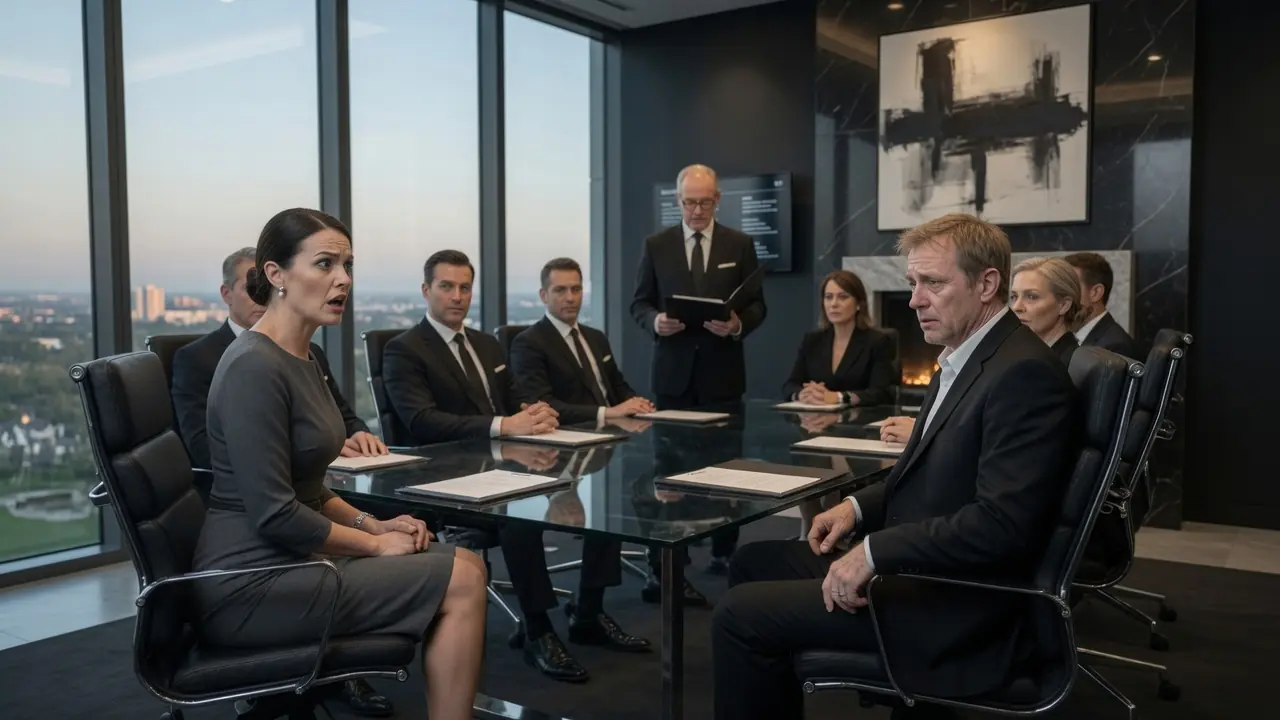
Inside, a few people sat in his overdecorated study.
Karina was there in slate gray, mourning phase over.
That same guy from the funeral sat beside her.
Flashy shoes. Smug face.
She glanced at me like I was a stranger she vaguely remembered living with.
I sat in a dark corner.
The lawyer arrived holding a thick folder like it might explode.
He cleared his throat.
“As executor of Mr. Glenn Darby’s estate, I will now read his final will, signed two months before his death.”
Two months.
Right after the last family trip, the one she insisted I skip.
“You will be bored,” she said.
I believed her.
Not anymore.
The assets sounded like a billionaire’s shopping list.
Homes. Luxury cars. Rare art.
Then came the bomb.
“To my daughter, Karina Elise Darby, I leave one million dollars to be held in trust and managed by Mr. Bradley Vaughn.”
She blinked, confused.
“Did you mean one hundred million?”
Silence.
“No,” the lawyer said. “One million.”
“The remainder of Mr. Darby’s estate goes to another individual named in this envelope.”
Then he read Glenn’s words.
“If you are hearing this, Karina, I am gone, and I have seen what you have become. You stopped visiting unless there were cameras. You brought that man into my house like I would not notice. You loved the money more than your father, so no reward.”
Karina said nothing.
Not a sound.
Then the lawyer read the last line.
“To the man who married my daughter knowing she might turn on him, the man who endured my mistreatment and stayed when most would not, Wendell Thomas Carr receives everything else.”
I felt the world collapse in on itself.
For a second, it was like gravity stopped working.
I could not breathe.
Karina looked at me like I had turned into a hallucination.
The guy sitting beside her shot out of his chair like it had shocked him.
I was speechless.
I had not asked for this.
I never wanted a fortune.
I wanted the version of life I had built.
Messy. Normal. Shared.
I wanted our dumb Sunday crossword puzzles.
I wanted our grumpy old cat.
But none of that was relevant anymore because now I owned a legacy worth two hundred fifty million dollars.
And the woman who had discarded me without looking back was suddenly avoiding my eyes like the floor had betrayed her too.
I did not stay for the rest of the formalities.
I could not.
I bolted for the nearest exit, desperate for fresh air, space, anything but that suffocating room.
She came after me.
I heard her heels scrape across marble like they had not in years.
“Wendell!” she yelled, but I did not slow down.
I walked straight past the sculpture-lined path, through the wrought iron gates, and down the tree-covered road because, for the first time, I was not the one being abandoned.
I walked for over an hour.
Not to be dramatic.
Not because I had no ride.
But because my body needed to move or else I would completely unravel.
Even the trees seemed like they were whispering about me.
The wind was heavier than it should have been.
I did not want his empire.
What I wanted was the ability to rewind time, to go back six months and pay attention to the signs I had dismissed.
I wanted to stop myself from trusting her again and again.
I wanted to stop myself before she changed her cologne, changed her tone, and said those awful, snide lines like, “You do not get the world I belong to.”
When I finally stumbled into my cousin’s place, I collapsed on the edge of that awful fold-out couch, still wearing the creased shirt from earlier.
The room smelled like old coffee and laundry.
His kid sat in the corner watching cartoons about squirrels flying helicopters.
I barely noticed.
All I could hear was Glenn’s final line echoing in my brain.
To the man who stayed long after he should have left.
I had not realized he had ever seen me for who I was.
And now he was gone.
That night brought no rest either, but not from confusion this time.
It was panic.
The fear of suddenly being responsible for something massive and complex.
I was not prepared.
I did not come from money.
I came from clearance racks, secondhand sofas, and praying that gas would last until payday.
I did not even know how to talk to estate attorneys.
What was I supposed to do with wealth so vast I could not even count the zeros?
Karina knew, though.
She had always known how to navigate power.
The next morning, she was waiting outside the industrial building where I still clocked in.
Yes, I went to work.
What else was I supposed to do?
She was leaning against her BMW like nothing had happened, like she had not detonated our lives.
The same smugness painted across her face.
The same cool confidence she used when manipulating department store returns.
“We need to talk,” she said, sliding her sunglasses onto her head like some courtroom diva.
I barely looked at her.
“There is nothing to talk about,” I muttered, brushing past.
But she followed me inside, right past the reception desk and my confused supervisor.
She cornered me near the vending machine, close enough that the scent of her old vanilla lotion stirred up memories I did not want.
For a brief moment, I forgot everything.
I remembered what it felt like waking up next to her and thinking I had found the one.
And then she opened her mouth.
“You do not deserve this, Wendell.”
No apology.
No regret.
Just venom served cold.
I blinked at her, stunned.
She had the audacity to say that out loud.
She continued, tone quieter but sharper.
“You think this is yours? You think this was meant for you? It was not. He was punishing me. That is all this is. You are a tool, Wendell. A placeholder. None of this is really about you.”
I laughed, not because it was funny, but because if I did not laugh, I would start trembling and never stop.
“A placeholder?” I repeated. “That is how you saw me?”
She folded her arms.
“You were a misstep I let drag on too long.”
That sentence left a scar I can still feel in my chest.
A mistake that lasted too long.
Before I could react, before I could find words that would match that cruelty, she pulled a thick file out of her designer tote.
The folder was stuffed with legal forms, brightly highlighted paragraphs, and neon sticky notes like a set of legal fangs.
“This is a revised proposal,” she said calmly, “for splitting the assets. You do not need everything. Let us be honest. You do not even know how to handle this kind of wealth. You will lose it. Let us avoid that disaster.”
“Is this a warning?” I asked, voice colder than I meant.
“It is an offer,” she replied. “A way for you to exit gracefully before you embarrass us both.”
And then she smiled.
That fake, calculated smile.
The one she used on waiters to get free dessert.
The one she used on my parents to win them over years ago.
I did not take the folder.
I could not.
My fists were tight at my sides, not out of rage, but humiliation, because part of me believed her.
A deep part, buried beneath years of compromise, whispered, “She is right. You do not belong in that world.”
But there was another voice too.
A quiet, shaky one.
One I had ignored for years.
It said, “Maybe I do belong. Maybe Glenn saw something she never did. Maybe staying when it hurt, when it was lonely, meant I was stronger than she ever realized. Maybe invisible loyalty was worth something after all.”
She pivoted sharply, heels clicking with that practiced confidence, still holding the folder.
“You will reach out,” she called back without looking. “You always do.”
But this time, I did not.
Because for the first time in my life, I had something that leveled the playing field.
Power.
And Karina had not put her tricks away, but I was not playing defense anymore.
By week’s end, everything around me felt fake.
I was still punching the time clock at the depot, still scraping the bottom of budget cereal bags in my cousin’s basement, and still receiving perfectly crafted messages from Karina, pretending she was doing me a favor.
She did not grovel.
She never did.
She negotiated like a broker at war.
Her texts came polished and empty.
Let us keep this civil.
No need to drag things out.
Think about the press.
The press.
As if anyone cared about the guy who once traded dryer repairs for a plate of ribs at a block party.
Still, somebody was paying attention.
Because by Friday, I got a call from one of Glenn’s lawyers.
Not the gray-haired one who read the will.
This guy sounded younger, less sure of himself.
He asked if I could stop by the office to review supplementary paperwork.
I asked, “What kind of paperwork?”
He just said, “It is related to the inheritance structure. You will want to see it.”
The address was in a sleek tower downtown, the kind of glass and steel building I used to walk past on lunch breaks, assuming I would never belong inside.
The front desk ignored me.
I sat on a couch more expensive than anything I owned, sweating through my button-down and praying I did not leave a stain.
When I was ushered into a frosty boardroom, someone handed me a sealed folder, then quietly stepped out to give me privacy.
My name was typed on the cover in bold.
I opened it and flipped through, most of it legalese.
I did not even pretend to understand until I reached the section labeled Addendum: Terms of Inheritance.
That was when I learned Glenn was not just petty.
He was precise.
His money came with a blueprint.
Almost forty percent of the total estate, millions, was placed in a locked trust under my name.
But it was not automatic.
There was a clause.
That part of the inheritance would only activate if I remained legally divorced from Karina for a full eighteen months.
If I ever got back together with her, on paper or otherwise, I would lose the whole portion.
And where would it go?
A dog sanctuary for abandoned pets.
I read it again and again, three times total, each time with growing disbelief.
Glenn had crafted a financial booby trap that punished me if I ever took her back.
Not just a will.
An ultimatum from beyond the grave.
A loyalty test dressed as a windfall.
Tucked at the very back, there was a scanned note scribbled in Glenn’s unmistakable handwriting.
Wendell, if you feel tempted to re-enter the cage, remember you were never her pet. She only knew how to feed you. Do not ever let her collar you again.
G.
It was both insulting and bizarrely poetic.
The man who once ridiculed me for folding his daughter’s towels was now posthumously calling me worthy of freedom.
And all I had to do was stay gone.
I should have been thankful.
I should have felt victorious.
But I did not.
I felt sick because Karina had come back, not out of love, but out of fear.
This was not about reconnection.
It was strategy.
It was manipulation.
She had not changed.
She was cornered.
That evening, her call went to voicemail.
I did not play it.
The next morning, I spotted her car again, parked outside my cousin’s place.
Same model. Same leather coat.
But no folder this time.
Just her looking tired, hair unkempt, eyes red, almost real.
“I just want to talk,” she said gently.
“You always do,” I replied.
She glanced at her hands, then met my eyes.
“So, you read it, did you not?”
I stayed silent.
Her lips tensed.
“It is humiliating, Wendell. What he did to us, what he wrote in that clause, it is sick. He is mocking us even now.”
I stared at her.
“Maybe he is just mocking you, Karina,” I said more bitterly than I meant.
She blinked.
That was the first crack in her performance.
“I never wanted to hurt you,” she whispered.
I let out a dry, disbelieving laugh.
“You did not want to hurt me? You had the paperwork ready before they even picked up the flowers from his funeral.”
“What did you expect me to do? Just stand there while you cashed in?”
“And that guy with the shiny loafers?”
She looked like she wanted to cry, but nothing came.
And that was when I saw it.
Really saw it.
She could not cry.
Not would not.
Could not.
The emotion just was not in her.
Maybe it never had been.
As she turned to leave, she pulled something from her coat pocket.
A photo.
Old. Worn.
Us on a blanket by the lake, plastic wine glasses, her resting her head on my chest.
“I have kept this,” she murmured. “You were not just a stepping stone.”
But I did not reach for it.
She left, and I left the photo on the porch.
That night, I looked up the dog rescue Glenn named.
Over three hundred animals lived there.
One of them, a pug with one lazy eye, was named Captain Pickles.
If I went back to her, he got the money.
I never thought a one-eyed pug would be the symbol of my dignity.
But standing in that moment, I understood everything.
Karina was not after me.
She was trying to disarm the trap her father had set.
But the timer was already running, and I was not playing her game anymore.
The photo sat outside for two full days.
A drizzle came that first night, enough to blur the ink and swell the paper.
I figured my cousin’s kid had taken it inside.
But no.
On Monday morning, as I left for work, it was still there, clinging to the porch, its corners curling, its colors fading, like a ghost that had finally aged.
I picked it up, not out of longing, but as a reminder.
Not of love.
But of what she let go.
You would assume this would be the end of the saga, that Karina would slink off into her designer world of glass chandeliers and imported wine, leaving me to stumble into my newfound wealth.
But that is not how she operates.
Karina never walked away quietly, and certainly not after losing to someone like me.
Three days later, I found an unmarked envelope in my mailbox.
No stamp.
No return address.
Just my name written in oversized red letters like something from a bad spy novel.
Inside was a single piece of paper.
No explanation.
No greeting.
Two lines.
There is more you do not know.
Wendell, be cautious about who you trust with Glenn’s past.
No name.
No hint of origin.
At first, I thought it was a joke.
Maybe even some weird prank.
Then I considered Karina.
It had her flair for drama, but not her tone.
She did not do subtle.
She did not drop hints.
Karina demanded.
She dictated.
That night, I stayed up tearing through every document and folder the estate lawyers had handed me.
Up until then, most of it had just overwhelmed me.
Legal terms I barely understood, and numbers too big to feel real.
But now I read like my life depended on it.
And then I found it.
It was not tucked inside a formal contract or buried under complicated financial codes.
No, it was sealed in a manila envelope marked Miscellaneous Communications.
Inside were several printed emails from Glenn’s private server.
Most were irrelevant.
Staff updates.
Assistant reminders.
But one thread stood out.
The subject line: Karina’s Request, Urgency Noted.
It was written by someone named A. Whitley.
The message was cold, stripped of emotion.
We have reviewed the request. As per our original agreement, document destruction cannot proceed without signatures from all listed trustees. At present, only one signature has been received. Destruction will not continue until the second is secured.
At first, I did not get it.
Destruction.
Trustees.
But the email was dated just two weeks before Glenn passed.
I scrolled to the start of the chain, and there it was.
Karina had submitted a formal request to have a document eliminated.
The file’s name: Addendum C, Disqualification Clause.
I did not need to be a lawyer to figure it out.
I printed every page and called the estate’s attorney at first light.
When I told him what I had uncovered, the line went silent.
Not for long, but long enough to tell me he had not expected I would ever dig this deep.
“Mr. Carr,” he said cautiously. “Those materials were reviewed after Mr. Darby’s passing. The clause remains valid. As you are aware, no revisions were made to the will following his last notarized version.”
“So, she tried to have it removed,” I muttered.
“She contacted us, yes, but the clause still stands legally.”
I ended the call and sat for what felt like hours, just staring into space.
She had not just left me.
She knew what her father had done.
She had known about the clause.
She tried to erase it before he died.
That photo she brought, the surprise visit to my job, the soft voice, the forced memories, it was not about reconciliation.
It was about cleanup.
That night, her name showed up on my screen again.
I did not pick up, but I let it go to voicemail.
Her tone had changed.
It was tighter, colder, controlled, but barely.
She knew she was losing control.
“Wendell, look, this has all been horrible. But you know as well as I do, this was not about you. He did this to punish me. You are just a stand-in. I spent my life under his rules. I deserve part of this. You do not really want to see me suffer, do you?”
I listened to it twice, then saved it.
Not for evidence.
Just to remember who she was when she thought I was not listening.
But what Karina had not figured out, and what Glenn must have hoped I eventually would, was that this rabbit hole went even deeper.
Beyond the emails were records, video clips, surveillance logs, archived estate access files.
And one entry caught my eye.
A video file dated three days before Glenn’s death, labeled Library, July 10th.
I had not even known there was a library on the property.
Karina had always told me that part of the house was off limits.
“Family archives,” she had said, “not for guests.”
It took almost a week to get access.
Dozens of phone calls, identity verifications, and legal clearance.
Part of me expected someone to block me at the gate, to tell me there had been a mistake, that I did not belong there after all.
But no.
The security guards nodded this time.
Not as Karina’s ex.
Not as the guy who once fixed the pool heater.
Now I was Mr. Carr, the sole heir.
And even the marble lions at the entryway seemed to respect that.
The library sat in the west wing, second floor, a part of the house I had never entered.
It smelled like dust and power.
Where I used to be told I did not belong, now I had a key.
Not metaphorically.
Literally.
One of the old estate workers, his name was Horace, I think, met me in the hallway.
He did not say much, just handed me a small brass key and muttered, “He wanted you to find this.”
The walls were lined with books that probably had not been opened in decades.
In the corner sat a faded leather globe, cracked and peeling.
And behind one of the wooden shelves, tucked out of sight, was a hidden drawer.
I never would have found it without Horace.
He just nodded and walked away like his job was done.
And that was when I realized Glenn had planned every moment of this.
Every layer.
Every trap.
Every test.
And Karina did not know I was standing in the very room where it would all unravel.
Inside the hidden drawer was a small flash drive nestled in a velvet-lined box labeled in Glenn’s neat, unmistakable handwriting.
Library 7/10. Final Record.
It did not weigh much in my hand, but somehow it carried the full gravity of everything I had failed to recognize for years.
I viewed it alone in the estate study behind locked doors and drawn curtains.
The file was short, barely five minutes long.
No background music.
No editing.
Just unfiltered footage from a static security camera mounted above the library’s fireplace.
The video opened with Karina not weeping, not grieving, not alone.
She was pacing aggressively, one hand clenching her phone while the other carved the air in frustration.
Across the room, Glenn sat at his desk, unmoving.
His eyes did not hold sadness, just fatigue.
I leaned closer.
“You do not get to do this,” Karina’s voice burst through the speakers. “You think you will die satisfied knowing you ruined me?”
He did not reply.
“You are seriously giving everything to the guy who fixed your sink?”
Still nothing.
She stormed toward him, practically shouting now.
“He is pathetic, Dad. He does not belong in our world. He does not even know how to tie a tie right. This is humiliating.”
Glenn finally stirred, leaning forward slightly.
“You made your bed,” he said, his voice even and cold.
“You walked out before I was gone.”
“So what?” she hissed. “You were barely holding on anyway.”
He lifted his hand to stop her.
“And yet I lived long enough to change the will.”
Her body froze.
Her carefully controlled expression cracked.
His next words came slower, like they had been rehearsed.
“You thought you could play both sides. Break away clean. Keep the freedom. Keep the wealth. Dodge responsibility. But that is not how this ends.”
“You treated love like currency. But Wendell, he never asked for anything. Not once. He never insulted me, even when I gave him every reason to.”
She took a step back, face unreadable, a mess of anger and disbelief.
“This is not about care,” she said at last. “It is about vengeance.”
“No,” Glenn replied, cool as stone. “It is about preservation. I am protecting what I built from you.”
And then the screen cut to black.
I sat in that silence, watching my reflection hover in the blank screen.
There was no triumph.
No feeling of justice.
Only emptiness.
Because deep down, some irrational part of me still hoped she had cared just a little.
But hearing her talk about me like I was a stain, it made things clear.
She did not lose me.
She threw me away.
And now the only thing she wanted was the thing she had assumed was hers.
What Karina never realized, and what Glenn had likely counted on me discovering, was that she had not just lost an inheritance.
She had lost her last advocate.
Because there was more.
Tucked behind the files beneath layers of estate records, deeds, and financial memos, I found a sealed envelope marked Private. Read Only After Death.
Inside was a final message and a medical document.
What I held was not just a final jab from the grave.
It was a warning.
I did not open it right away.
My hands shook, not from fear, from the weight of what I already knew in my gut.
I have never had patience for suspense.
I spoil movies for myself just to skip the tension.
But this was not fiction, and it bore Glenn’s initials.
The note was handwritten, rigidly formatted in all caps.
His letters were sharp, mechanical, like he had carved them into the page.
Wendell, if you are reading this, I am gone, and you have decided not to fall back under Karina’s influence. Good.
She never saw your strength, but I did. This is not a confession. It is a suspicion.
I do not believe my death was entirely natural. I know my daughter. I know what she becomes when she is desperate.
That sentence stopped me cold.
I do not have evidence, only instinct. Before the family retreat, my health was solid. All my doctors agreed. But something changed after that weekend.
Chest tightness, dizziness, weakness. She brought me some special tea. Said it would cleanse me. I vomited the first night. Never drank it again. I kept quiet.
What father accuses his daughter of poisoning him? But Wendell, if I did not go peacefully, promise me one thing. Do not let her leave untouched.
I put the paper down and stared at the polished wood grain beneath it.
This was not legal testimony.
It was not even an accusation.
It was a final thought from a man who had spent his entire life studying motives.
I wanted to dismiss it.
To say Glenn had imagined it, that grief had made him paranoid.
But I could not.
Not after watching that footage.
Not after hearing her venom.
Not after seeing how badly she wanted that clause gone.
And then it clicked.
Horace had shown me the server logs during the tour.
Barely mentioned them.
Each entry logged who accessed which rooms and when.
I ran down to the entry hall and found Horace.
I asked to see the records again.
He paused, his eyes narrowing.
Then I showed him Glenn’s letter.
He did not ask questions.
He did not hesitate.
He just gave a slow nod and led me straight to the terminal.
Because now the game had changed.
Glenn had left more than a will.
He had left a trail, and I was finally following it.
We pulled up the surveillance log for the weekend of the retreat.
Glenn had made a note of Karina’s movements.
Six visits to the kitchen, two to the guest room, once to the library, and seven times into his private suite.
All between midnight and four in the morning.
Seven entries.
Seven times she walked through that door.
When I asked Horace how often guests were allowed in that part of the house, his reply was blunt.
“Never. Only by direct invitation.”
And that was all I needed to hear.
I knew Glenn.
He would not invite Karina into his private space after midnight.
Not even once, let alone seven times.
It would not hold up in court.
No solid proof.
No case for the cops.
But it was enough.
Enough for me to understand her sudden interest in reconciliation.
Her visits, her voicemails, they were not born of sorrow.
They came from fear.
Not fear of losing a legacy.
Fear that I might figure out how quickly that legacy had become available.
Fear wrapped in designer perfume and insincere smiles.
So, I did something she never expected.
I called her.
She answered instantly, voice unsteady, like she had been sitting with the phone in her hand all day.
“Wendell.”
“I saw the recording,” I said. “From the library. And I read the letter.”
Silence.
Then, almost inaudibly, she replied, “You were not meant to find that.”
“No,” I agreed. “Just like you were not supposed to be sneaking into his room in the middle of the night.”
She inhaled sharply.
“You do not understand what you are implying.”
“I understand exactly,” I said. “And so do you.”
A pause.
Then that familiar edge returned, cold, measured, calculated.
“What are you after?” she asked.
It was the first time she did not hide behind a fake apology.
That was when it hit me.
Karina did not believe in remorse.
Not in family.
Not in loyalty.
She believed in bargaining chips, in leverage.
So I gave her none.
“Nothing,” I said. “I am not asking for anything. I am not offering silence. I will not protect you. No hush money, no shield. You will spend the next year unsure whether I will go to the police. You will smile in public, but you will flinch at every knock on the door.”
Her voice cracked.
“Wendell, please.”
I ended the call.
In that moment, I felt stronger than I ever had.
And I was not finished because Glenn had not just left me a fortune.
He had left me a tool.
I never planned to be wealthy.
I never imagined I would be in a courtroom half a year after my wife walked out, listening to attorneys debate security recordings, clauses, and herbal tea.
I never dreamed I would stand silently while Karina, flawless, untouchable Karina, crumbled under oath before a room full of strangers.
But Glenn always did appreciate poetic justice.
I did not go to the authorities right away.
I waited.
I paced myself.
I let her think I was bluffing.
Let her unravel quietly in her high-rise apartment with her wine and spreadsheets.
And while she tiptoed through her life, waiting for fallout, I started building a case.
I hired the same investigator Glenn had once trusted.
Someone who had worked with the Darby family for years.
He already suspected Karina.
He pieced it all together.
Dates. Transactions. Receipts from a boutique wellness supplier known for selling detox powders.
The same products Glenn had taken, then stopped.
The same powders we turned over to the lawyers handling the estate.
Things moved fast after that, quietly, efficiently.
Karina received formal notice of civil proceedings, allegations of tampering with estate protocols, attempted destruction of protected legal documentation, and manipulation of inheritance conditions.
This did not go criminal.
It was not about punishment.
It was about truth.
In the courtroom, the power of Glenn’s legacy landed like a sledgehammer.
Karina had come prepared to fight.
She walked out shattered.
The judge upheld the will’s full structure, the trust design, the addendum, the digital evidence, and Glenn’s own written testimony.
Karina’s remaining share was frozen, then rerouted, not to me, but to the alternate beneficiaries Glenn had chosen for moral breaches within the family: a list of charities.
She filed appeals twice.
She lost twice.
Each ruling honored the facts, the recordings, the details.
The quiet husband who had stayed in the background until the truth spoke for itself.
And me, I did not go on a spending spree.
I did not disappear to Europe.
I did not hire a staff or buy a mansion.
I rented a small place by a lake, adopted two aging dogs from Captain Pickles Rescue, and started helping out at the shelter every Saturday.
Funny how the clause meant to keep her away led me somewhere peaceful.
I have picked up skills I never thought I would need.
I have learned how to manage an estate, how to rebuild my trust in people one moment at a time, how to sleep again without dread or unanswered texts echoing through the night.
People ask if I still feel anger, if I miss her, and the answer is, I am not sure.
I do not miss the lies.
I do not miss the anxiety of walking on eggshells.
But I sometimes miss the version of her I once believed in, that imagined Karina who still cared.
But nostalgia is not love.
And missing who someone pretended to be does not mean you want them back.
A few weeks ago, I received an envelope.
No name.
No return address.
Inside was one handwritten line.
You destroyed everything.
I did not save it.
I let the dogs chew it up because she was wrong.
I did not destroy everything.
I salvaged what was left of myself.
And that was worth more than every dollar Glenn ever left behind.