Richard Ashmore had attended precisely forty-seven balls in his life and enjoyed none of them. He had a theory about this, which he had refined over twenty years of reluctant attendance.
The problem with balls was not the music, which was occasionally adequate, nor the food, which was sometimes excellent, nor even the company, which contained, if one looked carefully enough, one or two people worth speaking to.
The problem with balls was what they required of a person: the sustained performance of enjoyment in the presence of people who were also performing enjoyment, until the entire room became a kind of elaborate theater in which everyone was simultaneously actor and audience, and no one was watching anything real.
He had said this once at a ball to the woman he had married. Catherine had looked at him for a moment with the particular expression she reserved for things she found both accurate and unhelpful, and then she had taken his hand and led him onto the floor and said, “Then let us give them something real to watch.”
He had loved her for many reasons. That was one of them.
She had been dead for four years.
He was standing at the edge of the forty-eighth ball of his life, the Pembridge Summer Assembly, the first event of the London season, which he had attended because his sister had asked him to and because he had run out of convincing reasons to refuse.
He was thinking about Catherine, and about the performance of enjoyment, and about whether forty-eight balls constituted sufficient evidence that he would never enjoy one.
Then he became aware that someone was watching him. Not the social surveillance he was accustomed to, the careful monitoring of significant figures that everyone conducted while pretending not to, but something more direct.
The kind of watching that a person does when they have decided that what they are looking at is worth their full attention and are not particularly concerned about concealing the decision.
He turned.
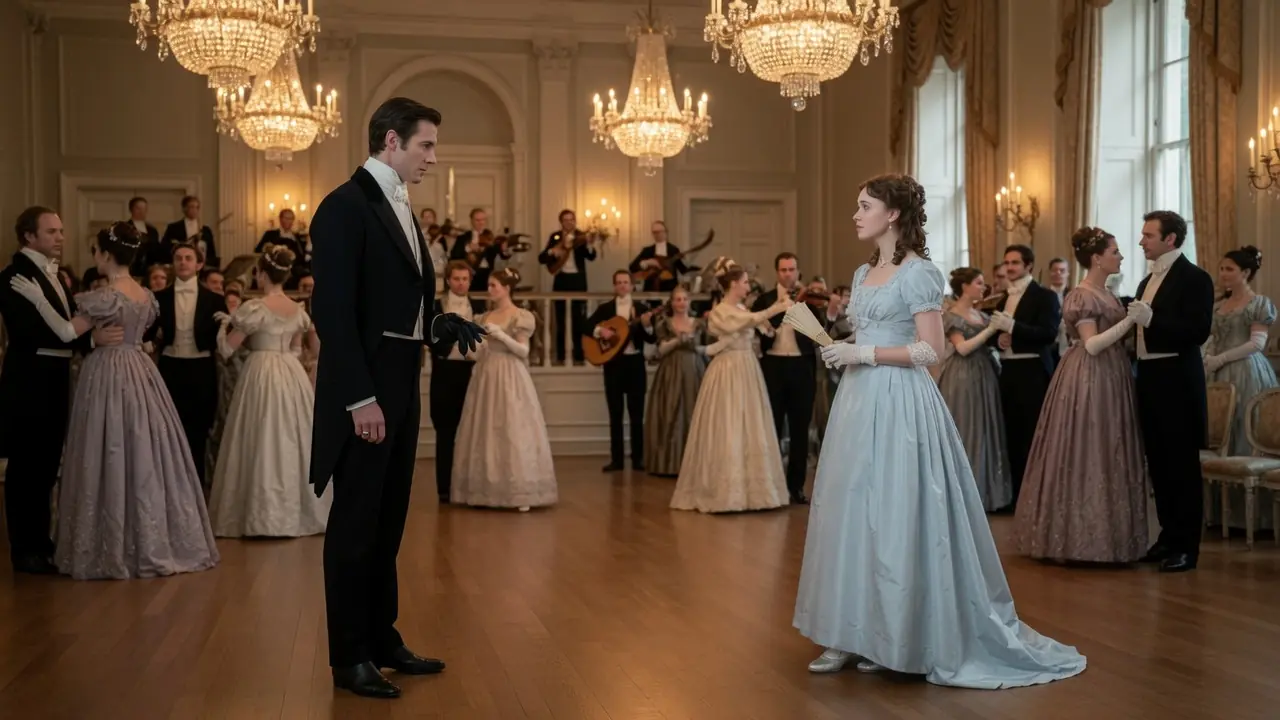
She was standing twenty feet away near the windows in a gown the color of winter sky, and she was looking at him with an expression he could not immediately read.
Not the performance of admiration he had encountered too many times, but something quieter and more specific.
The expression of someone who had been thinking about a thing for a long time and was now simply in the presence of it.
He knew who she was.
Everyone in London knew who Olivia Cartwright was, in the way that London always knew who combined beauty and intelligence and genuine warmth without the mixture producing the expected result of vanity.
She was twenty-four, the daughter of Lord and Lady Cartwright, and had been the subject of the season’s most persistent matrimonial speculation for three years running without apparently being troubled by this in the least.
Their eyes met.
She did not look away.
Neither, he discovered, did he.
Richard Ashmore, Duke of Westhaven, had been absent from London society for three years, not in the dramatic sense of exile, but in the quieter and more complete sense of a man who had decided that what London offered was not what he currently required.
He was thirty-eight. He had been a widower for four years, a father for six, and a duke for twelve.
The combination had produced in him a quality that people who encountered him in the country described as settled, and people who encountered him at the edge of a London ballroom described as forbidding.
In his own assessment, it was simply the appearance of a man who had stopped performing things he did not feel.
His daughter, Eliza, was six years old, the specific complicated inheritance of a marriage that had been everything he wanted and ended three years too soon.
She lived at Westhaven, his Wiltshire estate, with a governess named Miss Hartley, who had been selected with the precision of someone who understood that the person entrusted with his daughter’s daily formation was the most important appointment he would make in any given year.
Eliza was, he thought of her with the specific undefended warmth he permitted himself in private, remarkable.
She had Catherine’s directness and his own tendency toward observation, and at six she was developing the quality of attention that he hoped would serve her well in whatever world she eventually inhabited.
He had come to London because his sister, Harriet, had written four times in six weeks with increasing urgency.
The fourth letter contained the sentence, “Richard, if you do not come to London this season, I will come to Westhaven, and I will bring Mother, and we will not leave until you agree, which I understand you will find considerably more disruptive than simply attending the Pembridge Assembly.”
He had come to London.
Harriet met him at his townhouse on the Monday before the Assembly with the energy of someone who had been right about something for a long time.
“You look terrible,” she said with the affectionate directness of a younger sister who had earned the right.
“Thank you,” he said. “You look well.”
“I am well because I leave the house and speak to people,” she said. “You have been in Wiltshire for three years. Wiltshire is beautiful. Wiltshire is not the world.”
She looked at him with the focused assessment of someone making a decision.
“Come to the Assembly. Speak to people. Allow the possibility that something might interest you.”
“And if nothing does?” he said.
“Then we will have confirmed your hypothesis with current evidence,” she said, “and I will stop asking. But I do not think nothing will interest you. I think you have decided in advance that nothing will, which is different.”
He did not argue with this because it was accurate.
He went to the Assembly.
The Assembly was proceeding exactly as he had predicted, the elaborate social performance that the London season generated with the reliable productivity of an institution designed for exactly this purpose.
He found himself at the edge of the room thinking about Catherine and real things, and whether he had the energy for any of this.
And then Olivia Cartwright looked at him from twenty feet away, and something shifted in the room’s atmosphere that had nothing to do with the music or the crowd.
He crossed the room without a plan, which was unusual for him.
“We have not,” she said.
Her voice was calm and warm, the voice of someone entirely at ease.
“Though I have been aware of you for some time.”
“As has most of London,” he said. “I understand I am a subject of some discussion.”
“You are discussed,” she agreed. “Whether the discussion is accurate is another matter.”
She looked at him with the direct assessment he had noticed from across the room.
“The discussion describes you as forbidding and remote. I have been observing you for the past twenty minutes, and I would describe you as someone who finds the performance of enjoyment effortful and has decided not to perform it, which is different.”
He was quiet for a moment.
“That is a more accurate description than I have received from anyone in some time,” he said.
“I pay attention,” she said simply.
“To what?” he said.
“To what is actually there rather than what is supposed to be there.”
She tilted her head slightly.
“You were thinking about something specific when I first looked at you. Not the room.”
He looked at her.
“My wife,” he said.
He had not intended to say this. He said it because there was something in the quality of her attention that made performing an answer feel like a worse option than giving a real one.
She did not produce the social management that the word wife typically generated, the careful pivot, the sympathetic expression deployed and withdrawn.
She simply received it.
“She must have been someone worth thinking about,” she said.
“Yes,” he said. “She was.”
They stood in companionable silence. The specific silence of two people who had exchanged something real and were not rushing to cover it.
“Will you dance?” he said.
“Yes,” she said without hesitation.
They danced.
He did not think about the performance of enjoyment. He thought about the music, and about Olivia Cartwright’s hand in his, and about the expression she had worn when she said, “I pay attention.”
And about the fact that the forty-eighth ball of his life was, against all prediction, not entirely terrible.
His sister was waiting for him when he returned to the townhouse.
“Olivia Cartwright,” she said before he had removed his coat.
“Good evening, Harriet,” he said.
“You danced with her,” she said. “Once, which is notable because you have attended forty-seven previous balls and danced at none of them, including your own wedding reception, at which Catherine eventually led you onto the floor by main force.”
He sat down and looked at his sister, the face that had been for thirty-six years the most reliably honest face in his life.
“Tell me about her,” he said.
Harriet sat across from him with the expression of someone who had been waiting for this conversation.
“She is twenty-four,” Harriet said. “She has received eleven formal offers of marriage, all declined with a graciousness that produced no resentment in any case, which tells you something about how she manages people.”
“She is intelligent in the way women in London are rarely allowed to be intelligent in public, with opinions she expresses directly and supports with evidence. She reads. She argues when the subject merits it. She is kind without being soft.”
She paused.
“She has been out for three seasons and has not married.”
“Why?” he said.
Harriet looked at him for a moment.
“The unsatisfactory answer,” she said carefully, “is that Olivia Cartwright has been in love with someone specific for a considerable period of time, and the eleven men were not that person.”
She held his gaze.
“I do not know who the person is. I have my suspicions. I have not confirmed them.”
“Your suspicions,” he said.
“Our suspicions,” she said firmly, “not facts. And I am not going to present suspicions as facts to my brother, who has spent three years convincing himself that his life is essentially concluded because he would use them as a reason to retreat.”
She stood.
“Go to bed, Richard. Go to the Cavendish reception on Thursday. Allow the world to continue being interesting.”
She left.
He sat in the quiet of his drawing room and thought about Olivia Cartwright’s expression from across a ballroom, and her voice saying, “I pay attention to what is actually there,” and the specific quality of the silence they had stood in together after he said the word wife.
He did not sleep particularly well.
The Cavendish reception was fifty people rather than two hundred, which meant less room for the elaborate performance large events generated and more requirement for actual conversation.
Olivia was there in a gown of deep green. She was speaking with Lady Cavendish when he arrived and did not see him immediately.
He observed her for a few minutes before she turned, doing what she had done at the Pembridge Assembly, watching with the attention of someone who had decided that what they were looking at was worth their full focus.
The recognition of this symmetry produced in him something he had not felt in some time, the sense of being known in advance of the knowing.
She saw him.
The expression she wore in the first half second before her composure reinstated itself was the most informative half second he had encountered in years.
It was genuine and not uncomplicated and unmistakably about him.
He crossed the room.
They spoke for the better part of an hour about books. She had a specific disagreement with his interpretation of a passage, which she expressed with the confidence of someone who actually held an opinion rather than performing one.
They spoke about Wiltshire, which he found himself describing with something closer to pleasure than expected. She mentioned her work with a school in the east of the city without emphasis, as a thing she simply did.
“You have been away from London for three years,” she said at one point.
“Yes,” he said.
“By choice or by Harriet?” she said.
He looked at her. “You know my sister.”
“We are friends,” she said. “She has mentioned you. Not often, but specifically. She said you were the best person she knew, and that you had convinced yourself otherwise, and that she hoped the convincing would not be permanent.”
She held his gaze.
“I thought, when she said it, that it was something a sister says. I think, having met you, that it was simply accurate.”
He had no answer for that.
He held it privately as something worth keeping.
The correspondence began by accident and became something neither of them had planned.
He wrote to the school’s charitable organization after the reception. Olivia wrote back. He wrote to her directly.
She replied the following Thursday, three pages in a hand that was clear and precise and entirely itself.
He read her first real letter at his desk on a gray London morning and did not move from the desk for some time after.
She wrote about a boy named William.
There is a boy who arrived four months ago unable to read a single word and who read aloud to the class last Tuesday from a book he chose himself. He chose a book about navigation.
When I asked him why navigation, he said, “Because I want to know where things are.” I have been thinking about that answer for three days. I believe it is one of the finest reasons for wanting to know anything.
She wrote about a book they had both read.
The author’s central argument depends on an assumption about human nature that I find not only unsupported, but actively contradicted by every piece of evidence I have encountered in twenty-four years of being a person and observing other people being people.
I would like to discuss this with someone willing to be argued with. I understand this is a considerable request.
And at the end, with the unguarded quality that characterized everything she wrote:
I find that I am looking forward to your reply more than I expected to. I hope that does not alarm you.
I mention it because I prefer honesty to its alternative, and because I suspect you do, too.
He read this letter twice. Then he wrote back, four pages in one evening, which surprised him because he had not written four pages to anyone in three years.
He wrote about Eliza.
She asked me last week why the sky is blue. I told her it had to do with the way light behaves when it passes through the atmosphere.
She considered this and then said, “But why does it want to be blue?” I did not have an answer for why the sky wants to be blue. I have been thinking about it since.
I believe she may be asking a better question than the one I answered.
He wrote about the book she had disagreed with.
I also disagreed with the central argument, though I arrived at my objection from a different direction. I would very much like to be argued with.
I will attempt to be a worthy opponent.
And at the end, because she had been honest and he had decided that honesty was the only viable foundation for whatever this was:
Your mention of looking forward to my reply did not alarm me. On the contrary, I find I am already looking forward to yours.
The correspondence that developed over the following months had the quality of conversation between people who had discovered that written exchange allowed them to be more precisely themselves than social settings permitted.
Her third letter was about her father, whose health had been declining for two years.
He had a better day today. He sat in the garden for an hour, and the light was good, and he was more himself than he has been in a month.
I read to him. Not the navigation book this time, but a volume of essays he has had since before I was born, and whose margins contain his handwriting from when he was young.
I did not read the marginalia aloud. I looked at them while he dozed and thought about him at twenty-three, before he was a father or a lord or any of the things he became.
Just a young man reading and writing in the margins of things he found interesting.
It made me love him more specifically than I usually allow myself to, which is dangerous but also correct.
I mention this because you wrote about sitting in Eliza’s room after she fell asleep. I think you understand what I mean about loving someone more specifically than is safe.
He had read this letter standing at his study window and had not moved from the window for some time afterward.
He wrote back the same evening, which was not his habit, but some things do not improve with waiting.
You are right that I understand.
The specific love, or the love that sees a particular person rather than the general idea of the person, is both the most important kind and the kind that costs the most because it means you have allowed yourself to know someone fully rather than at the protective distance that the general idea permits.
I was not always capable of it with Eliza. In the first year after Catherine died, I was too far inside my own grief to be fully present to anything outside it.
The capability returned gradually over the second year. And what it returned to was Eliza, not the idea of a child, but this specific child who asks why the sky wants to be blue, and falls asleep before chapter four, and carries her mother in her face in ways I find sometimes almost unbearable and mostly simply precious.
I think the specific love is what you have been practicing for years in ways I am only now beginning to understand. I think it is the most generous thing I have been offered, and I am not yet sure I have adequately understood what it means to receive it.
She did not write back immediately.
When she did, three days later, the letter was shorter and more careful and contained one paragraph he returned to more than any other she had written.
You wrote that you are not sure you have adequately understood what it means to receive what I have been offering. I want you to know that understanding it adequately is not required. Receiving it honestly is enough.
I have not been waiting for you to understand. I have been waiting for you to be ready. Those are different things, and the second is something only you could determine.
I have been trusting you to determine it correctly. I believe you are doing that. That is enough.
He put this letter in the drawer with the others. He looked at it again the following morning and understood with the clarity that morning sometimes provides that he had been trusted fully, practically, without reservation by a person who had no guarantee that the trust was warranted and had extended it anyway.
He decided to be equal to it.
The decision arrived quietly, as real decisions do, in the morning light of a London Tuesday, and it produced before the morning was finished the letter he sent that said:
I am coming to see you. There is something I should have said some time ago.
The season progressed, and Richard found, with the specific surprise of someone whose hypothesis had been contradicted by current evidence, that the world was still occurring and that he was reentering it.
He attended events. He appeared with Olivia at three of them and without her at one, and discovered that the one without her was less interesting than the three with her, which was a piece of data he filed carefully alongside the letters in the drawer.
He was aware that people were watching. London always watched, and two people who danced once and corresponded and appeared together at multiple events were providing material.
He found that the awareness produced considerably less resistance than it would have three months ago.
Something had shifted in his orientation toward the world’s observation, not indifference, but a reduced priority assigned to what it concluded relative to what was actually present.
What was actually present was Olivia Cartwright, the most genuinely interesting person he had spoken to in years, whose letters he returned to with the attention of someone who found more in a thing each time they looked, and whose presence at the Ashworths’ dinner on a Tuesday in June produced in him an hour he was least willing to see end.
He had not said any of this to her.
He had been in the process of not saying it since the Pembridge Assembly with the thoroughness of a man who had decided a thing needed to be understood before it was expressed, and who had perhaps been doing the understanding for longer than strictly necessary.
He was thinking about this on a Thursday afternoon in July, in his garden with one of her letters in his hand, when Harriet arrived.
She sat across from him with the patience of a woman who had been waiting for a particular conversation and had decided it would now occur.
“Ask me,” she said.
He looked at his sister.
“How long has she cared about me?” he said specifically.
Harriet was quiet for a moment.
“She is going to be furious with me for telling you this,” she said.
“Then tell me only what she would tell me herself if I asked her directly,” he said.
Harriet looked at him, then at the letter in his hand, then back at him.
“She would tell you,” Harriet said carefully, “that she has been aware of you since she was nineteen, that she attended her first season with the specific hope of meeting you, having heard about you from a family connection, that she met you briefly at one event and nothing happened because Catherine was still—”
She stopped.
“Catherine died when Olivia was twenty,” he said quietly.
“Yes,” Harriet said, “and she did not pursue anything because it was too soon, and because she did not know you, and because she is not a person who pursues things in ways that feel dishonest.”
She paused.
“She came out the following season hoping, and the season after, and this season.”
She held his gaze.
“The eleven men were not you, Richard. That is why she declined them.”
The garden was very quiet.
“Four years,” he said.
“Yes,” Harriet said.
He looked at the letter in his hand, the letter that said, I have been trusting you to determine it correctly, and understood what the full weight of that patience had cost her and what it meant that she had paid it without complaint and without pressure.
“Why did she not tell me?” he said.
“Because she did not want you to feel obligated,” Harriet said. “Because she understood that what you needed was time and not pressure, and she was willing to give you both. Because she was not going to compromise what was between you by forcing a conversation before you were ready to have it.”
She stood.
“She has been waiting for you to be ready. The question is whether you are.”
He looked at his sister.
“I need to speak with her,” he said.
“Yes,” Harriet said, “you do.”
She paused at the garden gate.
“Richard, do not be adequate. She has waited four years. She deserves the full version.”
He called on her the following morning earlier than social convention required, because he had spent the night thinking about the future rather than the past, and the thinking had produced a clarity that did not improve with waiting.
She received him in the morning room, smaller than the drawing room, with the quality of a space that belonged to its inhabitant.
Books on the side table, a half-finished letter on the writing desk, flowers she had arranged herself.
She was surprised to see him. The first half second showed it, and then she was not surprised in the way of someone who had been expecting a conversation and was registering that it had arrived.
“Richard,” she said.
“Olivia,” he said.
He sat across from her and told her what he knew, directly, because there was no other approach consistent with what he believed.
“Harriet told me,” he said. “I asked her directly, and she told me. I want you to know that I asked. It was not volunteered, because I did not want you to feel that something private was given away without your knowledge.”
Olivia was very still.
“What did she tell you?” she said with the composure of someone managing something considerable beneath a composed surface.
“That you have cared about me for four years,” he said. “That the eleven offers you declined were declined because they were not me. That you have been waiting with a patience I do not have adequate words for.”
He held her gaze.
“I want to tell you what this information has done to me, because you have been honest with me for four months in writing and I owe you honesty now.”
She waited.
“I came to London,” he said, “a man who had decided his capacity for the relevant things had been spent. I had managed this belief for three years with what I considered appropriate efficiency.”
“I had arrived at a state that was not quite unhappiness, a careful, controlled, well-managed absence of the things that make the difference between a life that functions and a life that is fully lived.”
He paused.
“I now understand that you have been present at a distance for four years of that, that you chose patience over pressure and honesty over pursuit, that you sat in drawing rooms with eleven men and said no quietly and without drama and went home and waited.”
His voice was steady.
“I do not know how to tell you what it means to me to be the reason for that. I am not sure there are words adequate to it.”
The morning room was very quiet.
“There are not adequate words,” she said, “which is partly why I did not say it. Every version I imagined sounded either like a demand or like a performance, and I wanted neither.”
She looked at her hands for a moment, then back at him.
“I wanted you to arrive at it yourself if you arrived. I was not certain you would.”
“I have arrived,” he said.
She was very still.
“Late,” he said. “I am aware of that. The time that passed is real and cannot be recovered, and I am sorry for it.”
“I am not,” she said simply, as someone stating a fact they had already made peace with. “Every year of waiting produced the version of this moment that is worth having. You came back when you were ready. You are ready now. That is what matters.”
He looked at her, at the woman who had attended her first season at nineteen hoping to meet him, who had written letters of such genuine engagement that he had kept every one, who had trusted him to determine his own readiness correctly and had waited without flinching while he did.
“Olivia,” he said.
And then, because the weight of the moment needed something lighter to make it bearable, something that was also somehow entirely true, he said, “You are too beautiful for me.”
He had not planned to say it. It arrived sideways with a gentleness that made the larger thing possible.
She looked at him.
The morning room was entirely still. Four years of distance. Four years of waiting. Eleven men and the word no. Letters in a drawer and a boy who wanted to know where things were and a paragraph about loving someone more specifically than is safe.
All of it was present in the room, quiet and real and irreversible.
And then quietly, with the full weight of all of it behind the words, she said, “But I have saved my heart for you.”
Richard did not move immediately. He sat with what she had said, the way he sat in Eliza’s room after she fell asleep, in the quiet that contained evidence that the right things were in the right places, that the day had been sufficient, that something was well.
He let it be real before he responded to it because some things deserve to be received before they are answered.
Then he reached for her hand.
She gave it to him.
He brought Eliza to London the following week. He told her on the morning of the visit that he was taking her to meet someone important.
“Important how?” Eliza said.
She was six years old and direct, and she asked the questions that needed asking.
“Important to me,” he said. “I would like you to meet her, and I would like you to tell me honestly what you think.”
“What if I think she is not good?” she said.
“Then you will tell me,” he said, “and I will take it seriously.”
“And if I think she is good?” she said.
“Then you will tell me that, too,” he said.
Eliza appeared satisfied with this arrangement.
Olivia met them in the Cartwright garden.
On the table, he noticed, was a book placed cover-up with the deliberate casualness of something positioned with intention.
He recognized it as a book Eliza had mentioned in a letter he had shared at Olivia’s request, when she had asked what his daughter was currently reading.
Eliza saw the book before she saw Olivia and stopped.
“That is my book,” she said.
“I heard you were reading it,” Olivia said. “I thought we might talk about it if you were willing.”
Eliza looked at Olivia with the direct assessment she brought to all significant evaluations.
“Do you read?” Eliza said.
“Extensively,” Olivia said.
“Papa reads,” Eliza said. “He reads to me every evening. He does the voices.”
A pause.
“He does not always do them correctly, but he tries.”
“The trying is the important part,” Olivia said, with the gravity of someone agreeing with a significant point.
Eliza looked at her for another moment. Then she picked up the book and said, “I am on chapter seven. Where are you?”
“Chapter four,” Olivia said. “I started last night.”
“Then I will tell you what happens,” Eliza said, assuming responsibility. “But I will not tell you the surprising part because that would ruin it.”
“I appreciate that,” Olivia said.
They sat in the garden, and Eliza talked about the book with the focused enthusiasm of someone who had found a willing audience.
Olivia listened with the full attention she brought to everything worth attending to, asking questions at precisely the points requiring clarification, responding to Eliza’s thoughts with the seriousness they merited.
Richard sat to one side and watched.
He had spent the previous week thinking about the future, and the future he had been constructing had a quality he had not allowed himself to imagine for four years.
The specific quality of life that is fuller than one person alone can make it.
He had been managing without this quality efficiently and without complaint, and had not understood what he was managing without until he had something to compare it against.
He was comparing it now.
Eliza looked at him at a certain point, the direct assessing look she had inherited from both parents.
“Papa,” she said.
“Yes,” he said.
“She is good,” Eliza said.
The verdict of a six-year-old who had applied her full evaluative capacity to the question and was prepared to stand behind the conclusion.
“Yes,” he said. “She is.”
Olivia, across the garden, was looking at him with the expression he had first seen from twenty feet away at the Pembridge Assembly and now understood completely.
He smiled.
She smiled back.
In the garden, with his daughter between them and the July light equal on all three of them, Richard Ashmore understood something he had been approaching from a great distance for four years.
That the life he had been managing was not the life he was going to live, and that the difference between those two things was the specific grace of the right person who had the patience to wait until the right moment arrived.
He proposed on a Tuesday evening in August in the Cartwright garden because the place had the right weight, and because he had decided that the occasion required a setting that meant something rather than one that performed meaning.
She was reading when he arrived, actually reading with the absorbed completeness of someone entirely present in what they were doing.
She looked up when he came through the gate.
“You have an expression,” she said.
“I have a question,” he said.
She closed the book.
He sat in the chair that had become, over three months of visits, his chair, and looked at her in the August evening light.
“I want to tell you something before the question,” he said.
“Tell me,” she said.
“I came to London this season a man who had decided his best days were finished,” he said. “I had managed this belief for three years with what I considered appropriate efficiency, and I had arrived at a careful, controlled absence of the things that make the difference between a life that functions and a life that is fully lived.”
He held her gaze.
“You changed this. Not by doing anything extraordinary, but by paying attention. By writing letters of such genuine engagement that I kept every one of them and returned to them more than was strictly necessary.”
“By asking about Eliza in your second letter and about Catherine in your third without flinching from either. By declining eleven men because none of them was the right one, and having the honesty to know the difference and the patience to wait until the difference resolved itself into something real.”
He paused.
“By saving your heart, as you said, for the person you decided deserved it, and then trusting that he would eventually be capable of understanding what he was being offered.”
Her eyes were very bright.
“I am capable now,” he said. “I am aware I took longer than I should have. I am also aware that whatever time is ahead of us is more than sufficient for everything the time behind us did not contain.”
He looked at her steadily.
“Marry me, not as a transaction or an arrangement. Marry me because you are the most genuine person I have encountered in a long time. Marry me because Eliza said you were good, and Eliza is the most reliable assessor I know.”
“And marry me because I love you, which I am telling you directly and without qualification, having examined the evidence thoroughly and arrived at the only conclusion the evidence supports.”
She looked at him for a long moment.
Then she laughed, full and genuine, the laugh he had heard three times and collected with the attention of someone who understood the value of rare things.
“Yes,” she said, unequivocally and without reservation. “Yes.”
He reached across the space between them.
She took his hand.
“Four years,” he said.
“Worth every one,” she said. “I want you to know that as fact, not reassurance. Every year of waiting produced a version of this that was worth having.”
She looked at their joined hands.
“I would not change it.”
He looked at her in the August light and thought about forty-eight balls and one worth attending, and letters in a drawer, and a six-year-old girl’s verdict delivered with complete authority, and a morning room, and five words that had contained four years behind them.
He understood that the inventory of his life, conducted honestly, produced results that no one, least of all himself, would have predicted from the edge of a ballroom.
“I have a great deal of time to make up for,” he said.
“You have a great deal of time,” she said. “The making up is optional.”
They were married in October in the church nearest the Cartwright estate in Hampshire because Olivia had asked to be married from home, and because home was where things that mattered should begin.
Eliza was present in the specific capacity she had assigned herself, chief assessor of the occasion’s quality.
Lord Cartwright, whose health had declined but who had attended in a chair discreetly positioned to see everything, shook Richard’s hand afterward with the grip of someone investing everything remaining in a single gesture.
“Look after her,” he said.
“I will,” Richard said, with the weight of a man who understood from experience what that promise contained.
Harriet stood beside their mother and said nothing for most of the ceremony, which Richard understood as the fullest possible expression of his sister’s satisfaction.
Afterward, she hugged him briefly.
“I told you,” she said.
“You told me,” he agreed.
“In ways you were not ready to hear,” she said. “There is a difference.”
She looked at him with the face that had been for thirty-six years the most honest face in his life.
“You are ready now,” she said.
“Yes,” he said. “I am.”
There is a thing Harriet did not tell Richard because it was not hers to tell, and because some things belong to the people they happened to.
Two years before the Pembridge Assembly, on a January evening after a dinner, she and Olivia had been sitting by a fire that had burned low, both of them being more honest than the occasion strictly required.
Olivia had said, “I am going to tell you something I have not told anyone.”
Harriet had said, “Tell me.”
Olivia told her about Richard and the years of distance, and the decision she had made not to pursue, not to pressure, but to be present and honest, and to trust that if the thing was real, it would find its moment when the moment was right.
Harriet had listened with the full attention she brought to things that mattered.
Then she had said, “He will come back to London eventually. I will make him.”
Olivia had looked at her.
“When he does,” Harriet had said, “be exactly yourself. Nothing else is required.”
Olivia had been, when the moment arrived, exactly herself.
Nothing else had been required.
Harriet considered this at the wedding reception in October with the particular satisfaction of someone whose strategy had been executed correctly and whose confidence in the people she deployed it on had been entirely vindicated.
She had known since that January evening that these two specific people were exactly right for each other, that Richard’s quality of honest, precise attention and Olivia’s quality of patient, genuine love were not merely compatible, but were each what the other most needed.
She had been right.
She accepted a glass of champagne and raised it privately to the two people across the room who were entirely absorbed in each other.
To paying attention, she thought, and to the extraordinary patience of people who know what they are waiting for.
She drank.
Outside, the October afternoon was turning gold, and the world was still occurring, and everything was, Harriet concluded, entirely as it should be.
Which was, she reflected, simply what it meant to pay the right kind of attention to the people you loved.
Years after Olivia first wrote to Richard about the boy who wanted to know where things were, she received a note from the school director.
William, now twelve, had been selected for a scholarship to a grammar school in the city. The selection was based on his academic performance, which had been exceptional in mathematics and in his ability to reason through problems he had not previously encountered.
Olivia read this note at the breakfast table and said nothing for a moment.
Richard, across the table, looked at her.
“Good news?” he said.
“William,” she said. “The boy who wanted to know where things are.”
He remembered. He had kept her letters, all of them, and he remembered William and the navigation book and the answer she had been thinking about for three days.
“He has a scholarship,” she said.
Richard looked at his wife, at the expression on her face, which was not the satisfaction of a project completed, but something simpler and more complete.
The expression of someone who had paid attention to the right things at the right time, and was receiving the return on that attention in the form of a twelve-year-old boy who would go to a grammar school and learn things he could not yet imagine and become someone no one could currently predict.
“That is exactly what is supposed to happen,” he said.
“Yes,” she said. “It is.”
She put the note down beside her teacup.
She looked out at the February garden, where the first signs of the season’s change were beginning in the way they always began, gradually, without announcement, with the patience of things that grow according to their own schedule and cannot be hurried.
“I wrote to you about him in my first real letter,” she said, “the first one where I said something I actually meant, rather than something socially appropriate.”
“I know,” he said. “I remember.”
“He was the reason I wrote honestly,” she said. “He had done something that week that reminded me why honesty matters, why saying the true thing is better than saying the appropriate thing, even when the true thing is more exposed.”
She paused.
“I thought you were someone who would understand the question of wanting to know where things are.”
“I did understand it,” he said.
“You wrote back four pages,” she said, “in one evening.”
“Yes,” he said. “I did.”
She looked at him across the breakfast table, across three years of marriage and seven months of letters before that, and one night at the forty-eighth ball of his life where something had shifted in the room’s atmosphere and he had crossed twenty feet of polished floor without a plan.
“I am glad I wrote honestly,” she said.
“So am I,” he said. “Considerably.”
Eliza Ashmore turned seven in February on a cold, clear day that produced the specific quality of winter light she had always liked, sharp and honest, showing everything exactly as it was.
Her birthday gift from Olivia was a set of navigation charts, real ones, the kind sailors used, because Eliza had explained in November that she wanted to know where things were and had specified that she meant this literally and globally and with the correct level of detail.
Eliza spent the morning spread across the library floor with the charts around her, learning the geography of oceans she had never seen with the focused pleasure of someone engaged in serious work.
Richard watched from the doorway.
Olivia came to stand beside him.
“She is going to be extraordinary,” Olivia said.
“She already is,” he said.
They watched Eliza trace a route with her finger across the chart of the North Atlantic, her expression the expression of someone who had found a question interesting enough to deserve their full attention.
“She has your precision,” Olivia said.
“She has Catherine’s directness,” he said.
“She has both,” Olivia said. “They complement.”
He looked at his wife, at the person who had said, “I have saved my heart for you,” in a morning room in July with four years behind the words.
The person who had written letters that he kept in a drawer, who had asked what Eliza wanted for her birthday and listened to the full answer, including the part about global detail.
“Thank you for the charts,” he said.
“She told me what she needed,” Olivia said. “I listened.”
“You always listen,” he said.
She looked at him.
“So do you,” she said. “You have been listening since the Pembridge Assembly. You were listening when you wrote four pages back to my first letter and when you sat with what I said in the morning room before you reached for my hand.”
She paused.
“That is what I was waiting for. Not a declaration, not a gesture, but someone who would actually listen.”
He had no answer equal to this.
So he did what he had learned from her.
He received it fully without deflecting and let it be exactly what it was, which was everything.
Eliza looked up from the North Atlantic.
“Papa,” she said.
“Yes,” he said.
“Did you know that the distance between here and the coast of Newfoundland is approximately two thousand three hundred miles?”
“I did not know that specifically,” he said.
“Now you do,” she said with the satisfaction of someone who had given a useful gift and returned to her charts.
Richard and Olivia stood in the doorway of the library in the February light, in the house that was exactly what it was supposed to be, and did not need to say anything at all.
Some things are communicated entirely by the fact of being present together in the right place at the right time, which was, as it had always been, simply the result of paying attention.
And paying attention, as both of them now knew from experience, from letters in a drawer, from forty-eight balls and one worth attending, was not a small thing.
It was, in the end, everything.
Three months after their wedding, Richard and Olivia attended the Pembridge Winter Assembly. The same house, the same orchestra, the same polished floor.
It was the forty-ninth ball of Richard Ashmore’s life.
He was standing at the edge of the room, which was where he had always stood at balls, but the quality of the standing was entirely different.
He was not performing non-enjoyment. He was not cataloging the room’s deficiencies.
He was watching Olivia speak with Lady Pembridge across the floor with the specific attention he had learned from her, paying attention to what was actually there rather than what was supposed to be there.
What was actually there was his wife.
She saw him watching and crossed the room with the ease of someone entirely at home in whatever space she occupied.
“You are at the edge again,” she said.
“I find,” he said, “that the view is better from here.”
“What are you looking at?” she said.
“You,” he said. “Specifically.”
She looked at him with the expression he had first seen from twenty feet away and now saw every day and still found, each time, entirely worth looking at.
“Will you dance?” she said.
He thought about Catherine saying, “Then let us give them something real to watch.”
He thought about forty-eight balls and none of them worth attending until one Tuesday night when Olivia Cartwright had looked at him from across a room and not looked away.
He thought about the future, which he had spent three years refusing to imagine and which was now simply and completely something he was entirely willing to inhabit.
“Yes,” he said. “I will dance.”
They danced.
He did not think about the performance of enjoyment. He thought about the music and about her hand in his, and about the forty-ninth ball of his life, which was, he acknowledged this with the honest accounting he had always applied to evidence, the best one by a considerable margin.
At home in Westhaven, Eliza was at that moment theoretically in bed and actually finishing the book she and Olivia had been discussing in the garden, because she had decided that the surprising part was too close to stop before it arrived.
She reached it.
It was, as promised, surprising.
She put the book down and thought about it with the focused satisfaction of someone who had received exactly what was promised, then went to sleep in the easy sleep of a child who is in the right place, in a house that is fully inhabited by people paying the right kind of attention to each other and to her.
Outside, the October night was doing what October nights do, making the stars clear and the air cold and the lights in the windows warm against both.
Inside, in Richard’s study, the desk drawer contained a stack of letters tied with a cord.
The first began, “Dear Miss Cartwright, Harriet tells me you are involved with the Cavendish School. I would very much like to hear about it.”
The last, written on a Tuesday morning in July, said simply, “I am coming to see you. There is something I should have said some time ago. R.”
Between those two letters was the full record of what it looked like when two honest people paid genuine attention to each other and allowed what was there to become what it needed to become without rushing, without performing, without deciding in advance that the outcome was not possible.
Which was, in the end, the only thing love had ever required.
He came to the forty-eighth ball of his life expecting nothing.
She came having saved everything.
And somewhere between a garden and a morning room and a desk drawer full of honest letters, they found each other in the specific way that people find each other when they stop performing and start paying attention.
The forty-ninth ball was the best one.
It always is when you finally decide to actually be there.