Her name had not been spoken aloud in polite society for three years. Not whispered behind fans, not murmured between matrons over tea, simply erased as thoroughly and deliberately as one might strike an unwanted entry from a household ledger.
Lady Cecilia Windham had ceased to exist, not through death, not through disgrace of her own making, but through something far more calculated. Her family had decided she was inconvenient, and so they had made her disappear.
The Harwick winter ball was, by all accounts, the most glittering affair of the season. Countesses dripped with sapphires. Debutantes floated past in clouds of white muslin, their futures bright and unwritten, their mothers watchful as hawks surveying open fields.
The chandeliers cast everything in a generous golden warmth that made even cruelty look beautiful, which was, Cecilia had come to understand, precisely the point of such gatherings.
She had not been invited.
She had come anyway because the letter tucked against her stays, the letter she had intercepted that very morning, had told her something was happening tonight that concerned her directly. Something her family had taken great pains to ensure she would never learn.
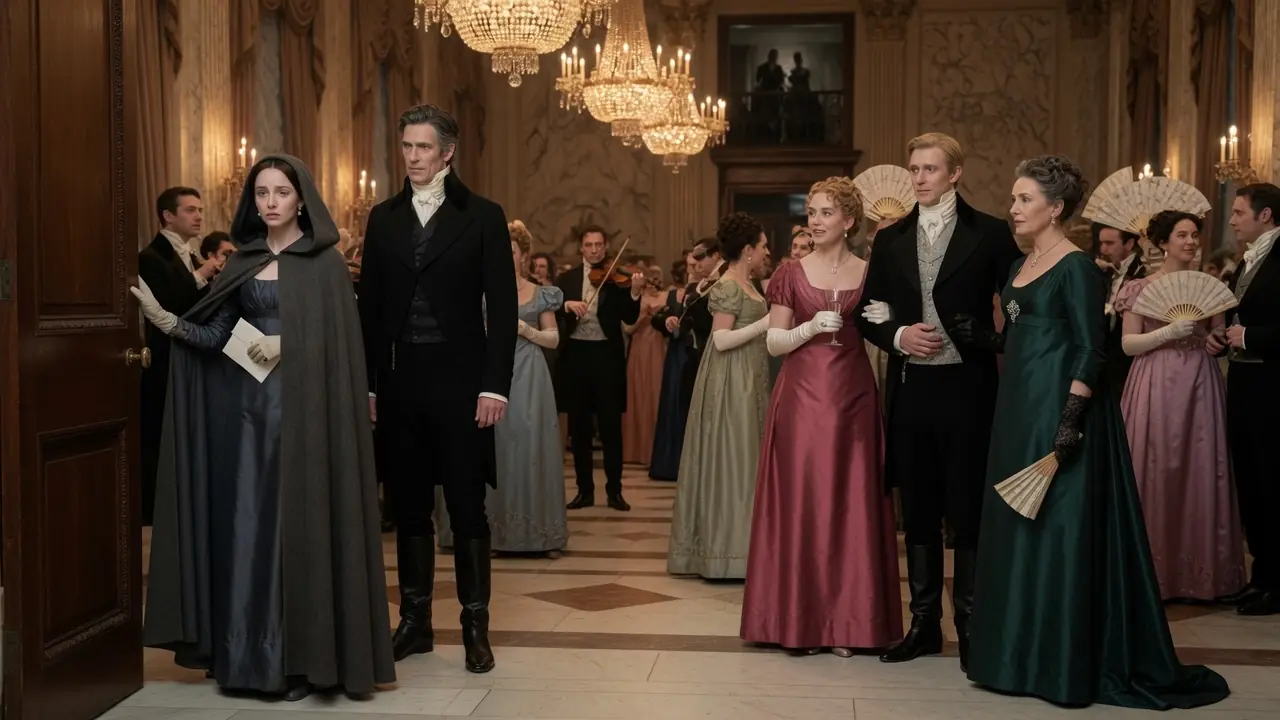
She stood now at the edge of the entrance hall, wrapped in a borrowed gray cloak, her dark hair pinned simply beneath a hood that shadowed her face.
Three years of careful invisibility had taught her skills her governess never had. How to move without drawing notice. How to breathe shallowly in rooms where the air belonged to others. How to watch the people who had forgotten she existed and see everything they wished to hide.
What she saw turned her blood to ice.
Her younger sister, Arabella, stood at the center of the ballroom in a gown of deep rose silk, radiant and laughing, her hand resting on the arm of a gentleman Cecilia recognized with a shock that nearly drove her backward into the wall.
Lord Pembridge.
The same Lord Pembridge whose sworn written testimony three years ago had named Cecilia as a woman of ruined character and destroyed everything she had ever been.
He was smiling at Arabella as though he had never held a pen in his life, and their mother, standing nearby with an expression of triumphant satisfaction, caught Cecilia’s eye across the crowded room.
For one suspended, breathless moment, the two women looked directly at one another.
Her mother looked away first, then deliberately, with the composed grace of a woman utterly certain of her own power, turned her back.
Cecilia did not move. She did not speak. She had learned in three years of enforced solitude that breaking apart was a luxury she could not afford.
But her hand found the doorframe beside her, and she held it the way a drowning person holds anything solid, her knuckles whitening beneath her gloves, her eyes burning with a grief too old and too deep for tears.
She did not notice, could not have noticed, the man standing in the shadows of the upper gallery above the ballroom floor. Tall, dark-coated, utterly still, a man whose pale eyes had been tracking the scene below with an expression that was not indifference, though it wore indifference’s face convincingly.
The Duke of Aldeare had attended this ball for reasons of his own, but he was no longer thinking about them.
He had not moved in several minutes. That alone was unusual for a man of Aldeare’s temperament.
He was not by nature a patient observer of other people’s entertainments. He attended these gatherings because his position demanded it, endured them because his sense of duty was stronger than his distaste, and departed them as early as propriety permitted.
He had perfected the art of being present without being engaged, of standing in a room full of people while remaining in every way that mattered entirely elsewhere.
But the woman in the gray cloak had not moved either, and something about her stillness was different from his own.
His stillness was a choice.
Hers looked like survival.
He had noticed her the moment she entered, which surprised him, because she had clearly intended not to be noticed. The borrowed cloak, the shadowed hood, the careful positioning near the doorframe rather than in it.
Every detail spoke of a woman who had learned to make herself small.
But there was something in the way she held herself within that smallness, spine straight, chin level, eyes clear despite whatever was clearly costing her enormously, that had snagged his attention and refused to release it.
Then he had followed her gaze across the ballroom, had seen what she was seeing, and had understood, with the particular clarity of a man who had spent years reading rooms and the people who occupied them, that he was watching something that went far beyond a family disagreement or a social slight.
He was watching a woman confront the architecture of her own destruction.
Cecilia did not know how long she stood there. Long enough for the waltz to end and another to begin. Long enough for Arabella to laugh twice at something Lord Pembridge said, each laugh a small, precise wound delivered without awareness of its target.
The letter she had intercepted had said enough, though not everything. Written in her mother’s hand, addressed to a name she had not yet been able to identify in full, it had spoken of arrangements being finalized, of Arabella’s happiness being paramount, of certain matters remaining permanently settled.
That phrase had been underlined.
Certain matters remaining permanently settled.
As though Cecilia were a legal dispute that had been resolved rather than a daughter who had been discarded.
She had known in the abstract that her family had moved forward without her. Three years of near-total silence had made that plain enough.
But knowing a thing and seeing it displayed before you with such cheerful, glittering indifference were entirely different experiences, and Cecilia found herself gripping the doorframe harder, breathing shallowly, reminding herself that she had not come here to fall apart.
She had come for answers.
She had come to understand what precisely was being finalized tonight.
She was still deciding whether to move deeper into the house or retreat entirely when she heard it. A voice carrying from a nearby cluster of guests with the careless volume of those who had never had reason to moderate themselves in public.
“Is that not the Windham girl, the elder one?”
Cecilia went very still.
“Surely not. She has not been received anywhere. Has not been for years.”
“I am almost certain of it. The cloak cannot disguise that face entirely. My mother was acquainted with Lady Windham before the whole dreadful business, and she always said the elder daughter had that particular look about her. Handsome in a severe way, too severe, really. One can almost see why things ended as they did.”
The cruelty was delivered in the pleasant conversational tone of someone discussing the weather, and Cecilia absorbed it the same way she had learned to absorb all such things, quietly, without visible reaction, adding it to the considerable weight she already carried.
But the cluster of guests had grown, and several faces were now turned in her direction, with the particular bright-eyed attention that London society reserved for disasters they were not personally required to manage.
She released the doorframe, drew herself to her full height, and was preparing to leave with what dignity remained available to her when the crowd near the ballroom’s entrance parted, and the evening changed entirely.
She heard him before she saw him.
Or rather, she heard the effect of him.
The way conversation dipped and reconfigured itself, the way footsteps adjusted direction, the subtle atmospheric shift that occurs when someone of sufficient consequence enters a space, and the space rearranges itself accordingly.
The Duke of Aldeare descended the gallery staircase with the unhurried certainty of a man who had never needed to move quickly because the world had always been willing to wait for him.
He was perhaps thirty-four, with dark hair gone silver at the temples and eyes of a gray so pale they appeared almost colorless in the candlelight. His expression was composed to the point of severity, but there was a quality of attention in his gaze, an acute and focused intelligence that suggested the composure was constructed rather than innate.
A discipline, not an absence.
He crossed the entrance hall with apparent purposelessness, acknowledging several acquaintances with the barest inclination of his head, and then stopped quite deliberately beside Cecilia.
Not near her.
Beside her.
Close enough that the message was unmistakable to anyone paying attention, and everyone was paying attention.
“Lady Cecilia,” he said, his voice pitched for her ears alone, low and utterly steady. “I had hoped you would be here this evening.”
Cecilia stared at him.
She had never spoken to the Duke of Aldeare in her life. She was reasonably certain he had never had occasion to learn her name, and yet he spoke it with the quiet familiarity of prior acquaintance.
His expression, when it met hers, held something she had not seen directed at her in three years.
Respect.
“Your Grace,” she managed, because whatever else three years of isolation had stripped from her, her manners were her own. “I fear you have the advantage of me.”
“I frequently do,” he replied, and there was something in it that might, in another man, have been the ghost of humor. “Will you walk with me?”
It was not precisely a question, but it was not the command it could have been, and Cecilia, acutely aware of the watching faces surrounding them, made the only decision available to a woman with nothing left to lose.
She took his offered arm.
The effect on the room was immediate and considerable.
The Duke of Aldeare was not merely powerful in the general aristocratic sense. He was the sort of man whose good opinion could resurrect a reputation and whose disapproval could dismantle one.
He sat on three parliamentary committees. He controlled patronage that half the families in this room depended upon in one form or another.
He was, in the precise social calculus of Regency England, as close to untouchable as a man could be without sitting on the throne.
And he was walking through the Harwick ball with Lady Cecilia Windham on his arm as though she had every right to be there, as though it were the most natural thing in the world.
Cecilia felt the stares like heat against her skin. She also felt, with a clarity that shamed her slightly, the illogical impulse to lean into the solid warmth of his arm and simply breathe.
She did not.
She kept her spine straight and her expression composed and looked straight ahead.
She did not have to wait long for her mother.
Lady Windham materialized from the crowd with the speed of a woman who had been watching the situation develop and had decided it required her immediate intervention.
Her expression was a masterwork of controlled alarm, the smile in place, the eyes calculating furiously behind it.
“Your Grace,” she said, inserting herself smoothly into their path. “What a delightful surprise. I had not realized you were acquainted with my...” She paused just fractionally. “With this young woman.”
The pause was deliberate.
The omission of daughter deliberate.
Cecilia absorbed both without expression.
The Duke looked at Lady Windham for a long, unhurried moment.
“Your daughter,” he said with a precision that left no room for the alternative framing her mother had attempted. “Yes, we have mutual acquaintances.”
He paused.
“Lord Carver among them.”
Something flickered across her mother’s face, gone before it could be named, but Cecilia caught it, and the Duke, she suspected, had intended her to.
Lord Carver.
She turned the name over carefully and filed it away.
She did not yet know what it meant.
“How charming,” her mother said, and her voice had thinned almost imperceptibly. “Though I am afraid Cecilia was not actually expected this evening.”
“She is here now,” the Duke said simply.
Finally, in a tone that suggested the conversation was complete.
Her mother withdrew because there was nothing else available to her, and Cecilia breathed again.
“Lord Carver,” she said quietly when they were beyond immediate earshot. “Why did you say that name to her?”
“Because her reaction to it was something I needed to see.”
“And what did you see?”
“Enough,” he said, “for now.”
It was not a satisfying answer.
It was, however, an honest one, and Cecilia, who had been given so few honest things in recent years, found she valued it more than she might have expected.
He guided her toward a window alcove near the ballroom’s far end, positioned so that they were visible to the room without being within easy conversational reach of it.
A choice that was both protective and deliberate.
He was making them visible on his terms.
“You did not come here to dance,” he observed.
“No.”
“Something brought you tonight. Something specific.”
“Yes.”
She studied him. The pale eyes, attentive and still, the patient quality of his waiting.
She was not by nature a trusting woman. Three years of betrayal had seen to that thoroughly.
And yet.
“Why are you doing this?” she asked. “You do not know me. My name in this city is essentially a warning. Every person in this room has watched you cross the floor with me and revised their understanding of the risks involved in your company. You have taken on a burden you had no reason to accept.”
He was quiet for a moment. Then something in his expression shifted just slightly.
“Three years ago,” he said, “I was approached by a solicitor acting on behalf of a young woman whose reputation was under attack. I was asked if I would provide testimony as to her character, having been briefly acquainted with her family in earlier years. I declined. I told myself it was not my matter, and that I had insufficient knowledge of the particulars.”
He paused.
“I have since learned enough to understand that my refusal was a moral failure dressed in the language of caution.”
Cecilia felt the words land in her chest.
“You knew of my situation three years ago.”
“I knew of it at its edges. I chose not to look more closely.”
His jaw tightened fractionally.
“I have been looking more closely since, for the last several months.”
The question she most needed to ask rose immediately.
“What have you found?”
“Enough to know,” he said carefully, “that what was done to you was deliberate and coordinated, and that Lord Pembridge did not write that testimony of his own initiative.”
The ballroom continued its glittering business around them. Arabella laughed again, somewhere distant. The chandeliers swayed in the warmth of a hundred bodies, and Cecilia stood very still, three years of uncertainty crystallizing around a single devastating question.
If Pembridge had not acted alone, then someone had directed him.
And there was only one person with sufficient motive and sufficient access.
She looked across the room to where her mother stood, champagne in hand, expression serene.
“I need you to tell me everything,” Cecilia said quietly.
“Not tonight,” the Duke replied. “Tonight, I need you to trust me with something simpler. Walk back through that room with me. Be seen. Let them see that you are not alone, and that what they believed was settled is considerably less settled than they assumed.”
She studied him for a long moment.
Then she stepped back into the light beside him.
What followed was extraordinary in the most precise sense.
The Duke moved through the Harwick ballroom with Cecilia beside him, and he stopped to speak with people.
To Lord and Lady Fenwick, who had once been her parents’ closest friends and had declined every subsequent connection with the Windham name. To Sir Edmund Price, who sat on the board of the charitable society her mother had had her quietly removed from. To the Harwick hosts themselves, who received her with visible uncertainty that transformed into visible welcome the moment the Duke’s expression made clear that uncertainty was not an acceptable response.
With each stop she felt something shift. Not the return of her former life. Something different.
Something that felt bewilderingly like ground forming beneath her feet after three years of free fall.
She also felt, at each stop, the weight of her mother’s gaze on her back, and once, turning at a particular angle, she caught Lord Pembridge watching them from across the room with an expression that contained, she thought, the early symptoms of fear.
She had seen that expression begin to form when the Duke first said Lord Carver’s name.
She did not yet understand the connection, but she filed it carefully away.
It was late, the candles burned lower, and the music softer when the Duke finally guided her to a quieter corridor off the main hall and stopped.
“There is something you should know,” he said, “before this goes further.”
“It has already gone rather far,” she observed.
“Yes. It is about to go further still, and you deserve to make that decision with full information.”
He reached into his coat and produced a folded document.
“This came into my possession six weeks ago through a contact in the legal profession whom I trust absolutely. I had it verified independently before tonight.”
Cecilia took the document with steady hands, unfolded it, read it, and read it again.
The handwriting was her mother’s.
The date was three years and four months ago, several months before the scandal broke.
It was a letter addressed to Lord Pembridge, outlining in specific and businesslike terms precisely what Lady Windham required of him, what she was willing to offer in exchange, and what outcome she expected his cooperation to produce.
The outcome described was the permanent social removal of Lady Cecilia Windham from the marriage market, so that the full attention of the family’s limited financial resources and social capital could be redirected toward securing an advantageous match for Arabella.
Her ruin had been commissioned, costed, planned in advance by her own mother.
In her own hand.
Cecilia lowered the letter.
She was not crying.
She had known, she realized, in the wordless place beneath conscious thought, for a long time. The knowledge had always been there, waiting for evidence to confirm what the heart already understood.
“She arranged it,” Cecilia said, not as an accusation, not as a performance of grief, simply as a fact being recorded. “For Arabella’s prospects.”
“Yes.”
“And Arabella?”
“I believe your sister was not informed of the mechanism used,” the Duke said carefully. “Whether that exonerates her is a question I cannot answer for you.”
No.
That was her question to answer, and not tonight.
She refolded the letter with deliberate care and held it out to him.
He shook his head.
“It is yours. It always should have been.”
She looked at the document in her hands. Then she looked up at the Duke of Aldeare, who had walked into the most dangerous social situation in the room tonight because he owed her a debt of conscience from a choice made three years ago.
“What do you want from this?” she asked. “From me. Be honest.”
He met her gaze without deflection.
“I want to make this right, as much as it can be made right.”
He paused.
“And I find, which I did not anticipate when I came tonight, that I also want to know you. Not as a cause or an obligation, but as a person.”
A brief, quiet beat.
“You have an exceptionally good spine, Lady Cecilia. I mean that as the highest possible compliment.”
Despite everything, despite the letter in her hands, and her mother’s eyes across the ballroom, and three years of carefully preserved grief, Cecilia felt something move in her chest that was not pain.
“You should know,” she said, “that I am not easy company. I have been alone too long for easy.”
“I have been alone too long for easy as well,” the Duke replied. “Perhaps that is not a disadvantage between us.”
The following weeks were not simple. Nothing about the road back from social oblivion ever was.
What the evening had done was shift the balance of possibility, redrawn the map of what might be recoverable.
He called regularly, formally, with correct and impeccable propriety, and with the underlying consistency of a man who had decided on a course and was not susceptible to dissuasion.
He brought her information as it became available, piece by piece, always honest about what he knew and what remained uncertain.
He asked for nothing in return except the conversation she had to offer, which she gave cautiously at first, and then less cautiously, and then with a directness that occasionally startled them both.
He took her to the opera, where they were seen and discussed for a week. He accompanied her to Lady Fenwick’s at-home, where three women who had cut her three years prior received her with the particular warmth of the newly converted.
He did not perform any of this. He simply included her consistently and without fanfare in his public life and let the room draw its own conclusions.
Society followed the firmest conviction in the space, and the Duke of Aldeare had convictions that could have anchored ships.
Her mother made two attempts at intervention.
The first was a letter, cold and precisely worded, threatening consequences that were largely theatrical, given that the consequences had already been delivered three years prior.
Cecilia read it once, set it aside, and wrote back with a composure that she suspected would be far more alarming to her mother than any expression of emotion.
The second attempt was more serious.
It came as a rumor, surfacing first in drawing rooms and then spreading with the particular velocity of a story that had been given a small initial push by someone who understood how these mechanisms worked.
The rumor suggested that Lady Cecilia’s return to society was built on false foundations. That the scandal three years ago had been accurately reported after all. That certain new evidence had emerged confirming the original accusations.
Cecilia heard it on a Tuesday. By Thursday it had reached her in three separate communications. By Friday it had reached the Duke.
She expected, if she was honest with herself, some degree of recalibration from him, some careful distancing, not abandonment perhaps, but a tactical withdrawal while the situation clarified.
She had learned to expect very little from people when the cost of loyalty became concrete, and she had prepared herself accordingly.
What the Duke did instead was request an urgent private meeting with Lord Pembridge.
She did not know this at the time. She learned it afterward from the Duke himself, who had the habit of telling her things after the fact, with the directness of a man who considered her entitled to a full account.
He had met with Pembridge privately and had presented him with a document pertaining to Pembridge’s own financial affairs, and a particular set of transactions that would not survive public scrutiny.
He had offered Pembridge a straightforward choice.
He had also, it emerged, already written to three members of the House of Lords.
The rumor collapsed within a fortnight. Not loudly. Rumors of this kind rarely died loudly.
But it receded, and in its recession left the particular silence that those who understood such things recognized as the sound of a powerful man having made his position permanently clear.
When Cecilia learned what he had done, she sought him out directly.
“You could have told me,” she said, without preamble, when she found him in the small library at the Fenwick house. “I had a right to know what was being said and what you intended to do about it.”
He set his book down.
“Yes,” he said. “You did. I acted before I thought. That was wrong of me.”
The admission was so straightforward, so absent of defense or qualification, that it disarmed her entirely.
“James,” she said, using his given name for the first time and feeling the weight of it. “What is this? What are we doing?”
He was quiet for a moment.
Then, with the careful precision of a man who chose every word deliberately, he said, “I think you know what I would like it to be. I have been trying to give you sufficient time and sufficient evidence of my intentions before I said so, because I understand that trust is not a thing that can be asked for. It must be built.”
“And I am aware that what has been done to you means that building it will take longer than it might for others.”
He met her eyes.
“I am not in any hurry, Cecilia. I have decided that quite firmly.”
She looked at him for a long time, at the careful steadiness of him, at the quality of his attention, which had not wavered since the Harwick ball, which had not diminished when the rumor circulated, which had not revised itself downward when being associated with her had cost him social energy and political capital, and the pointed inquiries of at least two mothers with unmarried daughters.
“I am still not easy,” she said.
“I know.”
“And I am still angry about all of it. I think I may be angry for quite some time.”
“I think that is entirely reasonable,” he said. “I intend to be somewhat angry on your behalf myself for an indeterminate period.”
Something cracked open in Cecilia’s chest that had been sealed for three years.
Not dramatically, not with any theatrical collapse, simply quietly, like a window being opened in a room that had been shut too long, and the clean, cold winter air coming through.
“I believe,” she said slowly, “that I would like to know you better.”
“I was hoping you might say that,” said the Duke of Aldeare.
And for the first time in all the weeks she had known him, he smiled.
Not the ghost of one.
A real smile that reached the pale gray eyes and transformed the severity of his face into something almost unbearably human.
The confrontation with her mother came not because Cecilia sought it, but because Lady Windham was not a woman who accepted losing gracefully.
She arrived unannounced at Cecilia’s rooms on a gray March morning with the momentum of someone who had been building toward this conversation for weeks and had run out of patience for alternatives.
She had brought Arabella with her.
Cecilia looked at her sister across the narrow sitting room and felt the complexity of that particular grief more acutely than she had anticipated.
Arabella looked older than she expected, and something in her expression, beneath the uncertainty, beneath the obedient positioning beside their mother, looked very much like shame.
Not the fresh shame of recent discovery, the older, heavier kind. The shame of someone who had been carrying knowledge for longer than was comfortable and had not known what to do with it.
“This ends now,” Lady Windham said, with the brisk certainty of a woman opening a business negotiation. “Whatever the Duke of Aldeare believes he is doing, it will cause far more harm than good. You will write to him today and release him from any understanding between you. In exchange, I am prepared to provide you with an adequate allowance and a restoration of—”
“Mother,” Arabella said quietly.
Lady Windham turned.
“Not now, Arabella.”
“I knew.”
Arabella’s voice was not loud, but it was very clear.
“Not at the beginning. But I have known for over a year what was arranged. I found a copy of the letter to Pembridge among your correspondence last winter. I did not know what to do with it. I told myself it was too late, that acting on it would help no one.”
She did not look at her mother.
She looked at Cecilia.
“I was afraid. That was the truth of it, and I am sorry. I know that is worth very little.”
The silence in the room was absolute.
“Arabella,” Lady Windham said, her voice dropping into something cold. “Be very certain before you continue.”
“I have been certain since last winter,” Arabella replied steadily. “I was too afraid to act on it until now. That was my failing, and I will not excuse it.”
She took a breath.
“I am prepared to provide a written account of what I know to whomever the Duke requires.”
Lady Windham looked at her younger daughter for a long moment with an expression that had nothing maternal in it.
Then she looked at Cecilia, and something in her face finally shifted. The architecture of certainty, so long maintained, showed its first fracture.
She left without another word.
And in leaving that way, in that silence, she surrendered more ground than any argument could have cost her.
Cecilia looked at Arabella. At the sister who had stood in rose silk and laughed in the candlelight, and had known for over a year what had been done, and had said nothing.
The grief of that was real.
It would not be resolved quickly.
“I cannot forgive you today,” Cecilia said honestly.
“I know,” Arabella said. “I am not asking you to.”
“But I am not certain I cannot forgive you eventually.”
Arabella pressed her lips together and nodded.
It was enough for now.
Some things required time in the same way wounds required air. Pressure alone did not heal them.
James was waiting at Lady Fenwick’s house that afternoon.
Cecilia told him what had happened. He listened without interruption.
Then he was quiet for a moment.
“Arabella’s written account, combined with the letter, gives you something actionable,” he said. “Your solicitor will confirm it. What was done was legally questionable from the beginning. The question was always evidence. You now have it in two independent forms.”
“I am not certain I want to pursue it legally,” Cecilia said.
He looked at her without surprise.
“Then we will find another way to make it right.”
“Is there one?”
“There is always one. It simply requires deciding what right looks like to you. Not to me, not to society. To you.”
She thought about that for a long moment.
She thought about what three years of invisibility had actually taken from her and what, if anything, could be returned. The years she had spent in those small rooms, quiet and erased, the friendships severed, the future she had been prevented from building.
None of that could be fully restored.
Legal proceedings would not return it. Social rehabilitation, even the thorough and careful kind the Duke had engineered, would not restore it entirely.
But she was here.
She was standing in a warm room in late March with a man who had looked at her across a crowded ballroom and chosen, at genuine personal cost, to look more closely.
She had her own rooms, her own small income, her own spine, which had survived three years of systematic erosion and was still remarkably intact.
Perhaps that was what right looked like.
Not reclamation.
Construction.
“I think,” she said slowly, “that I should like to build something rather than reclaim something. The life that was taken from me was not, if I am truthful, a life I would choose now. I was never consulted about it. It was simply presented as what I would have.”
She met his eyes.
“I should like to choose.”
James regarded her with the expression she had learned to read over these weeks. The one he wore when something she said reached him more directly than he had expected.
“Then choose,” he said.
“I am choosing to tell you,” she said carefully and steadily, “that I do not want to be a cause or an obligation or a debt you are paying to your own conscience. If what is between us is to be anything, it must be a choice. Freely made on both sides, with full knowledge of the cost.”
“I know the cost,” he said.
He was quiet for a moment, and she saw in his face something she recognized because she had worn it herself: the expression of a person who has been alone long enough that speaking the truth of what they feel requires a kind of courage disproportionate to the words themselves.
“I have been thinking since the Harwick ball,” he said finally, “about what sort of life I actually want, not the life my position requires or my family expects or society has mapped out for a man of my station. The life I want...”
He met her eyes.
“Every version of it that I can imagine clearly contains you in it, and every version that does not feels by comparison like a room with the windows permanently shut.”
Cecilia felt the warmth of that settle into her chest slowly, the way warmth returns to cold hands.
Not all at once, but real.
“Marry me,” he said. “Not to restore your name, though it will. Not to punish your mother, though it may. Marry me because I have found, rather to my own astonishment, that the world makes considerably more sense when you are in it. And because I think you deserve someone who sees you, Cecilia. Not the scandal or the restoration or the story of what was done to you. You.”
She looked at him for a long moment. At everything he had done and not done, at the steadiness that had never once faltered, at the quiet revolution he had conducted on her behalf without ever making her feel like a project or a cause.
Then she thought about three years of empty rooms and withheld letters, and a mother’s composed back turning away.
She thought about doorframes held in borrowed gray cloaks, and the extraordinary improbability of being seen by the one person whose seeing would matter.
As simply as that.
As fully as that.
Outside, March was becoming April, and London was beginning its slow shift toward warmth.
Inside, two people who had been alone in their different ways, one erased by others, one isolated by elevation, stood in a patch of afternoon light and discovered with the quiet certainty of things that are true rather than merely wished for, that they were no longer alone at all.