The letter arrived on a Tuesday morning, written in elegant script on paper so fine that Hannah Wells could see the watermark when she held it to the light streaming through the cottage window.
Dear Miss Wells, it began, I write to you not as a duke seeking a duchess, but as a man seeking understanding.
Hannah’s hands trembled as she read the words that would change her life forever. For three months, she had been corresponding with Duke Edmund Rothbone, a man whose letters revealed a soul so honest and vulnerable that she had fallen in love with his words before ever seeing his face.
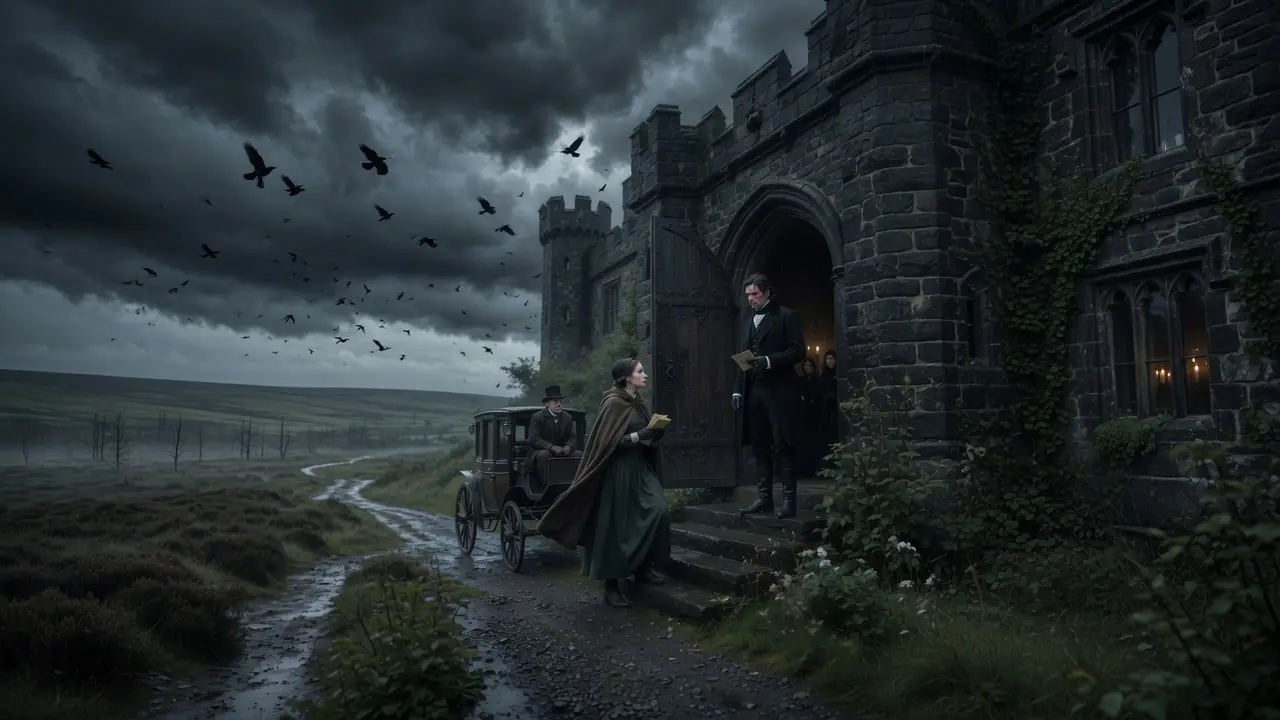
But now, as her modest carriage approached Raven’s Hollow Castle through the Yorkshire Moors, she understood why seven other women had fled after a single night. The castle loomed against storm clouds like something from a Gothic novel. All black stone towers, empty windows that seemed to watch, and a silence so complete it felt alive.
The other ladies had called it cursed, haunted, impossible. They had taken one look at the Duke himself, tall, scarred, with eyes that held too much pain, and declared him unmarriageable.
But Hannah Wells, daughter of a country vicar with nothing to her name but a good heart and an appreciation for beautiful words, saw something they had missed.
In his letters, Edmund had written, “I am not the man society expects a duke to be. I am broken in ways that show, and broken in ways that do not. But perhaps, if you are brave enough to look past the ruins, you might find something worth saving.”
As her carriage wheels crunched on the gravel drive and the massive doors of Raven’s Hollow opened to reveal the Duke himself, six feet of controlled power, a scar running from his left temple to his jaw, and gray eyes that seemed to hold the weight of the world, Hannah made a choice that would echo through both their lives.
She would not flee.
She would stay and discover whether love could truly grow in the shadows of a castle that time had forgotten.
Miss Hannah Wells sat at her small writing desk in the cramped parlor of Thornfield Cottage, reading the most extraordinary letter she had ever received. The paper was of the finest quality, bearing the seal of the Duke of Raven’s Hollow, and the words written upon it were unlike anything she had expected from a man of such elevated station.
Dear Miss Wells,
Your letter was a breath of fresh air in what has become a rather suffocating process. You write with a simplicity and sincerity that I find refreshing after months of correspondence filled with calculated charm and transparent ambition.
You ask nothing of my wealth or title, but instead inquire about my thoughts on literature and my opinion of the changing seasons. When did you last meet someone who cared more for your mind than your purse strings? For me, it has been far too long.
Hannah set down the letter with trembling hands. Three weeks ago, her father had mentioned in passing that the Duke of Raven’s Hollow was seeking a wife through correspondence rather than the traditional London season.
“Odd way to go about it,” Reverend Thomas Wells had mused over his morning tea, “though I suppose the man has his reasons. They say he has become quite reclusive since returning from the war.”
Hannah had been intrigued enough to write a simple letter of introduction, expecting nothing more than polite acknowledgement, if any response at all. Instead, she had received this remarkable reply that spoke to her as though she were an equal rather than a simple vicar’s daughter.
She picked up her pen and began to write.
Your Grace,
I confess myself surprised by your response, both by its promptness and its candor. You write that you value honesty above all else, so I shall be honest in return.
I am not a lady of fortune or elevated birth. My father is the vicar of little Thornfield, and our circumstances are modest at best. I have no dowry to speak of, no connections that would benefit a duke, and no accomplishments beyond a love of reading and a talent for managing household accounts on very little money.
If these facts do not immediately disqualify me from your consideration, I would be honored to continue our correspondence. You ask about literature. I confess a weakness for Gothic novels, though I suspect you would find them frivolous.
As for the seasons, I believe autumn is nature’s masterpiece, when the world transforms itself into something wild and beautiful before settling into winter’s peaceful sleep.
The response came within a week.
My dear Miss Wells,
Your honesty is precisely what I hoped to find, and your circumstances matter not at all to me. As for Gothic novels, I must confess a secret fondness for them myself.
There is something appealing about stories where brooding heroes find redemption through love, though I suspect real life is rarely so accommodating. You write beautifully about autumn. I too find it the most honest of seasons.
It hides nothing, apologizes for nothing, and transforms decay into beauty. Perhaps that is why it speaks to those of us who have learned that scars can be their own form of beauty.
And so began the most extraordinary correspondence of Hannah’s life. Over the following months, she and Edmund Rothbone exchanged letters that revealed more about each other than years of conventional courtship might have accomplished.
Edmund wrote about his love of astronomy, his struggles with the responsibilities of his dukedom, and his memories of serving as a cavalry officer in the Peninsular War. He was completely honest about his limitations and flaws, making no attempt to present himself as the perfect aristocratic husband.
I must tell you, Miss Wells, that I am not the man I was before the war. A French saber left me with a scar that runs from temple to jaw, and there are nights when old memories make sleep impossible.
I am not easy company, and I have little patience for the social niceties that society demands. If you are seeking a husband who will escort you to balls and charm your friends with witty conversation, I am decidedly not that man.
Hannah found his honesty refreshing rather than discouraging.
Dear Edmund,
For I hope I may call you that. You speak of your scars as though they diminish you, but I would argue they speak to your courage and sacrifice.
As for social niceties, I confess I have little use for them myself. I would rather have one honest conversation than a dozen filled with empty pleasantries.
You write that you are not easy company, but your letters suggest a man of deep thought and genuine feeling, qualities I value far more than charm.
As the weeks passed, Hannah found herself falling in love, not with a duke or a title, but with the mind and heart revealed in those carefully crafted letters.
Edmund wrote about watching the sunrise from the battlements of his castle, about his efforts to improve conditions for his tenants, and about his fear that he had become too set in solitary ways to ever successfully share his life with another person.
Hannah shared her own thoughts and dreams, her work helping her father with parish duties, her love of books and learning, and her sometimes overwhelming desire to see the world beyond their small village.
She told him about the loneliness of being an intelligent woman in a society that valued beauty and compliance over wit and independence.
I sometimes feel like a caged bird, Edmund, not because my father is unkind. He is the best of men. But because the world seems to have such narrow expectations for women like me.
I am expected to pretend that my greatest ambition is to manage a household and produce heirs, when in truth I long for something more meaningful.
Edmund’s response revealed a depth of understanding that took Hannah’s breath away.
My dearest Hannah,
Your letter moved me profoundly. I too have felt the weight of others’ expectations, the assumption that because I am a duke, I must be satisfied with a life of privilege and ceremony.
But titles and wealth mean nothing if one’s soul remains empty. You write of longing for something meaningful, and I would suggest that meaning comes not from what we do, but from whom we choose to do it with.
A household managed with love is more meaningful than a kingdom ruled without it. Children raised with wisdom and compassion matter more than all the heirs in Debrett’s Peerage.
Perhaps what we both seek is not a different life, but someone with whom to share the life we have. Someone who sees us as we truly are and loves us not despite our flaws, but because of them.
It was after this exchange that Edmund made his extraordinary offer.
Hannah,
I know this is highly irregular, but I would like to invite you to visit Raven’s Hollow Castle. I must warn you that seven other ladies have accepted similar invitations, and seven have departed within days of arriving.
They found the castle too isolated, too Gothic, too removed from civilized society. They found me too scarred, too serious, too set in my ways.
I tell you this not to discourage you, but because I believe in honesty above all else. If you choose to come, you should know exactly what you are accepting.
Raven’s Hollow is not a fashionable estate with manicured gardens and elegant neighbors. It is an ancient fortress on the Yorkshire Moors, beautiful in its way, but undeniably imposing.
I am not a charming courtier who will sweep you off your feet with pretty words and gallant gestures. I am a man marked by war and solitude, more comfortable with books than with people.
But if you are brave enough to come, if you are curious enough to see whether the connection we have forged through letters can survive the reality of my world, then I would be honored to welcome you to my home.
Hannah’s response was immediate and unwavering.
My dear Edmund,
You ask if I am brave enough to come to Raven’s Hollow, but I would ask in return, are you brave enough to have me?
I am not a sophisticated lady who will grace your drawing rooms with elegant conversation. I am a simple country girl who reads Gothic novels and helps her father tend to the spiritual needs of farmers and shopkeepers.
I have never been to London, never attended a ball, never moved in the circles that a duchess would be expected to navigate. But I am brave enough to look past surface appearances to find the truth beneath.
I am curious enough to want to see the castle that has inspired such beautiful descriptions in your letters. And I am hopeful enough to believe that what we have built through our correspondence is worth the risk of discovering whether it can flourish in person.
I will come to Raven’s Hollow, Edmund, not because I seek to be a duchess, but because I seek to know the man who has captured my heart with his honesty, his intelligence, and his courage in revealing his true self to a stranger.
The journey to Raven’s Hollow Castle took two days by hired carriage, winding through increasingly wild and desolate countryside. As they traveled north into Yorkshire, Hannah watched the landscape transform from gentle rolling hills to dramatic moors that stretched endlessly under gray skies.
Her fellow passenger, an elderly woman traveling to visit her daughter, had grown increasingly nervous as they progressed.
“Are you quite certain about your destination, dear?” she asked as they stopped to change horses at a coaching inn. “Raven’s Hollow Castle has quite a reputation in these parts. They say the Duke is, well, not quite right in the head since he came back from the war.”
Hannah smiled politely but said nothing. She had heard the rumors that Edmund was mad, that he was cursed, that his castle was haunted, but she had also read his letters, and she knew that gossip was a poor substitute for truth.
As her carriage finally crested the last hill and Raven’s Hollow Castle came into view, Hannah understood for the first time why the other women had fled.
The structure that rose from the moors was magnificent, but undeniably intimidating, a massive Gothic fortress of black stone that seemed to have grown from the very rock of the earth.
Towers reached toward the stormy sky like grasping fingers, and narrow windows stared out over the landscape like watchful eyes.
The castle was surrounded by wild gardens that had once been formal but now grew in beautiful abandon, and the only sounds were the wind across the moors and the distant cry of ravens.
“Blimey,” muttered the carriage driver, pulling his coat tighter against the wind. “No wonder them other ladies turned tail and ran. Place looks like something out of a nightmare.”
But as Hannah stepped down from the carriage and looked up at the imposing structure, she felt not fear, but fascination.
Yes, it was Gothic and dramatic, but it was also magnificent, a testament to centuries of history and human ambition. The stonework was masterful, the proportions perfect, and the way it seemed to emerge from the landscape suggested a harmony between human creation and natural beauty.
The massive oak doors opened as she approached, and Hannah’s breath caught as she saw Edmund Rothbone for the first time.
He was exactly as she had imagined and nothing like she had expected. Tall and broad-shouldered, with the bearing of a soldier and the presence of a man accustomed to command.
His dark hair was slightly longer than fashionable, and his gray eyes held depths that seemed to reflect the stormy sky above.
The scar that ran from his left temple to his jaw was exactly as he had described. A thin line that spoke of violence survived and courage tested.
But rather than marring his appearance, the scar gave him a romantic, dangerous quality that made Hannah’s pulse quicken. This was a man who had lived, who had fought, who bore the marks of his experiences with quiet dignity.
“Miss Wells,” he said, his voice deeper and more resonant than she had imagined. “You came.”
“Did you think I would not?” Hannah replied, offering him a slight curtsy. “Your letters were quite persuasive.”
Edmund’s mouth quirked in what might have been the beginning of a smile.
“My letters failed to persuade seven other ladies to remain longer than a few days. I had begun to think my castle was cursed.”
Hannah looked up at the imposing structure behind him, then back at his face.
“Perhaps the curse was not in your castle, but in your choice of guests. I am not so easily frightened.”
“We shall see,” Edmund said, but there was warmth in his gray eyes now. “Come, let me show you inside. Mrs. Hartwell has prepared the Rose Chamber for you. It has the best view of the moors.”
As they walked toward the entrance, Hannah was acutely aware of Edmund’s presence beside her. He moved with the controlled grace of a soldier, and she caught the faint scent of sandalwood and something uniquely masculine that made her suddenly conscious of her own femininity.
The interior of Raven’s Hollow Castle was as impressive as its exterior. The great hall soared three stories high, with ancient banners hanging from the rafters and a massive fireplace that could easily accommodate a small tree.
Portraits of long-dead Rothbones lined the walls, their painted eyes seeming to follow Hannah as she walked.
“Your ancestors?” she asked, pausing before a particularly stern-looking gentleman in Tudor dress.
“Indeed. The Rothbones have held this castle for over four hundred years. That particular gentleman was the third Duke. He supposedly fought alongside Henry VIII at the Field of the Cloth of Gold.”
Hannah studied the portrait with genuine interest. “He has your eyes.”
“And my stubborn disposition, according to family legend.” Edmund’s voice held a note of dry humor that made Hannah smile.
As they climbed a wide stone staircase, Edmund pointed out various features of the castle: the chapel where his parents had been married, the library that housed one of the finest collections of medieval manuscripts in England, and the portrait gallery where generations of duchesses gazed down with varying degrees of beauty and haughtiness.
“Here we are,” Edmund said, stopping before a heavy wooden door. “The Rose Chamber.”
The room was lovely, spacious, and comfortable, with a massive four-poster bed, elegant furniture, and tall windows that looked out over the wild beauty of the moors.
Someone had placed fresh roses in a vase on the writing desk, and a fire crackled warmly in the grate.
“It is beautiful,” Hannah said sincerely. “Thank you.”
Edmund lingered in the doorway, seeming reluctant to leave.
“Dinner is served at eight. I hope you will join me. We dine in the small dining room. The great hall is rather overwhelming for two people.”
“I would be delighted,” Hannah replied. “Edmund, thank you for inviting me here. I know it was not an easy decision.”
Something shifted in his expression, surprise perhaps at her use of his given name, or at the genuine warmth in her voice.
“Thank you for coming,” he said quietly. “For staying. I confess I had prepared myself for disappointment.”
After he left, Hannah moved to the window and looked out over the moors. The landscape was wild and beautiful, all rolling hills and ancient stone walls beneath a dramatic sky.
She could understand why the other ladies had found it intimidating. There was something untamed about this place, something that spoke of older, wilder times, but rather than frightening her, it called to something deep in her soul.
She had always felt constrained by the narrow confines of village life, had always dreamed of something grander and more adventurous.
Raven’s Hollow Castle, with its ancient stones and brooding atmosphere, felt like the setting for the kind of life she had only read about in books.
As she unpacked her few belongings, Hannah reflected on her first impression of Edmund. He was everything his letters had suggested: intelligent, complex, marked by experience, but not broken by it.
The scar that had apparently frightened other women only made him more interesting to her. It spoke of courage, of sacrifice, of a life lived fully rather than safely.
When eight o’clock arrived, Hannah made her way downstairs, following Edmund’s directions to the small dining room. She had chosen her best dress, a simple but elegant gown of deep blue wool that brought out her eyes, and arranged her brown hair in a style that was both modest and becoming.
The small dining room was intimate and warm, lit by candles and a cheerful fire. Edmund was waiting for her, dressed in evening clothes that emphasized his tall, powerful frame.
When he saw her, his eyes widened slightly.
“You look lovely,” he said, and there was no polite flattery in his voice, only honest appreciation.
“Thank you,” Hannah replied, feeling heat rise in her cheeks. “You clean up rather well yourself.”
Edmund’s laugh was surprised and genuine.
“I had forgotten that you speak your mind. It is refreshing after months of careful politeness.”
Dinner was served by silent, efficient servants, and the food was excellent: roasted beef, fresh vegetables from the castle gardens, and wine that Edmund explained had been laid down by his grandfather.
But it was the conversation that truly delighted Hannah. Away from the formality of letters, Edmund proved to be an engaging companion. He told her stories about the castle’s history, shared his observations about the changing political climate, and asked thoughtful questions about her life and opinions.
“You mentioned in one of your letters that you help your father with parish duties,” Edmund said as they shared a dessert of fresh pears and cream. “What does that entail?”
“Oh, a bit of everything,” Hannah replied. “I teach the village children to read, help organize charity for the poor, visit the sick and elderly. Nothing very grand, I’m afraid.”
“On the contrary, it sounds both meaningful and necessary. I confess I sometimes wonder if my own life serves any real purpose beyond maintaining an ancient title.”
Hannah studied his face in the candlelight. “Surely that is not true. You have tenants, responsibilities.”
“Yes, but sometimes I feel like a caretaker of the past rather than a builder of the future.”
Edmund’s voice held a note of melancholy that made Hannah’s heart ache.
“Perhaps,” she said carefully, “what you need is a partner who can help you see new possibilities.”
Their eyes met across the table, and Hannah felt something electric pass between them. A recognition. A possibility. A spark of something that might grow into something wonderful.
“Perhaps,” Edmund said quietly, “if I could find such a partner. If she could find it in herself to stay.”
As the evening wound down and Edmund escorted her back to her chamber, Hannah felt more certain than ever that she had made the right choice in coming to Raven’s Hollow.
The castle might be imposing and isolated, but it was also magnificent and full of history. And Edmund was exactly the kind of man she had hoped to find: intelligent, honest, complex, and utterly fascinating.
“Good night, Hannah,” he said softly as they reached her door. “I hope you sleep well.”
“Good night, Edmund,” she replied. “Thank you for a lovely evening.”
As she prepared for bed, Hannah reflected on the day’s events. She understood now why the other women had fled. Raven’s Hollow Castle was not for the faint of heart, and Edmund Rothbone was not a man who would be easy to know or to love.
But for a woman brave enough to look past the surface, patient enough to earn his trust, there were treasures here beyond imagining.
Hannah Wells had never been one to back down from a challenge, and she had no intention of starting now.
Hannah’s second day at Raven’s Hollow dawned clear and bright, with autumn sunlight streaming across the moors and painting the ancient stones of the castle in shades of gold and amber.
She woke early and dressed warmly, then made her way downstairs to explore the castle in the morning light. She found Edmund in the library, a magnificent room lined floor to ceiling with leather-bound volumes.
He was seated at a massive oak desk, writing what appeared to be correspondence, his dark hair falling across his forehead as he concentrated.
“Good morning,” Hannah said softly, not wanting to startle him.
Edmund looked up, and his serious expression transformed into something warmer.
“Hannah, you are an early riser.”
“I wanted to see the castle properly. I hope you do not mind the intrusion.”
“Not at all. In fact,” Edmund set down his pen and stood, “would you like a proper tour? There is much more to see than what I showed you yesterday.”
For the next two hours, Edmund guided Hannah through the labyrinthine corridors of Raven’s Hollow. She saw the armory where centuries of weapons were displayed with military precision, the chapel with its soaring Gothic arches and stained glass windows that cast rainbow patterns on the stone floor, and the portrait gallery where dozens of Rothbone ancestors gazed down with expressions ranging from benevolent to stern.
But it was the tower room that truly captured Hannah’s imagination.
Edmund led her up a narrow spiral staircase to a circular chamber at the very top of the castle’s highest tower. The room was furnished as a study, with comfortable chairs arranged around a fireplace and telescopes positioned near the windows.
“This is where I come to think,” Edmund explained, moving to one of the telescopes. “The view is extraordinary, and on clear nights, the stars are magnificent.”
Hannah moved to a window and gasped. The view was indeed extraordinary. The moors stretched endlessly in all directions, wild and beautiful under the clear sky. She could see for miles, all the way to the distant hills that marked the edge of Edmund’s vast estate.
“It is breathtaking,” she said. “I can understand why you would find peace here.”
Edmund joined her at the window, standing close enough that she could feel the warmth radiating from his body.
“The other ladies found it oppressive and isolated. Lady Peyton actually shuddered when I brought her up here.”
Hannah turned to look at him, noting the carefully controlled hurt in his voice.
“Then Lady Peyton lacks imagination. This is not oppressive. It is liberating. To be able to see so far, to feel so removed from the petty concerns of everyday life. It is like being closer to heaven.”
Something shifted in Edmund’s expression, a softening that made Hannah’s breath catch.
“You truly mean that.”
“I do, Edmund. This castle, this place, it is not cursed or frightening. It is magnificent. It is a sanctuary.”
They stood in silence for a moment, looking out over the moors together. Hannah was acutely aware of Edmund’s presence beside her, of the way the morning light caught the silver threads in his dark hair, of the clean, masculine scent of his cologne.
“Hannah,” Edmund said quietly, “may I ask you something?”
“Of course.”
“Why did you really come here? I know what you wrote in your letters, but you could have married anyone. Why risk everything on a correspondence with a scarred recluse?”
Hannah considered her answer carefully. The truth was complex, involving her growing feelings for the man revealed in his letters, her sense that she had found someone who truly understood her, and her conviction that what they had built through their correspondence was worth fighting for.
“Because,” she said finally, “your letters showed me a man I wanted to know. Not a duke, not a title, not a fortune. Just a man who thinks deeply and feels deeply and is not afraid to be honest about his struggles. I have never met anyone like that before.”
Edmund was quiet for a long moment, his gray eyes searching her face.
“You realize that I am all those things you mentioned. Scarred. Reclusive. Difficult. The war changed me, Hannah. I am not the man I was before.”
“I do not want the man you were before,” Hannah said with quiet conviction. “I want the man you are now, scars and all.”
The intensity of his gaze made her feel as though he was looking directly into her soul.
“You may be the most extraordinary woman I have ever met.”
“Or the most foolish,” Hannah replied with a self-deprecating smile.
“No,” Edmund said firmly. “Extraordinary.”
That afternoon, Edmund took Hannah riding across the moors. She was an accomplished horsewoman, having learned on her father’s old mare, and she delighted in the freedom of galloping across the open landscape on one of Edmund’s spirited horses.
They stopped to rest beside an ancient stone circle, weathered monuments that had stood on the moors for thousands of years. Hannah dismounted and walked among the stones, running her hands over their rough surfaces.
“Local legend says they were placed here by druids,” Edmund said, watching her with an expression of fascination. “Supposedly, they mark a place of power.”
“I can believe it,” Hannah replied. “There is something magical about this place. Something that makes you feel connected to all the people who came before.”
Edmund dismounted and joined her among the stones.
“You are not like any woman I have ever known, Hannah Wells.”
“Is that good or bad?” she asked, turning to face him.
“It is...” Edmund paused, seeming to search for words. “It is everything I did not know I was looking for.”
That evening, they dined again in the small dining room, but the atmosphere was different, more intimate, more charged with possibility.
Edmund had shed some of his careful reserve, and Hannah found herself falling deeper under the spell of his intelligence and unexpected humor.
“Tell me about the war,” she said as they shared a bottle of wine. “If you do not mind speaking of it.”
Edmund was quiet for a moment, swirling the wine in his glass.
“It was brutal. Necessary, but brutal. I served as a cavalry officer under Wellington. We saw action in Spain, Portugal, finally at Waterloo.”
“Is that where you were injured?”
Edmund’s hand moved unconsciously to his scar.
“No, that was earlier. A skirmish outside Salamanca. A French officer’s saber. He was quite skilled, but I was luckier.”
“You could have died,” Hannah said softly.
“Many good men did die. Better men than I, in many cases.”
Edmund’s voice carried the weight of survivor’s guilt that Hannah recognized from her work with veterans in her father’s parish.
“But you did not die,” she said firmly. “You survived, and you came home, and you have built something meaningful here that matters.”
Edmund looked at her with surprise.
“You have a gift for seeing light in dark places.”
“And you have a gift for carrying burdens that are not entirely yours to bear,” Hannah replied. “The men who died, they chose to serve just as you did. Their deaths do not diminish your right to live fully.”
Something in Edmund’s expression cracked, revealing a vulnerability that made Hannah’s heart ache.
“I have not lived fully. I have hidden away here, convinced that I was too damaged for normal human connection.”
“And now?” Hannah asked quietly.
Edmund met her eyes across the table.
“Now, I am beginning to think I might have been wrong.”
As the days passed, Hannah and Edmund fell into a comfortable routine. Mornings were spent exploring the castle and its grounds, afternoons riding across the moors or reading together in the library, evenings talking over dinner and wine.
With each passing day, Hannah felt herself falling deeper in love, not just with Edmund, but with the life they were building together.
Edmund, too, was changing. The careful reserve that had characterized their first meeting was gradually giving way to warmth and humor. He laughed more easily, smiled more often, and began to share stories and memories that revealed the depth of his character.
“I used to think this castle was a prison,” he told her one evening as they walked through the portrait gallery. “A beautiful prison, but a prison nonetheless.”
“And now?”
“Now it feels like it could be a home.”
“It is a home,” Hannah replied. “It is your home, and if you will have me, I would like it to be mine as well.”
Edmund stopped walking and turned to face her fully.
“Hannah, are you saying what I think you are saying?”
Hannah’s heart was racing, but her voice was steady.
“I am saying that I love you, Edmund Rothbone. Not your title, not your castle, not your fortune. I love the man who writes beautiful letters about sunrise over the moors. I love the man who carries the weight of the world on his shoulders and still finds room in his heart for kindness. I love the man who was brave enough to be honest about his flaws and patient enough to let me see past them.”
Edmund’s gray eyes were bright with emotion.
“Hannah, I love you too. More than I thought possible. More than I ever imagined I could love anyone.”
He stepped closer, close enough that Hannah could see the flecks of silver in his eyes, could feel the warmth of his breath on her face.
“May I kiss you?” he asked quietly.
“Please,” Hannah whispered.
When Edmund’s lips met hers, Hannah felt as though the world had shifted on its axis. The kiss was gentle at first, tentative, but as she responded, it deepened into something that spoke of passion long denied and love finally acknowledged.
When they finally broke apart, both were breathing heavily.
“Marry me,” Edmund said, his voice rough with emotion. “Hannah Wells, will you marry me?”
Hannah’s smile was radiant.
“Yes,” she said simply. “Yes, Edmund Rothbone, I will marry you.”
As they stood together in the portrait gallery, surrounded by centuries of Rothbone history, Hannah knew that she had found exactly what she had been searching for.
Not just love, but a partner, a home, and a future filled with infinite possibility.
Three months later, Hannah stood in the chapel of Raven’s Hollow Castle, wearing a gown of ivory silk that had belonged to Edmund’s grandmother. The dress had been altered to fit her perfectly, and the family pearls around her neck caught the light from the stained glass windows.
The chapel was small and intimate, filled with only their closest friends and family. Hannah’s father had made the journey from their village, beaming with pride as he prepared to perform the ceremony.
Edmund’s closest friend from his military days, Colonel James Morrison, served as his best man, but it was Edmund himself who took Hannah’s breath away.
He stood at the altar in his finest clothes, his gray eyes bright with love and anticipation. The scar that had once made him self-conscious now seemed to Hannah like a badge of honor, a reminder of his courage and strength.
“Dearly beloved,” Reverend Wells began, his voice carrying clearly through the ancient chapel. “We are gathered here today to witness the union of Edmund Charles Rothbone, Duke of Raven’s Hollow, and Hannah Elizabeth Wells.”
As the familiar words of the marriage service washed over her, Hannah reflected on the extraordinary journey that had brought her to this moment.
Six months ago, she had been a simple vicar’s daughter, with little prospect of marriage beyond the local squire’s younger son. Now she was about to become a duchess, mistress of one of the finest castles in England, and wife to a man she loved with all her heart.
“Edmund,” her father continued, “do you take Hannah to be your lawfully wedded wife? To have and to hold, for better or worse, for richer or poorer, in sickness and in health, till death do you part?”
“I do,” Edmund said, his voice strong and clear, his eyes never leaving Hannah’s face.
“Hannah, do you take Edmund to be your lawfully wedded husband? To have and to hold, for better or worse, for richer or poorer, in sickness and in health, till death do you part?”
“I do,” Hannah replied, her voice steady despite the tears of joy that threatened to spill over.
When Edmund slipped the wedding ring onto her finger, a beautiful band of gold set with diamonds that had belonged to generations of Rothbone duchesses, Hannah felt as though she was not just joining her life to his, but becoming part of something larger and more enduring.
“By the power vested in me by God and the Church of England,” Reverend Wells pronounced, “I now pronounce you husband and wife. Edmund, you may kiss your bride.”
Edmund’s kiss was tender and full of promise, and when they broke apart, Hannah saw that his eyes were bright with unshed tears.
“I love you, Duchess,” he whispered, using her new title for the first time.
“I love you too, husband,” Hannah replied, and the word felt perfect on her lips.
The wedding breakfast was held in the great hall, which had been decorated with flowers from the castle gardens and lit by hundreds of candles. The food was magnificent, the wine flowed freely, and the small gathering of guests was merry and warm.
Colonel Morrison gave a toast that brought tears to Hannah’s eyes.
“To Edmund and Hannah. May your love be as enduring as these ancient stones, and may your happiness echo through these halls for generations to come.”
As evening fell, the guests departed, leaving Hannah and Edmund alone in their castle. They walked hand in hand through the corridors that Hannah now knew as well as her childhood home, past portraits of Edmund’s ancestors, who seemed to smile down on them with approval.
“Are you happy?” Edmund asked as they reached the door to what was now their shared chamber.
“Happier than I ever imagined possible,” Hannah replied truthfully. “Edmund, thank you for taking a chance on a simple country girl.”
“Thank you,” Edmund said, cupping her face in his hands, “for seeing past the scars and the shadows to find something worth loving.”
Their wedding night was everything Hannah had hoped for: tender, passionate, and full of love. Edmund was gentle and considerate, taking his time to ensure her comfort. As they lay together afterward, Hannah’s head on Edmund’s chest, she felt complete in a way she had never experienced before.
“I used to lie awake in this bed, staring at the ceiling and wondering if I would spend the rest of my life alone,” Edmund said softly, his fingers combing through Hannah’s hair. “I never imagined I could be this happy.”
“Nor I,” Hannah murmured against his chest. “I used to dream of adventure, of a life beyond the confines of village society. I never dreamed I would find both adventure and love in the same place.”
In the months that followed, Hannah threw herself into her new role as Duchess of Raven’s Hollow with enthusiasm and grace. She worked with the housekeeper to modernize the castle’s domestic arrangements, established a school for the children of Edmund’s tenants, and began hosting small gatherings that slowly drew Edmund back into society.
The transformation in Edmund was remarkable. The brooding, isolated man Hannah had first met was gradually replaced by someone more confident and engaged.
He began taking a more active role in Parliament, using his influence to advocate for veterans’ affairs and rural education. The love and acceptance he found in his marriage seemed to heal wounds that had festered for years.
“You have given me back my life,” he told Hannah one evening, as they sat together in the tower room, watching the stars emerge in the clear night sky. “I had forgotten what it felt like to hope for the future.”
“You have given me a life I never dared to dream of,” Hannah replied, settling more comfortably against his side. “A home, a purpose, a love that grows stronger every day.”
A year after their wedding, Hannah gave birth to their first child, a son they named Thomas Edmund Rothbone. The baby was healthy and strong, with his father’s gray eyes and his mother’s determined chin.
Edmund was a devoted father, spending hours in the nursery reading to his son or simply watching him sleep.
“I want him to grow up knowing he is loved unconditionally,” he told Hannah. “I want him to feel free to be himself, scars and all.”
“He will,” Hannah assured him, watching her husband cradle their son with infinite tenderness. “He will grow up in a house filled with love and acceptance. He will know that true strength comes from being honest about both our gifts and our flaws.”
Two years later, their daughter Margaret was born, followed by another son, William. Raven’s Hollow Castle, once silent and brooding, now rang with the laughter of children and the warmth of a truly happy family.
But perhaps the most significant transformation was in the way Edmund viewed his role as Duke. No longer content to simply maintain what had come before, he began to see himself as a builder of the future.
He established programs to help veterans readjust to civilian life, invested in improvements for his tenants, and used his position to advocate for social reform.
“You helped me understand that privilege is not just about what we inherit, but about what we do with what we have been given,” he told Hannah as they walked through the gardens one spring morning, watching their children play among the flowers.
“We understood that together,” Hannah corrected, as she always did when Edmund tried to give her sole credit for his transformation. “Everything we have accomplished, we have accomplished as partners.”
The castle itself had been transformed as well. What had once been a Gothic fortress shrouded in solitude and shadow had become a place of warmth, learning, and genuine hospitality.
Visitors came not just to see the ancient stones and medieval tapestries, but to experience the kind of authentic connection and meaningful conversation that had become the hallmark of life at Raven’s Hollow.
“Do you ever think about those other ladies?” Hannah asked Edmund one evening as they prepared for bed. “The ones who fled after a few days?”
Edmund pulled her close, his arms encircling her with the protective tenderness that had become second nature to him.
“I think about how grateful I am that they left,” he said honestly. “Because if any of them had stayed, I would never have found you. Hannah, you are everything I did not know I was looking for.”
“And you are everything I was brave enough to hope for,” Hannah replied. “A man who values honesty over flattery, substance over appearance, love over convenience.”
As they lay together in the darkness, listening to the familiar sounds of their home, the wind across the moors, the settling of ancient stones, the soft breathing of their children in the nearby nursery, Hannah reflected on the extraordinary journey that had brought them to this moment.
She had answered an unconventional advertisement from a duke seeking a wife through correspondence. She had stayed at a Gothic castle that had frightened away seven other women. She had married a man marked by war and scarred by solitude.
And in doing so, she had found not just love, but her life’s purpose: to be the partner, friend, and companion to a man who deserved all the happiness the world could offer, and to help create a home where love, learning, and authentic connection could flourish.
Five years after Hannah’s arrival, the morning sun streamed through the tall windows of the breakfast room at Raven’s Hollow Castle, illuminating a scene of domestic happiness that would have been unimaginable just a few years earlier.
Hannah sat at the table with their three children, five-year-old Thomas, three-year-old Margaret, and baby William, while Edmund read aloud from the morning correspondence.
“Another letter from the War Office,” Edmund announced, setting down one particular missive with satisfaction. “They want to expand the veterans program to five additional locations across England.”
Hannah looked up from helping Margaret with her porridge, her face glowing with pride.
“Edmund, that is wonderful news. Your work is truly making a difference.”
The veterans program had grown from Edmund’s simple correspondence with other former soldiers into something much more significant: a comprehensive approach to helping men readjust to civilian life after military service.
Raven’s Hollow Castle now housed a small community of veterans who worked on the estate, taught in the school Hannah had established, and helped other former soldiers find purpose and peace.
“Papa, what is a veteran?” Thomas asked, looking up from his eggs with the serious expression that reminded Hannah so much of his father.
“A veteran is a soldier who has finished serving his country and come home,” Edmund explained patiently. “Sometimes they need help learning how to live peacefully again, and we try to provide that help here at Raven’s Hollow.”
“Like Uncle James,” Margaret piped up, referring to one of the veterans who had become a favorite with the children.
“Exactly like Uncle James,” Hannah confirmed, smiling at her daughter’s quick understanding.
As breakfast concluded and the children were taken to the nursery for their lessons, Hannah and Edmund retreated to the library for their daily planning session. It had become their custom to spend an hour each morning discussing the various projects and responsibilities that filled their days.
“I have been thinking about your suggestion,” Edmund said, settling into his favorite chair near the window.
“About writing a book?” Hannah looked up from her correspondence with interest.
Over the past year, several publishers had approached them about documenting their unconventional courtship and the programs they had established at Raven’s Hollow.
“And?” she prompted.
“I think we should do it. Not just for the money, though the proceeds could fund the expansion of the veterans program, but because our story might help others. Young women who feel trapped by society’s expectations. Veterans struggling to find their place in civilian life. Anyone who has ever felt too damaged or different to deserve love.”
Hannah set down her pen and moved to sit on the arm of Edmund’s chair, a gesture that had become natural over the years of their marriage.
“I love that idea,” she said softly. “But Edmund, I want to make sure we are honest about the challenges as well as the triumphs. Love did not magically solve all our problems. It gave us the strength to work through them together.”
Edmund reached up to take her hand, his thumb tracing over the wedding ring that had become as much a part of her as her own skin.
“That is exactly what I want to convey,” he said. “That real love is not about finding someone perfect, but about finding someone whose imperfections complement your own. Someone who sees your scars and chooses to stay anyway.”
Their conversation was interrupted by a knock at the library door. Mrs. Hartwell entered, followed by a young woman who looked nervous but determined.
“Your Graces,” the housekeeper said, “this is Miss Sarah Thornfield. She has come about the position as assistant teacher in the school.”
Hannah rose to greet the young woman, immediately recognizing something familiar in her bearing. The same mixture of hope and desperation that Hannah herself had felt when she first wrote to Edmund.
“Miss Thornfield,” Hannah said warmly. “Please sit down. Tell us about yourself.”
As the young woman began to speak about her education, her experience teaching her younger siblings, and her desire to do meaningful work, Hannah caught Edmund’s eye and saw that he too recognized the echoes of their own story.
“I know I am not the most qualified candidate,” Miss Thornfield concluded, her cheeks flushed with embarrassment. “I have no formal training, no connections, no references from grand families. But I love learning, and I believe every child deserves the chance to discover the world through books and knowledge.”
“Miss Thornfield,” Edmund said gently, “some of the most important qualifications cannot be found on paper. Passion, dedication, the ability to see potential where others see only limitations. These matter far more than formal credentials.”
Hannah nodded in agreement.
“When can you start?”
The young woman’s face lit up with joy and relief.
“Truly? You will have me?”
“We will have you,” Hannah confirmed. “Mrs. Hartwell will show you to your room and help you get settled.”
After Miss Thornfield had left with the housekeeper, Hannah and Edmund sat in comfortable silence for a moment.
“She reminds me of someone I once knew,” Edmund said with a smile.
“A young woman who wrote to a duke she had never met, asking for nothing more than honest conversation?” Hannah replied teasingly.
“Exactly that young woman. The one who was brave enough to see past appearances to find something worth saving.”
That afternoon, as Hannah worked in the school with their newest teacher, she reflected on how much their lives had changed since those first tentative letters.
What had begun as an unconventional correspondence had blossomed into something that touched lives far beyond their own.
The school now served not only the children of Edmund’s tenants, but also the children of veterans who had come to live at Raven’s Hollow. The library had been expanded to include works in multiple languages, reflecting the diverse backgrounds of their community.
The castle itself had become a place of pilgrimage for couples seeking to build relationships based on authentic connection rather than social convenience.
“Your Grace,” one of the older students approached Hannah during a break between lessons. “Will you tell us the story again about how you and His Grace met?”
Hannah smiled, settling into the chair they had designated as the storytelling spot. The children never tired of hearing about the letters, though she always edited the tale to be appropriate for young ears.
“Once upon a time,” she began, “there was a lonely duke who lived in a beautiful castle on the moors. He was very sad because he thought no one could ever love him for who he truly was. So he decided to write letters.”
As she told the familiar story, Hannah caught sight of Edmund through the window. He was working in the garden with some of the veterans, his sleeves rolled up and his face relaxed in a way that would have been impossible during his years of isolation.
The man who had once written desperate letters seeking understanding had become a beacon of hope for others struggling to find their place in the world.
The castle that had once been known for its Gothic gloom and reclusive master was now famous as a place where authentic love and meaningful work flourished side by side.
That evening, as they sat together in the tower room, their private retreat where they still went to watch the stars and plan their dreams, Hannah and Edmund began outlining the book they would write together.
“We should start with the advertisement,” Edmund suggested. “The decision to seek a wife through correspondence rather than conventional courtship.”
“And we should be honest about why the other women left,” Hannah added. “Not to criticize them, but to show that compatibility is not just about attraction or social standing. It is about shared values and the willingness to see beyond surface appearances.”
As they worked, their conversation was punctuated by the comfortable silences that had become one of the hallmarks of their relationship. They had learned to communicate not just through words, but through glances, touches, and the kind of understanding that comes only from years of genuine partnership.
“Hannah,” Edmund said as they prepared to retire for the evening. “Do you ever wonder what would have happened if you had not written that first letter? If you had been too intimidated by my reputation or too practical to risk everything on a correspondence with a stranger?”
Hannah considered the question as she had many times before.
“I try not to think about it,” she said finally. “It is too frightening to imagine. But Edmund, I think we would have found each other somehow. Not necessarily through letters, but in some way. I believe that souls that are meant to be together will always find a path to each other.”
Edmund pulled her close, his arms encircling her with the protective tenderness that had become second nature to him.
“I hope you are right,” he said softly, “because I cannot imagine a life without you, without this family we have built, without the purpose we have found together.”
As they lay together in the darkness, Hannah listened to the familiar sounds of their home: the wind across the moors, the settling of ancient stones, the soft breathing of their children in the nearby nursery.
These sounds, which had once seemed lonely and forbidding to other visitors, now represented everything she held dear.
Their love story had become more than just a personal triumph. It had become a testament to the power of authentic communication, the courage to look beyond surface appearances, and the transformative nature of love that is built on understanding rather than illusion.
The letters they had exchanged were now carefully preserved in the castle’s archives, not as private mementos, but as historical documents that scholars and romantics alike came to study.
Their correspondence had inspired other couples to seek deeper connections, had influenced military policies regarding veteran care, and had challenged social conventions about marriage and courtship.
But perhaps most importantly, their story had given hope to those who felt too damaged, too different, or too ordinary to deserve extraordinary love.
Through their example, others learned that the most beautiful relationships are often built not on perfection, but on the courage to be vulnerable, the wisdom to look deeper, and the faith to believe that authentic connection is always possible.
Ten years after Hannah’s first arrival at Raven’s Hollow, Hannah stood at the window of the tower room, watching the sunrise paint the Yorkshire Moors in shades of gold and rose.
The view was the same as it had been on that first morning when Edmund had brought her here, but everything else had changed in the most wonderful ways.
Below in the courtyard, she could see the bustling activity that had become the hallmark of life at Raven’s Hollow. Veterans worked alongside estate employees in the gardens. Children ran between the buildings on their way to lessons, and visitors from across England came to see the programs that had made the castle famous throughout the realm.
“Good morning, my love,” Edmund said, coming up behind her and wrapping his arms around her waist. “You are up early.”
“I was thinking about the book,” Hannah replied, leaning back against his chest. “The publisher wants to know if we can have the final manuscript ready by Christmas.”
“And can we?”
Hannah turned in his arms to face him, noting with satisfaction that the lines of pain and loneliness that had once marked his features had been completely replaced by laugh lines and the glow of deep contentment.
“I think so. We have covered our courtship, our wedding, the establishment of the programs here at Raven’s Hollow. What is left is the conclusion. What we have learned about love, about courage, about the importance of looking deeper than surface appearances.”
Edmund’s smile was radiant.
“And what have we learned, Duchess?”
Hannah considered the question, thinking back over the extraordinary decade that had transformed them both from lonely individuals into partners in every sense of the word.
“We have learned that the most lasting love is built not on passion alone, but on understanding, acceptance, and the daily choice to see and cherish each other exactly as we are,” she said slowly. “We have learned that courage is not the absence of fear, but the willingness to act in spite of fear. And we have learned that when we have the bravery to be completely authentic with another person, we create the possibility for connection that transcends anything we could have imagined.”
“And we have learned,” Edmund added, pressing a gentle kiss to her forehead, “that sometimes the most beautiful flowers grow in the most unlikely soil. That love can flourish in Gothic castles just as easily as in fashionable drawing rooms. That scars can be their own form of beauty when they are accepted with love.”
As they stood together in the tower room, surrounded by the evidence of the life they had built together, Hannah reflected on the journey that had brought them to this moment of perfect contentment.
The book they were writing had become more than just their personal story. It was a guide for others seeking authentic connection in a world that often valued appearance over substance.
Publishers across Europe were clamoring for translation rights, and they had already received hundreds of letters from readers who had been inspired by advanced excerpts.
“Your Grace,” came a soft knock at the door, followed by the voice of their eldest son, Thomas, now ten years old and already showing signs of his father’s thoughtful intelligence.
“Come in, darling,” Hannah called.
Thomas entered with his younger siblings: eight-year-old Margaret, six-year-old William, and their newest addition, three-year-old Elizabeth, who had inherited her mother’s golden hair and her father’s gray eyes.
“Papa,” Thomas said with the serious expression that reminded Hannah so much of Edmund. “Uncle James says there is a delegation coming from Parliament today. Are they here about the veterans program again?”
Edmund knelt down to his son’s level, a gesture that had become second nature over the years of fatherhood.
“Yes, they are. The program we started here has been so successful that the government wants to establish similar centers throughout the British Empire. What do you think about that?”
Margaret clapped her hands together with excitement.
“Does that mean more soldiers will get help like Uncle James and Uncle Robert?”
“Exactly,” Hannah said, gathering little Elizabeth into her arms. “Your father’s work is helping soldiers all over the world learn how to find peace after war.”
William, ever practical like his mother, asked, “Will they all come to live here?”
Edmund laughed, the sound rich and warm in the morning air.
“No, they will have their own centers, but they will use the same methods we have developed here. The important thing is that no soldier will have to face the challenges of returning home alone.”
As the children scampered off to their breakfast, Hannah and Edmund made their way to the great hall to prepare for the day’s important visitors.
The hall had been transformed over the years from a cold, imposing space into a warm center of activity, with comfortable seating areas arranged around the massive fireplace and walls lined with books and artwork created by the residents of Raven’s Hollow.
“Sometimes I can hardly believe how much has changed,” Edmund mused as they walked through the corridors that had once echoed with loneliness but now rang with laughter and conversation.
“Do you miss it?” Hannah asked teasingly. “The solitude, the brooding isolation, the Gothic atmosphere of mystery and melancholy?”
Edmund stopped walking and pulled her into his arms right there in the corridor, where portraits of his ancestors looked down with what Hannah had always imagined was approval.
“I miss nothing about the man I was before you came into my life,” he said with quiet intensity. “That man was existing, not living. He was surviving, not thriving. He had forgotten that the purpose of strength is not to stand alone, but to be able to support others.”
“And I,” Hannah replied, standing on her toes to kiss him softly, “had forgotten that courage is not about being fearless. It is about being afraid and choosing love anyway.”
The delegation from Parliament arrived precisely at noon, led by Lord Ashworth, who had become one of Edmund’s strongest supporters in the House of Lords.
The group included military officials, government ministers, and representatives from charitable organizations across the empire.
“Your Grace,” Lord Ashworth said, bowing formally to Hannah before clasping Edmund’s hand in genuine friendship. “I bring greetings from His Majesty, who has asked me to convey his personal appreciation for the work you have accomplished here.”
As they toured the facilities, the workshops where veterans learned new trades, the school where children from across the social spectrum learned together, the library that had become a center of learning for the entire region, Hannah watched Edmund with pride.
The man who had once hidden away in his tower room now spoke with confidence and passion about his work, his voice carrying the authority of someone who had found his true calling.
“The key,” Edmund explained to the delegation as they visited the workshop where former soldiers crafted furniture and metalwork, “is not just providing employment, but helping these men rediscover their sense of purpose and self-worth. Many of them return from war feeling broken, useless, forgotten. Here, they learn that their experiences, even the painful ones, have value.”
One of the government ministers, a stern man with graying whiskers, asked, “And what of the cost, Your Grace? Surely such comprehensive care is expensive?”
Hannah stepped forward, her voice clear and confident.
“The cost of ignoring these men’s needs is far greater than the cost of helping them heal. A veteran who finds purpose and peace contributes to society for decades. A veteran who is abandoned to despair becomes a burden on families, communities, and the nation as a whole.”
“Well said, Your Grace,” Lord Ashworth murmured approvingly.
That evening, after the delegation had departed with promises of full government support and funding, Hannah and Edmund sat in their private sitting room, sharing a quiet dinner and reflecting on the day’s events.
“They are going to name the program after you,” Hannah told him, unable to keep the pride from her voice. “The Rothbone Method for veteran rehabilitation.”
Edmund shook his head with a rueful smile.
“It should be the Raven’s Hollow Method, or better yet, the Wells-Rothbone Method. None of this would exist without your vision, your courage in staying when others fled, your belief that broken things could be made beautiful again.”
“We built this together,” Hannah insisted, as she always did when Edmund tried to give her sole credit. “Just as we built our marriage, our family, our life together. Edmund, always together.”
As they prepared for bed that night, Hannah found herself thinking about the letters that had started it all. Those careful, honest exchanges that had allowed two lonely souls to find each other across the barriers of class, expectation, and fear.
“Edmund,” she said as she brushed her hair at the dressing table. “Do you remember what you wrote in your very first letter to me about seeking understanding rather than just a wife?”
Edmund came to stand behind her, his hands resting gently on her shoulders as he met her eyes in the mirror.
“I remember every word of every letter I wrote to you. They were the most honest things I had ever written.”
“You found understanding,” Hannah said softly. “Not just from me, but from yourself. You learned to understand that your experiences, even the painful ones, could be transformed into something meaningful. You learned that isolation is not strength, but that true strength comes from connection and vulnerability.”
Edmund leaned down to press a kiss to the top of her head.
“And you, my darling wife, what did you find in those letters?”
Hannah smiled, thinking back to that nervous young woman who had first written to the mysterious Duke of Raven’s Hollow.
“I found my voice. I found my purpose. I found the courage to believe that I deserved a love built on honesty and respect rather than settling for convenience or security.”
As they lay together in the darkness, listening to the familiar sounds of their home, the wind across the moors, the settling of ancient stones, the soft breathing of their children in the nearby nursery, Hannah felt overwhelmed with gratitude for the journey that had brought them to this moment.
Their love story had become more than a personal triumph. It had become a beacon for others seeking authentic connection in a world that often valued surface over substance.
The book they were writing would soon carry their message to readers across the globe, inspiring other couples to seek deeper understanding, other individuals to look beyond appearances, and other communities to embrace those who seemed different or damaged.
But perhaps most importantly, their story had given hope to those who felt too scarred, too ordinary, or too different to deserve extraordinary love.
Through their example, others learned that the most beautiful relationships are built not on perfection, but on the courage to be vulnerable, the wisdom to look deeper, and the faith to believe that authentic connection is always possible.
“Hannah,” Edmund whispered in the darkness.
“Thank you for what?”
“For answering my letter. For staying when others fled. For seeing past the Gothic castle and the scarred duke to find something worth loving. For teaching me that the greatest adventures do not require traveling to distant lands. They require having the courage to open your heart to another person.”
Hannah turned in his arms, finding his lips in the darkness for a kiss that tasted of gratitude, contentment, and a love that had only grown deeper with time.
“Thank you,” she whispered back, “for having the courage to write those letters in the first place, for being honest about your struggles and your hopes, for showing me that true strength is not about being invulnerable. It is about being brave enough to let someone see your wounds and trust them to help you heal.”
As sleep claimed them, Hannah’s last conscious thought was of the morning to come. Another day in the life they had built together. Another opportunity to love and be loved. Another chance to prove that when two souls have the courage to be completely authentic with each other, they create something beautiful enough to inspire the world.
The Duke, who had written letters seeking a wife, had found not just a duchess, but a partner in every sense of the word.
The vicar’s daughter, who had been brave enough to stay, had found not just a husband, but a purpose that extended far beyond her own happiness.
Together, they had proven that the most meaningful love stories are not always the most conventional ones, that the greatest treasures are often hidden beneath unpromising surfaces, and that the courage to look deeper, to seek truth rather than comfort, authenticity rather than appearance, is always rewarded with riches beyond imagining.
Their correspondence had begun as a practical arrangement and had become a testament to the transformative power of honest communication. Their marriage had started with uncertainty and had blossomed into a partnership that touched lives across the empire and beyond.
And their love, built on letters, sustained by understanding, and deepened by shared purpose, would continue to inspire others for generations to come, reminding all who heard their story that the greatest adventures begin not with grand gestures, but with simple acts of courage.
Like writing a letter to a stranger.
Like staying when others flee.
Like choosing to see the person behind the reputation.
The legacy of Edmund and Hannah’s love story lived on in the letters they preserved, the programs they established, and the example they set for others seeking authentic connection in a world too often focused on surface appearances.
Raven’s Hollow Castle became known not as a Gothic fortress of isolation, but as a beacon of hope, a place where love had triumphed over fear, where understanding had conquered prejudice, and where two souls had found their perfect match by having the courage to be completely honest with each other.
Their story reminded all who heard it that the most beautiful relationships are built on truth, sustained by acceptance, and deepened by the daily choice to see and cherish each other exactly as they are.